Recognition: unknown
Perturbative, Nonperturbative and Exact Aspects of Crystalline Phases in the Gross-Neveu Model
Pith reviewed 2026-05-08 17:13 UTC · model grok-4.3
The pith
At large chemical potential the Gross-Neveu model develops an inhomogeneous phase in which a-particle bound states condense and a chiral condensate oscillates periodically.
A machine-rendered reading of the paper's core claim, the machinery that carries it, and where it could break.
Core claim
In the O(2N) Gross-Neveu model with chemical potential h for a ≤ N-2 fermions, a sufficiently large h triggers an inhomogeneous phase in which a-particle bound states condense; at large N this phase corresponds to a periodically oscillating chiral condensate. The usual dynamically generated scale Λ is replaced by two new dynamically generated scales Λ_n and Λ_c. These scales set the mass gaps of neutral and charged excitations above the inhomogeneous vacuum, control nonperturbative corrections to the free energy, and parametrize the oscillatory profile of the mean field.
What carries the argument
The inhomogeneous vacuum with a periodically oscillating chiral condensate, confirmed by perturbative QFT, semiclassical large-N analysis, and integrability, which introduces two distinct dynamical scales Λ_n (neutral) and Λ_c (charged) in place of the single scale Λ.
If this is right
- Nonperturbative corrections to the free energy are parametrized by the two scales Λ_n and Λ_c rather than a single Λ.
- Neutral excitations acquire a mass gap set by Λ_n while charged excitations acquire a gap set by Λ_c.
- The mean-field profile oscillates with a spatial period and amplitude fixed by Λ_n and Λ_c.
- Multiple nonperturbative effects in the theory are simultaneously governed by the pair of scales.
Where Pith is reading between the lines
- The two-scale structure may generalize to other integrable models with chemical potential and bound-state condensation.
- At finite N the separation between neutral and charged gaps could receive corrections that are still controlled by the same two scales.
- The consistency across perturbative, semiclassical and exact methods suggests that similar crystalline phases exist in related four-fermion theories.
Load-bearing premise
The semiclassical large-N limit and integrability methods remain valid and mutually consistent for a ≤ N-2 without uncontrolled corrections that would change the two-scale structure or the separation of neutral and charged gaps.
What would settle it
A direct computation or lattice simulation of the free energy and excitation gaps in the high-h regime that finds only a single dynamical scale controlling both neutral and charged sectors instead of two separate scales Λ_n and Λ_c.
Figures


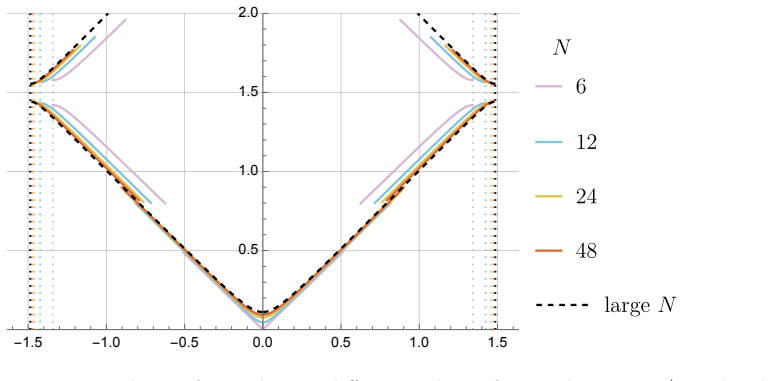
read the original abstract
We study the crystalline phase of the $O(2N)$ Gross--Neveu model with a chemical potential for $a \leq N-2$ of the fermions. We analyze the problem in three independent ways: using perturbative QFT methods, a semiclassical large $N$ analysis, and integrability techniques (both at finite and large $N$). The resulting picture is consistent across all three approaches: at sufficiently large chemical potential $h$, an inhomogeneous phase emerges in which $a$-particle bound states condense and which, at large $N$, corresponds to a periodically oscillating chiral condensate. In this phase, the usual dynamically generated scale $\Lambda$ is replaced by two new dynamically generated scales $\Lambda_{\rm n}$ and $\Lambda_{\rm c}$. These two scales govern the multiple nonperturbative effects in the theory, corresponding in particular to the mass gaps of neutral and charged excitations on top of the inhomogeneous vacuum, respectively. They also control the nonperturbative corrections to observables such as the free energy and provide the parameters characterizing the oscillatory profile of the mean field at large $N$. In this paper, we provide the necessary details of each of the three methods, thereby complementing the results announced in a previous, shorter publication.
Editorial analysis
A structured set of objections, weighed in public.
Referee Report
Summary. The paper studies the crystalline phase of the O(2N) Gross-Neveu model with chemical potential for a ≤ N-2 fermions. Using perturbative QFT methods, semiclassical large-N analysis, and integrability techniques (at finite and large N), it finds that at sufficiently large chemical potential h an inhomogeneous phase emerges in which a-particle bound states condense; at large N this corresponds to a periodically oscillating chiral condensate. In this phase the usual dynamical scale Λ is replaced by two new scales Λ_n and Λ_c that govern the mass gaps of neutral and charged excitations, control nonperturbative corrections to the free energy, and parametrize the oscillatory mean-field profile.
Significance. If the central claims hold, the work supplies a robust, multi-method characterization of the inhomogeneous phase and the emergence of two dynamically generated scales in place of the single scale Λ. The explicit agreement among perturbative, semiclassical, and integrability approaches on the two-scale structure, the identification of neutral versus charged gaps, and the oscillatory condensate profile constitutes a notable strength, especially given the model's integrability. This advances the understanding of crystalline phases in 2d fermionic QFTs with chemical potential and provides concrete, falsifiable predictions for the scales Λ_n and Λ_c.
minor comments (2)
- The abstract states that the three methods are independent and yield a consistent picture; a short dedicated subsection summarizing the cross-checks (e.g., matching values of Λ_n/Λ_c extracted from each method) would make the mutual consistency more immediately verifiable for readers.
- Notation for the two scales Λ_n and Λ_c is introduced in the abstract and used throughout; an early, self-contained definition paragraph that distinguishes their physical roles (neutral vs. charged gaps) would improve readability.
Simulated Author's Rebuttal
We thank the referee for the positive assessment of our manuscript, the detailed summary of our results, and the recommendation to accept. We are pleased that the consistency across perturbative, semiclassical, and integrability methods, as well as the emergence of the two new scales Λ_n and Λ_c, were highlighted as strengths.
Circularity Check
No significant circularity; three independent methods yield consistent two-scale structure
full rationale
The paper derives the inhomogeneous crystalline phase and the replacement of the single scale Λ by two new scales Λ_n and Λ_c through three explicitly independent methods (perturbative QFT, semiclassical large-N, and integrability at finite and large N). No equation or claim reduces a derived quantity to a fitted parameter or self-defined input by construction; the two-scale structure and the identification of neutral/charged gaps emerge from the mutual consistency of the three analyses rather than being presupposed. The reference to a prior shorter publication serves only to announce results whose details are supplied here, without load-bearing reliance on unverified self-citation. The derivation chain remains self-contained against external benchmarks.
Axiom & Free-Parameter Ledger
axioms (1)
- standard math Standard axioms of quantum field theory in 1+1 dimensions, including the existence of a dynamically generated scale Λ in the Gross-Neveu model.
Reference graph
Works this paper leans on
-
[1]
Gross and A
D.J. Gross and A. Neveu,Dynamical Symmetry Breaking in Asymptotically Free Field Theories,Phys. Rev. D10(1974) 3235. 2, 17
1974
-
[2]
Campbell and A.R
D.K. Campbell and A.R. Bishop,Soliton excitations in polyacetylene and relativistic field theory models,Nucl. Phys. B200(1982) 297. 2
1982
-
[3]
M. Thies,From relativistic quantum fields to condensed matter and back again: Updating the Gross–Neveu phase diagram,J. Phys. A39(2006) 12707 [hep-th/0601049]. 2, 23
-
[4]
Zamolodchikov and A.B
A.B. Zamolodchikov and A.B. Zamolodchikov,FactorizedS-matrices in two-dimensions as the exact solutions of certain relativistic quantum field theory models,Annals Phys.120 (1979) 253. 2
1979
-
[5]
Karowski and H.J
M. Karowski and H.J. Thun,CompleteS-matrix of theO(2N)Gross–Neveu model,Nucl. Phys. B190(1981) 61. 2
1981
-
[7]
Phys.B367(1991) 123
The Thermodynamic Bethe ansatz,Nucl. Phys.B367(1991) 123. 2, 3, 4, 39, 41, 45
1991
-
[8]
Wolff,The phase diagram of the infinite N Gross-Neveu model at finite temperature and chemical potential,Phys
U. Wolff,The phase diagram of the infinite N Gross-Neveu model at finite temperature and chemical potential,Phys. Lett. B157(1985) 303. 3
1985
-
[9]
A. Barducci, R. Casalbuoni, M. Modugno, G. Pettini and R. Gatto,Thermodynamics of the massive Gross-Neveu model,Phys. Rev. D51(1995) 3042 [hep-th/9406117]. 3
-
[10]
V. Schön and M. Thies,Emergence of Skyrme crystal in Gross–Neveu and ’t Hooft models at finite density,Phys. Rev. D62(2000) 096002 [hep-th/0003195]. 3, 4, 5
-
[11]
M. Thies and K. Urlichs,Revised phase diagram of the Gross–Neveu model,Phys. Rev. D 67(2003) 125015 [hep-th/0302092]. 3, 4, 5, 23
-
[12]
O. Schnetz, M. Thies and K. Urlichs,Phase diagram of the Gross–Neveu model: Exact results and condensed matter precursors,Annals Phys.314(2004) 425 [hep-th/0402014]. 3, 4, 5, 23, 61
-
[13]
G. Başar, G.V. Dunne and M. Thies,Inhomogeneous condensates in the thermodynamics of the chiral NJL2 model,Phys. Rev. D79(2009) 105012 [0903.1868]. 3, 4, 61
- [14]
-
[15]
R. Ciccone, L. Di Pietro and M. Serone,Inhomogeneous phase of the Chiral Gross–Neveu model,Phys. Rev. Lett.129(2022) 071603 [2203.07451]. 3 83
-
[16]
R. Ciccone, L. Di Pietro and M. Serone,Anomalies and persistent order in the chiral Gross–Neveu model,JHEP02(2024) 211 [2312.13756]. 3
-
[17]
M. Thies,Peierls instability for systems with several Fermi surfaces: An example from the chiral Gross-Neveu model,Phys. Rev. D113(2026) 036016 [2511.04212]. 3, 61
-
[18]
P. Azaria, R.M. Konik, P. Lecheminant, T. Palmai, G. Takacs and A.M. Tsvelik,Particle Formation and Ordering in Strongly Correlated Fermionic Systems: Solving a Model of Quantum Chromodynamics,Phys. Rev. D94(2016) 045003 [1601.02979]. 3
- [19]
-
[20]
Polyakov and P.B
A.M. Polyakov and P.B. Wiegmann,Theory of nonabelian Goldstone bosons in two dimensions,Phys. Lett. B131(1983) 121. 3, 37
1983
-
[21]
Forgacs, F
P. Forgacs, F. Niedermayer and P. Weisz,The Exact mass gap of the Gross-Neveu model
-
[22]
Phys.B367(1991) 144
The 1/N expansion,Nucl. Phys.B367(1991) 144. 3, 4, 39
1991
-
[23]
Volin,From the mass gap inO(N)to the non-Borel-summability inO(3)andO(4) sigma-models,Phys
D. Volin,From the mass gap inO(N)to the non-Borel-summability inO(3)andO(4) sigma-models,Phys. Rev. D81(2010) 105008 [0904.2744]. 3, 41, 57
-
[24]
M. Mariño and T. Reis,Renormalons in integrable field theories,JHEP04(2020) 160 [1909.12134]. 3, 41, 46, 57
-
[25]
L. Di Pietro, M. Mariño, G. Sberveglieri and M. Serone,Resurgence and1/Nexpansion in integrable field theories,JHEP10(2021) 166 [2108.02647]. 3, 46
- [26]
- [27]
-
[28]
Shifman, A.I
M.A. Shifman, A.I. Vainshtein and V.I. Zakharov,QCD and Resonance Physics. Theoretical Foundations,Nucl. Phys. B147(1979) 385. 3
1979
-
[29]
Benfatto and G
G. Benfatto and G. Gallavotti,Renormalization-group approach to the theory of the Fermi surface,Phys. Rev. B42(1990) 9967. 4
1990
-
[30]
Polchinski, Effective Field Theory and the Fermi Sur- face (1999), arXiv:hep-th/9210046
J. Polchinski,Effective field theory and the Fermi surface, inTheoretical Advanced Study Institute (TASI 92): From Black Holes and Strings to Particles, pp. 0235–276, 6, 1992 [hep-th/9210046]. 4
-
[31]
N.J. Evans, S.D.H. Hsu and M. Schwetz,An Effective field theory approach to color superconductivity at high quark density,Nucl. Phys. B551(1999) 275 [hep-ph/9808444]. 4 84
-
[32]
T. Schäfer and F. Wilczek,High density quark matter and the renormalization group in QCD with two and three flavors,Phys. Lett. B450(1999) 325 [hep-ph/9810509]. 4
-
[33]
A. Koenigstein, L. Pannullo, S. Rechenberger, M.J. Steil and M. Winstel,Detecting inhomogeneous chiral condensation from the bosonic two-point function in the (1 + 1)-dimensional Gross–Neveu model in the mean-field approximation*,J. Phys. A55 (2022) 375402 [2112.07024]. 5, 20, 21, 22
-
[34]
Dashen, B
R.F. Dashen, B. Hasslacher and A. Neveu,Semiclassical bound states in an asymptotically free theory,Phys. Rev. D12(1975) 2443. 5, 26, 32, 33, 34
1975
-
[35]
Mermin and H
N.D. Mermin and H. Wagner,Absence of ferromagnetism or antiferromagnetism in one-dimensional or two-dimensional isotropic Heisenberg models,Phys. Rev. Lett.17 (1966) 1133. 6
1966
-
[36]
Coleman,There are no Goldstone bosons in two-dimensions,Commun
S.R. Coleman,There are no Goldstone bosons in two-dimensions,Commun. Math. Phys. 31(1973) 259. 6
1973
-
[37]
Thies,Analytical solution of the Gross–Neveu model at finite density,Phys
M. Thies,Analytical solution of the Gross–Neveu model at finite density,Phys. Rev. D69 (2004) 067703 [hep-th/0308164]. 6, 23, 30, 32
-
[38]
O. Schnetz, M. Thies and K. Urlichs,Full phase diagram of the massive Gross–Neveu model,Annals Phys.321(2006) 2604 [hep-th/0511206]. 6, 17, 23, 25, 26, 28, 60, 61, 78, 80
- [39]
-
[40]
L. Alberte and A. Nicolis,Spontaneously broken boosts and the Goldstone continuum, JHEP07(2020) 076 [2001.06024]. 11
-
[41]
O. Schnetz, M. Thies and K. Urlichs,The Phase diagram of the massive Gross-Neveu model, revisited,hep-th/0507120. 17, 23, 26
-
[42]
M. Thies and K. Urlichs,From non-degenerate conducting polymers to dense matter in the massive Gross–Neveu model,Phys. Rev. D72(2005) 105008 [hep-th/0505024]. 23, 75, 76
-
[43]
Thies,Nonperturbative phase boundaries in the Gross-Neveu model from a stability analysis,Phys
M. Thies,Nonperturbative phase boundaries in the Gross-Neveu model from a stability analysis,Phys. Rev. D110(2024) 096012 [2408.09803]. 23
-
[44]
J. Feinberg,All about the static fermion bags in the Gross-Neveu model,Annals Phys.309 (2004) 166 [hep-th/0305240]. 26
-
[45]
Saxena and A.R
A. Saxena and A.R. Bishop,Multipolaron solutions of the gross-neveu field theory: Toda potential and doped polymers,Phys. Rev. A44(1991) R2251. 26
1991
-
[46]
G.V. Dunne and J. Feinberg,Self isospectral periodic potentials and supersymmetric quantum mechanics,Phys. Rev. D57(1998) 1271 [hep-th/9706012]. 26, 61 85
-
[47]
Fendley,Integrable sigma models and perturbed coset models,JHEP05(2001) 050 [hep-th/0101034]
P. Fendley,Integrable sigma models and perturbed coset models,JHEP05(2001) 050 [hep-th/0101034]. 38
-
[48]
Serone,Lectures on Resurgence in Integrable Field Theories,2405.02224
M. Serone,Lectures on Resurgence in Integrable Field Theories,2405.02224. 39, 46
- [49]
-
[50]
Melin,Integrability and thermodynamics of the gross-neveu model, 2023
V. Melin,Integrability and thermodynamics of the gross-neveu model, 2023. 40
2023
-
[51]
Zamolodchikov,Mass scale in the sine-Gordon model and its reductions,Int
A.B. Zamolodchikov,Mass scale in the sine-Gordon model and its reductions,Int. J. Mod. Phys. A10(1995) 1125. 41, 44
1995
-
[52]
Hasenfratz, M
P. Hasenfratz, M. Maggiore and F. Niedermayer,The Exact mass gap of the O(3) and O(4) nonlinear sigma models in d = 2,Phys. Lett.B245(1990) 522. 41
1990
-
[53]
Reis,On the resurgence of renormalons in integrable theories, Ph.D
T. Reis,On the resurgence of renormalons in integrable theories, Ph.D. thesis, U. of Geneva, 2022.2209.15386. 41, 46
- [54]
-
[55]
Fateev, E
V.A. Fateev, E. Onofri and A.B. Zamolodchikov,Integrable deformations of theO(3) sigma model. The sausage model,Nucl. Phys. B406(1993) 521. 44
1993
-
[56]
H. Saleur and B. Pozsgay,Scattering and duality in the 2 dimensional OSP(2|2) Gross Neveu and sigma models,JHEP02(2010) 008 [0910.0637]. 44
-
[57]
Sauzin,Introduction to 1-summability and resurgence,1405.0356
D. Sauzin,Introduction to 1-summability and resurgence,1405.0356. 46
-
[58]
Dorigoni,An Introduction to Resurgence, Trans-Series and Alien Calculus,Annals Phys
D. Dorigoni,An Introduction to Resurgence, Trans-Series and Alien Calculus,Annals Phys.409(2019) 167914 [1411.3585]. 46
-
[59]
I. Aniceto, G. Başar and R. Schiappa,A Primer on Resurgent Transseries and Their Asymptotics,Phys. Rept.809(2019) 1 [1802.10441]. 46
-
[60]
Finite-gap potentials as a semiclassical limit of the thermodynamic Bethe Ansatz
V. Melin, P. Wiegmann and K. Zarembo,Finite-gap potentials as a semiclassical limit of the thermodynamic Bethe Ansatz,2512.19655. 47, 59
work page internal anchor Pith review Pith/arXiv arXiv
- [61]
-
[62]
C.M. Bender and S.A. Orszag,Advanced mathematical methods for scientists and engineers, McGraw-Hill, NY, USA (1978), 10.1007/978-1-4757-3069-2. 56
-
[63]
Narayanan,Phase diagram of the largeNGross–Neveu model in a finite periodic box, Phys
R. Narayanan,Phase diagram of the largeNGross–Neveu model in a finite periodic box, Phys. Rev. D101(2020) 096001 [2001.09200]. 60 86
- [64]
-
[65]
G. Basar and G.V. Dunne,Self-consistent crystalline condensate in chiral Gross-Neveu and Bogoliubov-de Gennes systems,Phys. Rev. Lett.100(2008) 200404 [0803.1501]. 61
-
[66]
M. Mariño and R. Miravitllas,Trans-series from condensates,SciPost Phys.18(2025) 101 [2402.19356]. 61
-
[67]
Marino,Anatomy of the simplest renormalon,2504.12044
M. Marino,Anatomy of the simplest renormalon,2504.12044. 61
-
[68]
Trans-series from condensates in the non-linear sigma model
Y. Liu and M. Mariño,Trans-series from condensates in the non-linear sigma model, 2507.02605. 61
work page internal anchor Pith review Pith/arXiv arXiv
-
[69]
H. Li, D. Kusnezov and F. Iachello,Group theoretical properties and band structure of the lamé hamiltonian,Journal of Physics A: Mathematical and General33(2000) 6413. 78
2000
-
[70]
Tricomi,Integral Equations, (Pure and applied mathematics, v
F. Tricomi,Integral Equations, (Pure and applied mathematics, v. 5), Dover Publications (1985). 82 87
1985
discussion (0)
Sign in with ORCID, Apple, or X to comment. Anyone can read and Pith papers without signing in.