REVIEW 4 major objections 4 minor 114 references
A 3D lattice model with D4 gauge group reproduces, excitation by excitation, the BF field theory with an AAB twist.
Reviewed by Pith at T0; open to challenge. T0 means a machine referee read the full paper against a public rubric. the ladder, T0–T4 →
T0 review · deepseek-v4-flash
2026-08-03 14:10 UTC pith:XEDDVW7I
load-bearing objection A careful lattice construction with a real D4-to-BF+AAB matching, but the 'conclusive' claim is undercut by the absence of any braiding computation. the 4 major comments →
Bridging Microscopic Constructions and Continuum Topological Field Theory of Three-Dimensional Non-Abelian Topological Order
The pith
A machine-rendered reading of the paper's core claim, the machinery that carries it, and where it could break.
Core claim
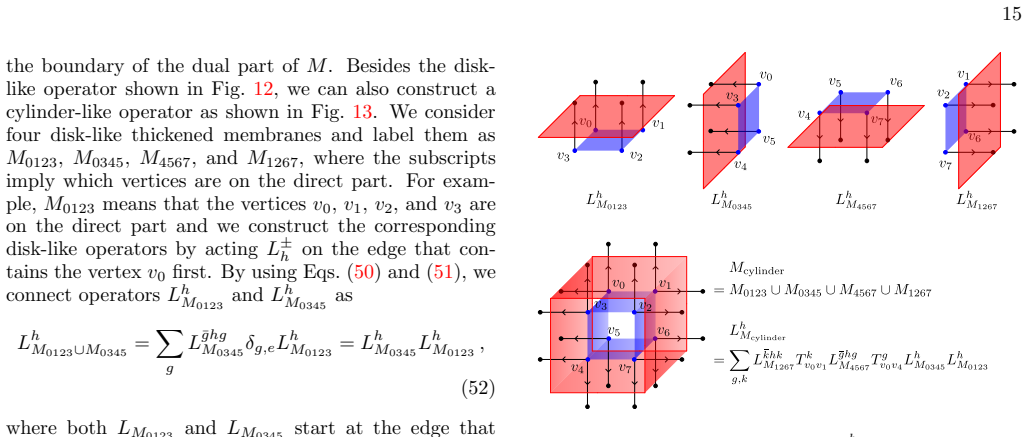
The paper claims that the 3D D4 quantum double model is a concrete microscopic construction of the (3+1)D BF field theory with AAB twist and gauge group G=(Z2)^3. Starting from a cubic-lattice Hamiltonian with D4 group elements on edges, the authors build cylinder-like thickened membrane operators that create particle-loop excitations labeled by (conjugacy class C, centralizer representation R). Fusion is obtained by decomposing tensor products of quantum double irreps, and shrinking by contracting the membrane to a string and decomposing the resulting local Hilbert space. Comparing complete fusion and shrinking tables—22 excitations on each side—they construct an explicit isomorphism f sati
What carries the argument
The central object is the thickened membrane operator W_M(C,R;c,j;c',j') built from four basic edge operators T±_g (projectors) and L±_g (left/right multiplications), acting on a cylinder-like membrane in the 3D quantum double model. It creates a pair of (possibly decorated) loop excitations on the two boundaries; local Hilbert spaces are representation spaces of the quantum double algebra D(G). Fusion is the tensor-product decomposition of these representations, shrinking is implemented by contracting the membrane via the connecting rule L^c_M = L^{g c g^{-1}}_{M'} L^c_{M∪M'}, and the final correspondence is carried by the isomorphism table mapping BF+AAB excitations to D4 quantum double ex
Load-bearing premise
The identification rests on the assumption that equal ground-state degeneracy, equal fusion rules, and equal shrinking rules are enough to conclude the D4 quantum double model and the BF+AAB continuum theory are the same topological order; braiding phases are not compared in the paper.
What would settle it
Compute a braiding phase—say the particle-loop or Borromean-rings phase—directly from the D4 lattice operators and compare it with the BF+AAB prediction. A mismatch in any braiding phase, despite matching fusion and shrinking, would show the two theories are not the same topological order and would falsify the microscopic-construction claim as stated.
If this is right
- The D4 quantum double Hamiltonian is an exactly solvable, short-range, tensor-product-local realization of BF+AAB topological order, so the continuum theory's predictions (including Borromean-rings braiding) become accessible to lattice simulation.
- Fusion-shrinking consistency, first derived in field theory, holds at the microscopic level for the quantum double model with arbitrary finite group G, making it a verifiable organizing principle.
- Non-Abelian shrinking channels can be deterministically selected by choosing internal degrees of freedom of the loop creation operator, not just enumerated.
- The isomorphism gives a concrete dictionary: B1/B2 fluxes map to conjugacy classes C_r/C_t, B3 flux to C_{r^2}, and A1/A2/A3 charges to the irreps R, T, B of D4, suggesting a central-extension origin 1→Z2→D4→(Z2)^2→1.
- The paper's explicit lattice operators provide the starting point for checking the pentagon and shrinking-fusion hexagon relations on the lattice, completing the microscopic counterpart of the diagrammatic framework.
Where Pith is reading between the lines
- If the correspondence is genuine, the D4 quantum double should also reproduce the Borromean-rings braiding phase of BF+AAB; computing that phase on the lattice would test the isomorphism more sharply than fusion and shrinking data alone.
- The authors' identification criteria—equal ground-state degeneracy, equal fusion, and equal shrinking—leave a logical gap: two distinct 3D topological orders could share these data and differ in braiding. A full proof of microscopic realization likely requires matching braiding phases (particle-loop, multi-loop, and Borromean) as well.
- The relaxed delta-function constraints yielding 22 excitations rather than 19 suggest the continuum BF+AAB theory may need re-examination; if correct, the excitation content of the theory is richer than previously reported.
- The central-extension conjecture 1→Z2→D4→(Z2)^2→1, if pursued, could point to lattice models for BF+AAB theories with more general gauge groups Z_{N1}×Z_{N2}×Z_{N3} by replacing D4 with suitable discrete extensions.
Editorial analysis
A structured set of objections, weighed in public.
Referee Report
Summary. The paper develops a microscopic operator framework for three-dimensional quantum double models and uses it to argue that the 3d D4 quantum double model is a microscopic construction of the (3+1)d BF field theory with an AAB twist and gauge group (Z2)^3. The authors construct lattice operators for particle and loop excitations, derive fusion and shrinking rules from quantum-double representation theory for G = D3 and D4, verify a fusion–shrinking consistency relation they attribute to earlier continuum work, and exhibit an isomorphism f between the 22 excitations of the D4 model and 22 Wilson-operator classes of the BF+AAB theory. The claimed identification is based on matching ground-state degeneracy (92 on T^3), fusion tables, and shrinking tables (Tables IV–VII), implemented through Eqs. (146) and (147). The abstract promises particle–loop and Borromean-rings braiding phases, but no braiding phase is computed in the body of the paper; in fact, Sec. VII lists braiding-related consistency as an open problem.
Significance. The paper contains substantial technical work: explicit cylinder-like membrane operators, representation-theoretic derivations of fusion and shrinking rules for D3 and D4, and a large set of internally consistent tables in the appendices. If the identification with BF+AAB could be established at the level of full topological data, the D4 quantum double would indeed provide the first concrete lattice realization of a continuum twisted BF theory with Borromean-rings braiding, and the lattice verification of fusion–shrinking consistency would be a useful bridge between the continuum diagrammatic framework and lattice models. These are real strengths. However, the central equivalence claim currently rests on a comparison that omits braiding, which is precisely the distinguishing feature of BF+AAB; the advertised braiding-phase computation is absent. The result is therefore not yet conclusive as stated, though the missing pieces appear to be within reach of the authors' operator formalism.
major comments (4)
- [Sec. VI D and Sec. VII] The claim that the isomorphism f satisfying Eqs. (146) and (147) 'conclusively demonstrates' that the D4 quantum double model is a microscopic construction of BF+AAB is not supported by the evidence presented. The comparison consists of the ground-state degeneracy (Sec. III A), the fusion tables (Sec. VI C, Tables IV–V) and the shrinking table (Table VI). No braiding phase—particle–loop, multi-loop, or Borromean-rings—is computed anywhere in the manuscript. BF+AAB is defined by its Borromean-rings braiding, and two distinct 3d topological orders can in principle share fusion and shrinking data while differing in braiding. The paper itself states in Sec. VII that it remains an open question whether consistency relations involving braiding statistics hold in this setting. The abstract's promise to compute 'particle-loop and Borromean-Rings braiding phases' is therefore not fulfilled. The c
- [Sec. VI B, Eqs. (124) and (129)] The Wilson operators for non-Abelian excitations contain a normalization factor 2 that is inserted 'to ensure that all fusion and shrinking coefficients are integers.' Since these integral coefficients are exactly the target data used in the isomorphism Table VII, this normalization is load-bearing and not parameter-free. If the prefactor is chosen to force integer fusion coefficients, the match with the quantum-double tables could be partly engineered. The authors should derive the prefactor from a fixed normalization convention—for example, requiring the identity operator to have expectation value 1 and fixing the operator product expansion of Wilson operators without arbitrary rescaling—or show that the isomorphism is independent of this choice.
- [Sec. VI B, Eqs. (129)–(130)] The manuscript changes the field-theoretic excitation count from 19 in Ref. [54] to 22 by relaxing the delta-function constraints in the Wilson operators for L^001_100, L^001_010, and L^001_110. This is a substantive modification of the continuum side of the correspondence. Only one example is exhibited (Eq. (129)); the claim that 'our analysis, based on gauge invariance and a careful treatment of delta functions, reveals' the 22 distinct operators is asserted rather than demonstrated. Since Table VII and the central isomorphism depend on the 22-entry count, the authors need to provide a systematic derivation of the equivalence classes of gauge-invariant Wilson operators under the relaxed constraints.
- [Sec. V E] The fusion–shrinking consistency condition Eq. (11) is verified explicitly only for the D3 example (Tables I and III). The text then concludes that Eq. (11) applies to the 3d quantum double model with arbitrary finite group G, and this statement is used as part of the microscopic basis of the D4 identification. For D4, whose tables are central to Sec. VI, no explicit check of Eq. (11) is shown. Since Eq. (11) is imported from the continuum framework, the authors should either prove the consistency relation from quantum-double representation theory for general G, or at least provide an explicit D4 verification, so that the D4 comparison is not relying on an unproved generalization.
minor comments (4)
- [Sec. VI B, Eq. (135)] The displayed shrinking rule reads 'S(L^001) = 1 ⊕ P_010', but the surrounding text concerns the non-Abelian pure loop L_100. This appears to be a typo; it should presumably be S(L_100).
- [Abstract and introduction] The abstract and Introduction (item iv) state that braiding phases are computed in this work. No braiding-phase computation appears in the text. This is a major mismatch between the advertised content and the actual content, and the wording should be corrected when the missing computation is either supplied or removed.
- [Sec. VI B, Eq. (124)] The notation d^{-1}A_1 = α_1 with dα_1 = A_1 is used without discussing the global ambiguity of the inverse derivative. The delta functions are intended to fix this, but a more explicit global-consistency statement would help the reader.
- [Appendix A] The universality of the pentagon Eq. (A5) and shrinking-fusion hexagon Eq. (A11) is stated as a conjecture. This should be clearly flagged as a conjecture rather than a theorem in the main text, since the body refers to the diagrammatic constraints as established principles.
Circularity Check
No significant circularity: the D4/BF+AAB data match rests on independently derived lattice tables and explicit Wilson-operator data; the overclaim about conclusiveness stems from missing braiding comparisons, not from circular reasoning.
full rationale
The paper's central identification of the 3d D4 quantum double model with the BF field theory with AAB twist and gauge group (Z2)^3 is based on comparing fusion and shrinking tables. On the lattice side, the fusion rules (Sec. IV) and shrinking rules (Sec. V) are derived from quantum double representation theory via Eqs. (66), (82), and (93), independently of the field-theory data. On the continuum side, the BF theory data are reviewed from explicit Wilson operators (Sec. VI B), and the paper even revises the excitation count from 19 to 22 based on a gauge-invariance analysis of delta functions, rather than merely importing the count. The consistency condition Eq. (11) is derived earlier in the paper from field theory and then verified in the lattice model, but the lattice rules are not derived from this condition, so the verification is not circular. The isomorphism f in Table VII is constructed by comparing independently defined fusion and shrinking tables; its existence is a nontrivial statement about two separately formulated mathematical structures, not an input by definition. The main weakness—that braiding phases, including Borromean-rings braiding, are not computed in the lattice model and the paper itself lists braiding-fusion-shrinking consistency as open—is an evidentiary incompleteness or overclaim, not a circular step. Therefore no circularity is found.
Axiom & Free-Parameter Ledger
free parameters (1)
- normalization factor 2 in non-Abelian Wilson operators =
2
axioms (4)
- standard math Quantum double representation theory gives a complete accounting of excitations, fusion coefficients, and quantum dimensions in the lattice model.
- domain assumption The BF+AAB continuum data (action Eq. (121), Wilson operators, 22-excitation count, full fusion/shrinking tables) are correct as stated.
- domain assumption Two 3D topological orders with equal GSD, fusion rules, and shrinking rules are the same topological order.
- domain assumption The lattice membrane-shrinking operation Eq. (76) faithfully implements continuum shrinking Eq. (9) and is a tensor functor satisfying Eq. (11).
Cite this review
Pith. "Pith review of Bridging Microscopic Constructions and Continuum Topological Field Theory of Three-Dimensional Non-Abelian Topological Order." pith.science (2026). https://pith.science/paper/XEDDVW7I
@misc{pith2026251221148,
  author       = {Pith},
  title        = {Pith review of: Bridging Microscopic Constructions and Continuum Topological Field Theory of Three-Dimensional Non-Abelian Topological Order},
  year         = {2026},
  howpublished = {\url{https://pith.science/paper/XEDDVW7I}},
  note         = {Machine review of arXiv:2512.21148}
}
read the original abstract
Continuum field-theoretical descriptions of topological order are often constructed at long distances without direct reference to microscopic short-distance realizations, guided instead by general principles such as gauge invariance, locality, symmetry, response, and topological invariance. A classic example is provided by Chern--Simons-type topological field theories for two-dimensional anyon systems. Recently, this framework has been extended to three-dimensional topological orders, where particle and loop excitations exhibit highly nontrivial phenomena, including braiding, fusion, and shrinking. Field-theoretical approaches have further led to diagrammatic representations, pentagon and hexagon relations, and \textit{fusion--shrinking consistency} conditions governing these processes. Despite these advances, a long-standing question remains: do such long-distance field-theoretical structures admit faithful microscopic counterparts with tensor-product local Hilbert spaces and short-range interactions? In this work, we answer this question by establishing an explicit correspondence between continuum topological field theory and microscopic lattice constructions of three-dimensional non-Abelian topological order. While Wilson operators encode long-distance topological excitations, we construct microscopic lattice operators that create, fuse, shrink, and braid particles and loops. Using these operators, we compute fusion and shrinking rules, particle--loop and Borromean-Rings braiding phases, and show how non-Abelian shrinking channels can be selectively controlled by the internal degrees of freedom of loop operators. We further show that the lattice shrinking rules satisfy the \textit{fusion--shrinking consistency} relations previously obtained from field theory, establishing these relations as a microscopically verifiable organizing principle for 3D topological order. Remarkably, by...
Figures




Reference graph
Works this paper leans on
-
[1]
(34) Consider a stringL=L 1 ∪L 2 ∪L 3, if we connectL 2 andL 3 first, by using Eq
Proof of Eq. (34) Consider a stringL=L 1 ∪L 2 ∪L 3, if we connectL 2 andL 3 first, by using Eq. (33), we have T g L1∪(L2∪L3) = X h T ¯hg L2∪L3 T h L1 = X h,m T ¯m¯hg L3 T m L2 T h L1 , (B1) where the bracket (L 2 ∪L 3) is introduced to emphasize thatL 2 andL 3 are connected first. If we connectL 1 and L2 first, then we have T g (L1∪L2)∪L3 = X m T ¯mg L3 T...
-
[2]
(35), (36) and (37) SupposeL= (v 0, v1,· · ·, vn) starts at the vertexv 0, goes throughnedges denoted byv ivi+1 and finally ends atv n
Proof of Eqs. (35), (36) and (37) SupposeL= (v 0, v1,· · ·, vn) starts at the vertexv 0, goes throughnedges denoted byv ivi+1 and finally ends atv n. We set the arrow ofv ivi+1 points fromv i tov i+1. Then we writeT g L as T g L = X h1,h2,···hn−1 T ¯hn−1g vn−1vn · · ·T ¯hihi+1 vivi+1 · · ·T ¯h1h2 v1v2 T h1 v0v1 . (B4) Notice that the vertex operatorA k vi...
-
[3]
(41), (42) and (43) We consider Eq
Proof of Eqs. (41), (42) and (43) We consider Eq. (41) first. Using Eq. (38), we have Ag v=∂0L |R;i, j⟩=Ag v=∂0LWL (R;i, j)|GS⟩ =Ag v=∂0L X h∈G ΓR∗ ij (h)T h L |GS⟩.(B14) Notice Eq. (36), we obtain Ag v=∂0L |R;i, j⟩= X h∈G ΓR∗ ij (h)T gh L Ag v=∂0L |GS⟩ = X h∈G ΓR∗ ij (h)T gh L |GS⟩,(B15) where we absorb theA g v=∂0L into the ground state in the last step...
-
[4]
(44) Consider X k WL2 (R;k, j)WL1 (R;i, k) = X k X g,h∈G ΓR∗ kj (h)T h L2 ΓR∗ ik (g)T g L1 = X g,h ΓR∗ ij (gh)T h L2 T g L1 = X m X g ΓR∗ ij (m)T ¯gm L2 T g L1 .(B19) By using Eq
Proof of Eq. (44) Consider X k WL2 (R;k, j)WL1 (R;i, k) = X k X g,h∈G ΓR∗ kj (h)T h L2 ΓR∗ ik (g)T g L1 = X g,h ΓR∗ ij (gh)T h L2 T g L1 = X m X g ΓR∗ ij (m)T ¯gm L2 T g L1 .(B19) By using Eq. (33), we have X m X g ΓR∗ ij (m)T ¯gm L2 T g L1 = X m ΓR∗ ij (m)T m L1∪L2 =WL=L1∪L2 (R;i, j).(B20) 36 Thus, we obtain the connecting rule of WL=L1∪L2 (R;i, j): WL1∪...
-
[5]
For simplicity, we consider the plaque- ttev 0v1v′ 1v′ 0 shown in Fig
The commutation relations betweenB p andL c M Whenplives in the bulk of the membraneM, we have [Bp, Lc M ] = 0. For simplicity, we consider the plaque- ttev 0v1v′ 1v′ 0 shown in Fig. 12. Suppose the edgesv 0v′ 0, v0v1, andv 1v′ 1 are assigned with group elementsg 1,g 2, andg 3 respectively, then we label this configuration as |g1, g2, g3⟩. Before the acti...
-
[6]
The commutation relations betweenA v andL c M Whenv̸=v 0 andc /∈Z(G), whereL c M is constructed by actingL ± c onv 0v′ 0 first, we have [A v, Lc M ] = 0. From Eq. (49), we can see that anyL c M has the form of Lc M = X · · · X g L¯gcg vv ′ T g v0v ! · · ·Lc v0v′ 0 ,(B24) where· · ·represents some terms that commute withAh v because they do not act on edge...
-
[7]
(56), (57), (58) and (59) First, we consider that whenv 0vin Eq
Proof of Eqs. (56), (57), (58) and (59) First, we consider that whenv 0vin Eq. (B24) is an edge, theL c M can be written as Lc M = X · · · X g0 L¯g0cg0 vv ′ T g0 v0v ! Lc v0v′ 0 .(B28) By using Eq. (36) andA g v0 Lc v0v′ 0 =L gc¯g v0v′ 0 Ag v0 , we have Ag v0 Lc M = X · · · X g0 L¯g0cg0 vv ′ Ag v0 T g0 v0v ! Lc v0v′ 0 = X · · · X g0 L¯g0cg0 vv ′ T gg0 v0v...
-
[8]
Kitaev, Anyons in an exactly solved model and be- yond, Annals of Physics321, 2 (2006), january Special Issue
A. Kitaev, Anyons in an exactly solved model and be- yond, Annals of Physics321, 2 (2006), january Special Issue
2006
-
[9]
B. Zeng, X. Chen, D.-L. Zhou, and X.-G. Wen, Quan- tum information meets quantum matter – from quan- tum entanglement to topological phase in many-body systems (2018), arXiv:1508.02595 [cond-mat.str-el]
Pith/arXiv arXiv 2018
-
[10]
Witten, Quantum field theory and the jones polyno- mial, Commun
E. Witten, Quantum field theory and the jones polyno- mial, Commun. Math. Phys.121, 351 (1989)
1989
-
[11]
V. G. Turaev,Quantum Invariants of Knots and 3- Manifolds(De Gruyter, Berlin, Boston, 2016)
2016
-
[12]
Blok and X
B. Blok and X. G. Wen, Effective theories of the frac- tional quantum hall effect at generic filling fractions, Phys. Rev. B42, 8133 (1990)
1990
-
[13]
Nayak, S
C. Nayak, S. H. Simon, A. Stern, M. Freedman, and S. Das Sarma, Non-abelian anyons and topologi- cal quantum computation, Rev. Mod. Phys.80, 1083 (2008)
2008
-
[14]
Wen,Quantum field theory of many-body systems: from the origin of sound to an origin of light and elec- trons(Oxford University Press, 2004)
X.-G. Wen,Quantum field theory of many-body systems: from the origin of sound to an origin of light and elec- trons(Oxford University Press, 2004)
2004
-
[15]
Kitaev, Fault-tolerant quantum computation by anyons, Annals of Physics303, 2 (2003)
A. Kitaev, Fault-tolerant quantum computation by anyons, Annals of Physics303, 2 (2003)
2003
-
[16]
B.-X. Li, Y. Zhou, and P. Ye, Three-dimensional frac- ton topological orders with boundary toeplitz braiding, Phys. Rev. B110, 205108 (2024)
2024
-
[17]
Bombin and M
H. Bombin and M. A. Martin-Delgado, Family of non- abelian kitaev models on a lattice: Topological con- densation and confinement, Phys. Rev. B78, 115421 (2008)
2008
-
[18]
Koch-Janusz, M
M. Koch-Janusz, M. Levin, and A. Stern, Exactly sol- uble lattice models for non-abelian states of matter in two dimensions, Phys. Rev. B88, 115133 (2013)
2013
-
[19]
S. H. Simon,Topological quantum(Oxford University Press, 2023)
2023
-
[20]
Vijay, J
S. Vijay, J. Haah, and L. Fu, A new kind of topological quantum order: A dimensional hierarchy of quasiparti- cles built from stationary excitations, Phys. Rev. B92, 235136 (2015)
2015
-
[21]
X. Ma, W. Shirley, M. Cheng, M. Levin, J. McGreevy, and X. Chen, Fractonic order in infinite-component chern-simons gauge theories, Phys. Rev. B105, 195124 (2022)
2022
-
[22]
Slagle, Foliated quantum field theory of fracton or- der, Phys
K. Slagle, Foliated quantum field theory of fracton or- der, Phys. Rev. Lett.126, 101603 (2021)
2021
- [23]
-
[24]
Ye and Z.-C
P. Ye and Z.-C. Gu, Topological quantum field theory of three-dimensional bosonic abelian-symmetry-protected topological phases, Phys. Rev. B93, 205157 (2016)
2016
-
[25]
Shankar, Renormalization-group approach to inter- acting fermions, Rev
R. Shankar, Renormalization-group approach to inter- acting fermions, Rev. Mod. Phys.66, 129 (1994)
1994
-
[26]
J. M. Leinaas and J. Myrheim, On the theory of iden- tical particles, Il Nuovo Cimento B (1971-1996)37, 1 (1977)
1971
-
[27]
P. Ye, T. L. Hughes, J. Maciejko, and E. Fradkin, Composite particle theory of three-dimensional gapped fermionic phases: Fractional topological insulators and charge-loop excitation symmetry, Phys. Rev. B94, 115104 (2016)
2016
-
[28]
B. Moy, H. Goldman, R. Sohal, and E. Fradkin, Theory of oblique topological insulators, SciPost Phys.14, 023 (2023)
2023
-
[29]
Ye and X.-G
P. Ye and X.-G. Wen, Constructing symmetric topolog- ical phases of bosons in three dimensions via fermionic projective construction and dyon condensation, Phys. Rev. B89, 045127 (2014)
2014
-
[30]
Putrov, J
P. Putrov, J. Wang, and S.-T. Yau, Braiding statis- tics and link invariants of bosonic/fermionic topological quantum matter in 2+1 and 3+1 dimensions, Annals of Physics384, 254 (2017)
2017
-
[31]
Q.-R. Wang, M. Cheng, C. Wang, and Z.-C. Gu, Topo- logical quantum field theory for abelian topological phases and loop braiding statistics in (3+1)-dimensions, Phys. Rev. B99, 235137 (2019)
2019
-
[32]
Hansson, V
T. Hansson, V. Oganesyan, and S. Sondhi, Supercon- ductors are topologically ordered, Annals of Physics 313, 497 (2004)
2004
-
[33]
X. Wen, H. He, A. Tiwari, Y. Zheng, and P. Ye, En- tanglement entropy for (3+1)-dimensional topological order with excitations, Phys. Rev. B97, 085147 (2018)
2018
-
[34]
A. P. O. Chan, P. Ye, and S. Ryu, Braiding with bor- romean rings in (3 + 1)-dimensional spacetime, Phys. Rev. Lett.121, 061601 (2018)
2018
-
[35]
Zhang and P
Z.-F. Zhang and P. Ye, Compatible braidings with hopf links, multiloop, and borromean rings in (3 + 1)-dimensional spacetime, Phys. Rev. Res.3, 023132 (2021)
2021
-
[36]
Ye and Z.-C
P. Ye and Z.-C. Gu, Vortex-line condensation in three dimensions: A physical mechanism for bosonic topolog- ical insulators, Phys. Rev. X5, 021029 (2015)
2015
-
[37]
Ye and J
P. Ye and J. Wang, Symmetry-protected topological phases with charge and spin symmetries: Response the- ory and dynamical gauge theory in two and three di- mensions, Phys. Rev. B88, 235109 (2013)
2013
-
[38]
M. G. Alford and F. Wilczek, Aharonov-bohm interac- tion of cosmic strings with matter, Phys. Rev. Lett.62, 1071 (1989)
1989
-
[39]
L. M. Krauss and F. Wilczek, Discrete gauge symmetry in continuum theories, Phys. Rev. Lett.62, 1221 (1989)
1989
-
[40]
Wang, C.-H
C. Wang, C.-H. Lin, and M. Levin, Bulk-boundary cor- respondence for three-dimensional symmetry-protected topological phases, Phys. Rev. X6, 021015 (2016)
2016
-
[41]
M. G. Alford, Kai-Ming Lee, J. March-Russell, and J. Preskill, Quantum field theory of non-abelian strings and vortices, Nuclear Physics B384, 251 (1992)
1992
-
[42]
Preskill and L
J. Preskill and L. M. Krauss, Local discrete symmetry 42 and quantum-mechanical hair, Nuclear Physics B341, 50 (1990)
1990
-
[43]
Wang and M
C. Wang and M. Levin, Braiding statistics of loop ex- citations in three dimensions, Phys. Rev. Lett.113, 080403 (2014)
2014
-
[44]
J. C. Wang, Z.-C. Gu, and X.-G. Wen, Field-theory rep- resentation of gauge-gravity symmetry-protected topo- logical invariants, group cohomology, and beyond, Phys. Rev. Lett.114, 031601 (2015)
2015
-
[45]
J. C. Wang and X.-G. Wen, Non-abelian string and par- ticle braiding in topological order: Modular SL(3,Z) representation and (3 + 1)-dimensional twisted gauge theory, Phys. Rev. B91, 035134 (2015)
2015
-
[46]
Jian and X.-L
C.-M. Jian and X.-L. Qi, Layer construction of 3d topo- logical states and string braiding statistics, Phys. Rev. X4, 041043 (2014)
2014
-
[47]
Jiang, A
S. Jiang, A. Mesaros, and Y. Ran, Generalized modular transformations in (3+1)D topologically ordered phases and triple linking invariant of loop braiding, Phys. Rev. X4, 031048 (2014)
2014
-
[48]
P. Ye, M. Cheng, and E. Fradkin, Fractionals-duality, classification of fractional topological insulators, and surface topological order, Phys. Rev. B96, 085125 (2017)
2017
-
[49]
Tiwari, X
A. Tiwari, X. Chen, and S. Ryu, Wilson operator alge- bras and ground states of coupledBFtheories, Phys. Rev. B95, 245124 (2017)
2017
-
[50]
A. Kapustin and R. Thorngren, Anomalies of discrete symmetries in various dimensions and group cohomol- ogy (2014), arXiv:1404.3230 [hep-th]
Pith/arXiv arXiv 2014
-
[51]
X. Chen, A. Tiwari, and S. Ryu, Bulk-boundary cor- respondence in (3+1)-dimensional topological phases, Phys. Rev. B94, 045113 (2016)
2016
-
[52]
A. Kapustin and N. Seiberg, Coupling a QFT to a TQFT and Duality, JHEP04, 001, arXiv:1401.0740 [hep-th]
-
[53]
Zhang, Q.-R
Z.-F. Zhang, Q.-R. Wang, and P. Ye, Continuum field theory of three-dimensional topological orders with emergent fermions and braiding statistics, Phys. Rev. Res.5, 043111 (2023)
2023
-
[54]
Qi and S.-C
X.-L. Qi and S.-C. Zhang, Topological insulators and superconductors, Rev. Mod. Phys.83, 1057 (2011)
2011
-
[55]
M. F. Lapa, C.-M. Jian, P. Ye, and T. L. Hughes, Topo- logical electromagnetic responses of bosonic quantum hall, topological insulator, and chiral semimetal phases in all dimensions, Phys. Rev. B95, 035149 (2017)
2017
-
[56]
Y. Huang, Z.-F. Zhang, and P. Ye, Fusion rules and shrinking rules of topological orders in five dimensions, JHEP11, 210, arXiv:2306.14611 [hep-th]
-
[57]
Witten, Fermion path integrals and topological phases, Rev
E. Witten, Fermion path integrals and topological phases, Rev. Mod. Phys.88, 035001 (2016)
2016
-
[58]
B. Han, H. Wang, and P. Ye, Generalized wen-zee terms, Phys. Rev. B99, 205120 (2019)
2019
-
[59]
Ning, Z.-X
S.-Q. Ning, Z.-X. Liu, and P. Ye, Fractionalizing global symmetry on looplike topological excitations, Phys. Rev. B105, 205137 (2022)
2022
-
[60]
Ning, Z.-X
S.-Q. Ning, Z.-X. Liu, and P. Ye, Symmetry enrichment in three-dimensional topological phases, Phys. Rev. B 94, 245120 (2016)
2016
-
[61]
Ye, Three-dimensional anomalous twisted gauge the- ories with global symmetry: Implications for quantum spin liquids, Phys
P. Ye, Three-dimensional anomalous twisted gauge the- ories with global symmetry: Implications for quantum spin liquids, Phys. Rev. B97, 125127 (2018)
2018
-
[62]
Zhang, Q.-R
Z.-F. Zhang, Q.-R. Wang, and P. Ye, Non-abelian fu- sion, shrinking, and quantum dimensions of abelian gauge fluxes, Phys. Rev. B107, 165117 (2023)
2023
-
[63]
Z.-F. Zhang and P. Ye, Topological orders, braiding statistics, and mixture of two types of twisted BF theo- ries in five dimensions, JHEP04, 138, arXiv:2104.07067 [hep-th]
- [64]
-
[65]
Y. Huang, Z.-F. Zhang, and P. Ye, Diagrammatics, pen- tagon equations, and hexagon equations of topological orders with loop- and membrane-like excitations, JHEP 2025(6), 238, arXiv:2405.19077 [hep-th]
Pith/arXiv arXiv 2025
-
[66]
M. A. Levin and X.-G. Wen, String-net condensation: A physical mechanism for topological phases, Phys. Rev. B71, 045110 (2005)
2005
-
[67]
L. Kong, T. Lan, X.-G. Wen, Z.-H. Zhang, and H. Zheng, Classification of topological phases with fi- nite internal symmetries in all dimensions, Journal of High Energy Physics2020, 93 (2020)
2020
-
[68]
Delcamp and A
C. Delcamp and A. Tiwari, From gauge to higher gauge models of topological phases, Journal of High Energy Physics2018, 1 (2018)
2018
-
[69]
L. Kong, Y. Tian, and S. Zhou, The center of monoidal 2-categories in 3+1d dijkgraaf-witten theory, Advances in Mathematics360, 106928 (2020)
2020
-
[70]
Delcamp and A
C. Delcamp and A. Tiwari, On 2-form gauge models of topological phases, Journal of High Energy Physics 2019, 1 (2019)
2019
-
[71]
Chen, Drinfel’d double symmetry of the 4d ki- taev model, Journal of High Energy Physics2023, 141 (2023)
H. Chen, Drinfel’d double symmetry of the 4d ki- taev model, Journal of High Energy Physics2023, 141 (2023)
2023
-
[72]
Z.-T. Xu, Z.-C. Gu, and S. Yang, Global phase dia- gram of doped quantum spin liquid on the Kagome lattice, arXiv e-prints , arXiv:2404.05685 (2024), arXiv:2404.05685 [cond-mat.str-el]
Pith/arXiv arXiv 2024
-
[73]
Y. Wan, J. C. Wang, and H. He, Twisted gauge theory model of topological phases in three dimensions, Phys. Rev. B92, 045101 (2015)
2015
-
[74]
Huxford, D
J. Huxford, D. X. Nguyen, and Y. B. Kim, Twisted lattice gauge theory: Membrane operators, three-loop braiding, and topological charge, Phys. Rev. B110, 035117 (2024)
2024
-
[75]
Ye, C.-S
P. Ye, C.-S. Tian, X.-L. Qi, and Z.-Y. Weng, Confinement-deconfinement interplay in quantum phases of doped mott insulators, Phys. Rev. Lett.106, 147002 (2011)
2011
-
[76]
Ye and Q.-R
P. Ye and Q.-R. Wang, Monopoles, confinement and charge localization in the t–j model with dilute holes, Nuclear Physics B874, 386 (2013)
2013
-
[77]
Y. Ma, P. Ye, and Z.-Y. Weng, Low-temperature pseu- dogap phenomenon: precursor of high-tc superconduc- tivity, New Journal of Physics16, 083039 (2014)
2014
-
[78]
Mei, Possible fermi liquid in the lightly doped kitaev spin liquid, Phys
J.-W. Mei, Possible fermi liquid in the lightly doped kitaev spin liquid, Phys. Rev. Lett.108, 227207 (2012)
2012
-
[79]
X.-Y. Song, A. Vishwanath, and Y.-H. Zhang, Doping the chiral spin liquid: Topological superconductor or chiral metal, Phys. Rev. B103, 165138 (2021)
2021
-
[80]
Barkeshli and X.-G
M. Barkeshli and X.-G. Wen,u(1)×u(1)⋊Z 2 chern- simons theory andZ 4 parafermion fractional quantum hall states, Phys. Rev. B81, 045323 (2010)
2010
discussion (0)
Sign in with ORCID, Apple, or X to comment. Anyone can read and Pith papers without signing in.