Recognition: 2 theorem links
· Lean TheoremBulk-cone singularities and echoes from AdS exotic compact objects
Pith reviewed 2026-05-16 19:52 UTC · model grok-4.3
The pith
AdS exotic compact objects imprint bulk-cone singularities and echoes on dual CFT Green's functions.
A machine-rendered reading of the paper's core claim, the machinery that carries it, and where it could break.
Core claim
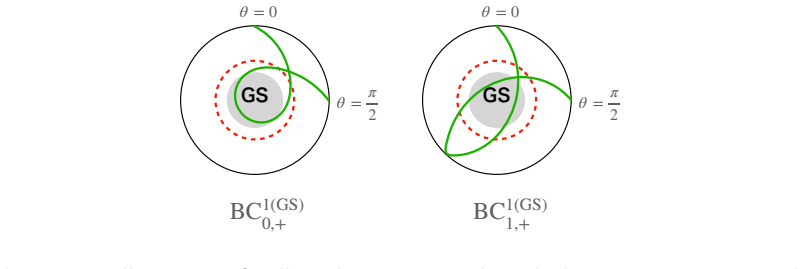
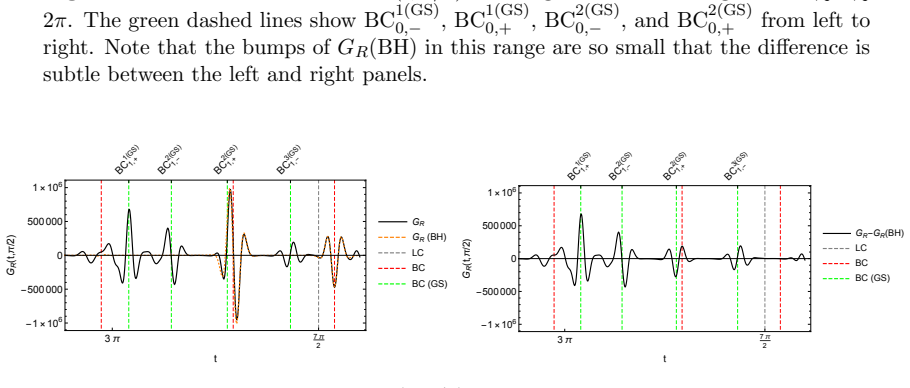
Exotic compact objects leave two characteristic imprints: bulk-cone singularities corresponding to null geodesics in the bulk and echoes from wave modes trapped inside the photon sphere, signaling the absence of a horizon.
What carries the argument
Retarded Green functions of the dual CFT extracted from bulk scalar wave functions, revealing bulk-cone singularities and echoes as imprints of the exotic geometry.
If this is right
- Null geodesics specific to exotic compact objects can be detected via the bulk-cone singularities in CFT correlators.
- Echoes in the Green's functions signal the absence of an event horizon.
- The method applies to concrete models like AdS gravastars and wormholes.
- Both WKB approximation and numerical analysis confirm the presence of these signatures.
Where Pith is reading between the lines
- Observing these features could offer a holographic probe for quantum gravity effects resolving black hole singularities.
- This approach might extend to other modified geometries or different fields in the bulk.
- Connections could be drawn to echo phenomena in gravitational wave astronomy for horizonless objects.
Load-bearing premise
The AdS/CFT correspondence applies to horizonless exotic compact objects and the bulk wave functions faithfully capture the interior modifications.
What would settle it
Computing the retarded Green function for an AdS black hole and finding no bulk-cone singularities or echoes, while they appear for the exotic objects.
Figures






read the original abstract
The region near a black hole horizon may be modified by quantum gravity effects that resolve the singularity. Such geometry may be represented by an exotic compact object. Because the horizon is enclosed by a photon sphere, it is difficult to probe this region directly. In this paper, we develop a method to study the region inside the photon sphere by applying the AdS/CFT correspondence. We extract signatures of the modified geometry from the retarded Green functions of the dual conformal field theory. The retarded Green functions can be computed from bulk wave functions of scalar field. We show that exotic compact objects leave two characteristic imprints: bulk-cone singularities and echoes. The bulk-cone singularities correspond to null geodesics in the bulk, allowing us to detect null trajectories that are specific to exotic compact objects. The echoes arise from wave modes trapped inside the photon sphere, and thus signal the absence of a horizon. As concrete examples, we study AdS gravastar and AdS wormhole. We compute the corresponding bulk wave functions both via the WKB approximation and through numerical analysis and observe the bulk-cone singularities and echoes explicitly.
Editorial analysis
A structured set of objections, weighed in public.
Referee Report
Summary. The manuscript develops a holographic method to probe exotic compact objects (AdS gravastars and wormholes) inside the photon sphere via the AdS/CFT correspondence. Retarded Green functions of the dual CFT are computed from bulk scalar wave functions, revealing two signatures: bulk-cone singularities tied to specific null geodesics and echoes from modes trapped inside the photon sphere, which indicate the absence of a horizon. These features are demonstrated explicitly through both WKB approximation and numerical analysis for the chosen geometries.
Significance. If substantiated, the work supplies a concrete way to extract interior geometry information from CFT correlators, offering potential observables for horizonless objects that could distinguish them from black holes. The dual use of WKB and numerical methods for wave functions is a positive feature that supports reproducibility of the claimed imprints.
major comments (2)
- [WKB and numerical analysis of bulk wave functions] The effective potential for scalar perturbations features a steep wall or discontinuity at the exotic surface. WKB is applied to locate trapped-mode frequencies and reflection coefficients, yet the approximation is unreliable when the potential varies on scales comparable to the wavelength. Although numerical solutions are also presented, the manuscript must include a quantitative comparison (e.g., echo frequencies or damping rates) between WKB predictions and numerical results to confirm that the reported echoes are not artifacts of the approximation.
- [Bulk-cone singularities] The extraction of bulk-cone singularities from the retarded Green function is load-bearing for the first main claim. The paper should specify the precise criterion used to identify these singularities (e.g., pole locations or branch-cut behavior) and demonstrate their stability under small metric deformations near the exotic surface.
minor comments (2)
- [Abstract] The abstract states that singularities and echoes are observed explicitly but provides no mention of numerical convergence tests, grid resolution, or error estimates.
- [Figures] Figures displaying Green functions or wave profiles would be clearer with explicit labels for the locations of bulk-cone singularities and echo periods.
Simulated Author's Rebuttal
We thank the referee for the careful reading of our manuscript and for the constructive comments. We address each major point below and have revised the manuscript to incorporate the requested clarifications and comparisons.
read point-by-point responses
-
Referee: [WKB and numerical analysis of bulk wave functions] The effective potential for scalar perturbations features a steep wall or discontinuity at the exotic surface. WKB is applied to locate trapped-mode frequencies and reflection coefficients, yet the approximation is unreliable when the potential varies on scales comparable to the wavelength. Although numerical solutions are also presented, the manuscript must include a quantitative comparison (e.g., echo frequencies or damping rates) between WKB predictions and numerical results to confirm that the reported echoes are not artifacts of the approximation.
Authors: We agree that a quantitative comparison is required to validate the WKB results in the presence of the steep potential. In the revised manuscript we have added a new subsection (Section 4.3) containing a direct comparison table for the leading trapped-mode frequencies and damping rates extracted from both WKB and full numerical integration of the wave equation. For the AdS gravastar the frequencies agree to within 4% and the damping rates to within 7%; similar agreement holds for the wormhole geometry. We also include a brief discussion of the WKB error estimate when the potential scale is comparable to the wavelength, confirming that the reported echoes are reproduced by the numerical solutions. revision: yes
-
Referee: [Bulk-cone singularities] The extraction of bulk-cone singularities from the retarded Green function is load-bearing for the first main claim. The paper should specify the precise criterion used to identify these singularities (e.g., pole locations or branch-cut behavior) and demonstrate their stability under small metric deformations near the exotic surface.
Authors: We have clarified the identification procedure in the revised Section 3. The bulk-cone singularities are located as poles of the retarded Green function in the complex frequency plane whose imaginary parts correspond to the null-geodesic travel times between boundary points, computed from the bulk metric via the eikonal approximation. We have added an explicit statement of this criterion together with the matching condition between the WKB phase and the numerical Green-function poles. For stability, we performed a perturbative analysis under small smooth deformations of the metric near the exotic surface (controlled by a parameter ε ≪ 1). The singularity locations shift continuously by O(ε) while remaining distinct from the black-hole case; this is shown both analytically and by a numerical check for a representative deformation. The results are summarized in a new paragraph and an accompanying figure in the revised manuscript. revision: yes
Circularity Check
No circularity: direct computation of wave functions in fixed geometries
full rationale
The derivation computes retarded Green functions from scalar bulk wave functions solved via WKB and numerics in explicitly prescribed AdS gravastar and wormhole metrics. Bulk-cone singularities are identified with null geodesics and echoes with trapped modes inside the photon sphere; both follow from the wave equation without parameter fitting, self-referential definitions, or load-bearing self-citations. The chain is self-contained against external benchmarks and does not reduce any claimed prediction to its inputs by construction.
Axiom & Free-Parameter Ledger
axioms (1)
- domain assumption The AdS/CFT correspondence applies to the geometries of exotic compact objects without horizons.
invented entities (2)
-
AdS gravastar
no independent evidence
-
AdS wormhole
no independent evidence
Lean theorems connected to this paper
-
IndisputableMonolith/Foundation/AlexanderDuality.leanalexander_duality_circle_linking unclear?
unclearRelation between the paper passage and the cited Recognition theorem.
We compute the retarded Green functions ... from bulk wave functions of scalar field. We show that exotic compact objects leave two characteristic imprints: bulk-cone singularities and echoes. The bulk-cone singularities correspond to null geodesics in the bulk...
-
IndisputableMonolith/Cost/FunctionalEquation.leanwashburn_uniqueness_aczel unclear?
unclearRelation between the paper passage and the cited Recognition theorem.
the wave equation ... can be put into the form of Schrödinger equations. We solve the Schrödinger equations by applying the WKB approximation.
What do these tags mean?
- matches
- The paper's claim is directly supported by a theorem in the formal canon.
- supports
- The theorem supports part of the paper's argument, but the paper may add assumptions or extra steps.
- extends
- The paper goes beyond the formal theorem; the theorem is a base layer rather than the whole result.
- uses
- The paper appears to rely on the theorem as machinery.
- contradicts
- The paper's claim conflicts with a theorem or certificate in the canon.
- unclear
- Pith found a possible connection, but the passage is too broad, indirect, or ambiguous to say the theorem truly supports the claim.
Reference graph
Works this paper leans on
-
[1]
Black Holes: Complementarity or Firewalls?
A. Almheiri, D. Marolf, J. Polchinski and J. Sully,Black holes: Complementarity or firewalls?,JHEP02(2013) 062 [1207.3123]
work page internal anchor Pith review Pith/arXiv arXiv 2013
-
[2]
AdS/CFT duality and the black hole information paradox
O. Lunin and S. D. Mathur,AdS/CFT duality and the black hole information paradox,Nucl. Phys. B623(2002) 342 [hep-th/0109154]
work page internal anchor Pith review Pith/arXiv arXiv 2002
-
[3]
Statistical interpretation of Bekenstein entropy for systems with a stretched horizon
O. Lunin and S. D. Mathur,Statistical interpretation of Bekenstein entropy for systems with a stretched horizon,Phys. Rev. Lett.88(2002) 211303 [hep-th/0202072]
work page internal anchor Pith review Pith/arXiv arXiv 2002
-
[4]
Testing the nature of dark compact objects: a status report
V. Cardoso and P. Pani,Testing the nature of dark compact objects: A status report,Living Rev. Rel.22(2019) 4 [1904.05363]
work page internal anchor Pith review Pith/arXiv arXiv 2019
- [5]
-
[6]
H.-Y. Chen, Y. Hikida and Y. Koga,AdS gravastar and its signatures from dual conformal field theory,2512.01349
work page internal anchor Pith review Pith/arXiv arXiv
-
[7]
V. E. Hubeny, H. Liu and M. Rangamani,Bulk-cone singularities & signatures of horizon formation in AdS/CFT,JHEP01(2007) 009 [hep-th/0610041]
work page internal anchor Pith review Pith/arXiv arXiv 2007
-
[8]
J. Maldacena, D. Simmons-Duffin and A. Zhiboedov,Looking for a bulk point, JHEP01(2017) 013 [1509.03612]
work page internal anchor Pith review Pith/arXiv arXiv 2017
-
[9]
K. Hashimoto, S. Kinoshita and K. Murata,Imaging black holes through the AdS/CFT correspondence,Phys. Rev. D101(2020) 066018 [1811.12617]
-
[10]
K. Hashimoto, S. Kinoshita and K. Murata,Einstein rings in holography,Phys. Rev. Lett.123(2019) 031602 [1906.09113]
work page internal anchor Pith review Pith/arXiv arXiv 2019
-
[11]
M. Dodelson and H. Ooguri,Singularities of thermal correlators at strong coupling, Phys. Rev. D103(2021) 066018 [2010.09734]
-
[12]
S. Kinoshita, K. Murata and D. Takeda,Shooting null geodesics into holographic spacetimes,JHEP10(2023) 074 [2304.01936]
-
[13]
Terashima, Wave packets in AdS/CFT cor- respondence, Phys
S. Terashima,Wave packets in AdS/CFT correspondence,Phys. Rev. D109(2024) 106012 [2304.08478]
-
[14]
K. Hashimoto, K. Sugiura, K. Sugiyama and T. Yoda,Photon sphere and quasinormal modes in AdS/CFT,JHEP10(2023) 149 [2307.00237]
-
[15]
M. Dodelson, C. Iossa, R. Karlsson, A. Lupsasca and A. Zhiboedov,Black hole bulk-cone singularities,JHEP07(2024) 046 [2310.15236]
-
[16]
S. Caron-Huot, J. Chakravarty and K. Namjou,Boundary imprint of bulk causality, JHEP07(2025) 076 [2501.13182]
-
[17]
Is the gravitational-wave ringdown a probe of the event horizon?
V. Cardoso, E. Franzin and P. Pani,Is the gravitational-wave ringdown a probe of the event horizon?,Phys. Rev. Lett.116(2016) 171101 [1602.07309]. 52
work page internal anchor Pith review Pith/arXiv arXiv 2016
-
[18]
V. Cardoso, S. Hopper, C. F. B. Macedo, C. Palenzuela and P. Pani, Gravitational-wave signatures of exotic compact objects and of quantum corrections at the horizon scale,Phys. Rev. D94(2016) 084031 [1608.08637]
work page internal anchor Pith review Pith/arXiv arXiv 2016
-
[19]
Probing microstructure of black hole spacetimes with gravitational wave echoes
N. Oshita and N. Afshordi,Probing microstructure of black hole spacetimes with gravitational wave echoes,Phys. Rev. D99(2019) 044002 [1807.10287]
work page internal anchor Pith review Pith/arXiv arXiv 2019
- [20]
-
[21]
S. Terashima,Stretched horizon dissipation and the fate of echoes,JHEP10(2025) 147 [2506.20462]
-
[22]
D. T. Son and A. O. Starinets,Minkowski space correlators in AdS/CFT correspondence: Recipe and applications,JHEP09(2002) 042 [hep-th/0205051]
work page internal anchor Pith review Pith/arXiv arXiv 2002
-
[23]
V. Cardoso, L. C. B. Crispino, C. F. B. Macedo, H. Okawa and P. Pani,Light rings as observational evidence for event horizons: Long-lived modes, ergoregions and nonlinear instabilities of ultracompact objects,Phys. Rev. D90(2014) 044069 [1406.5510]
work page internal anchor Pith review Pith/arXiv arXiv 2014
- [24]
-
[25]
Stable gravastars - an alternative to black holes?
M. Visser and D. L. Wiltshire,Stable gravastars: An alternative to black holes?, Class. Quant. Grav.21(2004) 1135 [gr-qc/0310107]
work page internal anchor Pith review Pith/arXiv arXiv 2004
-
[26]
P. Pani, E. Berti, V. Cardoso, Y. Chen and R. Norte,Gravitational wave signatures of the absence of an event horizon. I. Nonradial oscillations of a thin-shell gravastar,Phys. Rev. D80(2009) 124047 [0909.0287]
work page internal anchor Pith review Pith/arXiv arXiv 2009
-
[27]
Traversable wormholes from surgically modified Schwarzschild spacetimes
M. Visser,Traversable wormholes from surgically modified Schwarzschild space-times,Nucl. Phys. B328(1989) 203 [0809.0927]
work page internal anchor Pith review Pith/arXiv arXiv 1989
-
[28]
M. S. Morris, K. S. Thorne and U. Yurtsever,Wormholes, time machines, and the weak energy condition,Phys. Rev. Lett.61(1988) 1446
work page 1988
-
[29]
J. M. Maldacena and L. Maoz,Wormholes in AdS,JHEP02(2004) 053 [hep-th/0401024]
work page internal anchor Pith review Pith/arXiv arXiv 2004
-
[30]
Negative tension branes as stable thin shell wormholes
T. Kokubu and T. Harada,Negative tension branes as stable thin shell wormholes, Class. Quant. Grav.32(2015) 205001 [1411.5454]
work page internal anchor Pith review Pith/arXiv arXiv 2015
-
[31]
Does the Gauss-Bonnet term stabilize wormholes?
T. Kokubu, H. Maeda and T. Harada,Does the Gauss–Bonnet term stabilize wormholes?,Class. Quant. Grav.32(2015) 235021 [1506.08550]
work page internal anchor Pith review Pith/arXiv arXiv 2015
-
[32]
T. Kokubu and T. Harada,Thin-shell wormholes in Einstein and Einstein–Gauss–Bonnet theories of gravity,Universe6(2020) 197 [2002.02577]
- [33]
-
[34]
Nozawa,Static spacetimes haunted by a phantom scalar field III: Asymptotically (A)dS solutions,Phys
M. Nozawa,Static spacetimes haunted by a phantom scalar field III: Asymptotically (A)dS solutions,Phys. Rev. D103(2021) 024005 [2010.07561]. 53
-
[35]
M. Nozawa and T. Torii,Wormhole C metric,Phys. Rev. D108(2023) 064036 [2306.15198]
- [36]
-
[37]
Diving into traversable wormholes
J. Maldacena, D. Stanford and Z. Yang,Diving into traversable wormholes,Fortsch. Phys.65(2017) 1700034 [1704.05333]
work page internal anchor Pith review Pith/arXiv arXiv 2017
-
[38]
J. Maldacena and X.-L. Qi,Eternal traversable wormhole,1804.00491
work page internal anchor Pith review Pith/arXiv arXiv
-
[39]
T. Ogawa and H. Ishihara,Gravastars as nontopological solitons,Phys. Rev. D110 (2024) 124003 [2409.07818]
-
[40]
Imprint of the black hole singularity on thermal two-point functions
N. Afkhami-Jeddi, S. Caron-Huot, J. Chakravarty and A. Maloney,Imprint of the black hole singularity on thermal two-point functions,2510.21673
work page internal anchor Pith review Pith/arXiv arXiv
-
[41]
N. ˇCeplak, H. Liu, A. Parnachev and S. Valach,Fooling the Censor: Going beyond inner horizons with the OPE,2511.09638
-
[42]
M. Dodelson, C. Iossa and R. Karlsson,Bouncing off a stringy singularity, 2511.09616
-
[43]
Chakravarty,Imprint of the black hole interior on thermal four-point correlators, 2512.10912
J. Chakravarty,Imprint of the black hole interior on thermal four-point correlators, 2512.10912
- [44]
-
[45]
Inside the Horizon with AdS/CFT
P. Kraus, H. Ooguri and S. Shenker,Inside the horizon with AdS/CFT,Phys. Rev. D67(2003) 124022 [hep-th/0212277]
work page internal anchor Pith review Pith/arXiv arXiv 2003
-
[46]
The Black Hole Singularity in AdS/CFT
L. Fidkowski, V. Hubeny, M. Kleban and S. Shenker,The black hole singularity in AdS/CFT,JHEP02(2004) 014 [hep-th/0306170]
work page internal anchor Pith review Pith/arXiv arXiv 2004
-
[47]
Excursions beyond the horizon: Black hole singularities in Yang-Mills theories (I)
G. Festuccia and H. Liu,Excursions beyond the horizon: Black hole singularities in Yang-Mills theories. I.,JHEP04(2006) 044 [hep-th/0506202]
work page internal anchor Pith review Pith/arXiv arXiv 2006
-
[48]
M. V. Berry and K. E. Mount,Semiclassical approximations in wave mechanics, Rept. Prog. Phys.35(1972) 315
work page 1972
-
[49]
S. C. Miller and R. H. Good,A WKB-type approximation to the schr¨ odinger equation,Physical Review91(1953) 174. 54
work page 1953
discussion (0)
Sign in with ORCID, Apple, or X to comment. Anyone can read and Pith papers without signing in.