Recognition: 2 theorem links
· Lean TheoremNotes on off-shell conformal integrals and correlation functions at five points
Pith reviewed 2026-05-16 19:53 UTC · model grok-4.3
The pith
A basis of six uniform-transcendental integrals spans the five-point off-shell conformal cases at two loops.
A machine-rendered reading of the paper's core claim, the machinery that carries it, and where it could break.
Core claim
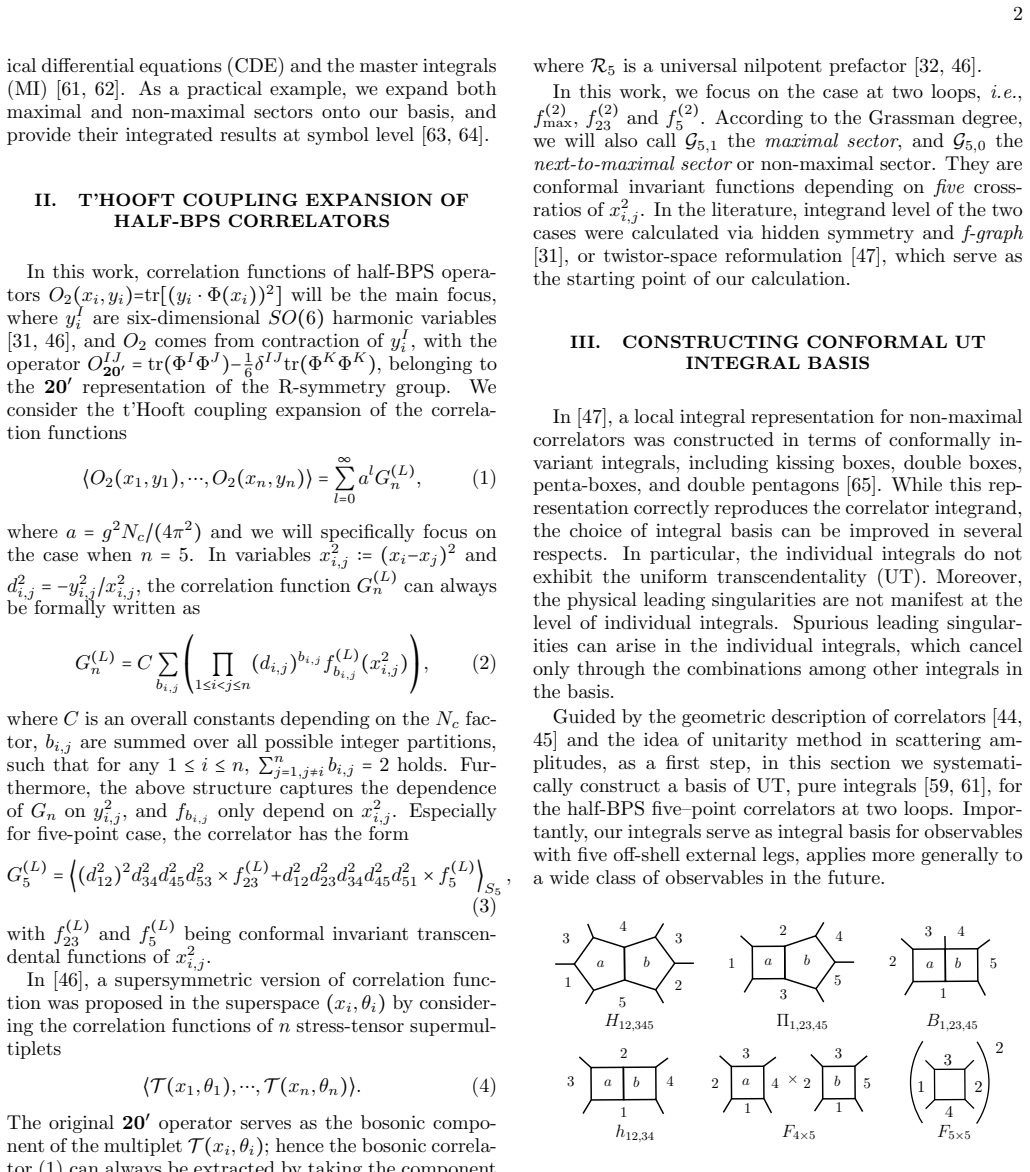
By diagonalizing leading singularities subject to conformal invariance, the authors obtain a basis of uniform-transcendental pure integrals that spans six distinct topologies and covers all five-point off-shell conformal integrals appearing in the two-loop half-BPS correlators.
What carries the argument
Diagonalization of leading singularities under conformal invariance to generate a basis of UT pure integrals across six topologies.
If this is right
- The integrated symbol-level results give explicit expressions for the two-loop five-point half-BPS correlators.
- This basis can be used to simplify computations of similar integrals in related theories or at higher orders.
- Mapping to known two-loop four-mass integral families allows reuse of existing computational tools.
- Both maximal and non-maximal sectors of the correlators are now accessible at symbol level.
Where Pith is reading between the lines
- If the basis is complete, it may extend to six-point or higher-point conformal integrals by similar diagonalization techniques.
- The symbol results could be used to extract physical information like OPE coefficients or check consistency with known bootstrap constraints.
- Generalizing the conformal frame fixing might reduce the number of independent integrals in other dimensions or signatures.
Load-bearing premise
The six topologies obtained by diagonalizing leading singularities under conformal invariance form a complete basis for all five-point off-shell conformal integrals that appear in the two-loop half-BPS correlators.
What would settle it
Finding a five-point off-shell conformal integral in the two-loop half-BPS correlator that cannot be expressed as a linear combination of the six topologies would show the basis is incomplete.
Figures


read the original abstract
We study five-point off-shell conformal integrals and the associated half-BPS correlation functions at two loops in the 't Hooft coupling expansion of maximally supersymmetric Yang-Mills theory. We construct a basis of uniform-transcendental (UT) pure integrals spanning six distinct topologies by diagonalizing leading singularities subject to conformal invariance. By fixing conformal frames, this basis can be mapped to known two-loop four-mass integral families. We then compute the integrated results by combining canonical differential equations with integration-by-parts reduction. As an application, we present symbol-level integrated results for the two-loop five-point half-BPS correlators, including both maximal and non-maximal sectors.
Editorial analysis
A structured set of objections, weighed in public.
Referee Report
Summary. This paper develops a basis for five-point off-shell conformal integrals at two loops by constructing six uniform-transcendental pure integrals through the diagonalization of leading singularities under conformal invariance constraints. The basis is mapped to standard two-loop four-mass integral families, and the authors derive symbol-level integrated expressions for the two-loop five-point half-BPS correlation functions in maximally supersymmetric Yang-Mills theory using canonical differential equations and integration-by-parts methods.
Significance. Should the six-topology basis prove complete, this manuscript would provide an important technical tool for computing conformal integrals and correlation functions at higher points and loops. The explicit results for the half-BPS correlators, including non-maximal sectors, contribute to the growing body of knowledge on multi-point functions in N=4 SYM, potentially aiding in checks of integrability and AdS/CFT predictions.
major comments (1)
- [Basis construction (as described in the abstract and main text)] The completeness of the six-topology UT basis is assumed without an explicit proof via vector space dimension counting or by demonstrating that a generic IBP reduction of five-point topologies yields masters that all reduce into this basis. If integrals without leading singularities or additional topologies are missed, the canonical DE solutions and symbol results for the correlators would be incomplete. This is a load-bearing assumption for the central claims.
Simulated Author's Rebuttal
We thank the referee for the positive assessment of our work and for the constructive comment on the basis construction. We address the concern directly below and will revise the manuscript to strengthen the justification.
read point-by-point responses
-
Referee: [Basis construction (as described in the abstract and main text)] The completeness of the six-topology UT basis is assumed without an explicit proof via vector space dimension counting or by demonstrating that a generic IBP reduction of five-point topologies yields masters that all reduce into this basis. If integrals without leading singularities or additional topologies are missed, the canonical DE solutions and symbol results for the correlators would be incomplete. This is a load-bearing assumption for the central claims.
Authors: We agree that an explicit demonstration of completeness strengthens the central claims. In the revised manuscript we will add a new subsection that enumerates the dimension of the vector space of two-loop five-point off-shell conformal integrals of uniform transcendental weight. We show that the only leading-singularity structures compatible with conformal invariance are those spanned by the six topologies obtained via our diagonalization procedure. We further verify, by explicit IBP reduction on a representative set of five-point topologies, that all masters reduce to linear combinations within this basis and that no additional UT integrals appear. This establishes that the canonical differential equations and the symbol-level results for the half-BPS correlators are complete. revision: yes
Circularity Check
No load-bearing circularity detected; basis construction and results rely on external mappings and standard IBP
full rationale
The derivation constructs a six-topology UT basis via diagonalization of leading singularities under conformal invariance, then maps the basis to known external two-loop four-mass integral families and applies canonical differential equations combined with standard IBP reduction. No central quantity is defined in terms of a fitted parameter from the same paper, no self-citation forms the load-bearing justification for completeness, and no step reduces by construction to its own inputs. The completeness of the basis for appearing integrals is asserted rather than dimensionally proven in the provided text, but this is an assumption about coverage rather than a definitional or fitted-input circularity. The overall chain remains self-contained against external benchmarks.
Axiom & Free-Parameter Ledger
axioms (2)
- domain assumption Conformal invariance constrains the allowed leading singularities of the five-point integrals.
- domain assumption The six topologies span the full space of five-point off-shell conformal integrals relevant to the half-BPS correlators.
Lean theorems connected to this paper
-
IndisputableMonolith/Cost/FunctionalEquation.leanwashburn_uniqueness_aczel unclear?
unclearRelation between the paper passage and the cited Recognition theorem.
We construct a basis of uniform-transcendental (UT) pure integrals spanning six distinct topologies by diagonalizing leading singularities subject to conformal invariance
-
IndisputableMonolith/Foundation/AlexanderDuality.leanalexander_duality_circle_linking unclear?
unclearRelation between the paper passage and the cited Recognition theorem.
By fixing conformal frames, this basis can be mapped to known two-loop four-mass integral families
What do these tags mean?
- matches
- The paper's claim is directly supported by a theorem in the formal canon.
- supports
- The theorem supports part of the paper's argument, but the paper may add assumptions or extra steps.
- extends
- The paper goes beyond the formal theorem; the theorem is a base layer rather than the whole result.
- uses
- The paper appears to rely on the theorem as machinery.
- contradicts
- The paper's claim conflicts with a theorem or certificate in the canon.
- unclear
- Pith found a possible connection, but the passage is too broad, indirect, or ambiguous to say the theorem truly supports the claim.
Reference graph
Works this paper leans on
-
[1]
J. M. Maldacena, Adv. Theor. Math. Phys.2, 231 (1998), arXiv:hep-th/9711200
work page internal anchor Pith review Pith/arXiv arXiv 1998
-
[2]
What is the Simplest Quantum Field Theory?
N. Arkani-Hamed, F. Cachazo, and J. Kaplan, JHEP 09, 016 (2010), arXiv:0808.1446 [hep-th]
work page internal anchor Pith review Pith/arXiv arXiv 2010
-
[3]
J. M. Drummond, J. Henn, G. P. Korchemsky, and E. Sokatchev, Nucl. Phys. B828, 317 (2010), arXiv:0807.1095 [hep-th]
work page internal anchor Pith review Pith/arXiv arXiv 2010
-
[4]
J. M. Drummond, J. M. Henn, and J. Plefka, JHEP05, 046 (2009), arXiv:0902.2987 [hep-th]
work page internal anchor Pith review Pith/arXiv arXiv 2009
-
[5]
L. F. Alday, B. Eden, G. P. Korchemsky, J. Maldacena, and E. Sokatchev, JHEP09, 123 (2011), arXiv:1007.3243 [hep-th]
work page internal anchor Pith review Pith/arXiv arXiv 2011
-
[6]
B. Eden, G. P. Korchemsky, and E. Sokatchev, JHEP 12, 002 (2011), arXiv:1007.3246 [hep-th]
work page internal anchor Pith review Pith/arXiv arXiv 2011
-
[7]
B. Eden, G. P. Korchemsky, and E. Sokatchev, Phys. Lett. B709, 247 (2012), arXiv:1009.2488 [hep-th]
work page internal anchor Pith review Pith/arXiv arXiv 2012
-
[8]
B. Eden, P. Heslop, G. P. Korchemsky, and E. Sokatchev, Nucl. Phys. B869, 329 (2013), arXiv:1103.3714 [hep-th]
work page internal anchor Pith review Pith/arXiv arXiv 2013
-
[9]
B. Eden, P. Heslop, G. P. Korchemsky, and E. Sokatchev, Nucl. Phys. B869, 378 (2013), arXiv:1103.4353 [hep-th]
work page internal anchor Pith review Pith/arXiv arXiv 2013
-
[10]
N. Arkani-Hamed, L. J. Dixon, A. J. McLeod, M. Spradlin, J. Trnka, and A. Volovich, (2022), arXiv:2207.10636 [hep-th]
- [11]
- [12]
-
[13]
K. A. Intriligator, Nucl. Phys. B551, 575 (1999), arXiv:hep-th/9811047
work page internal anchor Pith review Pith/arXiv arXiv 1999
-
[14]
Four point function of $\mathcal{N}=4$ stress-tensor multiplet at strong coupling
V. Gon¸ calves, JHEP04, 150 (2015), arXiv:1411.1675 [hep-th]
work page internal anchor Pith review Pith/arXiv arXiv 2015
-
[15]
V. Gon¸ calves, R. Pereira, and X. Zhou, JHEP10, 247 (2019), arXiv:1906.05305 [hep-th]
- [16]
-
[17]
V. Goncalves, M. Nocchi, and X. Zhou, JHEP06, 173 (2025), arXiv:2502.10269 [hep-th]
-
[18]
B. Fernandes, V. Goncalves, Z. Huang, Y. Tang, J. Vi- las Boas, and E. Y. Yuan, (2025), arXiv:2507.14124 [hep-th]
-
[19]
Perturbative Four-Point Functions In Planar N=4 SYM From Hexagonalization
F. Coronado, JHEP01, 056 (2019), arXiv:1811.00467 [hep-th]
work page internal anchor Pith review Pith/arXiv arXiv 2019
-
[20]
F. Coronado, Phys. Rev. Lett.124, 171601 (2020), arXiv:1811.03282 [hep-th]
-
[21]
Determinant formula for the octagon form factor in $\mathcal{N}$=4 SYM
I. Kostov, V. B. Petkova, and D. Serban, Phys. Rev. Lett.122, 231601 (2019), arXiv:1903.05038 [hep-th]
work page internal anchor Pith review Pith/arXiv arXiv 2019
- [22]
-
[23]
T. Fleury and V. Goncalves, JHEP07, 030 (2020), arXiv:2004.10867 [hep-th]
- [24]
- [25]
-
[26]
T. Bargheer, A. Bekov, C. Bercini, and F. Coronado, (2025), arXiv:2512.19780 [hep-th]. 7
-
[27]
Structure Constants and Integrable Bootstrap in Planar N=4 SYM Theory
B. Basso, S. Komatsu, and P. Vieira, (2015), arXiv:1505.06745 [hep-th]
work page internal anchor Pith review Pith/arXiv arXiv 2015
-
[28]
Tessellating cushions: four-point functions in N=4 SYM
B. Eden and A. Sfondrini, JHEP10, 098 (2017), arXiv:1611.05436 [hep-th]
work page internal anchor Pith review Pith/arXiv arXiv 2017
-
[29]
Hexagonalization of Correlation Functions
T. Fleury and S. Komatsu, JHEP01, 130 (2017), arXiv:1611.05577 [hep-th]
work page internal anchor Pith review Pith/arXiv arXiv 2017
-
[30]
Hexagonalization of Correlation Functions II: Two-Particle Contributions
T. Fleury and S. Komatsu, JHEP02, 177 (2018), arXiv:1711.05327 [hep-th]
work page internal anchor Pith review Pith/arXiv arXiv 2018
-
[31]
B. Eden, P. Heslop, G. P. Korchemsky, and E. Sokatchev, Nucl. Phys. B862, 193 (2012), arXiv:1108.3557 [hep-th]
work page internal anchor Pith review Pith/arXiv arXiv 2012
-
[32]
B. Eden, P. Heslop, G. P. Korchemsky, and E. Sokatchev, Nucl. Phys. B862, 450 (2012), arXiv:1201.5329 [hep-th]
work page internal anchor Pith review Pith/arXiv arXiv 2012
-
[33]
J. L. Bourjaily, P. Heslop, and V.-V. Tran, Phys. Rev. Lett.116, 191602 (2016), arXiv:1512.07912 [hep-th]
work page internal anchor Pith review Pith/arXiv arXiv 2016
-
[34]
J. L. Bourjaily, P. Heslop, and V.-V. Tran, JHEP11, 125 (2016), arXiv:1609.00007 [hep-th]
work page internal anchor Pith review Pith/arXiv arXiv 2016
- [35]
- [36]
-
[37]
Positive Geometries and Canonical Forms
N. Arkani-Hamed, Y. Bai, and T. Lam, JHEP11, 039 (2017), arXiv:1703.04541 [hep-th]
work page internal anchor Pith review Pith/arXiv arXiv 2017
-
[38]
E. Herrmann and J. Trnka, J. Phys. A55, 443008 (2022), arXiv:2203.13018 [hep-th]
-
[39]
N. Arkani-Hamed and J. Trnka, JHEP10, 030 (2014), arXiv:1312.2007 [hep-th]
work page internal anchor Pith review Pith/arXiv arXiv 2014
-
[40]
N. Arkani-Hamed and J. Trnka, JHEP12, 182 (2014), arXiv:1312.7878 [hep-th]
work page internal anchor Pith review Pith/arXiv arXiv 2014
- [41]
- [42]
-
[43]
B. Eden, P. Heslop, and L. Mason, JHEP09, 156 (2017), arXiv:1701.00453 [hep-th]
work page internal anchor Pith review Pith/arXiv arXiv 2017
- [44]
-
[45]
Leading singularities and chambers of Correlahedron
S. He, Y.-t. Huang, and C.-K. Kuo, (2025), arXiv:2505.09808 [hep-th]
work page internal anchor Pith review Pith/arXiv arXiv 2025
-
[46]
Correlation functions of the chiral stress-tensor multiplet in N=4 SYM
D. Chicherin, R. Doobary, B. Eden, P. Heslop, G. P. Korchemsky, L. Mason, and E. Sokatchev, JHEP06, 198 (2015), arXiv:1412.8718 [hep-th]
work page internal anchor Pith review Pith/arXiv arXiv 2015
-
[47]
T. Bargheer, T. Fleury, and V. Gon¸ calves, SciPost Phys. 15, 059 (2023), arXiv:2212.03773 [hep-th]
-
[48]
Higher-Point Correlators in N=4 SYM: Generating Functions
T. Bargheer, A. Bekov, C. Bercini, and F. Coronado, (2025), arXiv:2509.14332 [hep-th]
work page internal anchor Pith review Pith/arXiv arXiv 2025
-
[49]
A note on four-point functions of conformal operators in N=4 Super-Yang Mills
F. Gonzalez-Rey, I. Y. Park, and K. Schalm, Phys. Lett. B448, 37 (1999), arXiv:hep-th/9811155
work page internal anchor Pith review Pith/arXiv arXiv 1999
-
[50]
Anomalous dimensions in N=4 SYM theory at order g^4
M. Bianchi, S. Kovacs, G. Rossi, and Y. S. Stanev, Nucl. Phys. B584, 216 (2000), arXiv:hep-th/0003203
work page internal anchor Pith review Pith/arXiv arXiv 2000
-
[51]
The structure of n-point functions of chiral primary operators in N=4 super Yang-Mills at one-loop
N. Drukker and J. Plefka, JHEP04, 001 (2009), arXiv:0812.3341 [hep-th]
work page internal anchor Pith review Pith/arXiv arXiv 2009
-
[52]
Leading singularities and off-shell conformal integrals
J. Drummond, C. Duhr, B. Eden, P. Heslop, J. Pen- nington, and V. A. Smirnov, JHEP08, 133 (2013), arXiv:1303.6909 [hep-th]
work page internal anchor Pith review Pith/arXiv arXiv 2013
-
[53]
D. Chicherin, A. Georgoudis, V. Gon¸ calves, and R. Pereira, JHEP11, 069 (2018), arXiv:1809.00551 [hep- th]
-
[54]
B. Basso and L. J. Dixon, Phys. Rev. Lett.119, 071601 (2017), arXiv:1705.03545 [hep-th]
work page internal anchor Pith review Pith/arXiv arXiv 2017
-
[55]
C. Bercini, B. Fernandes, and V. Gon¸ calves, JHEP10, 242 (2024), arXiv:2401.06099 [hep-th]
- [56]
-
[57]
On Solving Dual Conformal Integrals in Coulomb-branch Amplitudes and Their Periods
S. He and X. Jiang, (2025), arXiv:2506.20095 [hep-th]
work page internal anchor Pith review Pith/arXiv arXiv 2025
- [58]
-
[59]
Local Integrals for Planar Scattering Amplitudes
N. Arkani-Hamed, J. L. Bourjaily, F. Cachazo, and J. Trnka, JHEP06, 125 (2012), arXiv:1012.6032 [hep- th]
work page internal anchor Pith review Pith/arXiv arXiv 2012
- [60]
-
[61]
J. M. Henn, Phys. Rev. Lett.110, 251601 (2013), arXiv:1304.1806 [hep-th]
work page internal anchor Pith review Pith/arXiv arXiv 2013
-
[62]
J. M. Henn, J. Phys. A48, 153001 (2015), arXiv:1412.2296 [hep-ph]
work page internal anchor Pith review Pith/arXiv arXiv 2015
-
[63]
A. B. Goncharov, M. Spradlin, C. Vergu, and A. Volovich, Phys. Rev. Lett.105, 151605 (2010), arXiv:1006.5703 [hep-th]
work page internal anchor Pith review Pith/arXiv arXiv 2010
-
[64]
C. Duhr, H. Gangl, and J. R. Rhodes, JHEP10, 075 (2012), arXiv:1110.0458 [math-ph]
work page internal anchor Pith review Pith/arXiv arXiv 2012
-
[65]
The integrand is represented by using its dual graph, where position-space points correspond to regions of the graph, and edges connecting adjacent regions represent propagators
-
[66]
J. L. Bourjaily, E. Herrmann, and J. Trnka, JHEP06, 059 (2017), arXiv:1704.05460 [hep-th]
work page internal anchor Pith review Pith/arXiv arXiv 2017
-
[67]
Having seven propagators, its maximal cut is called com- posite [59], and denoted as double red lines in (7)
-
[68]
We omit the possible iπ 2 factors in the measure d 4xa of integrals since they are not important for our discussion
-
[69]
N. I. Usyukina and A. I. Davydychev, Phys. Lett. B305, 136 (1993)
1993
-
[70]
Chen, Bull
K.-T. Chen, Bull. Am. Math. Soc.83, 831 (1977)
1977
-
[71]
Note that the class of d log-iterative integrals is strictly larger than the class of MPL functions
-
[72]
Kira - A Feynman Integral Reduction Program
P. Maierh¨ ofer, J. Usovitsch, and P. Uwer, Comput. Phys. Commun.230, 99 (2018), arXiv:1705.05610 [hep-ph]
work page internal anchor Pith review Pith/arXiv arXiv 2018
-
[73]
R. Morales, A. Spiering, M. Wilhelm, Q. Yang, and C. Zhang, Phys. Rev. Lett.131, 041601 (2023), arXiv:2212.09762 [hep-th]
-
[74]
A. Spiering, M. Wilhelm, and C. Zhang, Phys. Rev. Lett. 134, 071602 (2025), arXiv:2406.15549 [hep-th]
-
[75]
S. Caron-Huot and A.-K. Trinh, JHEP01, 196 (2019), arXiv:1809.09173 [hep-th]
work page internal anchor Pith review Pith/arXiv arXiv 2019
- [76]
-
[77]
S. Caron-Huot and F. Coronado, JHEP03, 151 (2022), arXiv:2106.03892 [hep-th]
-
[78]
S. Caron-Huot, F. Coronado, and B. M¨ uhlmann, JHEP 08, 008 (2023), arXiv:2304.12341 [hep-th]
- [79]
-
[80]
A. V. Belitsky, S. Hohenegger, G. P. Korchemsky, E. Sokatchev, and A. Zhiboedov, Nucl. Phys. B884, 206 (2014), arXiv:1309.1424 [hep-th]
work page internal anchor Pith review Pith/arXiv arXiv 2014
discussion (0)
Sign in with ORCID, Apple, or X to comment. Anyone can read and Pith papers without signing in.