Recognition: 1 theorem link
· Lean TheoremLangPrecip: Language-Aware Multimodal Precipitation Nowcasting
Pith reviewed 2026-05-16 19:09 UTC · model grok-4.3
The pith
Meteorological text descriptions constrain radar-based precipitation forecasts to achieve higher accuracy in heavy rain events.
A machine-rendered reading of the paper's core claim, the machinery that carries it, and where it could break.
Core claim
LangPrecip formulates short-term precipitation nowcasting as a semantically constrained trajectory generation problem under the Rectified Flow paradigm, enabling efficient integration of textual motion descriptions and radar information in latent space for physically consistent forecasts.
What carries the argument
Semantically constrained trajectory generation under the Rectified Flow paradigm that uses meteorological text as motion constraints on precipitation evolution.
If this is right
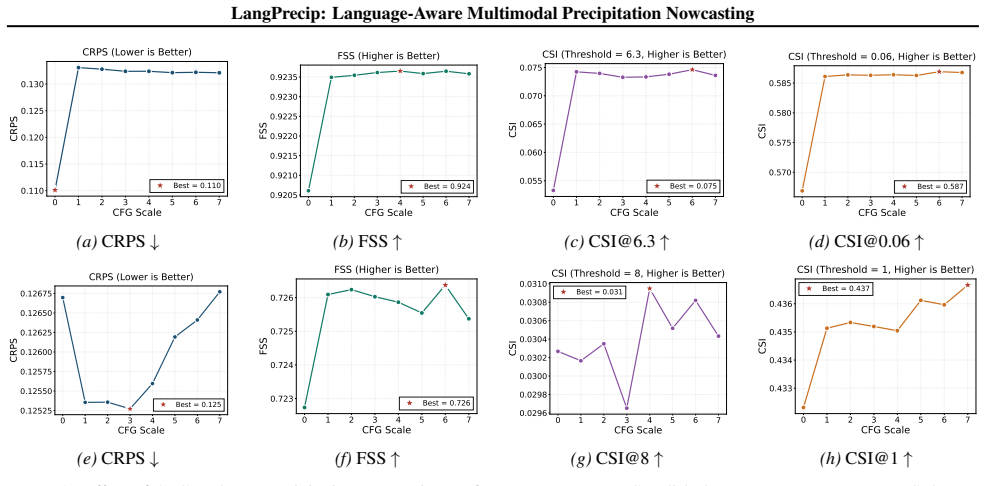
- Consistent improvements over state-of-the-art methods on Swedish and MRMS datasets.
- Over 60% gains in heavy-rainfall CSI at an 80-minute lead time on Swedish data.
- 19% gains in heavy-rainfall CSI at an 80-minute lead time on MRMS data.
- Introduction of the LangPrecip-160k dataset with paired radar sequences and text descriptions.
Where Pith is reading between the lines
- This approach could extend to other spatiotemporal prediction tasks like storm tracking where descriptive text is available.
- Textual constraints might allow effective forecasting even with lower-resolution radar inputs in resource-limited settings.
- Integration with real-time weather reports could enable dynamic updates to forecasts based on new textual observations.
Load-bearing premise
That the meteorological text descriptions accurately and sufficiently constrain future precipitation motion without introducing new ambiguities or biases that the model cannot resolve.
What would settle it
A controlled experiment showing that ablating the language input eliminates the reported CSI gains, or a dataset analysis revealing frequent mismatches between provided text and actual precipitation evolution, would falsify the claim.
Figures


read the original abstract
Short-term precipitation nowcasting is an inherently uncertain and under-constrained spatiotemporal forecasting problem, especially for rapidly evolving and extreme weather events. Existing generative approaches rely primarily on visual conditioning, leaving future motion weakly constrained and ambiguous. We propose a language-aware multimodal nowcasting framework(LangPrecip) that treats meteorological text as a semantic motion constraint on precipitation evolution. By formulating nowcasting as a semantically constrained trajectory generation problem under the Rectified Flow paradigm, our method enables efficient and physically consistent integration of textual and radar information in latent space.We further introduce LangPrecip-160k, a large-scale multimodal dataset with 160k paired radar sequences and motion descriptions. Experiments on Swedish and MRMS datasets show consistent improvements over state-of-the-art methods, achieving over 60 \% and 19\% gains in heavy-rainfall CSI at an 80-minute lead time.
Editorial analysis
A structured set of objections, weighed in public.
Referee Report
Summary. The paper proposes LangPrecip, a multimodal nowcasting framework that formulates short-term precipitation forecasting as semantically constrained trajectory generation under the Rectified Flow paradigm, using meteorological text descriptions as motion constraints on radar data. It introduces the LangPrecip-160k dataset of paired radar sequences and text descriptions, and reports consistent CSI improvements over SOTA baselines on Swedish and MRMS datasets, including >60% and >19% gains for heavy-rainfall CSI at 80-minute lead times.
Significance. If the central claim holds, the work would represent a meaningful advance in generative nowcasting by demonstrating that external language can supply physically consistent constraints that reduce ambiguity in visual-only models. The release of a large-scale multimodal dataset would also provide a useful resource for future research on text-conditioned spatiotemporal forecasting.
major comments (3)
- [Abstract / Experiments] Abstract and Experiments section: The headline CSI gains (over 60% on Swedish data and 19% on MRMS at 80 min lead time for heavy rainfall) are presented without ablation tables that isolate the language modality from added model capacity, without error bars or statistical significance tests, and without error analysis on failure cases. This prevents verification that the reported improvements stem from semantic motion constraints rather than other factors.
- [Dataset / Methods] Dataset and Methods sections: No description is given of text provenance, generation process, inter-annotator agreement, or quality metrics for the LangPrecip-160k motion descriptions. Without this, it is impossible to rule out data leakage from radar sequences or to confirm that the text is sufficiently specific to disambiguate velocity fields, growth/decay, or orographic effects as claimed.
- [Methods] Methods section: The text-radar alignment weight and flow rectification schedule are listed as free parameters, yet the paper asserts 'physically consistent' integration without showing how these parameters are chosen or whether the fusion remains robust when text descriptions contain ambiguities.
minor comments (2)
- [Methods] Notation for the Rectified Flow latent-space integration could be clarified with an explicit equation showing how text embeddings are injected into the velocity field.
- [Figures] Figure captions should explicitly label which panels show text-conditioned versus baseline predictions to aid comparison.
Simulated Author's Rebuttal
We thank the referee for the constructive and detailed feedback. We address each major comment below and will incorporate revisions to improve the clarity and verifiability of our claims.
read point-by-point responses
-
Referee: [Abstract / Experiments] Abstract and Experiments section: The headline CSI gains (over 60% on Swedish data and 19% on MRMS at 80 min lead time for heavy rainfall) are presented without ablation tables that isolate the language modality from added model capacity, without error bars or statistical significance tests, and without error analysis on failure cases. This prevents verification that the reported improvements stem from semantic motion constraints rather than other factors.
Authors: We agree that the current presentation does not sufficiently isolate the language contribution. In the revised manuscript we will add ablation tables comparing the full model against a capacity-matched vision-only baseline. We will also report standard deviations across multiple random seeds and include statistical significance tests (paired t-tests) on the CSI metrics at each lead time. Additionally, we will insert a dedicated error analysis subsection that examines representative failure cases, including instances of ambiguous text or weak radar signals, to clarify when semantic constraints provide the largest benefit. revision: yes
-
Referee: [Dataset / Methods] Dataset and Methods sections: No description is given of text provenance, generation process, inter-annotator agreement, or quality metrics for the LangPrecip-160k motion descriptions. Without this, it is impossible to rule out data leakage from radar sequences or to confirm that the text is sufficiently specific to disambiguate velocity fields, growth/decay, or orographic effects as claimed.
Authors: We will substantially expand the Dataset section. The motion descriptions were sourced from official meteorological reports and radar metadata provided by the Swedish Meteorological and Hydrological Institute and MRMS archives. Generation combined automated event parsing with expert human review to ensure descriptions capture motion, growth/decay, and orographic effects. In revision we will report the full provenance, the generation pipeline, inter-annotator agreement (Fleiss’ kappa on a sampled subset), and quality metrics such as keyword coverage for physical processes and a leakage audit confirming temporal but not content overlap with radar imagery. revision: yes
-
Referee: [Methods] Methods section: The text-radar alignment weight and flow rectification schedule are listed as free parameters, yet the paper asserts 'physically consistent' integration without showing how these parameters are chosen or whether the fusion remains robust when text descriptions contain ambiguities.
Authors: We will revise the Methods section to document the hyperparameter selection procedure: both the alignment weight and rectification schedule were chosen by grid search on a held-out validation set, optimizing for heavy-rain CSI while preserving trajectory smoothness. We will add a sensitivity analysis figure and accompanying text showing performance variation across reasonable ranges. To address robustness, we will include new experiments that deliberately introduce controlled ambiguities into the text (e.g., vague motion statements) and demonstrate that the rectified-flow formulation maintains physical consistency better than vision-only baselines. revision: yes
Circularity Check
No significant circularity; derivation relies on independent dataset and external Rectified Flow paradigm
full rationale
The paper's central claims rest on empirical CSI gains from a newly introduced LangPrecip-160k dataset paired with radar sequences and an external text encoder, formulated under the established Rectified Flow paradigm. No equations or steps reduce the reported predictions to fitted inputs by construction, nor do they depend on self-citations for uniqueness or ansatz smuggling. The multimodal fusion is presented as an additive constraint without definitional loops, and results are benchmarked against state-of-the-art methods on independent Swedish and MRMS datasets. This is a standard non-circular empirical contribution.
Axiom & Free-Parameter Ledger
free parameters (2)
- text-radar alignment weight
- flow rectification schedule
axioms (1)
- domain assumption Rectified flow produces physically plausible trajectories when conditioned on semantic embeddings
Lean theorems connected to this paper
-
IndisputableMonolith/Cost/FunctionalEquation.leanwashburn_uniqueness_aczel unclear?
unclearRelation between the paper passage and the cited Recognition theorem.
We formulate nowcasting as a semantically constrained trajectory generation problem under the Rectified Flow paradigm... minimizing the mean squared error L = E ||u(xt, cctx, t; θ) − vt||² where cctx = {X0:4, m} and m is a motion description
What do these tags mean?
- matches
- The paper's claim is directly supported by a theorem in the formal canon.
- supports
- The theorem supports part of the paper's argument, but the paper may add assumptions or extra steps.
- extends
- The paper goes beyond the formal theorem; the theorem is a base layer rather than the whole result.
- uses
- The paper appears to rely on the theorem as machinery.
- contradicts
- The paper's claim conflicts with a theorem or certificate in the canon.
- unclear
- Pith found a possible connection, but the passage is too broad, indirect, or ambiguous to say the theorem truly supports the claim.
Reference graph
Works this paper leans on
-
[1]
Terra: A multimodal spatio-temporal dataset spanning the earth
Chen, W., Hao, X., Wu, Y., and Liang, Y. Terra: A multimodal spatio-temporal dataset spanning the earth. In Advances in Neural Information Processing Systems, 2024
work page 2024
-
[2]
Chung, H. W., Hou, L., Longpre, S., Zoph, B., Tay, Y., Fedus, W., Li, Y., Wang, X., Dehghani, M., Brahma, S., et al. Scaling instruction-finetuned language models. Journal of Machine Learning Research, 25 0 (70): 0 1--53, 2024
work page 2024
-
[3]
Gao, Z., Shi, X., Wang, H., Zhu, Y., Wang, Y. B., Li, M., and Yeung, D.-Y. Earthformer: Exploring space-time transformers for earth system forecasting. Advances in Neural Information Processing Systems, 35: 0 25390--25403, 2022
work page 2022
-
[4]
Gao, Z., Shi, X., Han, B., Wang, H., Jin, X., Maddix, D., Zhu, Y., Li, M., and Wang, Y. B. Prediff: Precipitation nowcasting with latent diffusion models. Advances in Neural Information Processing Systems, 36: 0 78621--78656, 2023
work page 2023
-
[5]
Denoising diffusion probabilistic models
Ho, J., Jain, A., and Abbeel, P. Denoising diffusion probabilistic models. Advances in Neural Information Processing Systems, 33: 0 6840--6851, 2020
work page 2020
-
[6]
Imagen Video: High Definition Video Generation with Diffusion Models
Ho, J., Chan, W., Saharia, C., Whang, J., Gao, R., Gritsenko, A., Kingma, D. P., Poole, B., Norouzi, M., Fleet, D. J., et al. Imagen video: High definition video generation with diffusion models. arXiv preprint arXiv:2210.02303, 2022
work page internal anchor Pith review Pith/arXiv arXiv 2022
-
[7]
Precipitation nowcasting using diffusion transformer with causal attention
Li, C., Ling, X., Xue, Y., Luo, W., Zhu, L., Qin, F., Zhou, Y., and Huang, Y. Precipitation nowcasting using diffusion transformer with causal attention. IEEE Transactions on Geoscience and Remote Sensing, 2024
work page 2024
-
[8]
Alphapre: Amplitude-phase disentanglement model for precipitation nowcasting
Lin, K., Zhang, B., Yu, D., Feng, W., Chen, S., Gao, F., Li, X., and Ye, Y. Alphapre: Amplitude-phase disentanglement model for precipitation nowcasting. In Proceedings of the Computer Vision and Pattern Recognition Conference, pp.\ 17841--17850, 2025
work page 2025
-
[9]
Two-stage rainfall-forecasting diffusion model
Ling, X., Li, C., Qin, F., Zhu, L., and Huang, Y. Two-stage rainfall-forecasting diffusion model. IEEE Geoscience and Remote Sensing Letters, 21: 0 1--5, 2024 a
work page 2024
-
[10]
Ling, X., Li, C., Zhu, L., Qin, F., Zhu, P., and Huang, Y. Spacetime separable latent diffusion model with intensity structure information for precipitation nowcasting. IEEE Transactions on Geoscience and Remote Sensing, 2024 b
work page 2024
-
[11]
Flow Matching for Generative Modeling
Lipman, Y., Chen, R. T., Ben-Hamu, H., Nickel, M., and Le, M. Flow matching for generative modeling. arXiv preprint arXiv:2210.02747, 2022
work page internal anchor Pith review Pith/arXiv arXiv 2022
-
[12]
Flow Straight and Fast: Learning to Generate and Transfer Data with Rectified Flow
Liu, X., Gong, C., and Liu, Q. Flow straight and fast: Learning to generate and transfer data with rectified flow. arXiv preprint arXiv:2209.03003, 2022
work page internal anchor Pith review Pith/arXiv arXiv 2022
-
[13]
Ssrf-net: A stagewise scheduled rainfall forecasting network with an asymmetric architecture
Luo, W., Li, C., Ling, X., Deng, C., and Wang, Z. Ssrf-net: A stagewise scheduled rainfall forecasting network with an asymmetric architecture. IEEE Transactions on Geoscience and Remote Sensing, 63: 0 1--18, 2025
work page 2025
-
[14]
Latte: Latent diffusion transformer for video generation
Ma, X., Wang, Y., Chen, X., Jia, G., Liu, Z., Li, Y.-F., Chen, C., and Qiao, Y. Latte: Latent diffusion transformer for video generation. Transactions on Machine Learning Research, 2025
work page 2025
-
[15]
Chaosbench: A multi-channel, physics-based benchmark for subseasonal-to-seasonal climate prediction
Nathaniel, J., Qu, Y., Nguyen, T., Yu, S., Busecke, J., Grover, A., and Gentine, P. Chaosbench: A multi-channel, physics-based benchmark for subseasonal-to-seasonal climate prediction. arXiv preprint arXiv:2402.00712, 2024
-
[16]
Open-Sora 2.0: Training a Commercial-Level Video Generation Model in $200k
Peng, X., Zheng, Z., Shen, C., Young, T., Guo, X., Wang, B., Xu, H., Liu, H., Jiang, M., Li, W., et al. Open-sora 2.0: Training a commercial-level video generation model in 200 k. arXiv preprint arXiv:2503.09642, 2025
work page internal anchor Pith review Pith/arXiv arXiv 2025
-
[17]
A., Velasco-Forero, C., Seed, A., Germann, U., and Foresti, L
Pulkkinen, S., Nerini, D., P \'e rez Hortal, A. A., Velasco-Forero, C., Seed, A., Germann, U., and Foresti, L. Pysteps: An open-source python library for probabilistic precipitation nowcasting (v1. 0). Geoscientific Model Development, 12 0 (10): 0 4185--4219, 2019
work page 2019
-
[18]
Skilful precipitation nowcasting using deep generative models of radar
Ravuri, S., Lenc, K., Willson, M., Kangin, D., Lam, R., Mirowski, P., Fitzsimons, M., Athanassiadou, M., Kashem, S., Madge, S., et al. Skilful precipitation nowcasting using deep generative models of radar. Nature, 597 0 (7878): 0 672--677, 2021 a
work page 2021
-
[19]
Skilful precipitation nowcasting using deep generative models of radar
Ravuri, S., Willson, M., and et al. Skilful precipitation nowcasting using deep generative models of radar. Nature, 597(7878): 0 672--677, 2021 b
work page 2021
-
[20]
Convolutional lstm network: A machine learning approach for precipitation nowcasting
Shi, X., Chen, Z., Wang, H., Yeung, D.-Y., and Wong, W.-K. Convolutional lstm network: A machine learning approach for precipitation nowcasting. Advances in neural information processing systems, 28, 2015
work page 2015
-
[21]
Wan: Open and Advanced Large-Scale Video Generative Models
Wan, T., Wang, A., Ai, B., Wen, B., Mao, C., Xie, C.-W., Chen, D., Yu, F., Zhao, H., Yang, J., et al. Wan: Open and advanced large-scale video generative models. arXiv preprint arXiv:2503.20314, 2025
work page internal anchor Pith review Pith/arXiv arXiv 2025
-
[22]
Rainhcnet: Hybrid high-low frequency and cross-scale network for precipitation nowcasting
Wang, L., Wang, Z., Hu, W., and Bai, C. Rainhcnet: Hybrid high-low frequency and cross-scale network for precipitation nowcasting. IEEE Journal of Selected Topics in Applied Earth Observations and Remote Sensing, 2025 a
work page 2025
-
[23]
Nowcasting echo top for aviation operations using cnn-transformer
Wang, S., Sun, M., and Li, Y. Nowcasting echo top for aviation operations using cnn-transformer. IEEE Transactions on Intelligent Transportation Systems, 2025 b
work page 2025
-
[24]
Lavie: High-quality video generation with cascaded latent diffusion models
Wang, Y., Chen, X., Ma, X., Zhou, S., Huang, Z., Wang, Y., Yang, C., He, Y., Yu, J., Yang, P., et al. Lavie: High-quality video generation with cascaded latent diffusion models. International Journal of Computer Vision, 133 0 (5): 0 3059--3078, 2025 c
work page 2025
-
[25]
Diffcast: A unified framework via residual diffusion for precipitation nowcasting
Yu, D., Li, X., Ye, Y., Zhang, B., Luo, C., Dai, K., Wang, R., and Chen, X. Diffcast: A unified framework via residual diffusion for precipitation nowcasting. In Proceedings of the IEEE/CVF Conference on Computer Vision and Pattern Recognition, pp.\ 27758--27767, 2024
work page 2024
-
[26]
Open-Sora: Democratizing Efficient Video Production for All
Zheng, Z., Peng, X., Yang, T., Shen, C., Li, S., Liu, H., Zhou, Y., Li, T., and You, Y. Open-sora: Democratizing efficient video production for all. arXiv preprint arXiv:2412.20404, 2024
work page internal anchor Pith review Pith/arXiv arXiv 2024
-
[27]
" write newline "" before.all 'output.state := FUNCTION n.dashify 't := "" t empty not t #1 #1 substring "-" = t #1 #2 substring "--" = not "--" * t #2 global.max substring 't := t #1 #1 substring "-" = "-" * t #2 global.max substring 't := while if t #1 #1 substring * t #2 global.max substring 't := if while FUNCTION format.date year duplicate empty "emp...
discussion (0)
Sign in with ORCID, Apple, or X to comment. Anyone can read and Pith papers without signing in.