REVIEW 3 major objections 5 minor 2 cited by
Higgs-like inflation in scalar-torsion gravity remains viable under the latest Planck, ACT, DESI, and BICEP/Keck constraints, predicting a scalar spectral index ns≈0.968–0.977 and a tensor-to-scalar ratio r≈0.009–0.039.
Reviewed by Pith at T0; open to challenge. T0 means a machine referee read the full paper against a public rubric. the ladder, T0–T4 →
T0 review · deepseek-v4-flash
2026-08-03 13:19 UTC pith:SDUVJLGK
load-bearing objection Plausible framework, timely topic, but the printed analytic formulas contradict the paper's own tables, and the slow-roll claims are at odds with its own figures. the 3 major comments →
Higgs-like inflation in scalar-torsion f(T,φ) gravity in light of ACT-SPT-DESI constraints
The pith
A machine-rendered reading of the paper's core claim, the machinery that carries it, and where it could break.
Core claim
The core claim is that Higgs-like inflation in the general scalar-torsion f(T,φ) framework remains compatible with the tightest available CMB and large-scale-structure constraints. In the dominant-coupling regime, where the scalar-torsion interaction dominates over the Einstein-Hilbert term, the authors obtain analytical formulas for ns(N), r(N), and the running αs(N). For 50–60 e-folds and suitable choices of the parameters c, s, and γ, the model predicts ns≈0.968–0.977 and r≈0.009–0.039, which falls inside the 68% confidence contour of the combined Planck 2018, ACT DR6, DESI DR1, and BICEP/Keck datasets. Numerical integration of the slow-roll equations beyond the dominant-coupling approxim
What carries the argument
The central object is the scalar-torsion action f(T,ϕ)=−M_Pl²T/2−G(T)F(ϕ)−V(ϕ) with a power-law ansatz G(T)∼T^s, a Higgs-like coupling F(ϕ)=ξϕ^c, and the quartic potential V(ϕ)=λ(ϕ²−ν²)²/4. In the dominant-coupling (high-energy) regime, where T≪|GF|C(T)/M_Pl², the slow-roll equations simplify to yield closed-form relations between the number of e-folds N and the observables ns and r, together with explicit expressions for the couplings λ and ξ fixed by the observed amplitude of scalar perturbations. The key mechanism is the torsion-induced correction 2ηR in the scalar spectral index and the modified consistency relation in the tensor sector, which shift predictions relative to curvature-base
Load-bearing premise
The entire comparison with observations rests on the scalar and tensor power spectra taken from previous work by the same group, and on the validity of the slow-roll approximation at horizon crossing; the paper itself shows ηR reaching values well above unity near the end of inflation, so slow-roll may not hold throughout the full trajectory.
What would settle it
A future CMB experiment that measures r with precision σ(r)∼10⁻³ would decisively test the model: if r is found to exceed the predicted upper envelope of about 0.04 at N=60, or if ns is measured outside the 0.968–0.977 band at high significance, the scalar-torsion Higgs scenario would be excluded. Additionally, a full numerical integration of the background and perturbation equations without the slow-roll approximation, using the same action, would reveal whether the analytic spectra remain accurate when ηR becomes large.
If this is right
- If the model is correct, the upward shift of ns to ≈0.974 preferred by ACT and DESI is no longer an obstacle for Higgs-type inflation; torsion corrections naturally raise ns relative to plateau models.
- The predicted tensor-to-scalar ratio r≈0.009–0.039 lies within reach of upcoming CMB polarization experiments like Simons Observatory, CMB-S4, and LiteBIRD, providing a concrete observational test.
- The modified consistency relation r=8(−nT−3δ_{f,T}) implies that a measurement of r and nT together could distinguish torsion-based inflation from standard single-field inflation.
- The model fixes the effective self-coupling λ at roughly 10⁻¹⁵ and the nonminimal coupling ξ at order 0.1–0.01 in the numerically explored range, which can be compared with particle-physics expectations for a Higgs-like field.
- The running of the scalar spectral index αs is predicted to be negative and of order −(4 to −6)×10⁻⁴, a small but potentially measurable signature.
Where Pith is reading between the lines
- If future data continue to push ns toward 1, the allowed parameter space shrinks to a narrow band near c≈0.25 and s≈0.51–0.55, which may indicate fine-tuning; a precision measurement of ns beyond current errors would reveal how much tuning is needed.
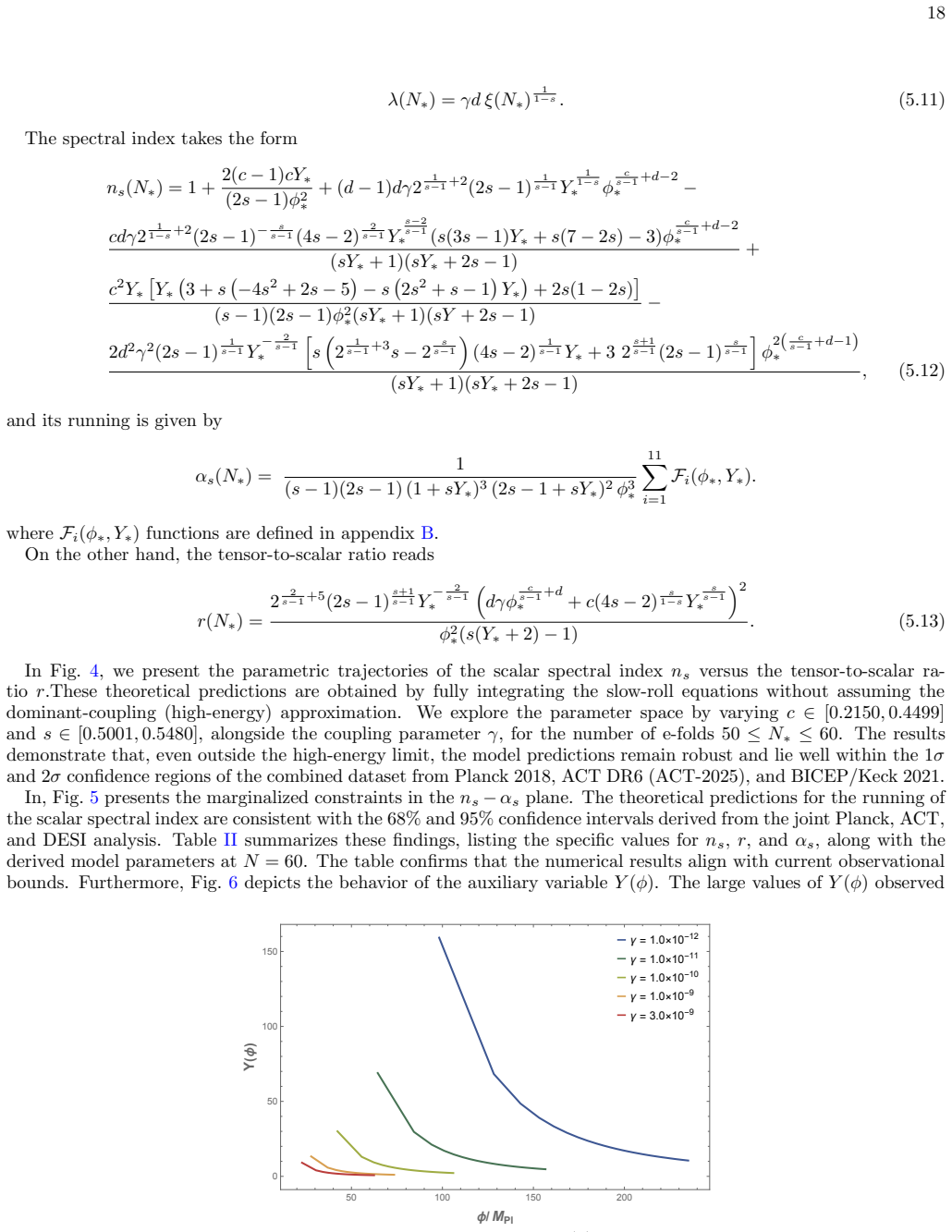
- The dominant-coupling regime involves trans-Planckian field values (ϕ∼100 M_Pl as shown in Fig. 6), which raises effective-field-theory concerns; the authors' unitarity discussion for a generic Higgs-like inflaton may not fully settle whether the slow-roll trajectory can be consistently embedded in a UV-complete theory.
- The paper leaves open the computation of non-Gaussianities and reheating dynamics within this scalar-torsion framework; those extensions could provide additional, independent observational signatures.
- Because the power spectra are imported from earlier work, a direct re-derivation of P_s(k) and P_T(k) from the second-order action—without the slow-roll truncation—would be a natural check of the robustness of the claimed compatibility.
Editorial analysis
A structured set of objections, weighed in public.
Referee Report
Summary. The paper studies Higgs-like inflation in scalar-torsion f(T,φ) gravity with action (2.13), specializing to G(T) ∼ T^s, F(φ)=ξφ^c and a quartic symmetry-breaking potential (Sec. IV). Working in the slow-roll approximation and using primordial spectra taken from the authors’ earlier papers [70,73], it derives closed-form expressions for n_s, α_s and r in the dominant-coupling regime (Eqs. 4.11–4.13), and then numerically integrates the slow-roll equations beyond that regime (Sec. V). The predictions are compared with Planck, ACT DR6, DESI DR1 and BICEP/Keck constraints, and the paper concludes that Higgs-like inflation in f(T,φ) gravity is fully consistent with current bounds and naturally accommodates the upward shift in n_s.
Significance. If the results were correct, this would be a useful contribution: it would show that a torsion-based modified-gravity inflationary model remains viable under the updated n_s–r constraints and offers distinctive tensor-sector and running predictions. The manuscript is clearly organized, provides explicit tables (Tables I–II) and goes beyond the dominant-coupling approximation numerically. However, the central numerical claims are not reproducible from the printed analytic formulas, and the slow-roll consistency of the calculation is not established. The claimed consistency with ACT-SPT-DESI data is therefore not yet supported.
major comments (3)
- [§IV, Table I, Eqs. (4.11)–(4.13)] Direct substitution of Table I inputs into the printed formulas does not reproduce the table. For c=0.2479, s=0.5110, N_*=60, Eq. (4.13) with \tilde d from (4.7) gives r≈0.058, while Table I lists r=0.0164. Moreover, Eq. (4.11) has an explicit 1/N_* dependence, yet Table I lists identical n_s values at N=50 and N=60 for every parameter row (e.g. 0.9708 in both columns for c=0.2479); Table II shows the same pattern. This indicates that the analytic formulas are not the expressions used to generate the tables and figures that support the abstract’s consistency claim. The mismatch must be resolved, not only cosmetically, because the headline numbers (n_s≈0.968–0.977, r≈0.009–0.039) all rest on these calculations.
- [§V, Fig. 7; §III.A, Eqs. (3.9)–(3.16)] The scalar and tensor power spectra used for n_s and r are first-order slow-roll expressions valid only for |η_R|≪1. Figure 7 shows η_R reaching values around 12 near N=0, and Fig. 3 also shows η_R exceeding unity, while the text and captions repeatedly assert that ϵ,|η_R|≪1. Because the number of e-folds N_* is computed by integrating the slow-roll equations from N=0, a region with |η_R|≫1 affects the resulting φ(N_*) and hence the horizon-crossing predictions. The authors need to show that this region is irrelevant to the quoted observables, or re-derive the spectra beyond first order in slow roll.
- [§IV–V, Figs. 1 and 4] The central statement that the model is “fully consistent” with Planck/ACT/DESI/BICEP-Keck rests on visually comparing hand-selected curves with contour plots. The parameters c, s, γ and N_* are varied freely, and no likelihood, χ², or posterior is computed. With several free parameters, the existence of points inside a 68% contour is not a statistical test of consistency. A quantitative comparison (even a simple χ² or profile likelihood) and a statement of which parameter region is observationally allowed are needed before the consistency claim can be evaluated.
minor comments (5)
- [Title/Abstract] The title says ACT-SPT-DESI constraints, and the Introduction cites SPT-3G [9], but the combined constraints used in the analysis are Planck, ACT DR6, DESI BAO and BICEP/Keck. Please clarify the role of SPT data.
- [Fig. 2 caption] The caption states “The blue contours show results from Planck 2018 … while the blue contours represent the joint constraints”; the second instance should presumably be “orange”.
- [§V and Fig. 7] The caption and text assert that ϵ and η_R remain “much smaller than unity,” but the plotted η_R axis reaches 12. The caption must be corrected to match the figure, and the discussion should address the large-η_R region near N=0.
- [Eq. (4.12)] The running α_s is written as the same negative bracket divided by N_*^2. If n_s−1 ≈ −A/N_*, then d(n_s−1)/dN = A/N_*^2, so the sign appears inconsistent with Eq. (4.11); please check this relation.
- [Various] Typographical errors include “regieme” (p.17), “unitaity” (p.21), “throught” (p.17), and “Fig. ,Fig. 2” (p.14). Please proofread.
Circularity Check
No significant circularity: the inflationary observables are derived from stated general power spectra and compared with external data; parameter scanning and slow-roll concerns are correctness issues, not definitional input-output equivalence.
full rationale
The derivation chain is not circular. The inflationary observables follow from the general scalar/tensor power spectra (Eqs. 2.45-2.57 and 3.9-3.16), which are imported from refs. [70,73] by overlapping authors. This is a self-citation and it is load-bearing for the numbers, but the cited results are general, parameter-free slow-roll spectra with stated assumptions (uniform-field gauge, linear perturbations, slow-roll truncation), not fits to the target observables; under the review rules such citations count as independent evidence rather than circularity. The paper also sketches the perturbation action from which those spectra arise. The subsequent Higgs-like specialization (quartic potential, F = xi phi^c, G ~ T^s) is algebra from those spectra, not a renaming of the input. lambda is fixed by the Planck scalar amplitude, while ns and r depend on c,s,N and are compared with external Planck/ACT/DESI/BICEP contours; scanning c,s,gamma is standard parameter-space exploration. The 'consistent with data' claim is an existence proof with tuned parameters rather than a sharp out-of-sample prediction, which weakens its force, but that is not a definitional circularity. Two correctness flags should be kept separate from circularity: the text asserts |eta_R| << 1 while its own Fig. 7 shows eta_R up to ~12 near N=0 (and Fig. 3 up to ~1.4), questioning slow-roll validity; and Eq. (4.13) evaluated with Table I inputs (c=0.1100, s=0.5110, N=60) gives r ~ 0.029 versus the listed 0.0092. The paper also states in Sec. IV that phi is not the SM Higgs, limiting the 'Higgs-like' label. None of these exhibits a predicted quantity equal by construction to a fitted input.
Axiom & Free-Parameter Ledger
free parameters (4)
- c =
0.1100–0.3857 (analytic); 0.2150–0.4499 (numerical)
- s =
0.5005–0.5495
- γ =
1e-12 to 3e-9
- N* =
50–60
axioms (5)
- domain assumption The power spectra of curvature and tensor perturbations in f(T,φ) gravity, Eqs. (2.45)–(2.57) and (3.9)–(3.16), are correct
- domain assumption The slow-roll approximation is valid at horizon crossing for the parameter ranges explored
- domain assumption The Higgs-like potential V(φ)=λ/4(φ^2−ν^2)^2 with ν negligible in the large-field regime φ^2≫ν^2
- ad hoc to paper The power-law forms G(T)=T^s and F(φ)=ξφ^c with s>1/2
- domain assumption The dominant-coupling (high-energy) regime condition T≪|G(T)F(φ)C(T)|/M_Pl^2
read the original abstract
We study Higgs-like inflation in the framework of scalar-torsion gravity, focusing on the general class of $f(T,\phi)$ theories in which gravitation is mediated by torsion rather than curvature. Motivated by the increasing precision of cosmic microwave background and large-scale-structure observations, we examine whether Higgs-like inflation remains compatible with current data in this extended gravitational setting. Working within the slow-roll approximation, we analyze the inflationary dynamics both analytically and numerically. In the dominant-coupling regime we derive closed-form expressions for the scalar spectral index and the tensor-to-scalar ratio as functions of the number of e-folds, and we subsequently relax this assumption by numerically solving the slow-roll equations. Confrontation with the latest constraints from Planck 2018, ACT DR6, DESI DR1, and BICEP/Keck shows that Higgs-like inflation in $f(T,\phi)$ gravity is fully consistent with current bounds, naturally accommodating the preferred shift in the scalar spectral index and leading to distinctive tensor-sector signatures.
Figures



Forward citations
Cited by 2 Pith papers
-
Reviving Motivated Inflationary Potentials with $K$-inflation in the light of ACT
K-inflation with non-canonical kinetic term G(φ) shifts α-attractor T-models and natural inflation into the Planck-ACT-LB-BK18 allowed region while satisfying Swampland conjectures and producing testable GW spectra.
-
Primordial black hole production in scalar field inflation within $f(T)$ gravity
In f(T) gravity with power-law and exponential models, a fiber inflation potential with ultra slow-roll phase amplifies the primordial curvature power spectrum on small scales to enable primordial black hole formation...
Reference graph
Works this paper leans on
-
[1]
Background evolution We begin by considering the homogeneous and isotropic cosmological background relevant for inflationary dynamics. In particular, we impose the standard flat Friedmann-Robertson-Walker (FR W) geometry by choosing the diagonal (proper) tetrad eA µ = diag(1, a, a, a),(2.17) and the zero spin connectionω A Bµ = 0 [60], which corresponds t...
-
[2]
1 + 1 + δf X δP X δf X δf ˙H # ,(3.10) = 2 M 2 P lT 2
Second order action and linear perturbations We now turn to the study of linear cosmological perturbations and the derivation of the second-order action governing the dynamics of primordial fluctuations. This analysis allows us to determine the scalar and tensor power spectra generated during inflation within scalar-torsionf(T, ϕ) gravity, and to identify...
2018
-
[3]
A. A. Starobinsky, Phys. Lett. B91, 99 (1980)
1980
-
[4]
A. H. Guth, Phys. Rev. D23, 347 (1981)
1981
-
[5]
Albrecht and P
A. Albrecht and P. J. Steinhardt, Phys. Rev. Lett.48, 1220 (1982)
1982
-
[6]
A. D. Linde, Phys. Lett. B108, 389 (1982)
1982
-
[7]
Weinberg,Cosmology(Oxford Univ
S. Weinberg,Cosmology(Oxford Univ. Press, 2008), ISBN 978-0-19-852682-7
2008
-
[8]
Baumann, PoST ASI2017, 009 (2018), 1807.03098
D. Baumann, PoST ASI2017, 009 (2018), 1807.03098
Pith/arXiv arXiv 2018
-
[9]
Y. Akrami et al. (Planck), Astron. Astrophys.641, A10 (2020), 1807.06211
Pith/arXiv arXiv 2020
-
[10]
P. A. R. Ade et al. (BICEP/Keck), Phys. Rev. Lett.127, 151301 (2021), 2110.00483
arXiv 2021
- [11]
-
[12]
T. Louis et al. (Atacama Cosmology Telescope), JCAP11, 062 (2025), 2503.14452
Pith/arXiv arXiv 2025
-
[13]
E. Calabrese et al. (Atacama Cosmology Telescope), JCAP11, 063 (2025), 2503.14454
Pith/arXiv arXiv 2025
-
[14]
M. Kamionkowski and E. D. Kovetz, Ann. Rev. Astron. Astrophys.54, 227 (2016), 1510.06042
Pith/arXiv arXiv 2016
-
[15]
P. D. Meerburg, R. Hloˇ zek, B. Hadzhiyska, and J. Meyers, Phys. Rev. D91, 103505 (2015), 1502.00302
Pith/arXiv arXiv 2015
- [16]
-
[17]
K. N. Abazajian et al. (CMB-S4) (2016), 1610.02743. 25
Pith/arXiv arXiv 2016
- [18]
-
[19]
P. Auclair et al. (LISA Cosmology Working Group), Living Rev. Rel.26, 5 (2023), 2204.05434
Pith/arXiv arXiv 2023
-
[20]
S. Kawamura et al., Prog. Theor. Exp. Phys.2021, 05A105 (2021), 2006.13545
Pith/arXiv arXiv 2021
-
[21]
R. Abbott et al. (LIGO Scientific, VIRGO, KAGRA), Phys. Rev. Lett.129, 061104 (2022), 2109.12197
Pith/arXiv arXiv 2022
-
[22]
H. Niikura, M. Takada, S. Yokoyama, T. Sumi, and S. Masaki, Phys. Rev. D99, 083503 (2019), 1901.07120
Pith/arXiv arXiv 2019
-
[23]
V. Takhistov, G. M. Fuller, and A. Kusenko, Phys. Rev. Lett.126, 071101 (2021), 2008.12780
Pith/arXiv arXiv 2021
-
[24]
S. Clark, B. Dutta, Y. Gao, L. E. Strigari, and S. Watson, Phys. Rev. D95, 083006 (2017), 1612.07738
Pith/arXiv arXiv 2017
-
[25]
Y. Ali-Ha ¨ ımoud and M. Kamionkowski, Phys. Rev. D95, 043534 (2017), 1612.05644
Pith/arXiv arXiv 2017
-
[26]
J. Fardeen, P. McGill, S. E. Perkins, W. A. Dawson, N. S. Abrams, J. R. Lu, M.-F. Ho, and S. Bird, Astrophys. J.965, 138 (2024), 2312.13249
Pith/arXiv arXiv 2024
-
[27]
O. Mena, S. Palomares-Ruiz, P. Villanueva-Domingo, and S. J. Witte, Phys. Rev. D100, 043540 (2019), 1906.07735
Pith/arXiv arXiv 2019
-
[28]
M.-L. Zhao, Y. Shao, S. Wang, and X. Zhang, arXiv e-prints (2025), 2507.02651
arXiv 2025
- [29]
- [30]
- [31]
- [32]
- [33]
- [34]
-
[35]
C. Germani, N. Kudryashova, and Y. Watanabe, JCAP08, 015 (2016), 1512.06344
Pith/arXiv arXiv 2016
-
[36]
J. Beltran Jimenez, L. Heisenberg, R. Kase, R. Namba, and S. Tsujikawa, Phys. Rev. D95, 063533 (2017), 1702.01193
Pith/arXiv arXiv 2017
-
[37]
L. Sebastiani, S. Myrzakul, and R. Myrzakulov, Eur. Phys. J. Plus132, 433 (2017), 1702.00064
Pith/arXiv arXiv 2017
-
[38]
V. K. Oikonomou and F. P. Fronimos, Class. Quant. Grav.38, 035013 (2021), 2006.05512
Pith/arXiv arXiv 2021
-
[39]
P. Chen, S. Koh, and G. Tumurtushaa (2021), 2107.08638
Pith/arXiv arXiv 2021
-
[40]
V. K. Oikonomou and F. P. Fronimos, Nucl. Phys. B971, 115522 (2021), 2108.10841
Pith/arXiv arXiv 2021
- [41]
-
[42]
R. Kallosh, A. Linde, and D. Roest, Phys. Rev. Lett.135, 161001 (2025), 2503.21030
Pith/arXiv arXiv 2025
- [43]
-
[44]
S. Chatrchyan et al. (CMS), Phys. Lett. B716, 30 (2012), 1207.7235
Pith/arXiv arXiv 2012
-
[45]
Fakir and W
R. Fakir and W. G. Unruh, Phys. Rev. D41, 1783 (1990)
1990
-
[46]
F. L. Bezrukov and M. Shaposhnikov, Phys. Lett. B659, 703 (2008), 0710.3755
Pith/arXiv arXiv 2008
-
[47]
F. Bezrukov, A. Magnin, M. Shaposhnikov, and S. Sibiryakov, JHEP01, 016 (2011), 1008.5157
Pith/arXiv arXiv 2011
- [48]
- [49]
-
[50]
C. Germani and A. Kehagias, Phys. Rev. Lett.105, 011302 (2010), 1003.2635
Pith/arXiv arXiv 2010
-
[51]
S. Karydas, E. Papantonopoulos, and E. N. Saridakis, Phys. Rev. D104, 023530 (2021), 2102.08450
Pith/arXiv arXiv 2021
-
[52]
J. Han, H. M. Lee, and J.-H. Song, arXiv e-prints (2025), 2506.21189
Pith/arXiv arXiv 2025
-
[53]
I. D. Gialamas, A. Karam, A. Racioppi, and M. Raidal, arXiv e-prints (2025), 2504.06002
arXiv 2025
-
[54]
S. Aoki, H. Otsuka, and R. Yanagita, Phys. Rev. D112, 043505 (2025), 2504.01622
Pith/arXiv arXiv 2025
-
[55]
Y.-F. Cai, S. Capozziello, M. De Laurentis, and E. N. Saridakis, Rept. Prog. Phys.79, 106901 (2016), 1511.07586
Pith/arXiv arXiv 2016
-
[56]
Einstein, Sitz
A. Einstein, Sitz. Preuss. Akad. Wiss217(1928)
1928
- [57]
-
[58]
R. Ferraro and F. Fiorini, Phys. Rev.D75, 084031 (2007), gr-qc/0610067
Pith/arXiv arXiv 2007
-
[59]
E. V. Linder, Phys. Rev.D81, 127301 (2010), 1005.3039
Pith/arXiv arXiv 2010
-
[60]
T. Harko, F. S. N. Lobo, G. Otalora, and E. N. Saridakis, Phys. Rev. D89, 124036 (2014), 1404.6212
Pith/arXiv arXiv 2014
-
[61]
T. Harko, F. S. N. Lobo, G. Otalora, and E. N. Saridakis, JCAP12, 021 (2014), 1405.0519
Pith/arXiv arXiv 2014
-
[62]
M. Krˇ sˇ s´ ak and E. N. Saridakis, Class. Quant. Grav.33, 115009 (2016), 1510.08432
Pith/arXiv arXiv 2016
-
[63]
Y. Leyva, C. Leiva, G. Otalora, and J. Saavedra, Phys. Rev. D105, 043523 (2022), 2111.07098
Pith/arXiv arXiv 2022
-
[64]
C.-Q. Geng, C.-C. Lee, E. N. Saridakis, and Y.-P. Wu, Phys. Lett. B704, 384 (2011), 1109.1092
Pith/arXiv arXiv 2011
-
[65]
C.-Q. Geng, C.-C. Lee, and E. N. Saridakis, JCAP1201, 002 (2012), 1110.0913
Pith/arXiv arXiv 2012
-
[66]
C. Xu, E. N. Saridakis, and G. Leon, JCAP1207, 005 (2012), 1202.3781
Pith/arXiv arXiv 2012
-
[67]
Otalora, JCAP1307, 044 (2013), 1305.0474
G. Otalora, JCAP1307, 044 (2013), 1305.0474
Pith/arXiv arXiv 2013
- [68]
- [69]
-
[70]
M. A. Skugoreva, E. N. Saridakis, and A. V. Toporensky, Phys. Rev. D91, 044023 (2015), 1412.1502
Pith/arXiv arXiv 2015
-
[71]
M. Hohmann, L. J¨ arv, and U. Ualikhanova, Phys. Rev. D97, 104011 (2018), 1801.05786
Pith/arXiv arXiv 2018
-
[72]
M. Gonzalez-Espinoza and G. Otalora, Phys. Lett. B809, 135696 (2020), 2005.03753
Pith/arXiv arXiv 2020
-
[73]
M. Gonzalez-Espinoza and G. Otalora, Eur. Phys. J. C81, 480 (2021), 2011.08377
Pith/arXiv arXiv 2021
-
[74]
M. Gonzalez-Espinoza, G. Otalora, and J. Saavedra, JCAP10, 007 (2021), 2101.09123
Pith/arXiv arXiv 2021
-
[75]
M. Gonzalez-Espinoza, R. Herrera, G. Otalora, and J. Saavedra, Eur. Phys. J. C81, 731 (2021), 2106.06145
Pith/arXiv arXiv 2021
-
[76]
C. Rodriguez-Benites, M. Gonzalez-Espinoza, G. Otalora, and M. Alva-Morales, Phys. Rev. D111, 043506 (2025), 2408.14614
Pith/arXiv arXiv 2025
-
[77]
L. K. Duchaniya, B. Mishra, and J. Levi Said, Eur. Phys. J. C83, 613 (2023), 2210.11944
Pith/arXiv arXiv 2023
-
[78]
L. K. Duchaniya, S. A. Kadam, J. Levi Said, and B. Mishra, Eur. Phys. J. C83, 27 (2023), 2209.03414
Pith/arXiv arXiv 2023
-
[79]
G. Otalora and E. N. Saridakis, Phys. Rev. D94, 084021 (2016), 1605.04599. 26
Pith/arXiv arXiv 2016
-
[80]
M. Gonzalez-Espinoza, G. Otalora, L. Kraiselburd, and S. Landau, JCAP05, 010 (2022), 2112.06117
Pith/arXiv arXiv 2022
discussion (0)
Sign in with ORCID, Apple, or X to comment. Anyone can read and Pith papers without signing in.