REVIEW 3 major objections 4 minor 100 references
The paper presents a model-agnostic search for long-lived quasinormal modes behind gravitational wave echoes, applies it to three high-SNR black hole mergers, and finds no statistically significant evidence of postmerger echoes, instead set
Reviewed by Pith at T0; open to challenge. T0 means a machine referee read the full paper against a public rubric. the ladder, T0–T4 →
T0 review · deepseek-v4-flash
2026-08-03 13:14 UTC pith:BLRLGIAB
load-bearing objection Solid incremental echo-search paper with a clean null result, but the 'model-independent' claim is stronger than the UniEw template validation supports. the 3 major comments →
Model-agnostic search of gravitational wave echoes in LVK data
The pith
A machine-rendered reading of the paper's core claim, the machinery that carries it, and where it could break.
Core claim
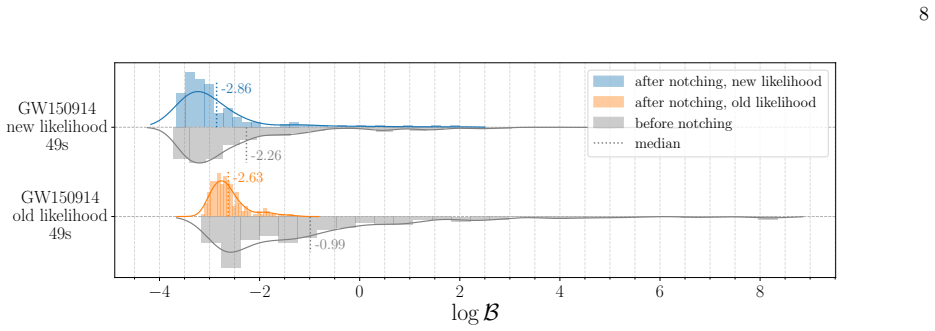
The paper's central claim is that the late-time echo signal, when the interior reflection is strong, can be captured by a simple uniform comb of equally spaced, long-lived quasinormal modes with a Lorentzian amplitude profile, and that a phase-marginalized likelihood which coherently combines all frequency bins and all detectors for each mode is substantially more sensitive than previous per-bin phase-marginalized approaches. The new likelihood (Eq. 10) marginalizes over a single constant phase per mode, producing a zeroth-order Bessel function of the complex matched-filter statistic, and it is shown to suppress instrumental line contamination, improve detection significance at long duration
What carries the argument
The carrying mechanism is the generalized phase-marginalized likelihood (Eq. 10): for each quasinormal mode n, the data from all detectors are combined into a single complex frequency-domain series, and the likelihood marginalizes over one constant phase per mode, yielding an I0 Bessel function of the absolute value of the coherent overlap between data and the search template, minus a network-optimal-SNR penalty. The search template is the 'UniEw' model, a uniform comb of equally spaced Lorentzian lines with common spacing Δf and damping time τ, which approximates the long-lived QNM spectrum without committing to a specific ultracompact-object microstructure. This reduces the problem to seve
Load-bearing premise
The entire search rests on the assumption that a real echo signal's phase around each mode is dominated by the Lorentzian line-shape term, so the slowly varying phase can be safely marginalized; if a physical waveform's phase evolves differently, the template will not match it and the null result would not exclude it.
What would settle it
Inject a numerically simulated echo waveform from a spinning ultracompact object with frequency-dependent reflectivity—so that the slow phase term δn + 2πftd is not actually slow—into real detector noise, run the pipeline, and check whether the injection is recovered with the claimed SNR; failure would show the search is blind to non-UniEw signals. Alternatively, a future detection of a comb-like line with cross-detector coherence and a matching phase pattern would falsify the null result.
If this is right
- If a merger remnant has a reflective surface close to the horizon, its late-time signal should appear as a comb of long-lived QNMs; this search provides the first model-agnostic probe of that regime.
- The new likelihood coherently combines frequency bins and detectors, so its detection significance and the stability of its upper limits improve with observation duration, whereas the old per-bin likelihood degrades.
- The 90% upper limits, e.g., SNR90% ≈ 4.8 and A90% ≈ 1.3 × 10^-24 for GW231226, imply that any echo signal in these events must have an average strain amplitude below roughly 10^-24.
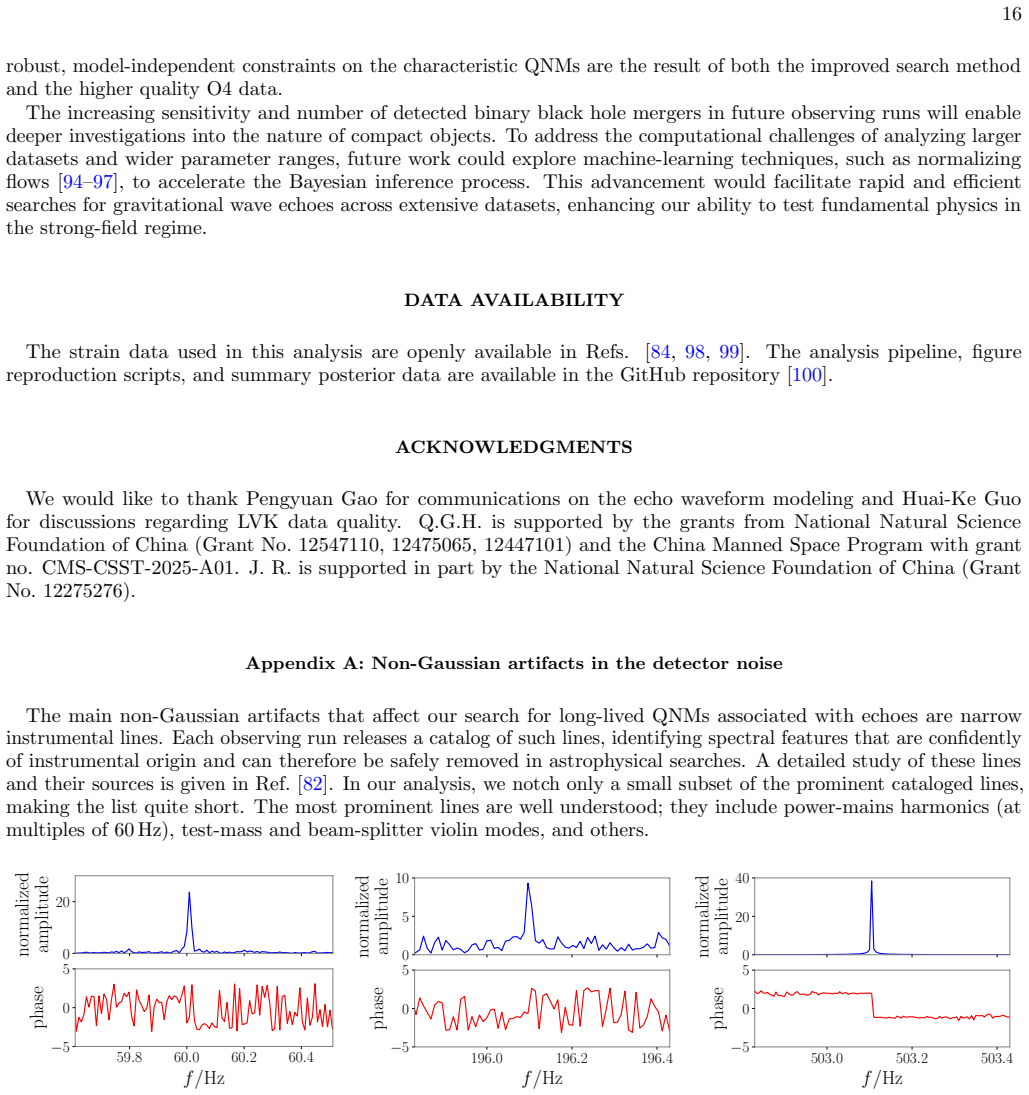
- Most instrumental lines are rejected by the phase-coherent combination, but a few transient, single-detector line features survive and are identified as non-astrophysical, illustrating the search's sensitivity to signal-like structures.
- The pipeline is applicable to future high-ringdown-SNR events and longer observation durations, where the phase-coherent gain is largest and the constraints will tighten.
Where Pith is reading between the lines
- Extension: the same phase-coherent likelihood formalism does not depend on echo-specific physics and could be applied to other long-lived narrow-band gravitational-wave sources, such as boson clouds around spinning black holes.
- Extension: the template's neglect of the slowly varying phase term δn + 2πftd is the main risk; if a real UCO's phase evolution is not dominated by the Lorentzian term—due to overlapping modes or frequency-dependent reflectivity—the search could systematically miss the signal, so the reported upper limits should be read as limits on UniEw-like signals.
- Extension: a testable prediction is that the strongest constraints should come from events with the lowest noise floor and longest usable postmerger stretch; applying the pipeline to GW250114 with longer T or to future O5 events should push SNR90% below 4.
- Extension: the per-event upper limits could be combined hierarchically across the full LVK catalog to produce the first model-independent population bound on near-horizon reflectivity of compact remnants.
Editorial analysis
A structured set of objections, weighed in public.
Referee Report
Summary. The paper extends the phase-marginalized likelihood of Ref. [70] to a two-detector network, coherently combining frequency bins within each QNM while marginalizing over a per-mode constant phase. It uses the simplified UniEw template (Eq. 16) and a Bayesian search pipeline with an iterative notching procedure, validates it on O1 background with 150 time-slide realizations and a single constant-reflectivity injection, and then applies it to GW150914, GW231226, and GW250114. No significant evidence for echoes is found; 90% upper limits are set on network SNR and average initial amplitude (e.g., SNR90%≈4.8 and A90%≈1.3e-24 for GW231226 at T=145 s with the new likelihood). The likelihood derivation (Eqs. 6-10) is internally consistent and correctly reduces to the old likelihood in the low-resolution limit.
Significance. If the claims are fully supported, this is a useful contribution: it provides an efficient coherent search statistic, demonstrates robustness of the notched pipeline on O1 data, and gives concrete null constraints on long-lived QNM amplitudes for a recently detected O4 event. The paper ships analysis code, summary posterior data, and uses public LVK data, which is a strength. However, the significance is reduced by the gap between the title/abstract's 'model-independent' framing and the actual use of a simplified UniEw template. The reported upper limits are conditional on the phase ansatz of Eq. (5), and the validation exercises only one phase-clean benchmark signal. The central method is sound, but the scope of the claims needs tightening and the robustness to model mismatch needs to be demonstrated.
major comments (3)
- [Secs. II-III, V-VI; Eqs. (5), (16); Fig. 7] The 'model-independent' claim is stronger than the evidence supports. The likelihood's coherent gain and the reported upper limits (Fig. 7, Table IV) depend on the phase model of Eq. (5), which is encoded in the UniEw template (Eq. 16). The only injection test (Sec. IV) uses a constant reflectivity Rwall=0.99 and a ringdown excitation, i.e., precisely the phase-clean case. The paper itself calls UniEw a 'simplified model' and 'leading-order description'. A model-mismatch robustness study is needed: inject waveforms with frequency-dependent reflectivity, overlapping modes, or different excitation phases, and quantify detection efficiency and bias in the inferred SNR/amplitude. Alternatively, the abstract and Secs. V-VI should explicitly state that the constraints apply only within the UniEw template family.
- [Sec. II, Eqs. (3), (5), (7)] The marginalization treats δ'_n = δ_n + 2π f t_d as constant across all bins of a mode. But using t_d≈1/Δf and the mode cutoff f_cut ≤ Δf/2, the phase variation 2π f_cut t_d can be O(π). Thus the constant-phase assumption is not automatically valid. For signals whose phase retains the second term of Eq. (5), the coherent sum could partially cancel even when the amplitude model is correct. The single injection does not probe this regime. The authors should either derive and verify a condition such as 2π f_cut t_d << 1 for the searched parameter space, or extend the phase treatment.
- [Secs. IV-V; Fig. 7; Table II] The upper-limit calibration is based on a loud injection (network SNR≈16, logB≈40 at T=49 s). The quoted 90% limits are around SNR≈5, but there is no injection-recovery study at near-threshold amplitudes. Without demonstrating that the posterior-based upper limits have correct coverage for weak signals, the strength of the constraints is not fully established. A small injection campaign at SNR values bracketing the claimed limits would address this.
minor comments (4)
- [Sec. V.A] The text says the strain-data preparation follows the procedure 'outlined in Sec. VI'; this should be Sec. III (pipeline description).
- [Title and Abstract] The title uses 'Model-independent' while the abstract uses 'model-agnostic' and the body repeatedly describes UniEw as simplified/leading-order. Please harmonize the terminology and qualify the claims consistently.
- [Footnote 3 and Eq. (16)] The admitted notation typo conflating A and A' should be corrected in the main text rather than only explained in a footnote.
- [Appendix A / Fig. 9] The broad quasi-periodic artifact seen for GW150914 at 114 s is said to require 'further investigation'. This is fine, but it would be useful to state explicitly in Sec. V.A that unresolved artifacts are included in the background distribution and therefore do not bias the p-values.
Circularity Check
No circular derivation: likelihood and upper limits are explicitly built on a labeled simplified template; the remaining concern is model-mismatch coverage, not circularity.
full rationale
The derivation chain is self-contained at the level of the search statistic: Eq. (2) is the standard UCO transfer function, Eqs. (4)-(5) are stated as a pole approximation around each QNM, and Eqs. (6)-(10) derive the network phase-marginalized likelihood from the Gaussian likelihood by phase marginalization. The search template Eq. (16) is explicitly labeled a simplified and leading-order description of long-lived QNMs (Sec. III), so the paper does not disguise the template as an exact first-principles waveform. The injection test uses a benchmark waveform from Eq. (2) with constant reflectivity Rwall=0.99 and ringdown excitation (Sec. IV), which is an internal self-consistency check rather than independent validation of the phase model against frequency-dependent reflectivity or overlapping modes. The null results for GW150914, GW231226, and GW250114 are computed from real data against time-slide backgrounds with p-values (Sec. V), and the upper limits are stated as limits on the UniEw search template parameters, not on an independently defined physical amplitude: 'we constrain its strength by setting upper limits on the network SNR and amplitude of the UniEw search template, which approximates the QNMs at leading order.' Thus no fitted parameter is renamed as a prediction, and no result equals its input by construction. The central limitation—that a real echo whose phase evolution differs from Eq. (5) could partially cancel in the coherent sum and bias the limits—is a model-mismatch/correctness risk rather than circularity. The reliance on Refs. [68,70] for the phase approximation and UniEw model is a self-citation, but the likelihood derivation is explicit and the real-data analysis is independent of those fitted values; I therefore rate this as minor self-citation, not load-bearing circularity.
Axiom & Free-Parameter Ledger
free parameters (9)
- η (interior-reflection efficiency parameter) =
η ∈ [1, 4] scanned
- Δf (frequency spacing between QNMs) =
posterior medians 3.8119 Hz (inj T=49s new)
- q0 (relative offset of QNM comb) =
posterior ~0.982-0.98 (injection)
- A′ (average frequency-domain amplitude) =
posterior ~1.2-1.5 ⟨|n_j|⟩ (injection); upper limits A90 ~1e-24 real
- τ (damping time of QNMs) =
posterior log10(1/τ) ~ -1.3 (injection)
- fmin, fmax (frequency band edges) =
posterior fmin ~140 Hz, fmax ~242 Hz (injection); priors [50, 1.1 f_RD]
- φHL,0 (relative detector response phase) =
posterior ~0 (injection)
- T (analysis duration) =
two benchmark values per event (e.g., 57.2 s and 114.4 s)
- line notch threshold (normalized strain amplitude 6) =
6
axioms (6)
- domain assumption Standard GW data-analysis assumptions: stationary Gaussian noise in each frequency bin, independent across bins and detectors, PSD known.
- domain assumption The late-time echo waveform is dominated by a single long-lived QNM per resonance, with amplitude and phase profile given by Eqs. (4)-(5).
- domain assumption The source sky position and waveform phase evolution permit approximating the detector response ratio R_I/R_J as a constant amplitude A_JI and phase φ_JI,j linear in frequency (Eqs. 13-14).
- domain assumption The remnant mass M and spin χ from the main-event analysis correctly set the prior bounds f_RD (Eq. 19) and Δf range (Eq. 18).
- domain assumption Time-slide background realizations are statistically independent samples from the same noise distribution as the postmerger search segments.
- ad hoc to paper The simplified UniEw template family adequately represents the target long-lived QNM signal.
read the original abstract
Gravitational wave echoes offer a unique probe of the near-horizon structure of astrophysical black holes, beyond the standard "black hole spectroscopy." Theoretical waveform predictions, however, remain uncertain, motivating robust searches that avoid specific echo modeling. We present a model-agnostic search framework targeting long-lived quasinormal modes (QNMs) expected from strong interior reflection. By employing a generalized phase-marginalized likelihood that coherently combines data for each QNM across a detector network, our method enhances sensitivity to the signals. To handle real detector noise, we implement an optimized notching procedure to suppress instrumental spectral lines and refine the Bayesian parameter settings. We validate the performance of this framework using injection studies on O1 background data, demonstrating reliable signal recovery in realistic noise conditions. We then apply this method to three binary black hole merger events with high ringdown signal-to-noise ratios (SNRs): GW150914 from O1, GW231226 from O4a, and the recently reported O4 event GW250114. No statistically significant evidence for postmerger echoes is found. Consequently, we derive 90% upper limits on the network SNR and the average initial strain amplitude of the long-lived QNMs. These results provide model-agnostic constraints on late-time echoes from LVK data, complementing existing searches for other echo signatures.
Figures




Reference graph
Works this paper leans on
-
[1]
B. P. Abbottet al.(LIGO Scientific, Virgo), Observation of Gravitational Waves from a Binary Black Hole Merger, Phys. Rev. Lett.116, 061102 (2016), arXiv:1602.03837 [gr-qc]. 20
Pith/arXiv arXiv 2016
-
[2]
B. P. Abbottet al.(LIGO Scientific, Virgo), GWTC-1: A Gravitational-Wave Transient Catalog of Compact Binary Mergers Observed by LIGO and Virgo during the First and Second Observing Runs, Phys. Rev. X9, 031040 (2019), arXiv:1811.12907 [astro-ph.HE]
Pith/arXiv arXiv 2019
-
[3]
R. Abbottet al.(LIGO Scientific, Virgo), GWTC-2: Compact Binary Coalescences Observed by LIGO and Virgo During the First Half of the Third Observing Run, Phys. Rev. X11, 021053 (2021), arXiv:2010.14527 [gr-qc]
Pith/arXiv arXiv 2021
-
[4]
R. Abbottet al.(KAGRA, VIRGO, LIGO Scientific), GWTC-3: Compact Binary Coalescences Observed by LIGO and Virgo during the Second Part of the Third Observing Run, Phys. Rev. X13, 041039 (2023), arXiv:2111.03606 [gr-qc]
Pith/arXiv arXiv 2023
-
[5]
A. G. Abacet al.(LIGO Scientific, VIRGO, KAGRA), GWTC-4.0: Updating the Gravitational-Wave Transient Catalog with Observations from the First Part of the Fourth LIGO-Virgo-KAGRA Observing Run, arXiv:2508.18082 [gr-qc] (2025)
Pith/arXiv arXiv 2025
-
[6]
A. G. Abacet al.(LIGO Scientific, Virgo, KAGRA), GW250114: Testing Hawking’s Area Law and the Kerr Nature of Black Holes, Phys. Rev. Lett.135, 111403 (2025), arXiv:2509.08054 [gr-qc]
Pith/arXiv arXiv 2025
-
[7]
Black Hole Spectroscopy and Tests of General Relativity with GW250114, arXiv:2509.08099 [gr-qc] (2025)
Pith/arXiv arXiv 2025
-
[8]
M. Isi, M. Giesler, W. M. Farr, M. A. Scheel, and S. A. Teukolsky, Testing the no-hair theorem with GW150914, Phys. Rev. Lett.123, 111102 (2019), arXiv:1905.00869 [gr-qc]
Pith/arXiv arXiv 2019
-
[9]
C. D. Capano, M. Cabero, J. Westerweck, J. Abedi, S. Kastha, A. H. Nitz, Y.-F. Wang, A. B. Nielsen, and B. Krishnan, Multimode Quasinormal Spectrum from a Perturbed Black Hole, Phys. Rev. Lett.131, 221402 (2023), arXiv:2105.05238 [gr-qc]
Pith/arXiv arXiv 2023
-
[10]
R. Cotesta, G. Carullo, E. Berti, and V. Cardoso, Analysis of Ringdown Overtones in GW150914, Phys. Rev. Lett.129, 111102 (2022), arXiv:2201.00822 [gr-qc]
Pith/arXiv arXiv 2022
-
[11]
H.-T. Wang, G. Yim, X. Chen, and L. Shao, Gravitational Wave Ringdown Analysis Using the F -statistic, Astrophys. J. 974, 230 (2024), arXiv:2409.00970 [gr-qc]
Pith/arXiv arXiv 2024
-
[12]
Giesleret al., Overtones and nonlinearities in binary black hole ringdowns, Phys
M. Giesleret al., Overtones and nonlinearities in binary black hole ringdowns, Phys. Rev. D111, 084041 (2025), arXiv:2411.11269 [gr-qc]
Pith/arXiv arXiv 2025
-
[13]
Bertiet al., Black hole spectroscopy: from theory to experiment, arXiv:2505.23895 [gr-qc] (2025)
E. Bertiet al., Black hole spectroscopy: from theory to experiment, arXiv:2505.23895 [gr-qc] (2025)
Pith/arXiv arXiv 2025
-
[14]
V. Cardoso, E. Franzin, and P. Pani, Is the gravitational-wave ringdown a probe of the event horizon?, Phys. Rev. Lett. 116, 171101 (2016), [Erratum: Phys.Rev.Lett. 117, 089902 (2016)], arXiv:1602.07309 [gr-qc]
Pith/arXiv arXiv 2016
-
[15]
V. Cardoso, S. Hopper, C. F. B. Macedo, C. Palenzuela, and P. Pani, Gravitational-wave signatures of exotic compact objects and of quantum corrections at the horizon scale, Phys. Rev. D94, 084031 (2016), arXiv:1608.08637 [gr-qc]
Pith/arXiv arXiv 2016
-
[16]
B. Holdom and J. Ren, Not quite a black hole, Phys. Rev. D95, 084034 (2017), arXiv:1612.04889 [gr-qc]
Pith/arXiv arXiv 2017
-
[17]
P. Bueno, P. A. Cano, F. Goelen, T. Hertog, and B. Vercnocke, Echoes of Kerr-like wormholes, Phys. Rev. D97, 024040 (2018), arXiv:1711.00391 [gr-qc]
Pith/arXiv arXiv 2018
-
[18]
J. Zhang and S.-Y. Zhou, Can the graviton have a large mass near black holes?, Phys. Rev. D97, 081501 (2018), arXiv:1709.07503 [gr-qc]
Pith/arXiv arXiv 2018
-
[19]
A. Urbano and H. Veerm¨ ae, On gravitational echoes from ultracompact exotic stars, JCAP04, 011, arXiv:1810.07137 [gr-qc]
-
[20]
M. Mannarelli and F. Tonelli, Gravitational wave echoes from strange stars, Phys. Rev. D97, 123010 (2018), arXiv:1805.02278 [gr-qc]
Pith/arXiv arXiv 2018
-
[21]
Z.-P. Li and Y.-S. Piao, Mixing of gravitational wave echoes, Phys. Rev. D100, 044023 (2019), arXiv:1904.05652 [gr-qc]
Pith/arXiv arXiv 2019
-
[22]
V. Cardoso, V. F. Foit, and M. Kleban, Gravitational wave echoes from black hole area quantization, JCAP08, 006, arXiv:1902.10164 [hep-th]
Pith/arXiv arXiv 1902
-
[23]
R. S. Conklin and B. Holdom, Gravitational wave echo spectra, Phys. Rev. D100, 124030 (2019), arXiv:1905.09370 [gr-qc]
Pith/arXiv arXiv 2019
-
[24]
Q. Wang, N. Oshita, and N. Afshordi, Echoes from Quantum Black Holes, Phys. Rev. D101, 024031 (2020), arXiv:1905.00446 [gr-qc]
Pith/arXiv arXiv 2020
-
[25]
Holdom, Damping of gravitational waves in 2-2-holes, Phys
B. Holdom, Damping of gravitational waves in 2-2-holes, Phys. Lett. B813, 136023 (2021), arXiv:2004.11285 [gr-qc]
Pith/arXiv arXiv 2021
-
[26]
Y. Fang, R.-Z. Guo, and Q.-G. Huang, Tests for the existence of horizon through gravitational waves from a small binary in the vicinity of a massive object, Phys. Lett. B822, 136654 (2021), arXiv:2108.04511 [astro-ph.CO]
Pith/arXiv arXiv 2021
-
[27]
C. Vlachos, E. Papantonopoulos, and K. Destounis, Echoes of Compact Objects in Scalar-Tensor Theories of Gravity, Phys. Rev. D103, 044042 (2021), arXiv:2101.12196 [gr-qc]
Pith/arXiv arXiv 2021
-
[28]
Zhang, Gravitational wave echoes from interacting quark stars, Phys
C. Zhang, Gravitational wave echoes from interacting quark stars, Phys. Rev. D104, 083032 (2021), arXiv:2107.09654 [hep-ph]
Pith/arXiv arXiv 2021
-
[29]
H. Huang, M.-Y. Ou, M.-Y. Lai, and H. Lu, Echoes from classical black holes, Phys. Rev. D105, 104049 (2022), arXiv:2112.14780 [hep-th]
Pith/arXiv arXiv 2022
-
[30]
R. A. Konoplya and A. Zhidenko, Can the abyss swallow gravitational waves or why we do not observe echoes?, EPL138, 49001 (2022), arXiv:2203.16635 [gr-qc]
Pith/arXiv arXiv 2022
-
[31]
Abedi, Firewall black holes and echoes from an action principle, Phys
J. Abedi, Firewall black holes and echoes from an action principle, Phys. Rev. D107, 064004 (2023), arXiv:2209.07363 [hep-th]
Pith/arXiv arXiv 2023
-
[32]
Y. Yang, D. Liu, Z. Xu, and Z.-W. Long, Ringing and echoes from black bounces surrounded by the string cloud, Eur. Phys. J. C83, 217 (2023), arXiv:2210.12641 [gr-qc]
Pith/arXiv arXiv 2023
-
[33]
V. Vellucci, E. Franzin, and S. Liberati, Echoes from backreacting exotic compact objects, Phys. Rev. D107, 044027 (2023), arXiv:2205.14170 [gr-qc]
Pith/arXiv arXiv 2023
-
[34]
G. Guo, P. Wang, H. Wu, and H. Yang, Echoes from hairy black holes, JHEP06, 073, arXiv:2204.00982 [gr-qc]
-
[35]
S. Mukherjee, S. Datta, S. Tiwari, K. S. Phukon, and S. Bose, Toward establishing the presence or absence of horizons in coalescing binaries of compact objects by using their gravitational wave signals, Phys. Rev. D106, 104032 (2022), arXiv:2202.08661 [gr-qc]. 21
Pith/arXiv arXiv 2022
-
[36]
N. Oshita and N. Afshordi, From entropy to echoes: Counting the quasi-normal modes and the quantum limit of silence, Phys. Lett. B841, 137901 (2023), arXiv:2302.08964 [hep-th]
Pith/arXiv arXiv 2023
-
[37]
M. V. S. Saketh and E. Maggio, Quasinormal modes of slowly-spinning horizonless compact objects, Phys. Rev. D110, 084038 (2024), arXiv:2406.10070 [gr-qc]
Pith/arXiv arXiv 2024
-
[38]
Z.-H. Yang, C. Xu, X.-M. Kuang, B. Wang, and R.-H. Yue, Echoes of massless scalar field induced from hairy Schwarzschild black hole, Phys. Lett. B853, 138688 (2024)
2024
-
[39]
H. Yang, Z.-W. Xia, and Y.-G. Miao, Echoes and quasi-normal modes of perturbations around Schwarzschild traversable wormholes, Eur. Phys. J. C85, 742 (2025), arXiv:2406.00377 [gr-qc]
Pith/arXiv arXiv 2025
-
[40]
C.-C. Zhu, J. Chen, W.-D. Guo, and Y.-X. Liu, Gravitational echoes from braneworlds, JHEP01, 010, arXiv:2406.16256 [gr-qc]
-
[41]
K. Lin, W.-L. Qian, A. B. Pavan, A. R. de Queiroz, and E. Abdalla, Echoes of bimodal axial gravitational perturbations in a uniform-density star in Einstein-Æther gravity, Phys. Rev. D112, 044031 (2025), arXiv:2507.21321 [gr-qc]
Pith/arXiv arXiv 2025
-
[42]
Y.-S. Cao, Y. Liu, and D.-F. Zeng, Gravitational wave echos from physical black holes, arXiv:2510.11518 [gr-qc] (2025)
arXiv 2025
- [43]
-
[44]
S. Terashima, Stretched horizon dissipation and the fate of echoes, JHEP10, 147, arXiv:2506.20462 [hep-th]
-
[45]
J. Abedi, H. Dykaar, and N. Afshordi, Echoes from the Abyss: Tentative evidence for Planck-scale structure at black hole horizons, Phys. Rev. D96, 082004 (2017), arXiv:1612.00266 [gr-qc]
Pith/arXiv arXiv 2017
-
[46]
J. Abedi, H. Dykaar, and N. Afshordi, Echoes from the Abyss: The Holiday Edition!, arXiv:1701.03485 [gr-qc] (2017)
Pith/arXiv arXiv 2017
-
[47]
J. Westerweck, A. Nielsen, O. Fischer-Birnholtz, M. Cabero, C. Capano, T. Dent, B. Krishnan, G. Meadors, and A. H. Nitz, Low significance of evidence for black hole echoes in gravitational wave data, Phys. Rev. D97, 124037 (2018), arXiv:1712.09966 [gr-qc]
Pith/arXiv arXiv 2018
-
[48]
A. Maselli, S. H. V¨ olkel, and K. D. Kokkotas, Parameter estimation of gravitational wave echoes from exotic compact objects, Phys. Rev. D96, 064045 (2017), arXiv:1708.02217 [gr-qc]
Pith/arXiv arXiv 2017
-
[49]
R. K. L. Lo, T. G. F. Li, and A. J. Weinstein, Template-based Gravitational-Wave Echoes Search Using Bayesian Model Selection, Phys. Rev. D99, 084052 (2019), arXiv:1811.07431 [gr-qc]
Pith/arXiv arXiv 2019
-
[50]
A. B. Nielsen, C. D. Capano, O. Birnholtz, and J. Westerweck, Parameter estimation and statistical significance of echoes following black hole signals in the first Advanced LIGO observing run, Phys. Rev. D99, 104012 (2019), arXiv:1811.04904 [gr-qc]
Pith/arXiv arXiv 2019
-
[51]
N. Uchikata, H. Nakano, T. Narikawa, N. Sago, H. Tagoshi, and T. Tanaka, Searching for black hole echoes from the LIGO-Virgo Catalog GWTC-1, Phys. Rev. D100, 062006 (2019), arXiv:1906.00838 [gr-qc]
Pith/arXiv arXiv 2019
-
[52]
Y.-T. Wang, J. Zhang, S.-Y. Zhou, and Y.-S. Piao, On echo intervals in gravitational wave echo analysis, Eur. Phys. J. C 79, 726 (2019), arXiv:1904.00212 [gr-qc]
Pith/arXiv arXiv 2019
-
[53]
Y.-T. Wang and Y.-S. Piao, Searching for gravitational wave echoes in GWTC-1 and O3 events, arXiv:2010.07663 [gr-qc] (2020)
Pith/arXiv arXiv 2010
-
[54]
J. Abedi, L. F. Longo Micchi, and N. Afshordi, GW190521: Search for echoes due to stimulated Hawking radiation from black holes, Phys. Rev. D108, 044047 (2023), arXiv:2201.00047 [gr-qc]
Pith/arXiv arXiv 2023
-
[55]
J. Westerweck, Y. Sherf, C. D. Capano, and R. Brustein, Sub-atomic constraints on the Kerr geometry of GW150914, arXiv:2108.08823 [gr-qc] (2021)
Pith/arXiv arXiv 2021
-
[56]
Abedi, Search for echoes on the edge of quantum black holes, Class
J. Abedi, Search for echoes on the edge of quantum black holes, Class. Quant. Grav.42, 205004 (2025), arXiv:2301.00025 [gr-qc]
Pith/arXiv arXiv 2025
-
[57]
N. Uchikata, T. Narikawa, H. Nakano, N. Sago, H. Tagoshi, and T. Tanaka, Searching for gravitational wave echoes from black hole binary events in the third observing run of LIGO, Virgo, and KAGRA collaborations, Phys. Rev. D108, 104040 (2023), arXiv:2309.01894 [gr-qc]
Pith/arXiv arXiv 2023
- [58]
- [59]
-
[60]
I. Hamoudy, J. Westerweck, and O. Birnholtz, Constraining Black Hole Horizon Properties Through Long-Duration Gravitational Wave Observations, arXiv:2511.06536 [gr-qc] (2025)
arXiv 2025
-
[61]
R. S. Conklin, B. Holdom, and J. Ren, Gravitational wave echoes through new windows, Phys. Rev. D98, 044021 (2018), arXiv:1712.06517 [gr-qc]
Pith/arXiv arXiv 2018
-
[62]
K. W. Tsang, M. Rollier, A. Ghosh, A. Samajdar, M. Agathos, K. Chatziioannou, V. Cardoso, G. Khanna, and C. Van Den Broeck, A morphology-independent data analysis method for detecting and characterizing gravitational wave echoes, Phys. Rev. D98, 024023 (2018), arXiv:1804.04877 [gr-qc]
Pith/arXiv arXiv 2018
-
[63]
J. Abedi and N. Afshordi, Echoes from the Abyss: A highly spinning black hole remnant for the binary neutron star merger GW170817, JCAP11, 010, arXiv:1803.10454 [gr-qc]
-
[64]
K. W. Tsang, A. Ghosh, A. Samajdar, K. Chatziioannou, S. Mastrogiovanni, M. Agathos, and C. Van Den Broeck, A morphology-independent search for gravitational wave echoes in data from the first and second observing runs of Advanced LIGO and Advanced Virgo, Phys. Rev. D101, 064012 (2020), arXiv:1906.11168 [gr-qc]
Pith/arXiv arXiv 2020
-
[65]
F. Salemi, E. Milotti, G. A. Prodi, G. Vedovato, C. Lazzaro, S. Tiwari, S. Vinciguerra, M. Drago, and S. Klimenko, Wider look at the gravitational-wave transients from GWTC-1 using an unmodeled reconstruction method, Phys. Rev. D100, 042003 (2019), arXiv:1905.09260 [gr-qc]
Pith/arXiv arXiv 2019
-
[66]
Holdom, Not quite black holes at LIGO, Phys
B. Holdom, Not quite black holes at LIGO, Phys. Rev. D101, 064063 (2020), arXiv:1909.11801 [gr-qc]. 22
Pith/arXiv arXiv 2020
-
[67]
R. S. Conklin and N. Afshordi, Boltzmann Meets Lorentz: A Surrogate Model for Black Hole Echoes, arXiv:2201.00027 [gr-qc] (2021)
Pith/arXiv arXiv 2021
-
[68]
J. Ren and D. Wu, Gravitational wave echoes search with combs, Phys. Rev. D104, 124023 (2021), arXiv:2108.01820 [gr-qc]
Pith/arXiv arXiv 2021
-
[69]
A. Miani, C. Lazzaro, G. A. Prodi, S. Tiwari, M. Drago, E. Milotti, and G. Vedovato, Constraints on the amplitude of gravitational wave echoes from black hole ringdown using minimal assumptions, Phys. Rev. D108, 064018 (2023), arXiv:2302.12158 [gr-qc]
Pith/arXiv arXiv 2023
-
[70]
D. Wu, P. Gao, J. Ren, and N. Afshordi, Model-independent search for the quasinormal modes of gravitational wave echoes, Phys. Rev. D108, 124006 (2023), arXiv:2308.01017 [gr-qc]
Pith/arXiv arXiv 2023
-
[71]
H. Nakano, N. Sago, H. Tagoshi, and T. Tanaka, Black hole ringdown echoes and howls, PTEP2017, 071E01 (2017), arXiv:1704.07175 [gr-qc]
Pith/arXiv arXiv 2017
-
[72]
E. Maggio, A. Testa, S. Bhagwat, and P. Pani, Analytical model for gravitational-wave echoes from spinning remnants, Phys. Rev. D100, 064056 (2019), arXiv:1907.03091 [gr-qc]
Pith/arXiv arXiv 2019
-
[73]
S. Xin, B. Chen, R. K. L. Lo, L. Sun, W.-B. Han, X. Zhong, M. Srivastava, S. Ma, Q. Wang, and Y. Chen, Gravitational- wave echoes from spinning exotic compact objects: Numerical waveforms from the Teukolsky equation, Phys. Rev. D104, 104005 (2021), arXiv:2105.12313 [gr-qc]
Pith/arXiv arXiv 2021
-
[74]
M. Srivastava and Y. Chen, Gravitational radiation close to a black hole horizon: Waveform regularization and the out-going echo, Phys. Rev. D104, 104006 (2021), arXiv:2108.01329 [gr-qc]
Pith/arXiv arXiv 2021
-
[75]
N. Deppe, L. Heisenberg, H. Inchausp´ e, L. E. Kidder, D. Maibach, S. Ma, J. Moxon, K. C. Nelli, W. Throwe, and N. L. Vu, Echoes from beyond: Detecting gravitational-wave quantum imprints with LISA, Phys. Rev. D111, 124035 (2025), arXiv:2411.05645 [gr-qc]
Pith/arXiv arXiv 2025
-
[76]
R. F. Rosato, S. Biswas, S. Chakraborty, and P. Pani, Greybody factors, reflectionless scattering modes, and echoes of ultracompact horizonless objects, Phys. Rev. D111, 084051 (2025), arXiv:2501.16433 [gr-qc]
Pith/arXiv arXiv 2025
-
[77]
R. F. Rosato, S. Biswas, S. Chakraborty, and P. Pani, Excitation factors for horizonless compact objects: long-lived modes, echoes, and greybody factors, arXiv:2511.08692 [gr-qc] (2025)
Pith/arXiv arXiv 2025
-
[78]
V. Cardoso and P. Pani, Testing the nature of dark compact objects: a status report, Living Rev. Rel.22, 4 (2019), arXiv:1904.05363 [gr-qc]
Pith/arXiv arXiv 2019
-
[79]
N. Oshita, H. Motohashi, and S. Noda, Evaporation of echoing black holes, Phys. Rev. D106, 044044 (2022), arXiv:2205.15342 [gr-qc]
Pith/arXiv arXiv 2022
-
[80]
J. D. Romano and N. J. Cornish, Detection methods for stochastic gravitational-wave backgrounds: a unified treatment, Living Rev. Rel.20, 2 (2017), arXiv:1608.06889 [gr-qc]
Pith/arXiv arXiv 2017
discussion (0)
Sign in with ORCID, Apple, or X to comment. Anyone can read and Pith papers without signing in.