REVIEW 5 major objections 5 minor 21 references
A model can erase specific knowledge from itself even if the only data it sees is anonymized, by working in the model's internal activation geometry rather than on raw text.
Reviewed by Pith at T0; open to challenge. T0 means a machine referee read the full paper against a public rubric. the ladder, T0–T4 →
T0 review · deepseek-v4-flash
2026-08-03 12:10 UTC pith:YOCIMWIV
load-bearing objection Real problem framing, but the main evaluation table doesn't reproduce from the paper's own formulas—verify before relying on any performance claim. the 5 major comments →
Shadow Unlearning: A Neuro-Semantic Approach to Fidelity-Preserving Faceless Forgetting in LLMs
The pith
A machine-rendered reading of the paper's core claim, the machinery that carries it, and where it could break.
Core claim
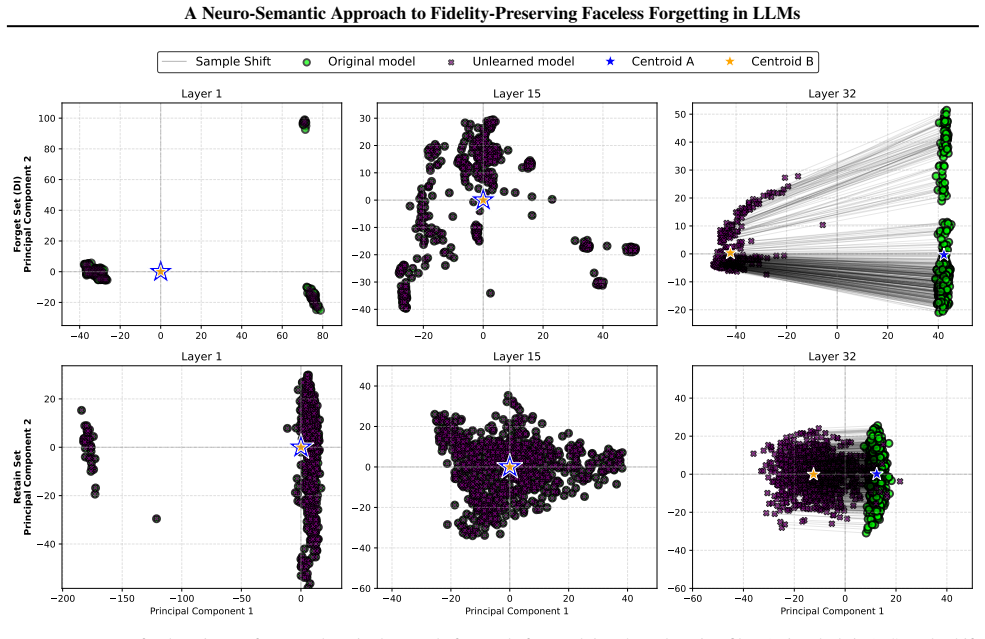
The central claim is that unlearning can be done on anonymized data alone by operating in the model's internal activation geometry. A lightweight MLP aligner, trained once on public (original, anonymized) text pairs, projects anonymized activations into the original activation space; PCA over the projected forget-set activations yields a forget subspace; and a non-trainable filter I - alpha*U*U^T, inserted at the final layer, subtracts the forget-subspace component from every activation during inference. The paper argues this simultaneously makes the forget set hard to detect via membership inference, preserves retain-set performance, and avoids any gradient update of the target model, givin
What carries the argument
The Latent Representation Aligner Pθ, a lightweight MLP trained with ||Pθ(φ_l(x_anon)) - φ_l(x_orig)||² and an inversion-resistance term, maps anonymized activations into the original activation space. The Forget Subspace U is the top-k PCA basis of those projected forget activations. The Unlearning Filter UL_filter = I - α U U^T is a non-trainable adapter that projects each activation away from the forget subspace at inference, attenuating forget-related concepts while leaving the orthogonal complement intact.
Load-bearing premise
The load-bearing premise is that a small MLP trained on public (original, anonymized) text pairs can predict the original activation of an anonymized forget sample accurately enough that the principal directions of those predictions coincide with the true semantic content to be forgotten; the paper's own domain-wise similarity numbers (as low as 0.47 for one model and domain) and its stated dependence on overlap between forget and retain distributions mark this as the fragile
What would settle it
Take a model after NSPU unlearning and ask it the original, non-anonymized forget questions: if it still reproduces the gold answers at the same confidence as the target model, the filter removed nothing relevant. A sharper test is out-of-distribution: feed the aligner anonymized forget text from a domain absent from its public training corpus and compare Pθ(φ_l(x_anon)) to the true φ_l(x_orig) via cosine similarity; if the similarity collapses toward zero, the forget subspace is built from noise and the reported separations on the synthetic set would not transfer.
If this is right
- Unlearning pipelines can be restructured so the forget set is anonymized before it reaches the model operator, removing a major PII exposure point during deletion requests.
- Because the target model stays frozen, a deletion request can be serviced with a single matrix multiply per token instead of gradient updates, with FLOP counts roughly 10x lower than gradient baselines and about 10^6 lower than retraining.
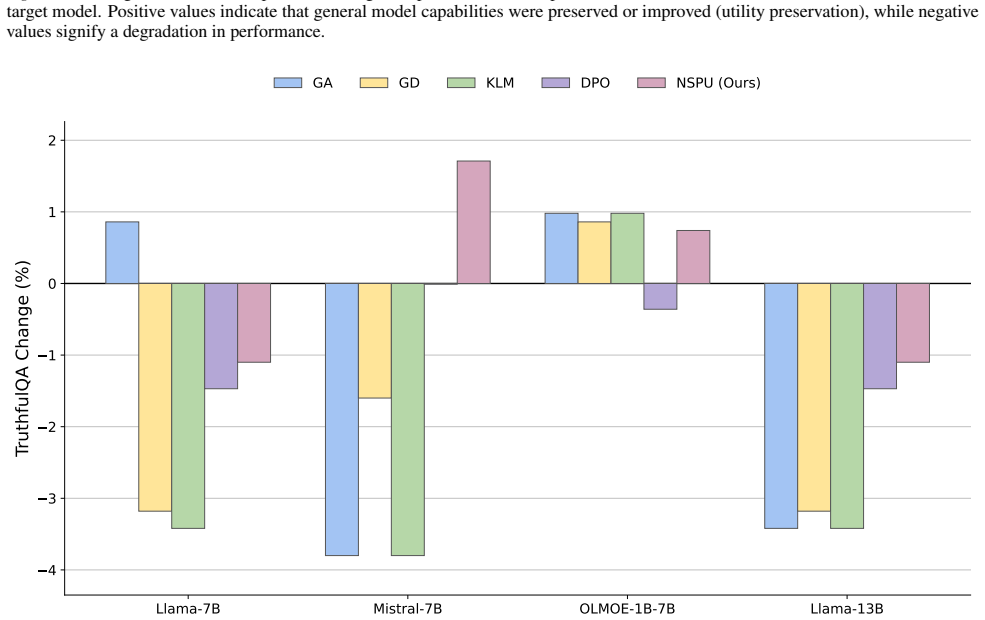
- The harmonic evaluation stack (perplexity, truth ratio, ROUGE-L, and conditional NLL combined into retention-versus-forgetting ratios) gives a single score for the utility--efficacy tradeoff, making it possible to compare unlearning methods on how much knowledge survives rather than only on how much is forgotten.
- The entity-level analysis suggests the method can erase specific PII types, such as person names, locations, and phone numbers, while leaving other domain knowledge in place.
Where Pith is reading between the lines
- An extension the paper does not develop: because the filter is a linear projection independent of the input text, the same U could be built from any one-way anonymization function f(·), as long as the aligner is retrained on that f's outputs, making shadow unlearning a plug-in for pseudonymization schemes beyond NER tag replacement.
- The paper tests paraphrased, context-augmented, and hard-token attacks on the filter, but it leaves open a sharper adversarial question: whether someone with access to the aligner Pθ can invert its outputs to reconstruct the original text. The InvOptScore term is designed to raise that cost, and a direct inversion attack on the aligner would be the natural stress test.
- Because the evaluation rests on synthetic author profiles, the practical deployment claim—that a public-corpus-trained aligner maps real-world anonymized forget sets reliably—remains untested at scale. Running the pipeline on a real PII-bearing corpus with known ground-truth pairs would be the direct way to test transfer.
Editorial analysis
A structured set of objections, weighed in public.
Referee Report
Summary. The paper proposes Shadow Unlearning, a paradigm in which machine unlearning is performed on an anonymized forget set, and introduces NSPU, a three-stage method: (i) train an MLP to map anonymized activations back into the original activation space, (ii) construct a PCA-based forget subspace from the projected anonymized forget activations, and (iii) insert a non-trainable linear filter I−αUU^T into the frozen target model. The authors introduce a synthetic five-domain MuFU benchmark and evaluate four LLMs against GA, GD, KLM, DPO, and NPO using four harmonic trade-off metrics plus an SQS-based membership-inference analysis. The central claims are that NSPU consistently outperforms the baselines, preserves utility, enhances user privacy, and is at least 10 times more computationally efficient than standard unlearning approaches. I find that the headline evaluation is not self-consistent: the reported metric values in Table 2 cannot be reproduced from the paper's own equations, and the stated efficiency claim is contradicted by Table 3. As a result, the principal empirical claims are not currently supported.
Significance. The idea of performing unlearning on anonymized data is timely, and the frozen-target projection architecture is an interesting and nonstandard approach. The construction of the MuFU benchmark and the breadth of models and ablations are also useful if the underlying measurements are reliable. However, the current manuscript does not establish its central claims. The main evidence for 'NSPU consistently outperforms baselines' is a table whose values do not follow the paper's stated formulas, and the 'at least 10x' efficiency claim is contradicted by the paper's own FLOPs table. Because these are load-bearing issues in the abstract, Section 4.4, and Takeaway 2, the contribution cannot be assessed as presented. If the evaluation were corrected and independently reproducible, the paradigm could be a valuable addition to privacy-preserving unlearning; the present version does not provide that reliable basis.
major comments (5)
- [§4.4, Table 2, Eqs. (4) and (13)] The HCS/HPS and HCNLL values are not derivable from the definitions. For Mistral-7B NSPU, Table 2 gives GF=−0.084 and CR=2.066, but Eq. (4) yields HPS = 2(−0.084)/((−0.084)(2.066)+1) = −0.203, not 4.995. For Llama-7B NSPU, GF=1.388 and CR=2.055 yield HPS ≈ 0.721, not 1.067. Similarly, Eq. (13) with Mistral's GFL=0.955 and CRL=1.650 gives HCNLL ≈ 0.741, not 1.281. Since the aggregate scores and the conclusion that 'NSPU consistently outperforms baseline unlearning methods' are built on these columns, the central experimental result is unsupported as reported.
- [Abstract, §4.5, Table 3] The claim that NSPU is 'at least 10x more computationally efficient than standard unlearning approaches' is contradicted by the paper's own FLOPs table. For Llama-7B, NSPU is 7.63e16 FLOPs versus GA's 1.29e17, a ratio of about 1.7x; for Mistral-7B the ratio is about 1.7x; for Llama-13B about 1.7x; for OLMoE about 2.1x. Even compared with GD/DPO/NPO at 5.16e17 FLOPs, the Llama-7B ratio is about 6.8x, still below 10x. Only the comparison with retraining from scratch approaches the claimed 10^6x. Takeaway 2 and the abstract therefore materially overstate the efficiency result.
- [§3.6, Table 12, §4.4] The reported superiority of NSPU may be inflated by tuning and by construction. The forget subspace U is built from the same anonymized forget set that is later used to compute forget-set effectiveness, and α is selected separately for every model and overlap variant (values range from 0.01 to 0.315 in Table 12) with no described validation or selection criterion. Without a sensitivity analysis or an independent validation split, one cannot tell whether the head-to-head win reflects the method itself or favorable hyperparameter selection. The paper should report how α was chosen and show performance across a range of α values.
- [§3.4, §7, Table 5, Appendix B] The privacy claim is not currently established. The method requires training a projector to map anonymized activations back into the original activation space; Table 5 reports cosine similarities up to 0.87 (Llama-13B), and Appendix B refers to the projector as a 'deanonymization module.' Section 3.1 asserts that the anonymization function f is one-way in practice, but the projector appears to be a partial inversion tool. No attack on the projection is reported, and InvOptScore is only a heuristic training penalty rather than a demonstrated privacy guarantee. Thus 'enhances user privacy' remains a conjecture rather than a measured property.
- [Table 2, Table 9] Several entries appear to be copy-paste artifacts rather than distinct measurements. In Table 2, the GA and KLM rows are numerically identical for Llama-7B (e.g., GF=104.730, CR=110.110) and again for Mistral-7B (GF=154.695, CR=202.520), even though KLM includes an additional retain-set KL regularizer and therefore should differ from GA. In Appendix B Table 9, the MLP reconstruction rows for Mistral-7B and OLMoE-1B-7B are identical across all overlap settings (e.g., 5%: MSE=1.044, R²=0.443), despite being different models. These duplicates further undermine the reliability of the reported numerical results.
minor comments (5)
- [§4.2, Table 2] The notation is inconsistent: the text defines HPS, but Table 2 uses the column label HCS without defining it. Please harmonize the metric names.
- [§5.3] The text says 'As depicted in Table 6' when referring to the LLM-as-a-judge results; the relevant artifact is Figure 6, while Table 6 is the PII attribute similarity table. The cross-reference should be corrected.
- [Appendix C, Eqs. (30)-(31)] Equation (31) writes UL_filter = I − α v_in U U^T, but v_in is an activation vector, not a d×d matrix, so the expression is dimensionally inconsistent. From the preceding definitions the filter should be I − α U U^T. Also, the section is titled 'Theoretical Guarantee' but contains only an algebraic re-derivation; no formal forgetting guarantee is provided.
- [§3.6] The phrase 'training-free unlearning procedure' is misleading because Stage 1 trains the latent representation aligner Pθ. It would be more accurate to say that NSPU performs no gradient updates to the target model.
- [Abstract, §8] The abstract says 'Code is available at Github' without a URL, and the reproducibility statement does not provide a repository link or dataset access information. For a paper whose central evaluation is currently unreproducible, providing the actual artifacts is essential.
Circularity Check
No circularity found; NSPU's derivation is self-contained. Table 2 non-reproducibility and Appendix C algebra errors are correctness issues, not circular reductions.
full rationale
The paper's derivation chain—Latent Representation Aligner (Eq. 1), forget subspace PCA (Section 3.5.1), unlearning filter (Section 3.6.1), and harmonic metrics (Eqs. 4, 6, 9, 13)—does not reduce any claimed result to its own inputs by construction under the stated hard rules. The forget subspace is intentionally computed from the anonymized forget set and then evaluated on the same underlying forget data; this is the standard unlearning objective, not a fitted parameter renamed as a prediction, and the comparison with baselines is symmetric. No load-bearing self-citation or imported uniqueness theorem appears; the cited anonymization work is external. I considered the possibility that tuning alpha (Table 12) or using the forget set to build the subspace makes the forgetting scores forced, but the paper does not state that alpha was selected on the test metrics, and the forgetting/retention tradeoff still leaves independent content. The main problems are not circularity: Table 2's HCS/HCNLL values cannot be reproduced from Eqs. (4) and (13) (e.g., Mistral-7B GF=-0.084, CR=2.066 gives HPS≈-0.20, not 4.995), and Appendix C's 'theoretical guarantee' contains a dimensionally inconsistent derivation (Eqs. 30-31). These are reproducibility/correctness failures. The Limitations section (Section 7) explicitly concedes dependence on public-corpus/forget overlap, which is an acknowledged validity caveat, not a circular step.
Axiom & Free-Parameter Ledger
free parameters (4)
- α (unlearning filter strength) =
0.0097–0.315 (Table 12, varies per model and overlap variant)
- PCA explained-variance threshold τ =
0.95
- Inversion penalty weight λ_inv =
not reported
- Projector layer l and MLP architecture =
4096-8192-8192-4096 for LLaMA-7B; final-layer placement for filter
axioms (4)
- domain assumption Anonymized texts retain enough semantic structure for a low-capacity projector to reconstruct the original activation geometry of the target model.
- domain assumption Removing the top principal components of the forget-set activations attenuates the target knowledge without damaging orthogonal retain knowledge; i.e., knowledge is linearly separable in activation space.
- domain assumption The public corpora used to train the projector are distributionally close enough to the forget data for the learned mapping to transfer.
- ad hoc to paper The NER anonymization function f is one-way in practice, so the anonymized forget set is safe to share even though the projector can partially undo it.
read the original abstract
Machine unlearning aims to selectively remove the influence of specific training samples to satisfy privacy regulations such as the GDPR's 'Right to be Forgotten'. However, many existing methods require access to the data being removed, exposing it to membership inference attacks and potential misuse of Personally Identifiable Information (PII). We address this critical challenge by proposing Shadow Unlearning, a novel paradigm of approximate unlearning, that performs machine unlearning on anonymized forget data without exposing PII. We further propose a novel privacy-preserving framework, Neuro-Semantic Projector Unlearning (NSPU) to achieve Shadow unlearning. To evaluate our method, we compile Multi-domain Fictitious Unlearning (MuFU) forget set across five diverse domains and introduce an evaluation stack to quantify the trade-off between knowledge retention and unlearning effectiveness. Experimental results on various LLMs show that NSPU achieves superior unlearning performance, preserves model utility, and enhances user privacy. Additionally, the proposed approach is at least 10x more computationally efficient than standard unlearning approaches. Our findings foster a new direction for privacy-aware machine unlearning that balances data protection and model fidelity.
Figures





Reference graph
Works this paper leans on
-
[1]
Mean Squared Error (MSE).The Mean Squared Error measures the average squared deviation between the true and reconstructed embeddings: MSE= 1 N NX i=1 ∥yi − ˆyi∥2 2 .(17) 2.Mean Absolute Error (MAE).MAE quantifies the average magnitude of reconstruction error: MAE= 1 N NX i=1 |yi − ˆyi|.(18)
-
[2]
correct": fully aligns with Gold Answer meaning, including variants or paraphrases. -
answer correctness - "correct": fully aligns with Gold Answer meaning, including variants or paraphrases. - "partially correct": somewhat aligns but missing key info. - "incorrect": wrong or unrelated. STEP 2 | Output Format Return strictly valid JSON using exactly this schema (no explanations): { "evaluation":{ "model":{ "answer exists": <0 or 1>, "answe...
2020
-
[3]
Coefficient of Determination (R2).The R2 metric measures the proportion of variance in the original embeddings explained by the reconstructed embeddings: R2 = 1− PN i=1 ∥yi − ˆyi∥2 2PN i=1 ∥yi − ¯y∥2 2 ,(19) where ¯ydenotes the mean embedding over the dataset. Table 7.Domain-wise PII Distribution PII Type Sports Finance Digital Informatics Science Politic...
1953
-
[4]
Cosine Similarity.To measure semantic alignment, we compute cosine similarity between each original and recon- structed embedding: cos(θi) = yi · ˆyi ∥yi∥2 ∥ˆyi∥2 .(20)
-
[5]
{question}
Pearson Correlation.Pearson correlation captures linear correlation between the embedding dimensions of yi and ˆyi: ρi = Cov(yi, ˆyi) σyi σˆyi .(21) 19 A Neuro-Semantic Approach to Fidelity-Preserving Faceless Forgetting in LLMs Table 11.Models used in our experiments. Model name Parameters count Model type Llama-7B 7B Base Mistral-7B-Instruct-v0.1 7B Ins...
2023
-
[6]
- 0 otherwise
answer exists - 1 if any part answers the question. - 0 otherwise
-
[7]
FLOPs for Retraining from Scratch on retain dataset Given that LLaMA 7B was trained on 2 trillion tokens (2×10 12) with 7 billion parameters (7×10 9), and retain dataset consists of 3600 samples each with 512 tokens such that the total number of tokens are (2×10 12) + (3600×512 ). The number of FLOPs for retraining is calculated as: 6×(2×10 12 + 3600×512)...
-
[8]
Gradient Ascent: Finetuning for 2000 forget set samples (Each with 512 Tokens and three epochs) • Forward pass FLOPs: 2×2000×512×7×10 9 = 1.4336×10 16 • Backward pass FLOPs (approximately twice the forward pass): 2×(2×2000×512×7×10 9) = 2.8672×10 16 • Total FLOPs per epoch: 1.43×10 16 + 2.86×10 16 = 4.3008×10 16 • Total FLOPs for 3 epochs: (4.3008×10 16)×...
2000
-
[9]
Gradient difference: we perform the finetuning on the Gradient ascent model on 3600 retain set samples each with 512 tokens for five epochs. • Forward pass FLOPs: 2×3600×512×7×10 9 = 2.58048×10 16 • Backward pass FLOPs (approximately twice the forward pass): 2×(2×3600×512×7×10 9) = 5.16096×10 16 • Total FLOPs to finetune on retain data per epoch: 2.58×10 ...
-
[10]
1.29024×10 17
KLM method: It follows the same number FLOPs required for gradient ascent approach. 1.29024×10 17
-
[11]
5.16096×10 17
DPO method: It follows the same number FLOPs required for gradient difference approach. 5.16096×10 17
-
[12]
5.16096×10 17
NPO method: It follows the same number FLOPs required for DPO approach. 5.16096×10 17
-
[13]
{retain dataset}
NSPU Method (Proposed Unlearning Method) Stage 1: •Step 1:FLOPs per forward pass through MLP The MLP consists of 3 linear layers with two ReLU and dropout layers (ReLU and dropout FLOPs considered negligible compared to linear layers). FLOPs for each linear layer computed as: FLOPs≈2×input units×output units Layer 1:2×4096×8192 = 67,108,864 Layer 2:2×8192...
2021
-
[14]
- No thematic, semantic, or contextual overlap is allowed
Domain Exclusion: - The non-member dataset must not share ANY domain, theme, topic, subject area, or conceptual space with the retain or forget datasets. - No thematic, semantic, or contextual overlap is allowed
-
[15]
Content Exclusion: - No author names, book titles, story elements, named entities, or identifiers found in the retain or forget datasets. Continued on next page 28 A Neuro-Semantic Approach to Fidelity-Preserving Faceless Forgetting in LLMs Non-Member Dataset Generation Prompt (Continued) - No reused sentences, paraphrases, writing patterns, stylistic str...
-
[16]
Style Separation: - The writing style, vocabulary, grammar, and sentence constructions must be substantially different from both datasets
-
[17]
- Question: 1--2 sentences
Format Specification: - Each sample must be in Question--Answer format. - Question: 1--2 sentences. - Answer: 1--3 sentences
-
[18]
- Use neutral, creative, or abstract topics unrelated to either dataset
Originality Requirement: - All content must be synthetic, novel, and not derived from any part of the retain or forget data. - Use neutral, creative, or abstract topics unrelated to either dataset. OUTPUT FORMAT (MANDATORY): Produce exactly 400 QA pairs using the following format: Q: <question> A: <answer> Do NOT include any explanations, reasoning steps,...
2025
-
[19]
From each set of 20 QA pairs, select exactly 3 QA pairs
-
[20]
-- Augment only the question by incorporating relevant contextual information drawn from the remaining 17 QA pairs within the same set
For each selected QA pair: -- Preserve the original answer without any modification. -- Augment only the question by incorporating relevant contextual information drawn from the remaining 17 QA pairs within the same set. -- The added context must be factually consistent with the original content and strictly derived from the given set (no external facts)
-
[21]
Retain the original question alongside the context-enriched question. Output Format: Produce the final output as a JSONL file, where each line corresponds to one QA pair and follows this schema: Continued on next page 30 A Neuro-Semantic Approach to Fidelity-Preserving Faceless Forgetting in LLMs Prompt for Context-Enriched QA Construction (Continued) "or...
arXiv 2024
discussion (0)
Sign in with ORCID, Apple, or X to comment. Anyone can read and Pith papers without signing in.