REVIEW 3 major objections 3 minor 18 references
Switching the language an LLM negotiates in can shift outcomes more than switching the model, reversing who wins in buyer-seller games.
Reviewed by Pith at T0; open to challenge. T0 means a machine referee read the full paper against a public rubric. the ladder, T0–T4 →
T0 review · deepseek-v4-flash
2026-08-03 12:02 UTC pith:PCENR6CX
load-bearing objection A well-built testbed for cross-lingual LLM negotiation, but the central claim that language outweighs model choice is not supported by the paper's own numbers, and the language manipulation is unverified. the 3 major comments →
The Language of Bargaining: Linguistic Effects in LLM Negotiations
The pith
A machine-rendered reading of the paper's core claim, the machinery that carries it, and where it could break.
Core claim
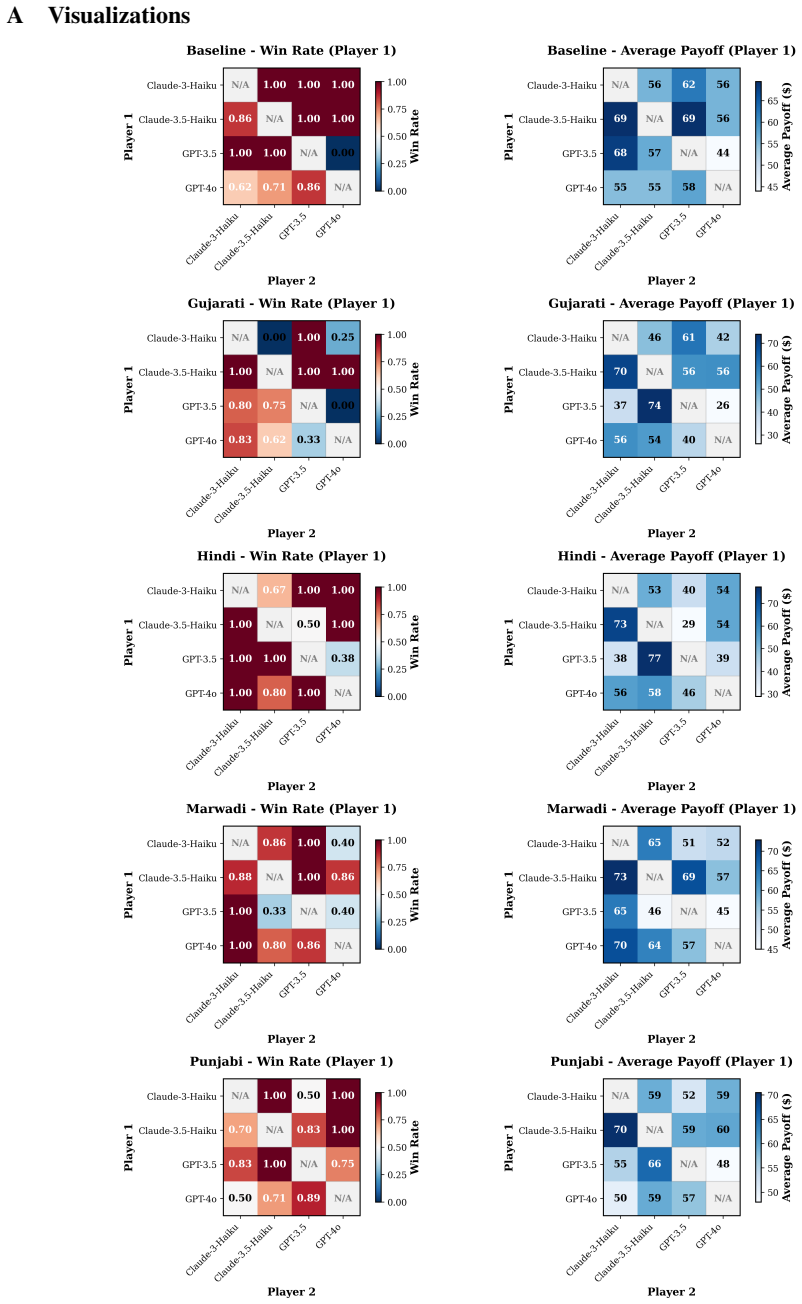
The paper reports three main empirical claims. First, instructing LLM agents to 'speak and bargain only in [language]' changes negotiation outcomes even though game rules, temperature, and incentives are fixed; in the Buy-Sell game, the English baseline gives buyers an average advantage of 13.1 while Marwadi gives sellers an advantage of 12.3, a full reversal. Second, the effect is task-contingent: Indic framings lower acceptance and stability in distributive games (Ultimatum, Buy-Sell) but increase trade volume and exploration in the integrative Resource Exchange game. Third, the pattern is consistent with stereotype activation in training data—Marwadi's trader stereotype yields disciplined
What carries the argument
The central object is the language-framing prompt—'You speak and bargain only in [language]'—used as a controlled intervention while everything else stays fixed. Three game structures (ultimatum, buy-sell, resource exchange) provide the test bed, and the evaluative machinery is a set of objective metrics: acceptance rate, player payoffs, win rate, conversation rounds, plus game-specific buyer/seller advantage and trade volume. The hypothesized mechanism is that training data encodes cultural scripts and stereotypes that language labels activate, making language a latent policy prior that can outweigh model identity.
Load-bearing premise
The claim rests on the assumption that the only thing changing between conditions is the language label in the system prompt; the paper does not verify that models actually produce text in the requested language (especially Marwadi), and the label 'Marwadi' may activate cultural stereotypes rather than linguistic structure—an issue acknowledged in the limitations but not controlled.
What would settle it
Transcribe and language-tag the actual dialogues from each condition. If the 'Marwadi' and 'Hindi' conditions contain mostly English or Hindi text, or if the outcome differences disappear once you control for the language actually generated, the central claim fails. A second test: replace 'Marwadi' with a matched nonce label or a different community name; if the seller-advantage effect persists, it is stereotype association, not language.
If this is right
- English-only evaluation of LLM negotiation is incomplete and potentially misleading; multilingual, culturally aware evaluation is needed for fair deployment.
- Language choice can be as strong or stronger a control variable than model choice, so benchmark rankings of negotiation ability may depend on the language of the interaction.
- Language effects are task-contingent: a language can reduce stability in distributive games while increasing exploration in integrative ones, so there is no uniform 'multilingual degradation.'
- Simplified negotiation settings expose training-data biases, such as buyer-favoring or seller-favoring scripts, more sharply than complex tasks.
- Cultural stereotypes encoded in training data can dominate task-level reasoning, as when Marwadi framing reverses buyer-seller advantages across all model pairings.
Where Pith is reading between the lines
- The 'language' effect may actually be a stereotype-label effect: a natural test is to use nonce language names or matched cultural labels, which would separate linguistic structure from label-triggered associations.
- If language is a latent policy prior, real-world deployment of LLMs in e-commerce or customer-service negotiations in Indian languages could systematically shift prices and surplus in ways English-only evaluations would miss.
- Prompt language could become a cheap intervention to rebalance negotiation outcomes—for example, reducing buyer exploitation by changing the negotiated language—without retraining models.
- The paper's claim that Marwadi's effect 'cannot be explained linguistically' because Marwadi is similar to Hindi is under-determined without measuring what language the models actually generate; that measurement is the missing link.
Editorial analysis
A structured set of objections, weighed in public.
Referee Report
Summary. The paper investigates whether the language of a negotiation prompt (English vs. Hindi, Punjabi, Gujarati, Marwadi) acts as a latent policy prior in LLM negotiations. Using three games (Ultimatum, Buy-Sell, Resource Exchange) with paired model matchups across four LLMs, it reports language-conditioned differences in acceptance rates, payoffs, win rates, and trade volumes. The central claim is that language choice can shift negotiation outcomes more strongly than changing the underlying model, reversing proposer advantages and reallocating surplus. The paper also proposes task-contingent effects: Indic languages reduce stability in distributive games but increase exploration in integrative settings. However, the evidence presented does not support the strongest claims, and the experimental design conflates language with cultural stereotyping through the language label.
Significance. If the findings were robust, they would constitute a useful contribution to multilingual LLM evaluation, highlighting that English-only benchmarks may miss systematic behavioral variation. The controlled simulation framework — 3,600 runs, fixed incentives, multiple models — is a sound methodological starting point. However, the central 'stronger than model' claim is contradicted by the paper's own numbers, no statistical significance testing is reported, and the language manipulation is not verified. As a result, the paper's headline conclusions are not currently supported.
major comments (3)
- [§5.4 vs. Tables 1–2] The abstract and conclusion claim that language choice can shift outcomes 'more strongly than changing models.' This is directly contradicted by the paper's own numbers. In the Ultimatum Game, GPT-3.5 as Player 1 against GPT-4o achieves a payoff of 44, compared to ~56 for stronger models (§5.4), a model gap of ~12 payoff units. In Table 1, the cross-language range in Player 1 payoff is only from 51.64 (Hindi) to 59.27 (Marwadi), i.e., ~7.6 units. In Buy-Sell, the seller advantage gap between GPT-4o (19.3–20.5) and GPT-3.5 (-7.5 to -12.1) is over 30 points (§5.4), while the cross-language range in Table 2 is only 6.89 (English) to 12.32 (Marwadi), i.e., ~5.4 units. Thus, the paper's own data show that model identity dominates language effects, contradicting the paper's primary claim.
- [Tables 1–3 and §5.1.3, §5.2.3, §5.3.3] No significance tests are reported for any of the cross-language or cross-model differences. The results are presented as means ± standard deviations, and many differences are small relative to the reported dispersion (e.g., Table 1 P1 payoff ranges from 51.64 to 59.27 with SDs around 16–26; Table 2 seller advantage differs by ~5 with SDs around 8–12). Without confidence intervals, hypothesis tests, or effect sizes, claims such as 'strongly supported' (P3), 'complete reversal', and 'cross-model consistency' are not statistically grounded. The 10 runs per condition may be insufficient to support the granular model-pair claims in §5.4, yet the paper does not quantify uncertainty for those comparisons.
- [§4.1, §4.3, §7] The language manipulation is not verified. The only manipulation is the system prompt 'You speak and bargain only in [language]' (§4.1). The paper logs full dialogues (§4.3) but never reports any check that models actually generated text in the target language, especially Marwadi, a low-resource variety. Moreover, the label 'Marwadi' is both a language and a culturally loaded community label; prediction P3 (§3.2) explicitly anticipates stereotype activation, and the results in §5.1.3 and §5.2.3 interpret Marwadi effects as stereotype-driven. This design perfectly confounds the linguistic channel with the cultural stereotype activated by the label. A label-only control (e.g., 'You are a Marwadi trader' without changing the language) would be needed to separate these. The limitation in §7 acknowledges the cultural attribution issue but does not control for the confound. Consequently, the c
minor comments (3)
- [Tables 2–3] Win rate columns in Tables 2 and 3 lack standard deviations, while Table 1 reports them. This inconsistency makes it harder to assess the stability of win-rate estimates, which are aggregated across model pairings.
- [§5.1.3] The text states Hindi acceptance is 87.2% and Gujarati 92.0%, but Table 1 reports 87.61% and 92.45%. Please align the numbers.
- [References] Some reference formatting issues: 'mingyu jeon and Suh' should be capitalized as 'Jeon and Suh'; 'V olume' in Table 3 appears to be a spacing typo. Also, the paper should ensure consistent spelling of 'Marwadi' (sometimes written 'Marwari' in the literature).
Circularity Check
No equations or fitted parameters; the circularity is at the construct level: the Marwadi 'language effect' is the stereotype-bearing label itself, so P3 is confirmed by construction.
specific steps
-
self definitional
[§3.1–§3.2 (P3), §4.1 system prompt, §5.1.3/§5.2.3/§5.2.4]
"The persona prompts are: "You speak and bargain only in [language]. Negotiate accordingly." ... P3 (Stereotype Activation): Marwadi linguistic framing produces better advantages, reflecting potential trader class stereotypes ... Marwadi doesn’t just shift outcomes ... This cannot be explained linguistically (Marwadi is similar to Hindi) and directly reflects stereotype-driven behavioral scripts from training data."
The independent variable is the label placed in the system prompt; the paper never verifies the model actually generated Marwadi text. The label 'Marwadi' was selected in §3.1 because Marwadi communities 'are stereotypically portrayed as shrewd traders.' Thus the observed Marwadi seller advantage is an effect of the stereotype-bearing label, i.e., the manipulation itself. The authors' P3 predicts exactly this stereotype activation from the same label, and §5.2.4 admits the result 'cannot be explained linguistically.' Therefore the headline claim that language acts as a latent policy prior reduces, for the Marwadi cases, to the fact that a culturally loaded word was inserted into the prompt; no independent linguistic channel is demonstrated.
full rationale
The paper contains no fitted parameters, no derived equations, and no self-citation chain; most of its empirical comparisons (Hindi vs English, task-contingent effects, model capacity effects) are legitimate hypothesis tests. However, the Marwadi-specific evidence—used in the abstract and conclusion as a central demonstration that linguistic framing reverses outcomes—is operationally confounded: the 'language' manipulation is just the label, and the label was chosen for its stereotype. The authors' own statement that the result 'cannot be explained linguistically' confirms that the Marwadi effect is not a measured language property. This is a partial, construct-level circularity, not a formal derivation-level one, so the score is 4 rather than 6–8. The remaining limitations (no manipulation check, limited games) are validity concerns rather than circularity.
Axiom & Free-Parameter Ledger
axioms (3)
- domain assumption LLM training data encodes cultural and linguistic behavioral priors that are activated by language labels.
- ad hoc to paper The four models always follow the language instruction and generate meaningful text in the specified Indic language.
- domain assumption The NegotiationArena games and metrics capture negotiation behavior relevant to the claims.
Cite this review
Pith. "Pith review of The Language of Bargaining: Linguistic Effects in LLM Negotiations." pith.science (2026). https://pith.science/paper/PCENR6CX
@misc{pith2026260104387,
  author       = {Pith},
  title        = {Pith review of: The Language of Bargaining: Linguistic Effects in LLM Negotiations},
  year         = {2026},
  howpublished = {\url{https://pith.science/paper/PCENR6CX}},
  note         = {Machine review of arXiv:2601.04387}
}
read the original abstract
Negotiation is a core component of social intelligence, requiring agents to balance strategic reasoning, cooperation, and social norms. Recent work shows that LLMs can engage in multi-turn negotiation, yet nearly all evaluations occur exclusively in English. Using controlled multi-agent simulations across Ultimatum, Buy-Sell, and Resource Exchange games, we systematically isolate language effects across English and four Indic framings (Hindi, Punjabi, Gujarati, Marwadi) by holding game rules, model parameters, and incentives constant across all conditions. We find that language choice can shift outcomes more strongly than changing models, reversing proposer advantages and reallocating surplus. Crucially, effects are task-contingent: Indic languages reduce stability in distributive games yet induce richer exploration in integrative settings. Our results demonstrate that evaluating LLM negotiation solely in English yields incomplete and potentially misleading conclusions. These findings caution against English-only evaluation of LLMs and suggest that culturally-aware evaluation is essential for fair deployment.
Figures




Reference graph
Works this paper leans on
-
[1]
online" 'onlinestring :=
ENTRY address archivePrefix author booktitle chapter edition editor eid eprint eprinttype howpublished institution journal key month note number organization pages publisher school series title type volume year doi pubmed url lastchecked label extra.label sort.label short.list INTEGERS output.state before.all mid.sentence after.sentence after.block STRING...
-
[2]
write newline
" write newline "" before.all 'output.state := FUNCTION n.dashify 't := "" t empty not t #1 #1 substring "-" = t #1 #2 substring "--" = not "--" * t #2 global.max substring 't := t #1 #1 substring "-" = "-" * t #2 global.max substring 't := while if t #1 #1 substring * t #2 global.max substring 't := if while FUNCTION word.in bbl.in capitalize " " * FUNCT...
-
[3]
Federico Bianchi, Patrick John Chia, Mert Yuksekgonul, Jacopo Tagliabue, Dan Jurafsky, and James Zou. 2024. https://arxiv.org/abs/2402.05863 How well can llms negotiate? negotiationarena platform and analysis . In Proceedings of the 41st International Conference on Machine Learning, ICML'24. JMLR.org
Pith/arXiv arXiv 2024
-
[4]
Tolga Bolukbasi, Kai-Wei Chang, James Y Zou, Venkatesh Saligrama, and Adam T Kalai. 2016. https://arxiv.org/abs/1607.06520 Man is to computer programmer as woman is to homemaker? debiasing word embeddings . Advances in neural information processing systems, 29
Pith/arXiv arXiv 2016
-
[5]
Jeanne M Brett. 2007. Negotiating globally: How to negotiate deals, resolve disputes, and make decisions across cultural boundaries. John Wiley & Sons
2007
-
[6]
Cohen, Zhe Su, Hsien-Te Kao, Daniel Nguyen, Spencer Lynch, Maarten Sap, and Svitlana Volkova
Myke C. Cohen, Zhe Su, Hsien-Te Kao, Daniel Nguyen, Spencer Lynch, Maarten Sap, and Svitlana Volkova. 2025. https://arxiv.org/abs/2506.15928 Exploring big five personality and ai capability effects in llm-simulated negotiation dialogues . Preprint, arXiv:2506.15928
Pith/arXiv arXiv 2025
-
[7]
Arid Hasan, Imran Razzak, and Usman Naseem
Krishno Dey, Prerona Tarannum, Md. Arid Hasan, Imran Razzak, and Usman Naseem. 2024. https://arxiv.org/abs/2410.13153 Better to ask in english: Evaluation of large language models on english, low-resource and cross-lingual settings . Preprint, arXiv:2410.13153
Pith/arXiv arXiv 2024
-
[8]
Edward T Hall. 1976. Beyond culture. Anchor
1976
-
[9]
He He, Derek Chen, Anusha Balakrishnan, and Percy Liang. 2018. https://doi.org/10.18653/v1/D18-1256 Decoupling strategy and generation in negotiation dialogues . In Proceedings of the 2018 Conference on Empirical Methods in Natural Language Processing, pages 2333--2343, Brussels, Belgium. Association for Computational Linguistics
-
[10]
Mourad Heddaya, Solomon Dworkin, Chenhao Tan, Rob Voigt, and Alexander Zentefis. 2023. https://doi.org/10.18653/v1/2023.acl-long.735 Language of bargaining . In Proceedings of the 61st Annual Meeting of the Association for Computational Linguistics (Volume 1: Long Papers), pages 13161--13185, Toronto, Canada. Association for Computational Linguistics
-
[11]
Yuncheng Hua, Lizhen Qu, and Reza Haf. 2024. https://doi.org/10.18653/v1/2024.findings-emnlp.473 Assistive large language model agents for socially-aware negotiation dialogues . In Findings of the Association for Computational Linguistics: EMNLP 2024, pages 8047--8074, Miami, Florida, USA. Association for Computational Linguistics
-
[12]
Deuksin Kwon, Emily Weiss, Tara Kulshrestha, Kushal Chawla, Gale Lucas, and Jonathan Gratch. 2024. https://doi.org/10.18653/v1/2024.findings-emnlp.310 Are LLM s effective negotiators? systematic evaluation of the multifaceted capabilities of LLM s in negotiation dialogues . In Findings of the Association for Computational Linguistics: EMNLP 2024, pages 53...
-
[13]
Mike Lewis, Denis Yarats, Yann Dauphin, Devi Parikh, and Dhruv Batra. 2017. https://doi.org/10.18653/v1/D17-1259 Deal or no deal? end-to-end learning of negotiation dialogues . In Proceedings of the 2017 Conference on Empirical Methods in Natural Language Processing, pages 2443--2453, Copenhagen, Denmark. Association for Computational Linguistics
-
[14]
mingyu jeon and Jae Young Suh. 2024. https://openreview.net/forum?id=j7RkeNqSDo Mimicking human emotions: Persona-driven behavior of LLM s in the buy and sell negotiation game . In Language Gamification - NeurIPS 2024 Workshop
2024
-
[15]
Ryan Shea, Aymen Kallala, Xin Lucy Liu, Michael W. Morris, and Zhou Yu. 2024. https://doi.org/10.18653/v1/2024.emnlp-main.709 ACE : A LLM -based negotiation coaching system . In Proceedings of the 2024 Conference on Empirical Methods in Natural Language Processing, pages 12720--12749, Miami, Florida, USA. Association for Computational Linguistics
-
[16]
Harman Singh, Nitish Gupta, Shikhar Bharadwaj, Dinesh Tewari, and Partha Talukdar. 2024. https://doi.org/10.18653/v1/2024.acl-long.595 I ndic G en B ench: A multilingual benchmark to evaluate generation capabilities of LLM s on I ndic languages . In Proceedings of the 62nd Annual Meeting of the Association for Computational Linguistics (Volume 1: Long Pap...
-
[17]
Thomas A Timberg. 1978. The Marwaris: From traders to industrialists. Vikas Publishing House
1978
-
[18]
Michelle Vaccaro, Michael Caosun, Harang Ju, Sinan Aral, and Jared R. Curhan. 2025. https://arxiv.org/abs/2503.06416 Advancing ai negotiations: New theory and evidence from a large-scale autonomous negotiations competition . Preprint, arXiv:2503.06416
arXiv 2025
discussion (0)
Sign in with ORCID, Apple, or X to comment. Anyone can read and Pith papers without signing in.