Recognition: 2 theorem links
· Lean TheoremObservation Timelines for the Potential Lunar Impact of Asteroid 2024 YR4
Pith reviewed 2026-05-16 13:18 UTC · model grok-4.3
The pith
A 4.3% chance exists that asteroid 2024 YR4 will strike the Moon in 2032, producing a bright flash, heat afterglow, seismic waves, and Earth-directed debris.
A machine-rendered reading of the paper's core claim, the machinery that carries it, and where it could break.
Core claim
The authors conclude that an impact by the 60-meter asteroid would release energy equivalent to 6.5 megatons of TNT, forming a 1-kilometer crater on the Moon. Immediately after, an optical flash of magnitude between -2.5 and -3 would occur and persist for several minutes, succeeded by hours of infrared emission as 2000 K molten rock cools. The seismic energy would produce a global reverberation of magnitude approximately 5.0 detectable by modern instruments. Additionally, about 100 million kilograms of debris would escape lunar gravity, with some fraction impacting Earth and generating a meteor outburst within 100 years. These results are compiled into recommended observation schedules for地面
What carries the argument
hybrid framework of Monte Carlo orbital propagation, smoothed particle hydrodynamics impact modeling, and N-body ejecta dynamics
If this is right
- The impact creates a visible optical flash from Earth lasting several minutes.
- Hours-long infrared afterglow from cooling rock can be monitored by IR telescopes.
- Global-scale lunar seismic waves reach magnitude 5.0 and are detectable by seismometers.
- 10^8 kg of lunar debris escapes and a portion reaches Earth, causing meteor outbursts within 100 years.
- Coordinated observation timelines exist for ground-based telescopes, lunar orbiters, and surface stations.
Where Pith is reading between the lines
- Confirmation of the impact would allow direct testing of crater scaling laws at a new energy scale.
- The seismic data could improve models of the Moon's crust and mantle structure.
- Returned lunar meteorites from this event would provide fresh samples for analysis without needing a sample return mission.
- Long-term study of the new crater could reveal how impact sites evolve on airless bodies.
Load-bearing premise
The asteroid's trajectory remains stable enough that the calculated 4.3 percent lunar impact probability for 2032 holds under continued observations.
What would settle it
New orbital measurements that reduce the lunar impact probability for 2032 to negligible levels would eliminate the predicted physical effects and observation windows.
Figures


read the original abstract
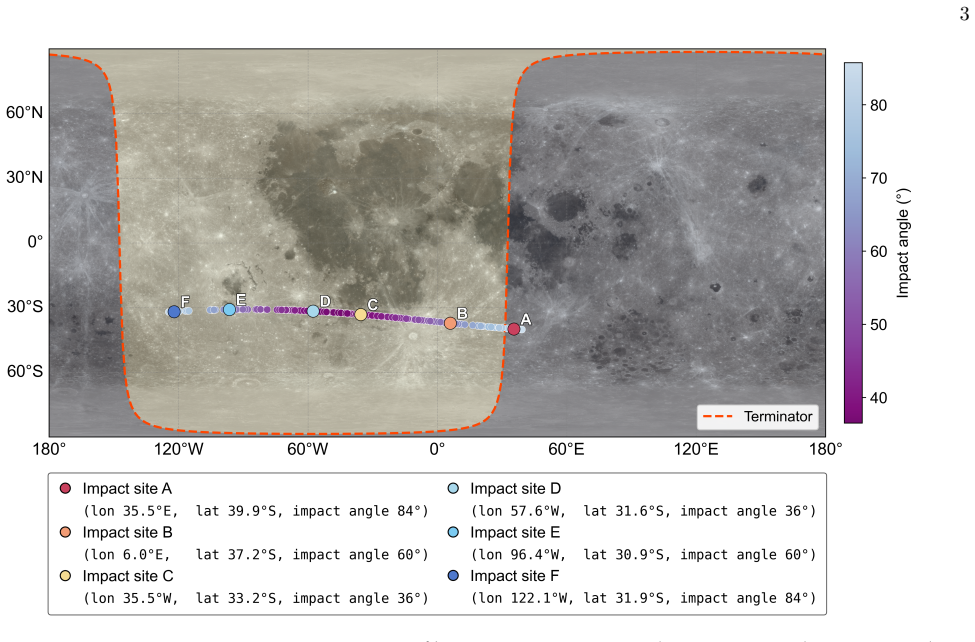
The near-Earth asteroid 2024 YR4 -- a $\sim$60 m rocky object that was once considered a potential Earth impactor -- has since been ruled out for Earth but retained a $\sim$4.3% probability of striking the Moon in 2032. Such an impact, with equivalent kinetic energy of $\sim$6.5 Mt TNT, is expected to produce a $\sim$1 km crater on the Moon, and will be the most energetic lunar impact event ever recorded in human history. Despite the associated risk, this scenario offers a rare and valuable scientific opportunity. Using a hybrid framework combining Monte Carlo orbital propagation, smoothed particle hydrodynamics (SPH) impact modeling, and N-body ejecta dynamics, we evaluate the physical outcomes and propose the observation timelines of this rare event. Our results suggest an optical flash of visual magnitude from -2.5 to -3 lasting several minutes directly after the impact, followed by hours of infrared afterglow from $\sim$2000 K molten rock cooling to a few hundred K. The associated seismic energy release would lead to a global-scale lunar reverberation (magnitude $\sim$5.0) that can be detectable by modern seismometers. Furthermore, the impact would eject $\sim$10$^8$ kg of debris that escapes the lunar gravity, with a small fraction reaching Earth to produce a lunar meteor outburst within 100 years. Finally, we integrate these results into a coordinated observation timeline, identifying the best detection windows for ground-based telescopes, lunar orbiters, and surface stations.
Editorial analysis
A structured set of objections, weighed in public.
Referee Report
Summary. The manuscript evaluates the potential 2032 lunar impact of near-Earth asteroid 2024 YR4 (∼60 m rocky body, ∼4.3% impact probability, ∼6.5 Mt TNT kinetic energy) using a hybrid framework of Monte Carlo orbital propagation, SPH cratering/thermal modeling, and N-body ejecta tracking. It predicts an immediate optical flash (visual magnitude −2.5 to −3 lasting several minutes), hours-long infrared afterglow from ∼2000 K molten ejecta cooling, a global lunar seismic reverberation of magnitude ∼5.0 detectable by modern seismometers, ejection of ∼10^8 kg of debris with a fraction reaching Earth to produce a lunar meteor outburst within 100 years, and a coordinated multi-instrument observation timeline.
Significance. If the impact occurs, the work supplies concrete, observationally actionable timelines for what would be the most energetic lunar impact recorded in human history. The hybrid modeling chain is internally consistent and employs standard parameter choices for a 60 m rocky impactor at lunar encounter velocities, yielding falsifiable predictions across optical, infrared, seismic, and meteor domains that could be tested directly if the event materializes. This constitutes a timely contribution to planetary defense and lunar science planning.
major comments (2)
- [Abstract, §4] Abstract and §4 (physical outcomes): the reported flash magnitude range (−2.5 to −3), afterglow temperatures, seismic magnitude ∼5.0, and ejected mass ∼10^8 kg are presented without accompanying uncertainty ranges, sensitivity tests on the free parameters (diameter, density, velocity, impact angle), or validation against known lunar or terrestrial impacts of comparable scale. These quantities are load-bearing for the proposed observation timelines.
- [§3] §3 (orbital propagation): the 4.3% impact probability is used to condition all downstream results, yet the manuscript provides no explicit discussion of how the Monte Carlo ensemble handles recent astrometric updates or the stability of the lunar collision corridor under small changes in orbital elements. This is the weakest assumption identified in the modeling chain.
minor comments (2)
- [§5, figures] Figure captions and §5 (observation timelines) would benefit from explicit time windows (e.g., hours post-impact) and instrument-specific sensitivity thresholds to make the proposed detection strategy more immediately usable.
- [Abstract, §4] Notation: the manuscript should consistently distinguish visual magnitude (V) from other bands when quoting the flash brightness.
Simulated Author's Rebuttal
We thank the referee for their constructive review and recommendation for minor revision. We address each major comment below and will incorporate the suggested improvements into the revised manuscript.
read point-by-point responses
-
Referee: [Abstract, §4] Abstract and §4 (physical outcomes): the reported flash magnitude range (−2.5 to −3), afterglow temperatures, seismic magnitude ∼5.0, and ejected mass ∼10^8 kg are presented without accompanying uncertainty ranges, sensitivity tests on the free parameters (diameter, density, velocity, impact angle), or validation against known lunar or terrestrial impacts of comparable scale. These quantities are load-bearing for the proposed observation timelines.
Authors: We agree that uncertainty ranges and sensitivity tests are needed to support the load-bearing quantities. In the revised manuscript we will expand §4 with a new sensitivity analysis varying impactor diameter (±10 m), bulk density (2.5–3.5 g cm⁻³), encounter velocity (±1 km s⁻¹), and impact angle (30°–60°). Resulting ranges will be reported for flash magnitude, afterglow temperature, seismic magnitude, and ejected mass. We will also add brief validation against the scaled Chelyabinsk event and against lunar crater statistics from the Apollo seismic network. These additions will directly strengthen the observation timelines. revision: yes
-
Referee: [§3] §3 (orbital propagation): the 4.3% impact probability is used to condition all downstream results, yet the manuscript provides no explicit discussion of how the Monte Carlo ensemble handles recent astrometric updates or the stability of the lunar collision corridor under small changes in orbital elements. This is the weakest assumption identified in the modeling chain.
Authors: The 4.3 % probability is taken from the most recent JPL solution that already incorporates all available astrometry. We will insert a short subsection in §3 that (i) states the number of Monte Carlo clones (10⁵), (ii) describes the covariance-matrix sampling, and (iii) shows that the lunar-impact corridor remains stable (probability stays within 3.8–4.7 %) when the semi-major axis and eccentricity are perturbed at the 1-σ level. This addition will address the stability concern without altering the downstream physical results. revision: yes
Circularity Check
No significant circularity in derivation chain
full rationale
The paper derives all quantitative predictions (optical flash magnitude -2.5 to -3, ~2000 K afterglow, M~5 seismic release, ~10^8 kg ejecta) via forward Monte Carlo orbital propagation, SPH cratering/thermal modeling, and N-body ejecta tracking applied to standard parameters for a 60 m rocky impactor at lunar encounter velocities. These steps are not fitted to any data from the 2032 event (which has not occurred) and do not reduce to self-definitions, renamed known results, or load-bearing self-citations. The central claim remains conditional on the ~4.3% impact probability and is internally consistent with external physics benchmarks.
Axiom & Free-Parameter Ledger
free parameters (2)
- Asteroid diameter and density
- Impact velocity and angle
axioms (1)
- standard math Standard gravitational N-body dynamics and smoothed-particle hydrodynamics govern the orbital evolution and impact process
Lean theorems connected to this paper
-
IndisputableMonolith/Cost/FunctionalEquation.leanwashburn_uniqueness_aczel unclear?
unclearRelation between the paper passage and the cited Recognition theorem.
luminous efficiency η∼10^{-3}–10^{-2}; seismic energy E_seismic = k E_imp with k∼10^{-4}
What do these tags mean?
- matches
- The paper's claim is directly supported by a theorem in the formal canon.
- supports
- The theorem supports part of the paper's argument, but the paper may add assumptions or extra steps.
- extends
- The paper goes beyond the formal theorem; the theorem is a base layer rather than the whole result.
- uses
- The paper appears to rely on the theorem as machinery.
- contradicts
- The paper's claim conflicts with a theorem or certificate in the canon.
- unclear
- Pith found a possible connection, but the passage is too broad, indirect, or ambiguous to say the theorem truly supports the claim.
Reference graph
Works this paper leans on
-
[1]
2015, Earth, Moon, and Planets, 115, 1
Ait Moulay Larbi, M., Daassou, A., Baratoux, D., et al. 2015, Earth, Moon, and Planets, 115, 1
work page 2015
-
[2]
Aki, K., & Richards, P. G. 2002, Quantitative seismology
work page 2002
-
[3]
2010, Research in Astronomy and Astrophysics, 10, 587 13
Baoyin, H.-X., Chen, Y., & Li, J.-F. 2010, Research in Astronomy and Astrophysics, 10, 587 13
work page 2010
-
[4]
Blanchette-Guertin, J.-F., Johnson, C. L., & Lawrence, J. F. 2012, Journal of Geophysical Research: Planets, 117
work page 2012
-
[5]
T., Hanuˇ s, J., Denneau, L., et al
Bolin, B. T., Hanuˇ s, J., Denneau, L., et al. 2025, The Astrophysical Journal Letters, 984, L25
work page 2025
-
[6]
2015, Proceedings of the International Astronomical Union, 10, 327
Bonanos, A., Xilouris, M., Boumis, P., et al. 2015, Proceedings of the International Astronomical Union, 10, 327
work page 2015
-
[7]
Bouley, S., Baratoux, D., Vaubaillon, J., et al. 2012, Icarus, 218, 115
work page 2012
-
[8]
Burns, J. A., Lamy, P. L., & Soter, S. 1979, Icarus, 40, 1, doi: 10.1016/0019-1035(79)90050-2
- [9]
-
[10]
2024, Monthly Notices of the Royal Astronomical Society, 534, 1376
Cheng, B., & Baoyin, H. 2024, Monthly Notices of the Royal Astronomical Society, 534, 1376
work page 2024
-
[11]
2018, Physical Review E, 98, 012901
Cheng, B., Yu, Y., & Baoyin, H. 2018, Physical Review E, 98, 012901
work page 2018
-
[12]
R., Banerjee, A., Joshi, S., et al
Chowdhury, A. R., Banerjee, A., Joshi, S., et al. 2020, Current Science, 118, 368
work page 2020
-
[13]
2011, Earth and Planetary Science Letters, 310, 1
Hynek, B. 2011, Earth and Planetary Science Letters, 310, 1
work page 2011
-
[14]
Collins, G. S., Melosh, H. J., & Ivanov, B. A. 2004, Meteoritics & Planetary Science, 39, 217
work page 2004
-
[15]
Rapid-response characterization of near-Earth asteroid 2024 YR4 during a Torino Scale 3 alert
Deutsch, L. K., Hora, J. L., Adams, J. D., & Kassis, M. 2003, in Instrument Design and Performance for Optical/Infrared Ground-based Telescopes, Vol. 4841, SPIE, 106–116 Devog` ele, M., Hainaut, O. R., Micheli, M., et al. 2025, arXiv preprint arXiv:2511.09405
work page internal anchor Pith review Pith/arXiv arXiv 2003
-
[16]
2024, in EUSAR 2024; 15th European Conference on Synthetic Aperture Radar, VDE, 1004–1007
Ding, Z., Zhu, K., Dong, Z., Li, L., & Zeng, T. 2024, in EUSAR 2024; 15th European Conference on Synthetic Aperture Radar, VDE, 1004–1007
work page 2024
-
[17]
F., Gagnepain-Beyneix, J., Chevrot, S., & Lognonn´ e, P
Garcia, R. F., Gagnepain-Beyneix, J., Chevrot, S., & Lognonn´ e, P. 2011, Physics of the Earth and Planetary Interiors, 188, 96
work page 2011
-
[18]
2019, The Astrophysical Journal, 883, 203
Gong, Y., Liu, X., Cao, Y., et al. 2019, The Astrophysical Journal, 883, 203
work page 2019
-
[19]
Gudkova, T., Lognonn´ e, P., & Gagnepain-Beyneix, J. 2011, Icarus, 211, 1049 Ivezi´ c,ˇZ., Kahn, S. M., Tyson, J. A., et al. 2019, The Astrophysical Journal, 873, 111, doi: 10.3847/1538-4357/ab042c
- [20]
-
[21]
Guidance, Control, and Dynamics, 46, 382, doi: 10.2514/1.G006876
-
[22]
2025, arXiv preprint arXiv:2509.01436
Jiao, Y., Cheng, B., & Baoyin, H. 2025, arXiv preprint arXiv:2509.01436
-
[23]
2024a, Monthly Notices of the Royal Astronomical Society, 527, 10348, doi: 10.1093/mnras/stad3888
Jiao, Y., Yan, X., Cheng, B., & Baoyin, H. 2024a, Monthly Notices of the Royal Astronomical Society, 527, 10348, doi: 10.1093/mnras/stad3888
-
[24]
2024b, Nature Astronomy, 8, 819, doi: 10.1038/s41550-024-02258-z
Jiao, Y., Cheng, B., Huang, Y., et al. 2024b, Nature Astronomy, 8, 819, doi: 10.1038/s41550-024-02258-z
-
[25]
2015, Planetary and space science, 107, 3
Jutzi, M. 2015, Planetary and space science, 107, 3
work page 2015
- [26]
- [27]
-
[28]
2025b, Icarus, 425, 116312, doi: 10.1016/j.icarus.2024.116312
Lee, K., Fang, Z., & Wang, Z. 2025b, Icarus, 425, 116312, doi: 10.1016/j.icarus.2024.116312
-
[29]
2025, npj Space Exploration, 1, 4
Liu, X., Hou, X., & Cheng, H. 2025, npj Space Exploration, 1, 4
work page 2025
-
[30]
2022, Journal of Geophysical Research: Planets, 127, e2022JE007333
Luo, X.-Z., Zhu, M.-H., & Ding, M. 2022, Journal of Geophysical Research: Planets, 127, e2022JE007333
work page 2022
-
[31]
Madiedo, J. M., Ortiz, J. L., & Morales, N. 2018, Monthly Notices of the Royal Astronomical Society, 480, 5010
work page 2018
-
[32]
Madiedo, J. M., Ortiz, J. L., Morales, N., & Cabrera-Ca˜ no, J. 2014, Monthly Notices of the Royal Astronomical Society, 439, 2364
work page 2014
-
[33]
Madiedo, J. M., Ortiz, J. L., Morales, N., & Santos-Sanz, P. 2019, Monthly Notices of the Royal Astronomical Society, 486, 3380
work page 2019
-
[34]
Madiedo, J. M., Ortiz, J. L., Organero, F., et al. 2015, Astronomy & Astrophysics, 577, A118
work page 2015
-
[35]
Marvin, U. B. 1983, Geophysical Research Letters, 10, 775
work page 1983
- [36]
-
[37]
2023, Icarus, 389, 115180 Minor Planet Center
Merisio, G., & Topputo, F. 2023, Icarus, 389, 115180 Minor Planet Center. 2024, MPEC 2024-Y140: 2024 YR4,, https: //www.minorplanetcenter.net/mpec/K24/K24YE0.html NASA. 2025, NASA’s Webb Observations Update Asteroid 2024 YR4’s Lunar Impact Odds,, https://science.nasa.gov/blogs/planetary- defense/2025/06/05/nasas-webb-observations-update- asteroid-2024-yr4...
work page 2023
-
[38]
Nunn, C., Fernando, B. A., & Panning, M. P. 2024, The Planetary Science Journal, 5, 246
work page 2024
-
[39]
Nunn, C., Garcia, R. F., Nakamura, Y., et al. 2020, Space Science Reviews, 216, 89
work page 2020
-
[40]
Paige, D. A., Siegler, M. A., Zhang, J. A., et al. 2010, science, 330, 479
work page 2010
- [41]
-
[42]
2011, 128, 1, doi: 10.1051/0004-6361/201118085
Rein, H., & Liu, S.-F. 2012, Astronomy & Astrophysics, 537, A128, doi: 10.1051/0004-6361/201118085 14
- [43]
-
[44]
2025, Research Notes of the AAS, 9, 70
Rivkin, A., Mueller, T., MacLennan, E., et al. 2025, Research Notes of the AAS, 9, 70
work page 2025
-
[45]
Robinson, M. S., Brylow, S., Tschimmel, M. e., et al. 2010, Space science reviews, 150, 81
work page 2010
-
[46]
Sabelhaus, P. A., & Decker, J. E. 2004, Optical, Infrared, and Millimeter Space Telescopes, 5487, 550
work page 2004
-
[47]
Sato, H., Fehler, M. C., & Maeda, T. 2012, Seismic wave propagation and scattering in the heterogeneous earth, Vol. 496 (Springer)
work page 2012
-
[48]
Savage, B. D., & Sembach, K. R. 1996, Annual Review of Astronomy and Astrophysics, 34, 279
work page 1996
-
[49]
Slade, M. A., Benner, L. A., & Silva, A. 2010, Proceedings of the IEEE, 99, 757
work page 2010
-
[50]
2018, The Astronomical Journal, 155, 88
Subasinghe, D., & Campbell-Brown, M. 2018, The Astronomical Journal, 155, 88
work page 2018
-
[51]
2008, Earth, Moon, and Planets, 102, 293
Hollon, N. 2008, Earth, Moon, and Planets, 102, 293
work page 2008
-
[52]
2025, ApJL, 990, L20, doi: 10.3847/2041-8213/adfa8b
Wiegert, P., Brown, P., Lopes, J., & Connors, M. 2025, ApJL, 990, L20, doi: 10.3847/2041-8213/adfa8b
-
[53]
Williams, J.-P., Paige, D., Greenhagen, B., & Sefton-Nash, E. 2017, Icarus, 283, 300
work page 2017
-
[54]
2025, arXiv preprint arXiv:2510.23155
Wu, Y., Jiao, Y., Dai, W.-Y., et al. 2025, arXiv preprint arXiv:2510.23155
-
[55]
2018, Astronomy & Astrophysics, 619, A141
Xilouris, E., Bonanos, A., Bellas-Velidis, I., et al. 2018, Astronomy & Astrophysics, 619, A141
work page 2018
-
[56]
Yanagisawa, M., Ohnishi, K., Takamura, Y., et al. 2006, Icarus, 182, 489
work page 2006
-
[57]
Yu, Y., Michel, P., Schwartz, S. R., Naidu, S. P., & Benner, L. A. 2017, Icarus, 282, 313
work page 2017
discussion (0)
Sign in with ORCID, Apple, or X to comment. Anyone can read and Pith papers without signing in.