Recognition: 2 theorem links
· Lean TheoremOn the role of gravity, turbulence, and the magnetic field in angular momentum transfer within molecular clouds
Pith reviewed 2026-05-16 13:00 UTC · model grok-4.3
The pith
Hydrodynamic torques exceed gravitational, magnetic, and pressure torques in magnitude for angular momentum transfer in simulated molecular clouds.
A machine-rendered reading of the paper's core claim, the machinery that carries it, and where it could break.
Core claim
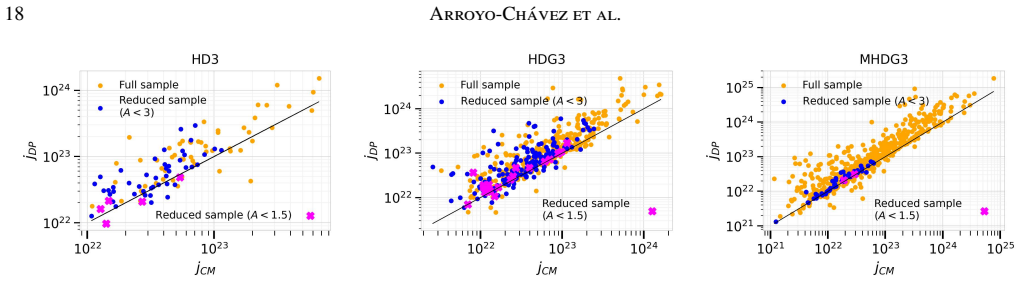
In the simulations, hydrodynamic torques have the largest magnitudes compared to gravitational, magnetic, and pressure-gradient torques on the clumps. This supports the view that gravity drives cloud formation and contraction while turbulence redistributes angular momentum through exchanges between fluid parcels.
What carries the argument
Hydrodynamic torques (incorporating turbulent viscosity) measured on clumps extracted from the SPH simulations with varying physics.
If this is right
- The j ~ R^{3/2} relation is reproduced most accurately by the gravity-plus-turbulence simulation when using only clumps with aspect ratio below 3.
- Purely hydrodynamic simulations produce no dense elongated structures, showing turbulence alone cannot generate filaments.
- Adding the magnetic field creates mostly filamentary clumps, where the full sample may appear to follow the relation only due to competing increases in j from geometry and decreases from suppressed turbulence.
- Hydrodynamic torques being largest in magnitude indicates turbulence is the main agent redistributing angular momentum at clump scales.
Where Pith is reading between the lines
- If hydrodynamic torques dominate, cloud evolution models should emphasize turbulent mixing over magnetic braking for angular momentum transport.
- The sample split implies that observations limited to rounder clumps may more reliably trace the underlying physical scaling without geometric bias.
- Varying magnetic field strength in follow-up simulations could reveal whether stronger fields further reduce hydrodynamic torque contributions.
Load-bearing premise
The definitions of full and reduced clump samples by aspect ratio cleanly separate geometric effects from physical torque effects without selection bias that alters the apparent j-R relation.
What would settle it
Direct measurements from high-resolution observations of molecular cloud velocity fields showing gravitational or magnetic torques exceeding hydrodynamic torques in magnitude would falsify the dominance result.
Figures



read the original abstract
Observations of molecular structures on scales of $\sim 0.1-50$ pc show that the specific angular momentum ($j$) scales with radius ($R$) as $j\sim R^{3/2}$. We study the effects of turbulence, gravity, and the magnetic field in shaping this scaling, by measuring clump size and specific angular momentum in three SPH simulations of the formation of giant molecular clouds, progressively adding these three ingredients. In each simulation, we define ``full'' and ``reduced'' clump samples, the latter restricted to aspect ratios $A<3$. We find that, in the non-magnetic runs, elongated clumps deviate the most from the \jR\ relation, which is best reproduced by the reduced sample in the gravity+turbulence run. In the purely hydrodynamic case, no dense elongated structures form, suggesting that turbulence alone is insufficient to generate dense filaments, although clumps have $j$ magnitudes consistent with observations. In the gravity+turbulence+magnetic field run, most of the clumps are filamentary, yet the full sample appears to follow the observed \jR\ relation. This result, rather than being a real trend, could be the combination of the increase in $j$ by the filamentary geometry, and its reduction by turbulence inhibition by the magnetic field. Finally, we measure the gravitational, magnetic, pressure-gradient, and hydrodynamic torques (which involve turbulent viscosity) in our clump samples. We find that, in magnitude, the hydrodynamic torques tend to be larger than the rest. This result is consistent with our previous work, where we proposed that gravity drives cloud formation and contraction, while turbulence redistributes angular momentum through fluid-parcel exchanges.
Editorial analysis
A structured set of objections, weighed in public.
Referee Report
Summary. The paper uses three SPH simulations of giant molecular cloud formation (hydrodynamic, gravity+turbulence, and gravity+turbulence+magnetic) to examine how these ingredients shape the observed j ~ R^{3/2} scaling of specific angular momentum with clump radius. Clumps are identified in full and reduced (aspect ratio A<3) samples; the reduced sample in the gravity+turbulence run best matches the observed relation, while the magnetic run produces mostly filamentary clumps whose apparent compliance is attributed to geometric j boost offset by magnetic suppression of turbulence. Torque measurements show hydrodynamic (turbulent-viscosity) torques dominating in magnitude over gravitational, magnetic, and pressure-gradient torques, interpreted as consistent with gravity driving contraction and turbulence redistributing angular momentum via fluid-parcel exchanges.
Significance. If the torque-dominance result survives quantitative checks, the work would strengthen the picture that turbulence, rather than magnetic or gravitational torques, is the primary agent redistributing angular momentum inside molecular clouds, with direct implications for models of cloud evolution and star formation. The progressive inclusion of physics across runs is a clear methodological strength, but the absence of error bars, convergence tests, and torque histograms currently limits the strength of the central claim.
major comments (2)
- [Abstract] Abstract (torque paragraph): the statement that 'in magnitude, the hydrodynamic torques tend to be larger than the rest' is presented without histograms, time-averaged values, uncertainties, or resolution checks. Because the comparison uses the same full/reduced samples as the j-R analysis, and the magnetic run is dominated by A>3 filaments that are excluded from the reduced sample, the reported dominance could be an artifact of the A<3 cut rather than a physical result.
- [Abstract] Abstract (j-R discussion for magnetic run): the interpretation that the full-sample compliance with j ~ R^{3/2} is 'rather than being a real trend' but instead a cancellation between filamentary geometry and magnetic suppression of turbulence is offered post hoc and is explicitly tied to consistency with the authors' prior work rather than derived independently from the new torque measurements.
minor comments (1)
- [Abstract] The abstract does not report the number of clumps in each sample or any quantitative fit statistics (e.g., R^2 or slope uncertainties) for the j-R relations, which would help readers assess how well the reduced gravity+turbulence sample reproduces the observed scaling.
Simulated Author's Rebuttal
We thank the referee for the careful reading and valuable feedback on our paper. Below we provide point-by-point responses to the major comments. We have revised the abstract and plan to include additional figures and quantitative measures in the next version of the manuscript.
read point-by-point responses
-
Referee: [Abstract] Abstract (torque paragraph): the statement that 'in magnitude, the hydrodynamic torques tend to be larger than the rest' is presented without histograms, time-averaged values, uncertainties, or resolution checks. Because the comparison uses the same full/reduced samples as the j-R analysis, and the magnetic run is dominated by A>3 filaments that are excluded from the reduced sample, the reported dominance could be an artifact of the A<3 cut rather than a physical result.
Authors: We agree that additional quantitative details are needed to support the torque dominance claim. In the revised manuscript, we will add histograms showing the distribution of torque magnitudes for gravitational, magnetic, pressure-gradient, and hydrodynamic components. We will also report time-averaged torque values with uncertainties derived from the temporal variations in the simulations. We will examine whether the hydrodynamic torque dominance holds in the full sample for the magnetic run (including A>3 filaments) and clarify the results accordingly. We note that the current simulations do not include resolution variations for convergence tests. revision: partial
-
Referee: [Abstract] Abstract (j-R discussion for magnetic run): the interpretation that the full-sample compliance with j ~ R^{3/2} is 'rather than being a real trend' but instead a cancellation between filamentary geometry and magnetic suppression of turbulence is offered post hoc and is explicitly tied to consistency with the authors' prior work rather than derived independently from the new torque measurements.
Authors: The interpretation draws from both the new simulation results, which show the formation of filamentary structures only when the magnetic field is included, and the torque measurements indicating that hydrodynamic torques dominate, supporting the role of turbulence in angular momentum redistribution. While it is consistent with our prior work, the current study provides independent evidence through the progressive addition of physics. We will revise the abstract to better highlight how the torque results support the interpretation independently, reducing reliance on prior work. This addresses the post hoc concern by strengthening the link to the new data. revision: yes
- Resolution checks and convergence tests for the torque analysis, as additional simulations at varying resolutions are not available.
Circularity Check
No significant circularity in simulation-based torque and j-R measurements
full rationale
The paper reports direct measurements of clump sizes, specific angular momenta, and torques (gravitational, magnetic, pressure-gradient, hydrodynamic) extracted from three SPH simulations that progressively include gravity, turbulence, and magnetic fields. These quantities are computed from the simulation outputs on defined full and reduced (A<3) samples and compared against the observed j ~ R^{3/2} scaling; no parameters are fitted to the target relation and then relabeled as predictions. The single reference to prior work appears only as an interpretive note on the torque-magnitude ordering and does not supply the numerical result or forbid alternative interpretations. The analysis of filamentary geometry versus magnetic suppression in the MHD run is presented as a post-hoc possibility rather than a deductive step that reduces to the input data by construction. The derivation chain therefore remains self-contained against the simulation data and external observational benchmark.
Axiom & Free-Parameter Ledger
axioms (1)
- domain assumption SPH simulations with the chosen resolution and initial conditions faithfully capture the relevant fluid dynamics and torque exchanges in molecular clouds
Lean theorems connected to this paper
-
IndisputableMonolith/Cost/FunctionalEquation.leanwashburn_uniqueness_aczel unclear?
unclearRelation between the paper passage and the cited Recognition theorem.
We find that, in magnitude, the hydrodynamic torques tend to be larger than the rest. This result is consistent with our previous work, where we proposed that gravity drives cloud formation and contraction, while turbulence redistributes angular momentum through fluid-parcel exchanges.
-
IndisputableMonolith/Foundation/RealityFromDistinction.leanreality_from_one_distinction unclear?
unclearRelation between the paper passage and the cited Recognition theorem.
Observations of molecular structures on scales of ∼0.1-50 pc show that the specific angular momentum (j) scales with radius (R) as j∼R^{3/2}.
What do these tags mean?
- matches
- The paper's claim is directly supported by a theorem in the formal canon.
- supports
- The theorem supports part of the paper's argument, but the paper may add assumptions or extra steps.
- extends
- The paper goes beyond the formal theorem; the theorem is a base layer rather than the whole result.
- uses
- The paper appears to rely on the theorem as machinery.
- contradicts
- The paper's claim conflicts with a theorem or certificate in the canon.
- unclear
- Pith found a possible connection, but the passage is too broad, indirect, or ambiguous to say the theorem truly supports the claim.
Reference graph
Works this paper leans on
-
[1]
2022, ApJ, 925, 78, doi: 10.3847/1538-4357/ac3915
Álvarez-Gutiérrez,R.H.,Stutz,A.M.,Law,C.Y.,etal.2021,ApJ, 908, 86, doi: 10.3847/1538-4357/abd47c Arroyo-Chávez, G., & Vázquez-Semadeni, E. 2022, ApJ, 925, 78, doi: 10.3847/1538-4357/ac3915
-
[2]
2013, A&A, 553, A119, doi: 10.1051/0004-6361/201220822
Arzoumanian, D., André, P., Peretto, N., & Könyves, V. 2013, A&A, 553, A119, doi: 10.1051/0004-6361/201220822
-
[3]
Heitsch, F., & Zamora-Avilés, M. A. 2011, MNRAS, 411, 65, doi: 10.1111/j.1365-2966.2010.17657.x Bate,M.R.,Bonnell,I.A.,&Bromm,V.2003,MNRAS,339,577, doi: 10.1046/j.1365-8711.2003.06210.x
-
[4]
1995, ARA&A, 33, 199, doi: 10.1146/annurev.aa.33.090195.001215
Bodenheimer, P. 1995, ARA&A, 33, 199, doi: 10.1146/annurev.aa.33.090195.001215
-
[5]
2016, ApJ, 833, 113, doi: 10.3847/1538-4357/833/1/113
Camacho, V., Vázquez-Semadeni, E., Ballesteros-Paredes, J., et al. 2016, ApJ, 833, 113, doi: 10.3847/1538-4357/833/1/113
-
[6]
Caselli, P., Benson, P. J., Myers, P. C., & Tafalla, M. 2002, ApJ, 572, 238, doi: 10.1086/340195
-
[7]
Chen, C.-Y., & Ostriker, E. C. 2018, ApJ, 865, 34, doi: 10.3847/1538-4357/aad905
-
[8]
Chen, H. H.-H., Pineda, J. E., Offner, S. S. R., et al. 2019, ApJ, 886, 119, doi: 10.3847/1538-4357/ab4ce9
-
[9]
2007, ApJ, 669, 1058, doi: 10.1086/521868
Chen, X., Launhardt, R., & Henning, T. 2007, ApJ, 669, 1058, doi: 10.1086/521868
-
[10]
Federrath, C., Roman-Duval, J., Klessen, R. S., Schmidt, W., & Mac Low, M. M. 2010, A&A, 512, A81, doi: 10.1051/0004-6361/200912437
-
[11]
Fleck, R. C., J. 1982, ApJ, 261, 631, doi: 10.1086/160374
-
[12]
Fleck, R. C., J., & Clark, F. O. 1981, ApJ, 245, 898, doi: 10.1086/158866
-
[13]
Gaudel, M., Maury, A. J., Belloche, A., et al. 2020, A&A, 637, A92, doi: 10.1051/0004-6361/201936364
-
[14]
Goldsmith, P. F., & Arquilla, R. 1985, in Protostars and Planets II, ed. D. C. Black & M. S. Matthews (The University of Arizona Press), 137–149 21
work page 1985
-
[15]
Goodman, A. A., Benson, P. J., Fuller, G. A., & Myers, P. C. 1993, ApJ, 406, 528, doi: 10.1086/172465
-
[16]
2020, ApJ, 903, 136, doi: 10.3847/1538-4357/abba1f
Guerrero-Gamboa, R., & Vázquez-Semadeni, E. 2020, ApJ, 903, 136, doi: 10.3847/1538-4357/abba1f
-
[17]
2016, A&A, 587, A97, doi: 10.1051/0004-6361/201526015
Hacar, A., Kainulainen, J., Tafalla, M., Beuther, H., & Alves, J. 2016, A&A, 587, A97, doi: 10.1051/0004-6361/201526015
-
[18]
2023, The Journal of Open Source Software, 8, 5263, doi: 10.21105/joss.05263
Harris, A., & Tricco, T. 2023, The Journal of Open Source Software, 8, 5263, doi: 10.21105/joss.05263
-
[19]
2013, A&A, 556, A153, doi: 10.1051/0004-6361/201321292
Hennebelle, P. 2013, A&A, 556, A153, doi: 10.1051/0004-6361/201321292
-
[20]
Heyer, M., Krawczyk, C., Duval, J., & Jackson, J. M. 2009, ApJ, 699, 1092, doi: 10.1088/0004-637X/699/2/1092
-
[21]
Heyer, M. H., & Brunt, C. M. 2004, ApJL, 615, L45, doi: 10.1086/425978
-
[22]
G., Mardones, D., Kong, S., & Plunkett, A
Hsieh, C.-H., Arce, H. G., Mardones, D., Kong, S., & Plunkett, A. 2021, ApJ, 908, 92, doi: 10.3847/1538-4357/abd034
-
[23]
Hunter, J. D. 2007, Computing in Science and Engineering, 9, 90, doi: 10.1109/MCSE.2007.55 Ibáñez-Mejía,J.C.,MacLow,M.-M.,Klessen,R.S.,&Baczynski, C. 2016, ApJ, 824, 41, doi: 10.3847/0004-637X/824/1/41
-
[24]
2018, PASJ, 70, S53, doi: 10.1093/pasj/psx089
Inoue, T., Hennebelle, P., Fukui, Y., et al. 2018, PASJ, 70, S53, doi: 10.1093/pasj/psx089
-
[25]
2016, ApJ, 833, 10, doi: 10.3847/0004-637X/833/1/10
Inoue, T., & Inutsuka, S.-i. 2016, ApJ, 833, 10, doi: 10.3847/0004-637X/833/1/10
-
[26]
Jappsen, A. K., & Klessen, R. S. 2004, A&A, 423, 1, doi: 10.1051/0004-6361:20040220
-
[27]
Keto, E. R., & Myers, P. C. 1986, ApJ, 304, 466, doi: 10.1086/164181
-
[28]
Klessen, R. S., & Hennebelle, P. 2010, A&A, 520, A17, doi: 10.1051/0004-6361/200913780
-
[29]
2000, ApJ, 532, 980, doi: 10.1086/308594
Koyama, H., & Inutsuka, S.-I. 2000, ApJ, 532, 980, doi: 10.1086/308594
-
[30]
2019, ApJ, 876, 33, doi: 10.3847/1538-4357/ab12ce
Kuznetsova, A., Hartmann, L., & Heitsch, F. 2019, ApJ, 876, 33, doi: 10.3847/1538-4357/ab12ce
-
[31]
Larson, R. B. 1981, MNRAS, 194, 809, doi: 10.1093/mnras/194.4.809
-
[32]
Larson, R. B. 1984, MNRAS, 206, 197, doi: 10.1093/mnras/206.1.197
-
[33]
2019, The Journal of Open Source Software, 4, 1884, doi: 10.21105/joss.01884
Mentiplay, D. 2019, The Journal of Open Source Software, 4, 1884, doi: 10.21105/joss.01884
-
[34]
2019, ApJ, 881, 11, doi: 10.3847/1538-4357/ab2382
Misugi, Y., Inutsuka, S.-i., & Arzoumanian, D. 2019, ApJ, 881, 11, doi: 10.3847/1538-4357/ab2382
-
[35]
2023a, ApJ, 943, 76, doi: 10.3847/1538-4357/aca88d
Misugi, Y., Inutsuka, S.-i., & Arzoumanian, D. 2023a, ApJ, 943, 76, doi: 10.3847/1538-4357/aca88d
-
[36]
Misugi, Y., Inutsuka, S.-i., Arzoumanian, D., & Tsukamoto, Y. 2023b, arXiv e-prints, arXiv:2312.16920, doi: 10.48550/arXiv.2312.16920 Mouschovias,T.C.1991,inNATOAdvancedStudyInstitute(ASI) Series C, Vol. 342, The Physics of Star Formation and Early Stellar Evolution, ed. C. J. Lada & N. D. Kylafis (Springer, Dordrecht), 449
-
[37]
2015, ApJ, 804, 44, doi: 10.1088/0004-637X/804/1/44
Murray, N., & Chang, P. 2015, ApJ, 804, 44, doi: 10.1088/0004-637X/804/1/44
-
[38]
Offner, S. S. R., Klein, R. I., & McKee, C. F. 2008, ApJ, 686, 1174, doi: 10.1086/590238
-
[39]
2020, ApJ, 900, 82, doi: 10.3847/1538-4357/abaa47
Padoan, P., Pan, L., Juvela, M., Haugbølle, T., & Nordlund, Å. 2020, ApJ, 900, 82, doi: 10.3847/1538-4357/abaa47
-
[40]
Pandhi, A., Friesen, R. K., Fissel, L., et al. 2023, MNRAS, 525, 364, doi: 10.1093/mnras/stad2283
-
[41]
2011, Journal of Machine Learning Research, 12, 2825
Pedregosa, F., Varoquaux, G., Gramfort, A., et al. 2011, Journal of Machine Learning Research, 12, 2825
work page 2011
-
[42]
E., Zhao, B., Schmiedeke, A., et al
Pineda, J. E., Zhao, B., Schmiedeke, A., et al. 2019, ApJ, 882, 103, doi: 10.3847/1538-4357/ab2cd1
-
[43]
Myers, P. C. 2003, A&A, 405, 639, doi: 10.1051/0004-6361:20030659
-
[44]
Price, D. J., & Federrath, C. 2010, MNRAS, 406, 1659, doi: 10.1111/j.1365-2966.2010.16810.x
-
[45]
Price, D. J., Wurster, J., Tricco, T. S., et al. 2018, PASA, 35, e031, doi: 10.1017/pasa.2018.25
-
[46]
2012, ApJL, 750, L31, doi: 10.1088/2041-8205/750/2/L31
Robertson, B., & Goldreich, P. 2012, ApJL, 750, L31, doi: 10.1088/2041-8205/750/2/L31
-
[47]
Robitaille, T., & Bressert, E. 2012, APLpy: Astronomical Plotting Library in Python„ Astrophysics Source Code Library http://ascl.net/1208.017
work page 2012
-
[48]
Rosolowsky, E. W., Pineda, J. E., Kauffmann, J., & Goodman, A. A. 2008, ApJ, 679, 1338, doi: 10.1086/587685
-
[49]
Shu, F. H., Adams, F. C., & Lizano, S. 1987, ARA&A, 25, 23, doi: 10.1146/annurev.aa.25.090187.000323
-
[50]
1978, Physical processes in the interstellar medium (Wiley-VCH), doi: 10.1002/9783527617722
Spitzer, L. 1978, Physical processes in the interstellar medium (Wiley-VCH), doi: 10.1002/9783527617722
-
[51]
Springel, V., Yoshida, N., & White, S. D. M. 2001, NewA, 6, 79, doi: 10.1016/S1384-1076(01)00042-2
-
[52]
Takahashi, S. Z., Tomida, K., Machida, M. N., & Inutsuka, S.-i. 2016, MNRAS, 463, 1390, doi: 10.1093/mnras/stw1994
-
[53]
2016, PASJ, 68, 24, doi: 10.1093/pasj/psw002
Tatematsu, K., Ohashi, S., Sanhueza, P., et al. 2016, PASJ, 68, 24, doi: 10.1093/pasj/psw002
-
[54]
Tricco, T. S., Price, D. J., & Federrath, C. 2016, MNRAS, 461, 1260, doi: 10.1093/mnras/stw1280
-
[55]
Tricco, T. S., Price, D. J., & Laibe, G. 2017, MNRAS, 471, L52, doi: 10.1093/mnrasl/slx096 van der Walt, S., Colbert, S. C., & Varoquaux, G. 2011, Computing in Science & Engineering, 13, 22, doi: 10.1109/MCSE.2011.37 Vázquez-Semadeni, E., Ballesteros-Paredes, J., & Scalo, J. M. 1998,inAmericanAstronomicalSocietyMeetingAbstracts,Vol. 193, American Astronom...
-
[56]
Gazol, A., & Kim, J. 2008, MNRAS, 390, 769, doi: 10.1111/j.1365-2966.2008.13778.x
-
[57]
1996, ApJ, 473, 881, doi: 10.1086/178200
Vazquez-Semadeni, E., Passot, T., & Pouquet, A. 1996, ApJ, 473, 881, doi: 10.1086/178200
-
[58]
Methods17, 261–272, DOI: 10.1038/s41592-019-0686-2 (2020)
Virtanen, P., Gommers, R., Oliphant, T. E., et al. 2020, Nature Methods, 17, 261, doi: 10.1038/s41592-019-0686-2
-
[59]
2020, ApJ, 890, 157, doi: 10.3847/1538-4357/ab6e63
Xu, S., & Lazarian, A. 2020, ApJ, 890, 157, doi: 10.3847/1538-4357/ab6e63
-
[60]
Xu, X., Li, D., Dai, Y. S., Fuller, G. A., & Yue, N. 2020a, ApJL, 894, L20, doi: 10.3847/2041-8213/ab8ad7
-
[61]
Xu, X., Li, D., Dai, Y. S., Goldsmith, P. F., & Fuller, G. A. 2020b, ApJ, 898, 122, doi: 10.3847/1538-4357/ab9a45
discussion (0)
Sign in with ORCID, Apple, or X to comment. Anyone can read and Pith papers without signing in.