Sparse ActionGen: Accelerating Diffusion Policy with Real-time Pruning
Pith reviewed 2026-05-21 16:28 UTC · model grok-4.3
The pith
By pruning and reusing computations adaptively during each rollout, Sparse ActionGen makes diffusion-based robot action generation up to four times faster without loss of performance.
A machine-rendered reading of the paper's core claim, the machinery that carries it, and where it could break.
Core claim
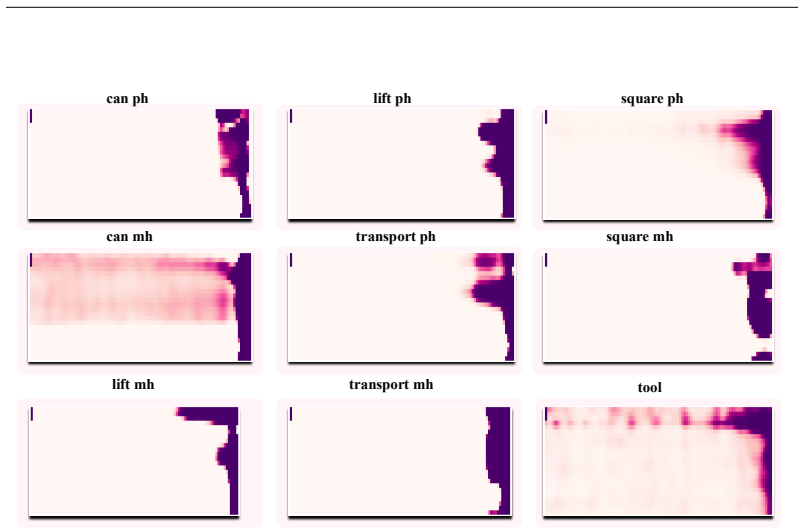
SAG customizes a rollout-adaptive prune-then-reuse mechanism that first identifies prunable computations globally and then reuses cached activations to substitute them during action diffusion. To capture the rollout dynamics, SAG parameterizes an observation-conditioned diffusion pruner for environment-aware adaptation and instantiates it with a highly parameter- and inference-efficient design for real-time prediction. Furthermore, SAG introduces a one-for-all reusing strategy that reuses activations across both timesteps and blocks in a zig-zag manner, minimizing the global redundancy.
What carries the argument
observation-conditioned diffusion pruner that identifies globally prunable computations from rollout dynamics and enables adaptive reuse of cached activations
Load-bearing premise
The pruner can correctly identify which computations are safe to prune from the current observation without introducing errors that degrade action quality or safety.
What would settle it
A benchmark rollout in which the pruner incorrectly skips critical denoising steps and produces visibly lower-quality or unsafe actions compared with the full diffusion process.
Figures




read the original abstract
Diffusion Policy has dominated action generation due to its strong capabilities for modeling multi-modal action distributions, but its multi-step denoising processes make it impractical for real-time visuomotor control. Existing caching-based acceleration methods typically rely on $\textit{static}$ schedules that fail to adapt to the $\textit{dynamics}$ of robot-environment interactions, thereby leading to suboptimal performance. In this paper, we propose $\underline{\textbf{S}}$parse $\underline{\textbf{A}}$ction$\underline{\textbf{G}}$en ($\textbf{SAG}$) for extremely sparse action generation. To accommodate the iterative interactions, SAG customizes a rollout-adaptive prune-then-reuse mechanism that first identifies prunable computations globally and then reuses cached activations to substitute them during action diffusion. To capture the rollout dynamics, SAG parameterizes an observation-conditioned diffusion pruner for environment-aware adaptation and instantiates it with a highly parameter- and inference-efficient design for real-time prediction. Furthermore, SAG introduces a one-for-all reusing strategy that reuses activations across both timesteps and blocks in a zig-zag manner, minimizing the global redundancy. Extensive experiments on multiple robotic benchmarks demonstrate that SAG achieves up to 4$\times$ generation speedup without sacrificing performance. Project Page: https://sparse-actiongen.github.io.
Editorial analysis
A structured set of objections, weighed in public.
Referee Report
Summary. The manuscript proposes Sparse ActionGen (SAG) to accelerate diffusion policies for real-time robotic action generation. It introduces a rollout-adaptive prune-then-reuse mechanism that employs an observation-conditioned diffusion pruner to identify globally prunable computations based on environment dynamics, combined with a zig-zag one-for-all strategy for reusing cached activations across timesteps and blocks. The central claim is that SAG delivers up to 4× generation speedup on multiple robotic benchmarks while preserving performance.
Significance. If the reliability of the adaptive pruner and the absence of performance degradation are rigorously demonstrated, the work would meaningfully advance practical deployment of diffusion policies in visuomotor control by addressing the computational bottleneck of iterative denoising in a dynamics-aware manner. The shift from static caching to observation-conditioned pruning represents a targeted improvement over prior acceleration techniques.
major comments (2)
- [§3.2] §3.2 (observation-conditioned diffusion pruner): The description provides no explicit bound on pruner error rate, no analysis of how mis-pruning decisions propagate through the multi-step denoising chain, and no evaluation of accumulated errors in action sequences under distribution shift or unseen rollout dynamics. This directly undermines the central 'without sacrificing performance' claim.
- [§5] §5 (experiments): The reported 4× speedup lacks specification of exact baselines, performance metrics (e.g., success rate, trajectory error), statistical error bars across multiple runs, and safety metrics such as collision rates or task failure rates. Without these, the no-performance-loss assertion cannot be assessed.
minor comments (2)
- [Abstract] The abstract and introduction could more clearly distinguish the proposed zig-zag reuse from standard caching methods by including a brief comparison table of computational savings.
- [§3] Notation for the pruner output and reuse indices should be defined consistently in the method section to avoid ambiguity when describing the global pruning decisions.
Simulated Author's Rebuttal
Thank you for the opportunity to respond to the referee's comments. We appreciate the constructive feedback on our manuscript regarding the analysis of the observation-conditioned diffusion pruner and the experimental reporting. We address each point below and have incorporated revisions to enhance the clarity and rigor of the paper.
read point-by-point responses
-
Referee: [§3.2] §3.2 (observation-conditioned diffusion pruner): The description provides no explicit bound on pruner error rate, no analysis of how mis-pruning decisions propagate through the multi-step denoising chain, and no evaluation of accumulated errors in action sequences under distribution shift or unseen rollout dynamics. This directly undermines the central 'without sacrificing performance' claim.
Authors: We acknowledge the absence of an explicit theoretical bound on the pruner error rate in the current version of the manuscript. The pruner is optimized end-to-end to preserve the quality of generated actions, and our experiments demonstrate no significant performance degradation across benchmarks. To address concerns about error propagation and distribution shift, we have added new experiments evaluating the pruner's decisions under varying dynamics and included an analysis of accumulated errors in the revised §3.2. These additions provide empirical support for the reliability of the approach. revision: yes
-
Referee: [§5] §5 (experiments): The reported 4× speedup lacks specification of exact baselines, performance metrics (e.g., success rate, trajectory error), statistical error bars across multiple runs, and safety metrics such as collision rates or task failure rates. Without these, the no-performance-loss assertion cannot be assessed.
Authors: The original manuscript specifies comparisons to the vanilla Diffusion Policy and prior acceleration techniques, with performance measured via success rates and trajectory errors on standard benchmarks. We agree that additional details improve the assessment. In the revision, we have included statistical error bars from multiple runs (over 5 seeds) and reported safety-related metrics such as collision rates for relevant tasks. The exact baselines and metrics are now more explicitly detailed in the updated §5 to allow full evaluation of the no-performance-loss claim. revision: yes
Circularity Check
No circularity: empirical method with no derivations or self-referential reductions
full rationale
The paper describes SAG as an additive mechanism consisting of a rollout-adaptive prune-then-reuse process, an observation-conditioned diffusion pruner, and a zig-zag one-for-all activation reuse strategy. No equations, derivations, fitted parameters renamed as predictions, or self-citation load-bearing steps appear in the abstract or method summary. Performance claims of up to 4× speedup rest on experimental results across robotic benchmarks rather than any definitional equivalence or reduction to inputs by construction. The approach is therefore self-contained against external benchmarks with no load-bearing circular steps.
Axiom & Free-Parameter Ledger
Lean theorems connected to this paper
-
IndisputableMonolith/Cost/FunctionalEquation.leanwashburn_uniqueness_aczel unclear?
unclearRelation between the paper passage and the cited Recognition theorem.
SAG parameterizes an observation-conditioned diffusion pruner ... one-for-all reusing strategy that reuses activations across both timesteps and blocks in a zig-zag manner
-
IndisputableMonolith/Foundation/RealityFromDistinction.leanreality_from_one_distinction unclear?
unclearRelation between the paper passage and the cited Recognition theorem.
end-to-end global sparsity loss ... target global pruning rate ρ
What do these tags mean?
- matches
- The paper's claim is directly supported by a theorem in the formal canon.
- supports
- The theorem supports part of the paper's argument, but the paper may add assumptions or extra steps.
- extends
- The paper goes beyond the formal theorem; the theorem is a base layer rather than the whole result.
- uses
- The paper appears to rely on the theorem as machinery.
- contradicts
- The paper's claim conflicts with a theorem or certificate in the canon.
- unclear
- Pith found a possible connection, but the passage is too broad, indirect, or ambiguous to say the theorem truly supports the claim.
Forward citations
Cited by 1 Pith paper
-
Test-time Sparsity for Extreme Fast Action Diffusion
Test-time sparsity with a parallel pipeline and omnidirectional feature reuse accelerates action diffusion by 5x to 47.5 Hz while cutting FLOPs 92% with no performance loss.
Reference graph
Works this paper leans on
-
[1]
$\pi_0$: A Vision-Language-Action Flow Model for General Robot Control
Kevin Black, Noah Brown, Danny Driess, Adnan Esmail, Michael Equi, Chelsea Finn, Niccolo Fusai, Lachy Groom, Karol Hausman, Brian Ichter, et al. pi 0: A vision-language-action flow model for general robot control.arXiv preprint arXiv:2410.24164,
work page internal anchor Pith review Pith/arXiv arXiv
-
[2]
Falcon: Fast visuomotor policies via partial denoising
Haojun Chen, Minghao Liu, Chengdong Ma, Xiaojian Ma, Zailin Ma, Huimin Wu, Yuanpei Chen, Yifan Zhong, Mingzhi Wang, Qing Li, and Yaodong Yang. Falcon: Fast visuomotor policies via partial denoising. 2025a. URLhttps://arxiv.org/abs/2503.00339. Pengtao Chen, Mingzhu Shen, Peng Ye, Jianjian Cao, Chongjun Tu, Christos-Savvas Bouganis, Yiren Zhao, and Tao Chen...
-
[3]
Zhuoqun Chen, Xiu Yuan, Tongzhou Mu, and Hao Su. Responsive noise-relaying diffusion policy: Responsive and efficient visuomotor control.arXiv preprint arXiv:2502.12724, 2025b. Cheng Chi, Zhenjia Xu, Siyuan Feng, Eric Cousineau, Yilun Du, Benjamin Burchfiel, Russ Tedrake, and Shuran Song. Diffusion policy: Visuomotor policy learning via action diffusion.T...
-
[4]
Vggt-dp: Generalizable robot control via vision foundation models.arXiv preprint arXiv:2509.18778,
Shijia Ge, Yinxin Zhang, Shuzhao Xie, Weixiang Zhang, Mingcai Zhou, and Zhi Wang. Vggt-dp: Generalizable robot control via vision foundation models.arXiv preprint arXiv:2509.18778,
-
[5]
Relay policy learning: Solving long-horizon tasks via imitation and reinforcement learning
Abhishek Gupta, Vikash Kumar, Corey Lynch, Sergey Levine, and Karol Hausman. Relay policy learning: Solving long-horizon tasks via imitation and reinforcement learning.arXiv preprint arXiv:1910.11956,
-
[6]
Eric Jang, Shixiang Gu, and Ben Poole
URL https://arxiv.org/abs/2406.04806. Eric Jang, Shixiang Gu, and Ben Poole. Categorical reparameterization with gumbel-softmax.arXiv preprint arXiv:1611.01144,
-
[7]
Block-wise Adaptive Caching for Accelerating Diffusion Policy
Kangye Ji, Yuan Meng, Hanyun Cui, Ye Li, Shengjia Hua, Lei Chen, and Zhi Wang. Block-wise adaptive caching for accelerating diffusion policy.arXiv preprint arXiv:2506.13456,
work page internal anchor Pith review Pith/arXiv arXiv
-
[8]
Bofang Jia, Pengxiang Ding, Can Cui, Mingyang Sun, Pengfang Qian, Siteng Huang, Zhaoxin Fan, and Donglin Wang. Score and distribution matching policy: Advanced accelerated visuomotor policies via matched distillation.arXiv preprint arXiv:2412.09265,
-
[9]
Ye Li, Jiahe Feng, Yuan Meng, Kangye Ji, Chen Tang, Xinwan Wen, Shutao Xia, Zhi Wang, and Wenwu Zhu. Ts-dp: Reinforcement speculative decoding for temporal adaptive diffusion policy acceleration.arXiv preprint arXiv:2512.15773, 2025a. 11 Ye Li, Yuan Meng, Zewen Sun, Kangye Ji, Chen Tang, Jiajun Fan, Xinzhu Ma, Shutao Xia, Zhi Wang, and Wenwu Zhu. Sp-vla: ...
-
[10]
Yijun Liu, Yuwei Liu, Yuan Meng, Jieheng Zhang, Yuwei Zhou, Ye Li, Jiacheng Jiang, Kangye Ji, Shijia Ge, Zhi Wang, et al. Spatial policy: Guiding visuomotor robotic manipulation with spatial-aware modeling and reasoning.arXiv preprint arXiv:2508.15874, 2025c. Xinyin Ma, Gongfan Fang, Michael Bi Mi, and Xinchao Wang. Learning-to-cache: Accelerating diffusi...
-
[11]
Consistency Policy: Accelerated Visuomotor Policies via Consistency Distillation, June 2024
Aaditya Prasad, Kevin Lin, Jimmy Wu, Linqi Zhou, and Jeannette Bohg. Consistency policy: Accelerated visuomotor policies via consistency distillation.arXiv preprint arXiv:2405.07503,
-
[12]
Fora: Fast-forward caching in diffusion transformer acceleration.arXiv preprint arXiv:2407.01425,
Pratheba Selvaraju, Tianyu Ding, Tianyi Chen, Ilya Zharkov, and Luming Liang. Fora: Fast-forward caching in diffusion transformer acceleration.arXiv preprint arXiv:2407.01425,
-
[13]
SmolVLA: A Vision-Language-Action Model for Affordable and Efficient Robotics
Mustafa Shukor, Dana Aubakirova, Francesco Capuano, Pepijn Kooijmans, Steven Palma, Adil Zoui- tine, Michel Aractingi, Caroline Pascal, Martino Russi, Andres Marafioti, et al. Smolvla: A vision- language-action model for affordable and efficient robotics.arXiv preprint arXiv:2506.01844,
work page internal anchor Pith review Pith/arXiv arXiv
-
[14]
Denoising Diffusion Implicit Models
Jiaming Song, Chenlin Meng, and Stefano Ermon. Denoising diffusion implicit models.arXiv preprint arXiv:2010.02502,
work page internal anchor Pith review Pith/arXiv arXiv 2010
-
[15]
Zhendong Wang, Zhaoshuo Li, Ajay Mandlekar, Zhenjia Xu, Jiaojiao Fan, Yashraj Narang, Linxi Fan, Yuke Zhu, Yogesh Balaji, Mingyuan Zhou, et al. One-step diffusion policy: Fast visuomotor policies via diffusion distillation.arXiv preprint arXiv:2410.21257,
-
[16]
DexVLA: Vision-Language Model with Plug-In Diffusion Expert for General Robot Control
Junjie Wen, Yichen Zhu, Jinming Li, Zhibin Tang, Chaomin Shen, and Feifei Feng. Dexvla: Vision-language model with plug-in diffusion expert for general robot control.arXiv preprint arXiv:2502.05855,
work page internal anchor Pith review Pith/arXiv arXiv
-
[17]
12 Yantai Yang, Yuhao Wang, Zichen Wen, Luo Zhongwei, Chang Zou, Zhipeng Zhang, Chuan Wen, and Linfeng Zhang. Efficientvla: Training-free acceleration and compression for vision-language- action models.arXiv preprint arXiv:2506.10100,
-
[18]
3D Diffusion Policy: Generalizable Visuomotor Policy Learning via Simple 3D Representations
Yanjie Ze, Gu Zhang, Kangning Zhang, Chenyuan Hu, Muhan Wang, and Huazhe Xu. 3d diffusion policy: Generalizable visuomotor policy learning via simple 3d representations.arXiv preprint arXiv:2403.03954,
work page internal anchor Pith review Pith/arXiv arXiv
-
[19]
URLhttps://openreview.net/forum?id=yYZbZGo4ei. 13 A APPENDIX A.1 THEUSE OFLARGELANGUAGEMODELS(LLMS) In this work, Large Language Models (LLMs) were used solely to polish the language for clarity and readability. No LLMs were employed for idea generation, experimental design, data analysis, or any other part of the research process. A.2 MORE DETAILS ON THE...
work page 2019
discussion (0)
Sign in with ORCID, Apple, or X to comment. Anyone can read and Pith papers without signing in.