A Universal Large Language Model -- Drone Command and Control Interface
Pith reviewed 2026-05-16 11:41 UTC · model grok-4.3
The pith
MCP protocol creates a universal natural-language interface between any LLM and any drone
A machine-rendered reading of the paper's core claim, the machinery that carries it, and where it could break.
Core claim
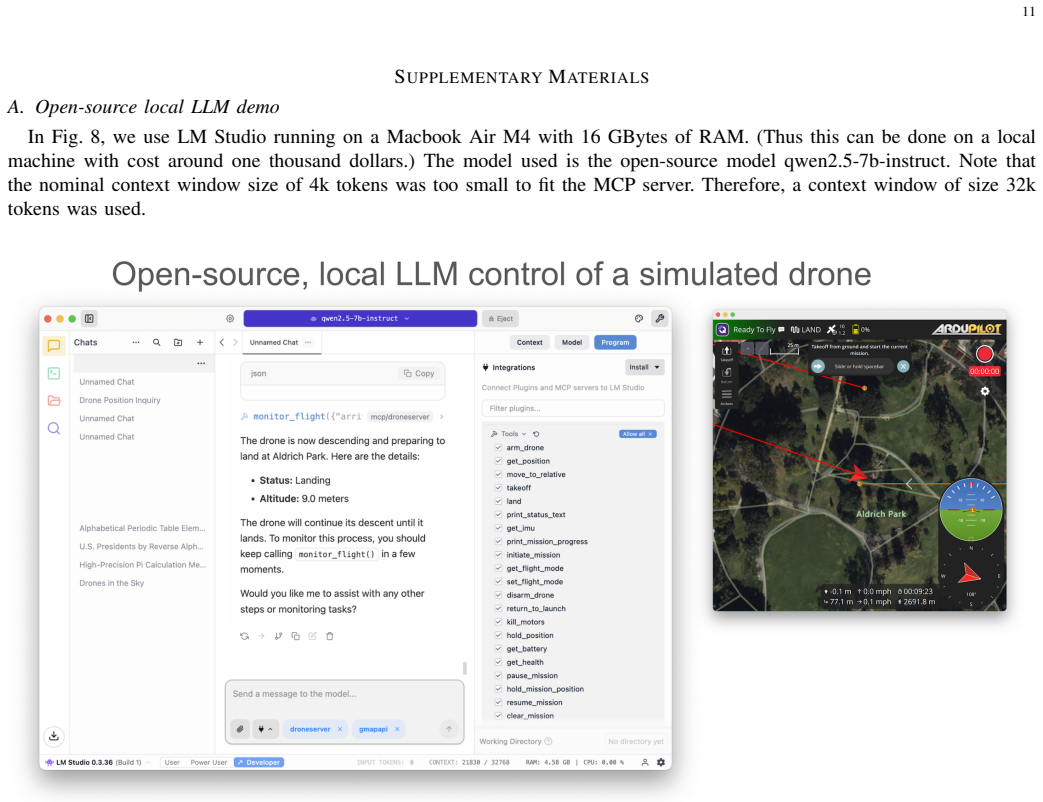
We develop and deploy a cloud based Linux machine hosting an MCP server that supports the Mavlink protocol, an ubiquitous drone control language used almost universally by millions of drones including Ardupilot and PX4 framework. We demonstrate flight control of a real unmanned aerial vehicle. In further testing, we demonstrate extensive flight planning and control capability in a simulated drone, integrated with a Google Maps MCP server for up to date, real time navigation information.
What carries the argument
MCP server that implements Mavlink protocol support, translating LLM output into standardized drone commands and returning sensor data
If this is right
- Any LLM can issue natural-language flight plans and receive live telemetry without writing custom glue code for each model or vehicle.
- External data sources such as maps or weather become directly accessible to the LLM through the same MCP connection used for command execution.
- The interface works unchanged across Ardupilot, PX4, and any other Mavlink-compatible autopilot, covering the large majority of existing drone hardware.
- Flight missions can be replanned on the fly using the LLM's general knowledge while the drone is airborne.
Where Pith is reading between the lines
- The same MCP-Mavlink pattern could be reused for other robotic platforms that already expose a standard command language.
- Safety validation layers would need to be inserted inside the MCP server to filter LLM outputs before they reach the flight controller.
- Multiple MCP servers could be chained so that one LLM conversation coordinates an entire fleet of drones.
Load-bearing premise
The MCP standard can deliver low-latency, reliable, and safe real-time command translation for safety-critical drone flight without introducing unacceptable delays or failure modes.
What would settle it
A timed flight test in which the measured delay between an LLM command and the corresponding drone maneuver exceeds the threshold required for stable closed-loop control, or produces an unsafe trajectory.
Figures


read the original abstract
The use of artificial intelligence (AI) for drone control can have a transformative impact on drone capabilities, especially when real world information can be integrated with drone sensing, command, and control, part of a growing field of physical AI. Large language models (LLMs) can be advantageous if trained at scale on general knowledge, but especially and in particular when the training data includes information such as detailed map geography topology of the entire planet, as well as the ability to access real time situational data such as weather. However, challenges remain in the interface between drones and LLMs in general, with each application requiring a tedious, labor intensive effort to connect the LLM trained knowledge to drone command and control. Here, we solve that problem, using an interface strategy that is LLM agnostic and drone agnostic, providing the first universal, versatile, comprehensive and easy to use drone control interface. We do this using the new model context protocol (MCP) standard, an open standard that provides a universal way for AI systems to access external data, tools, and services. We develop and deploy a cloud based Linux machine hosting an MCP server that supports the Mavlink protocol, an ubiquitous drone control language used almost universally by millions of drones including Ardupilot and PX4 framework.We demonstrate flight control of a real unmanned aerial vehicle. In further testing, we demonstrate extensive flight planning and control capability in a simulated drone, integrated with a Google Maps MCP server for up to date, real time navigation information. This demonstrates a universal approach to integration of LLMs with drone command and control, a paradigm that leverages and exploits virtually all of modern AI industry with drone technology in an easy to use interface that translates natural language to drone control.
Editorial analysis
A structured set of objections, weighed in public.
Referee Report
Summary. The manuscript presents an MCP-based server that translates LLM outputs to Mavlink commands for drone control, asserting that the resulting interface is LLM-agnostic and drone-agnostic. It reports successful real-UAV flight demonstrations and simulated planning integrated with a Google Maps MCP server, positioning the work as the first universal, versatile drone-control interface for LLMs.
Significance. If the universality and reliability claims are substantiated, the approach could materially reduce integration effort between general-purpose LLMs and existing drone autopilots, enabling natural-language mission specification and real-time map data fusion. The absence of quantitative metrics, however, leaves the practical significance of the reported demonstrations unclear.
major comments (2)
- [Demonstrations] The demonstrations (real-UAV flight and simulated Google-Maps planning) supply no latency distributions, command-success rates, error-recovery statistics, or failure-mode analysis for the MCP-Mavlink translation layer. Without these data the central claim that the interface is reliable and universal remains unsupported.
- [Demonstrations] No experiments vary the LLM (different model families or sizes) or the autopilot (ArduPilot vs. PX4) while holding the MCP server fixed. The agnosticism assertions therefore rest on single-instance behavior rather than measured generalization.
minor comments (1)
- [Abstract] The abstract states that Mavlink is 'used almost universally by millions of drones'; a brief citation to the Mavlink specification or adoption statistics would strengthen this claim.
Simulated Author's Rebuttal
We thank the referee for the constructive comments on our manuscript. We address each major comment below and indicate the revisions planned for the next version.
read point-by-point responses
-
Referee: The demonstrations (real-UAV flight and simulated Google-Maps planning) supply no latency distributions, command-success rates, error-recovery statistics, or failure-mode analysis for the MCP-Mavlink translation layer. Without these data the central claim that the interface is reliable and universal remains unsupported.
Authors: We acknowledge that the manuscript does not include quantitative metrics such as latency distributions, success rates, or detailed failure-mode analysis. The reported demonstrations establish basic functionality of the MCP-Mavlink translation in both real and simulated settings. In the revised manuscript we will incorporate available timing data from the flight logs, observed command success in the described tests, and a discussion of error handling provided by the Mavlink protocol. A comprehensive statistical evaluation of failure modes would require additional controlled experiments that exceed the scope of the current work and will be noted as future research. revision: partial
-
Referee: No experiments vary the LLM (different model families or sizes) or the autopilot (ArduPilot vs. PX4) while holding the MCP server fixed. The agnosticism assertions therefore rest on single-instance behavior rather than measured generalization.
Authors: The claims of LLM- and drone-agnosticism rest on the architectural use of open standards (MCP for any compatible LLM client and Mavlink for any compatible autopilot) rather than on exhaustive empirical testing. The MCP server implementation contains no LLM-specific or autopilot-specific code. We will revise the manuscript to clarify this design-based generality, explicitly note that the demonstrations used a single LLM and ArduPilot-based platform, and state that systematic cross-model and cross-autopilot validation remains future work. revision: partial
Circularity Check
No circularity; claims rest on system implementation without derivations or fitted inputs
full rationale
The manuscript presents an engineering implementation of an MCP-Mavlink bridge for LLM-drone interfacing, with demonstrations of real UAV flight and simulated planning. No equations, parameter fitting, predictions, or derivation chains appear in the provided text or abstract. Central assertions of universality and agnosticism are supported by reported system behavior rather than by any self-referential reduction, self-citation load-bearing step, or renaming of known results. The work is therefore self-contained as a descriptive systems paper.
Axiom & Free-Parameter Ledger
axioms (1)
- domain assumption MCP provides a reliable, low-latency universal interface to external tools and services including drone command protocols
Reference graph
Works this paper leans on
-
[1]
Artificial intelligence applied to drone control: A state of the art,
D. Caballero-Martin, J. M. Lopez-Guede, J. Estevez, and M. Gra ˜na, “Artificial intelligence applied to drone control: A state of the art,” Drones, vol. 8, no. 7, p. 296, 2024
work page 2024
-
[2]
Champion-level drone racing using deep reinforcement learning,
E. Kaufmann, L. Bauersfeld, A. Loquercio, M. M ¨uller, V . Koltun, and D. Scaramuzza, “Champion-level drone racing using deep reinforcement learning,”Nature, vol. 620, no. 7976, pp. 982–987, 2023
work page 2023
-
[3]
Mavlink: Micro air vehicle communication protocol,
L. Meier, “Mavlink: Micro air vehicle communication protocol,” https: //mavlink.io, 2013, accessed: August 1, 2025
work page 2013
-
[4]
(2024) Model context protocol (mcp) specification
Anthropic. (2024) Model context protocol (mcp) specification. Model Context Protocol. Accessed: Dec. 19, 2025. [Online]. Available: https://modelcontextprotocol.io/specification/
work page 2024
-
[5]
The Linux Foundation, “Linux foundation announces the formation of the agentic AI foundation (AAIF), anchored by new project contributions including model context protocol (MCP), goose and AGENTS.md,” Press Release, Dec 2025, accessed: Dec. 19, 2025. [Online]. Available: https://www.linuxfoundation.org/press/ linux-foundation-announces-the-formation-of-th...
work page 2025
-
[6]
Robot builds a robot’s brain: Ai generated drone command and control station hosted in the sky,
P. Burke, “Robot builds a robot’s brain: Ai generated drone command and control station hosted in the sky,”arXiv preprint arXiv:2508.02962, 2025
-
[7]
Model context protocol python sdk,
Anthropic, “Model context protocol python sdk,” https://github.com/ modelcontextprotocol/python-sdk, 2024, accessed: Dec. 19, 2025
work page 2024
-
[8]
L. Hu, O. Pathak, Z. He, H. Lee, M. Bedwany, J. Mica, and P. J. Burke, ““cloudstation:” a cloud-based ground control station for drones,”IEEE Journal on Miniaturization for Air and Space Systems, vol. 2, no. 1, pp. 36–42, 2020
work page 2020
-
[9]
Drones from a to z: Experiential learning at its finest,
P. Burke, P. Wei, M. Fakih, and D. Burke, “Drones from a to z: Experiential learning at its finest,” https://doi.org/10.36227/techrxiv.175695608.82891552/v1, 2025
-
[10]
MA VLink Router Project, “mavlink-router,” https://github.com/ mavlink-router/mavlink-router, 2024, accessed: Dec. 19, 2025. 9
work page 2024
-
[11]
SITL Simulator (Software in the Loop),
ArduPilot Dev Team, “SITL Simulator (Software in the Loop),” https: //ardupilot.org/dev/docs/sitl-simulator-software-in-the-loop.html, 2025, accessed: 2025-08-01
work page 2025
-
[12]
A simulated, virtual drone for testing and development,
P. Burke, “A simulated, virtual drone for testing and development,” https: //github.com/PeterJBurke/CreateSITLenv, 2025, accessed: 2025-08-01
work page 2025
-
[13]
M. Bachman and A. Berenberg. Announcing official MCP support for google services. Google Cloud. [Online]. Available: https://cloud.google.com/blog/products/ai-machine-learning/ announcing-official-mcp-support-for-google-services
-
[14]
(2024, Nov) Code execution with MCP: building more efficient AI agents
Anthropic. (2024, Nov) Code execution with MCP: building more efficient AI agents. Anthropic Engineering. Accessed: Dec. 19, 2025. [Online]. Available: https://www.anthropic.com/engineering/ code-execution-with-mcp
work page 2024
-
[15]
N. Ak Kanigur, M. Mert, and I. Duru, “Leveraging large language models and artificial intelligence for uavs in 6g-enabled non-terrestrial networks,” in2025 9th International Symposium on Multidisciplinary Studies and Innovative Technologies (ISMSIT). IEEE, 2025, pp. 1–7
work page 2025
-
[16]
Y . Ping, T. Liang, H. Ding, G. Lei, J. Wu, X. Zou, K. Shi, R. Shao, C. Zhang, W. Zhanget al., “Multimodal large language models-enabled uav swarm: Towards efficient and intelligent autonomous aerial sys- tems,”arXiv preprint arXiv:2506.12710, 2025
-
[17]
F. S. Chagas, N. Ruseno, and A. A. A. Bechina, “Artificial intelligence approaches for uav deconfliction: A comparative review and framework proposal,”Automation, vol. 6, no. 4, p. 54, 2025
work page 2025
-
[18]
Ai-driven safety and security for uavs: From machine learning to large language models,
Z. Yang, Y . Zhang, J. Zeng, Y . Yang, Y . Jia, H. Song, T. Lv, Q. Sun, and J. An, “Ai-driven safety and security for uavs: From machine learning to large language models,”Drones, vol. 9, no. 6, p. 392, 2025
work page 2025
-
[19]
Uavs meet llms: Overviews and perspectives towards agentic low-altitude mobility,
Y . Tian, F. Lin, Y . Li, T. Zhang, Q. Zhang, X. Fu, J. Huang, X. Dai, Y . Wang, C. Tianet al., “Uavs meet llms: Overviews and perspectives towards agentic low-altitude mobility,”Information Fusion, vol. 122, p. 103158, 2025
work page 2025
-
[20]
Recent advances in transformer and large language models for uav applications,
H. Kheddar, Y . Habchi, M. C. Ghanem, M. Hemis, and D. Niyato, “Recent advances in transformer and large language models for uav applications,”arXiv preprint arXiv:2508.11834, 2025
-
[21]
When large language models meet uavs: How far are we?
Y . Chen, X. Que, J. Zhang, T. Chen, G. Li, and J. Chen, “When large language models meet uavs: How far are we?”arXiv preprint arXiv:2509.12795, 2025
-
[22]
J. Wu, H. You, B. Sun, and J. Du, “Llm-driven pareto-optimal multi- mode reinforcement learning for adaptive uav navigation in urban wind environments,”IEEE Access, 2025
work page 2025
-
[23]
Uavs meet agentic ai: A multidomain survey of autonomous aerial intelligence and agentic uavs,
R. Sapkota, K. I. Roumeliotis, and M. Karkee, “Uavs meet agentic ai: A multidomain survey of autonomous aerial intelligence and agentic uavs,” arXiv preprint arXiv:2506.08045, 2025
-
[24]
Uav leveraging genai/llms, a brief survey,
D. D. Cidjeu, J. L. K. E. Fendji, V . C. Kamla, and I. Tchappi, “Uav leveraging genai/llms, a brief survey,”Procedia Computer Science, vol. 265, pp. 382–389, 2025
work page 2025
-
[25]
Logisticsvln: Vision-language navigation for low-altitude termi- nal delivery based on agentic uavs,
X. Zhang, Y . Tian, F. Lin, Y . Liu, J. Ma, K. S. Szatm ´ary, and F.-Y . Wang, “Logisticsvln: Vision-language navigation for low-altitude termi- nal delivery based on agentic uavs,”arXiv preprint arXiv:2505.03460, 2025
-
[26]
Next-generation llm for uav: From natural language to autonomous flight,
L. Yuan, C. Deng, D.-J. Han, I. Hwang, S. Brunswicker, and C. G. Brin- ton, “Next-generation llm for uav: From natural language to autonomous flight,”arXiv preprint arXiv:2510.21739, 2025
-
[27]
Large language models for uavs: Current state and pathways to the future,
S. Javaid, H. Fahim, B. He, and N. Saeed, “Large language models for uavs: Current state and pathways to the future,”IEEE Open Journal of Vehicular Technology, 2024
work page 2024
-
[28]
F. Yao, Y . Yue, Y . Liu, X. Sun, and K. Fu, “Aeroverse: Uav-agent benchmark suite for simulating, pre-training, finetuning, and evaluating aerospace embodied world models,”arXiv preprint arXiv:2408.15511, 2024
-
[29]
Llm- agents driven automated simulation testing and analysis of small un- crewed aerial systems,
V . S. A. Duvvuru, B. Zhang, M. Vierhauser, and A. Agrawal, “Llm- agents driven automated simulation testing and analysis of small un- crewed aerial systems,”arXiv preprint arXiv:2501.11864, 2025
-
[30]
Chat with uav– human-uav interaction based on large language models,
H. Wang, Z. Chen, G. Li, B. Ma, and C. Li, “Chat with uav– human-uav interaction based on large language models,”arXiv preprint arXiv:2512.08145, 2025
-
[31]
Context-aware autonomous drone navigation using large language models (llms),
A.-M. Khan, I. U. Rehman, N. Saeed, D. Sobnath, F. Khan, and M. A. K. Khattak, “Context-aware autonomous drone navigation using large language models (llms),” inProceedings of the AAAI Symposium Series, vol. 6, no. 1, 2025, pp. 102–107
work page 2025
-
[32]
Swarmchain: Collaborative llm inference for uav swarm control,
B. Han, Y . Chen, J. Li, J. Li, and J. Su, “Swarmchain: Collaborative llm inference for uav swarm control,”IEEE Internet of Things Magazine, 2025
work page 2025
-
[33]
Swarmchat: An llm-based, context-aware multimodal interaction system for robotic swarms,
E. M. Eumi, H. Abbass, and N. Marcus, “Swarmchat: An llm-based, context-aware multimodal interaction system for robotic swarms,” in International Conference on Swarm Intelligence. Springer, 2025, pp. 181–192
work page 2025
-
[34]
Swarmgpt: Combining large language models with safe motion planning for drone swarm choreography,
M. Schuck, D. O. Dahanaggamaarachchi, B. Sprenger, V . Vyas, S. Zhou, and A. P. Schoellig, “Swarmgpt: Combining large language models with safe motion planning for drone swarm choreography,”IEEE Robotics and Automation Letters, 2025
work page 2025
-
[35]
A framework leveraging large language models for autonomous uav control in flying networks,
D. Nunes, R. Amorim, P. Ribeiro, A. Coelho, and R. Campos, “A framework leveraging large language models for autonomous uav control in flying networks,”arXiv preprint arXiv:2506.04404, 2025
-
[36]
S. Mishra, R. D. Yadav, A. Das, S. Gupta, W. Pan, and S. Roy, “Aermani- vlm: Structured prompting and reasoning for aerial manipulation with vision language models,”arXiv preprint arXiv:2511.01472, 2025
-
[37]
A. Koubaa and K. Gabr, “Agentic uavs: Llm-driven autonomy with integrated tool-calling and cognitive reasoning,”arXiv preprint arXiv:2509.13352, 2025
-
[38]
Taking flight with dialogue: Enabling natural language control for px4-based drone agent,
S. K. Lim, M. J. Y . Chong, J. H. Khor, and T. Y . Ling, “Taking flight with dialogue: Enabling natural language control for px4-based drone agent,”arXiv preprint arXiv:2506.07509, 2025
-
[39]
S. Ahmmad, Z. A. Aditto, M. M. Hossain, N. Yeasmin, and S. Hossain, “Autonomous navigation of cloud-controlled quadcopters in confined spaces using multi-modal perception and llm-driven high semantic reasoning,”arXiv preprint arXiv:2508.07885, 2025
-
[40]
Leveraging large language models for real-time uav control,
K. Choutri, S. Fadloun, A. Khettabi, M. Lagha, S. Meshoul, and R. Fareh, “Leveraging large language models for real-time uav control,” Electronics, vol. 14, no. 21, p. 4312, 2025
work page 2025
-
[41]
Typefly: Flying drones with large language model,
G. Chen, X. Yu, N. Ling, and L. Zhong, “Typefly: Flying drones with large language model,”arXiv preprint arXiv:2312.14950, 2023
-
[42]
General-purpose aerial intelligent agents empow- ered by large language models,
J. Zhao and X. Lin, “General-purpose aerial intelligent agents empow- ered by large language models,”arXiv preprint arXiv:2503.08302, 2025
-
[43]
Cognitive guardrails for open-world decision making in autonomous drone swarms,
J. Cleland-Huang, P. A. A. Granadeno, A. M. R. Bernal, D. Hernandez, M. Murphy, M. Petterson, and W. Scheirer, “Cognitive guardrails for open-world decision making in autonomous drone swarms,”arXiv preprint arXiv:2505.23576, 2025
-
[44]
A. Navarro, C. de Quinto, and J. A. Hern ´andez, “Beyond visual line of sight: Uavs with edge ai, connected llms, and vr for autonomous aerial intelligence,”arXiv preprint arXiv:2507.15049, 2025
-
[45]
´A. Moraga, J. de Curt `o, I. de Zarz `a, and C. T. Calafate, “Ai-driven uav and iot traffic optimization: Large language models for congestion and emission reduction in smart cities,”Drones, vol. 9, no. 4, p. 248, 2025
work page 2025
-
[46]
Llm-daas: Llm-driven drone- as-a-service operations from text user requests,
L. Wassim, K. Mohamed, and A. Hamdi, “Llm-daas: Llm-driven drone- as-a-service operations from text user requests,” inThe International Conference of Advanced Computing and Informatics. Springer, 2024, pp. 108–121
work page 2024
-
[47]
S. Majumdar, S. E. Kirkley, and B. B. Mallik, “Llm-guided hybrid architecture for autonomous fire response: Dialog-driven planning in space and disaster missions,” in2025 IEEE World AI IoT Congress (AIIoT). IEEE, 2025, pp. 1049–1054
work page 2025
-
[48]
Llm-ql: a llm- enhanced q-learning approach for scheduling multiple parallel drones,
Q. Zhou, J. Wu, M. Zhu, Y . Zhou, F. Xiao, and Y . Zhang, “Llm-ql: a llm- enhanced q-learning approach for scheduling multiple parallel drones,” IEEE Transactions on Knowledge and Data Engineering, 2025
work page 2025
-
[49]
Chatfly: Low-latency drone planning with large language models,
G. Chen, X. Yu, N. Ling, and L. Zhong, “Chatfly: Low-latency drone planning with large language models,”IEEE Transactions on Mobile Computing, 2025
work page 2025
-
[50]
M. L. Tazir, M. Mancas, and T. Dutoit, “From words to flight: Integrating openai chatgpt with px4/gazebo for natural language-based drone con- trol,” inInternational Workshop on Computer Science and Engineering, 2023. Javier N. Ramos-Silvareceived his M.Sc. degree in telecommunications engineering and B.Eng. degree in electronics and telecommunications fr...
work page 2023
-
[51]
in EECS at the University of California, Irvine, USA
He is currently working toward the Ph.D. in EECS at the University of California, Irvine, USA. His main research areas are quantum sensing, compact modeling, antennas and microwave circuit design. 10 Peter J. Burke(M’02–SM’17-F’20) received the Ph.D. degree in physics from Yale University, New Haven, CT, USA, in 1998. From 1998 to 2001, he was a Sherman F...
work page 1998
discussion (0)
Sign in with ORCID, Apple, or X to comment. Anyone can read and Pith papers without signing in.