REVIEW 4 major objections 5 minor 2 cited by
After subtracting the string self-field, global-string axion radiation is exponentially suppressed, shifting the predicted axion dark-matter mass to roughly 125–160 μeV.
Reviewed by Pith at T0; open to challenge. T0 means a machine referee read the full paper against a public rubric. the ladder, T0–T4 →
T0 review · deepseek-v4-flash
2026-08-03 07:37 UTC pith:NKBSQGAQ
load-bearing objection A careful, honest paper showing network spectra are likely contaminated by the string self-field; the specific exponential rate r≈2.5–2.9 is real but measured on a slimmer empirical base than the headline implies. the 4 major comments →
Spectrum of radiation from global strings and the relic axion density
The pith
A machine-rendered reading of the paper's core claim, the machinery that carries it, and where it could break.
Core claim
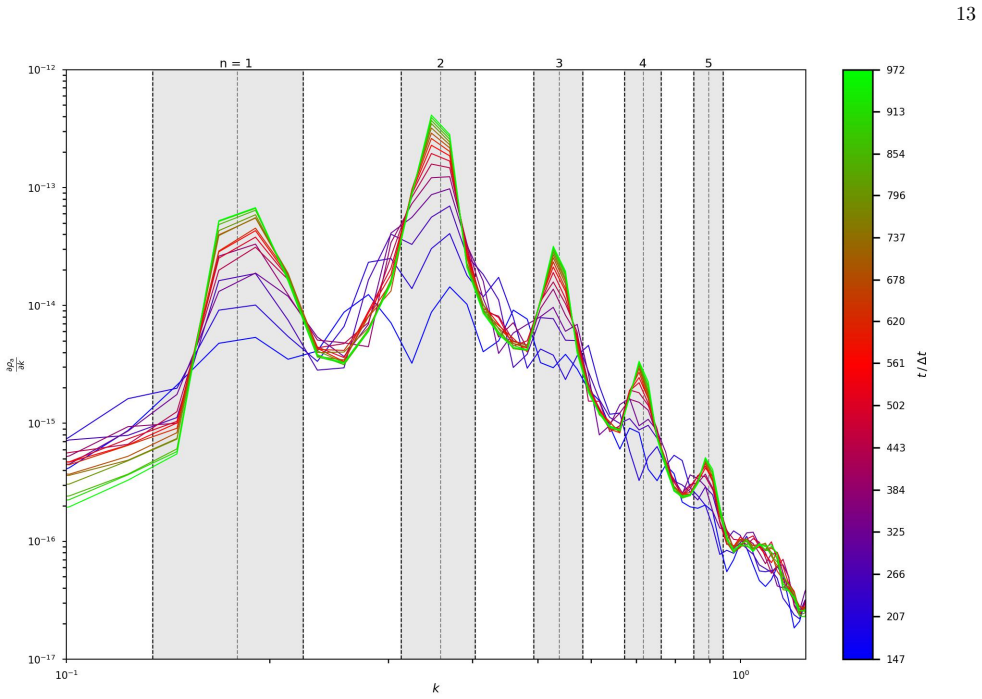
On the paper's own terms, the central claim is that the spectrum of axion radiation from a perturbed straight global string is exponential, not hard: fitting harmonics n=2–5 gives P_n ∝ e^{-rn}, r≈2.5–2.9, with total power ∝ε^4 as expected. This is obtained only after decomposing the field phase into the static string ansatz θ plus perturbations Δα, and masking a cylinder of radius 33Δx; without that subtraction the spectrum of ϕ∂_t α peaks at the fundamental and falls only as k^{-2.25}, which the authors attribute to string motion. They therefore argue that large network simulations using ϕ∂_t α without self-field subtraction are likely measuring the self-field, and they use the exponential
What carries the argument
The key object is the phase decomposition α = α_str + Δα, separating the static string self-field (α_str≈θ, azimuthal around the string) from the propagating axion perturbation Δα. The authors compute the axion energy spectrum from the Fourier transform of ϕ∂_t(Δα) after subtracting the static field and excising a cylinder of radius r0=33Δx, with a mode-mixing kernel to correct for the mask. The analytic relic-density calculation is carried by the factor G2, which encodes the spectral shape's effect on axion number density, together with G1 for loop decay; this factorization isolates the spectrum as the dominant uncertainty.
Load-bearing premise
The load-bearing premise is that excising a cylinder of radius 33 grid cells around one oscillating string isolates the true propagating axion field in a way that carries over to dense networks, while the quantitative exponential fit itself rests on harmonics n=2–5 from a single box size analyzed for only about one oscillation after radiation first reaches the boundary.
What would settle it
Extract the spectrum from a network simulation using masks large enough to exclude the string self-field, and compare the power-law versus exponential shape; a hard spectrum with p≈1 surviving the correction would refute the claim, as would an exponential fit that fails to stabilize at r≈2.5–2.9 when a single-string run is extended beyond the boundary-limited window.
If this is right
- The relic axion density from global strings is highly sensitive to the radiation spectrum, captured by a single factor G2, so predictions for m_a shift by orders of magnitude between hard and exponential spectra.
- Spectra of ϕ∂_t α without self-field subtraction—the method used by large network simulations—are dominated by string motion, so previously inferred hard spectral indices do not reflect the propagating axion population.
- Using the measured exponential spectrum, the axion mass required to match the observed dark-matter density is roughly 125 μeV for direct string emission and 160 μeV for loop-dominated soft emission, with detection frequencies around 30–38 GHz.
- The total radiated power follows ε^4 and the harmonic powers fall as P_n ∝ e^{-rn} with r≈2.5–2.9, consistent with Nambu-like Kalb-Ramond expectations.
- A substantial mask radius, about 33 grid spacings, is required to isolate axion radiation—far larger than masks previously applied in network simulations.
Where Pith is reading between the lines
- If self-field contamination is as strong in networks as in this single-string case, past axion mass predictions from hard spectra may be systematically low; reanalyzing existing network simulations with larger masks would test this directly.
- The exponential spectrum for a single string suggests the Kalb-Ramond/Nambu description of global strings may be more accurate than recent network simulations imply; if confirmed, the debate over loop production and scaling density could shift back toward Nambu-like behavior.
- A natural next step is to apply the same subtraction-and-mask procedure to oscillating loops; if loops also emit exponentially, the loop-dominated scenario converges on m_a≈160 μeV, provided the runtime limitation from boundary reflections is overcome.
- The authors' analytic factorization of the relic density into cosmology-dependent and spectrum-dependent factors could be used to convert any future measured spectrum, from network or loop simulations, directly into a mass prediction without rerunning the cosmology.
Editorial analysis
A structured set of objections, weighed in public.
Referee Report
Summary. The paper studies the spectrum of axion radiation from global strings. It first develops a parametric model for the relic axion density showing that the result is very sensitive to the radiation spectrum. It then presents numerical simulations of a perturbed straight global string, arguing that the common practice of using ϕ∂_t α is dominated by the string self-field. After subtracting the self-field and applying a cylindrical mask, the authors claim the spectrum is exponential, P_n ∝ e^{-r n} with r ≈ 2.5–2.9, and that the total power scales as ε^4. Using this spectrum in their relic-density framework gives m_a ≈ 125 μeV for direct long-string emission and ≈160 μeV for loop-dominated decay, much higher than the ~4 μeV obtained from a hard power-law spectrum.
Significance. If the central claim is correct, the paper makes an important contribution: it identifies a concrete and plausible reason why large network simulations may measure a hard spectrum (self-field contamination), and it provides a transparent analytic framework separating the spectral function G_2 from the cosmological normalization. The demonstration that the self-field subtraction qualitatively changes the spectrum (Figs. 7–8) is convincing and should be of interest to the axion-string community. The exact evaluation of G_1 and the explicit dependence on the spectrum parameters in Eqs. (14)–(26) are useful improvements over earlier treatments. However, the quantitative claim of an exponential spectrum with r≈2.5–2.9 currently rests on a narrow numerical analysis that is partially inconsistent with the paper's own stated boundary limitations, and the extrapolation to a network is explicitly not demonstrated. The paper is therefore valuable as a methodological warning and a parametric framework, but its headline mass predictions need stronger numerical support.
major comments (4)
- [§III, Appendix A, Figs. 9–11] The central quantitative claim, r≈2.5–2.9, is extracted from the n_x=801 runs at times up to t≈1000 Δt, while Appendix A states that t_b = n_x dx/(2dt) ≈ 934 Δt and that "we cannot perform any analysis for times later than t_b" because the boundary reflects a small fraction of radiation that can interfere with the spectrum. Fig. 9 explicitly includes "the first such time step after the radiation hits the boundary," and Fig. 11 shows the r(t) curves for L=40,50 reaching the quoted band only at late times, with L=80,100 not stabilizing. This means the quoted r may be contaminated by boundary reflections. Please provide fits restricted to t<t_b, quantify the reflection amplitude, or run larger boxes so that the spectral peaks form before t_b.
- [§III, Fig. 11] The exponential fit P_n ∝ e^{-r n} is based on only harmonics n=2–5 from a single box size (n_x=801), with no error bars. Appendix A shows that the n_x=201 and n_x=401 simulations do not exhibit clean harmonic peaks, so there is no cross-box convergence check. The preference for an exponential over a power law is only illustrated in an inset for one time and one L; no quantitative goodness-of-fit or stability under different fitting ranges (e.g., n=2–4 vs n=2–5, different time windows) is given. Please report error bars on P_n, fits over multiple harmonic ranges and time windows, and a statistical comparison (e.g., Δχ²) between the exponential and power-law forms.
- [§V and Abstract] The paper explicitly states in §V that a simple oscillating string is not a network and "we are not suggesting that the spectra will necessarily be similar," yet the abstract presents m_a≈125 μeV "using our spectra" as a concrete scenario. The mass prediction therefore goes beyond what the simulations actually demonstrate. Please either provide a network-level test or clearly label the m_a≈125 μeV and ≈160 μeV values as illustrative single-string results that indicate sensitivity, not as network predictions.
- [Appendix B] The mode-mixing kernel is derived for ensemble-averaged spectra, but the analysis uses it for a single realization without ensemble averaging. The authors note this approximation may fail at low k, but the harmonics n=2–5 at k=4π/L–10π/L are not obviously in the regime where the approximation is guaranteed to hold. No validation of the reconstruction is shown on a synthetic field with a known spectrum. Please validate the reconstruction procedure on a controlled test case and quantify the systematic uncertainty in P_n for the harmonic range used.
minor comments (5)
- [Fig. 9 caption] The caption says the spectra are shown "until and including the first such time step after the radiation hits the boundary," which conflicts with Appendix A's statement that no analysis can be performed after t_b. Please remove or justify this inconsistency.
- [Abstract] The abstract says "we find that this leads to a range of possible axion masses... albeit that they are typically higher" and gives m_a≈125 μeV and ≈160 μeV; please mark explicitly that these are based on a single oscillating string, not a network.
- [Eq. (35)] The notation P=βε^4 is used, but later β/μ≈0.16 is quoted. Please clarify the units and define μ consistently (tension per unit length vs f_a^2).
- [Fig. 3 caption] The phrase "the nx case" appears to be missing a subscript; it should be "the n_x=801 case."
- [General] Several instances of "ran" should be "run" (e.g., "we ran until t≈1000 Δt"). Also, the abbreviation "nx" is used inconsistently with "n_x".
Circularity Check
No significant circularity; r is an empirical fit and the relic-density mapping uses it as an input. Score 1 only for minor reliance on previous self-work that is not load-bearing; the main caveats are data-quality issues, not circularity.
full rationale
The paper's derivation chain is linear: (i) simulate perturbed straight global strings; (ii) separate the propagating axion phase Δα from the string self-field by subtracting the boosted static-field ansatz and applying a cylindrical mask; (iii) measure the harmonic powers P_n directly from the simulation and fit P_n ∝ e^{-rn} (or n^{-p}); (iv) insert the fitted spectrum g(z)=exp[-rz/4π] into the analytic Ω_a integral and invert Ω_a h²≈0.12 for m_a. No equation defines the output in terms of the input: r is not set by the relic-density model, the exponential is tested against the simulation data and compared with a power law, and the mass calculation is an independent mapping from assumed network parameters and the fitted spectrum to m_a. The authors do rely on their earlier work (refs [24]-[26]) for KR-action expectations (P∝ε^4, n=2 dominance, loop formulas), but these are consistency checks/inputs and are re-validated against the new simulations, so the central result does not reduce to a self-citation. I therefore identify no circular step. I do explicitly flag, as robustness rather than circularity, the boundary-time contradiction: Appendix A says "we cannot perform any analysis for times later than t_b" and that "the boundary reflects a small fraction of the radiation back into the volume... interfering with the formation of the spectrum", yet the main n_x=801 runs "were ran until t≈1000 Δt, that is within one period of the string's oscillation after t_b"; Fig. 11 also shows L=80,100 not reaching a stable r. These are correctness risks for r≈2.5-2.9 and for the derived masses, but they are not input-output circularity.
Axiom & Free-Parameter Ledger
free parameters (8)
- ζ (long-string density parameter) =
13 (Nambu) or 0.5–1.5 (field theory), fiducial 1
- ⟨v²⟩ (rms string velocity) =
≈0.35
- Γ̂a = β Γ_a (loop radiation coefficient) =
≈46
- Γ̃a = 4π γ log(Δ/δ) (long-string radiation strength) =
200–1000
- α/κ (loop-size to decay parameter) =
0.1–10
- Fℓ (fraction of energy into loops) =
0–1
- q, n* / p, m* (spectral index and UV cutoff) or exponential r =
q≈0.9–2, n*≈10^3–10^9; p≈1, m*≈e^70; or r≈2.5–2.9 (measured)
- β1 (QCD instanton amplitude in m_a(T)) =
≈0.026 (DIGA), varying by ~3 orders between lattice groups
axioms (6)
- domain assumption One-scale model for string network evolution (Eqs. 2–3)
- domain assumption The emission spectrum g(z) is time-independent and the same functional form applies to loops and long strings
- standard math Axion number-to-entropy ratio conserved from T_AD to today
- domain assumption Static-string ansatz subtraction with Lorentz-boost approximation θ′≈θ, r′≈r is accurate
- ad hoc to paper Mode-mixing kernel derived for ensemble averages can be applied to a single realization
- ad hoc to paper Masking with r_0=33 Δx and reconstruction (Appendix B) yields an unbiased estimate of the true spectrum
read the original abstract
We discuss key aspects of the nature of radiation from global strings and its impact on the relic axion density. Using a simple model we demonstrate the dependence on the spectrum of radiation emitted by strings. We then study the radiation emitted by perturbed straight strings paying particular attention to the difference between the overall phase of the field and the small perturbations about the string solution which are the axions. We find that a significant correction is required to be sure that one is analyzing the axions and not the self-field of the string. Typically this requires one to excise a sizeable region around the string - something which is not usually done in the case of numerical field theory simulations of string networks. We have measured the spectrum of radiation from these strings and find that it is compatible with an exponential, as predicted by the Nambu-like Kalb-Ramond action, and in particular is not a ``hard'' spectrum often found in string network simulations. We conclude by attempting to assess the uncertainties on relic density and find that this leads to a range of possible axion masses when compared to the measured density from the Cosmic Microwave Background, albeit that they are typically higher than what is predicted by the Initial Misalignment Mechanism. If the decay is via a ``soft spectrum'' from loops produced close to the backreaction scale we find that $m_{\rm a}\approx 160\,\mu{\rm eV}$ and a detection frequency $f\approx 38\,{\rm GHz}$. If axions are emitted directly by the string network, and we use emission spectra reported in field theory simulations, then $m_{\rm a}\approx 4\,\mu{\rm eV}$ and $f\approx 1\,{\rm GHz}$, however this increases to $m_a \approx 125\,\mu{\rm eV}$ and $f\approx 30\,{\rm GHz}$ using our spectra for the case of an oscillating string. In all scenarios there are significant remaining uncertainties that we delineate.
Figures




Forward citations
Cited by 2 Pith papers
-
Whispers of Supergravity in Gravitational Wave Backgrounds: Determining the Gravitino Mass from Cosmic Thermal History
Gravitino masses in the 100 TeV to 10^10 TeV range can be inferred from two frequency features in the stochastic gravitational wave spectrum produced by an early matter-dominated phase.
-
Echoes of Global Cosmic Strings
Global cosmic strings from symmetry breaking produce Nambu-Goldstone bosons whose cosmological signatures can be constrained by current and upcoming CMB and large-scale structure observations.
Reference graph
Works this paper leans on
-
[1]
If we had used (11) we would have deduced that G1(x)∝(1 +x) 3/2−1 which has the same dependence on xasx→0, but it is very different for largex
We note that, within the context of the calculation, this limit is not the same as all the energy being emitted from the long strings due to influence of the spectrum - ifα→ ∞all the axions would be emitted with very high frequencies, reducingn a for the same amount of energy emitted. If we had used (11) we would have deduced that G1(x)∝(1 +x) 3/2−1 which...
-
[2]
R. D. Peccei and H. R. Quinn, Constraints imposed by cp conservation in the presence of pseudoparticles, Physical Review D16, 1791 (1977)
1977
-
[3]
Weinberg, A new light boson?, Physical Review Letters 40, 223 (1978)
S. Weinberg, A new light boson?, Physical Review Letters 40, 223 (1978)
1978
-
[4]
D. J. Marsh, Axion cosmology, Physics Reports643, 1 (2016)
2016
-
[5]
M. Dine, W. Fischler, and M. Srednicki, A simple solution to the strong CP problem with a harmless axion, Physics Letters B104, 199 (1981)
1981
-
[6]
A. R. Zhitnitsky, On Possible Suppression of the Axion Hadron Interactions. (In Russian), Sov. J. Nucl. Phys. 31, 260 (1980), [Yad. Fiz.31,497(1980)]
1980
-
[7]
Wilczek, Problem of strong P and T invariance in the presence of instantons, Physical Review Letters40, 279 (1978)
F. Wilczek, Problem of strong P and T invariance in the presence of instantons, Physical Review Letters40, 279 (1978)
1978
-
[8]
Topological defects in Cosmology
In our simulations, this led to a markedly different spectrum, one which we have shown to agree well with the expectations from the Nambu-Goto action — the total power followsP∝ε 4 and the power emitted in each mode goes likeP n ∝e −rn withr≈2.5−2.9 — albeit with a noticeable relaxation time. If we were to take this seriously and consider axion emission t...
-
[9]
M. S. Turner, Thermal Production of Not SO Invisible Axions in the Early Universe, Phys. Rev. Lett.59, 2489 (1987), [Erratum: Phys.Rev.Lett. 60, 1101 (1988)]
1987
-
[10]
J. E. Kim, Weak-interaction singlet and strong CP invariance, Physical Review Letters43, 103 (1979)
1979
-
[11]
M. A. Shifman, A. I. Vainshtein, and V. I. Zakharov, Can confinement ensure natural CP invariance of strong interactions?, Nuclear Physics B166, 493 (1980)
1980
-
[12]
Preskill, M
J. Preskill, M. B. Wise, and F. Wilczek, Cosmology of the invisible axion, Physics Letters B120, 127 (1983). 20
1983
-
[13]
Dine and W
M. Dine and W. Fischler, The not-so-harmless axion, Physics Letters B120, 137 (1983)
1983
-
[14]
Abbott and P
L. Abbott and P. Sikivie, A cosmological bound on the invisible axion, Physics Letters B120, 133 (1983)
1983
-
[15]
O. Wantz and E. P. S. Shellard, Axion cosmology revisited, Phys. Rev. D82, 123508 (2010), arXiv:0910.1066 [astro-ph.CO]
Pith/arXiv arXiv 2010
-
[16]
Sikivie, Of Axions, Domain Walls and the Early Universe, Phys
P. Sikivie, Of Axions, Domain Walls and the Early Universe, Phys. Rev. Lett.48, 1156 (1982)
1982
-
[17]
R. L. Davis, Cosmic Axions from Cosmic Strings, Phys. Lett. B180, 225 (1986)
1986
-
[18]
S. Borsanyiet al., Calculation of the axion mass based on high-temperature lattice quantum chromodynamics, Nature539, 69 (2016), arXiv:1606.07494 [hep-lat]
Pith/arXiv arXiv 2016
-
[19]
K. J. Bae, J.-H. Huh, and J. E. Kim, Updating the axion cold dark matter energy density, Journal of Cosmology and Astro-Particle Physics2008, 005 (2008), arXiv:0806.0497 [hep-ph]
Pith/arXiv arXiv 2008
-
[20]
Both works calculate the topological susceptibility, which we have converted to mass ratios using the value forχ(0) provided in [18]
we use the fitting formula that they provide (note that it is extended to higher temperatures as the data that the fit was based upon only reaches up to 512 MeV) while the Borsanyi et al.plot uses the direct numerical results that are provided in Table S9 of the Supplementary Information [18]. Both works calculate the topological susceptibility, which we ...
-
[21]
S. Borsanyi, M. Dierigl, Z. Fodor, S. D. Katz, S. W. Mages, D. Nogradi, J. Redondo, A. Ringwald, and K. K. Szabo, Axion cosmology, lattice QCD and the dilute instanton gas, Phys. Lett. B752, 175 (2016), arXiv:1508.06917 [hep-lat]
Pith/arXiv arXiv 2016
-
[22]
Bazavov, T
A. Bazavov, T. Bhattacharya, M. Cheng, C. DeTar, H.-T. Ding, S. Gottlieb, R. Gupta, P. Hegde, U. M. Heller, F. Karsch, E. Laermann, L. Levkova, S. Mukherjee, P. Petreczky, C. Schmidt, R. A. Soltz, W. Soeldner, R. Sugar, D. Toussaint, W. Unger, and P. Vranas (HotQCD Collaboration), Chiral and deconfinement aspects of the qcd transition, Phys. Rev. D85, 054...
2012
-
[23]
Chen, T.-W
Y.-C. Chen, T.-W. Chiu, and T.-H. Hsieh (TWQCD Collaboration), Topological susceptibility in finite temperature qcd with physical (u/d, s, c) domain-wall quarks, Phys. Rev. D106, 074501 (2022)
2022
-
[24]
C. Bonati, M. D’Elia, M. Mariti, G. Martinelli, M. Mesiti, F. Negro, F. Sanfilippo, and G. Villadoro, Axion phenomenology andθ-dependence fromN f = 2+1 lattice QCD, JHEP03, 155, arXiv:1512.06746 [hep-lat]
-
[25]
Petreczky, H.-P
P. Petreczky, H.-P. Schadler, and S. Sharma, The topological susceptibility in finite temperature qcd and axion cosmology, Physics Letters B762, 498 (2016)
2016
-
[26]
R. L. Davis and E. P. S. Shellard, DO AXIONS NEED INFLATION?, Nucl. Phys. B324, 167 (1989)
1989
-
[27]
Battye and E
R. Battye and E. Shellard, Global string radiation, Nuclear Physics B423, 260 (1994)
1994
-
[28]
R. A. Battye and E. P. S. Shellard, Axion string constraints, Phys. Rev. Lett.73, 2954 (1994), [Erratum: Phys.Rev.Lett. 76, 2203–2204 (1996)], arXiv:astro-ph/9403018
Pith/arXiv arXiv 1994
-
[29]
R. Battye and E. Shellard, Recent perspectives on axion cosmology, Arxiv preprint astro-ph/9706014 (1997)
Pith/arXiv arXiv 1997
-
[30]
Vilenkin and T
A. Vilenkin and T. Vachaspati, Radiation of Goldstone Bosons From Cosmic Strings, Phys. Rev. D35, 1138 (1987)
1987
-
[31]
Kalb and P
M. Kalb and P. Ramond, Classical direct interstring action, Physical Review D9, 2273 (1974)
1974
-
[32]
Nambu, Strings, monopoles, and gauge fields, Physical Review D10, 4262 (1974)
Y. Nambu, Strings, monopoles, and gauge fields, Physical Review D10, 4262 (1974)
1974
-
[33]
R. L. Davis and E. P. S. Shellard, Antisymmetric Tensors and Spontaneous Symmetry Breaking, Phys. Lett. B214, 219 (1988)
1988
-
[34]
Harari and P
D. Harari and P. Sikivie, On the evolution of global strings in the early universe, Physics Letters B195, 361 (1987)
1987
-
[35]
Hagmann, P
C. Hagmann, P. Sikivie, N. S. Sullivan, and D. B. Tanner, Results from a search for cosmic axions, Phys. Rev. D42, 1297 (1990)
1990
-
[36]
Aghanimet al.(Planck), Planck 2018 results
N. Aghanimet al.(Planck), Planck 2018 results. VI. Cosmological parameters, Astron. Astrophys.641, A6 (2020), [Erratum: Astron.Astrophys. 652, C4 (2021)], arXiv:1807.06209 [astro-ph.CO]
Pith/arXiv arXiv 2018
-
[37]
M. Yamaguchi, J. Yokoyama, and M. Kawasaki, Evolution of a global string network in a matter dominated universe, Phys. Rev. D61, 061301 (2000), arXiv:hep-ph/9910352
Pith/arXiv arXiv 2000
-
[38]
M. Kawasaki, T. Sekiguchi, M. Yamaguchi, and J. Yokoyama, Long-term dynamics of cosmological axion strings, PTEP2018, 091E01 (2018), arXiv:1806.05566 [hep-ph]
Pith/arXiv arXiv 2018
-
[39]
K. Saikawa, J. Redondo, A. Vaquero, and M. Kaltschmidt, Spectrum of global string networks and the axion dark matter mass, arXiv preprint arXiv:2401.17253 (2024)
Pith/arXiv arXiv 2024
-
[40]
M. Kaltschmidt, J. Redondo, K. Saikawa, and A. Vaquero, The Spectrum of Global Axion Strings (2025) arXiv:2502.02398 [hep-ph]
Pith/arXiv arXiv 2025
-
[41]
Buschmann, J
M. Buschmann, J. W. Foster, and B. R. Safdi, Early-universe simulations of the cosmological axion, Physical review letters124, 161103 (2020)
2020
-
[42]
Buschmann, J
M. Buschmann, J. W. Foster, A. Hook, A. Peterson, D. E. Willcox, W. Zhang, and B. R. Safdi, Dark matter from axion strings with adaptive mesh refinement, Nature communications13, 1049 (2022)
2022
-
[43]
J. N. Benabou, M. Buschmann, J. W. Foster, and B. R. Safdi, Axion mass prediction from adaptive mesh refinement cosmological lattice simulations, Phys. Rev. Lett.134, 241003 (2025)
2025
-
[44]
Hindmarsh, J
M. Hindmarsh, J. Lizarraga, A. Lopez-Eiguren, and J. Urrestilla, Scaling density of axion strings, Physical Review Letters124, 021301 (2020)
2020
-
[45]
V. B. . Klaer and G. D. Moore, The dark-matter axion mass, JCAP11, 049, arXiv:1708.07521 [hep-ph]
-
[46]
V. B. Klaer and G. D. Moore, Global cosmic string networks as a function of tension, JCAP06, 021, arXiv:1912.08058 [hep-ph]
Pith/arXiv arXiv 1912
-
[47]
M. Hindmarsh, J. Lizarraga, A. Lopez-Eiguren, and J. Urrestilla, Approach to scaling in axion string networks, Phys. Rev. D103, 103534 (2021), arXiv:2102.07723 [astro-ph.CO]
Pith/arXiv arXiv 2021
-
[48]
H. Kim, J. Park, and M. Son, Axion dark matter from cosmic string network, JHEP07, 150, arXiv:2402.00741 [hep-ph]
-
[49]
Hiramatsu, M
T. Hiramatsu, M. Kawasaki, T. Sekiguchi, M. Yamaguchi, and J. Yokoyama, Improved estimation of radiated axions from cosmological axionic strings, Phys. Rev. D83, 123531 (2011)
2011
-
[50]
Correia, M
J. Correia, M. Hindmarsh, J. Lizarraga, A. Lopez-Eiguren, K. Rummukainen, and J. Urrestilla, Scaling density of axion strings in terasite simulations, Phys. Rev. D111, 063532 (2025)
2025
-
[51]
M. Gorghetto, E. Hardy, and G. Villadoro, More axions from strings, SciPost Phys.10, 050 (2021), arXiv:2007.04990 [hep-ph]
Pith/arXiv arXiv 2021
- [52]
-
[53]
M. Gorghetto, E. Hardy, and G. Villadoro, Axions from Strings: the Attractive Solution, JHEP07, 151, arXiv:1806.04677 [hep-ph]
-
[54]
J. Correia, M. Hindmarsh, J. Lizarraga, A. Lopez-Eiguren, K. Rummukainen, and J. Urrestilla, The spectrum of axions in a scaling string network 21 (2025), arXiv:2512.13653 [hep-ph]
arXiv 2025
-
[55]
M. Hindmarsh, J. Lizarraga, J. Urrestilla, D. Daverio, and M. Kunz, Scaling from gauge and scalar radiation in Abelian Higgs string networks, Phys. Rev. D96, 023525 (2017), arXiv:1703.06696 [astro-ph.CO]
Pith/arXiv arXiv 2017
-
[56]
J. N. Moore, E. P. S. Shellard, and C. J. A. P. Martins, Evolution of abelian-higgs string networks, Phys. Rev. D 65, 023503 (2001)
2001
-
[57]
M. Hindmarsh, S. Stuckey, and N. Bevis, Abelian Higgs Cosmic Strings: Small Scale Structure and Loops, Phys. Rev. D79, 123504 (2009), arXiv:0812.1929 [hep-th]
Pith/arXiv arXiv 2009
-
[58]
M. Hindmarsh, J. Lizarraga, A. Urio, and J. Urrestilla, Loop decay in Abelian-Higgs string networks, Phys. Rev. D104, 043519 (2021), arXiv:2103.16248 [astro-ph.CO]
Pith/arXiv arXiv 2021
-
[59]
Allen and E
B. Allen and E. P. S. Shellard, Cosmic string evolution: a numerical simulation, Phys. Rev. Lett.64, 119 (1990)
1990
-
[60]
E. P. S. Shellard and B. Allen, On the evolution of cosmic strings, inNuffield Workshop: Symposium on the Formation and Evolution of Cosmic Strings(1989)
1989
-
[61]
D. P. Bennett and F. R. Bouchet, Evidence for a Scaling Solution in Cosmic String Evolution, Phys. Rev. Lett. 60, 257 (1988)
1988
-
[62]
D. P. Bennett and F. R. Bouchet, Cosmic string evolution, Phys. Rev. Lett.63, 2776 (1989)
1989
-
[63]
D. P. Bennett and F. R. Bouchet, High resolution simulations of cosmic string evolution. 1. Network evolution, Phys. Rev. D41, 2408 (1990)
1990
-
[64]
Drew and E
A. Drew and E. Shellard, Radiation from global topological strings using adaptive mesh refinement: Methodology and massless modes, Physical Review D 105, 063517 (2022)
2022
-
[65]
A. Saurabh, T. Vachaspati, and L. Pogosian, Decay of Cosmic Global String Loops, Phys. Rev. D101, 083522 (2020), arXiv:2001.01030 [hep-ph]
Pith/arXiv arXiv 2020
-
[66]
Vilenkin and E
A. Vilenkin and E. P. S. Shellard,Cosmic strings and other topological defects(Cambridge University Press, 1994)
1994
-
[67]
M. S. Turner, Cosmic and Local Mass Density of Invisible Axions, Phys. Rev. D33, 889 (1986)
1986
-
[68]
Hadjidimos, Successive overrelaxation (sor) and related methods, Journal of Computational and Applied Mathematics123, 177 (2000)
A. Hadjidimos, Successive overrelaxation (sor) and related methods, Journal of Computational and Applied Mathematics123, 177 (2000)
2000
-
[69]
A. Drew, T. Kinowski, and E. Shellard, Axion string source modelling, arXiv preprint arXiv:2312.07701 (2023)
Pith/arXiv arXiv 2023
-
[70]
L. Di Luzio, M. Giannotti, E. Nardi, and L. Visinelli, The landscape of QCD axion models, Phys. Rept.870, 1 (2020), arXiv:2003.01100 [hep-ph]
Pith/arXiv arXiv 2020
-
[71]
E. Hivon, K. M. Gorski, C. B. Netterfield, B. P. Crill, S. Prunet, and F. Hansen, Master of the cosmic microwave background anisotropy power spectrum: a fast method for statistical analysis of large and complex cosmic microwave background data sets, Astrophys. J. 567, 2 (2002), arXiv:astro-ph/0105302
Pith/arXiv arXiv 2002
-
[72]
Program Generation, Optimization, and Platform Adaptation
M. Frigo and S. G. Johnson, The design and implementation of FFTW3, Proceedings of the IEEE 93, 216 (2005), special issue on “Program Generation, Optimization, and Platform Adaptation”. Appendix A: T ests of the calculations of the power forn x = 200and400 To investigate the influence of the simulations’ finite volume on the behavior, we observe, we compa...
2005
discussion (0)
Sign in with ORCID, Apple, or X to comment. Anyone can read and Pith papers without signing in.