Whispers of Supergravity in Gravitational Wave Backgrounds: Determining the Gravitino Mass from Cosmic Thermal History
Pith reviewed 2026-06-29 10:17 UTC · model grok-4.3
The pith
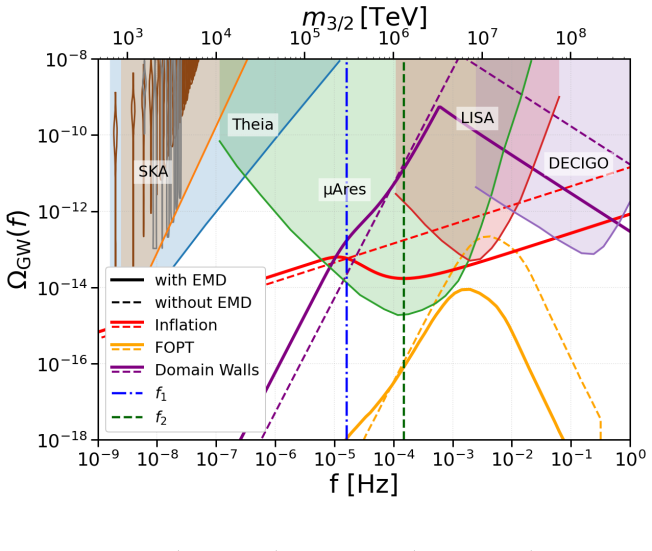
Features in the stochastic gravitational wave background directly determine the gravitino mass and its initial abundance.
A machine-rendered reading of the paper's core claim, the machinery that carries it, and where it could break.
Core claim
Gravitinos above the electroweak scale decay before BBN but induce an early matter-dominated era whose onset and termination frequencies in the stochastic gravitational wave background provide a direct determination of both the gravitino mass and its initial abundance.
What carries the argument
The pair of frequencies in the gravitational wave spectrum that mark the beginning and end of the early matter-dominated era caused by gravitino decay.
If this is right
- Gravitational wave observatories can access gravitino masses from O(100) TeV to O(10^10) TeV.
- The NANOGrav signal already probes gravitino masses between 500 and 10^4 TeV.
- Both the mass and the initial abundance are recoverable from the same two frequency features.
- Gravitational wave data thereby test supergravity in a regime unreachable by colliders.
Where Pith is reading between the lines
- The same frequency-mapping technique could apply to any long-lived particle that triggers a comparable early matter-dominated phase.
- Detection of the predicted features would independently confirm an early matter era whose timing is set by a single particle species.
- Precision of the mass extraction may be limited by uncertainties in the initial gravitational wave spectrum shape.
Load-bearing premise
The early matter-dominated era produced by gravitino decay imprints two cleanly identifiable frequency features that map uniquely to the gravitino mass and abundance without significant contamination from other processes.
What would settle it
A measured stochastic gravitational wave spectrum that lacks any pair of frequency breaks consistent with a single gravitino mass, or that shows breaks incompatible with the predicted mapping for any mass in the 100 TeV to 10^10 TeV range.
Figures
read the original abstract
Gravitino masses above the electroweak scale provide the simplest solution to the gravitino problem, but such large mass scales lie far beyond the reach of collider experiments. We show that the stochastic gravitational wave background offers a direct probe of this otherwise inaccessible regime. Despite decaying before Big-Bang Nucleosynthesis (BBN), these gravitinos naturally generate a period of early matter domination in the early universe. This non-standard epoch leaves a characteristic imprint on any primordial gravitational wave background, characterised by two frequencies corresponding to the onset and end of this phase. We demonstrate that these features can be used to directly infer both the gravitino mass and its initial abundance in a direct mapping. Future gravitational wave observatories span a vast frequency range, enabling sensitivity to gravitino masses from the BBN bound of $\mathcal{O}(100)\,\text{TeV}$ all the way up to $\mathcal{O}(10^{10})\,\text{TeV}$, with recent signal by NANOGrav already probing masses in the range $500$-$10^4$ TeV. Gravitational wave observables therefore probe an enormous region of parameter space, far beyond the reach of collider experiments. We are entering an era in which supergravity can be probed through gravitational wave backgrounds alongside collider experiments.
Editorial analysis
A structured set of objections, weighed in public.
Referee Report
Summary. The paper claims that gravitinos with masses above the electroweak scale decay before BBN and induce an early matter-dominated era whose onset and end imprint two characteristic frequencies on any primordial GW background; these frequencies permit a direct mapping to both the gravitino mass m_{3/2} and its initial abundance, thereby probing masses from the BBN bound O(100) TeV up to O(10^{10}) TeV, with NANOGrav already sensitive to 500–10^4 TeV.
Significance. If the asserted one-to-one frequency-to-parameter mapping is robust and independent of other early-universe dynamics, the result would open a new observational window on supergravity at mass scales far beyond colliders, directly linking stochastic GW backgrounds to pre-BBN thermal history.
major comments (2)
- [Abstract] Abstract: the claim that the two MD-era frequency breaks 'can be used to directly infer both the gravitino mass and its initial abundance in a direct mapping' is asserted without any visible derivation, explicit equations, error propagation, or demonstration that the mapping is independent of the initial abundance (itself listed as a free parameter). This mapping is load-bearing for all quantitative sensitivity statements.
- [Abstract] Abstract: no quantitative test is supplied showing that the pair of frequency breaks remains unique once realistic uncertainties in the primordial tensor spectrum or additional early-universe features (different decaying relics, kination phases, or g_* jumps at the QCD transition) are included; without such a demonstration the claimed one-to-one correspondence does not hold.
minor comments (1)
- The NANOGrav mass range 500–10^4 TeV is stated without reference to the specific signal or data release used to derive it.
Simulated Author's Rebuttal
We thank the referee for their report and the opportunity to clarify the manuscript. We address each major comment below.
read point-by-point responses
-
Referee: [Abstract] Abstract: the claim that the two MD-era frequency breaks 'can be used to directly infer both the gravitino mass and its initial abundance in a direct mapping' is asserted without any visible derivation, explicit equations, error propagation, or demonstration that the mapping is independent of the initial abundance (itself listed as a free parameter). This mapping is load-bearing for all quantitative sensitivity statements.
Authors: The abstract summarizes the result; the explicit derivation appears in Sections 3 and 4. There we obtain two independent relations: the onset frequency depends on the temperature at which ρ_{3/2} = ρ_rad (a function of both m_{3/2} and the initial yield Y_{3/2}), while the end frequency is fixed solely by the gravitino lifetime au ≈ m_{3/2}^{-3} (or the appropriate power). Solving the two-frequency system therefore yields both parameters simultaneously. The mapping is not claimed to be independent of Y_{3/2}; rather, the pair of observables determines both quantities. We will revise the abstract to include a parenthetical reference to these equations and will add a short paragraph on error propagation in the revised text. revision: partial
-
Referee: [Abstract] Abstract: no quantitative test is supplied showing that the pair of frequency breaks remains unique once realistic uncertainties in the primordial tensor spectrum or additional early-universe features (different decaying relics, kination phases, or g_* jumps at the QCD transition) are included; without such a demonstration the claimed one-to-one correspondence does not hold.
Authors: We agree that a systematic study of degeneracies would strengthen the result. The manuscript demonstrates that an early matter-dominated era produces a characteristic pair of breaks whose frequency ratio is fixed by the lifetime scaling. Other mechanisms (kination, additional relics, g_* jumps) generally produce different spectral features or require fine-tuned parameters to mimic both breaks at once. Nevertheless, we will add a new subsection in the revised version that qualitatively discusses these potential degeneracies and explains why the specific two-break pattern tied to a decaying relic with m_{3/2} > 100 TeV is distinctive. A full Monte-Carlo scan over all possible early-universe extensions lies beyond the present scope. revision: yes
Circularity Check
No circularity: standard cosmological mapping from MD-era timing to GW breaks
full rationale
The paper calculates the two characteristic frequencies from the onset and end of the gravitino-induced early matter-dominated era using the standard Friedmann equation, decay lifetime au o m_{3/2}, and the condition that the era ends before BBN. These frequencies are then inverted to solve for m_{3/2} and the initial abundance Y_{3/2}. This is a direct, parameter-to-observable relation derived from the thermal history; the mapping is not obtained by fitting to the target GW data nor by self-citation of a uniqueness theorem. No equations reduce the claimed prediction to a tautology or to a fitted input renamed as output. The derivation is self-contained against external benchmarks of early-universe cosmology.
Axiom & Free-Parameter Ledger
free parameters (1)
- initial gravitino abundance
axioms (2)
- domain assumption Gravitinos with masses above the electroweak scale decay before BBN and produce a period of early matter domination.
- domain assumption The onset and end of early matter domination produce two identifiable frequency features in the primordial GW background.
Reference graph
Works this paper leans on
-
[1]
Y. A. Golfand and E. P. Likhtman, JETP Lett.13, 323 (1971)
1971
-
[2]
D. V. Volkov and V. P. Akulov, Phys. Lett. B46, 109 (1973)
1973
-
[3]
Salam and J
A. Salam and J. A. Strathdee, Nucl. Phys. B76, 477 (1974)
1974
-
[4]
Wess and B
J. Wess and B. Zumino, Nucl. Phys. B70, 39 (1974)
1974
-
[5]
Ferrara and P
S. Ferrara and P. van Nieuwenhuizen, Phys. Rev. Lett.37, 1669 (1976)
1976
-
[6]
Deser and B
S. Deser and B. Zumino, Phys. Lett. B62, 335 (1976)
1976
-
[7]
Dimopoulos and H
S. Dimopoulos and H. Georgi, Nucl. Phys. B193, 150 (1981)
1981
-
[8]
H. E. Haber and G. L. Kane, Phys. Rept.117, 75 (1985)
1985
-
[9]
H. P. Nilles, Phys. Rept.110, 1 (1984)
1984
-
[10]
S. P. Martin, Adv. Ser. Direct. High Energy Phys.18, 1 (1998), arXiv:hep-ph/9709356
work page internal anchor Pith review Pith/arXiv arXiv 1998
-
[11]
M. B. Green and J. H. Schwarz, Phys. Lett. B149, 117 (1984)
1984
-
[12]
J. H. Schwarz, Phys. Rept.89, 223 (1982)
1982
-
[13]
Candelas, G
P. Candelas, G. T. Horowitz, A. Strominger, and E. Witten, Nucl. Phys. B258, 46 (1985)
1985
-
[14]
Dirichlet-Branes and Ramond-Ramond Charges
J. Polchinski, Phys. Rev. Lett.75, 4724 (1995), arXiv:hep-th/9510017
work page internal anchor Pith review Pith/arXiv arXiv 1995
-
[15]
String Theory Dynamics In Various Dimensions
E. Witten, Nucl. Phys. B443, 85 (1995), arXiv:hep-th/9503124
work page internal anchor Pith review Pith/arXiv arXiv 1995
-
[16]
Alvarez-Gaume and E
L. Alvarez-Gaume and E. Witten, Nucl. Phys. B234, 269 (1984)
1984
-
[17]
J. R. Ellis, J. S. Hagelin, D. V. Nanopoulos, K. A. Olive, and M. Srednicki, Nucl. Phys. B 238, 453 (1984)
1984
-
[18]
A. H. Chamseddine, R. L. Arnowitt, and P. Nath, Phys. Rev. Lett.49, 970 (1982)
1982
-
[19]
Barbieri, S
R. Barbieri, S. Ferrara, and C. A. Savoy, Phys. Lett. B119, 343 (1982). 19
1982
-
[20]
Weinberg, Phys
S. Weinberg, Phys. Rev. Lett.48, 1303 (1982)
1982
-
[21]
T. Moroi,Effects of the gravitino on the inflationary universe, Other thesis (1995), arXiv:hep- ph/9503210
-
[22]
Big-Bang Nucleosynthesis and Gravitino
M. Kawasaki, K. Kohri, T. Moroi, and A. Yotsuyanagi, Phys. Rev. D78, 065011 (2008), arXiv:0804.3745 [hep-ph]
work page internal anchor Pith review Pith/arXiv arXiv 2008
-
[23]
M. Bolz, A. Brandenburg, and W. Buchmuller, Nucl. Phys. B606, 518 (2001), [Erratum: Nucl.Phys.B 790, 336–337 (2008)], arXiv:hep-ph/0012052
work page internal anchor Pith review Pith/arXiv arXiv 2001
-
[24]
Irreducible Gravitational Wave Background as a Particle Detector
A. Ghoshal, A. Spalding, and G. White, (2026), arXiv:2604.20792 [hep-ph]
work page internal anchor Pith review Pith/arXiv arXiv 2026
- [25]
-
[26]
Imprint of domain wall annihilation on induced gravitational waves
R. Roshan, (2026), arXiv:2604.25726 [hep-ph]
work page internal anchor Pith review Pith/arXiv arXiv 2026
-
[27]
Pearce, L
M. Pearce, L. Pearce, G. White, and C. Bal´ azs, Journal of Cosmology and Astroparticle Physics2024, 021 (2024)
2024
-
[28]
Barenboim and W.-I
G. Barenboim and W.-I. Park, Physics Letters B759, 430 (2016)
2016
-
[29]
H. Assadullahi and D. Wands, Physical Review D79(2009), 10.1103/physrevd.79.083511
-
[30]
Alabidi, K
L. Alabidi, K. Kohri, M. Sasaki, and Y. Sendouda, Journal of Cosmology and Astroparticle Physics2013, 033–033 (2013)
2013
-
[31]
K. Kohri and T. Terada, Physical Review D97(2018), 10.1103/physrevd.97.123532
-
[32]
K. Inomata, K. Kohri, T. Nakama, and T. Terada, Physical Review D100(2019), 10.1103/physrevd.100.043532
-
[33]
O. Ferreira, E. S. Fraga, M. Hippert, and J. Schaffner-Bielich, Phys. Rev. D112, 094009 (2025), arXiv:2507.06518 [hep-ph]
-
[34]
O. Ferreira, E. S. Fraga, and J. Schaffner-Bielich, (2026), arXiv:2603.26946 [hep-ph]
-
[35]
Caprini and D
C. Caprini and D. G. Figueroa, Classical and Quantum Gravity35, 163001 (2018)
2018
-
[36]
Bin´ etruy, A
P. Bin´ etruy, A. Boh´ e, C. Caprini, and J.-F. Dufaux, Journal of Cosmology and Astroparticle Physics2012, 027–027 (2012)
2012
-
[37]
Roshan and G
R. Roshan and G. White, Rev. Mod. Phys.97, 015001 (2025)
2025
-
[38]
van Remortel, K
N. van Remortel, K. Janssens, and K. Turbang, Progress in Particle and Nuclear Physics 128, 104003 (2023)
2023
-
[39]
Christensen, Reports on Progress in Physics82, 016903 (2018)
N. Christensen, Reports on Progress in Physics82, 016903 (2018). 20
2018
-
[40]
Caprini, M
C. Caprini, M. Hindmarsh, S. Huber, T. Konstandin, J. Kozaczuk, G. Nardini, J. M. No, A. Petiteau, P. Schwaller, G. Servant, and D. J. Weir, Journal of Cosmology and Astroparticle Physics2016, 001–001 (2016)
2016
- [41]
-
[42]
L. A. Boyle and P. J. Steinhardt, Physical Review D77(2008), 10.1103/physrevd.77.063504
-
[43]
L. A. Boyle and P. J. Steinhardt, Phys. Rev. D77, 063504 (2008), arXiv:astro-ph/0512014
work page internal anchor Pith review Pith/arXiv arXiv 2008
- [44]
-
[45]
M. Hindmarsh, S. J. Huber, K. Rummukainen, and D. J. Weir, Phys. Rev. D92, 123009 (2015), arXiv:1504.03291 [astro-ph.CO]
work page internal anchor Pith review Pith/arXiv arXiv 2015
-
[46]
G. Crawford and D. Sutherland, JHEP04, 197 (2025), arXiv:2409.18177 [hep-ph]
-
[47]
Vilenkin, Phys
A. Vilenkin, Phys. Rev. D23, 852 (1981)
1981
-
[48]
Vachaspati and A
T. Vachaspati and A. Vilenkin, Phys. Rev. D31, 3052 (1985)
1985
-
[49]
J. J. Blanco-Pillado and K. D. Olum, Physical Review D96(2017), 10.1103/phys- revd.96.104046
-
[50]
Hiramatsu, M
T. Hiramatsu, M. Kawasaki, and K. Saikawa, Journal of Cosmology and Astroparticle Physics 2010, 032–032 (2010)
2010
-
[51]
Vilenkin and E
A. Vilenkin and E. P. S. Shellard,Cosmic Strings and Other Topological Defects(Cambridge University Press, 2000)
2000
-
[52]
A. Ghoshal, A. Spalding, and G. White, (2025), arXiv:2512.14684 [astro-ph.CO]
work page internal anchor Pith review Pith/arXiv arXiv 2025
- [53]
-
[54]
T. W. B. Kibble, J. Phys. A9, 1387 (1976)
1976
- [55]
- [56]
-
[57]
B. P. Abbottet al.(LIGO Scientific, Virgo), Phys. Rev. Lett.116, 061102 (2016), arXiv:1602.03837 [gr-qc]. 21
work page internal anchor Pith review Pith/arXiv arXiv 2016
-
[58]
B. P. Abbottet al.(LIGO Scientific, Virgo), Phys. Rev. Lett.116, 241103 (2016), arXiv:1606.04855 [gr-qc]
work page internal anchor Pith review Pith/arXiv arXiv 2016
-
[59]
B. P. Abbottet al.(LIGO Scientific, VIRGO), Phys. Rev. Lett.118, 221101 (2017), [Erratum: Phys.Rev.Lett. 121, 129901 (2018)], arXiv:1706.01812 [gr-qc]
work page internal anchor Pith review Pith/arXiv arXiv 2017
-
[60]
B. . P. . Abbottet al.(LIGO Scientific, Virgo), Astrophys. J. Lett.851, L35 (2017), arXiv:1711.05578 [astro-ph.HE]
work page internal anchor Pith review Pith/arXiv arXiv 2017
-
[61]
B. P. Abbottet al.(LIGO Scientific, Virgo), Phys. Rev. Lett.119, 141101 (2017), arXiv:1709.09660 [gr-qc]
work page internal anchor Pith review Pith/arXiv arXiv 2017
-
[62]
B. P. Abbottet al.(LIGO Scientific, Virgo), Phys. Rev. Lett.119, 161101 (2017), arXiv:1710.05832 [gr-qc]
work page internal anchor Pith review Pith/arXiv arXiv 2017
-
[63]
L. Badurina, O. Buchmueller, J. Ellis, M. Lewicki, C. McCabe, and V. Vaskonen, Phil. Trans. A. Math. Phys. Eng. Sci.380, 20210060 (2021), arXiv:2108.02468 [gr-qc]
-
[64]
P. W. Graham, J. M. Hogan, M. A. Kasevich, and S. Rajendran, Phys. Rev. D94, 104022 (2016), arXiv:1606.01860 [physics.atom-ph]
work page internal anchor Pith review Pith/arXiv arXiv 2016
-
[65]
P. W. Graham, J. M. Hogan, M. A. Kasevich, S. Rajendran, and R. W. Romani (MAGIS), (2017), arXiv:1711.02225 [astro-ph.IM]
work page internal anchor Pith review Pith/arXiv arXiv 2017
-
[66]
Badurinaet al., JCAP05, 011 (2020), arXiv:1911.11755 [astro-ph.CO]
L. Badurinaet al., JCAP05, 011 (2020), arXiv:1911.11755 [astro-ph.CO]
-
[67]
Punturoet al., Class
M. Punturoet al., Class. Quant. Grav.27, 194002 (2010)
2010
-
[68]
Sensitivity Studies for Third-Generation Gravitational Wave Observatories
S. Hildet al., Class. Quant. Grav.28, 094013 (2011), arXiv:1012.0908 [gr-qc]
work page internal anchor Pith review Pith/arXiv arXiv 2011
-
[69]
B. P. Abbottet al.(LIGO Scientific), Class. Quant. Grav.34, 044001 (2017), arXiv:1607.08697 [astro-ph.IM]
work page internal anchor Pith review Pith/arXiv arXiv 2017
-
[70]
Cosmic Explorer: The U.S. Contribution to Gravitational-Wave Astronomy beyond LIGO
D. Reitzeet al., Bull. Am. Astron. Soc.51, 035 (2019), arXiv:1907.04833 [astro-ph.IM]
work page internal anchor Pith review Pith/arXiv arXiv 2019
-
[71]
The Laser Interferometer Space Antenna: Unveiling the Millihertz Gravitational Wave Sky
J. Bakeret al., (2019), arXiv:1907.06482 [astro-ph.IM]
work page internal anchor Pith review Pith/arXiv arXiv 2019
- [72]
-
[73]
Unveiling the Gravitational Universe at \mu-Hz Frequencies
A. Sesanaet al., Exper. Astron.51, 1333 (2021), arXiv:1908.11391 [astro-ph.IM]
work page internal anchor Pith review Pith/arXiv arXiv 2021
-
[74]
J. Garcia-Bellido, H. Murayama, and G. White, JCAP12, 023 (2021), arXiv:2104.04778 [hep-ph]
-
[75]
C. L. Carilli and S. Rawlings, New Astron. Rev.48, 979 (2004), arXiv:astro-ph/0409274
work page internal anchor Pith review Pith/arXiv arXiv 2004
-
[76]
Gravitational wave astronomy with the SKA
G. Janssenet al., PoSAASKA14, 037 (2015), arXiv:1501.00127 [astro-ph.IM]
work page internal anchor Pith review Pith/arXiv arXiv 2015
-
[77]
Weltmanet al., Fundamental physics with the Square Kilometre Array, Publ
A. Weltmanet al., Publ. Astron. Soc. Austral.37, e002 (2020), arXiv:1810.02680 [astro- ph.CO]. 22
-
[78]
European Pulsar Timing Array Limits On An Isotropic Stochastic Gravitational-Wave Background
L. Lentatiet al.(EPTA), Mon. Not. Roy. Astron. Soc.453, 2576 (2015), arXiv:1504.03692 [astro-ph.CO]
work page internal anchor Pith review Pith/arXiv arXiv 2015
-
[79]
S. Babaket al.(EPTA), Mon. Not. Roy. Astron. Soc.455, 1665 (2016), arXiv:1509.02165 [astro-ph.CO]
work page internal anchor Pith review Pith/arXiv arXiv 2016
-
[80]
Z. Arzoumanianet al.(NANOGRAV), Astrophys. J.859, 47 (2018), arXiv:1801.02617 [astro- ph.HE]
work page internal anchor Pith review Pith/arXiv arXiv 2018
discussion (0)
Sign in with ORCID, Apple, or X to comment. Anyone can read and Pith papers without signing in.