REVIEW 4 major objections 4 minor 2 cited by
A string-inspired black hole with two branches predicts a universal tidal ratio and consistently reduced light bending.
Reviewed by Pith at T0; open to challenge. T0 means a machine referee read the full paper against a public rubric. the ladder, T0–T4 →
T0 review · deepseek-v4-flash
2026-08-03 07:34 UTC pith:U2ECTLGB
load-bearing objection The lensing and plasma parts are worth a look, but the Tsallis thermodynamics section is built on a botched integral and the abstract's observational claims overshoot. the 4 major comments →
Branch structure and nonextensive thermodynamics of Kalb-Ramond-ModMax black holes: observational signatures
The pith
A machine-rendered reading of the paper's core claim, the machinery that carries it, and where it could break.
Core claim
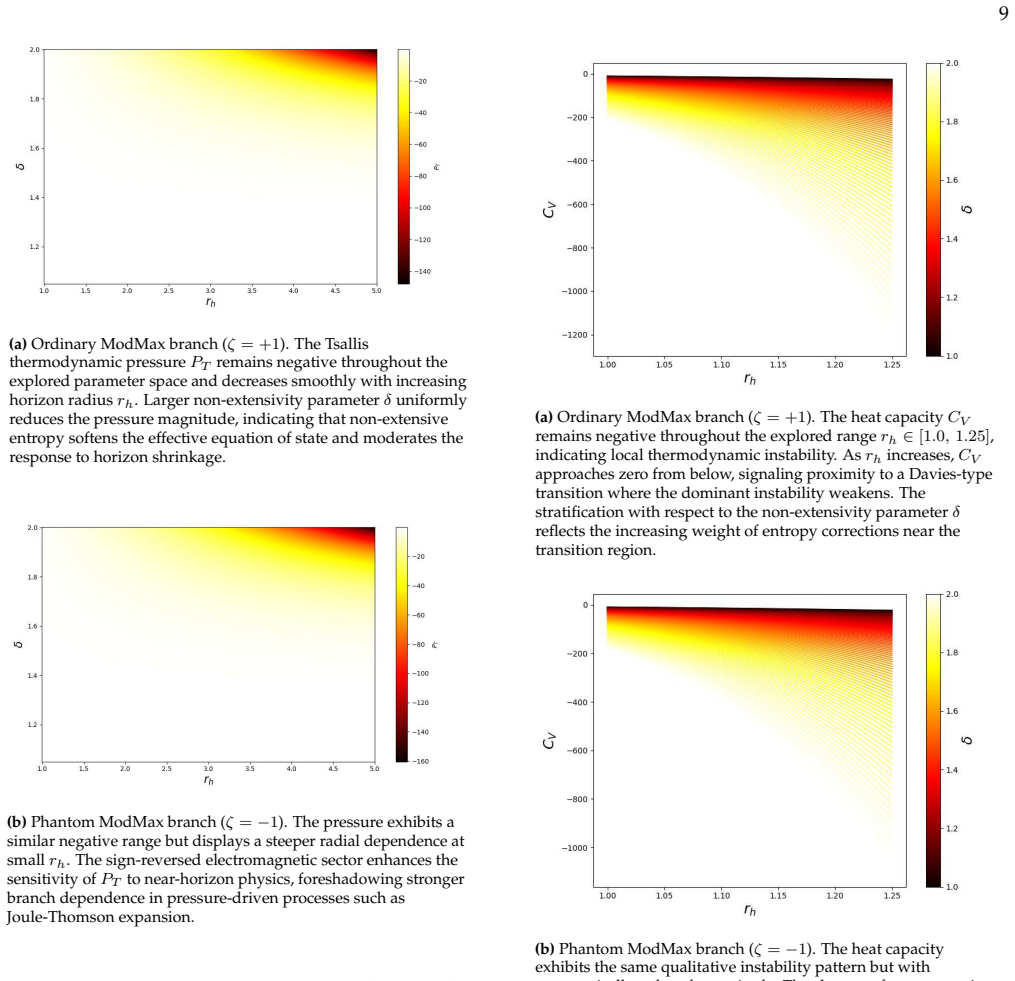
The central claim is that the Kalb-Ramond-ModMax black hole is phenomenologically distinguishable from standard electrovacuum black holes in five independent channels: horizon topology, Tsallis thermodynamics, gravitational lensing, photon spheres in plasma, and tidal forces. Concretely, the paper derives the OIA-corrected vacuum deflection angle α̂_vac = π(√(1-ℓ) - 1) + 4M(1-ℓ)/b + ... , showing a negative topological contribution that reduces light bending; a Tsallis-entropy thermodynamics with branch-dependent heat capacity and Joule-Thomson inversion curves; and a universal tidal balance ratio R_rad/R_ang = 3/2 in the ordinary branch. These are presented as concrete observational handles
What carries the argument
The central object is the exact metric function f(r) = 1/(1-ℓ) - 2M/r + ζ Q² e^{-γ}/((1-ℓ)² r²), which encodes the Kalb-Ramond rescaling (ℓ), the ModMax charge suppression (e^{-γ}), and the branch selector ζ = ±1. The paper's key machinery consists of the Ono-Ishihara-Asada extension of the Gauss-Bonnet theorem for non-Euclidean optical geometry, yielding the negative topological boundary correction π(√(1-ℓ) - 1); the Tsallis entropy ansatz S_T = (π r_h²)^δ with first-law integration for the thermodynamics; and geodesic deviation in an orthonormal frame for tidal forces. The branch parameter ζ is the organizing principle that propagates through all sectors.
Load-bearing premise
The entire thermodynamics section rests on the Tsallis entropy ansatz S_T = (π r_h²)^δ together with the first-law integration E_T = ∫T_H dS_T performed at fixed mass and charge; if this prescription is wrong, the claimed branch-dependent stability and Joule-Thomson behavior do not follow.
What would settle it
Recompute E_T from the first law by direct numerical integration of T_H dS_T for δ = 1: if the result is not the ADM mass M, the closed-form internal energy (Eq. 11) is an artifact of the integration step, and the thermodynamic claims collapse. Separately, a high-precision measurement of a candidate charged black hole's deflection angle that matches the Schwarzschild value 4M/b with no ℓ-dependent suppression would falsify the lensing channel.
If this is right
- If the central claim holds, Event Horizon Telescope and next-generation interferometric arrays can constrain the Kalb-Ramond-ModMax parameters through the predicted reduction of the deflection angle and the ℓ-dependent photon-sphere radius.
- The ordinary branch is connected to Reissner-Nordström and predicts a universal tidal balance ratio R_rad/R_ang = 3/2, which is a parameter-free observational target.
- The phantom branch, with its single horizon, strictly positive Hawking temperature, reinforced lensing, and absence of tidal inversion, would either be excluded or cleanly identified by the same observations.
- In strongly stratified plasma, the photon-sphere radius is dominated by the Kalb-Ramond parameter ℓ, so multi-frequency shadow observations could isolate Lorentz-symmetry-breaking effects from electromagnetic ones.
- A negative topological lensing correction, distinct from the positive correction in global-monopole spacetimes, provides a channel to distinguish the two sources of non-flatness.
Where Pith is reading between the lines
- Because the geometry, lensing, and tidal results do not depend on the Tsallis entropy postulate, their observational signatures would survive even if the thermodynamics section is revised.
- The claimed universal 3/2 tidal ratio, if robust for rotating analogues, could become a powerful probe for tidal disruption events around such black holes.
- The δ = 1 internal-energy inconsistency (Eq. 11 does not reduce to the ADM mass M) suggests that the Tsallis integration prescription, not the spacetime solution itself, is the fragile link in the thermodynamic claims.
Editorial analysis
A structured set of objections, weighed in public.
Referee Report
Summary. The manuscript constructs a static, spherically symmetric black-hole solution in Einstein gravity with a Kalb-Ramond background and ModMax nonlinear electrodynamics, characterized by mass M, charge Q, the Lorentz-violating parameter ℓ, the ModMax parameter γ, and a branch selector ζ=±1. It studies horizon structure, Hawking temperature, Tsallis thermodynamics (internal energy, free energy, pressure, heat capacity), Joule-Thomson expansion, weak gravitational lensing via the Ono-Ishihara-Asada extension, plasma-modified photon spheres, and tidal forces. The central claim is that these sectors yield branch-dependent, multi-channel observational signatures that could be constrained by EHT and next-generation interferometric observations.
Significance. If correct, the paper would provide a broad and useful phenomenology for string-motivated black holes: the exact metric and branch classification are clean, the OIA treatment of the non-Euclidean asymptotic structure is an appropriate extension of the Gauss-Bonnet method, and the analytic deflection angle in Eq. (36) has the correct Schwarzschild and Reissner-Nordström limits. The plasma and tidal sections contain reproducible numerical tables. However, the thermodynamic channel—one of the headline results—is built on a demonstrably incorrect integration and an inconsistent heat-capacity definition, so the claimed thermodynamic and Joule-Thomson signatures cannot be accepted as stated. The 'universal tidal balance ratio' is an algebraic identity already present in Reissner-Nordström and is not a new observable. Thus the multi-channel observational claim is substantially weakened.
major comments (4)
- [II.C, Eq. (8)] The Hawking temperature is not the surface gravity of a unit-normalized Killing vector. Since f(∞)=1/(1-ℓ), the normalized Killing field is √(1-ℓ)∂_t, so T_H should carry an additional factor √(1-ℓ) relative to κ/(2π). The missing factor propagates into Eqs. (11), (14), (18), (21), and (23), changing all ℓ-dependent thermodynamic and Joule-Thomson results. This is a physical normalization issue, not a convention: the temperature measured by asymptotic observers is defined with respect to the unit-normalized Killing vector.
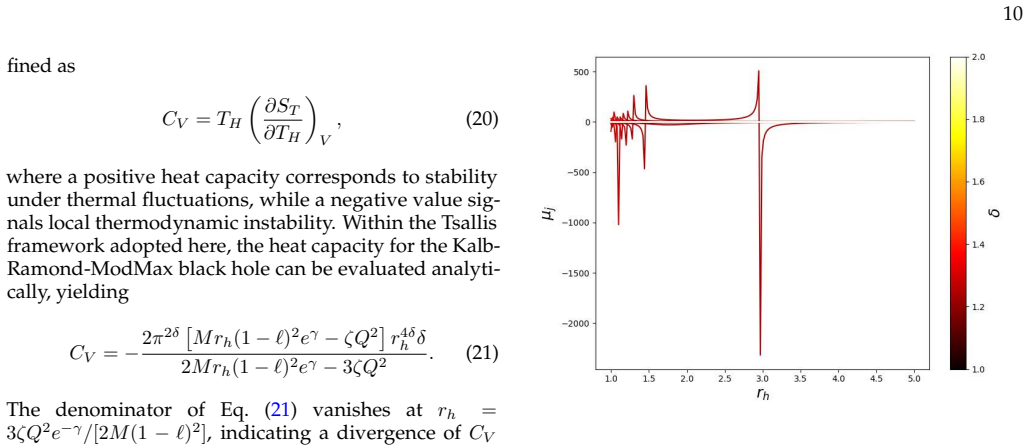
- [III.A, Eqs. (10)-(12)] Eq. (11) is not the integral of Eq. (10) with T_H from Eq. (8). For δ=1, ℓ=0, Q=0, Eq. (11) gives (π/2)Mr_h² = 2πM³ at r_h=2M, whereas the physical Schwarzschild first-law integral from M=0 to M gives E=M, and even taking Eq. (10) literally with r_h as integration variable gives M ln r_h + const, not Eq. (11). Direct differentiation of Eq. (11) gives (∂E_T/∂S_T)=M/2, not M/(2πr²). The denominators (2δ-1)(4δ-3) and the claimed divergences are therefore artifacts of the incorrect closed form. Furthermore, Eq. (10) is not well-posed at fixed M and Q because r_h is fixed by f(r_h)=0; changing r_h at fixed M,Q does not move along the physical solution family. Since E_T feeds F_T, P_T, C_V, and μ_J, the thermodynamic and Joule-Thomson results in §§III-IV collapse.
- [III.C, Eqs. (16)-(21)] With V=4πr_h³/3, fixing V fixes r_h and therefore fixes S_T=(πr_h²)^δ. Hence (∂S_T/∂T_H)_V=0 by construction and the heat capacity at constant volume C_V is identically zero. Eq. (21), which is nonzero, cannot be C_V. The quantity plotted in Fig. 6 is at best an unlabelled derivative at other fixed parameters, and the resulting local-stability and Davies-type conclusions are unsupported.
- [VII.B, Eqs. (59)-(60)] The reported 'universal' ratio R_rad/R_ang=3/2 follows immediately by setting each tidal component to zero: R_rad=3ζQ²e^{-γ}/[2M(1-ℓ)²] and R_ang=ζQ²e^{-γ}/[M(1-ℓ)²], whose ratio is 3/2. This is identical to the Reissner-Nordström relation and is a formal consequence of the two-term structure of the tidal tensor. It contains no new dynamical content and cannot serve as an independent channel distinguishing KR-ModMax from standard RN; calling it 'universal and independent of all model parameters' overstates its significance.
minor comments (4)
- [Abstract and Sec. VIII] The claim of 'concrete observational handles' through EHT and next-generation interferometers is premature: the paper provides no forecasts, no comparison with observed EHT data, and no discussion of systematics. Qualitative parameter trends are useful, but the stated observational reach goes beyond what is demonstrated.
- [Sec. VI, Table III] The inhomogeneous profile ω_p²(r)=κ_r/r^α with α=1 and κ_0=1 has the units of the left-hand side fixed by r^α; specifying units of κ_0 would make the numerical values meaningful and reproducible.
- [Eq. (12)] The expression for A contains an unbalanced bracket and is difficult to verify. A cleaner presentation (or an intermediate step) would help readers check the derivative of Eq. (11).
- [Sec. VII] There are typographical slips such as 'Reissner-Nordstrm' and inconsistent subscript notation for the Hawking temperature. These do not affect the results but should be corrected.
Circularity Check
No significant circularity: the model parameters are inherited, not fitted, and the claimed results are derived consequences of an explicit ansatz rather than restatements of their inputs.
full rationale
The paper does not fit parameters to data and then present those fits as predictions; the KR-ModMax metric, Hawking temperature, lensing angle, plasma photon-sphere equations, and tidal components are all explicit analytic functions of the model parameters. The tidal balance ratio R_rad/R_ang=3/2 follows algebraically by dividing the two geodesic-deviation balance equations, but this is a genuine consequence of the metric's structure, not an input imposed to produce that ratio. The Tsallis thermodynamics is derived from an explicit entropy ansatz S_T=(π r_h^2)^δ; its predictions are therefore conditional on that ansatz, which is a modeling assumption rather than a circularity. The paper's many self-citations are normal references to prior works on Kalb-Ramond black holes, Tsallis cosmology, and lensing methods, and none is load-bearing in the sense of importing an unverified uniqueness theorem or forbidden alternative. The apparent inconsistency noted by the reader between Eq. (11) and Eq. (10) is a mathematical/correctness issue, not a circularity: the claimed integral fails even on its own integrand, but the derivation is not equivalent to its input by construction. Because no fitted parameter is relabeled as a prediction and no central claim reduces to a self-citation chain, the circularity score is 0.
Axiom & Free-Parameter Ledger
free parameters (5)
- ℓ (Kalb-Ramond LSB parameter) =
illustrative: 0.0-0.8 (figures/tables)
- γ (ModMax parameter) =
illustrative: 0-3
- δ (Tsallis non-extensivity) =
illustrative: 1.0-2.0
- (M, Q) illustrative values =
M=1, Q=0.3-1.3
- Plasma profile (κ0, ω0, α) =
κ0=1, ω0=0.5, α=1
axioms (7)
- domain assumption The KR-ModMax metric f(r)=1/(1-ℓ)-2M/r+ζQ²e^{-γ}/((1-ℓ)²r²) is the exact solution
- domain assumption KR condensate rescales couplings: G_eff=G/(1-ℓ), asymptotic lapse 1/(1-ℓ)
- domain assumption ModMax NED is the unique conformal+duality-invariant deformation of Maxwell theory
- ad hoc to paper Tsallis entropy S_T=(πr_h²)^δ with δ≥1
- ad hoc to paper First-law integration at fixed M,Q: E_T=∫T_H dS_T
- standard math OIA generalization of the Gauss-Bonnet theorem applies to this optical metric
- domain assumption Static plasma with u^α=f^{-1/2}δ^α_t and power-law ω_p²=κ0/r^α
read the original abstract
Motivated by the low-energy effective action of heterotic string theory, where the Kalb-Ramond (KR) two-form and nonlinear gauge corrections arise simultaneously, we investigate a static, spherically symmetric black hole (BH) in Einstein gravity coupled to a KR field and ModMax nonlinear electrodynamics (NED). The solution depends, beyond mass and charge, on the Lorentz-symmetry-breaking (LSB) parameter $\ell$, the ModMax deformation parameter $\gamma$, and a discrete branch selector $\zeta=\pm1$. We show that the ordinary branch admits extremal and non-extremal configurations, while the phantom branch generically supports a single-horizon geometry. BH thermodynamics is analyzed within the Tsallis non-extensive framework, revealing branch-dependent stability and Joule-Thomson (JT) behavior. Weak gravitational lensing is computed via the Ono-Ishihara-Asada (OIA) extension of the Gauss-Bonnet (GB) theorem, yielding a negative topological correction that reduces light bending relative to the Schwarzschild baseline, opposite in sign to Barriola-Vilenkin (BV) monopole backgrounds. Photon sphere (PS) properties in plasma environments and tidal forces through geodesic deviation are also studied, revealing a universal tidal balance ratio $R_{\rm rad}/R_{\rm ang}=3/2$ in the ordinary branch. These multi-channel signatures provide concrete observational handles for constraining the KR-ModMax framework through Event Horizon Telescope (EHT) data and next-generation interferometric arrays.
Figures




Forward citations
Cited by 2 Pith papers
-
Gravitational-Bumblebee perturbations: Exact decoupling and isospectrality
Bumblebee gravity perturbations decouple exactly into gravitational and vector sectors, with gravitational modes dynamically immune to Lorentz violation and odd-even parities strictly isospectral.
-
Where Thermodynamics Meets Geometry: Critical-Radius Coincidences in Confining-NED Black Holes with Barrow Entropy
In confining-NED black holes with Barrow entropy, peak Hawking temperature, heat-capacity divergence, Joule–Thomson inversion and radial tidal-force zero all coincide at the single radius where A''(r)=0.
Reference graph
Works this paper leans on
-
[1]
uniformly shiftsr p outward for both branches. ζ γ ω2 p/ω2 0 rp Ordinary Branch (ζ= +1) +1 0 0.00 2.103 +1 0 0.05 2.118 +1 0 0.10 2.134 +1 0 0.20 2.171 +1 1 0.00 2.300 +1 1 0.05 2.317 +1 1 0.10 2.334 +1 1 0.20 2.374 Phantom Branch (ζ=−1) −1 0 0.00 2.637 −1 0 0.05 2.656 −1 0 0.10 2.677 −1 0 0.20 2.723 −1 1 0.00 2.492 −1 1 0.05 2.510 −1 1 0.10 2.530 −1 1 0....
-
[2]
Black holes and other clues to the quantum structure of gravity,
Steven B. Giddings, “Black holes and other clues to the quantum structure of gravity,” Galaxies9, 16 (2021), arXiv:2012.14434 [gr-qc]
Pith/arXiv arXiv 2021
-
[3]
Gravitational waves on charged black hole backgrounds in modified gravity,
Miguel Barroso Varela and Hugo Rauch, “Gravitational waves on charged black hole backgrounds in modified gravity,” Gen. Rel. Grav.56, 16 (2024), arXiv:2311.07376 [gr-qc]
Pith/arXiv arXiv 2024
-
[4]
Saridakiset al.(CANTATA),Modified Grav- ity and Cosmology
Emmanuel N. Saridakiset al.(CANTATA),Modified Grav- ity and Cosmology. An Update by the CANTATA Network, edited by Emmanuel N. Saridakis, Ruth Lazkoz, Vincenzo Salzano, Paulo Vargas Moniz, Salvatore Capozziello, Jose Beltr´an Jim´enez, Mariafelicia De Laurentis, and Gonzalo J. Olmo (Springer, 2021) arXiv:2105.12582 [gr-qc]
Pith/arXiv arXiv 2021
-
[5]
Modified gravity and cosmology,
Timothy Clifton, Pedro G Ferreira, Antonio Padilla, and Constantinos Skordis, “Modified gravity and cosmology,” Physics reports513, 1–189 (2012)
2012
-
[6]
Unified cosmic history in modified gravity: from F(R) theory to Lorentz non-invariant models,
Shin’ichi Nojiri and Sergei D. Odintsov, “Unified cosmic history in modified gravity: from F(R) theory to Lorentz non-invariant models,” Phys. Rept.505, 59–144 (2011), arXiv:1011.0544 [gr-qc]
Pith/arXiv arXiv 2011
-
[7]
Testing black hole candidates with elec- tromagnetic radiation,
Cosimo Bambi, “Testing black hole candidates with elec- tromagnetic radiation,” Rev. Mod. Phys.89, 025001 (2017), arXiv:1509.03884 [gr-qc]
Pith/arXiv arXiv 2017
-
[8]
Rotating AdS black holes in Maxwell-f(T) gravity,
G. G. L. Nashed and Emmanuel N. Saridakis, “Rotating AdS black holes in Maxwell-f(T) gravity,” Class. Quant. Grav.36, 135005 (2019), arXiv:1811.03658 [gr-qc]
Pith/arXiv arXiv 2019
-
[9]
New rotat- ing black holes in nonlinear Maxwell f(R) gravity,
G. G. L. Nashed and Emmanuel N. Saridakis, “New rotat- ing black holes in nonlinear Maxwell f(R) gravity,” Phys. 21 (a)ζ=−1,ℓ= 0.2,γ= 0.5,Q= 0.2(r + = 1.62). Weak Lorentz-symmetry-breaking and ModMax effects produce a wide, shallow embedding surface with a gradual approach to the horizon. (b)ζ=−1,ℓ= 0.5,γ= 3.0,Q= 0.5(r + = 1.02). Strong ModMax suppression...
Pith/arXiv arXiv 2020
-
[10]
Stability of motion and thermodynamics in charged black holes in f(T) gravity,
G. G. L. Nashed and Emmanuel N. Saridakis, “Stability of motion and thermodynamics in charged black holes in f(T) gravity,” JCAP05, 017 (2022), arXiv:2111.06359 [gr-qc]
Pith/arXiv arXiv 2022
-
[11]
New anisotropic star solutions in mimetic gravity,
G. G. L. Nashed and Emmanuel N. Saridakis, “New anisotropic star solutions in mimetic gravity,” Eur. Phys. J. Plus138, 318 (2023), arXiv:2206.12256 [gr-qc]
Pith/arXiv arXiv 2023
-
[12]
Modified black hole solution with a back- ground Kalb–Ramond field,
L. A. Lessa, J. E. G. Silva, R. V . Maluf, and C. A. S. Almeida, “Modified black hole solution with a back- ground Kalb–Ramond field,” Eur. Phys. J. C80, 335 (2020), 22 arXiv:1911.10296 [gr-qc]
Pith/arXiv arXiv 2020
-
[13]
Electri- cally charged black holes in gravity with a background Kalb–Ramond field,
Zheng-Qiao Duan, Ju-Ying Zhao, and Ke Yang, “Electri- cally charged black holes in gravity with a background Kalb–Ramond field,” Eur. Phys. J. C84, 798 (2024), arXiv:2310.13555 [gr-qc]
Pith/arXiv arXiv 2024
-
[14]
Erdem Sucu and Izzet Sakalli, “Ads black holes in einstein- kalb-ramond gravity: Quantum corrections, phase transi- tions, and orbital dynamics,” NUCLEAR PHYSICS B1018 (2025), 10.1016/j.nuclphysb.2025.117081
arXiv 2025
-
[15]
Spherically sym- metric solutions of gravitational field equations in Kalb- Ramond background,
Soumitra SenGupta and Saurabh Sur, “Spherically sym- metric solutions of gravitational field equations in Kalb- Ramond background,” Phys. Lett. B521, 350–356 (2001), arXiv:gr-qc/0102095
Pith/arXiv arXiv 2001
-
[16]
String-Inspired Gravity through Symmetries,
Jos´e Antonio Belinch´on, “String-Inspired Gravity through Symmetries,” Universe2, 3 (2016)
2016
-
[17]
Induced Einstein-Kalb-Ramond the- ory and the black hole,
W. F. Kao, W. B. Dai, Shang-Yung Wang, Tzuu-Kang Chyi, and Shih-Yuun Lin, “Induced Einstein-Kalb-Ramond the- ory and the black hole,” Phys. Rev. D53, 2244–2247 (1996)
1996
-
[18]
Par- ity violating gravitational coupling of electromagnetic fields,
Parthasarathi Majumdar and Soumitra SenGupta, “Par- ity violating gravitational coupling of electromagnetic fields,” Class. Quant. Grav.16, L89–L94 (1999), arXiv:gr- qc/9906027
arXiv 1999
-
[19]
Foundations of the new field the- ory,
M. Born and L. Infeld, “Foundations of the new field the- ory,” Proc. Roy. Soc. Lond. A144, 425–451 (1934)
1934
-
[20]
Regular black hole in general relativity coupled to nonlinear electrodynamics,
Eloy Ayon-Beato and Alberto Garcia, “Regular black hole in general relativity coupled to nonlinear electrodynamics,” Phys. Rev. Lett.80, 5056–5059 (1998), arXiv:gr-qc/9911046
Pith/arXiv arXiv 1998
-
[21]
A non-linear duality-invariant conformal ex- tension of Maxwell’s equations,
Igor Bandos, Kurt Lechner, Dmitri Sorokin, and Paul K. Townsend, “A non-linear duality-invariant conformal ex- tension of Maxwell’s equations,” Phys. Rev. D102, 121703 (2020), arXiv:2007.09092 [hep-th]
Pith/arXiv arXiv 2020
-
[22]
On p-form gauge theories and their conformal limits,
Igor Bandos, Kurt Lechner, Dmitri Sorokin, and Paul K. Townsend, “On p-form gauge theories and their conformal limits,” JHEP03, 022 (2021), arXiv:2012.09286 [hep-th]
Pith/arXiv arXiv 2021
-
[23]
Thermodynamics and phase transition of anti de Sitter black holes with ModMax non- linear electrodynamics and perfect fluid dark matter,
Y. Sekhmani, S. K. Maurya, M. K. Jasim, ˙I. Sakallı, J. Ray- imbaev, and I. Ibragimov, “Thermodynamics and phase transition of anti de Sitter black holes with ModMax non- linear electrodynamics and perfect fluid dark matter,” Eur. Phys. J. C85, 229 (2025)
2025
-
[24]
Ther- modynamic Topology of Topological Black Hole in F(R)- ModMax Gravity’s Rainbow,
B. Eslam Panah, B. Hazarika, and P . Phukon, “Ther- modynamic Topology of Topological Black Hole in F(R)- ModMax Gravity’s Rainbow,” PTEP2024, 083E02 (2024), arXiv:2405.20022 [hep-th]
Pith/arXiv arXiv 2024
-
[25]
Gauge field theories with Lorentz-violating operators of arbitrary dimension,
V . Alan Kosteleck´y and Zonghao Li, “Gauge field theories with Lorentz-violating operators of arbitrary dimension,” Phys. Rev. D99, 056016 (2019), arXiv:1812.11672 [hep-ph]
Pith/arXiv arXiv 2019
-
[26]
Exploring Lorentz-violating effects of Kalb-Ramond field on charged black hole ther- modynamics and photon dynamics,
Erdem Sucu and ˙Izzet Sakall, “Exploring Lorentz-violating effects of Kalb-Ramond field on charged black hole ther- modynamics and photon dynamics,” Phys. Rev. D111, 064049 (2025)
2025
-
[27]
Static and spherically symmetric black holes in gravity with a background Kalb-Ramond field,
Ke Yang, Yue-Zhe Chen, Zheng-Qiao Duan, and Ju-Ying Zhao, “Static and spherically symmetric black holes in gravity with a background Kalb-Ramond field,” Phys. Rev. D108, 124004 (2023), arXiv:2308.06613 [gr-qc]
Pith/arXiv arXiv 2023
-
[28]
The Four laws of black hole mechanics,
James M. Bardeen, B. Carter, and S. W. Hawking, “The Four laws of black hole mechanics,” Commun. Math. Phys. 31, 161–170 (1973)
1973
-
[29]
Particle Creation by Black Holes,
S. W. Hawking, “Particle Creation by Black Holes,” Com- mun. Math. Phys.43, 199–220 (1975), [Erratum: Com- mun.Math.Phys. 46, 206 (1976)]
1975
-
[30]
Black hole thermodynamical entropy,
Constantino Tsallis and Leonardo J. L. Cirto, “Black hole thermodynamical entropy,” EUROPEAN PHYSICAL JOURNAL C73(2013), 10.1140/epjc/s10052-013-2487-6
-
[31]
Possible Generalization of Boltzmann-Gibbs Statistics,
Constantino Tsallis, “Possible Generalization of Boltzmann-Gibbs Statistics,” J. Statist. Phys.52, 479– 487 (1988)
1988
-
[32]
Holographic dark energy through Tsallis entropy,
Emmanuel N. Saridakis, Kazuharu Bamba, R. Myrza- kulov, and Fotios K. Anagnostopoulos, “Holographic dark energy through Tsallis entropy,” JCAP12, 012 (2018), arXiv:1806.01301 [gr-qc]
Pith/arXiv arXiv 2018
-
[33]
Alleviating both H0 and σ8 tensions in Tsallis cosmology,
Spyros Basilakos, Andreas Lymperis, Maria Petronikolou, and Emmanuel N. Saridakis, “Alleviating both H0 and σ8 tensions in Tsallis cosmology,” Eur. Phys. J. C84, 297 (2024), arXiv:2308.01200 [gr-qc]
Pith/arXiv arXiv 2024
-
[34]
Barrow black hole corrected-entropy model and Tsallis nonexten- sivity,
Everton M. C. Abreu and Jorge Ananias Neto, “Barrow black hole corrected-entropy model and Tsallis nonexten- sivity,” Phys. Lett. B810, 135805 (2020), arXiv:2009.10133 [gr-qc]
Pith/arXiv arXiv 2020
-
[35]
Generalized black hole entropy in two dimensions,
Shin’ichi Nojiri, Sergei D. Odintsov, and Valerio Faraoni, “Generalized black hole entropy in two dimensions,” Int. J. Geom. Meth. Mod. Phys.20, 2350148 (2023), arXiv:2303.02663 [hep-th]
Pith/arXiv arXiv 2023
-
[36]
Spin de- pendent quantum corrections to schwarzschild black hole thermodynamics with barrow entropy and gup,
Erdem Sucu, Izzet Sakalli, and Yusuf Sucu, “Spin de- pendent quantum corrections to schwarzschild black hole thermodynamics with barrow entropy and gup,” Interna- tional Journal of Geometric Methods in Modern Physics (2026)
2026
-
[37]
S. I. Kruglov, “Magnetic black holes within Einstein–AdS gravity coupled to nonlinear electrodynamics, extended phase space thermodynamics and Joule–Thomson expan- sion,” Can. J. Phys.101, 739–748 (2023), arXiv:2401.15115 [physics.gen-ph]
Pith/arXiv arXiv 2023
-
[38]
Joule–Thomson expansion of the torus-like black hole,
Jing Liang, Wei Lin, and Benrong Mu, “Joule–Thomson expansion of the torus-like black hole,” Eur. Phys. J. Plus 136, 1169 (2021), arXiv:2103.03119 [gr-qc]
Pith/arXiv arXiv 2021
-
[39]
Zitterbewe- gung oscillations and GUP-induced quantum modifica- tions of Yang-Mills black holes in perfect fluid dark matter,
˙Izzet Sakallı, Yusuf Sucu, and Erdem Sucu, “Zitterbewe- gung oscillations and GUP-induced quantum modifica- tions of Yang-Mills black holes in perfect fluid dark matter,” Nucl. Phys. B1022, 117216 (2026)
2026
-
[40]
Meng-Yao Zhang, Hao Chen, Hassan Hassanabadi, Zheng- Wen Long, and Hui Yang, “Critical behavior and Joule-Thomson expansion of charged AdS black holes surrounded by exotic fluid with modified Chaplygin equation of state*,” Chin. Phys. C48, 065101 (2024), arXiv:2401.17589 [gr-qc]
Pith/arXiv arXiv 2024
-
[41]
A Deter- mination of the Deflection of Light by the Sun’s Gravita- tional Field, from Observations Made at the Total Eclipse of May 29, 1919,
F. W. Dyson, A. S. Eddington, and C. Davidson, “A Deter- mination of the Deflection of Light by the Sun’s Gravita- tional Field, from Observations Made at the Total Eclipse of May 29, 1919,” Phil. Trans. Roy. Soc. Lond. A220, 291– 333 (1920)
1919
-
[42]
The Confrontation between General Relativity and Experiment,
Clifford M. Will, “The Confrontation between General Relativity and Experiment,” Living Rev. Rel.17, 4 (2014), arXiv:1403.7377 [gr-qc]
Pith/arXiv arXiv 2014
-
[43]
Applications of the Gauss-Bonnet theorem to gravitational lensing,
G. W. Gibbons and M. C. Werner, “Applications of the Gauss-Bonnet theorem to gravitational lensing,” Class. Quant. Grav.25, 235009 (2008), arXiv:0807.0854 [gr-qc]
Pith/arXiv arXiv 2008
-
[44]
Gravitational lensing in the Kerr-Randers optical geometry,
M. C. Werner, “Gravitational lensing in the Kerr-Randers optical geometry,” Gen. Rel. Grav.44, 3047–3057 (2012), arXiv:1205.3876 [gr-qc]
Pith/arXiv arXiv 2012
-
[45]
Deflection angle and lensing signature of covariant f(T) gravity,
Xin Ren, Yaqi Zhao, Emmanuel N. Saridakis, and Yi-Fu Cai, “Deflection angle and lensing signature of covariant f(T) gravity,” JCAP10, 062 (2021), arXiv:2105.04578 [astro- ph.CO]
Pith/arXiv arXiv 2021
-
[46]
The effect of quark–antiquark confinement on the deflection an- gle by the NED black hole,
Erdem Sucu and Ali ¨Ovg ¨un, “The effect of quark–antiquark confinement on the deflection an- gle by the NED black hole,” Phys. Dark Univ.44, 101446 (2024), arXiv:2403.07044 [gr-qc]
Pith/arXiv arXiv 2024
-
[47]
Quantum gravity corrections and plasma- 23 induced lensing of magnetically charged black holes,
Erdem Sucu, “Quantum gravity corrections and plasma- 23 induced lensing of magnetically charged black holes,” Nucl. Phys. B1022, 117285 (2026)
2026
-
[48]
Erdem Sucu and Izzet Sakalli, “Astrophysical reality of black hole thermodynamics and dynamics: Trans- formative influence of hernquist dark matter distribu- tions,” PHYSICS OF THE DARK UNIVERSE49(2025), 10.1016/j.dark.2025.102051
arXiv 2025
-
[49]
Observational Test of f(Q) Grav- ity with Weak Gravitational Lensing,
Qingqing Wang, Xin Ren, Yi-Fu Cai, Wentao Luo, and Emmanuel N. Saridakis, “Observational Test of f(Q) Grav- ity with Weak Gravitational Lensing,” Astrophys. J.974, 7 (2024), arXiv:2406.00242 [astro-ph.CO]
Pith/arXiv arXiv 2024
-
[50]
Toshiaki Ono, Asahi Ishihara, and Hideki Asada, “Grav- itomagnetic bending angle of light with finite-distance corrections in stationary axisymmetric spacetimes,” Phys. Rev. D96, 104037 (2017), arXiv:1704.05615 [gr-qc]
Pith/arXiv arXiv 2017
-
[51]
Gravitational bending angle of light for finite distance and the Gauss-Bonnet theorem,
Asahi Ishihara, Yusuke Suzuki, Toshiaki Ono, Tsubasa Ki- tamura, and Hideki Asada, “Gravitational bending angle of light for finite distance and the Gauss-Bonnet theorem,” Phys. Rev. D94, 084015 (2016), arXiv:1604.08308 [gr-qc]
Pith/arXiv arXiv 2016
-
[52]
Light Deflection by a Rotating Global Monopole Spacetime,
Kimet Jusufi, Marcus C. Werner, Ayan Banerjee, and Ali ¨Ovg ¨un, “Light Deflection by a Rotating Global Monopole Spacetime,” Phys. Rev. D95, 104012 (2017), arXiv:1702.05600 [gr-qc]
Pith/arXiv arXiv 2017
-
[53]
Influence of a plasma on the shadow of a spherically symmetric black hole,
Volker Perlick, Oleg Yu. Tsupko, and Gennady S. Bisnovatyi-Kogan, “Influence of a plasma on the shadow of a spherically symmetric black hole,” Phys. Rev. D92, 104031 (2015), arXiv:1507.04217 [gr-qc]
Pith/arXiv arXiv 2015
-
[54]
Frequency-dependent effects of gravita- tional lensing within plasma,
Adam Rogers, “Frequency-dependent effects of gravita- tional lensing within plasma,” Mon. Not. Roy. Astron. Soc. 451, 17–25 (2015), arXiv:1505.06790 [gr-qc]
Pith/arXiv arXiv 2015
-
[55]
Erdem Sucu, ˙Izzet Sakallı, ¨Ozcan Sert, and Yusuf Sucu, “Quantum-corrected thermodynamics and plasma lensing in non-minimally coupled symmetric telepar- allel black holes,” Phys. Dark Univ.50, 102063 (2025), arXiv:2508.11076 [gr-qc]
Pith/arXiv arXiv 2025
-
[56]
Michael Paul Hobson, George P Efstathiou, and An- thony N Lasenby,General relativity: an introduction for physi- cists(Cambridge university press, 2006)
2006
-
[57]
Influence of tidal forces on the triggering of seismic events,
Peter Varga and Erik Grafarend, “Influence of tidal forces on the triggering of seismic events,” PURE AND APPLIED GEOPHYSICS175, 1649–1657 (2018)
2018
-
[58]
96 (Springer Science & Business Media, 2012)
Valeri Frolov and Igor Novikov,Black hole physics: Basic concepts and new developments, Vol. 96 (Springer Science & Business Media, 2012)
2012
-
[59]
General relativistic orbital decay in a seven-minute-orbital-period eclipsing binary system,
Kevin B. Burdgeet al., “General relativistic orbital decay in a seven-minute-orbital-period eclipsing binary system,” Nature571, 528–531 (2019), arXiv:1907.11291 [astro-ph.SR]
Pith/arXiv arXiv 2019
-
[60]
Tidal deformation of a slowly rotating black hole,
Eric Poisson, “Tidal deformation of a slowly rotating black hole,” Phys. Rev. D91, 044004 (2015), arXiv:1411.4711 [gr- qc]
Pith/arXiv arXiv 2015
-
[61]
Lorentz-violating Mod- Max black holes in phantom-enhanced Kalb–Ramond gravity: Thermodynamics and topological charges,
Y. Sekhmani, S. K. Maurya, J. Rayimbaev, M. Altanji, I. Ibragimov, and S. Muminov, “Lorentz-violating Mod- Max black holes in phantom-enhanced Kalb–Ramond gravity: Thermodynamics and topological charges,” Phys. Dark Univ.50, 102079 (2025)
2025
-
[62]
Sergey Il’ich Kruglov, “AdS Black Holes in the Framework of Nonlinear Electrodynamics, Thermodynamics, and Joule–Thomson Expansion,” Symmetry14, 1597 (2022), arXiv:2209.05394 [physics.gen-ph]
Pith/arXiv arXiv 2022
-
[63]
Static neutral black holes in Kalb-Ramond gravity,
Wentao Liu, Di Wu, and Jieci Wang, “Static neutral black holes in Kalb-Ramond gravity,” JCAP09, 017 (2024), arXiv:2406.13461 [hep-th]
Pith/arXiv arXiv 2024
-
[64]
Spontaneous Lorentz Violation from Infrared Gravity,
Fabrizio Illuminati, Gaetano Lambiase, and Lu- ciano Petruzziello, “Spontaneous Lorentz Violation from Infrared Gravity,” Symmetry13, 1854 (2021), arXiv:2108.09253 [hep-th]
Pith/arXiv arXiv 2021
-
[65]
Space-time torsion and parity violation: A Gauge invariant formulation,
Biswarup Mukhopadhyaya, Soumitra SenGupta, and Saurabh Sur, “Space-time torsion and parity violation: A Gauge invariant formulation,” Mod. Phys. Lett. A17, 43– 50 (2002), arXiv:hep-th/0106236
Pith/arXiv arXiv 2002
-
[66]
Manifestly SL(2, R) Duality-Symmetric Forms in ModMax Theory,
H. Babaei-Aghbolagh, Komeil Babaei Velni, Davood Mah- davian Yekta, and H. Mohammadzadeh, “Manifestly SL(2, R) Duality-Symmetric Forms in ModMax Theory,” JHEP 12, 147 (2022), arXiv:2210.13196 [hep-th]
Pith/arXiv arXiv 2022
-
[67]
The thermodynamic profile of AdS black holes in Lorentz-violating Bumblebee and Kalb-Ramond gravity,
Syed Masood, “The thermodynamic profile of AdS black holes in Lorentz-violating Bumblebee and Kalb-Ramond gravity,” (2024), arXiv:2411.06188 [gr-qc]
Pith/arXiv arXiv 2024
-
[68]
Black hole entropy is the noether charge,
Robert M Wald, “Black hole entropy is the noether charge,” Physical Review D48, R3427 (1993)
1993
-
[69]
Topology, entropy and Witten index of dilaton black holes,
G. W. Gibbons and R. E. Kallosh, “Topology, entropy and Witten index of dilaton black holes,” Phys. Rev. D51, 2839– 2862 (1995), arXiv:hep-th/9407118
Pith/arXiv arXiv 1995
-
[70]
Entropy, area, and black hole pairs,
Stephen W Hawking, Gary T Horowitz, and Simon F Ross, “Entropy, area, and black hole pairs,” arXiv preprint gr-qc/9409013 (1994)
Pith/arXiv arXiv 1994
-
[71]
Black-hole thermodynamics,
Jacob D Bekenstein, “Black-hole thermodynamics,” Physics Today33, 24–31 (1980)
1980
-
[72]
A q-parameter bound for particle spectra based on black hole thermo- dynamics with R´enyi entropy,
Tam´as S. Bir ´o and Viktor G. Czinner, “A q-parameter bound for particle spectra based on black hole thermo- dynamics with R´enyi entropy,” Phys. Lett. B726, 861–865 (2013), arXiv:1309.4261 [gr-qc]
Pith/arXiv arXiv 2013
-
[73]
Ahmad Al-Badawi, Faizuddin Ahmed, and ˙Izzet Sakallı, “Particle dynamics and thermal properties in Kalb–Ramond ModMax black holes: Theoretical predic- tions for observational tests of exotic physics,” Phys. Dark Univ.50, 102076 (2025), arXiv:2508.03226 [gr-qc]
Pith/arXiv arXiv 2025
-
[74]
P-V critical- ity of charged AdS black holes,
David Kubiznak and Robert B. Mann, “P-V critical- ity of charged AdS black holes,” JHEP07, 033 (2012), arXiv:1205.0559 [hep-th]
Pith/arXiv arXiv 2012
-
[75]
Some remarks on criticality and thermodynamics of the dynamic phan- tom AdS black holes,
M. Umair Shahzad and Lubna Nosheen, “Some remarks on criticality and thermodynamics of the dynamic phan- tom AdS black holes,” Eur. Phys. J. C82, 470 (2022)
2022
-
[76]
Ekrem Aydiner, Erdem Sucu, and Izzet Sakalli, “Regular magnetically charged black holes from nonlinear electrody- namics: Thermodynamics, light deflection, and orbital dy- namics,” PHYSICS OF THE DARK UNIVERSE50(2025), 10.1016/j.dark.2025.102164
arXiv 2025
-
[77]
Rui-Bo Wang, Lei You, Shi-Jie Ma, Jian-Bo Deng, and Xian-Ru Hu, “Thermodynamic phase transition and Joule-Thomson expansion of a quantum corrected black hole in AdS spacetime,” Chin. Phys.49, 115102 (2025), arXiv:2504.06907 [gr-qc]
Pith/arXiv arXiv 2025
-
[78]
Testing the nature of dark compact objects: a status report,
Vitor Cardoso and Paolo Pani, “Testing the nature of dark compact objects: a status report,” LIVING REVIEWS IN RELATIVITY22(2019), 10.1007/s41114-019-0020-4
-
[79]
Strong gravitational lensing — A probe for extra dimensions and Kalb-Ramond field,
Sumanta Chakraborty and Soumitra SenGupta, “Strong gravitational lensing — A probe for extra dimensions and Kalb-Ramond field,” JCAP07, 045 (2017), arXiv:1611.06936 [gr-qc]
Pith/arXiv arXiv 2017
-
[80]
Mikko Partanen and Jukka Tulkki, “Light deflection in unified gravity and measurable deviation from general relativity in the second post-Newtonian order,” (2025), arXiv:2505.14446 [gr-qc]
arXiv 2025
discussion (0)
Sign in with ORCID, Apple, or X to comment. Anyone can read and Pith papers without signing in.