REVIEW 3 major objections 6 minor 2 cited by
This paper claims that self-generated visual imagery currently provides no benefit for multi-step visual reasoning, and that models fail to use even correct visual aids as evidence.
Reviewed by Pith at T0; open to challenge. T0 means a machine referee read the full paper against a public rubric. the ladder, T0–T4 →
T0 review · deepseek-v4-flash
2026-08-03 05:20 UTC pith:I7K5D3PY
load-bearing objection Solid, well-scoped negative result on visual thought, but the interpretation-error decomposition is weaker than the headline and the oracle-visual format (block-appended images) confounds the deepest claim. the 3 major comments →
MentisOculi: Revealing the Limits of Reasoning with Mental Imagery
The pith
A machine-rendered reading of the paper's core claim, the machinery that carries it, and where it could break.
Core claim
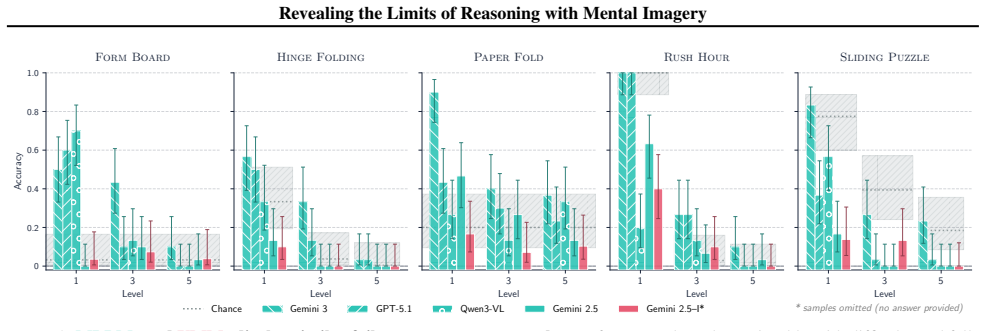
On the paper's own terms, the central discovery is that explicit visual thought is currently ineffective: across five tasks and multiple model families, no self-generated imagery—latent tokens, interleaved images from unified multimodal models, or video rollouts—reliably outperforms text-only reasoning. A control using ground-truth visual chains of thought shows performance can rise on some tasks (notably Form Board), but models still often fail to turn correct images into actionable evidence. The paper concludes that frontier models possess the textual competence and sometimes the generation capacity, but cannot couple image generation with reliable multi-step reasoning.
What carries the argument
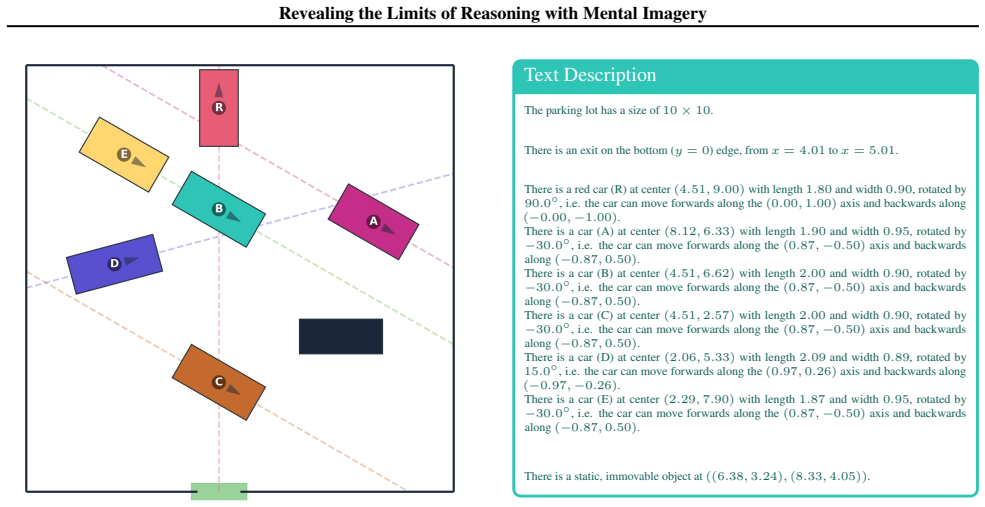
The central object is MentisOculi, a procedural benchmark whose five tasks (Form Board, Hinge Folding, Paper Fold, Rush Hour, Sliding Puzzle) are designed to be hard to textualize and best solved visually, with difficulty stratified by minimum number of operations. Its load-bearing mechanism is the ground-truth visual chain-of-thought: a step-aligned sequence of intermediate state images provided by the generator. Replacing a model's self-generated images with these oracle visuals lets the paper separate generation errors (wrong images) from interpretation errors (correct images not used), which is the diagnostic that carries the argument.
Load-bearing premise
The load-bearing premise is that presenting ground-truth visual chain-of-thought images as one appended block is a fair test of a model's ability to use correct visuals; if that format itself undermines performance, the paper's 'interpretation error' conclusion would overstate the model's deficit.
What would settle it
Take a fixed set of Rush Hour instances and compare a unified multimodal model with ground-truth images appended as one block (the paper's protocol) versus the same images interleaved one at a time immediately before the reasoning step that uses them. If step-aligned presentation lifts accuracy to match the text-transcript competence level, the paper's claim that models fail to leverage ground-truth visualizations would be weakened.
If this is right
- If the paper is right, current unified multimodal models cannot be relied on to reason through multi-step spatial problems by generating images; text-only inference is at least as good.
- The competence result implies that visual puzzles like Rush Hour are not inherently beyond model reasoning—failure is in perception or representation, not logic—so targeted training on visual state-tracking could unlock gains.
- Because performance rises on some tasks when oracle visuals replace generated ones, improving image-generation consistency is a necessary (though not sufficient) condition for visual thought to help.
- The benchmark's procedural generation and stratification provide a reusable tool for tracking progress: as models improve, harder generated instances can be released without contamination.
- Established text-reasoning enhancements (in-context learning, prompt optimization, higher reasoning budget, tool use) yield no systematic visual-reasoning gains, suggesting the bottleneck is specific to visual-state manipulation rather than general reasoning effort.
Where Pith is reading between the lines
- A reader should be cautious about the 'interpretation error' label: in the oracle control, ground-truth images are appended as one block rather than interleaved at the exact step where they belong, so part of the failure could be an input-format limitation rather than a fundamental inability to use visual evidence.
- A stronger test would interleave ground-truth images one at a time just before each reasoning step; if performance then matches text-level competence, the paper's deepest claim would need refinement.
- The benchmark's design could also serve as a training curriculum: using freshly generated instances with ground-truth visual traces may teach models to treat self-generated images as state trackers rather than decorative outputs.
- The human comparison suggests models lack adaptive effort allocation, which may be a separate failure from generation or interpretation; interventions that make models spend more compute on harder visual states might help.
Editorial analysis
A structured set of objections, weighed in public.
Referee Report
Summary. The paper introduces MENTISOCULI, a procedurally generated, stratified benchmark of five multi-step visual reasoning tasks (Form Board, Hinge Folding, Paper Fold, Rush Hour, Sliding Puzzle) with ground-truth visual chain-of-thought solutions. It evaluates text-only MLLMs, latent-visual-reasoning models (Mirage), unified multimodal models (UMMs; Gemini 2.5-I, Gemini 3-I) prompted to interleave self-generated images, and a video model (Veo 3.1). The headline finding is that explicit visual thoughts—whether latent, interleaved-image, or video-based—do not improve text-only reasoning, with performance often at or below chance at the hardest levels. The paper further claims a dual failure for UMMs: generation errors (incorrect intermediate images) and interpretation errors (failure to use even ground-truth visualizations as evidence). Secondary contributions include negative results for ICL, prompt optimization, increased reasoning budget, and tool use, plus a small human psychophysics study showing humans allocate more time to harder puzzles while Gemini 3 does not.
Significance. If the headline result holds, this is a timely and important negative result for the emerging 'thinking with images' paradigm. The benchmark itself is a valuable community asset: it is procedural, stratified, includes ground-truth visual chain-of-thought for fine-grained diagnosis, avoids low-information grid-world shortcuts, and the authors ship generators and evaluation code. The text-only competence control (Figure 4) is a well-designed check showing that the tasks are not beyond frontier models' reasoning ability. The negative results for ICL, prompt optimization, and reasoning budget are also useful. However, the deepest mechanistic claim—that UMMs 'fail to leverage even ground-truth visualizations'—depends on an oracle-visual protocol that appends all ground-truth images as a single block, which may measure input-format limitations rather than a fundamental interpretation deficit. Because this claim appears in the abstract, the conclusion, and Takeaway 3, it needs to be supported by a stronger control before the paper's full conclusions are justified.
major comments (3)
- [Section 4.3 and Appendix H.5] The oracle-visual condition appends the entire ground-truth chain of thought as one undifferentiated image block at the end of the prompt (H.5: 'The following images correspond to intermediate images in the reasoning process. You must use them to obtain your answer'). This differs structurally from the interleaved self-generation condition (H.2), where images are generated after each move and are immediately followed by textual state updates. A UMM may process a long appended block poorly—due to attention, resolution, or missing per-step textual anchors—so low oracle accuracy could reflect an input-format artifact rather than an inability to interpret visual state as evidence. This confound is load-bearing for the 'interpretation error' claim in Section 4.3, the abstract, and Takeaway 3. Please add an interleaved oracle condition that places each ground-truth image at the corresponding r
- [Section 4.3 and Figure 5] The interpretation-error decomposition is computed for a single model, Gemini 2.5-I, yet the abstract and Takeaway 3 state that 'UMMs' generally fail to leverage ground-truth visualizations. One model family instance is too narrow to support a plural mechanistic claim. Either run the oracle-visual condition on at least Gemini 3-I (and ideally another UMM class) or restrict the claim to 'the tested Gemini 2.5-I.' The paper already reports Gemini 3-I data for the interleaved condition, so the oracle experiment could be extended at moderate cost.
- [Section 4.3 / Figure 5] The relative contributions of generation and interpretation errors are stated qualitatively ('Generation errors are evidently a problem' and 'UMMs also suffer from interpretation errors') but no explicit decomposition metric is defined. The gap between interleaved and oracle performance measures the joint effect of generation errors and prompt-format differences, while the gap between oracle and text-only MLLM measures interpretation. These are not separately quantified. Please define concrete quantities (e.g., per-task oracle accuracy, generation fidelity rate, and a combined error decomposition) and report them with confidence intervals, since the current figures do not show variance across the three query repetitions.
minor comments (6)
- [Appendix H.2] The first 'HINGEFOLDING' prompt under H.2 is actually the FORMBOARD prompt ('target shape outlined in black and five pieces labeled A through E'), a copy-paste error. This will confuse readers and should be corrected.
- [Appendix G.2] Typo: 'eaach' should be 'each'.
- [Appendix E.1] Heading 'Quantitive Results' should be 'Quantitative Results'.
- [Figure 10 caption] The caption uses 'R = 0.98' while the text reports 'R2 ≥ 0.98'; please standardize (and clarify whether the plotted values are R or R²).
- [Section 3.4] The chance-performance computation for the planning tasks is only described verbally ('accounting for (limited) backtracking'). Please provide the formula or a pseudocode description so the reported chance baselines are reproducible.
- [Section 4.5 / Figure 7] The human comparison is based on n=5 participants and a time-threshold simulation. The paper cites a small-sample design defense, but the claim 'Gemini 3 performs like humans at 5–10 s' would benefit from confidence intervals around the human time-accuracy curves.
Circularity Check
No significant circularity; the paper's conclusions are empirical comparisons against independent text-only baselines, not derivations from fitted inputs.
full rationale
MENTISOCULI is an empirical benchmark paper. Its central claims—that self-generated imagery does not improve text-only reasoning and that UMMs fail to leverage ground-truth visualizations—are established by querying frontier models on procedurally generated instances and comparing accuracy against text-only baselines on the same instances. No parameter is fitted to the outcome and then renamed as a prediction; the oracle-visual condition injects ground-truth images as an experimental manipulation, not as a fitted input. The paper's self-citations (e.g., Wiedemer et al. for the video auto-rater, Mayilvahanan et al. in the discussion) are ancillary tools or speculative pointers rather than load-bearing derivations. The most plausible concern—that appending oracle images as a single block (Appendix H.5) may confound interpretation ability with input-format limitations—is a validity threat to a specific mechanistic conclusion, but it is not a definitional or construction-level circularity: the headline negative result does not reduce to that manipulation. There is no exhibited equation or fitted parameter equivalent to the paper's predictions, so no circular step is identified.
Axiom & Free-Parameter Ledger
free parameters (4)
- chance_sequence_length =
6 steps
- samples_per_level_per_task =
30
- query_budget =
3
- human_time_threshold =
5–30 s
axioms (4)
- domain assumption Appending all oracle chain-of-thought images as a block (Appendix H.5) is a faithful test of a model's ability to use visual aids; any resulting failure reflects interpretation, not input-format or attention limitations.
- domain assumption Procedurally generated instances have not been memorized during pretraining; no contamination check is performed.
- domain assumption The verbose text transcription of Rush Hour (Section G.1) is lossless with respect to the simulator state, so solving from it counts as purely textual reasoning.
- domain assumption The lenient video auto-rater heuristic (first move per vehicle, relative order, ignoring minor artifacts) recovers the intended action sequence from Veo 3.1 rollouts.
read the original abstract
Frontier models are transitioning from multimodal large language models (MLLMs) that merely ingest visual information to unified multimodal models (UMMs) capable of native interleaved generation. This shift has sparked interest in using intermediate visualizations as a reasoning aid, akin to human mental imagery. Central to this idea is the ability to form, maintain, and manipulate visual representations in a goal-oriented manner. To evaluate and probe this capability, we develop MentisOculi, a procedural, stratified suite of multi-step reasoning problems amenable to visual solution, tuned to challenge frontier models. Evaluating visual strategies ranging from latent tokens to explicit generated imagery, we find they generally fail to improve performance. Analysis of UMMs specifically exposes a critical limitation: While they possess the textual reasoning capacity to solve a task and can sometimes generate correct visuals, they suffer from compounding generation errors and fail to leverage even ground-truth visualizations. Our findings suggest that despite their inherent appeal, visual thoughts do not yet benefit model reasoning. MentisOculi establishes the necessary foundation to analyze and close this gap across diverse model families.
Figures




Forward citations
Cited by 2 Pith papers
-
Visual prompt engineering for video models
Automatically converting task images to photorealistic variants (visual prompt engineering) improves video-model reasoning performance, often beating text prompt engineering and test-time scaling.
-
Do multimodal models imagine electric sheep?
Fine-tuning VLMs to output action sequences for puzzles causes emergent internal visual representations that improve performance when integrated into reasoning.
Reference graph
Works this paper leans on
-
[1]
Qwen2.5-VL technical report.arXiv preprint arXiv:2502.13923, 2025
Bai, S., Chen, K., Liu, X., Wang, J., Ge, W., Song, S., Dang, K., Wang, P., Wang, S., Tang, J., Zhong, H., Zhu, Y ., Yang, M., Li, Z., Wan, J., Wang, P., Ding, W., Fu, Z., Xu, Y ., Ye, J., Zhang, X., Xie, T., Cheng, Z., Zhang, H., Yang, Z., Xu, H., and Lin, J. Qwen2.5-VL technical report.arXiv preprint arXiv:2502.13923, 2025
Pith/arXiv arXiv 2025
-
[2]
Chen, X., Wu, Z., Liu, X., Pan, Z., Liu, W., Xie, Z., Yu, X., and Ruan, C. Janus-pro: Unified multimodal understanding and generation with data and model scaling.arXiv preprint arXiv:2501.17811, 2025
Pith/arXiv arXiv 2025
-
[3]
Thinking with generated images
Chern, E., Hu, Z., Chern, S., Kou, S., Su, J., Ma, Y ., Deng, Z., and Liu, P. Thinking with generated images. arXiv preprint arXiv:2505.22525, 2025
Pith/arXiv arXiv 2025
-
[4]
On the measure of intelligence.arXiv preprint arXiv:1911.01547, 2019
Chollet, F. On the measure of intelligence.arXiv preprint arXiv:1911.01547, 2019
Pith/arXiv arXiv 1911
-
[5]
T.De Oratore
Cicero, M. T.De Oratore. Harper & Brothers, New York, -55. Citation from Book III, Chapter XLI, Sec- tion 163. Cited from English edition edited and trans- lated by J. S. Watson, 1875
-
[6]
Cui, Y ., Chen, H., Deng, H., Huang, X., Li, X., Liu, J., Liu, Y ., Luo, Z., Wang, J., Wang, W., et al. Emu3. 5: Native multimodal models are world learners.arXiv preprint arXiv:2510.26583, 2025
Pith/arXiv arXiv 2025
-
[7]
de Oliveira, B. L., Martins, L. G., Brand˜ao, B., da Luz, M. L., Soares, T. W. d. L., and Melo, L. C. Sliding puzzles gym: A scalable benchmark for state represen- tation in visual reinforcement learning.arXiv preprint arXiv:2410.14038, 2024
arXiv 2024
-
[8]
Emerging properties in unified multimodal pretraining.arXiv preprint arXiv:2505.14683, 2025
Deng, C., Zhu, D., Li, K., Gou, C., Li, F., Wang, Z., Zhong, S., Yu, W., Nie, X., Song, Z., et al. Emerging properties in unified multimodal pretraining.arXiv preprint arXiv:2505.14683, 2025
Pith/arXiv arXiv 2025
-
[9]
ImageNet: A large-scale hier- archical image database
Deng, J., Dong, W., Socher, R., Li, L.-J., Li, K., and Fei-Fei, L. ImageNet: A large-scale hier- archical image database. In2009 IEEE Confer- ence on Computer Vision and Pattern Recognition, pp. 248–255. IEEE, 6 2009. doi: 10.1109/cvpr. 2009.5206848. URL http://dx.doi.org/10. 1109/cvpr.2009.5206848
arXiv 2009
-
[10]
Ekstrom, R. B. and Harman, H. H.Manual for kit of factor-referenced cognitive tests, 1976. Educational testing service, 1976
1976
-
[11]
Fan, Y ., He, X., Yang, D., Zheng, K., Kuo, C.-C., Zheng, Y ., Narayanaraju, S. J., Guan, X., and Wang, X. E. GRIT: Teaching MLLMs to think with images. arXiv preprint arXiv:2505.15879, 2025
Pith/arXiv arXiv 2025
-
[12]
Gebru, T., Morgenstern, J., Vecchione, B., Vaughan, J. W., Wallach, H., III, H. D., and Crawford, K. Datasheets for datasets.Communications of the ACM, 64(12):86–92, 11 2021. ISSN 1557-7317. doi: 10.1145/3458723. URL http://dx.doi.org/ 10.1145/3458723. 9 Revealing the Limits of Reasoning with Mental Imagery
doi:10.1145/3458723 2021
-
[13]
Veo 3 model card
Google DeepMind. Veo 3 model card. https://storage.googleapis.com/ deepmind-media/Model-Cards/ Veo-3-Model-Card.pdf , 2025. Accessed: 2026-01-20
2025
-
[14]
Gemini 2.5 Flash and native capabilities – audio & image model card
Google DeepMind. Gemini 2.5 Flash and native capabilities – audio & image model card. https://storage.googleapis. com/deepmind-media/Model-Cards/ Gemini-2-5-Flash-Model-Card.pdf ,
-
[15]
Gemini 3 pro image model card
Google DeepMind. Gemini 3 pro image model card. https://storage.googleapis. com/deepmind-media/Model-Cards/ Gemini-3-Pro-Image-Model-Card.pdf ,
-
[16]
Gemini 3 pro model card
Google DeepMind. Gemini 3 pro model card. https://storage.googleapis. com/deepmind-media/Model-Cards/ Gemini-3-Pro-Model-Card.pdf , 2025. Accessed: 2026-01-09
2025
-
[17]
Accessed: 2026-01-09
2026
-
[18]
Courier Corporation, 1954
Hadamard, J.An essay on the psychology of invention in the mathematical field. Courier Corporation, 1954
1954
-
[19]
LTX-2: Efficient joint audio-visual foundation model,
HaCohen, Y ., Brazowski, B., Chiprut, N., Bitterman, Y ., Kvochko, A., Berkowitz, A., Shalem, D., Lifschitz, D., Moshe, D., Porat, E., Richardson, E., Shiran, G., Chachy, I., Chetboun, J., Finkelson, M., Kupchick, M., Zabari, N., Guetta, N., Kotler, N., Bibi, O., Gordon, O., Panet, P., Benita, R., Armon, S., Kulikov, V ., In- ger, Y ., Shiftan, Y ., Melum...
-
[20]
Huang, J.-T., Dai, D., Huang, J.-Y ., Yuan, Y ., Liu, X., Wang, W., Jiao, W., He, P., and Tu, Z. Visfac- tor: Benchmarking fundamental visual cognition in multimodal large language models.arXiv preprint arXiv:2502.16435, 2025
Pith/arXiv arXiv 2025
-
[21]
HunyuanVideo: A systematic framework for large video generative models, 2025
Kong, W., Tian, Q., Zhang, Z., Min, R., Dai, Z., Zhou, J., Xiong, J., Li, X., Wu, B., Zhang, J., Wu, K., Lin, Q., Yuan, J., Long, Y ., Wang, A., Wang, A., Li, C., Huang, D., Yang, F., Tan, H., Wang, H., Song, J., Bai, J., Wu, J., Xue, J., Wang, J., Wang, K., Liu, M., Li, P., Li, S., Wang, W., Yu, W., Deng, X., Li, Y ., Chen, Y ., Cui, Y ., Peng, Y ., Yu, ...
Pith/arXiv arXiv 2025
-
[22]
W., Li, L., Yang, Z., Wang, L., and Cheng, Y
Hao, Y ., Gu, J., Wang, H. W., Li, L., Yang, Z., Wang, L., and Cheng, Y . Can mllms reason in multimodality? emma: An enhanced multimodal reasoning bench- mark.arXiv preprint arXiv:2501.05444, 2025
Pith/arXiv arXiv 2025
-
[23]
Unfolding spatial cognition: Evaluating multimodal models on visual simulations
Li, L., Bigverdi, M., Gu, J., Ma, Z., Yang, Y ., Li, Z., Choi, Y ., and Krishna, R. Unfolding spatial cognition: Evaluating multimodal models on visual simulations. arXiv preprint arXiv:2506.04633, 2025
Pith/arXiv arXiv 2025
-
[24]
Liang, Y ., Chow, W., Li, F., Ma, Z., Wang, X., Mao, J., Chen, J., Gu, J., Wang, Y ., and Huang, F. ROVER: Benchmarking reciprocal cross-modal rea- soning for omnimodal generation.arXiv preprint arXiv:2511.01163, 2025
arXiv 2025
-
[25]
B., Liu, O., Guo, P., Neiswanger, W., Huang, F., et al
Li, A., Wang, C., Fu, D., Yue, K., Cai, Z., Zhu, W. B., Liu, O., Guo, P., Neiswanger, W., Huang, F., et al. Zebra-cot: A dataset for interleaved vision language reasoning.arXiv preprint arXiv:2507.16746, 2025
arXiv 2025
-
[26]
Liu, Z., Ren, W., Liu, H., Zhou, Z., Chen, S., Qiu, H., Huang, X., An, Z., Yang, F., Patel, A., et al. TUNA: Taming unified visual representations for native unified multimodal models.arXiv preprint arXiv:2512.02014, 2025
arXiv 2025
-
[27]
Jigsaw-puzzles: From seeing to under- standing to reasoning in vision-language models
Lyu, Z., Zhang, D., Ye, W., Li, F., Jiang, Z., and Yang, Y . Jigsaw-puzzles: From seeing to under- standing to reasoning in vision-language models. InProceedings of the 2025 Conference on Empir- ical Methods in Natural Language Processing, pp. 26003–26014. Association for Computational Lin- guistics, 2025. doi: 10.18653/v1/2025.emnlp-main
-
[28]
Sora: A review on background, technology, limitations, and opportunities of large vision models,
Liu, Y ., Zhang, K., Li, Y ., Yan, Z., Gao, C., Chen, R., Yuan, Z., Huang, Y ., Sun, H., Gao, J., He, L., and Sun, L. Sora: A review on background, technology, limitations, and opportunities of large vision models,
-
[29]
McCarty, M. and Morales, J. Artificial phantasia: Evidence for propositional reasoning-based mental imagery in large language models.arXiv preprint arXiv:2509.23108, 2025
Pith/arXiv arXiv 2025
-
[30]
Mi, Z., Wang, K.-C., Qian, G., Ye, H., Liu, R., Tulyakov, S., Aberman, K., and Xu, D. I think, 10 Revealing the Limits of Reasoning with Mental Imagery therefore i diffuse: Enabling multimodal in-context reasoning in diffusion models.arXiv preprint arXiv:2502.10458, 2025
Pith/arXiv arXiv 2025
-
[31]
Oxford University Press, Oxford, 2023
Nanay, B.Mental Imagery. Oxford University Press, Oxford, 2023. ISBN 978-0-19-880950-0. doi: 10. 1093/oso/9780198809500.001.0001
arXiv 2023
-
[32]
GPT-5.1 model documentation
OpenAI. GPT-5.1 model documentation. https://platform.openai.com/docs/ models/gpt-5.1, 2026. Accessed: 2026-01-20
2026
-
[33]
Llms on the line: Data de- termines loss-to-loss scaling laws.arXiv preprint arXiv:2502.12120, 2025
Mayilvahanan, P., Wiedemer, T., Mallick, S., Bethge, M., and Brendel, W. Llms on the line: Data de- termines loss-to-loss scaling laws.arXiv preprint arXiv:2502.12120, 2025
Pith/arXiv arXiv 2025
-
[34]
K., Wijmans, E., Kraehenbuehl, P., and Koltun, V
Ramakrishnan, S. K., Wijmans, E., Kraehenbuehl, P., and Koltun, V . Does spatial cognition emerge in fron- tier models?arXiv preprint arXiv:2410.06468, 2024
Pith/arXiv arXiv 2024
-
[35]
Richardson, A.Defining Mental Imagery, pp. 1–12. Springer Berlin Heidelberg, 1969. ISBN 9783662378175. doi: 10.1007/978-3-662-37817-5
-
[36]
Seedance 1.5 pro: A native audio- visual joint generation foundation model, 2025
Seedance, T., Chen, H., Chen, S., Chen, X., Chen, Y ., Chen, Y ., Chen, Z., Cheng, F., Cheng, T., Cheng, X., Chi, X., Cong, J., Cui, J., Cui, Q., Dong, Q., Fan, J., Fang, J., Fang, Z., Feng, C., Feng, H., Gao, M., Gao, Y ., Guo, D., Guo, Q., Hao, B., Hao, Q., He, B., He, Q., Hoang, T., Hu, R., Hu, X., Huang, W., Huang, Z., Huang, Z., Ji, D., Jiang, S., Ji...
Pith/arXiv arXiv 2025
-
[37]
S., Tinaz, B., Fabian, Z., and Soltanolkotabi, M
Sepehri, M. S., Tinaz, B., Fabian, Z., and Soltanolkotabi, M. Hyperphantasia: A benchmark for evaluating the mental visualization capabilities of multimodal LLMs.arXiv preprint arXiv:2507.11932, 2025
arXiv 2025
-
[38]
Qu, L., Zhang, H., Liu, Y ., Wang, X., Jiang, Y ., Gao, Y ., Ye, H., Du, D. K., Yuan, Z., and Wu, X. Token- Flow: Unified image tokenizer for multimodal under- standing and generation. In2025 IEEE/CVF Con- ference on Computer Vision and Pattern Recognition (CVPR), pp. 2545–2555. IEEE, 6 2025. doi: 10.1109/ cvpr52734.2025.00243. URL http://dx.doi. org/10.1...
arXiv 2025
-
[39]
Smith, P. L. and Little, D. R. Small is beau- tiful: In defense of the small-n design.Psy- chonomic Bulletin & Review, 25(6):2083–2101, 3 2018. ISSN 1531-5320. doi: 10.3758/ s13423-018-1451-8. URL http://dx.doi.org/ 10.3758/s13423-018-1451-8
-
[40]
Chameleon: Mixed-modal early-fusion foundation models.arXiv preprint arXiv:2405.09818, 2024
Team, C. Chameleon: Mixed-modal early-fusion foundation models.arXiv preprint arXiv:2405.09818, 2024
Pith/arXiv arXiv 2024
-
[41]
URL http://dx.doi.org/10.1007/ 978-3-662-37817-5_1
-
[42]
Tong, J., Mou, Y ., Li, H., Li, M., Yang, Y ., Zhang, M., Chen, Q., Liang, T., Hu, X., Zheng, Y ., et al. Thinking with video: Video generation as a promis- ing multimodal reasoning paradigm.arXiv preprint arXiv:2511.04570, 2025
Pith/arXiv arXiv 2025
-
[43]
S., Matarese, N., Swersky, K., Kim, B., Jaini, P., and Geirhos, R
Wiedemer, T., Li, Y ., Vicol, P., Gu, S. S., Matarese, N., Swersky, K., Kim, B., Jaini, P., and Geirhos, R. Video models are zero-shot learners and reasoners.arXiv preprint arXiv:2509.20328, 2025
Pith/arXiv arXiv 2025
-
[44]
OpenEvolve: an open-source evolutionary coding agent, 2025
Sharma, A. OpenEvolve: an open-source evolutionary coding agent, 2025. URL https://github. com/algorithmicsuperintelligence/ openevolve
2025
-
[45]
Xie, J., Yang, Z., and Shou, M. Z. Show-o2: Improved native unified multimodal models.arXiv preprint arXiv:2506.15564, 2025. 11 Revealing the Limits of Reasoning with Mental Imagery
Pith/arXiv arXiv 2025
-
[46]
Xu, W., Wang, J., Wang, W., Chen, Z., Zhou, W., Yang, A., Lu, L., Li, H., Wang, X., Zhu, X., et al. Vi- sulogic: A benchmark for evaluating visual reasoning in multi-modal large language models.arXiv preprint arXiv:2504.15279, 2025
Pith/arXiv arXiv 2025
-
[47]
Team, Q. Qwen3 technical report, 2025. URLhttps: //arxiv.org/abs/2505.09388
Pith/arXiv arXiv 2025
-
[48]
Yang, Z., Yu, X., Chen, D., Shen, M., and Gan, C. Machine mental imagery: Empower multimodal reasoning with latent visual tokens.arXiv preprint arXiv:2506.17218, 2025
Pith/arXiv arXiv 2025
-
[49]
DeepEyes: Incentiviz- ing” thinking with images” via reinforcement learning
Zheng, Z., Yang, M., Hong, J., Zhao, C., Xu, G., Yang, L., Shen, C., and Yu, X. DeepEyes: Incentiviz- ing” thinking with images” via reinforcement learning. arXiv preprint arXiv:2505.14362, 2025
Pith/arXiv arXiv 2025
-
[50]
Wu, Q., Zhao, H., Saxon, M., Bui, T., Wang, W. Y ., Zhang, Y ., and Chang, S. Vsp: Assessing the dual challenges of perception and reasoning in spatial plan- ning tasks for vlms.arXiv preprint arXiv:2407.01863, 2024
Pith/arXiv arXiv 2024
-
[53]
Video as the new language for real-world decision making
Yang, S., Walker, J., Parker-Holder, J., Du, Y ., Bruce, J., Barreto, A., Abbeel, P., and Schuurmans, D. Video as the new language for real-world decision making. arXiv preprint arXiv:2402.17139, 2024
Pith/arXiv arXiv 2024
-
[56]
When visualizing is the first step to reason- ing: MIRA, a benchmark for visual chain-of-thought
Zhou, Y ., Tu, H., Wang, Z., Wang, Z., Muennighoff, N., Nie, F., Choi, Y ., Zou, J., Deng, C., Yan, S., et al. When visualizing is the first step to reason- ing: MIRA, a benchmark for visual chain-of-thought. arXiv preprint arXiv:2511.02779, 2025. 12 Revealing the Limits of Reasoning with Mental Imagery A. Automatic Puzzle Generation To construct MENTISOC...
arXiv 2025
-
[60]
answer":
Pieces are shown in their correct orientation and size (no rotation or scaling needed). Task: Determine the subset of pieces from{A, B, C, D, E}necessary to assemble the target shape. Output: Respond in JSON format as follows: {"answer": "A C E"} List only the letter labels of the pieces needed, separated by space. 24 Revealing the Limits of Reasoning wit...
-
[61]
Shapes are connected in a kinematic chain; each hinge connects two adjacent shapes
-
[65]
answer":
The goal is to find the sequence of hinge rotations that transforms the initial configuration into the target. Task: Determine the rotation angle (in degrees) for each numbered hinge to achieve the target configuration. Output: Respond in JSON format as follows: {"answer": "A 90, B 90, C 180"} Each pair specifies the hinge label and its rotation angle in ...
-
[72]
Track where the hole is punched through all folded layers
-
[73]
Mentally unfold the paper with the punched hole step-by-step in reverse order
-
[74]
answer":
Determine which unfolded pattern (A, B, C, D, or E) matches your mental result. Output: Respond in JSON format as follows: {"answer": "C"} RUSHHOUR Look at the image: It shows the initial configuration of a congested parking lot. Each colored rectangle with a letter and arrow represents a vehicle. Black rectangles without a letter represent immovable obst...
-
[78]
answer":
The red vehicle must reach the exit on the edge of the grid. Task: Plan the minimal sequence of moves needed to free the red car and allow it to exit the parking lot. Each move should specify which vehicle moves and in which direction (forward or backward). Output: Respond in JSON format as follows: {"answer": "A forward, C backward, E forward, R forward"...
-
[83]
answer":
The goal is to reconstruct the original, coherent image by rearranging the scrambled tiles. Task: Determine the shortest sequence of moves needed to solve the puzzle and restore the original image. Output: Respond in JSON format as follows: {"answer": "up right down left up"} Each word specifies a direction to move the blank tile. You may guess the most p...
-
[84]
The target shape can be assembled using 1 to 5 of the given pieces
-
[85]
Pieces must fit together perfectly with no gaps or overlaps
-
[86]
Some pieces are distractors and are not needed
-
[87]
answer":
Pieces are shown in their correct orientation and size (no rotation or scaling needed). Task: Move one piece at a time of{A, B, C, D, E}from the right into the outlined target shape on the left. Generate a new image for each move. If you notice a mistake, you may also return a piece from the outlined target shape back to the candidate shapes. Also generat...
-
[88]
Shapes are connected in a kinematic chain — each hinge connects two adjacent shapes
-
[89]
All shapes are connected; all shapes to the right of the rotated shape rotate with it
Rotating hingeNcauses the shape on the right side of the hinge in the original configuration to rotate anti-clockwise. All shapes are connected; all shapes to the right of the rotated shape rotate with it. All shapes to the left of the hinge remain fixed
-
[90]
Rotations must be multiples of45 ◦ (i.e.,45 ◦,90 ◦,135 ◦,180 ◦,225 ◦,270 ◦,315 ◦)
-
[91]
Shapes maintain their connections throughout all rotations
-
[92]
answer":
The goal is to find the sequence of hinge rotations that transforms the initial configuration into the target. Task: Determine the rotation angle (in degrees) for each numbered hinge to achieve the target configuration. After each move, generate a new image in which you update the left side of the image to reflect your proposed hinge rotation. Once the ou...
-
[93]
The paper starts as a flat square
-
[94]
Each step shows the paper being folded along a line (horizontal, vertical, or diagonal)
-
[95]
After all folds are complete, one hole is punched through all layers at the marked positions
-
[96]
When the paper is unfolded completely, holes appear at multiple positions due to the layering
-
[97]
One of the five options (A, B, C, D, E) shows the correct hole pattern. Task:
-
[98]
Mentally follow each fold in sequence as shown in the first row
-
[99]
Track where holes are punched through all folded layers
-
[100]
Unfold the paper with the punched hole step-by-step in reverse order
-
[101]
After each unfolding move, generate an image of the (partially) unfolded paper with hole(s) in the correct positions
-
[102]
answer":
Determine which unfolded pattern (A, B, C, D, or E) matches your generated result. Output: First, reason through the moves and generate images with the progressively more unfolded paper sheet. Make sure that these updated images are generated by following the rules specified above. Generate one image after each unfold. Finally, respond in JSON format as f...
-
[106]
answer":
The red vehicle must reach the exit on the edge of the grid. Task: Plan the minimal sequence of moves needed to free the red car and allow it to exit the parking lot. Each move should specify which vehicle moves and in which direction (forward or backward). After each move, generate an image showing the updated puzzle state. Output: First, reason through ...
discussion (0)
Sign in with ORCID, Apple, or X to comment. Anyone can read and Pith papers without signing in.