REVIEW 3 major objections 5 minor 2 cited by
The paper claims that CoGHP outperforms prior offline goal-conditioned RL by autoregressively generating a chain of latent subgoals before each action, all within one unified MLP-Mixer policy.
Reviewed by Pith at T0; open to challenge. T0 means a machine referee read the full paper against a public rubric. the ladder, T0–T4 →
CoGHP autoregressively plans a chain of latent subgoals inside a single MLP-Mixer policy and beats prior hierarchical offline RL baselines on most OGBench tasks.
T0 review reviewed 2026-08-03 challenge →
load-bearing objection Solid empirical architecture paper that shows single-network autoregressive subgoal chains beat separate high/low policies on long-horizon tasks, but the teacher-forcing mismatch and hand-tuned H/k should temper the boldest claims. the 3 major comments →
Chain-of-Goals Hierarchical Policy for Long-Horizon Offline Goal-Conditioned RL
The pith
A machine-rendered reading of the paper's core claim, the machinery that carries it, and where it could break.
The reading
Core claim
CoGHP's central claim is that long-horizon offline goal-conditioned RL improves when hierarchical planning is reformulated as autoregressive sequence generation in a unified architecture. Given state and goal embeddings, the policy generates H latent subgoals in reverse order—farthest to nearest—and then an action, with each subgoal functioning as a reasoning token that conditions subsequent predictions. A shared goal-conditioned value function supplies advantage-weighted training targets for both subgoal and action heads, and an MLP-Mixer backbone with a learnable causal token-mixer handles the fixed-role token sequence. On OGBench, CoGHP reports 79% success on pointmaze-giant and 78% on an
What carries the argument
The load-bearing object is the CoGHP policy network: a unified MLP-Mixer backbone that repeatedly processes a fixed-length token sequence—state, goal, H subgoal placeholders, and action placeholder—through alternating token-mixing and channel-mixing MLPs plus a learnable lower-triangular causal mixer. The causal mixer lets each token attend only to itself and earlier tokens, which the paper argues suits fixed-position token roles. A single goal-conditioned IQL value function and AWR-style losses with teacher forcing train all prediction steps end-to-end.
Load-bearing premise
The reported gains assume the subgoal count H and subgoal spacing k are hand-tuned per environment; the paper's own sensitivity tables show performance collapsing when they are off, so the central outperformance claim rests on that tuning being near-optimal.
What would settle it
Hold H and k fixed at one setting across all OGBench environments, or select them automatically, and compare CoGHP to HIQL. If the large gaps on antmaze-giant and scene disappear—as Table 5 already shows for off-optimal H and k—then the outperformance is conditional on per-environment tuning rather than on the chain-of-goals mechanism itself.
If this is right
- Separate high-level and low-level networks may be unnecessary for offline goal-conditioned long-horizon control; one network can absorb both levels.
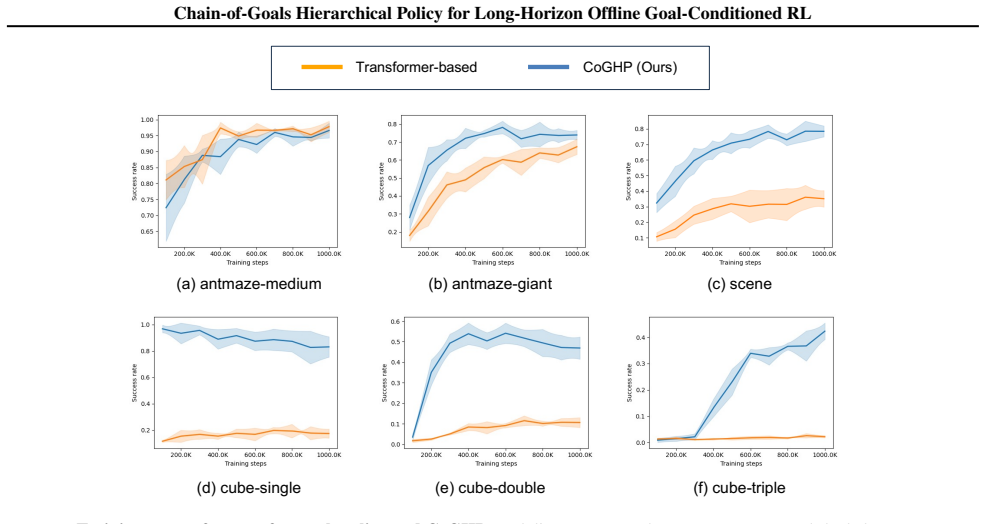
- Gains grow with task complexity, from medium to giant mazes and from single to triple cube, suggesting the chain mechanism scales with horizon.
- The approach transfers to pixel-based observations without architectural changes, reaching 95% on visual-antmaze-medium and 98% on visual-cube-single.
- Final-goal awareness is preserved even when intermediate subgoals are imperfect, because the goal token remains a constant condition throughout generation.
- Fixed-role token sequences may be better served by MLP-Mixer backbones than Transformers in this setting, based on the paper's capacity-matched ablations.
Where Pith is reading between the lines
- The gains hinge on hand-tuned subgoal count H and spacing k; the paper's own Table 5 shows success collapsing at off-optimal settings (e.g., antmaze-giant H=2, k=10 gives 32% versus HIQL's 65%). An automatic horizon selector is the natural next test.
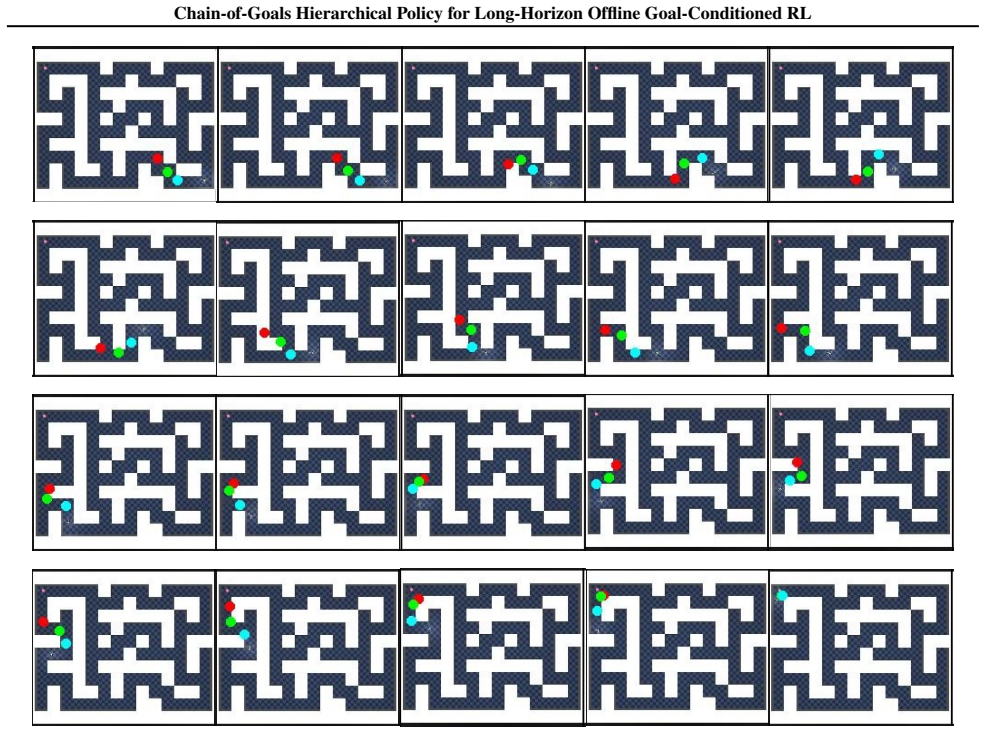
- Reverse-order generation, farthest-to-nearest, behaves like coarse-to-fine planning: the visualizations show subgoal spacing narrowing near the goal, suggesting the model learns adaptive temporal abstraction rather than fixed intervals.
- Since subgoals are encoded future states, CoGHP is close to a latent plan predictor. Swapping in skill or language embeddings would test whether the chain-of-goals benefit generalizes beyond state-space waypoints.
- A clean ablation would decouple the autoregressive chain from the causal mixer: letting H vary per episode, or replacing the causal mask with attention, would isolate what drives the reported gains.
Editorial analysis
A structured set of objections, weighed in public.
Referee Report
Summary. The paper proposes CoGHP, a unified autoregressive policy for offline goal-conditioned RL. Instead of separate high-level and low-level networks, CoGHP generates a sequence of H latent subgoals (encoded future states) followed by the primitive action, using an MLP-Mixer backbone with a learnable lower-triangular causal mixer. Training uses IQL-style value functions and advantage-weighted regression, with teacher forcing: each subgoal prediction is conditioned on ground-truth dataset subgoals. On OGBench navigation and manipulation benchmarks, CoGHP reports strong results, especially on antmaze-giant (78% vs. 65% for HIQL) and scene (78% vs. 38% for HIQL), with ablations on backbone, causal mixer, subgoal count, and hyperparameter sensitivity.
Significance. If the results hold, the paper makes a useful empirical contribution: it shows that a single-network autoregressive sequence of latent subgoals can match or beat two-level hierarchical off-policy methods on long-horizon tasks, and it provides one of the first MLP-Mixer applications in offline RL. The experimental protocol is solid: OGBench, 8 seeds, per-task results, capacity-matched transformer baseline, and extensive ablations. The core architectural idea is clearly stated and reproducible from the appendix. However, the central claim that the autoregressive chain is the mechanism behind the gains is weakened by the paper's own teacher-forcing ablation, and the reported improvements are contingent on per-environment tuning of H and k.
major comments (3)
- [§4.4, §C.8, Table 9] Teacher forcing creates a train/test input distribution mismatch. The policy is trained with ground-truth subgoal embeddings (Eq. 7, Algorithm 1 lines 8–11), but evaluated on its own autoregressively generated subgoals (Eq. 6). The paper's ablation (Table 9) shows that training without teacher forcing collapses success from 78% to 18% on antmaze-giant and from 54% to 3% on cube-double. This indicates the closed-loop autoregressive mechanism is not robustly learned; the model has never seen its own subgoal predictions during training and cannot recover from its own errors. The paper should either incorporate scheduled sampling / closed-loop fine-tuning, or explicitly analyze subgoal error accumulation. As written, the claim that 'each latent subgoal acts as a reasoning step that conditions subsequent predictions' is only supported for the teacher-forced training distribution.
- [§5.1, Table 3, §C.3, §D] The reported gains depend heavily on per-environment hyperparameter tuning of subgoal count H and timestep interval k. Table 5(b) shows antmaze-giant success drops from 78% (H=2,k=50) to 32% (H=2,k=10); Table 5(c) shows cube-double drops from 54% (H=1,k=10) to 16% (H=2,k=10). The paper acknowledges this in Section D but provides no adaptive or principled mechanism for selecting H and k. Since the central claim is 'consistently outperforms strong baselines,' the claim is contingent on this tuning. The authors should either temper the claim or provide a practical heuristic/adaptive selection procedure.
- [Abstract, Table 1, Table 4] The statement 'consistently outperforms strong offline baselines' is stronger than the data show. The paper's own Table 1 reports GCIQL at 99±1 on cube-single vs. CoGHP's 97±3, and Table 4 reports HIQL at 99±0 on visual-cube vs. CoGHP's 98±1. In several per-task results, baselines exceed CoGHP. Please qualify the claim to 'competitive or best in most environments' or provide a statistical test for aggregate superiority.
minor comments (5)
- [Figure 6 caption] The caption reads 'CoGHP Architecture' but the figure plots subgoal count vs. success. The caption should describe the subgoal-count analysis.
- [§C.6] The text says 'Table 6' when referring to the causal mixer ablation; the actual table is Table 7.
- [§C.3] The phrase 'supports the point made in the Section D' should be 'Section D' (or 'the Limitations section'); the reference is informal.
- [Eq. (7)] The conditioning notation is inconsistent: the expectation uses dataset states s_i:H but the log-probability conditions on z_{i+1:H}. Please clarify the mapping between target states and latent subgoals.
- [Algorithm 1] Line 9 says 'Predict latent subgoal z_i' but during teacher forcing the model conditions on ground-truth subgoals. The pseudocode should indicate that the inputs for i>H are dataset-provided, not the model's own predictions.
Circularity Check
No circular derivation found; CoGHP's reported results are empirical benchmark outcomes, not predictions that reduce to fitted inputs.
full rationale
CoGHP is an empirical architecture/method paper rather than a derivation-from-first-principles paper. The claimed contribution is autoregressive generation of H latent subgoals plus a primitive action in a single MLP-Mixer policy. The training signals come from the offline dataset and an independently learned IQL value function: target subgoals s1:H are sampled at fixed k-step intervals from dataset trajectories (Appendix A.2.1), and the policy is trained via advantage-weighted regression using Vψ learned from the IQL temporal-difference objective (Eqs. 4, 7–9). The reported success rates are measured against actual environment goals in OGBench, not against the policy's own advantage estimates or fitted subgoal targets. No equation in the paper makes the output equal to an input by construction, and no fitted parameter is renamed as a prediction. The self-citations (e.g., Choi & Seo 2025 in Related Work) are peripheral and not load-bearing; no uniqueness theorem or prior author result is invoked to force the architecture. The paper's own limitations section (Sec. D) and ablations (Table 5, Sec. C.3; Table 9, Sec. C.8) document sensitivity to the subgoal horizon H, spacing k, and teacher forcing, but those are empirical robustness and train/test-consistency concerns, not circularity: they do not make the central claim equivalent to its inputs. The comparison against external OGBench baselines provides independent evidence, so the paper is self-contained with respect to circularity.
Axiom & Free-Parameter Ledger
free parameters (3)
- H (number of latent subgoals) =
{1,2,2} for navigation; 1 for manipulation; 1 for visual tasks
- k (subgoal timestep interval) =
{25,50,50} for navigation; 10 for manipulation; 25 for visual tasks
- lambda_h (subgoal loss weight) =
{0.04,0.02,0.02} for navigation; 0.1 for manipulation; 0.04 for visual
axioms (5)
- domain assumption IQL value learning and AWR policy extraction are valid for offline goal-conditioned RL.
- domain assumption The learned value function V(s, e_g) can be evaluated on latent subgoals in the same embedding space as goals.
- ad hoc to paper Future states at fixed k-step intervals along an offline trajectory provide meaningful subgoal supervision.
- domain assumption Teacher forcing with ground-truth subgoal embeddings yields a policy that works when rolled out with its own predictions.
- domain assumption MLP-Mixer with a learnable lower-triangular causal mixer can represent the necessary autoregressive dependencies.
invented entities (1)
-
Latent subgoal sequence z_1:H
no independent evidence
Cite this review
Pith. "Pith review of Chain-of-Goals Hierarchical Policy for Long-Horizon Offline Goal-Conditioned RL." pith.science (2026). https://pith.science/paper/WLPR73BW
@misc{pith2026260203389,
  author       = {Pith},
  title        = {Pith review of: Chain-of-Goals Hierarchical Policy for Long-Horizon Offline Goal-Conditioned RL},
  year         = {2026},
  howpublished = {\url{https://pith.science/paper/WLPR73BW}},
  note         = {Machine review of arXiv:2602.03389}
}
read the original abstract
Offline goal-conditioned reinforcement learning remains challenging for long-horizon tasks. While hierarchical approaches mitigate this issue by decomposing tasks, most existing methods rely on separate high- and low-level networks and generate only a single intermediate subgoal, leaving several structural limitations in long-horizon decision-making. To address this limitation, we draw inspiration from chain-of-thought reasoning and propose the Chain-of-Goals Hierarchical Policy (CoGHP), a novel framework that reformulates hierarchical decision-making as autoregressive sequence modeling within a unified architecture. Given a state and a final goal, CoGHP autoregressively generates a sequence of latent subgoals followed by the primitive action, where each latent subgoal acts as a reasoning step that conditions subsequent predictions. To implement this efficiently, we introduce an MLP-Mixer backbone, which supports cross-token communication and captures structural relationships among state, goal, latent subgoals, and action. Across challenging navigation and manipulation benchmarks, CoGHP consistently outperforms strong offline baselines, demonstrating improved performance on long-horizon tasks. Project page: https://wlsdn9350.github.io/projects/coghp/
Figures



Forward citations
Cited by 2 Pith papers
-
Switching Successor Measures for Hierarchical Zero-shot Reinforcement Learning
Switching successor measures extend classical successor measures to enable hierarchical zero-shot RL via the FB π-Switch algorithm that extracts subgoal-selection and control policies from forward-backward representations.
-
Unifying Object-Centric World Models and Diffusion Policy: A Hierarchical Framework for Multi-Stage Robotic Tasks
WorldDP combines a high-level object-centric world model for subgoal planning with a low-level diffusion policy for execution, claiming better performance than baselines on multi-stage robotic manipulation benchmarks.
Reference graph
Works this paper leans on
-
[318]
PMLR, 2023. Chebotar, Y ., Hausman, K., Lu, Y ., Xiao, T., Kalashnikov, D., Varley, J., Irpan, A., Eysenbach, B., Julian, R., Finn, C., et al. Actionable models: Unsupervised offline re- inforcement learning of robotic skills.arXiv preprint arXiv:2104.07749, 2021. Chen, S.-A., Li, C.-L., Yoder, N., Arik, S. O., and Pfis- ter, T. Tsmixer: An all-mlp archit...
Pith/arXiv arXiv 2023
-
[2023]
current state, final goal, sequential intermediate subgoals, and primitive action
and (Park et al., 2023). We train the value function using these sampled states and goals via: LV (ψ) =E (s,s′,g)∼D Lτ 2 r(s, g) +γV¯ψ(s′, ϕψg (g))−V ψ(s, ϕψg (g)) .(14) To generate training targets for CoGHP, we first sample a trajectory of lengthT and pick a time indext. We uniformly sample the final goal g from that trajectory. Next, we sample H subgoa...
2023
This paper was first reviewed by deepseek-v4-flash on August 3, 2026.
discussion (0)
Sign in with ORCID, Apple, or X to comment. Anyone can read and Pith papers without signing in.