REVIEW 3 major objections 6 minor 36 references
Diffusion models trained on scaled spectral coefficients solve PDEs from sparse data faster and more accurately than grid-based alternatives.
Reviewed by Pith at T0; open to challenge. T0 means a machine referee read the full paper against a public rubric. the ladder, T0–T4 →
T0 review · deepseek-v4-flash
2026-08-03 02:41 UTC pith:OLUG6QUE
load-bearing objection A solid engineering contribution combining spectral latent diffusion with physics guidance; the theory is a thin lemma, and the empirical claims need a truncation-error check before they fully land. the 3 major comments →
Physics-informed diffusion models in spectral space
The pith
A machine-rendered reading of the paper's core claim, the machinery that carries it, and where it could break.
Core claim
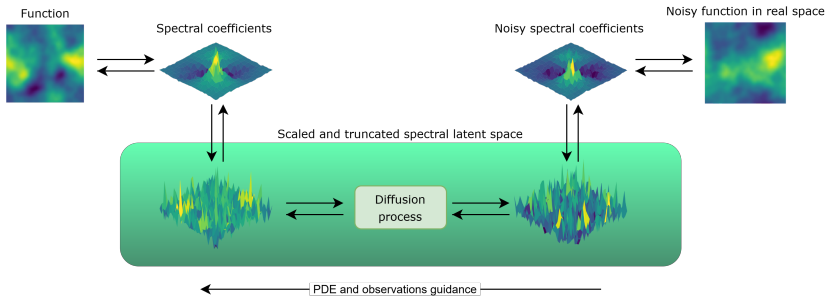
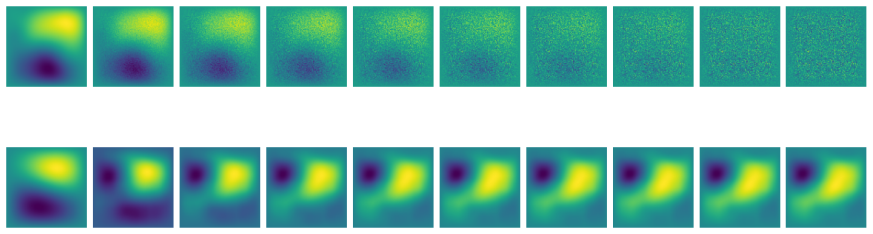
PISD (physics-informed spectral diffusion) learns to generate solutions by running a diffusion model on a finite set of data-scaled spectral coefficients. The scaling, where each coefficient is divided by its standard deviation in the training data, ensures that the induced forward process in function space stays within a Sobolev space with controlled regularity (Theorem 3.2). This regularity guarantee is what allows the PDE residual and measurement mismatch to be used as guidance throughout the reverse process. At inference, the paper replaces the usual gradient-descent guidance of diffusion posterior sampling with a frequency-aware Adam optimizer that updates low-frequency modes more aggre
What carries the argument
The central object is the scaled spectral encoding E(f)(k) = \hat{f}(k)/s_k, where s_k^2 is the variance of the k-th spectral coefficient in the data distribution, with inverse I(alpha) = sum_k s_k alpha_k \phi_k. This per-coefficient scaling makes Gaussian noise in latent space correspond to a function with the same Sobolev regularity as the data, so PDE operators remain well defined at all diffusion steps. The second mechanism is the frequency-aware Adam guidance, which applies larger updates to low-frequency modes and stabilizes physics-informed generation.
Load-bearing premise
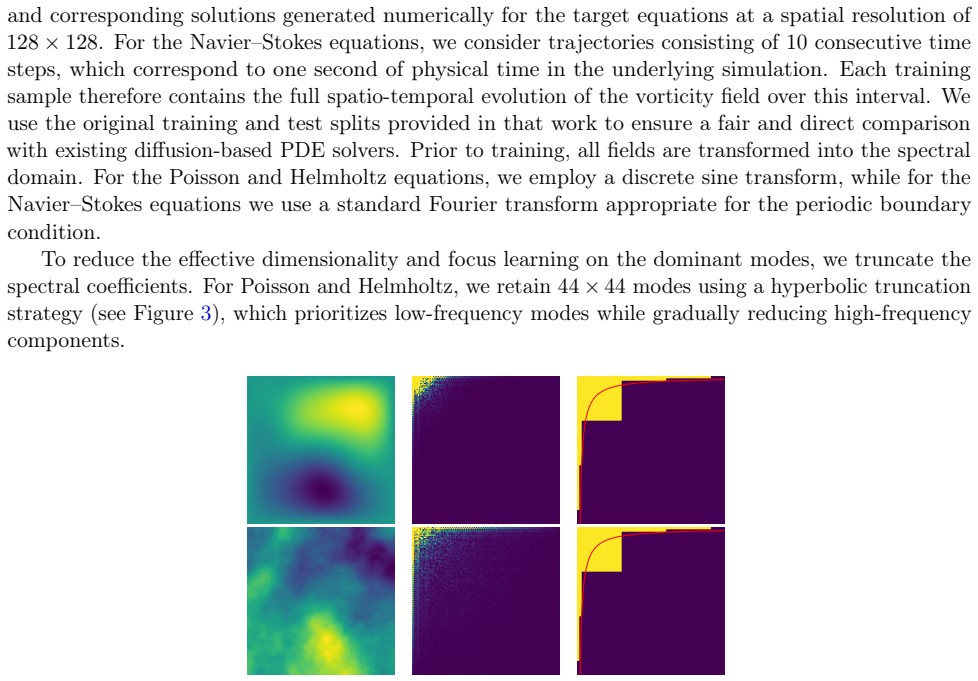
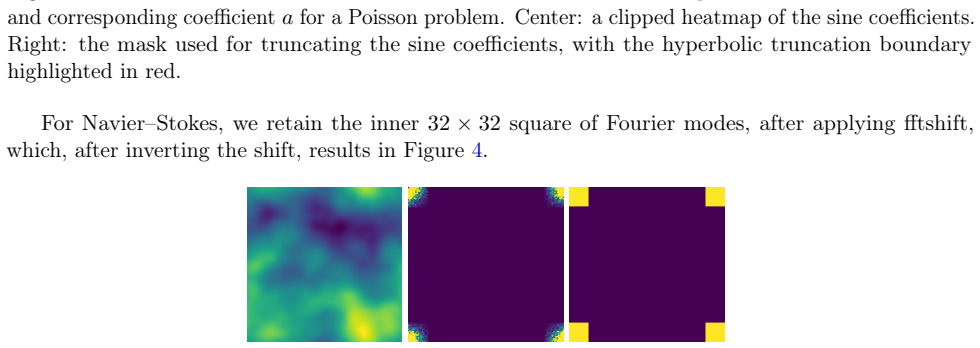
The method assumes that a fixed, hand-chosen truncation of spectral coefficients (44x44 or 32x32 modes) plus per-coefficient scaling preserves enough of the function-space structure that both the generated samples and the computed PDE residuals faithfully represent the true PDE problem.
What would settle it
Construct a test problem whose true solution has significant energy in modes beyond the truncation set (e.g., a sharply localized source for Poisson) and check whether the relative error of PISD grows sharply as the truncation set is made smaller. If the error grows substantially while the true solution is fixed, the truncation is discarding essential information and the claim that the spectral representation is faithful fails.
If this is right
- Because the noise has controlled smoothness, PDE constraints can be enforced at every diffusion step instead of only in the final 10% of the reverse process, leading to much lower PDE residuals.
- The spectral representation reduces dimensionality: a 128x128 grid becomes a 44x44 or 32x32 coefficient space, producing a 3-15x inference speedup.
- A single trained model supports forward, inverse, and joint reconstruction problems, and for Navier-Stokes it can condition on observations at arbitrary time steps within one trajectory.
- Fourier-space derivative formulas allow exact evaluation of the PDE residual, avoiding finite-difference approximation errors.
- With lower residuals, the remaining reconstruction error is largely attributable to the ill-posedness of sparse-observation problems rather than to model error.
Where Pith is reading between the lines
- The data-dependent scaling principle is not limited to Fourier or sine bases; transferring it to wavelet bases could yield analogous regularity guarantees for functions with sharp features, extending the method to a wider class of PDEs.
- The frequency-aware Adam guidance could be a general tool for diffusion guidance in any setting where latent dimensions have heterogeneous scales, such as image super-resolution or inverse problems with multiscale structure.
- The regularity guarantee suggests an automatic way to choose truncation sets: retain coefficients whose variance-weighted Sobolev contribution is non-negligible, rather than relying on fixed hyperbolic or square masks.
- If learned encoders replace hand-crafted spectral transforms, the same scaling idea could adapt to irregular geometries, but the theoretical guarantee would need to be re-derived for the learned basis.
Editorial analysis
A structured set of objections, weighed in public.
Referee Report
Summary. The paper proposes Physics-Informed Spectral Diffusion (PISD), a generative model that learns distributions over PDE solutions in a latent space of truncated, per-coefficient variance-scaled spectral coefficients. Training follows a standard denoising diffusion objective on these coefficients; at inference, a reverse-time ODE is guided by DPS-style gradient terms that penalize deviation from sparse observations and from the PDE residual L_PDE, with the gradient update performed by a frequency-aware Adam optimizer. The method is evaluated on Poisson, Helmholtz, and incompressible Navier–Stokes equations, and the authors report 3–15× inference speedups over DiffusionPDE and FunDPS, matching or improving relative reconstruction error, and substantially lower PDE residuals. The paper also contains a theoretical statement (Lemma 3.2, sometimes called Theorem 3.2) showing that Gaussian noise in the scaled spectral representation inherits finite H^k second moments from the data.
Significance. PISD is an appealing engineering contribution: spectral latent diffusion with data-driven scaling is a natural and efficient representation for smooth PDE fields, and the empirical comparison with Adam guidance versus SGD (Table 8) is a useful practical finding. The code is released, and the experimental suite covers forward, inverse, and joint reconstruction problems. The regularity lemma is correct, though it only concerns the noise distribution. The main weaknesses are in the numerical evaluation: the accuracy claims depend on an unquantified spectral truncation, the reported PDE residuals are computed on the truncated representation and coincide with the guidance objective, and the method has many tuned hyperparameters. These issues are fixable, but they currently prevent the paper's central claims from being fully supported.
major comments (3)
- [§3.4, Eq. (11); Appendix B] The accuracy claims (Tables 1–4) rest on the fixed truncation K in Eq. (11) and the approximation I(E(f))≈f in Eq. (4). Appendix B asserts that the reconstruction error is 'negligible' but gives no measured value. Since PISD outputs are band-limited (44×44 or 32×32 modes) while baselines produce 128×128 fields, the relative-error comparison has an unavoidable floor if the true solution has energy above the cutoff. Please report the discarded-mode energy fraction for each dataset and evaluate PISD outputs zero-padded to 128×128.
- [§4.2–4.3, Eqs. (15),(19),(22)] The PDE residuals reported for PISD are computed on the truncated spectral coefficients via (19)/(22). For the linear Poisson/Helmholtz problems, all residual components outside K are identically zero in this representation, so the low residuals in Tables 1–3 (e.g., 0.87 vs 237) are partly a consequence of the truncation. Moreover, L_PDE is exactly the objective minimized by λ_PDE guidance in Eq. (8) and Algorithm 1, so low residual values are partly by construction. To support the 'lower PDE residual' claim, compute residuals on a common full-grid discretization and report error bars.
- [§3.4, Lemma 3.2 and Appendix A] Lemma 3.2 (labeled 'Theorem 3.2' in two places) proves only that Gaussian noise N inherits finite H^k second moments from the data. It does not show that the denoiser or the reverse ODE (6)/(8) preserves regularity of sample paths. In the implemented finite-dimensional latent space the regularity statement is automatic, since I(α) is a finite sum of smooth basis functions. The claim that the induced diffusion process 'remains within H^k' overstates the theorem; please qualify it as a statement about the idealized infinite-dimensional noise process.
minor comments (6)
- [§3.1/§3.4/§4.2] Numbering inconsistencies: the statement in §3.4 is called 'Lemma 3.2' but the text refers to 'Theorem 3.2 is proven in Section A'; also §3.4 and §4.2 refer to 'Theorem 3.1' where 'Example 3.1' is meant.
- [§4.3] The section is titled 'Navier–Stokes equations (Unbounded Domain)' but the domain is the torus T^2 = R^2/Z^2, which is compact/periodic. Please correct the title to avoid confusion.
- [Table 3] The table is very hard to parse: the rows for u do not clearly separate the relative-error values and PDE residuals of the three methods. Please reformat, e.g., with separate columns per method and per metric.
- [Tables 1–3] PDE residuals are reported only as point values despite averaging over 50–100 independent runs. Please provide standard deviations, quartiles, or error bars for these quantities.
- [§3.3 vs Appendix B] The frequency-aware Adam variant used in experiments (Eqs. 27–30) appears only in Appendix B, while Algorithm 1 simply calls 'ADAM'. For reproducibility, describe the frequency-dependent learning rate in the main text or explicitly cross-reference it in Algorithm 1.
- [Eq. (11)] If some spectral coefficients have zero variance, then s_k = 0 and the encoding E(f)(k) = f_hat(k)/s_k is undefined. Please state how such modes are treated (e.g., excluded from K or regularized).
Circularity Check
PDE-residual validation duplicates the guidance objective; accuracy claims remain independent but rely on unquantified truncation.
specific steps
-
fitted input called prediction
[Algorithm 1 (Inference/Sampling Phase); Section 4.2 (Tables 1-3); Eq. (8)]
"Gpde ← ∇x[ LPDE(I(Dθ*(x, σn))) ] ... x ← x − ADAM(λobsGobs + λPDEGpde) ... Across all tasks, PISD yields significantly lower PDE residuals than the baselines ... This suggests that the remaining error in PISD is dominated by the inherent uncertainty of the ill-posed problem under sparse observations, rather than by its inability to satisfy the PDE."
The PDE residual reported in Tables 1-3 is the same functional LPDE that Algorithm 1 minimizes at every reverse-time step via λPDEGpde in the Adam guidance update. Therefore low residual values are enforced by construction and cannot serve as independent evidence that PISD satisfies the PDE. Moreover, the residual is computed in the truncated spectral latent space: Eq. (19) evaluates Δu from the retained sine coefficients and Eq. (22) sums only over retained Fourier modes, so modes beyond the 44×44/32×32 cutoff contribute zero to the reported residual. The baselines' finite-difference residuals on the full 128×128 grid measure a different quantity, making the residual comparison partly circular and partly a discretization mismatch. Relative-error comparisons against ground truth are indepe
full rationale
The paper's core derivation—scaled spectral encoding in Eq. (11), Lemma 3.2/Theorem 3.2 on Sobolev regularity, and DPS-style guidance—is self-contained and not circular. The regularity theorem is a direct Fourier-series computation: s_n^2 = Var(hat X(n)) makes E||N||^2_Hk = Σ Var(hat X(n))||n||^{2k} ≤ E||X||^2_Hk; no fitted quantity is relabeled as a prediction. The central accuracy claim (matching or improving relative error with 3-15x speedup) rests on relative errors to ground-truth fields, which are independent of the training/guidance losses. The main circularity is narrower: the PDE residual used to validate the method is exactly the objective minimized by λ_PDE guidance in Algorithm 1, so the paper's claim of 'significantly lower PDE residuals' and the interpretation that PISD failures are due to ill-posedness rather than PDE violation are partly by construction. There is also an unquantified truncation assumption (Appendix B asserts 'negligible reconstruction error' without reporting a value) and residual evaluation is performed on the retained spectral modes rather than the full 128×128 grid; these are correctness risks, not circularity. No load-bearing self-citations or author-imported uniqueness theorems were found. Score 4 reflects one partial circularity in a supporting metric while the main accuracy result retains independent content.
Axiom & Free-Parameter Ledger
free parameters (4)
- Per-mode spectral scales s_n =
dataset-dependent; one per retained mode (44x44 or 32x32)
- Guidance weights lambda_obs, lambda_PDE (zeta_obs, zeta_PDE) =
e.g. 0.05/0.0005 forward, 20/0.00005 inverse, 0.0001/0.5 Navier-Stokes (Tables 5-6)
- Adam frequency-aware hyperparameters =
beta1=0.985 or 0.97, beta2=0.98, lr_low=0.2, lr_high=0.01
- Truncation sets K =
44x44 hyperbolic for Poisson/Helmholtz; 32x32 square for Navier-Stokes
axioms (5)
- standard math Fourier characterization of H^k(T^d): ||f||^2_H^k is equivalent to sum |hat f(n)|^2 ||n||^{2k}
- domain assumption Data distribution nu is supported on PDE solutions, nu({L_PDE=0})=1, and has finite H^k second moments
- domain assumption Truncated spectral encoding E and inverse I satisfy I(E(f)) approximately f with negligible reconstruction error for the PDEs studied
- ad hoc to paper PDE residual L_PDE computed on truncated coefficients is a faithful measure of physical consistency and comparable across methods using different derivative discretizations
- ad hoc to paper Denoiser D_theta* is a good approximation of the true denoising function and Adam guidance drives the reverse process toward L_PDE=0
read the original abstract
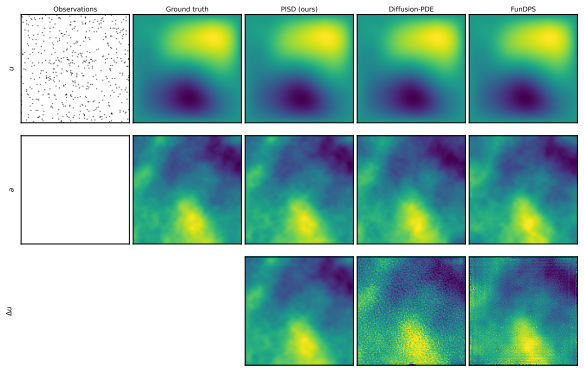
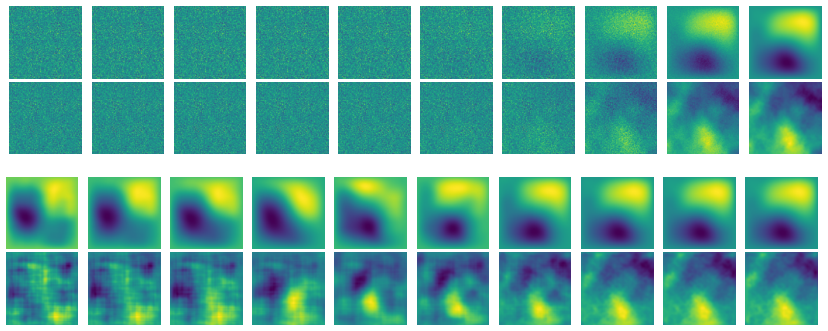
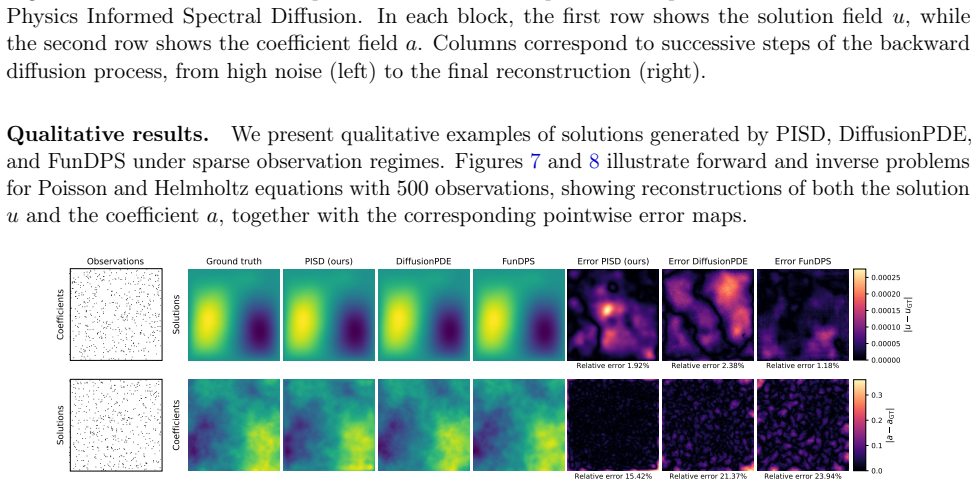
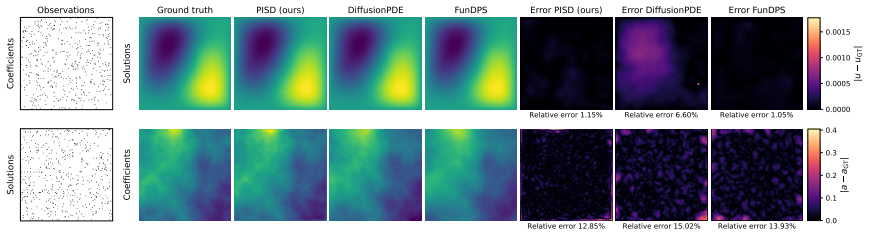
We propose physics-informed spectral diffusion (PISD), a methodology that combines generative latent diffusion models with physics-informed machine learning to generate solutions of partial differential equations (PDEs) conditioned on partial observations, which includes, in particular, forward and inverse PDE problems. We learn the joint distribution of PDE parameters and solutions via a diffusion process in a latent space of scaled spectral representations, where Gaussian noise corresponds to functions with controlled regularity. This spectral formulation enables significant dimensionality reduction compared to grid-based diffusion models and ensures that the induced process in function space remains within a class of functions for which the PDE operators are well defined. Building on diffusion posterior sampling, we enforce physics-informed constraints and measurement conditions during inference, applying Adam-based updates at each diffusion step. We evaluate the proposed approach on Poisson, Helmholtz, and incompressible Navier-Stokes equations, demonstrating improved accuracy and computational efficiency compared with existing diffusion-based PDE solvers, which are state of the art for sparse observations. Code is available at https://github.com/deeplearningmethods/PISD.
Figures
Reference graph
Works this paper leans on
-
[1]
InICLR 2020 Workshop on Integration of Deep Neural Models and Differential Equations(2019)
Anandkumar, A., Azizzadenesheli, K., Bhattacharya, K., Kov achki, N., Li, Z., Liu, B., and Stuart, A.Neural operator: Graph kernel network for partial differential equations. InICLR 2020 Workshop on Integration of Deep Neural Models and Differential Equations(2019)
2020
-
[2]
M.Physics-informed diffusion models.arXiv:2403.14404 (2024)
Bastek, J.-H., Sun, W., and Kochmann, D. M.Physics-informed diffusion models.arXiv:2403.14404 (2024)
Pith/arXiv arXiv 2024
-
[3]
T., Klasky, M
Chung, H., Kim, J., Mccann, M. T., Klasky, M. L., and Ye, J. C.Diffusion posterior sampling for general noisy inverse problems. InInternational Conference on Learning Representations(2023)
2023
-
[4]
Ciftci, K., and Hackl, K.A physics-informed gan framework based on model-free data-driven computa- tional mechanics.Computer Methods in Applied Mechanics and Engineering 424(2024), 116907
2024
-
[5]
Springer International Publishing, 2017
Einsiedler, M., and W ard, T.Functional Analysis, Spectral Theory, and Applications. Springer International Publishing, 2017
2017
-
[6]
InThirty-seventh Conference on Neural Information Processing Systems (2023)
Franzese, G., Corallo, G., Rossi, S., Heinonen, M., Filippone, M., and Michiardi, P.Continuous- time functional diffusion processes. InThirty-seventh Conference on Neural Information Processing Systems (2023)
2023
-
[7]
Hagemann, P., Mildenberger, S., Ruthotto, L., Steidl, G., and Yang, N. T.Multilevel diffusion: Infinite dimensional score-based diffusion models for image generation.arXiv:2303.04772(Mar. 2023)
Pith/arXiv arXiv 2023
-
[8]
InAdvances in Neural Information Processing Systems(2020), H
Ho, J., Jain, A., and Abbeel, P.Denoising diffusion probabilistic models. InAdvances in Neural Information Processing Systems(2020), H. Larochelle, M. Ranzato, R. Hadsell, M. Balcan, and H. Lin, Eds., vol. 33, Curran Associates, Inc., pp. 6840–6851
2020
-
[9]
Hu, P., W ang, R., Zheng, X., Zhang, T., Feng, H., Feng, R., Wei, L., W ang, Y., Ma, Z.-M., and Wu, T.Wavelet diffusion neural operator.arXiv:2412.04833(Dec. 2024). [10]Huang, J., Yang, G., W ang, Z., and Park, J. J.Diffusionpde: Generative pde-solving under partial observation.Advances in Neural Information Processing Systems 37(2024), 130291–130323
Pith/arXiv arXiv 2024
-
[11]
Jacobsen, C., Zhuang, Y., and Duraisamy, K.Cocogen: Physically consistent and conditioned score-based generative models for forward and inverse problems.SIAM Journal on Scientific Computing 47, 2 (2025), C399–C425
2025
-
[12]
InAdvances in Neural Information Processing Systems(2022), S
Karras, T., Aittala, M., Aila, T., and Laine, S.Elucidating the design space of diffusion-based generative models. InAdvances in Neural Information Processing Systems(2022), S. Koyejo, S. Mohamed, A. Agarwal, D. Belgrave, K. Cho, and A. Oh, Eds., vol. 35, Curran Associates, Inc., pp. 26565–26577
2022
-
[13]
InProceedings of The 26th International Conference on Artificial Intelligence and Statistics(25–27 Apr 2023), F
Kerrigan, G., Ley, J., and Smyth, P.Diffusion generative models in infinite dimensions. InProceedings of The 26th International Conference on Artificial Intelligence and Statistics(25–27 Apr 2023), F. Ruiz, J. Dy, and J.-W. van de Meent, Eds., vol. 206 ofProceedings of Machine Learning Research, PMLR, pp. 9538–9563
2023
-
[14]
P., and Ba, J.Adam: A method for stochastic optimization.arXiv:1412.6980(Dec
Kingma, D. P., and Ba, J.Adam: A method for stochastic optimization.arXiv:1412.6980(Dec. 2014)
Pith/arXiv arXiv 2014
-
[15]
Kolesnikov, A., Dosovitskiy, A., Weissenborn, D., Heigold, G., Uszkoreit, J., Beyer, L., Minderer, M., Dehghani, M., Houlsby, N., Gelly, S., Unterthiner, T., and Zhai, X.An image is worth 16x16 words: Transformers for image recognition at scale
-
[16]
14 [17]Li, Z., Han, W., Zhang, Y., Fu, Q., Li, J., Qin, L., Dong, R., Sun, H., Deng, Y., and Yang, L
Kov achki, N., Li, Z., Liu, B., Azizzadenesheli, K., Bhattacharya, K., Stuart, A., and Anand- kumar, A.Neural operator: Learning maps between function spaces with applications to pdes.Journal of Machine Learning Research 24, 89 (2023), 1–97. 14 [17]Li, Z., Han, W., Zhang, Y., Fu, Q., Li, J., Qin, L., Dong, R., Sun, H., Deng, Y., and Yang, L. Learning spat...
2023
-
[18]
B., Azizzadenesheli, K., liu, B., Bhattacharya, K., Stuart, A., and Anandkumar, A.Fourier neural operator for parametric partial differential equations
Li, Z., Kov achki, N. B., Azizzadenesheli, K., liu, B., Bhattacharya, K., Stuart, A., and Anandkumar, A.Fourier neural operator for parametric partial differential equations. InInternational Conference on Learning Representations(2021)
2021
-
[19]
Data Sci
Li, Z., Zheng, H., Kov achki, N., Jin, D., Chen, H., Liu, B., Azizzadenesheli, K., and Anandku- mar, A.Physics-informed neural operator for learning partial differential equations.ACM / IMS J. Data Sci. 1, 3 (May 2024)
2024
-
[20]
H., Kov achki, N
Lim, J. H., Kov achki, N. B., Baptista, R., Beckham, C., Azizzadenesheli, K., Kossaifi, J., Voleti, V., Song, J., Kreis, K., Kautz, J., Pal, C., V ahdat, A., and Anandkumar, A.Score-based diffusion models in function space.Journal of Machine Learning Research 26, 158 (2025), 1–62
2025
-
[21]
B., Byun, T., Kang, T., Kim, S., Lee, K., and Choi, S.Score-based generative modeling through stochastic evolution equations in hilbert spaces
Lim, S., YOON, E. B., Byun, T., Kang, T., Kim, S., Lee, K., and Choi, S.Score-based generative modeling through stochastic evolution equations in hilbert spaces. InAdvances in Neural Information Processing Systems(2023), A. Oh, T. Naumann, A. Globerson, K. Saenko, M. Hardt, and S. Levine, Eds., vol. 36, Curran Associates, Inc., pp. 37799–37812
2023
-
[22]
E.Learning nonlinear operators via deeponet based on the universal approximation theorem of operators.Nature Machine Intelligence 3, 3 (Mar
Lu, L., Jin, P., Pang, G., Zhang, Z., and Karniadakis, G. E.Learning nonlinear operators via deeponet based on the universal approximation theorem of operators.Nature Machine Intelligence 3, 3 (Mar. 2021), 218–229
2021
-
[23]
C., and Anandkumar, A.Diffusion-based inverse solver on function spaces with applications to pdes.Machine Learning and the Physical Sciences Workshop at NeurIPS(2024)
Mammadov, A., Berner, J., Azizzadenesheli, K., Ye, J. C., and Anandkumar, A.Diffusion-based inverse solver on function spaces with applications to pdes.Machine Learning and the Physical Sciences Workshop at NeurIPS(2024)
2024
-
[24]
Na, K., Lee, J., Yun, S.-Y., and Lim, S.Probability-flow ode in infinite-dimensional function spaces. arXiv:2503.10219(Mar. 2025)
Pith/arXiv arXiv 2025
-
[25]
Oommen, V., Bora, A., Zhang, Z., and Karniadakis, G. E.Integrating neural operators with diffusion models improves spectral representation in turbulence modeling.arXiv:2409.08477(Sept. 2024)
Pith/arXiv arXiv 2024
-
[26]
J., Bortoli, V
Phillips, A., Seror, T., Hutchinson, M. J., Bortoli, V. D., Doucet, A., and Mathieu, E. Spectral diffusion processes. InNeurIPS 2022 Workshop on Score-Based Methods(2022)
2022
-
[27]
Pidstrigach, J., Marzouk, Y., Reich, S., and W ang, S.Infinite-dimensional diffusion models.Journal of Machine Learning Research 25, 414 (2024), 1–52
2024
-
[28]
Qiu, J., Huang, J., Zhang, X., Lin, Z., Pan, M., Liu, Z., and Miao, F.Pi-fusion: Physics-informed diffusion model for learning fluid dynamics.arXiv:2406.03711(June 2024)
Pith/arXiv arXiv 2024
-
[29]
Raissi, M., Perdikaris, P., and Karniadakis, G.Physics-informed neural networks: A deep learning framework for solving forward and inverse problems involving nonlinear partial differential equations.Journal of Computational Physics 378(2019), 686–707
2019
-
[30]
In2022 IEEE/CVF Conference on Computer Vision and Pattern Recognition (CVPR)(2022), pp
Rombach, R., Blattmann, A., Lorenz, D., Esser, P., and Ommer, B.High-resolution image synthesis with latent diffusion models. In2022 IEEE/CVF Conference on Computer Vision and Pattern Recognition (CVPR)(2022), pp. 10674–10685
2022
-
[31]
B.A physics-informed diffusion model for high-fidelity flow field reconstruction.Journal of Computational Physics 478(2023), 111972
Shu, D., Li, Z., and F arimani, A. B.A physics-informed diffusion model for high-fidelity flow field reconstruction.Journal of Computational Physics 478(2023), 111972. 15
2023
-
[32]
M., Turner, R
Shysheya, A., Diaconu, C., Bergamin, F., Perdikaris, P., Hernández-Lobato, J. M., Turner, R. E., and Mathieu, E.On conditional diffusion models for pde simulations. InAdvances in Neural Infor- mation Processing Systems(2024), A. Globerson, L. Mackey, D. Belgrave, A. Fan, U. Paquet, J. Tomczak, and C. Zhang, Eds., vol. 37, Curran Associates, Inc., pp. 23246–23300
2024
-
[33]
Sirignano, J., and Spiliopoulos, K.Dgm: A deep learning algorithm for solving partial differential equations.Journal of Computational Physics 375(2018), 1339–1364
2018
-
[34]
P., Kumar, A., Ermon, S., and Poole, B.Score-based generative modeling through stochastic differential equations
Song, Y., Sohl-Dickstein, J., Kingma, D. P., Kumar, A., Ermon, S., and Poole, B.Score-based generative modeling through stochastic differential equations. InInternational Conference on Learning Representations(2021)
2021
-
[35]
InAdvances in Neural Information Processing Systems(2021), M
V ahdat, A., Kreis, K., and Kautz, J.Score-based generative modeling in latent space. InAdvances in Neural Information Processing Systems(2021), M. Ranzato, A. Beygelzimer, Y. Dauphin, P. Liang, and J. W. Vaughan, Eds., vol. 34, Curran Associates, Inc., pp. 11287–11302
2021
-
[36]
W ang, S., Dou, Z., Liu, T.-R., and Lu, L.Fundiff: Diffusion models over function spaces for physics-informed generative modeling.arXiv:2506.07902(2025)
arXiv 2025
-
[37]
Yang, G., and Sommer, S.A denoising diffusion model for fluid field prediction.arXiv:2301.11661(Jan. 2023)
Pith/arXiv arXiv 2023
-
[38]
C., Azizzadenesheli, K., and Anandkumar, A.Guided diffusion sampling on function spaces with applications to PDEs
Yao, J., Mammadov, A., Berner, J., Kerrigan, G., Ye, J. C., Azizzadenesheli, K., and Anandkumar, A.Guided diffusion sampling on function spaces with applications to PDEs. InThe Thirty-ninth Annual Conference on Neural Information Processing Systems(2025). 16 A Proof of Theorem 3.2 Proof. The proof of Theorem 3.2 relies on the following elementary connecti...
2025
discussion (0)
Sign in with ORCID, Apple, or X to comment. Anyone can read and Pith papers without signing in.