REVIEW 3 major objections 4 minor 40 references
For the Standard Model extended by one or two real gauge-singlet scalars, all scalar Lie point symmetries — strict variational, divergence, and non-variational — are classified into a short list of inequivalent algebras, with algorithms tha
Reviewed by Pith at T0; open to challenge. T0 means a machine referee read the full paper against a public rubric. the ladder, T0–T4 →
T0 review · deepseek-v4-flash
2026-08-02 21:07 UTC pith:X6LVXQXC
load-bearing objection Careful and useful classification, held back by an unproved technical step and hidden computer algebra; worth reviewing, not rejecting. the 3 major comments →
Scalar Lie point symmetries of the Standard Model with one or two real gauge singlets
The pith
A machine-rendered reading of the paper's core claim, the machinery that carries it, and where it could break.
Core claim
The paper establishes that the scalar Lie point symmetries of the SM+S and SM+2S are completely classified. For the SM+S, the realizable, inequivalent Euler–Lagrange symmetry algebras are exactly a(1)⊕u(1)_Y (a free, massless singlet), s_h⊕u(1)_Y (massless singlet with a linear term), s_c⊕u(1)_Y (free massive singlet), and u(1)_Y (the hypercharge rephasing, always present). For the SM+2S, the list grows to 11 inequivalent Euler–Lagrange algebras, including so(2) rotations corresponding to a complex singlet with a global U(1), the affine algebra a(2) of the free two-singlet kinetic theory, and mixed shift/scaling algebras, with the variational and strict variational subalgebras separately enu
What carries the argument
The load-bearing machinery is Corollary 1, which characterizes the three symmetry types for Lagrangians of the form L = T − V. For a scalar point symmetry X = η^i(φ) ∂_{φ^i} with constant part a^i and linear-potential coefficients α_i, X is a strict variational symmetry if and only if pr X(T)=0 and a^i α_i = 0; a divergence symmetry if pr X(T) is a total divergence and (a^i α_i ≠ 0 or the divergence is nonzero); and non-variational if E(pr X(T)) ≠ 0. The proof rests on the identity pr X(E(L)) = E(pr X(L)) − D*_Q E(L) and on the hypothesis that E(L)=0 has no polynomial consequences, which forces pr X(V) to be a constant. Affine reparametrizations (orthogonal changes of singlet basis and const
Load-bearing premise
The classification of strict variational, divergence, and non-variational symmetries assumes that the SM+S and SM+2S field equations imply no nonzero polynomial relation among the scalar fields, a hypothesis the paper invokes but never verifies.
What would settle it
Pick a concrete parameter point, e.g. the SM+S free massive singlet (µ_s² ≠ 0, all other singlet couplings zero), write out the five scalar Euler–Lagrange equations, and test whether the system implies any nonzero polynomial identity p(ϕ_1,...,ϕ_5)=0. If such an identity exists, Theorem 1's conclusion that pr X(V) is constant fails, and the s_c⊕u(1)_Y classification of symmetry types would need revision.
If this is right
- For any numerical SM+S or SM+2S potential, the symmetry algebras g_EL, g_var, and g_svar can be read off from parameter conditions alone, making systematic parameter scans feasible without solving determining equations.
- The theorems give a general criterion for when a scalar field symmetry is variational (and hence yields a Noether current) versus merely a symmetry of the field equations, applicable beyond these two models to any Lagrangian with a potential of the assumed form.
- The variational symmetries of SM+S reduce to the singlet shift (strict when α=0, divergence otherwise) plus hypercharge; in SM+2S the only variational generators are the two singlet shifts, the rotation s_2∂_{s1} − s_1∂_{s2}, and hypercharge, which tells model-builders which continuous symmetries can be imposed consistently.
- Models realizing the a(2)⊕u(1)_Y algebra correspond to a free, massless two-singlet sector; models realizing so(2)⊕u(1)_Y are equivalent to a complex singlet with a global U(1), matching known pseudo-Goldstone dark matter setups.
Where Pith is reading between the lines
- The 'no polynomial consequences' hypothesis is the main unverified link; checking it explicitly for representative parameter points via elimination of derivatives (e.g., by computing a Gröbner basis of the differential ideal of the field equations) would confirm the classification's scope.
- The parameter-based algorithms could be turned into automated scans that flag which symmetry algebra a given benchmark point in the singlet-extension parameter space realizes, useful for dark matter and baryogenesis studies.
- The classification's approach — start from the symmetry algebra of the kinetic terms and reduce by reparametrizations — suggests a route to SM+KS with K>2, though the reduction tree complexity grows rapidly; the paper explicitly notes the boost algebra k⊕u(1)_Y with eigenvalues ±1 is not realizable in SM+2S, a caution for naive symmetry searches.
Editorial analysis
A structured set of objections, weighed in public.
Referee Report
Summary. The paper classifies scalar Lie point symmetries for the Standard Model extended by one or two real gauge-singlet scalars (SM+S and SM+2S), distinguishing strict variational, divergence, and non-variational (Euler–Lagrange) symmetries. For SM+S it finds four inequivalent realizable algebras; for SM+2S eleven. It provides parameter-based algorithms to determine the symmetry algebra of any numerical instance without solving determining equations, and it proves general results (Theorem 1, Proposition 1, Corollary 1, Proposition 2) characterizing symmetry types for Lagrangians with potentials. The classification is obtained by solving determining equations with the Mathematica packages SYM/Reduce over a reduction tree of 31 parameter branches.
Significance. If the results hold, the paper delivers a useful catalogue of scalar Lie point symmetries for two popular BSM models and an efficient algorithm for symmetry identification in parameter scans. The general characterization in Corollary 1 and the explicit proof of Proposition 3 are valuable extensions of earlier work. The g_EL classification is derived directly from the determining equations and is supported by explicit examples, e.g., the Leaf 6 analysis and the calculations around Eqs. (4.113)–(4.115). However, the SVS/DS/NVS classification rests on a structural hypothesis that is stated but never verified for the physical models, which limits confidence in the variational and strict-variational lists.
major comments (3)
- [§2.4 (Theorem 1, Corollary 1) and §§3.3, 4.5] The theorem and corollary assume that the system E(L)=0 'has no polynomial consequences'. This hypothesis is never verified for SM+S or SM+2S. It is essential for the step concluding that prX(V) is constant from on-shell vanishing of its partial derivatives, and thereby underpins the SVS/DS/NVS classification of every generator. If some branch of the reduction tree admitted a nonzero polynomial relation among the scalar fields, a generator classified as non-variational could actually be a divergence symmetry (or vice versa), changing the g_var and g_svar lists in Eqs. (5.4)–(5.5). The authors should either prove the property for these field equations (e.g., by a local-solvability/Cauchy–Kovalevskaya argument using the nondegenerate kinetic terms) or provide a direct per-leaf computation of prX(L) and E(prX(L)) for each generator in the set ℵ, thereby avoiding the hypothesis altogether.
- [§4.4 and Appendix A] The exhaustiveness of the computational classification is not fully transparent. The text states that SYM/Reduce solves the determining equations for each of the 31 leaves, but the solving steps and intermediate differential-elimination results are not shown. To support the claimed completeness of the reduction tree and the resulting classification, the authors should make the code available or include a detailed appendix (or supplementary material) with, for each leaf, the reduced determining equations and the final solutions, together with a justification that the branching in Figures 1–3 covers all possible parameter values.
- [Eq. (5.3)] The summary list contains 'sc_2⊕u(1)_Y' as one of the eleven inequivalent algebras, but Section 4.5.1 shows that sc_1≂O sc_2≂O sc, so sc_2⊕u(1)_Y is not inequivalent to sc⊕u(1)_Y, which is already listed. The intended entry is presumably 'sc_1⊕sc_2⊕u(1)_Y', which appears as one of the three (2+1)d algebras in (4.157). As written, the list contradicts the 'inequivalent' claim and the count of eleven; please correct this.
minor comments (4)
- [Notation in §5 and §4.5] The notation 'sc_2' is ambiguous: it is used for a one-dimensional algebra acting on the second singlet, but in (5.3) it appears to represent a two-dimensional direct sum. Recommend writing 'sc_1⊕sc_2' explicitly when that is intended.
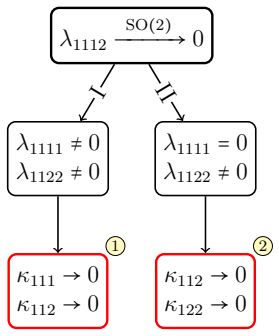
- [Figure 2] The reduction tree is very dense. A legend distinguishing red leaves, intermediate nodes, and '∅' nodes, and perhaps a higher-resolution or simplified version, would improve readability.
- [§2.4, proof of Proposition 1] The 'no cancellations' argument between Eqs. (2.55) and (2.56) is somewhat terse. A sentence explaining why, under the assumptions on T, E_i(prX(T)) cannot contain a pure polynomial term in the φ variables would help the reader follow the proof.
- [References] Several standard results are cited to [19], the author's previous work. Since the present paper aims to be self-contained, consider restating the most important definitions (e.g., the equivalence notation ≂O and the affine-vector-field notation) with equation numbers, rather than relying on the earlier reference.
Circularity Check
No significant circularity: the symmetry algebras are derived from determining equations and parameter reductions, not from the quantities they are claimed to classify.
full rationale
The paper's central claim is a classification of scalar Lie point symmetries obtained by solving the linearized symmetry condition (2.18) for the Euler-Lagrange equations and then organizing the solutions by orthogonal affine reparametrizations. The parameter conditions such as (3.21)-(3.26) and (4.69)-(4.71) are outputs of the determining-equation solve, not fitted inputs; the classification is not defined in terms of the listed algebras. Theorems 1 and Corollary 1 are proven in the text, albeit under the explicit hypothesis that E(L)=0 'has no polynomial consequences' (Section 2.4), and this hypothesis is not verified for SM+S/SM+2S in Sections 3.3 and 4.5. That is an unverified assumption (a correctness risk) rather than a circular step: the characterization would be invalid if the hypothesis failed, but it does not reduce the claimed prediction to the theorem's input by construction. Self-citations to [19] and [26] are contextual (overlapping review, standard reparametrization facts) and are not load-bearing; the main theorem used later is proved in this paper. No fitted-input-called-prediction, self-definitional, or renaming pattern is present, so a low circularity score is appropriate.
Axiom & Free-Parameter Ledger
axioms (5)
- domain assumption The system E(L)=0 for SM+S and SM+2S has no polynomial consequences: no nonzero polynomial p(φ)=0 follows from the field equations.
- domain assumption All terms in the kinetic sector T are either at least quadratic in the gauge fields or at least linear in field derivatives.
- ad hoc to paper The Mathematica packages SYM and Reduce correctly solve the determining equations for all 31 leaves.
- standard math Orthogonal affine reparametrizations, together with rescaling of the group parameter, are the correct equivalence relation for identifying inequivalent symmetry realizations.
- domain assumption Renormalization preserves variational symmetries in the absence of anomalies, so tree-level symmetry analysis is relevant for the effective potential.
read the original abstract
We present a classification of all scalar Lie point symmetries of the Standard Model with one or two real gauge-singlet scalars (SM+S and SM+2S). By analyzing the associated field equations, we identify all realizable and inequivalent Lie point symmetry algebras of these models, distinguishing strict variational, variational (including divergence symmetries), and Euler--Lagrange cases. In addition, we devise efficient algorithms that, for any given numerical instance of the models, determine the Lie point symmetry algebra in each of the three categories by a parameter-based decision procedure using affine reparametrizations and simple parameter tests, thereby avoiding explicit symmetry analysis and the need to derive and solve the determining equations. Finally, we prove several relevant general results, including a characterization of the three disjoint types of Lie point symmetry generators -- strict variational, divergence, and non-variational -- for a broad class of Lagrangians with potentials, including the SM+S and SM+2S.
Figures


Reference graph
Works this paper leans on
-
[1]
Silveira and A
V. Silveira and A. Zee,Scalar phantoms,Physics Letters B161(1985) 136–140
1985
-
[2]
McDonald,Gauge singlet scalars as cold dark matter.,Physical review
J. McDonald,Gauge singlet scalars as cold dark matter.,Physical review. D, Particles and fields50 6(1994) 3637–3649
1994
-
[3]
Burgess, M
C. Burgess, M. Pospelov and T. ter Veldhuis,The minimal model of nonbaryonic dark matter: a singlet scalar,Nuclear Physics B619(Dec., 2001) 709–728
2001
-
[4]
Arcadi, A
G. Arcadi, A. Djouadi and M. Raidal,Dark matter through the higgs portal,Physics Reports842(2020) 1–180
2020
-
[5]
Ahriche,What is the criterion for a strong first order electroweak phase transition in singlet models?,Physical Review D75(Apr., 2007)
A. Ahriche,What is the criterion for a strong first order electroweak phase transition in singlet models?,Physical Review D75(Apr., 2007)
2007
-
[6]
J. R. Espinosa, T. Konstandin and F. Riva,Strong Electroweak Phase Transitions in the Standard Model with a Singlet,Nucl. Phys. B854(2012) 592–630, [1107.5441]. 48
Pith/arXiv arXiv 2012
-
[7]
J. Ellis, M. Lewicki, M. Merchand, J. M. No and M. Zych,The scalar singlet extension of the Standard Model: gravitational waves versus baryogenesis,JHEP01 (2023) 093, [2210.16305]
Pith/arXiv arXiv 2023
-
[8]
Yu, T.-P
Y. Yu, T.-P. Tang and L. Feng,New constraints on singlet scalar dark matter model with lz, invisible higgs decay and gamma-ray line observations, 2025
2025
-
[9]
Lewis and M
I. Lewis and M. Sullivan,Benchmarks for double higgs production in the singlet-extended standard model at the lhc,Physical Review D96(Aug., 2017)
2017
-
[10]
C.-Y. Chen, J. Kozaczuk and I. M. Lewis,Non-resonant collider signatures of a singlet-driven electroweak phase transition,Journal of High Energy Physics2017 (Aug., 2017)
2017
-
[11]
Tofighi, O
A. Tofighi, O. Ghodsi and M. Saeedhoseini,Phase transition in multi-scalar-singlet extensions of the standard model,Physics Letters B748(Sept., 2015) 208–211
2015
-
[12]
V. R. Shajiee and A. Tofighi,Electroweak phase transition, gravitational waves and dark matter in two scalar singlet extension of the standard model,The European Physical Journal C79(Apr., 2019)
2019
-
[13]
Barger, P
V. Barger, P. Langacker, M. McCaskey, M. Ramsey-Musolf and G. Shaughnessy, Complex singlet extension of the standard model,Phys. Rev. D79(Jan, 2009) 015018
2009
-
[14]
K. Kannike and M. Raidal,Phase Transitions and Gravitational Wave Tests of Pseudo-Goldstone Dark Matter in the Softly Broken U(1) Scalar Singlet Model, Phys. Rev. D99(2019) 115010, [1901.03333]
Pith/arXiv arXiv 2019
-
[15]
Arina, A
C. Arina, A. Beniwal, C. Degrande, J. Heisig and A. Scaffidi,Global fit of pseudo-nambu-goldstone dark matter,Journal of High Energy Physics2020(Apr.,
-
[16]
Symmetries in quantum field theory
D. B. Skinner, “Symmetries in quantum field theory.” Chapter 6 of the lecture notes forQuantum Field Theory II(University of Cambridge, Part III Mathematical Tripos), 2015
2015
-
[17]
Alvarez-Gaum´ e and F
L. Alvarez-Gaum´ e and F. Zamora,Duality in quantum field theory (and string theory), Sept., 1997
1997
-
[18]
Lie and F
S. Lie and F. Engel,Theorie der Transformationsgruppen, vol. 1-3. B.G. Teubner, Leipzig, 1888-1893
-
[19]
M. A. Solberg,Lie symmetry analysis of the two-higgs-doublet model field equations, Physica Scripta101(jan, 2026) 035209
2026
-
[20]
P. J. Olver,Applications of Lie Groups to Differential Equations, vol. 107 of Graduate Texts in Mathematics. Springer, New York, 2 ed., 1993, 10.1007/978-1-4612-4350-2
-
[21]
Lectures on Lie Groups and Differential Equations
P. J. Olver, “Lectures on Lie Groups and Differential Equations.” https://www-users.cse.umn.edu/~olver/sm.html, 2012. 49
2012
-
[22]
P. E. Hydon,Symmetry Methods for Differential Equations: A Beginner’s Guide, vol. 22 ofCambridge Texts in Applied Mathematics. Cambridge University Press, Cambridge, 2000
2000
-
[23]
G. W. Bluman, A. F. Cheviakov and S. C. Anco,Applications of Symmetry Methods to Partial Differential Equations, vol. 168 ofApplied Mathematical Sciences. Springer, 2010
2010
-
[24]
Cantwell,Introduction to Symmetry Analysis
B. Cantwell,Introduction to Symmetry Analysis. Cambridge Texts in Applied Mathematics. Cambridge University Press, 2002
2002
-
[25]
Dimas and D
S. Dimas and D. Tsoubelis,SYM: A new symmetry-finding package for Mathematica, inThe 10th international conference in modern group analysis, pp. 64–70, Nicosia, University of Cyprus, 2005
2005
-
[26]
K. Olaussen, P. Osland and M. A. Solberg,Symmetry and Mass Degeneration in Multi-Higgs-Doublet Models,JHEP07(2011) 020, [1007.1424]
Pith/arXiv arXiv 2011
-
[27]
Coleman and E
S. Coleman and E. Weinberg,Radiative corrections as the origin of spontaneous symmetry breaking,Phys. Rev. D7(1973) 1888–1910
1973
-
[28]
Gildener and S
E. Gildener and S. Weinberg,Symmetry breaking and scalar bosons,Phys. Rev. D 13(1976) 3333–3341
1976
-
[29]
J. E. Camargo-Molina, B. O’Leary, W. Porod and F. Staub,Vevacious: A tool for finding the global minima of one-loop effective potentials,Eur. Phys. J. C73(2013) 2588, [1307.1477]
Pith/arXiv arXiv 2013
-
[30]
Staub,Reopen parameter regions in two-higgs doublet models,Phys
F. Staub,Reopen parameter regions in two-higgs doublet models,Phys. Lett. B776 (2018) 407–411, [1705.03677]
Pith/arXiv arXiv 2018
-
[31]
M. E. Krauss, T. Opferkuch and F. Staub,The ultraviolet landscape of two-higgs doublet models,Eur. Phys. J. C78(2018) 1020, [1807.07581]
Pith/arXiv arXiv 2018
-
[32]
I. P. Ivanov and F. Vaz˜ ao,Yet another lesson on the stability conditions in multi-higgs potentials,JHEP11(2020) 104, [2006.00036]
Pith/arXiv arXiv 2020
-
[33]
Robens, T
T. Robens, T. Stefaniak and J. Wittbrodt,Two-real-scalar-singlet extension of the sm: Lhc phenomenology and benchmark scenarios,The European Physical Journal C80(Feb., 2020)
2020
-
[34]
Branco, P
G. Branco, P. Ferreira, L. Lavoura, M. Rebelo, M. Sher and J. P. Silva,Theory and phenomenology of two-higgs-doublet models,Physics Reports516(July, 2012) 1–102
2012
-
[35]
P. J. Olver,Equivalence, Invariants and Symmetry. Cambridge University Press, Cambridge, 1995, 10.1017/CBO9780511609565
-
[36]
A. Andrada, M. L. Barberis, I. G. Dotti and G. P. Ovando,Product structures on four dimensional solvable lie algebras,Homology, Homotopy and Applications7 (2005) 9–37, [math/0402234]. 50
Pith/arXiv arXiv 2005
-
[37]
Ovando,Four dimensional symplectic lie algebras,Beitr¨ age zur Algebra und Geometrie47(2006) 419–434
G. Ovando,Four dimensional symplectic lie algebras,Beitr¨ age zur Algebra und Geometrie47(2006) 419–434
2006
-
[38]
Plantey, R. and Solberg, M. Aa.,Computable conditions for order-2 CP symmetry in NHDM potentials,JHEP05(2024) 260, [2404.02004]
Pith/arXiv arXiv 2024
-
[39]
P. E. Hydon,How to use Lie symmetries to find discrete symmetries, inModern Group Analysis VII(N. H. Ibragimov, K. R. Naqvi and E. Straume, eds.), pp. 141–147. MARS Publishers, Trondheim, 1999
1999
-
[40]
Hydon,How to construct the discrete symmetries of partial differential equations, European Journal of Applied Mathematics11(2000) 515–527
P. Hydon,How to construct the discrete symmetries of partial differential equations, European Journal of Applied Mathematics11(2000) 515–527. 51
2000
discussion (0)
Sign in with ORCID, Apple, or X to comment. Anyone can read and Pith papers without signing in.