REVIEW 3 major objections 5 minor 81 references
BEV features give LLMs 46% better cross-view spatial reasoning; distilling LLM semantics into the same BEV then lifts closed-loop driving safety by 29%.
Reviewed by Pith at T0; open to challenge. T0 means a machine referee read the full paper against a public rubric. the ladder, T0–T4 →
T0 review · grok-4.5
2026-07-15 13:43 UTC pith:ILP3AL57
load-bearing objection Solid representation study plus a practical distillation recipe that lifts closed-loop safety; the causal isolation of the LLM teacher is incomplete but the empirical gains are real and worth engaging. the 3 major comments →
BEVLM: Distilling Semantic Knowledge from LLMs into Bird's-Eye View Representations
The pith
A machine-rendered reading of the paper's core claim, the machinery that carries it, and where it could break.
Core claim
A spatially consistent BEV feature map is a superior input representation for LLMs in multi-view driving scenes, raising object-centric cross-view accuracy by 46% over independent multi-view image tokens. Freezing the LLM and distilling its semantic knowledge into the BEV encoder via VQA further produces a representation that, when used by an end-to-end planner, raises the NeuroNCAP closed-loop safety score by 29% and lowers collision rate.
What carries the argument
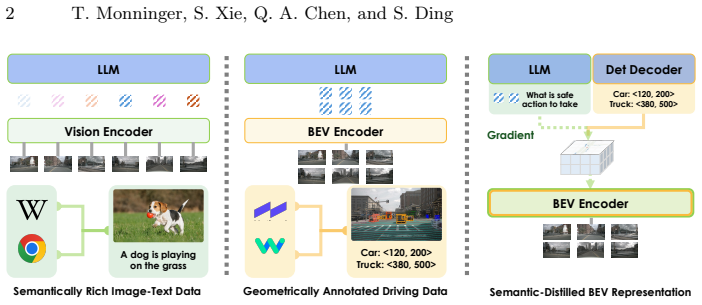
BEVLM: a lightweight MLP projector that maps a max-pooled BEV grid into LLM token space, followed by representation distillation in which the frozen LLM supplies a fixed semantic teacher manifold through VQA losses while joint detection preserves geometric structure.
Load-bearing premise
One epoch of distillation from a human-curated driving VQA set under a frozen LLM injects the right safety semantics into the BEV encoder without destroying the geometric structure needed for planning.
What would settle it
Train an identical BEV encoder using only perception VQA questions (or with the teacher LLM weights randomly scrambled) and measure NeuroNCAP score and impact velocity; if the safety gains disappear or reverse relative to the full Behavior+Planning distillation, the claim that LLM semantic knowledge is the causal driver fails.
If this is right
- LLMs can answer panoramic spatial questions more accurately when given one fused BEV token map instead of separate multi-view image tokens.
- End-to-end planners that inherit a semantically distilled BEV encoder produce lower-severity collisions and higher NeuroNCAP scores in closed-loop safety-critical re-simulations.
- Behavior and planning VQA subsets contribute more of the safety gain than perception or prediction subsets alone.
- Scaling the frozen teacher LLM from 1B to 8B further improves the distilled BEV's closed-loop planning metrics.
Where Pith is reading between the lines
- The same distillation recipe should transfer to other BEV encoder families without redesigning the downstream planner heads.
- Replacing human-curated DriveLM questions with large-scale synthetic or VLM-generated VQA could remove the labor bottleneck and test whether the method scales with teacher data volume.
- Treating BEV as a fixed semantic manifold suggests future vision-language-action controllers could natively operate on BEV grids rather than raw multi-view tokens.
Editorial analysis
A structured set of objections, weighed in public.
Referee Report
Summary. The paper argues that Bird’s-Eye View (BEV) features are a superior unified input for LLM spatial reasoning in autonomous driving compared with independent multi-view image tokens, and that semantic knowledge can be distilled from frozen LLMs into BEV encoders via VQA. Empirically, BEV tokens improve object-centric MCQ accuracy on Ego3D by 46.0% over perspective tokens (and match a 10× larger ViT). The authors then freeze an LLM teacher, train a BEV encoder jointly on DriveLM VQA + detection for one epoch, and show that the resulting encoder, when plugged into UniAD, raises the NeuroNCAP closed-loop safety score from 2.10 to 2.71 (≈29%) while lowering collision rate from 0.62 to 0.55. Ablations examine pooling, VQA subsets, and teacher scale (1B vs 8B).
Significance. If the causal claims hold, the work supplies a practical bridge between geometrically structured BEV pipelines (still the workhorse of production AD stacks) and the semantic richness of foundation VLMs. The representation study cleanly isolates the BEV fusion step and is valuable on its own; a verified distillation recipe that measurably improves closed-loop safety on NeuroNCAP would be of immediate interest to both the end-to-end planning and VLA communities. Strengths include multi-VLM consistency, full class-wise tables, VQA-subset and pooling ablations, and qualitative roll-outs that illustrate anticipatory behavior.
major comments (3)
- §4.1–5.3 and Table 4: the central safety claim (NeuroNCAP 2.10→2.71) attributes gains to “LLM semantic distillation.” After detection pre-training the BEV encoder is unfrozen for one epoch of joint VQA+detection loss, then re-frozen. The sole control is a pure-detection baseline that never unfreezes the encoder. Consequently any improvement could arise from additional gradient steps on the BEV features (or from the detection regularizer) rather than alignment to the frozen LLM’s semantic manifold. A matched-compute detection-only continuation for the same number of steps, or a randomly-initialized decoder of identical capacity, is required to isolate the claimed mechanism.
- Abstract vs. §5 / Table 4: the abstract states gains “across UniAD and VAD, with gains of up to 28.2%,” yet the body reports only UniAD numbers (and quotes 29.0%). Either VAD results must be added with the same protocol or the abstract claim must be corrected; the present discrepancy undermines reproducibility of the headline number.
- §4.1 Eq. (1) and the “semantic manifold” framing: the distillation objective is ordinary next-token CE under a frozen LLM; the latent-alignment interpretation is post-hoc. Without an analysis showing that the BEV features actually move toward the teacher’s token space (e.g., cosine similarity to LLM embeddings of safety concepts, or probing for “blocked lane” / “unsafe velocity” before vs. after distillation), the claim that high-level semantics rather than generic multi-task regularization are transferred remains unproven.
minor comments (5)
- Abstract / body number inconsistency: 46.0% vs. “46 %”, 28.2% vs. 29.0%; unify all reported percentages.
- Table 1 / Appendix B: majority-class and linear-probe baselines are useful; please also report the exact spatial mask construction for the linear probe so the experiment is fully reproducible.
- Fig. 4 and Appendix D: velocity profiles are informative; adding the corresponding NeuroNCAP impact-velocity numbers next to each qualitative example would strengthen the link to the quantitative score.
- §3.2 / Table 3: token counts (I_ViT 4 608, I_UniAD 2 250, B_UniAD 2 500) are close but not identical; a short note on whether padding or truncation was applied would remove a minor confound.
- Appendix E limitations: the authors correctly flag the human-curated DriveLM dependency and single BEV architecture; elevating a short version of this discussion into the main text would help readers gauge generality.
Circularity Check
No circularity: empirical representation comparisons and distillation gains measured on external benchmarks (Ego3D, NeuroNCAP) with no by-construction reductions.
full rationale
The paper's load-bearing claims are purely empirical. The 46% cross-view accuracy gain (Tab. 3) is a direct head-to-head measurement of BUniAD vs. IViT/IUniAD tokens on the external Ego3D object-centric split under identical LLM and projector training; nothing is fitted then re-reported as a prediction. The 29% NeuroNCAP safety improvement (Tab. 4) is likewise an external closed-loop evaluation after one-epoch joint VQA+detection fine-tuning of a frozen-LLM student BEV encoder (Eq. 1 uses ordinary next-token CE as proxy; the LLM remains frozen and is never trained on NeuroNCAP). The VQA-subset ablation (Tab. 6) and downsampling ablation (Tab. 5) are ordinary controls, not self-definitional. Self-citations to UniAD/BEVFormer supply the shared encoder architecture and baseline, which is standard reuse rather than a load-bearing uniqueness theorem or ansatz smuggled from the same authors. No parameter is fitted to a subset and then called a prediction of a related quantity; no result reduces by construction to its inputs. The derivation chain is therefore self-contained against external data.
Axiom & Free-Parameter Ledger
free parameters (3)
- distillation epochs / loss weights =
1 epoch, equal weights
- BEV downsampling method and resolution =
max-pool 50×50
- learning rates and optimizer schedule =
1e-3 / 1e-6
axioms (4)
- domain assumption A frozen LLM’s next-token prediction loss on VQA is a faithful proxy for the ideal semantic token embeddings required by the teacher manifold.
- domain assumption Joint object-detection supervision is sufficient to prevent catastrophic forgetting of geometric structure during semantic distillation.
- domain assumption NeuroNCAP’s NeRF-based closed-loop scenarios are a valid proxy for real-world safety-critical driving.
- standard math Standard transformer next-token prediction and MLP projection mathematics hold.
invented entities (1)
-
BEVLM / semantic-distilled BEV representation
no independent evidence
read the original abstract
The integration of Large Language Models (LLMs) into autonomous driving has attracted growing interest for their strong reasoning and semantic understanding abilities, which are essential for handling complex decision-making and long-tail scenarios. However, existing methods typically feed LLMs with tokens from multi-view and multi-frame images independently, leading to redundant computation and limited spatial consistency. This separation in visual processing hinders accurate 3D spatial reasoning and fails to maintain geometric coherence across views. On the other hand, Bird's-Eye View (BEV) representations learned from geometrically annotated tasks (e.g., object detection) provide spatial structure but lack the semantic richness of foundation vision encoders. To bridge this gap, we propose BEVLM, a framework that connects a spatially consistent and semantically distilled BEV representation with LLMs. Through extensive experiments, we show that BEVLM enables LLMs to reason more effectively in cross-view driving scenes, improving accuracy by 46.0%, by leveraging BEV features as unified inputs. Furthermore, by distilling semantic knowledge from LLMs into BEV representations, BEVLM significantly improves closed-loop end-to-end driving performance in safety-critical scenarios across UniAD and VAD, with gains of up to 28.2%.
Figures


Reference graph
Works this paper leans on
-
[1]
arXiv preprint arXiv:2303.08774 (2023)
Achiam, J., Adler, S., Agarwal, S., Ahmad, L., Akkaya, I., Aleman, F.L., Almeida, D., Altenschmidt, J., Altman, S., Anadkat, S., et al.: GPT-4 Technical Report. arXiv preprint arXiv:2303.08774 (2023)
Pith/arXiv arXiv 2023
-
[2]
In: Proceedings of the IEEE International Con- ference on Computer Vision (ICCV) (2015)
Antol, S., Agrawal, A., Lu, J., Mitchell, M., Batra, D., Zitnick, C.L., Parikh, D.: VQA: Visual Question Answering. In: Proceedings of the IEEE International Con- ference on Computer Vision (ICCV) (2015)
2015
-
[3]
In: Proceedings of the acl work- shop on intrinsic and extrinsic evaluation measures for machine translation and/or summarization
Banerjee, S., Lavie, A.: METEOR: An Automatic Metric for MT Evaluation with Improved Correlation with Human Judgments. In: Proceedings of the acl work- shop on intrinsic and extrinsic evaluation measures for machine translation and/or summarization. pp. 65–72 (2005)
2005
-
[4]
arXiv Preprint arXiv:2507.19370 (2025)
Brandstaetter, F., Schuetz, E., Winter, K., Flohr, F.: BEV-LLM: Leveraging Mul- timodal BEV Maps for Scene Captioning in Autonomous Driving. arXiv Preprint arXiv:2507.19370 (2025)
Pith/arXiv arXiv 2025
-
[5]
In: Proceedings of the IEEE/CVF Conference on Computer Vision and Pattern Recognition (CVPR) (2020)
Caesar, H., Bankiti, V., Lang, A.H., Vora, S., Liong, V.E., Xu, Q., Krishnan, A., Pan, Y., Baldan, G., Beijbom, O.: nuScenes: A Multimodal Dataset for Au- tonomous Driving. In: Proceedings of the IEEE/CVF Conference on Computer Vision and Pattern Recognition (CVPR) (2020)
2020
-
[6]
In: Conference on Robot Learning (CoRL) (2025)
Cao, W., Hallgarten, M., Li, T., Dauner, D., Gu, X., Wang, C., Miron, Y., Aiello, M., Li, H., Gilitschenski, I., Ivanovic, B., Pavone, M., Geiger, A., Chitta, K.: Pseudo-Simulation for Autonomous Driving. In: Conference on Robot Learning (CoRL) (2025)
2025
-
[7]
In: IEEE Symposium on Security and Privacy (SP)
Cao, Y., Wang, N., Xiao, C., Yang, D., Fang, J., Yang, R., Chen, Q.A., Liu, M., Li, B.: Invisible for Both Camera and LiDAR: Security of Multi-Sensor Fusion Based Perception in Autonomous Driving Under Physical-World Attacks. In: IEEE Symposium on Security and Privacy (SP). pp. 176–194. IEEE (2021)
2021
-
[8]
In: IEEE/CVF Conference on Computer Vision and Pattern Recognition (CVPR)
Chen, B., Xu, Z., Kirmani, S., Ichter, B., Sadigh, D., Guibas, L., Xia, F.: Spa- tialVLM: Endowing Vision-Language Models with Spatial Reasoning Capabilities. In: IEEE/CVF Conference on Computer Vision and Pattern Recognition (CVPR). pp. 14455–14465 (2024) 16 T. Monninger, S. Xie, Q. A. Chen, and S. Ding
2024
-
[9]
arXiv preprint arXiv:2412.18607 (2024)
Chen, Y., Wang, Y., Zhang, Z.: DrivingGPT: Unifying Driving World Model- ing and Planning with Multi-Modal Autoregressive Transformers. arXiv preprint arXiv:2412.18607 (2024)
Pith/arXiv arXiv 2024
-
[10]
In: Proceedings of the IEEE Conference on Computer Vision and Pattern Recognition (CVPR) (2017)
Chollet, F.: Xception: Deep Learning with Depthwise Separable Convolutions. In: Proceedings of the IEEE Conference on Computer Vision and Pattern Recognition (CVPR) (2017)
2017
-
[11]
arXiv Preprint arXiv:2507.06261 (2025)
Comanici, G., Bieber, E., Schaekermann, M., Pasupat, I., Sachdeva, N., Dhillon, I., Blistein,M.,Ram,O.,Zhang,D.,Rosen,E.,etal.:Gemini2.5:PushingtheFrontier with Advanced Reasoning, Multimodality, Long Context, and Next Generation Agentic Capabilities. arXiv Preprint arXiv:2507.06261 (2025)
Pith/arXiv arXiv 2025
-
[12]
In: Conference on Robot Learn- ing
Dauner, D., Hallgarten, M., Geiger, A., Chitta, K.: Parting with Misconceptions About Learning-Based Vehicle Motion Planning. In: Conference on Robot Learn- ing. pp. 1268–1281. PMLR (2023)
2023
-
[13]
Advances in Neural Information Processing Systems37, 28706–28719 (2024)
Dauner, D., Hallgarten, M., Li, T., Weng, X., Huang, Z., Yang, Z., Li, H., Gilitschenski, I., Ivanovic, B., Pavone, M., et al.: NavSim: Data-Driven Non- Reactive Autonomous Vehicle Simulation and Benchmarking. Advances in Neural Information Processing Systems37, 28706–28719 (2024)
2024
-
[14]
In: NeurIPS 2025 Workshop on Regulatable ML (2025)
Ding, S., Vasa, S., Ramadwar, A.: Explanation-Driven Counterfactual Testing for Faithfulness in Vision-Language Model Explanations. In: NeurIPS 2025 Workshop on Regulatable ML (2025)
2025
-
[15]
arXiv Preprint arXiv:2010.11929 (2020)
Dosovitskiy, A.: An Image Is Worth 16x16 Words: Transformers for Image Recog- nition at Scale. arXiv Preprint arXiv:2010.11929 (2020)
Pith/arXiv arXiv 2010
-
[16]
In: Proceedings of the IEEE/CVF Winter Con- ference on Applications of Computer Vision (WACV) (2022)
Fadadu, S., Pandey, S., Hegde, D., Shi, Y., Chou, F.C., Djuric, N., Vallespi- Gonzalez, C.: Multi-View Fusion of Sensor Data for Improved Perception and Prediction in Autonomous Driving. In: Proceedings of the IEEE/CVF Winter Con- ference on Applications of Computer Vision (WACV) (2022)
2022
-
[17]
arXiv preprint arXiv:2505.15925 (2025)
Feng, B., Mei, Z., Li, B., Ost, J., Girgis, R., Majumdar, A., Heide, F.: VERDI: VLM-Embedded Reasoning for Autonomous Driving. arXiv preprint arXiv:2505.15925 (2025)
Pith/arXiv arXiv 2025
-
[18]
arXiv preprint arXiv:2503.19755 (2025)
Fu,H.,Zhang,D.,Zhao,Z.,Cui,J.,Liang,D.,Zhang,C.,Zhang,D.,Xie,H.,Wang, B., Bai, X.: Orion: A Holistic End-to-End Autonomous Driving Framework by Vision-Language Instructed Action Generation. arXiv preprint arXiv:2503.19755 (2025)
Pith/arXiv arXiv 2025
-
[19]
arXiv preprint arXiv:2509.06266 (2025)
Gholami,M.,Rezaei,A.,Weimin,Z.,Mao,S.,Zhou,S.,Zhang,Y.,Akbari,M.:Spa- tial Reasoning with Vision-Language Models in Ego-Centric Multi-View Scenes. arXiv preprint arXiv:2509.06266 (2025)
arXiv 2025
-
[20]
Guo, Z., Gubernatorov, K., Asfaw, S., Yagudin, Z., Tsetserukou, D.: VDT-Auto: End-to-EndAutonomousDrivingwithVLM-GuidedDiffusionTransformers.arXiv preprint arXiv:2502.20108 (2025)
Pith/arXiv arXiv 2025
-
[21]
In: Proceedings of the IEEE Conference on Computer Vision and Pattern Recognition (CVPR) (2016)
He, K., Zhang, X., Ren, S., Sun, J.: Deep Residual Learning for Image Recogni- tion. In: Proceedings of the IEEE Conference on Computer Vision and Pattern Recognition (CVPR) (2016)
2016
-
[22]
In: Proceedings of the IEEE/CVF International Con- ference on Computer Vision (ICCV)
Heo, B., Kim, J., Yun, S., Park, H., Kwak, N., Choi, J.Y.: A Comprehensive Over- haul of Feature Distillation. In: Proceedings of the IEEE/CVF International Con- ference on Computer Vision (ICCV). pp. 1921–1930 (2019)
1921
-
[23]
arXiv preprint arXiv:1503.02531 (2015)
Hinton, G., Vinyals, O., Dean, J.: Distilling the Knowledge in a Neural Network. arXiv preprint arXiv:1503.02531 (2015)
Pith/arXiv arXiv 2015
-
[24]
In: IEEE/CVF Conference on Computer Vision and Pattern Recognition (CVPR) (2023) BEVLM 17
Hu,Y.,Yang,J.,Chen,L.,Li,K.,Sima,C.,Zhu,X.,Chai,S.,Du,S.,Lin,T.,Wang, W., et al.: Planning-Oriented Autonomous Driving. In: IEEE/CVF Conference on Computer Vision and Pattern Recognition (CVPR) (2023) BEVLM 17
2023
-
[25]
arXiv Preprint arXiv:2112.11790 (2021)
Huang, J., Huang, G., Zhu, Z., Ye, Y., Du, D.: BEVDet: High-Performance Multi- Camera 3D Object Detection in Bird’s-Eye-View. arXiv Preprint arXiv:2112.11790 (2021)
Pith/arXiv arXiv 2021
-
[26]
In: European Conference on Computer Vision (ECCV)
Huang, Z., Tang, T., Chen, S., Lin, S., Jie, Z., Ma, L., Wang, G., Liang, X.: Making Large Language Models Better Planners with Reasoning-Decision Alignment. In: European Conference on Computer Vision (ECCV). Springer (2024)
2024
-
[27]
Transactions on Machine Learning Research (2025),https://openreview.net/forum?id=kH3t5lmOU8
Hwang, J.J., Xu, R., Lin, H., Hung, W.C., Ji, J., Choi, K., Huang, D., He, T., Cov- ington,P.,Sapp,B.,Zhou,Y.,Guo,J.,Anguelov,D.,Tan,M.:EMMA:End-to-End Multimodal Model for Autonomous Driving. Transactions on Machine Learning Research (2025),https://openreview.net/forum?id=kH3t5lmOU8
2025
-
[28]
Advances in Neu- ral Information Processing Systems37, 819–844 (2024)
Jia, X., Yang, Z., Li, Q., Zhang, Z., Yan, J.: Bench2Drive: Towards Multi-Ability Benchmarking of Closed-Loop End-to-End Autonomous Driving. Advances in Neu- ral Information Processing Systems37, 819–844 (2024)
2024
-
[29]
arXiv preprint arXiv:2410.22313 (2024)
Jiang, B., Chen, S., Liao, B., Zhang, X., Yin, W., Zhang, Q., Huang, C., Liu, W., Wang, X.: Senna: Bridging Large Vision-Language Models and End-to-End Autonomous Driving. arXiv preprint arXiv:2410.22313 (2024)
Pith/arXiv arXiv 2024
-
[30]
In: IEEE/CVF International Conference on Computer Vision (ICCV) (2023)
Jiang,B.,Chen,S.,Xu,Q.,Liao,B.,Chen,J.,Zhou,H.,Zhang,Q.,Liu,W.,Huang, C., Wang, X.: VAD: Vectorized Scene Representation for Efficient Autonomous Driving. In: IEEE/CVF International Conference on Computer Vision (ICCV) (2023)
2023
-
[31]
In: IEEE/CVF International Conference on Computer Vision (ICCV) (2023)
Kirillov, A., Mintun, E., Ravi, N., Mao, H., Rolland, C., Gustafson, L., Xiao, T., Whitehead, S., Berg, A.C., Lo, W.Y., et al.: Segment Anything. In: IEEE/CVF International Conference on Computer Vision (ICCV) (2023)
2023
-
[32]
In: IEEE/CVF International Conference on Computer Vision (ICCV) (2023)
Kong, L., Liu, Y., Li, X., Chen, R., Zhang, W., Ren, J., Pan, L., Chen, K., Liu, Z.: Robo3D: Towards Robust and Reliable 3D Perception Against Corruptions. In: IEEE/CVF International Conference on Computer Vision (ICCV) (2023)
2023
-
[33]
In: Inter- national Conference on Machine Learning (ICML)
Li, J., Li, D., Xiong, C., Hoi, S.: BLIP: Bootstrapping Language-Image Pre- Training for Unified Vision-Language Understanding and Generation. In: Inter- national Conference on Machine Learning (ICML). PMLR (2022)
2022
-
[34]
In: European Conference on Computer Vision (ECCV)
Li, Z., Wang, W., Li, H., Xie, E., Sima, C., Lu, T., Qiao, Y., Dai, J.: BEVFormer: Learning Bird’s-Eye-View Representation from Multi-Camera Images via Spa- tiotemporal Transformers. In: European Conference on Computer Vision (ECCV). Springer (2022)
2022
-
[35]
Li, Z., Yu, Z., Lan, S., Li, J., Kautz, J., Lu, T., Alvarez, J.M.: Is Ego Status All You Need for Open-Loop End-to-End Autonomous Driving? In: IEEE/CVF Conference on Computer Vision and Pattern Recognition (CVPR) (2024)
2024
-
[36]
In: The Eleventh International Conference on Learning Representations (ICLR) (2023)
Liao, B., Chen, S., Wang, X., Cheng, T., Zhang, Q., Liu, W., Huang, C.: MapTR: Structured Modeling and Learning for Online Vectorized HD Map Construction. In: The Eleventh International Conference on Learning Representations (ICLR) (2023)
2023
-
[37]
In: Text Summarization Branches Out
Lin, C.Y.: ROUGE: A Package for Automatic Evaluation of Summaries. In: Text Summarization Branches Out. pp. 74–81 (2004)
2004
-
[38]
In: Proceedings of the IEEE Conference on Computer Vision and Pattern Recognition (CVPR) (2017)
Lin, T.Y., Dollár, P., Girshick, R., He, K., Hariharan, B., Belongie, S.: Feature Pyramid Networks for Object Detection. In: Proceedings of the IEEE Conference on Computer Vision and Pattern Recognition (CVPR) (2017)
2017
-
[39]
Advances in Neural Information Processing Systems36(2023)
Liu, H., Li, C., Wu, Q., Lee, Y.J.: Visual Instruction Tuning. Advances in Neural Information Processing Systems36(2023)
2023
-
[40]
In: 2023 IEEE International Conference on Robotics and Automation (ICRA)
Liu, Z., Tang, H., Amini, A., Yang, X., Mao, H., Rus, D.L., Han, S.: BEVFusion: Multi-Task Multi-Sensor Fusion with Unified Bird’s-Eye View Representation. In: 2023 IEEE International Conference on Robotics and Automation (ICRA). IEEE (2023) 18 T. Monninger, S. Xie, Q. A. Chen, and S. Ding
2023
-
[41]
In: European Conference on Computer Vision (ECCV)
Ljungbergh, W., Tonderski, A., Johnander, J., Caesar, H., Åström, K., Fels- berg, M., Petersson, C.: NeuroNCap: Photorealistic Closed-Loop Safety Testing for Autonomous Driving. In: European Conference on Computer Vision (ECCV). Springer (2024)
2024
-
[42]
arXiv preprint arXiv:1711.05101 (2017)
Loshchilov, I., Hutter, F.: Decoupled Weight Decay Regularization. arXiv preprint arXiv:1711.05101 (2017)
Pith/arXiv arXiv 2017
-
[43]
Lu, H., Liu, W., Zhang, B., Wang, B., Dong, K., Liu, B., Sun, J., Ren, T., Li, Z., Yang, H., Sun, Y., Deng, C., Xu, H., Xie, Z., Ruan, C.: DeepSeek-VL: Towards Real-World Vision-Language Understanding (2024)
2024
-
[44]
IEEE Transac- tions on Pattern Analysis and Machine Intelligence (2024)
Ma, Y., Wang, T., Bai, X., Yang, H., Hou, Y., Wang, Y., Qiao, Y., Yang, R., Manocha, D., Zhu, X.: Vision-Centric BEV Perception: A Survey. IEEE Transac- tions on Pattern Analysis and Machine Intelligence (2024)
2024
-
[45]
In: Proceedings of the IEEE/CVF Conference on Computer Vision and Pattern Recognition (CVPR) (2024)
Min, C., Zhao, D., Xiao, L., Zhao, J., Xu, X., Zhu, Z., Jin, L., Li, J., Guo, Y., Xing, J., et al.: DriveWorld: 4D Pre-Trained Scene Understanding via World Models for Autonomous Driving. In: Proceedings of the IEEE/CVF Conference on Computer Vision and Pattern Recognition (CVPR) (2024)
2024
-
[46]
arXiv preprint arXiv:2503.13430 (2025)
Monninger, T., Anwar, M.Z., Antol, S., Staab, S., Ding, S.: AugMapNet: Improving Spatial Latent Structure via BEV Grid Augmentation for Enhanced Vectorized Online HD Map Construction. arXiv preprint arXiv:2503.13430 (2025)
arXiv 2025
-
[47]
In: 2025 IEEE/RSJ International Conference on Intelligent Robots and Systems (IROS)
Monninger, T., Zhang, Z., Mo, Z., Anwar, M.Z., Staab, S., Ding, S.: MapDiffusion: Generative diffusion for vectorized online hd map construction and uncertainty estimation in autonomous driving. In: 2025 IEEE/RSJ International Conference on Intelligent Robots and Systems (IROS). pp. 4099–4106. IEEE (2025)
2025
-
[48]
IEEE Transactions on Intelligent Transportation Systems22(7), 4316–4336 (2020)
Muhammad, K., Ullah, A., Lloret, J., Del Ser, J., De Albuquerque, V.H.C.: Deep Learning for Safe Autonomous Driving: Current Challenges and Future Directions. IEEE Transactions on Intelligent Transportation Systems22(7), 4316–4336 (2020)
2020
-
[49]
In: IEEE/CVF Confer- ence on Computer Vision and Pattern Recognition (CVPR) (2024)
Pan, C., Yaman, B., Nesti, T., Mallik, A., Allievi, A.G., Velipasalar, S., Ren, L.: VLP: Vision Language Planning for Autonomous Driving. In: IEEE/CVF Confer- ence on Computer Vision and Pattern Recognition (CVPR) (2024)
2024
-
[50]
In: Annual Meeting of the Association for Computational Linguistics
Papineni, K., Roukos, S., Ward, T., Zhu, W.J.: BLEU: A Method for Automatic Evaluation of Machine Translation. In: Annual Meeting of the Association for Computational Linguistics. pp. 311–318 (2002)
2002
-
[51]
In: AAAI Conference on Artificial Intelligence
Qian, T., Chen, J., Zhuo, L., Jiao, Y., Jiang, Y.G.: nuScenes-QA: A Multi-Modal Visual Question Answering Benchmark for Autonomous Driving Scenario. In: AAAI Conference on Artificial Intelligence. vol. 38, pp. 4542–4550 (2024)
2024
-
[52]
In: International Conference on Machine Learning (ICML)
Radford, A., Kim, J.W., Hallacy, C., Ramesh, A., Goh, G., Agarwal, S., Sastry, G., Askell, A., Mishkin, P., Clark, J., Krueger, G., Sutskever, I.: Learning Transferable Visual Models from Natural Language Supervision. In: International Conference on Machine Learning (ICML). PMLR (2021)
2021
-
[53]
In: IEEE/CVF Conference on Computer Vision and Pattern Recognition (CVPR)
Renz, K., Chen, L., Arani, E., Sinavski, O.: SimLingo: Vision-Only Closed-Loop Autonomous Driving with Language-Action Alignment. In: IEEE/CVF Conference on Computer Vision and Pattern Recognition (CVPR). pp. 11993–12003 (2025)
2025
-
[54]
In: 30th USENIX Security Symposium (USENIX Security) (2021)
Sato, T., Shen, J., Wang, N., Jia, Y., Lin, X., Chen, Q.A.: Dirty Road Can Attack: SecurityofDeepLearningBasedAutomatedLaneCenteringUnderPhysical-World Attack. In: 30th USENIX Security Symposium (USENIX Security) (2021)
2021
-
[55]
In: IEEE/CVF Conference on Computer Vision and Pattern Recognition (CVPR) (2024)
Shao, H., Hu, Y., Wang, L., Song, G., Waslander, S.L., Liu, Y., Li, H.: LMDrive: Closed-Loop End-to-End Driving with Large Language Models. In: IEEE/CVF Conference on Computer Vision and Pattern Recognition (CVPR) (2024)
2024
-
[56]
In: European Conference on Computer Vision (ECCV)
Sima, C., Renz, K., Chitta, K., Chen, L., Zhang, H., Xie, C., Beißwenger, J., Luo, P., Geiger, A., Li, H.: DriveLM: Driving with Graph Visual Question Answering. In: European Conference on Computer Vision (ECCV). Springer (2024) BEVLM 19
2024
-
[57]
Tian, X., Gu, J., Li, B., Liu, Y., Wang, Y., Zhao, Z., Zhan, K., Jia, P., Lang, X., Zhao, H.: DriveVLM: The Convergence of Autonomous Driving and Large Vision- LanguageModels.In:ConferenceonRobotLearning.pp.4698–4726.PMLR(2024)
2024
-
[58]
In: IEEE/CVF Conference on Computer Vision and Pattern Recognition (CVPR)
Vedantam, R., Zitnick, C.L., Parikh, D.: CIDEr: Consensus-Based Image Descrip- tion Evaluation. In: IEEE/CVF Conference on Computer Vision and Pattern Recognition (CVPR). pp. 4566–4575 (2015)
2015
-
[59]
In: ISOC Network and Distributed Systems Security (NDSS) Symposium (2022)
Wan,Z.,Shen,J.,Chuang,J.,Xia,X.,Garcia,J.,Ma,J.,Chen,Q.A.:TooAfraidto Drive: Systematic Discovery of Semantic DoS Vulnerability in Autonomous Driv- ing Planning Under Physical-World Attacks. In: ISOC Network and Distributed Systems Security (NDSS) Symposium (2022)
2022
-
[60]
In: IEEE/CVF Conference on Computer Vision and Pattern Recognition (CVPR) (2025)
Wang, S., Yu, Z., Jiang, X., Lan, S., Shi, M., Chang, N., Kautz, J., Li, Y., Alvarez, J.M.: OmniDrive: A Holistic Vision-Language Dataset for Autonomous Driving with Counterfactual Reasoning. In: IEEE/CVF Conference on Computer Vision and Pattern Recognition (CVPR) (2025)
2025
-
[61]
arXiv preprint arXiv:2511.00088 (2025)
Wang, Y., Luo, W., Bai, J., Cao, Y., Che, T., Chen, K., Chen, Y., Diamond, J., Ding, Y., Ding, W., et al.: Alpamayo-R1: Bridging Reasoning and Action Pre- diction for Generalizable Autonomous Driving in the Long Tail. arXiv preprint arXiv:2511.00088 (2025)
Pith/arXiv arXiv 2025
-
[62]
arXiv Preprint arXiv:2503.03074 (2025)
Winter, K., Azer, M., Flohr, F.B.: BEVDriver: Leveraging BEV Maps in LLMs for Robust Closed-Loop Driving. arXiv Preprint arXiv:2503.03074 (2025)
Pith/arXiv arXiv 2025
-
[63]
In: Proceedings of the IEEE/CVF Conference on Computer Vision and Pattern Recognition (CVPR) (2020)
Wu, P., Chen, S., Metaxas, D.N.: MotionNet: Joint Perception and Motion Predic- tion for Autonomous Driving Based on Bird’s Eye View Maps. In: Proceedings of the IEEE/CVF Conference on Computer Vision and Pattern Recognition (CVPR) (2020)
2020
-
[64]
In: IEEE/CVF International Conference on Computer Vision (ICCV) (October 2025)
Xie, S., Kong, L., Dong, Y., Sima, C., Zhang, W., Chen, Q.A., Liu, Z., Pan, L.: Are VLMs Ready for Autonomous Driving? An Empirical Study from the Relia- bility, Data, and Metric Perspectives. In: IEEE/CVF International Conference on Computer Vision (ICCV) (October 2025)
2025
-
[65]
IEEE Transactions on Pattern Analysis and Machine Intelligence47(5) (2025)
Xie, S., Kong, L., Zhang, W., Ren, J., Pan, L., Chen, K., Liu, Z.: Benchmarking and Improving Bird’s Eye View Perception Robustness in Autonomous Driving. IEEE Transactions on Pattern Analysis and Machine Intelligence47(5) (2025). https://doi.org/10.1109/TPAMI.2025.3535960
-
[66]
Transactions on Machine Learning Research (2024)
Xie, S., Li, Z., Wang, Z., Xie, C.: On the Adversarial Robustness of Camera-Based 3D Object Detection. Transactions on Machine Learning Research (2024)
2024
-
[67]
In: IEEE/CVF Conference on Computer Vision and Pattern Recognition (CVPR) (2025)
Xie, Y., Xu, R., He, T., Hwang, J.J., Luo, K., Ji, J., Lin, H., Chen, L., Lu, Y., Leng, Z., et al.: S4-Driver: Scalable Self-Supervised Driving Multimodal Large Language Model with Spatio-Temporal Visual Representation. In: IEEE/CVF Conference on Computer Vision and Pattern Recognition (CVPR) (2025)
2025
-
[68]
arXiv preprint arXiv:2412.14446 (2024)
Xu, Y., Hu, Y., Zhang, Z., Meyer, G.P., Mustikovela, S.K., Srinivasa, S., Wolff, E.M., Huang, X.: VLM-AD: End-to-End Autonomous Driving Through Vision- Language Model Supervision. arXiv preprint arXiv:2412.14446 (2024)
Pith/arXiv arXiv 2024
-
[69]
IEEE Robotics and Automation Letters9(10) (2024)
Xu, Z., Zhang, Y., Xie, E., Zhao, Z., Guo, Y., Wong, K.Y.K., Li, Z., Zhao, H.: DriveGPT4: Interpretable End-to-End Autonomous Driving via Large Language Model. IEEE Robotics and Automation Letters9(10) (2024)
2024
-
[70]
arXiv Preprint arXiv:2505.09388 (2025)
Yang, A., Li, A., Yang, B., Zhang, B., Hui, B., Zheng, B., Yu, B., Gao, C., Huang, C., Lv, C., et al.: Qwen3 Technical Report. arXiv Preprint arXiv:2505.09388 (2025)
Pith/arXiv arXiv 2025
-
[71]
Yang, A., Yang, B., Zhang, B., Hui, B., Zheng, B., Yu, B., Li, C., Liu, D., Huang, F., Wei, H., Lin, H., Yang, J., Tu, J., Zhang, J., Yang, J., Yang, J., Zhou, J., Lin, J., Dang, K., Lu, K., Bao, K., Yang, K., Yu, L., Li, M., Xue, M., Zhang, P., Zhu, Q., Men, R., Lin, R., Li, T., Tang, T., Xia, T., Ren, X., Ren, X., Fan, Y., Su, 20 T. Monninger, S. Xie, Q...
Pith/arXiv arXiv 2025
-
[72]
In: Proceedings of the IEEE/CVF Conference on Computer Vision and Pattern Recognition (CVPR) (2024)
Yang, H., Zhang, S., Huang, D., Wu, X., Zhu, H., He, T., Tang, S., Zhao, H., Qiu, Q., Lin, B., et al.: UniPAD: A Universal Pre-Training Paradigm for Autonomous Driving. In: Proceedings of the IEEE/CVF Conference on Computer Vision and Pattern Recognition (CVPR) (2024)
2024
-
[73]
arXiv preprint arXiv:2311.01043 (2023)
Yang, Z., Jia, X., Li, H., Yan, J.: LLM4Drive: A Survey of Large Language Models for Autonomous Driving. arXiv preprint arXiv:2311.01043 (2023)
Pith/arXiv arXiv 2023
-
[74]
arXiv preprint arXiv:2505.17685 (2025)
Zeng, S., Chang, X., Xie, M., Liu, X., Bai, Y., Pan, Z., Xu, M., Wei, X., Guo, N.: FutureSightDrive: Thinking Visually with Spatio-Temporal COT for Autonomous Driving. arXiv preprint arXiv:2505.17685 (2025)
Pith/arXiv arXiv 2025
-
[75]
In: IEEE/CVF International Conference on Computer Vision (ICCV) (2023)
Zhai, X., Mustafa, B., Kolesnikov, A., Beyer, L.: Sigmoid Loss for Language Im- age Pre-Training. In: IEEE/CVF International Conference on Computer Vision (ICCV) (2023)
2023
-
[76]
arXiv Preprint arXiv:2205.09743 (2022)
Zhang, Y., Zhu, Z., Zheng, W., Huang, J., Huang, G., Zhou, J., Lu, J.: BEV- erse: Unified Perception and Prediction in Bird’s-Eye-View for Vision-Centric Au- tonomous Driving. arXiv Preprint arXiv:2205.09743 (2022)
Pith/arXiv arXiv 2022
-
[77]
In: IEEE/CVF International Conference on Com- puter Vision (ICCV) (October 2025)
Zhou, X., Liang, D., Tu, S., Chen, X., Ding, Y., Zhang, D., Tan, F., Zhao, H., Bai, X.: HERMES: A Unified Self-Driving World Model for Simultaneous 3D Scene Understanding and Generation. In: IEEE/CVF International Conference on Com- puter Vision (ICCV) (October 2025)
2025
-
[78]
arXiv preprint arXiv:2503.23463 (2025)
Zhou, X., Han, X., Yang, F., Ma, Y., Knoll, A.C.: OpenDriveVLA: Towards End- to-End Autonomous Driving with Large Vision Language Action Model. arXiv preprint arXiv:2503.23463 (2025)
arXiv 2025
-
[79]
arXiv preprint arXiv:2506.13757 (2025)
Zhou, Z., Cai, T., Zhao, S.Z., Zhang, Y., Huang, Z., Zhou, B., Ma, J.: AutoVLA: A Vision-Language-Action Model for End-to-End Autonomous Driving with Adap- tive Reasoning and Reinforcement Fine-Tuning. arXiv preprint arXiv:2506.13757 (2025)
Pith/arXiv arXiv 2025
-
[80]
In: The Twelfth International Conference on Learning Representations (ICLR) (2024)
Zhu, D., Chen, J., Shen, X., Li, X., Elhoseiny, M.: MiniGPT-4: Enhancing Vision- Language Understanding with Advanced Large Language Models. In: The Twelfth International Conference on Learning Representations (ICLR) (2024)
2024
discussion (0)
Sign in with ORCID, Apple, or X to comment. Anyone can read and Pith papers without signing in.