Measuring Primitive Accumulation: An Information-Theoretic Approach to Capitalist Enclosure in PIK2, Indonesia
Pith reviewed 2026-05-15 12:09 UTC · model grok-4.3
The pith
A Marxian probability simplex and Fisher-Rao geometry quantify the speed and irreversibility of land enclosure in a Jakarta coastal development.
A machine-rendered reading of the paper's core claim, the machinery that carries it, and where it could break.
Core claim
Projecting 10-meter Sentinel-2 LULC data from 2017-2024 onto a Marxian probability simplex of Commons, Agrarian, and Capital fractions allows Fisher-Rao geodesic distances to register a 0.405 rad/yr transformation pulse in 2019-2020, absorbing Markov chains to compute expected conversion times of 46.0 years for cropland and 38.1 years for tree cover into built environment, percolation analysis to locate a giant connected component at occupation probabilities far below the random threshold, and box-counting dimension to track increasing boundary irregularity, thereby measuring the kinematic and topological signatures of capitalist spatial accumulation.
What carries the argument
The Marxian probability simplex that partitions terrestrial pixels into Commons, Agrarian, and Capital fractions, with Fisher-Rao geodesic distance, absorbing Markov chains, and percolation analysis as the working tools.
If this is right
- A distinct transformation pulse of 0.405 rad/yr occurred during the 2019-2020 construction window.
- Cropland converts to built area on an expected 46-year horizon and tree cover on a 38-year horizon.
- Built pixels show 96.4 percent self-retention once occupied.
- A giant connected component of built area appears at occupation probabilities 0.096 to 0.162, well below the random percolation threshold.
- The urban boundary fractal dimension rises from 1.316 to 1.397, consistent with increasingly irregular frontier advance.
Where Pith is reading between the lines
- The same simplex-plus-percolation workflow could be applied to other coastal mega-projects to test whether absorption times and low-threshold giant components recur.
- Long absorption times imply that early land-use decisions lock in decades of future change, offering a quantitative basis for projecting cumulative enclosure.
- The gap between observed percolation threshold and the random value supplies a direct metric for distinguishing planned from organic urban growth that could be compared across cities.
Load-bearing premise
Sentinel-2 land-use classes can be partitioned into commons, agrarian, and capital fractions on a probability simplex without large classification error or mismatch with the underlying theory.
What would settle it
Re-classifying the same Sentinel-2 pixels with different boundary rules between the three fractions and finding that the 0.405 rad/yr pulse disappears or the absorption times shift by more than a decade.
Figures


read the original abstract
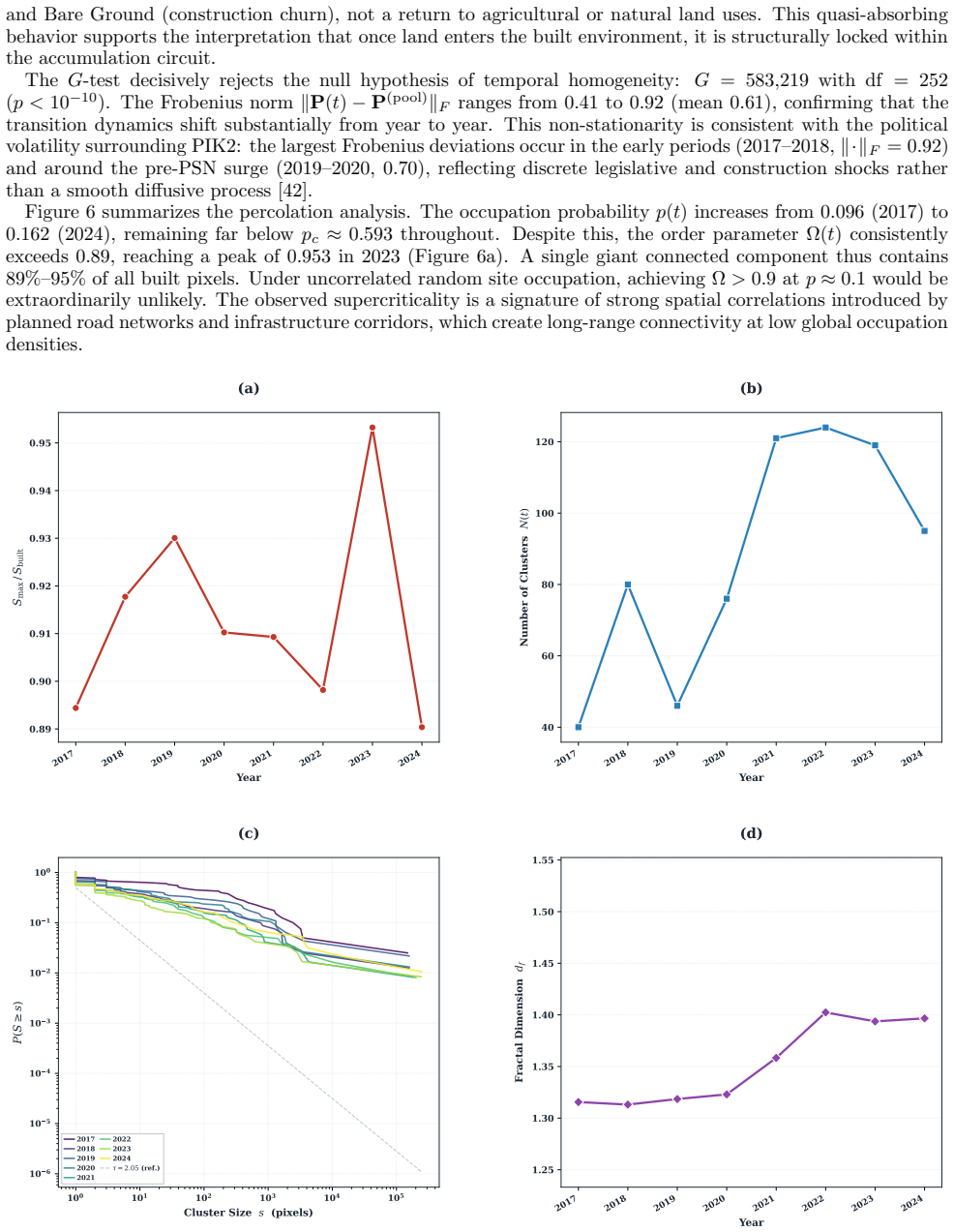
Large-scale land enclosure for speculative mega-development constitutes a non-equilibrium spatial process whose velocity, topology, and irreversibility remain poorly quantified. We study the Pantai Indah Kapuk 2 (PIK2) coastal mega-development north of Jakarta, Indonesia, using eight years (2017--2024) of Sentinel-2 land-use/land-cover (LULC) data at 10-meter resolution. The landscape is projected onto a Marxian probability simplex partitioning terrestrial pixels into Commons, Agrarian, and Capital fractions. Fisher-Rao (FR) geodesic distances on this simplex identify a transformation pulse of $0.405$~rad/yr during 2019--2020, coinciding with major construction activity. Absorbing Markov chain analysis yields expected absorption times into the built environment of $46.0$~years for cropland and $38.1$~years for tree cover, with a pooled built-area self-retention rate of $96.4\%$. Percolation analysis reveals that a giant connected component containing $89$--$95\%$ of all built pixels persists at occupation probabilities $p \in [0.096, 0.162]$, far below the random percolation threshold $p_c \approx 0.593$, indicating planned rather than stochastic spatial growth. The box-counting fractal dimension of the urban boundary increases from $d_f = 1.316$ to $1.397$, consistent with increasingly irregular frontier expansion. These results suggest that information-geometric and statistical-mechanical tools can characterize the kinematic and topological signatures of capitalist spatial accumulation with quantitative precision.
Editorial analysis
A structured set of objections, weighed in public.
Referee Report
Summary. The manuscript claims that projecting eight years of 10m Sentinel-2 LULC data for the PIK2 mega-development onto a Marxian probability simplex (Commons, Agrarian, Capital fractions) allows Fisher-Rao geodesic distances, absorbing Markov chains, percolation analysis, and box-counting fractal dimensions to quantify the kinematic and topological signatures of capitalist spatial accumulation, yielding a 0.405 rad/yr transformation pulse in 2019-2020, absorption times of 46.0 yr (cropland) and 38.1 yr (tree cover), 96.4% built-area retention, sub-critical percolation at p=0.096-0.162, and fractal dimension increase from 1.316 to 1.397.
Significance. If the LULC-to-simplex mapping is shown to be robust, the work supplies a concrete, information-geometric and statistical-mechanical toolkit for measuring non-equilibrium spatial processes such as enclosure, with falsifiable numerical outputs (pulse rate, absorption times, percolation thresholds) that distinguish planned from random growth. This could strengthen empirical socio-physics by linking remote-sensing observables directly to theoretical categories.
major comments (2)
- [Methods (LULC-to-simplex projection)] The central quantitative claims rest on partitioning Sentinel-2 LULC classes into the Commons-Agrarian-Capital simplex, yet the manuscript supplies no explicit assignment rules, confusion-matrix validation against ground-truth tenure data, or sensitivity analysis to alternative mappings. Because FR distances, absorption times, and percolation thresholds are computed directly on this projection, any systematic mismatch between physical cover classes and Marxian ownership relations propagates into the reported 0.405 rad/yr pulse and 38-46 yr absorption times.
- [Results (FR distances, Markov absorption, percolation)] The abstract and results report precise numerical values (0.405 rad/yr, 96.4% retention, percolation at p in [0.096,0.162]) without error bars, bootstrap uncertainties, or robustness checks against data resolution, temporal aggregation, or simplex vertex definitions. This absence makes it impossible to assess whether the claimed distinction from random percolation (p_c≈0.593) is statistically significant.
minor comments (2)
- [Methods] Clarify the precise definition of the probability simplex vertices and any normalization steps applied to the 10 m pixels; this notation is used throughout but not fully specified in the abstract.
- [Data and Methods] Add a brief statement on data availability or code repository so that the reported absorption times and fractal dimensions can be reproduced from the Sentinel-2 time series.
Simulated Author's Rebuttal
We thank the referee for the constructive comments on our manuscript. We address each major point below, indicating where revisions will be incorporated and where limitations prevent full compliance.
read point-by-point responses
-
Referee: [Methods (LULC-to-simplex projection)] The central quantitative claims rest on partitioning Sentinel-2 LULC classes into the Commons-Agrarian-Capital simplex, yet the manuscript supplies no explicit assignment rules, confusion-matrix validation against ground-truth tenure data, or sensitivity analysis to alternative mappings. Because FR distances, absorption times, and percolation thresholds are computed directly on this projection, any systematic mismatch between physical cover classes and Marxian ownership relations propagates into the reported 0.405 rad/yr pulse and 38-46 yr absorption times.
Authors: We agree that the absence of explicit assignment rules reduces reproducibility. The revised manuscript will add a dedicated Methods subsection specifying the exact LULC-to-simplex mapping criteria. A sensitivity analysis to alternative vertex assignments will also be included. High-resolution ground-truth tenure data for confusion-matrix validation is unavailable for PIK2, so this specific validation cannot be performed; the limitation will be stated explicitly. revision: partial
-
Referee: [Results (FR distances, Markov absorption, percolation)] The abstract and results report precise numerical values (0.405 rad/yr, 96.4% retention, percolation at p in [0.096,0.162]) without error bars, bootstrap uncertainties, or robustness checks against data resolution, temporal aggregation, or simplex vertex definitions. This absence makes it impossible to assess whether the claimed distinction from random percolation (p_c≈0.593) is statistically significant.
Authors: We accept that uncertainty estimates and robustness checks are required. The revised version will add bootstrap-derived error bars on the transformation rate, absorption times, retention probability, and percolation thresholds. Robustness tests with respect to spatial resolution, temporal binning, and vertex definitions will be reported to support the statistical significance of the sub-critical percolation result. revision: yes
- Confusion-matrix validation against ground-truth tenure data, as no such dataset exists at 10 m resolution for the study area and period.
Circularity Check
No significant circularity: interpretive partitioning serves as input; downstream metrics are independently computed.
full rationale
The paper maps Sentinel-2 LULC classes onto a Marxian probability simplex as an explicit modeling choice, then applies standard Fisher-Rao distances, absorbing Markov chains, percolation thresholds, and box-counting dimensions to the resulting time series of fractions. These computations are not equivalent to the input mapping by construction; the reported quantities (0.405 rad/yr pulse, 38–46 yr absorption times, sub-critical percolation) are derived outputs rather than re-statements of the partitioning rules. No self-citation chain, fitted-parameter renaming, or ansatz smuggling is present in the derivation. The analysis remains self-contained against the external LULC dataset.
Axiom & Free-Parameter Ledger
axioms (1)
- domain assumption Sentinel-2 LULC classes can be partitioned into Commons, Agrarian, and Capital fractions on a probability simplex that faithfully represents Marxian categories
Lean theorems connected to this paper
-
IndisputableMonolith/Cost/FunctionalEquation.leanwashburn_uniqueness_aczel unclear?
unclearRelation between the paper passage and the cited Recognition theorem.
The landscape is projected onto a Marxian probability simplex partitioning terrestrial pixels into Commons, Agrarian, and Capital fractions. Fisher-Rao (FR) geodesic distances on this simplex identify a transformation pulse of 0.405 rad/yr
-
IndisputableMonolith/Foundation/RealityFromDistinction.leanreality_from_one_distinction unclear?
unclearRelation between the paper passage and the cited Recognition theorem.
Absorbing Markov chain analysis yields expected absorption times into the built environment of 46.0 years for cropland and 38.1 years for tree cover
-
IndisputableMonolith/Foundation/AlexanderDuality.leanalexander_duality_circle_linking unclear?
unclearRelation between the paper passage and the cited Recognition theorem.
Percolation analysis reveals that a giant connected component containing 89–95% of all built pixels persists at occupation probabilities p ∈ [0.096, 0.162], far below the random percolation threshold pc ≈ 0.593
What do these tags mean?
- matches
- The paper's claim is directly supported by a theorem in the formal canon.
- supports
- The theorem supports part of the paper's argument, but the paper may add assumptions or extra steps.
- extends
- The paper goes beyond the formal theorem; the theorem is a base layer rather than the whole result.
- uses
- The paper appears to rely on the theorem as machinery.
- contradicts
- The paper's claim conflicts with a theorem or certificate in the canon.
- unclear
- Pith found a possible connection, but the passage is too broad, indirect, or ambiguous to say the theorem truly supports the claim.
Reference graph
Works this paper leans on
-
[1]
Primitive accumulation, accumulation by dispossession, accumulation by ‘extra-economic’ means.Prog
Glassman, J. Primitive accumulation, accumulation by dispossession, accumulation by ‘extra-economic’ means.Prog. Hum. Geogr.2006,30, 608–625.https://doi.org/10.1177/0309132506070172
-
[2]
Smith, N.Uneven Development: Nature, Capital, and the Production of Space, 3rd ed.; University of Georgia Press: Athens, GA, 2008
work page 2008
- [3]
-
[4]
Marx, K.Capital: A Critique of Political Economy, Volume I; Penguin Classics: London, UK, 1976. Trans- lated by Ben Fowkes. Originally published 1867
work page 1976
-
[5]
De Angelis, M. Marx and primitive accumulation: The continuous character of capital’s ”en- closures”.The Commoner2001,2, N.2.https://thecommoner.org/wp-content/uploads/2019/10/ Marx-and-primitive-accumulation-deAngelis.pdf
work page 2019
-
[6]
Brenner, N.Implosions/Explosions: Towards a Study of Planetary Urbanization; Jovis: Berlin, Germany, 2014
work page 2014
-
[7]
Translated by Agnes 12 Schwarzschild
Luxemburg, R.The Accumulation of Capital; Routledge: London, UK, 2003. Translated by Agnes 12 Schwarzschild. Originally published 1913
work page 2003
-
[8]
Understanding the Allure of Big Infrastructure: Jakarta’s Great Garuda Sea Wall Project
Colven, E. Understanding the Allure of Big Infrastructure: Jakarta’s Great Garuda Sea Wall Project. Water Altern.2017,10, 250–264.https://www.water-alternatives.org/index.php/alldoc/articles/ vol10/v10issue2/354-a10-2-4
work page 2017
-
[9]
Garschagen, M.; Surtiari, G. A. K.; Harb, M. Is Jakarta’s New Flood Risk Reduction Strategy Transforma- tional?Sustainability2018,10, 2934.https://doi.org/10.3390/su10082934
-
[10]
Z.; Andreas, H.; Gumilar, I.; Fukuda, Y.; Pohan, Y
Abidin, H. Z.; Andreas, H.; Gumilar, I.; Fukuda, Y.; Pohan, Y. E.; Deguchi, T. Land subsidence of Jakarta (Indonesia) and its relation with urban development.Nat. Hazards2011,59, 1753–1771.https://doi. org/10.1007/s11069-011-9866-9
-
[11]
Erkens, G.; Bucx, T.; Dam, R.; de Lange, G.; Lambert, J. Sinking coastal cities.Proc. Int. Assoc. Hydrol. Sci.2015,372, 189–198.https://doi.org/10.5194/piahs-372-189-2015
-
[12]
Kementerian Koordinator Bidang Perekonomian Republik Indonesia. Pemerintah Tetap- kan 14 PSN Baru, Hasil Kajian Lengkap untuk Pemerataan Sektor Pembangu- nan dari Infrastruktur hingga Pariwisata, Pendidikan, dan Kesehatan. Siaran Pers HM.4.6/91/SET.M.EKON.3/03/2024, 2024.https://www.ekon.go.id/publikasi/detail/5687/ pemerintah-tetapkan-14-psn-baru-hasil-k...
work page 2024
-
[13]
The Jakarta Post. Prabowo administration halts PIK 2 National Strategic Project status amid land dispute probes.The Jakarta Post, January 2025.https://www.thejakartapost.com/
work page 2025
-
[14]
Amari, S.Information Geometry and Its Applications; Springer: Tokyo, Japan, 2016.https://doi.org/ 10.1007/978-4-431-55978-8
-
[15]
Cover, T. M.; Thomas, J. A.Elements of Information Theory, 2nd ed.; John Wiley & Sons: Hoboken, NJ, 2006.https://doi.org/10.1002/047174882X
-
[16]
On Measures of Entropy and Information.Proc
R´ enyi, A. On Measures of Entropy and Information.Proc. 4th Berkeley Symp. Math. Stat. Probab.1961,1, 547–561. University of California Press
work page 1961
-
[17]
Shannon, C. E. A mathematical theory of communication.Bell Syst. Tech. J.1948,27, 379–423.https: //doi.org/10.1002/j.1538-7305.1948.tb01338.x
-
[18]
Kullback, S.; Leibler, R. A. On information and sufficiency.Ann. Math. Stat.1951,22, 79–86.https: //doi.org/10.1214/aoms/1177729694
-
[19]
Kemeny, J. G.; Snell, J. L.Finite Markov Chains; Springer-Verlag: New York, NY, 1976
work page 1976
-
[20]
R.Markov Chains; Cambridge University Press: Cambridge, UK, 1997.https://doi.org/10
Norris, J. R.Markov Chains; Cambridge University Press: Cambridge, UK, 1997.https://doi.org/10. 1017/CBO9780511810633
work page 1997
-
[21]
https://doi.org/10.1201/9781315274386
Stauffer, D.; Aharony, A.Introduction to Percolation Theory, 2nd ed.; Taylor & Francis: London, UK, 1992. https://doi.org/10.1201/9781315274386
-
[22]
B.The Fractal Geometry of Nature; W
Mandelbrot, B. B.The Fractal Geometry of Nature; W. H. Freeman and Co.: New York, NY, 1982
work page 1982
-
[23]
Witten, T. A.; Sander, L. M. Diffusion-Limited Aggregation, a Kinetic Critical Phenomenon.Phys. Rev. Lett.1981,47, 1400–1403.https://doi.org/10.1103/PhysRevLett.47.1400
-
[24]
Grimmett, G.Percolation, 2nd ed.; Springer: Berlin, Germany, 1999.https://doi.org/10.1007/ 978-3-662-03981-6
work page 1999
-
[25]
Batty, M.Cities and Complexity: Understanding Cities with Cellular Automata, Agent-Based Models, and Fractals; The MIT Press: Cambridge, MA, 2007
work page 2007
-
[26]
Makse, H. A.; Havlin, S.; Stanley, H. E. Modelling urban growth patterns.Nature1995,377, 608–612. https://doi.org/10.1038/377608a0
-
[27]
Overcoming catastrophic forgetting in neural networks
Rozenfeld, H. D.; Rybski, D.; Andrade, J. S.; Batty, M.; Stanley, H. E.; Makse, H. A. Laws of popu- lation growth.Proc. Natl. Acad. Sci. U.S.A.2008,105, 18702–18707.https://doi.org/10.1073/pnas. 0807435105
-
[28]
Sokal, R. R.; Rohlf, F. J.Biometry: The Principles and Practice of Statistics in Biological Research, 4th ed.; W. H. Freeman and Co.: New York, NY, 2012
work page 2012
-
[29]
A Full-Parameters Microwave Properties Measurement System of 20m Diameter Anechoic Chamber,
Karra, K.; Kontgis, C.; Statman-Weil, Z.; Mazzariello, J. C.; Mathis, M.; Brumby, S. P. Global land use/land cover with Sentinel-2 and deep learning.IEEE Int. Geosci. Remote Sens. Symp. IGARSS2021, 4704–4707. https://doi.org/10.1109/IGARSS47720.2021.9553499
-
[30]
Farr, T. G.; Rosen, P. A.; Caro, E.; Crippen, R.; Duren, R.; Hensley, S.; Kobrick, M.; Paller, M.; Rodriguez, E.; Roth, L.; Seal, D.; Shaffer, S.; Shimada, J.; Umland, J.; Werner, M.; Oskin, M.; Burbank, D.; Alsdorf, D. The Shuttle Radar Topography Mission.Rev. Geophys.2007,45, RG2004.https://doi.org/10.1029/ 2005RG000183
work page 2007
-
[31]
Lambin, E. F.; Turner, B. L.; Geist, H. J.; Agbola, S. B.; Angelsen, A.; Bruce, J. W.; Coomes, O. T.; Dirzo, R.; Fischer, G.; Folke, C.; George, P. S.; Homewood, K.; Imbernon, J.; Leemans, R.; Li, X.; Moran, E. F.; Mortimore, M.; Ramakrishnan, P. S.; Richards, J. F.; Sk˚ anes, H.; Steffen, W.; Stone, G. D.; Svedin, U.; Veldkamp, T. A.; Vogel, C.; Xu, J. T...
-
[32]
Cressie, N. A. C.Statistics for Spatial Data; John Wiley & Sons: New York, NY, 1993.https://doi.org/ 10.1002/9781119115151
-
[33]
Harris, C. R. et al. Array programming with NumPy.Nature2020,585, 357–362.https://doi.org/10. 1038/s41586-020-2649-2
-
[34]
Hunter, J. D. Matplotlib: A 2D Graphics Environment.Comput. Sci. Eng.2007,9, 90–95.https://doi. 13 org/10.1109/MCSE.2007.55
-
[35]
Virtanen, P. et al. SciPy 1.0: fundamental algorithms for scientific computing in Python.Nat. Methods 2020,17, 261–272.https://doi.org/10.1038/s41592-019-0686-2
-
[36]
Rew, R.; Davis, G. NetCDF: an interface for scientific data access.IEEE Comput. Graph. Appl.1990,10, 76–82.https://doi.org/10.1109/38.56302
-
[37]
Gillies, S. et al.Rasterio: geospatial raster I/O for Python programmers; 2013.https://github.com/ rasterio/rasterio
work page 2013
-
[38]
PROJ contributors.PROJ coordinate transformation software library; Open Source Geospatial Foundation, 2021.https://proj.org/
work page 2021
-
[39]
F.; Uieda, L.; Scharroo, R.; Wobbe, F.; Smith, W
Wessel, P.; Luis, J. F.; Uieda, L.; Scharroo, R.; Wobbe, F.; Smith, W. H. F.; Tian, D. The Generic Mapping Tools Version 6.Geochem. Geophys. Geosyst.2019,20, 5556–5564.https://doi.org/10.1029/ 2019GC008515
work page 2019
-
[40]
Fauziah, N.; William, M. N.; Dhiyaulhaq, M. N. S. From Green to Growth: A Critical Assessment of Legal Frameworks and Environmental Consequences in the PIK 2 Project, Tangerang.Int. J. Law Polit. Stud. 2025,7, 24–31.https://doi.org/10.32996/ijlps.2025.7.2.2
-
[41]
Public Policy Analysis of the Development of Pantai Indah Kapuk 2 (PIK 2).Neo J
Latifah, E.; Handoko, P.; Nugroho, A.; Yudistira, Y. Public Policy Analysis of the Development of Pantai Indah Kapuk 2 (PIK 2).Neo J. Econ. Soc. Humanit.2024,3, 236–244.https://doi.org/10.56403/ nejesh.v3i3.226
work page 2024
-
[42]
Alfiana, R.; Dahyono. The Legal Impact of Agrarian Conflicts in The PIK2 National Strategic Project on Local Community Rights.Int. J. Sci. Environ.2026,6, 379–384.https://doi.org/10.51601/ijse.v6i1. 347 14
discussion (0)
Sign in with ORCID, Apple, or X to comment. Anyone can read and Pith papers without signing in.