Recognition: 2 theorem links
· Lean TheoremThe gravitational S-matrix from the path integral: asymptotic symmetries and soft theorems
Pith reviewed 2026-05-15 09:25 UTC · model grok-4.3
The pith
The gravitational path integral with asymptotic boundaries yields BMS Ward identities that enforce the soft graviton theorems.
A machine-rendered reading of the paper's core claim, the machinery that carries it, and where it could break.
Core claim
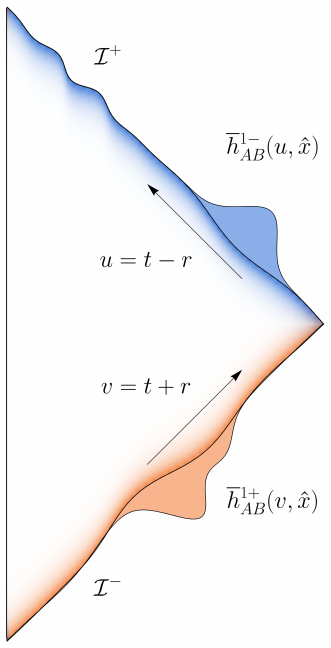
The path integral with asymptotic boundary conditions defines a Carrollian boundary partition function whose invariance under extended BMS transformations implies Ward identities for the associated boundary correlators; these identities are simply related to S-matrix elements and thereby derive the leading and subleading soft graviton theorems from BMS symmetry.
What carries the argument
The Carrollian boundary partition function, defined by the gravitational path integral with asymptotic boundary conditions, whose invariance under extended BMS transformations generates the Ward identities relating boundary correlators to S-matrix elements.
If this is right
- The leading soft graviton theorem follows directly as a consequence of BMS symmetry through the Ward identities.
- The subleading soft graviton theorem likewise follows from the same BMS invariance.
- Explicit computations of selected terms in the partition function confirm that they satisfy the derived Ward identities.
- The subleading theorem is fixed once the leading theorem and Poincaré Ward identities are imposed.
Where Pith is reading between the lines
- The same boundary-partition-function construction could be applied to loop-level corrections if the asymptotic boundary conditions are suitably extended.
- Analogous Ward-identity derivations might connect asymptotic symmetries to soft theorems in other theories that admit Carrollian boundary descriptions.
- The direct link between boundary correlators and S-matrix elements suggests a possible route to organize flat-space scattering data without reference to bulk diagrams.
Load-bearing premise
The derivation holds provided subtleties associated with poles in the superrotations and corner terms can be handled in the usual way.
What would settle it
An explicit diagrammatic computation of a partition-function term whose associated correlator violates one of the BMS Ward identities would falsify the central claim.
Figures
read the original abstract
We extend a previously developed formulation of the S-matrix, based on a path integral with asymptotic boundary conditions, to include gravity. The path integral defines a Carrollian boundary partition function whose invariance under asymptotic symmetries implies Ward identities obeyed by the associated boundary correlators, which are simply related to standard S-matrix elements. We develop this in the context of extended BMS transformations at tree level. Modulo well-known subtleties associated with poles in the superrotations and corner terms, this leads to an efficient derivation of the leading and subleading soft graviton theorems from BMS symmetry. Our general arguments are verified by explicit diagrammatic computation of specific terms in the partition function, which are shown to satisfy the Ward identities. We also show how, in our context, the subleading soft theorem is fixed by Poincar\'e Ward identities together with the leading soft theorem.
Editorial analysis
A structured set of objections, weighed in public.
Referee Report
Summary. The paper extends a path-integral formulation of the S-matrix to gravity via asymptotic boundary conditions, defining a Carrollian boundary partition function. Invariance under extended BMS transformations implies Ward identities for boundary correlators related to S-matrix elements. This framework derives the leading and subleading soft graviton theorems at tree level (modulo subtleties with superrotation poles and corner terms), verified by explicit diagrammatic computations of partition-function terms. The subleading theorem is additionally shown to follow from Poincaré Ward identities combined with the leading soft theorem.
Significance. If the acknowledged subtleties are handled rigorously, the work supplies an efficient path-integral derivation of soft theorems directly from BMS symmetry, extending prior S-matrix formulations. The explicit diagrammatic verifications and the reduction of the subleading case to Poincaré plus leading provide concrete support and structural insight, strengthening connections between asymptotic symmetries and gravitational scattering.
major comments (2)
- [Main derivation of Ward identities] The central step from path-integral invariance under extended BMS transformations to the Ward identities for boundary correlators (detailed in the main derivation) requires more explicit equations showing how the Carrollian partition function maps to the precise form of the identities used for the soft theorems, including the relation to standard S-matrix elements.
- [Abstract and soft theorems section] Abstract and the section discussing the soft theorems: the derivation is qualified as holding 'modulo well-known subtleties associated with poles in the superrotations and corner terms'. Since these subtleties are load-bearing for the Ward identities and the central claim, a dedicated clarification of their treatment within the path-integral setup is needed.
minor comments (2)
- Ensure consistent numbering and cross-referencing of all equations, especially those defining the boundary correlators and soft factors.
- [Diagrammatic verification section] The diagrammatic figures in the verification section would benefit from explicit labels connecting diagram elements to the corresponding terms in the Ward identities.
Simulated Author's Rebuttal
We thank the referee for the positive assessment and constructive comments. We address each major comment below and will make the requested clarifications in a revised version of the manuscript.
read point-by-point responses
-
Referee: [Main derivation of Ward identities] The central step from path-integral invariance under extended BMS transformations to the Ward identities for boundary correlators (detailed in the main derivation) requires more explicit equations showing how the Carrollian partition function maps to the precise form of the identities used for the soft theorems, including the relation to standard S-matrix elements.
Authors: We agree that expanding the central derivation with additional explicit equations will improve readability. In the revised manuscript we will insert a new subsection (or expanded paragraphs in the existing derivation) that step-by-step shows: (i) the variation of the Carrollian boundary partition function under an extended BMS transformation, (ii) the resulting Ward identity for the boundary correlators, and (iii) the direct dictionary that identifies these correlators with standard S-matrix elements. This will make the mapping fully explicit without altering the underlying logic. revision: yes
-
Referee: [Abstract and soft theorems section] Abstract and the section discussing the soft theorems: the derivation is qualified as holding 'modulo well-known subtleties associated with poles in the superrotations and corner terms'. Since these subtleties are load-bearing for the Ward identities and the central claim, a dedicated clarification of their treatment within the path-integral setup is needed.
Authors: We acknowledge that the parenthetical qualification in the abstract and soft-theorems section requires a more self-contained discussion. In the revision we will add a dedicated paragraph (or short subsection) that explicitly states how the path-integral formulation handles the superrotation poles and corner terms: we will recall the standard regularization used in the literature, note that the same regularization is inherited by the Carrollian partition function, and clarify that the Ward identities remain valid once these terms are subtracted in the usual way. This will remove any ambiguity while preserving the tree-level scope of the derivation. revision: yes
Circularity Check
Derivation chain is self-contained with no circular reductions
full rationale
The paper extends a prior path-integral formulation of the S-matrix to gravity and shows that BMS invariance of the Carrollian boundary partition function implies Ward identities for boundary correlators tied to S-matrix elements. This yields the leading soft graviton theorem directly from BMS symmetry at tree level. The subleading theorem is then shown to follow from Poincaré Ward identities together with the already-derived leading theorem. No equation or step reduces the target soft theorems to their inputs by construction, no parameter is fitted and relabeled as a prediction, and no load-bearing uniqueness theorem is imported solely via self-citation. The central BMS-to-Ward-identity mapping is independent of the soft theorems themselves, and the manuscript explicitly flags the standard subtleties rather than smuggling assumptions. The derivation is therefore self-contained against external benchmarks.
Axiom & Free-Parameter Ledger
axioms (2)
- domain assumption A path integral with asymptotic boundary conditions defines the S-matrix
- domain assumption Invariance under extended BMS transformations implies Ward identities for the boundary correlators
Lean theorems connected to this paper
-
IndisputableMonolith/Foundation/RealityFromDistinction.leanreality_from_one_distinction unclear?
unclearRelation between the paper passage and the cited Recognition theorem.
The path integral defines a Carrollian boundary partition function whose invariance under asymptotic symmetries implies Ward identities obeyed by the associated boundary correlators, which are simply related to standard S-matrix elements.
-
IndisputableMonolith/Cost/FunctionalEquation.leanwashburn_uniqueness_aczel unclear?
unclearRelation between the paper passage and the cited Recognition theorem.
Modulo well-known subtleties associated with poles in the superrotations and corner terms, this leads to an efficient derivation of the leading and subleading soft graviton theorems from BMS symmetry.
What do these tags mean?
- matches
- The paper's claim is directly supported by a theorem in the formal canon.
- supports
- The theorem supports part of the paper's argument, but the paper may add assumptions or extra steps.
- extends
- The paper goes beyond the formal theorem; the theorem is a base layer rather than the whole result.
- uses
- The paper appears to rely on the theorem as machinery.
- contradicts
- The paper's claim conflicts with a theorem or certificate in the canon.
- unclear
- Pith found a possible connection, but the passage is too broad, indirect, or ambiguous to say the theorem truly supports the claim.
Forward citations
Cited by 2 Pith papers
-
On Carrollian Loop Amplitudes for Gauge Theory and Gravity
Loop-level Carrollian amplitudes in N=4 SYM and N=8 supergravity are differential operators on tree-level versions, with logarithmic eikonal behavior and IR-safe factorization via natural splitting.
-
On Carrollian Loop Amplitudes for Gauge Theory and Gravity
Loop-level Carrollian amplitudes in gauge theory and gravity preserve tree-level structures, show logarithmic dependence in the eikonal regime, and factorize to yield an IR-safe definition.
Reference graph
Works this paper leans on
-
[1]
S. S. Gubser, I. R. Klebanov, and A. M. Polyakov,Gauge theory correlators from noncritical string theory,Phys. Lett. B 428 (1998) 105–114,arXiv:hep-th/9802109
work page internal anchor Pith review Pith/arXiv arXiv 1998
-
[2]
Anti De Sitter Space And Holography
E. Witten,Anti-de Sitter space and holography,Adv. Theor. Math. Phys. 2 (1998) 253– 291,arXiv:hep-th/9802150
work page internal anchor Pith review Pith/arXiv arXiv 1998
-
[3]
I. Y. Arefeva, L. D. Faddeev, and A. A. Slavnov,Generating Functional for the s Matrix in Gauge Theories,Teor. Mat. Fiz. 21 (1974) 311–321. [4]Methods in Field Theory. Les Houches Summer School in Theoretical Physics. Session 28, July 28-September 6, 1975, . 1976
work page 1974
-
[4]
A. Jevicki and C.-k. Lee,The S Matrix Generating Functional and Effective Action, Phys. Rev. D 37 (1988) 1485
work page 1988
- [5]
-
[6]
P. Kraus and R. M. Myers,Carrollian Partition Functions and the Flat Limit of AdS, arXiv:2407.13668 [hep-th]
-
[7]
P. Kraus and R. M. Myers,Carrollian partition function for bulk Yang-Mills theory, JHEP 08 (2025) 180,arXiv:2503.00916 [hep-th]
- [8]
- [9]
-
[10]
Carroll versus Newton and Galilei: two dual non-Einsteinian concepts of time
C. Duval, G. W. Gibbons, P. A. Horvathy, and P. M. Zhang,Carroll versus Newton and Galilei: two dual non-Einsteinian concepts of time,Class. Quant. Grav. 31 (2014) 085016,arXiv:1402.0657 [gr-qc]. 60
work page internal anchor Pith review Pith/arXiv arXiv 2014
-
[11]
Conformal Carroll groups and BMS symmetry
C. Duval, G. W. Gibbons, and P. A. Horvathy,Conformal Carroll groups and BMS symmetry,Class. Quant. Grav. 31 (2014) 092001,arXiv:1402.5894 [gr-qc]
work page internal anchor Pith review Pith/arXiv arXiv 2014
-
[12]
Gauging the Carroll Algebra and Ultra-Relativistic Gravity
J. Hartong,Gauging the Carroll Algebra and Ultra-Relativistic Gravity,JHEP 08 (2015) 069,arXiv:1505.05011 [hep-th]
work page internal anchor Pith review Pith/arXiv arXiv 2015
-
[13]
Holographic Reconstruction of 3D Flat Space-Time
J. Hartong,Holographic Reconstruction of 3D Flat Space-Time,JHEP 10 (2016) 104, arXiv:1511.01387 [hep-th]
work page internal anchor Pith review Pith/arXiv arXiv 2016
-
[14]
Flat Holography: Aspects of the dual field theory
A. Bagchi, R. Basu, A. Kakkar, and A. Mehra,Flat Holography: Aspects of the dual field theory,JHEP 12 (2016) 147,arXiv:1609.06203 [hep-th]
work page internal anchor Pith review Pith/arXiv arXiv 2016
-
[15]
Flat holography and Carrollian fluids
L. Ciambelli, C. Marteau, A. C. Petkou, P. M. Petropoulos, and K. Siampos,Flat holography and Carrollian fluids,JHEP 07 (2018) 165,arXiv:1802.06809 [hep-th]
work page internal anchor Pith review Pith/arXiv arXiv 2018
-
[16]
L. Ciambelli, R. G. Leigh, C. Marteau, and P. M. Petropoulos,Carroll Structures, Null Geometry and Conformal Isometries,Phys. Rev. D 100 no. 4, (2019) 046010, arXiv:1905.02221 [hep-th]
- [17]
- [18]
- [19]
- [20]
- [21]
-
[22]
K. Nguyen and P. West,Carrollian Conformal Fields and Flat Holography,Universe 9 no. 9, (2023) 385,arXiv:2305.02884 [hep-th]
-
[23]
J. de Boer, J. Hartong, N. A. Obers, W. Sybesma, and S. Vandoren,Carroll stories, JHEP 09 (2023) 148,arXiv:2307.06827 [hep-th]
- [24]
- [25]
- [26]
-
[27]
Ciambelli,Asymptotic limit of null hypersurfaces,Class
L. Ciambelli,Asymptotic limit of null hypersurfaces,Class. Quant. Grav. 42 no. 23, (2025) 235020,arXiv:2501.17357 [hep-th]
-
[28]
Operator Product Expansion in Carrollian CFT
K. Nguyen and J. Salzer,Operator product expansion in Carrollian CFT,JHEP 07 (2025) 193,arXiv:2503.15607 [hep-th]
work page internal anchor Pith review Pith/arXiv arXiv 2025
-
[29]
G. Poulias and S. Vandoren,On Carroll partition functions and flat space holography, JHEP 06 (2025) 232,arXiv:2503.20615 [hep-th]
-
[30]
I. Surubaru and B. Zhu,Carrollian amplitudes and holographic correlators in AdS3/CFT2,Phys. Rev. D 112 no. 2, (2025) 026023,arXiv:2504.07650 [hep-th]
-
[31]
A. Lipstein, R. Ruzziconi, and A. Yelleshpur Srikant,Towards a flat space Carrollian hologram from AdS4/CFT3,JHEP 06 (2025) 073,arXiv:2504.10291 [hep-th]
-
[32]
S. Agrawal and K. Nguyen,Soft theorems and spontaneous symmetry breaking,Phys. Rev. D 112 no. 2, (2025) L021903,arXiv:2504.10577 [hep-th]
-
[33]
A. Fiorucci, S. Pekar, P. Marios Petropoulos, and M. Vilatte,Carrollian-Holographic Derivation of Gravitational Flux-Balance Laws,Phys. Rev. Lett. 135 no. 26, (2025) 261602,arXiv:2505.00077 [hep-th]
- [34]
-
[35]
A. Bagchi, A. Banerjee, P. Dhivakar, S. Mondal, and A. Shukla,The Carrollian Kaleidoscope,arXiv:2506.16164 [hep-th]
work page internal anchor Pith review Pith/arXiv arXiv
-
[36]
L. Ciambelli and P. Jai-akson,Foundations of Carrollian Geometry, arXiv:2510.21651 [hep-th]
-
[37]
Nguyen,Lectures on Carrollian Holography,arXiv:2511.10162 [hep-th]
K. Nguyen,Lectures on Carrollian Holography,arXiv:2511.10162 [hep-th]
-
[38]
Ruzziconi,Carrollian Physics and Holography,arXiv:2602.02644 [hep-th]
R. Ruzziconi,Carrollian Physics and Holography,arXiv:2602.02644 [hep-th]
-
[39]
Lectures on the Infrared Structure of Gravity and Gauge Theory
A. Strominger,Lectures on the Infrared Structure of Gravity and Gauge Theory, arXiv:1703.05448 [hep-th]. 62
work page internal anchor Pith review Pith/arXiv arXiv
-
[40]
Raclariu,Lectures on Celestial Holography,arXiv:2107.02075 [hep-th]
A.-M. Raclariu,Lectures on Celestial Holography,arXiv:2107.02075 [hep-th]
-
[41]
Pasterski,Lectures on celestial amplitudes,Eur
S. Pasterski,Lectures on celestial amplitudes,Eur. Phys. J. C 81 no. 12, (2021) 1062, arXiv:2108.04801 [hep-th]
-
[42]
S. Pasterski, M. Pate, and A.-M. Raclariu,Celestial Holography, inSnowmass 2021. 11, 2021.arXiv:2111.11392 [hep-th]
-
[43]
T. McLoughlin, A. Puhm, and A.-M. Raclariu,The SAGEX review on scattering amplitudes chapter 11: soft theorems and celestial amplitudes,J. Phys. A 55 no. 44, (2022) 443012,arXiv:2203.13022 [hep-th]
-
[44]
Donnay,Celestial holography: An asymptotic symmetry perspective,Phys
L. Donnay,Celestial holography: An asymptotic symmetry perspective,Phys. Rept. 1073 (2024) 1–41,arXiv:2310.12922 [hep-th]
- [45]
-
[46]
K. Costello and N. M. Paquette,Celestial holography meets twisted holography: 4d amplitudes from chiral correlators,JHEP 10 (2022) 193,arXiv:2201.02595 [hep-th]
-
[47]
K. Costello, N. M. Paquette, and A. Sharma,Top-Down Holography in an Asymptot- ically Flat Spacetime,Phys. Rev. Lett. 130 no. 6, (2023) 061602,arXiv:2208.14233 [hep-th]
-
[48]
K. Costello, N. M. Paquette, and A. Sharma,Burns space and holography,JHEP 10 (2023) 174,arXiv:2306.00940 [hep-th]
- [49]
-
[50]
Sachs,Asymptotic symmetries in gravitational theory,Phys
R. Sachs,Asymptotic symmetries in gravitational theory,Phys. Rev. 128 (1962) 2851– 2864
work page 1962
-
[51]
Symmetries of asymptotically flat 4 dimensional spacetimes at null infinity revisited
G. Barnich and C. Troessaert,Symmetries of asymptotically flat 4 dimensional space- times at null infinity revisited,Phys. Rev. Lett. 105 (2010) 111103,arXiv:0909.2617 [gr-qc]
work page internal anchor Pith review Pith/arXiv arXiv 2010
-
[52]
Weinberg,Infrared photons and gravitons,Phys
S. Weinberg,Infrared photons and gravitons,Phys. Rev. 140 (1965) B516–B524
work page 1965
-
[53]
Evidence for a New Soft Graviton Theorem
F. Cachazo and A. Strominger,Evidence for a New Soft Graviton Theorem, arXiv:1404.4091 [hep-th]. 63
work page internal anchor Pith review Pith/arXiv arXiv
-
[54]
T. He, V. Lysov, P. Mitra, and A. Strominger,BMS supertranslations and Weinberg’s soft graviton theorem,JHEP 05 (2015) 151,arXiv:1401.7026 [hep-th]
work page internal anchor Pith review Pith/arXiv arXiv 2015
-
[55]
Aspects of the BMS/CFT correspondence
G. Barnich and C. Troessaert,Aspects of the BMS/CFT correspondence,JHEP 05 (2010) 062,arXiv:1001.1541 [hep-th]
work page internal anchor Pith review Pith/arXiv arXiv 2010
-
[56]
Supertranslations call for superrotations
G. Barnich and C. Troessaert,Supertranslations call for superrotations,PoS CNCFG2010 (2010) 010,arXiv:1102.4632 [gr-qc]
work page internal anchor Pith review Pith/arXiv arXiv 2010
-
[57]
G. Barnich and C. Troessaert,BMS charge algebra,JHEP 12 (2011) 105, arXiv:1106.0213 [hep-th]
work page internal anchor Pith review Pith/arXiv arXiv 2011
-
[58]
On BMS Invariance of Gravitational Scattering
A. Strominger,On BMS Invariance of Gravitational Scattering,JHEP 07 (2014) 152, arXiv:1312.2229 [hep-th]
work page internal anchor Pith review Pith/arXiv arXiv 2014
-
[59]
Semiclassical Virasoro Symmetry of the Quantum Gravity S-Matrix
D. Kapec, V. Lysov, S. Pasterski, and A. Strominger,Semiclassical Virasoro symmetry of the quantum gravityS-matrix,JHEP 08 (2014) 058,arXiv:1406.3312 [hep-th]
work page internal anchor Pith review Pith/arXiv arXiv 2014
-
[60]
Asymptotic symmetries and subleading soft graviton theorem
M. Campiglia and A. Laddha,Asymptotic symmetries and subleading soft graviton theorem,Phys. Rev. D 90 no. 12, (2014) 124028,arXiv:1408.2228 [hep-th]
work page internal anchor Pith review Pith/arXiv arXiv 2014
-
[61]
New symmetries for the Gravitational S-matrix
M. Campiglia and A. Laddha,New symmetries for the Gravitational S-matrix,JHEP 04 (2015) 076,arXiv:1502.02318 [hep-th]
work page internal anchor Pith review Pith/arXiv arXiv 2015
-
[62]
Asymptotic symmetries of gravity and soft theorems for massive particles
M. Campiglia and A. Laddha,Asymptotic symmetries of gravity and soft theorems for massive particles,JHEP 12 (2015) 094,arXiv:1509.01406 [hep-th]
work page internal anchor Pith review Pith/arXiv arXiv 2015
-
[63]
J. Distler, R. Flauger, and B. Horn,Double-soft graviton amplitudes and the extended BMS charge algebra,JHEP 08 (2019) 021,arXiv:1808.09965 [hep-th]
-
[64]
M. Campiglia and A. Laddha,Loop Corrected Soft Photon Theorem as a Ward Identity, JHEP 10 (2019) 287,arXiv:1903.09133 [hep-th]
-
[65]
M. Campiglia and J. Peraza,Generalized BMS charge algebra,Phys. Rev. D 101 no. 10, (2020) 104039,arXiv:2002.06691 [gr-qc]
-
[66]
M. Campiglia and A. Laddha,BMS Algebra, Double Soft Theorems, and All That, arXiv:2106.14717 [hep-th]
- [67]
-
[68]
S. Agrawal, L. Donnay, K. Nguyen, and R. Ruzziconi,Logarithmic soft graviton theorems from superrotation Ward identities,JHEP 02 (2024) 120,arXiv:2309.11220 [hep-th]
- [69]
-
[70]
M. Campiglia and A. Sudhakar,Gravitational Poisson brackets at null infinity compatible with smooth superrotations,JHEP 12 (2024) 170,arXiv:2408.13067 [gr-qc]
- [71]
-
[72]
Z. Bern, S. Davies, and J. Nohle,On Loop Corrections to Subleading Soft Behavior of Gluons and Gravitons,Phys. Rev. D 90 no. 8, (2014) 085015,arXiv:1405.1015 [hep-th]
work page internal anchor Pith review Pith/arXiv arXiv 2014
-
[73]
B. Sahoo and A. Sen,Classical and Quantum Results on Logarithmic Terms in the Soft Theorem in Four Dimensions,JHEP 02 (2019) 086,arXiv:1808.03288 [hep-th]
- [74]
-
[75]
L. Baulieu, L. Ciambelli, and T. Wetzstein,Extended-BMS Anomalies and Flat Space Holography,arXiv:2504.10304 [hep-th]
-
[76]
Atul Bhatkar,Asymptotic conservation law with Feynman boundary condition,Phys
S. Atul Bhatkar,Asymptotic conservation law with Feynman boundary condition,Phys. Rev. D 103 no. 12, (2021) 125026,arXiv:2101.09734 [hep-th]
-
[77]
M. Brice˜ no, H. A. Gonz´ alez, M. Henneaux, and A. P´ erez,Matching conditions at null infinity in the presence of logarithms: the role of advanced and retarded radiation, JHEP 02 (2026) 103,arXiv:2510.21072 [hep-th]
-
[78]
Holography in the Flat Space Limit
L. Susskind,Holography in the flat space limit,AIP Conf. Proc. 493 no. 1, (1999) 98–112, arXiv:hep-th/9901079
work page internal anchor Pith review Pith/arXiv arXiv 1999
-
[79]
J. Polchinski,S matrices from AdS space-time,arXiv:hep-th/9901076
work page internal anchor Pith review Pith/arXiv arXiv
-
[80]
S. B. Giddings,Flat space scattering and bulk locality in the AdS / CFT correspondence, Phys. Rev. D 61 (2000) 106008,arXiv:hep-th/9907129. 65
work page internal anchor Pith review Pith/arXiv arXiv 2000
discussion (0)
Sign in with ORCID, Apple, or X to comment. Anyone can read and Pith papers without signing in.