Recognition: 2 theorem links
· Lean TheoremGamma-Ray Bursts as an Independent High-Redshift Probe of Dark Energy
Pith reviewed 2026-05-15 08:33 UTC · model grok-4.3
The pith
Gamma-ray bursts with plateau phases can constrain the dark energy equation of state to a precision comparable to Planck using samples of around 66 events.
A machine-rendered reading of the paper's core claim, the machinery that carries it, and where it could break.
Core claim
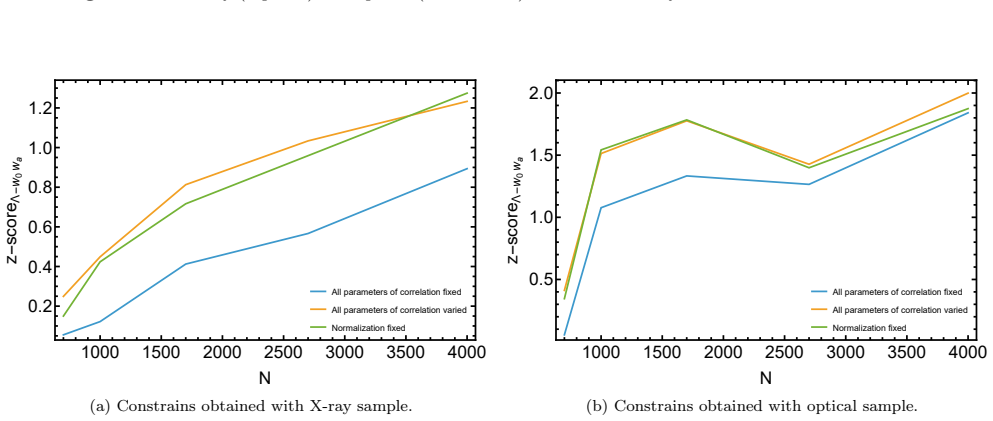
Our results show that GRB samples containing several tens to hundreds of well-characterized plateau can already approach the precision currently achieved by CMB measurements on the Dark Energy equation-of-state parameter w. Particularly, a sample of ∼66 optical GRBs can reach a precision σ_w ≈ 0.47, comparable to that obtained from Planck within the wCDM framework. Using simulated GRB samples from the observed population and the two-dimensional Dainotti relations, these forecasts indicate that GRBs will serve as an independent high-redshift probe to test deviations from ΛCDM.
What carries the argument
The two-dimensional Dainotti relations between the luminosity at the end of the plateau phase and its rest-frame duration in X-ray and optical observations.
Load-bearing premise
The two-dimensional Dainotti relations remain valid and unbiased when extrapolated to high redshifts up to z=9.2 without significant selection effects or evolution in the GRB population.
What would settle it
Observing a sample of high-redshift GRBs where the measured plateau luminosity-duration correlation deviates from the low-redshift calibration by more than the expected scatter would falsify the forecasted precision.
Figures




read the original abstract
Testing the $\Lambda$CDM model requires cosmological probes spanning the wide redshift interval between Type Ia Supernovae (SNe Ia, $z\lesssim2.9$) and the Cosmic Microwave Background (CMB, $z\approx1100$). Gamma-Ray Bursts (GRBs), observed up to redshift $z=9.2$, offer the opportunity to explore this regime. Here, we investigate how many GRBs are needed to become a useful cosmological probe capable of independently testing deviations from $\Lambda$CDM suggested by the recent DESI BAO observations. We develop forecasts based on the two-dimensional X-ray and optical Dainotti relations, between the luminosity at the end of the plateau phase and its rest-frame duration. Using simulated GRB samples constructed from the observed population, we evaluate the constraining power of GRBs on cosmological parameters within the $w$CDM and $w_0w_a$CDM models, both independently and in combination with CMB observations. Our results show that GRB samples containing several tens to hundreds of well-characterized plateau can already approach the precision currently achieved by CMB measurements on the Dark Energy (DE) equation-of-state parameter $w$. Particularly, a sample of $\sim66$ optical GRBs can reach a precision $\sigma_w \approx 0.47$, comparable to that obtained from Planck within the $w$CDM framework. Such sample sizes are already attainable through Machine Learning techniques that double the number of GRBs using inferred redshifts. These forecasts indicate that future GRB observations, when combined with next-generation transient missions and improved statistical techniques, will provide an independent high-redshift probe of cosmic expansion and will play an important role in testing the robustness of potential Dynamical DE signals suggested by other cosmological datasets.
Editorial analysis
A structured set of objections, weighed in public.
Referee Report
Summary. The paper develops forecasts for the constraining power of Gamma-Ray Bursts (GRBs) on dark energy parameters using simulated samples constructed from the observed population via the two-dimensional X-ray and optical Dainotti relations (luminosity at end of plateau vs. rest-frame duration). It claims that samples of several tens to hundreds of well-characterized GRBs can approach CMB-level precision on w, with a specific result that ~66 optical GRBs yield σ_w ≈ 0.47 in wCDM, comparable to Planck, and that such samples are already attainable via machine learning redshift inference; the forecasts are performed both standalone and in combination with CMB data in wCDM and w0waCDM models.
Significance. If the central forecasts hold, the work would establish GRBs as a viable independent high-redshift (up to z=9.2) cosmological probe capable of testing potential dynamical dark energy signals suggested by DESI BAO, bridging the gap between SNe Ia and CMB. The use of forward simulations from the observed GRB population (rather than fitting to target cosmological data) and the explicit sample-size thresholds provide concrete, falsifiable targets for future observations and machine-learning redshift techniques.
major comments (3)
- [Methods (simulation procedure)] The simulation procedure (described in the methods section on sample construction) assumes the 2D Dainotti relations fitted on the mostly low-z observed sample remain unbiased and unevolving when extrapolated to z up to 9.2; this assumption is load-bearing for the quoted σ_w ≈ 0.47 because any redshift-dependent change in slope, normalization, or scatter directly scales the simulated error budgets and Fisher-matrix constraints.
- [Results (Fisher forecasts)] The handling of selection effects and Malmquist bias in the simulated high-z catalogs is not validated with redshift-split tests or explicit evolution corrections; without these, the claimed precision for a sample of ~66 optical GRBs may be optimistic and the comparison to Planck wCDM results cannot be taken at face value.
- [§4 (cosmological parameter estimation)] The error propagation from the Dainotti relation parameters into the cosmological likelihood does not include marginalization over possible redshift evolution of the relation coefficients; this omission affects the standalone GRB constraints and their combination with CMB data.
minor comments (2)
- [Abstract] The abstract and introduction use 'several tens to hundreds' without a precise table linking sample size to σ_w; adding such a summary table would improve clarity.
- [Introduction] Notation for the plateau luminosity and duration in the Dainotti relations is introduced without an explicit equation reference in the first use; a numbered equation would aid readers.
Simulated Author's Rebuttal
We thank the referee for their thorough review and valuable comments on our manuscript. We have carefully considered each point and provide point-by-point responses below. Where appropriate, we have revised the manuscript to address the concerns raised.
read point-by-point responses
-
Referee: [Methods (simulation procedure)] The simulation procedure (described in the methods section on sample construction) assumes the 2D Dainotti relations fitted on the mostly low-z observed sample remain unbiased and unevolving when extrapolated to z up to 9.2; this assumption is load-bearing for the quoted σ_w ≈ 0.47 because any redshift-dependent change in slope, normalization, or scatter directly scales the simulated error budgets and Fisher-matrix constraints.
Authors: We agree that the extrapolation of the Dainotti relations to high redshifts is a key assumption in our forecasts. The relations were calibrated using the available observed sample, which spans a range of redshifts up to z~9, though predominantly lower z. In the revised manuscript, we have expanded the methods section to explicitly discuss this assumption, including references to studies that have tested for redshift evolution in GRB relations and found no significant evidence within current uncertainties. We also added a sensitivity analysis showing how moderate evolution would impact the forecasted constraints, thereby quantifying the robustness of our results. revision: partial
-
Referee: [Results (Fisher forecasts)] The handling of selection effects and Malmquist bias in the simulated high-z catalogs is not validated with redshift-split tests or explicit evolution corrections; without these, the claimed precision for a sample of ~66 optical GRBs may be optimistic and the comparison to Planck wCDM results cannot be taken at face value.
Authors: The simulation procedure incorporates the observed distributions and selection effects from the real GRB population to construct the mock catalogs. However, we acknowledge that explicit validation through redshift-split tests was not presented. In the revised version, we have included additional tests splitting the observed sample into low- and high-redshift subsets to verify the consistency of the Dainotti relations and to assess potential biases. These tests support the validity of our approach, and we have updated the results section accordingly to include these validations, making the comparison to Planck more robust. revision: yes
-
Referee: [§4 (cosmological parameter estimation)] The error propagation from the Dainotti relation parameters into the cosmological likelihood does not include marginalization over possible redshift evolution of the relation coefficients; this omission affects the standalone GRB constraints and their combination with CMB data.
Authors: In our Fisher forecast methodology, the Dainotti relation parameters are fixed to their observed best-fit values, which is a common practice in such forecasting studies to provide baseline constraints. To address the referee's concern, we have revised §4 to include a marginalization over the uncertainties in the relation parameters, treating them as nuisance parameters. Additionally, we discuss the potential for redshift evolution and provide updated constraints that account for this. This strengthens the standalone GRB results and their combination with CMB data. revision: yes
Circularity Check
Forecasts are forward simulations using empirically fitted Dainotti relations; no reduction to self-definition or fitted inputs called predictions
full rationale
The paper fits the two-dimensional X-ray and optical Dainotti relations to the observed (mostly low-z) GRB population and uses those fixed parameters plus assumed scatter to generate simulated catalogs at z up to 9.2. Cosmological constraints on w (and w0, wa) are then obtained from these mocks via standard Fisher-matrix or likelihood methods. This chain does not reduce by construction to the input fits: the quoted precisions (e.g., σ_w ≈ 0.47 for ~66 optical GRBs) are explicit functions of sample size, redshift distribution, and relation scatter, not tautological re-statements of the fitted slope or normalization. Self-citation to prior Dainotti-relation papers is present but not load-bearing for the forecast procedure itself, which remains independent of the target cosmological parameters and externally falsifiable once real high-z GRBs are observed. No self-definitional, ansatz-smuggling, or renaming steps appear in the derivation.
Axiom & Free-Parameter Ledger
axioms (1)
- domain assumption The two-dimensional X-ray and optical Dainotti relations hold without significant evolution or selection bias for GRBs at redshifts up to z=9.2
Lean theorems connected to this paper
-
IndisputableMonolith/Cost/FunctionalEquation.leanwashburn_uniqueness_aczel unclear?
unclearRelation between the paper passage and the cited Recognition theorem.
forecasts based on the two-dimensional X-ray and optical Dainotti relations, between the luminosity at the end of the plateau phase and its rest-frame duration... simulated GRB samples constructed from the observed population
-
IndisputableMonolith/Foundation/AlphaDerivationExplicit.leanalphaProvenanceCert unclear?
unclearRelation between the paper passage and the cited Recognition theorem.
a sample of ∼66 optical GRBs can reach a precision σ_w ≈ 0.47
What do these tags mean?
- matches
- The paper's claim is directly supported by a theorem in the formal canon.
- supports
- The theorem supports part of the paper's argument, but the paper may add assumptions or extra steps.
- extends
- The paper goes beyond the formal theorem; the theorem is a base layer rather than the whole result.
- uses
- The paper appears to rely on the theorem as machinery.
- contradicts
- The paper's claim conflicts with a theorem or certificate in the canon.
- unclear
- Pith found a possible connection, but the passage is too broad, indirect, or ambiguous to say the theorem truly supports the claim.
Forward citations
Cited by 2 Pith papers
-
Magnetar-powered long gamma-ray bursts and connection to superluminous supernovae and fast radio bursts
A sample of 169 magnetar-candidate long GRBs shows these objects have magnetic fields roughly ten times stronger than those powering SLSNe or FRBs, with B_p scaling as P_0 to the power 0.8.
-
Magnetar-powered long gamma-ray bursts and connection to superluminous supernovae and fast radio bursts
A sample of 169 magnetar-candidate long GRBs yields B_p proportional to P_0 to the power 0.83 and fields an order of magnitude stronger than those in superluminous supernovae.
Reference graph
Works this paper leans on
-
[1]
Abdalla, E., et al. 2022, JHEAp, 34, 49, doi: 10.1016/j.jheap.2022.04.002
work page internal anchor Pith review doi:10.1016/j.jheap.2022.04.002 2022
-
[2]
G., Aguilar, J., Ahlen, S., et al
Adame, A. G., Aguilar, J., Ahlen, S., et al. 2025, jcap, 2025, 021, doi: 10.1088/1475-7516/2025/02/021 19
-
[3]
Adil, S. A., Dainotti, M. G., & Sen, A. A. 2024, jcap, 2024, 015, doi: 10.1088/1475-7516/2024/08/015
-
[4]
Aghanim, N., et al. 2020a, Astron. Astrophys., 641, A6, doi: 10.1051/0004-6361/201833910
-
[5]
Aghanim, N., et al. 2020b, Astron. Astrophys., 641, A5, doi: 10.1051/0004-6361/201936386
-
[6]
Aghanim, N., et al. 2020c, Astron. Astrophys., 641, A1, doi: 10.1051/0004-6361/201833880
-
[7]
Aghanim, N., et al. 2020d, Astron. Astrophys., 641, A8, doi: 10.1051/0004-6361/201833886
-
[8]
2021, prd, 103, 083533, doi: 10.1103/PhysRevD.103.083533
Alam, S., Aubert, M., Avila, S., et al. 2021, prd, 103, 083533, doi: 10.1103/PhysRevD.103.083533
-
[9]
C., Capozziello, S., Luongo, O., & Muccino, M
Alfano, A. C., Capozziello, S., Luongo, O., & Muccino, M. 2024, Journal of High Energy Astrophysics, 42, 178, doi: https://doi.org/10.1016/j.jheap.2024.05.002
-
[10]
2002, A&A, 390, 81, doi: 10.1051/0004-6361:20020722
Amati, L., Frontera, F., Tavani, M., et al. 2002, aap, 390, 81, doi: 10.1051/0004-6361:20020722
-
[11]
2018, Advances in Space Research, 62, 191, doi: 10.1016/j.asr.2018.03.010
Amati, L., O’Brien, P., Götz, D., et al. 2018, Advances in Space Research, 62, 191, doi: 10.1016/j.asr.2018.03.010
-
[12]
10 Years of XRT light curves: a general view of the X-ray afterglow
Bardho, O., Boer, M., & Gendre, B. 2015, arXiv e-prints, arXiv:1503.02020, doi: 10.48550/arXiv.1503.02020
work page internal anchor Pith review Pith/arXiv arXiv doi:10.48550/arxiv.1503.02020 2015
-
[13]
2023, MNRAS, doi: 10.1093/mnras/stad763
Capozziello, S. 2023, MNRAS, doi: 10.1093/mnras/stad763
-
[14]
2012, aap, 539, A3, doi: 10.1051/0004-6361/201117895
Chincarini, G. 2012, aap, 539, A3, doi: 10.1051/0004-6361/201117895
-
[15]
Cannizzo, J. K., & Gehrels, N. 2009, apj, 700, 1047, doi: 10.1088/0004-637X/700/2/1047
-
[16]
Cannizzo, J. K., Troja, E., & Gehrels, N. 2011, apj, 734, 35, doi: 10.1088/0004-637X/734/1/35
-
[17]
2022a, Monthly Notices of the Royal Astronomical Society, 516, 1386, doi: 10.1093/mnras/stac2170
Cao, S., Dainotti, M., & Ratra, B. 2022a, Monthly Notices of the Royal Astronomical Society, 516, 1386, doi: 10.1093/mnras/stac2170
-
[18]
2022b, Monthly Notices of the Royal Astronomical Society, 512, 439, doi: 10.1093/mnras/stac517
Cao, S., Dainotti, M., & Ratra, B. 2022b, Monthly Notices of the Royal Astronomical Society, 512, 439, doi: 10.1093/mnras/stac517
-
[19]
2021, Monthly Notices of the Royal Astronomical Society, 510, 2928, doi: 10.1093/mnras/stab3559
Cao, S., Khadka, N., & Ratra, B. 2021, Monthly Notices of the Royal Astronomical Society, 510, 2928, doi: 10.1093/mnras/stab3559
-
[20]
Cardone, V. F., Capozziello, S., & Dainotti, M. G. 2009, mnras, 400, 775, doi: 10.1111/j.1365-2966.2009.15456.x
-
[21]
2010, , 405, 1025, 10.1111/j.1365-2966.2010.16486.x
Willingale, R. 2010, Monthly Notices of the Royal Astronomical Society, 408, 1181, doi: 10.1111/j.1365-2966.2010.17197.x
-
[22]
Chevallier, M., & Polarski, D. 2001, International Journal of Modern Physics D, 10, 213, doi: 10.1142/S0218271801000822
-
[23]
Cucchiara, A., Levan, A. J., Fox, D. B., et al. 2011, apj, 736, 7, doi: 10.1088/0004-637X/736/1/7
-
[24]
G., Bargiacchi, G., Bogdan, M., et al
Dainotti, M. G., Bargiacchi, G., Bogdan, M., et al. 2023a, apj, 951, 63, doi: 10.3847/1538-4357/acd63f
-
[25]
Dainotti, M. G., Cardone, V. F., & Capozziello, S. 2008, Monthly Notices of the Royal Astronomical Society, 391, L79, doi: 10.1111/j.1745-3933.2008.00560.x
-
[26]
2013a, Monthly Notices of the Royal Astronomical Society, 436, 82, doi: 10.1093/mnras/stt1516
Capozziello, S. 2013a, Monthly Notices of the Royal Astronomical Society, 436, 82, doi: 10.1093/mnras/stt1516
-
[27]
Dainotti, M. G., De Simone, B., Schiavone, T., et al. 2022, Galaxies, 10, doi: 10.3390/galaxies10010024
-
[28]
2011, The Astrophysical Journal, 730, 135, doi: 10.1088/0004-637X/730/2/135
Ostrowski, M., & Willingale, R. 2011, The Astrophysical Journal, 730, 135, doi: 10.1088/0004-637X/730/2/135
-
[29]
G., Hernandez, X., Postnikov, S., et al
Dainotti, M. G., Hernandez, X., Postnikov, S., et al. 2017a, apj, 848, 88, doi: 10.3847/1538-4357/aa8a6b
-
[30]
Dainotti, M. G., Lenart, A. Ł., Chraya, A., et al. 2023c, mnras, 518, 2201, doi: 10.1093/mnras/stac2752
-
[31]
2017b, Astronomy & Astrophysics, 600, A98, doi: 10.1051/0004-6361/201628384
Pian, E. 2017b, Astronomy & Astrophysics, 600, A98, doi: 10.1051/0004-6361/201628384
-
[32]
G., Nielson, V., Sarracino, G., et al
Dainotti, M. G., Nielson, V., Sarracino, G., et al. 2022a, Monthly Notices of the Royal Astronomical Society, 514, 1828, doi: 10.1093/mnras/stac1141
-
[33]
G., Petrosian, V., Singal, J., & Ostrowski, M
Dainotti, M. G., Petrosian, V., Singal, J., & Ostrowski, M. 2013b, apj, 774, 157, doi: 10.1088/0004-637X/774/2/157
-
[34]
2016, apjl, 825, L20, doi: 10.3847/2041-8205/825/2/L20
Ostrowski, M. 2016, apjl, 825, L20, doi: 10.3847/2041-8205/825/2/L20
-
[35]
G., Sarracino, G., & Capozziello, S
Dainotti, M. G., Sarracino, G., & Capozziello, S. 2022b, pasj, doi: 10.1093/pasj/psac057
-
[36]
G., Sharma, R., Narendra, A., et al
Dainotti, M. G., Sharma, R., Narendra, A., et al. 2023d, The Astrophysical Journal Supplement, 267, 42, doi: 10.3847/1538-4365/acdd07
-
[37]
Dainotti, M. G., Simone, B. D., Schiavone, T., et al. 2021, The Astrophysical Journal, 912, 150, doi: 10.3847/1538-4357/abeb73
-
[38]
G., Willingale, R., Capozziello, S., Cardone, V
Dainotti, M. G., Willingale, R., Capozziello, S., Cardone, V. F., & Ostrowski, M. 2010, Astrophys. J. Lett., 722, L215, doi: 10.1088/2041-8205/722/2/L215
-
[39]
Dainotti, M. G., Livermore, S., Kann, D. A., et al. 2020, apjl, 905, L26, doi: 10.3847/2041-8213/abcda9
-
[40]
Dainotti, M. G., Young, S., Li, L., et al. 2022c, The Astrophysical Journal Supplement, 261, 25, doi: 10.3847/1538-4365/ac7c64 20
-
[41]
G., Narendra, A., Pollo, A., et al
Dainotti, M. G., Narendra, A., Pollo, A., et al. 2024, ApJL, 967, L30, doi: 10.3847/2041-8213/ad4970
-
[42]
G., De Simone, B., Garg, A., et al
Dainotti, M. G., De Simone, B., Garg, A., et al. 2025a, Journal of High Energy Astrophysics, 48, 100405, doi: 10.1016/j.jheap.2025.100405
-
[43]
G., Bhardwaj, S., Cook, C., et al
Dainotti, M. G., Bhardwaj, S., Cook, C., et al. 2025b, ApJS, 277, 31, doi: 10.3847/1538-4365/adafa9 Del Vecchio, R., Dainotti, M. G., & Ostrowski, M. 2016, apj, 828, 36, doi: 10.3847/0004-637X/828/1/36
-
[44]
2023, apj, 943, 126, doi: 10.3847/1538-4357/acaefd
Deng, C., Huang, Y.-F., & Xu, F. 2023, apj, 943, 126, doi: 10.3847/1538-4357/acaefd
-
[45]
2025, arXiv e-prints, arXiv:2501.16058, doi: 10.48550/arXiv.2501.16058 Di Valentino, E
Deng, C., Huang, Y.-F., Xu, F., & Kurban, A. 2025, arXiv e-prints, arXiv:2501.16058, doi: 10.48550/arXiv.2501.16058 Di Valentino, E. 2022, Universe, 8, 399, doi: 10.3390/universe8080399 Di Valentino, E., & Brout, D., eds. 2024, The Hubble Constant Tension, Springer Series in Astrophysics and Cosmology (Springer), doi: 10.1007/978-981-99-0177-7 Di Valentin...
-
[46]
1992, apj, 399, 345, doi: 10.1086/171931
Efron, B., & Petrosian, V. 1992, apj, 399, 345, doi: 10.1086/171931
-
[47]
2024, Journal of High Energy Astrophysics, 44, 323, doi: 10.1016/j.jheap.2024.10.010
Migliaccio, M. 2024, Journal of High Energy Astrophysics, 44, 323, doi: 10.1016/j.jheap.2024.10.010
-
[48]
2004, ApJ, 611, 1005, doi: 10.1086/422091
Gehrels, N., Chincarini, G., Giommi, P., et al. 2004, The Astrophysical Journal, 611, 1005, doi: 10.1086/422091
-
[49]
Gelman, A., & Rubin, D. B. 1992, Statist. Sci., 7, 457, doi: 10.1214/ss/1177011136 Giarè, W. 2023, arXiv e-prints, doi: 10.1007/978-981-99-0177-7_36
-
[50]
2014, European Physical Journal C, 74, 2729, doi: 10.1140/epjc/s10052-014-2729-2
Gong, Y., & Gao, Q. 2014, European Physical Journal C, 74, 2729, doi: 10.1140/epjc/s10052-014-2729-2
-
[51]
Hambleton, K. M., Bianco, F. B., Street, R., et al. 2023, Publications of the Astronomical Society of the Pacific, 135, 105002, doi: 10.1088/1538-3873/acdb9a Hascoët, R., Daigne, F., & Mochkovitch, R. 2014, mnras, 442, 20, doi: 10.1093/mnras/stu750
-
[52]
J., Rubin, D., Aldering, G., et al
Hoyt, T. J., Rubin, D., Aldering, G., et al. 2026, arXiv e-prints. https://arxiv.org/abs/2601.19424
-
[53]
Hu, J. P., Wang, F. Y., & Dai, Z. G. 2021, mnras, 507, 730, doi: 10.1093/mnras/stab2180
-
[54]
2004, PhRvD, 70, 043009, doi: 10.1103/PhysRevD.70.043009
Hu, W., & Jain, B. 2004, PhRvD, 70, 043009, doi: 10.1103/PhysRevD.70.043009
-
[55]
2015, A&A, 582, A115, doi: 10.1051/0004-6361/201526461
Valle, M. 2015, A&A, 582, A115, doi: 10.1051/0004-6361/201526461
-
[56]
Kamionkowski, M., & Riess, A. G. 2023, Ann. Rev. Nucl. Part. Sci., 73, 153, doi: 10.1146/annurev-nucl-111422-024107
-
[57]
Kaushal, A., Manchanda, A., Dainotti, M. G., et al. 2026, Journal of High Energy Astrophysics, 51, 100519, doi: 10.1016/j.jheap.2025.100519
-
[58]
2015, Advances in Astronomy, 2015, 341018, doi: 10.1155/2015/341018
Kawakubo, Y., Sakamoto, T., Yoshida, A., & Kazanas, D. 2015, Advances in Astronomy, 2015, 341018, doi: 10.1155/2015/341018
-
[59]
2021, jcap, 2021, 042, doi: 10.1088/1475-7516/2021/09/042
Khadka, N., Luongo, O., Muccino, M., & Ratra, B. 2021, jcap, 2021, 042, doi: 10.1088/1475-7516/2021/09/042
-
[60]
Lamb, D. Q. 2003, AIP Conference Proceedings, doi: 10.1063/1.1579395
-
[61]
Lamb, D. Q., & Reichart, D. E. 2000, ApJ, 536, 1, doi: 10.1086/308918
-
[62]
Lee, S. 2025, Pedagogic Null Tests of Dynamical Dark Energy Hints: Reconstructing LambdaCDM with Consistent BAO, CMB, and SNe Mocks, https://arxiv.org/abs/2511.16703
-
[63]
Lenart, A. Ł., Dainotti, M. G., Khatiya, N., et al. 2025, Journal of High Energy Astrophysics, 47, 100384, doi: 10.1016/j.jheap.2025.100384
-
[64]
Levine, D., Dainotti, M., Zvonarek, K. J., et al. 2022, The Astrophysical Journal, 925, 15, doi: 10.3847/1538-4357/ac4221
-
[65]
Lewis, A., & Bridle, S. 2002, Phys. Rev. D, 66, 103511, doi: 10.1103/PhysRevD.66.103511
-
[66]
2023, The Astrophysical Journal, 953, 58, doi: 10.3847/1538-4357/ace107
Li, J.-L., Yang, Y.-P., Yi, S.-X., et al. 2023, The Astrophysical Journal, 953, 58, doi: 10.3847/1538-4357/ace107
-
[67]
2024, A&A, 689, A165, doi: 10.1051/0004-6361/202348542
Li, Jia-Lun, Yang, Yu-Peng, Yi, Shuang-Xi, et al. 2024, A&A, 689, A165, doi: 10.1051/0004-6361/202348542
-
[68]
Linder, E. V. 2003, Phys. Rev. Lett., 90, 091301, doi: 10.1103/PhysRevLett.90.091301 LSST Science Collaboration, Abell, P. A., Allison, J., et al. 2009, arXiv e-prints, arXiv:0912.0201, doi: 10.48550/arXiv.0912.0201
work page internal anchor Pith review Pith/arXiv arXiv doi:10.1103/physrevlett.90.091301 2003
-
[69]
2020, aap, 641, A174, doi: 10.1051/0004-6361/202038264
Luongo, O., & Muccino, M. 2020, aap, 641, A174, doi: 10.1051/0004-6361/202038264
-
[70]
2021a, mnras, 503, 4581, doi: 10.1093/mnras/stab795
Luongo, O., & Muccino, M. 2021a, mnras, 503, 4581, doi: 10.1093/mnras/stab795
-
[71]
2021b, Galaxies, 9, 77, doi: 10.3390/galaxies9040077
Luongo, O., & Muccino, M. 2021b, Galaxies, 9, 77, doi: 10.3390/galaxies9040077
-
[72]
Gamma-Ray Burst Light Curve Reconstruction: A Comparative Machine and Deep Learning Analysis
Manchanda, A., Kaushal, A., Dainotti, M. G., et al. 2024, arXiv e-prints, arXiv:2412.20091, doi: 10.48550/arXiv.2412.20091 21
work page internal anchor Pith review Pith/arXiv arXiv doi:10.48550/arxiv.2412.20091 2024
-
[73]
2012, Memorie della Societa Astronomica Italiana Supplementi, 21, 143
Mangano, V., Sbarufatti, B., & Stratta, G. 2012, Memorie della Societa Astronomica Italiana Supplementi, 21, 143
work page 2012
-
[74]
Margutti, R., Zaninoni, E., Bernardini, M. G., et al. 2013, mnras, 428, 729, doi: 10.1093/mnras/sts066
-
[75]
2020, Symmetry, 12, 1118, doi: 10.3390/sym12071118
Muccino, M. 2020, Symmetry, 12, 1118, doi: 10.3390/sym12071118
-
[76]
2021, The Astrophysical Journal, 908, 181, doi: 10.3847/1538-4357/abd254
Muccino, M., Izzo, L., Luongo, O., et al. 2021, The Astrophysical Journal, 908, 181, doi: 10.3847/1538-4357/abd254
-
[77]
Narendra, A., Dainotti, M. G., Sarkar, M., et al. 2025, Astronomy & Astrophysics, 698, A92, doi: 10.1051/0004-6361/202452651
-
[78]
Perivolaropoulos, L., & Skara, F. 2022, New Astron. Rev., 95, 101659, doi: 10.1016/j.newar.2022.101659
-
[79]
1999, , 517, 565, 10.1086/307221
Perlmutter, S., Aldering, G., Goldhaber, G., et al. 1999, apj, 517, 565, doi: 10.1086/307221
work page internal anchor Pith review doi:10.1086/307221 1999
-
[80]
Petrosian, V., & Dainotti, M. G. 2024, ApJL, 963, L12, doi: 10.3847/2041-8213/ad2763
discussion (0)
Sign in with ORCID, Apple, or X to comment. Anyone can read and Pith papers without signing in.