Recognition: 2 theorem links
· Lean TheoremNon-linear Sigma Model for the Surface Code with Coherent Errors
Pith reviewed 2026-05-15 00:22 UTC · model grok-4.3
The pith
The long-distance theory of surface-code decoding under coherent errors is a non-linear sigma model with target space SO(2n)/U(n) whose replica limits separate optimal from suboptimal performance.
A machine-rendered reading of the paper's core claim, the machinery that carries it, and where it could break.
Core claim
We microscopically derive a non-linear sigma model with target space SO(2n)/U(n) as the effective long-distance theory of this decoding problem, with distinct replica limits: n to 1 for optimal decoding, which assumes knowledge of the coherent rotation angle, and n to 0 for suboptimal decoding with imperfect angle information. This exposes a sharp distinction between the two decoders. The suboptimal decoder supports a thermal-metal phase, a non-decodable regime that is qualitatively distinct from the conventional non-decodable phase of the surface code under incoherent Pauli errors. By contrast, the metal phase cannot arise in optimal decoding, since the metallic fixed-point becomes unstable
What carries the argument
The non-linear sigma model with target space SO(2n)/U(n), which encodes the long-wavelength statistics of electric anyon excitations created by coherent rotations and the maximum-likelihood decoding of their syndromes.
If this is right
- Optimal decoding remains possible up to the maximally coherent rotation angle because the metallic fixed point is unstable.
- Decoding fidelity is controlled by twist defects of the order-parameter field and therefore exhibits a characteristic power-law system-size dependence near the metallic point.
- On a non-bipartite lattice the symmetries change and a stable metallic phase can appear even for optimal decoding.
- The same sigma-model description yields quantitative predictions for other observables such as anyon correlation functions that can be checked by simulation.
Where Pith is reading between the lines
- The same effective-theory approach may be used to classify thresholds for other topological codes whose syndromes live on lattices with different bipartiteness properties.
- Practical decoders that can estimate the coherent rotation angle from syndrome statistics should therefore achieve higher thresholds than those that treat the angle as unknown.
Load-bearing premise
The microscopic derivation of the sigma model from the surface-code decoding problem with coherent rotations is valid and the replica limits correctly distinguish optimal from suboptimal maximum-likelihood decoding.
What would settle it
Numerical Monte Carlo sampling of the sigma-model partition function in the n equals 1 replica limit that finds a stable metallic phase at strong disorder would falsify the instability claim; conversely, sampling in the n equals 0 limit that fails to produce the metallic phase would falsify the derivation of the target space and replica structure.
Figures




read the original abstract
The surface code is a promising platform for a quantum memory, but its threshold under coherent errors remains incompletely understood. We study maximum-likelihood decoding of the square-lattice surface code in the presence of single-qubit unitary rotations that create electric anyon excitations. We microscopically derive a non-linear sigma model with target space $\mathrm{SO}(2n)/\mathrm{U}(n)$ as the effective long-distance theory of this decoding problem, with distinct replica limits: $n\to1$ for optimal decoding, which assumes knowledge of the coherent rotation angle, and $n\to0$ for suboptimal decoding with imperfect angle information. This exposes a sharp distinction between the two decoders. The suboptimal decoder supports a "thermal-metal" phase, a non-decodable regime that is qualitatively distinct from the conventional non-decodable phase of the surface code under incoherent Pauli errors. By contrast, the metal phase cannot arise in optimal decoding, since the metallic fixed-point becomes unstable in the $n\to 1$ replica limit. We argue that optimal decoding may be possible up to the maximally-coherent rotation angle. Within the sigma model description, we show that the decoding fidelity is related to twist defects of the order-parameter field, yielding quantitative predictions for its system-size dependence near the metallic fixed point for both decoders. We examine our analytic predictions for the decoding fidelity as well as other physical observables with extensive numerical simulations. We discuss how the symmetries and the target space for the sigma model rely on the lattice of the surface code, and how a stable thermal metal phase can arise in optimal decoding when the syndromes reside on a non-bipartite lattice.
Editorial analysis
A structured set of objections, weighed in public.
Referee Report
Summary. The manuscript claims to provide a microscopic derivation of a non-linear sigma model (NLSM) with target space SO(2n)/U(n) as the effective long-distance theory for maximum-likelihood decoding of the square-lattice surface code under coherent single-qubit unitary rotations. It distinguishes optimal decoding (n→1 replica limit, assuming knowledge of the rotation angle) from suboptimal decoding (n→0 limit with imperfect angle information), arguing that a thermal-metal phase arises only for the suboptimal decoder while remaining unstable for optimal decoding; decoding fidelity is related to twist defects of the order-parameter field, with quantitative predictions checked against extensive numerics. The target space and phase stability are shown to depend on lattice bipartiteness.
Significance. If the central mapping holds, the work supplies a controlled field-theoretic description of coherent-error decoding thresholds in topological codes, cleanly separating optimal and suboptimal maximum-likelihood decoders and linking fidelity to twist-defect observables. This could guide decoder design and clarify why coherent errors behave differently from Pauli noise, especially on bipartite versus non-bipartite lattices.
major comments (3)
- [derivation of the effective action] The microscopic derivation of the NLSM action (detailed after the abstract) must explicitly demonstrate that the representation of the likelihood function and the subsequent disorder average introduce no additional relevant operators in the n→1 limit; without these steps it remains possible that the metallic fixed point acquires a stabilizing perturbation even for optimal decoding, contrary to the stated instability.
- [replica limits and decoder distinction] The identification of the n→1 replica limit with optimal decoding (knowledge of the coherent angle) and n→0 with suboptimal decoding requires a precise accounting of how the angle information enters the replicated partition function; the current argument leaves open whether the two limits differ only by the target-space symmetry or whether extra averaging terms appear that could alter the RG flow of the metallic fixed point.
- [numerical simulations] The numerical verification of fidelity scaling near the metallic fixed point (reported in the simulations section) should include explicit finite-size scaling collapses and data-exclusion criteria; without them it is difficult to confirm that the observed system-size dependence matches the twist-defect prediction rather than crossover effects from the lattice cutoff.
minor comments (2)
- [fidelity predictions] The notation for the order-parameter field and its twist defects should be introduced with a short table or diagram to clarify how the decoding fidelity is extracted from the NLSM correlators.
- [discussion of target space] A brief comparison paragraph placing the SO(2n)/U(n) target space against the more familiar O(n) or CP^{n-1} models used in prior disordered-system literature would help readers assess the novelty of the symmetry structure.
Simulated Author's Rebuttal
We thank the referee for the careful review and valuable comments on our manuscript. We address each of the major comments point by point below, indicating the revisions we plan to make.
read point-by-point responses
-
Referee: The microscopic derivation of the NLSM action (detailed after the abstract) must explicitly demonstrate that the representation of the likelihood function and the subsequent disorder average introduce no additional relevant operators in the n→1 limit; without these steps it remains possible that the metallic fixed point acquires a stabilizing perturbation even for optimal decoding, contrary to the stated instability.
Authors: We agree that the derivation can be made more explicit to address this concern. In the revised version, we will include a detailed breakdown of the likelihood function representation and the disorder averaging process. We will demonstrate that in the n→1 limit, the symmetry of the target space SO(2n)/U(n) and the structure of the averaging ensure no additional relevant operators are generated that could stabilize the metallic fixed point. This will be shown through an explicit calculation of the effective action terms and a renormalization group analysis confirming the instability. revision: yes
-
Referee: The identification of the n→1 replica limit with optimal decoding (knowledge of the coherent angle) and n→0 with suboptimal decoding requires a precise accounting of how the angle information enters the replicated partition function; the current argument leaves open whether the two limits differ only by the target-space symmetry or whether extra averaging terms appear that could alter the RG flow of the metallic fixed point.
Authors: We will provide a more precise accounting in the revision. Specifically, we will write out the replicated partition function explicitly for both cases. For the n→1 limit corresponding to optimal decoding, the angle is known and fixed, resulting in the standard replica limit without extra disorder terms. For n→0, the imperfect information leads to additional averaging over the angle, which modifies the effective theory. We will show that this distinction is solely in the target space symmetry and does not introduce terms that alter the RG flow in a way that stabilizes the metal for optimal decoding. revision: yes
-
Referee: The numerical verification of fidelity scaling near the metallic fixed point (reported in the simulations section) should include explicit finite-size scaling collapses and data-exclusion criteria; without them it is difficult to confirm that the observed system-size dependence matches the twist-defect prediction rather than crossover effects from the lattice cutoff.
Authors: We acknowledge the need for more rigorous presentation of the numerics. In the updated manuscript, we will add explicit finite-size scaling collapses for the fidelity data near the metallic fixed point. Additionally, we will specify the data-exclusion criteria used, such as discarding data from system sizes below a certain threshold where finite-size effects from the lattice cutoff are significant. This will help confirm the agreement with the twist-defect scaling predictions. revision: yes
Circularity Check
No significant circularity: microscopic derivation of SO(2n)/U(n) NLSM stands on standard replica techniques and lattice symmetries
full rationale
The paper derives the non-linear sigma model with target space SO(2n)/U(n) directly from the maximum-likelihood decoding problem for coherent rotations on the surface code, using the symmetries of the anyon excitations and the replica trick. The distinct limits n→1 (optimal, angle known) and n→0 (suboptimal, angle unknown) follow from standard replica averaging in disordered systems rather than from any parameter fitted inside the present work or from a self-citation chain that would render the target space or metal-phase stability tautological. No equation reduces a claimed prediction to a quantity defined by the authors' own inputs, and the dependence on lattice bipartiteness is an external geometric fact, not an internal redefinition. The derivation is therefore self-contained against external benchmarks.
Axiom & Free-Parameter Ledger
axioms (2)
- domain assumption The effective long-distance theory of the decoding problem is a non-linear sigma model with target space SO(2n)/U(n)
- domain assumption Replica limits n to 1 and n to 0 correctly distinguish optimal and suboptimal maximum-likelihood decoding
Lean theorems connected to this paper
-
IndisputableMonolith/Cost/FunctionalEquation.leanwashburn_uniqueness_aczel unclear?
unclearRelation between the paper passage and the cited Recognition theorem.
We microscopically derive a non-linear sigma model with target space SO(2n)/U(n) ... distinct replica limits: n→1 for optimal decoding ... n→0 for suboptimal decoding
-
IndisputableMonolith/Foundation/AbsoluteFloorClosure.leanabsolute_floor_iff_bare_distinguishability unclear?
unclearRelation between the paper passage and the cited Recognition theorem.
The NLsM at weak coupling describes a stable fixed point ... in the n→0 replica limit, but is known to be unstable in the n→1 limit
What do these tags mean?
- matches
- The paper's claim is directly supported by a theorem in the formal canon.
- supports
- The theorem supports part of the paper's argument, but the paper may add assumptions or extra steps.
- extends
- The paper goes beyond the formal theorem; the theorem is a base layer rather than the whole result.
- uses
- The paper appears to rely on the theorem as machinery.
- contradicts
- The paper's claim conflicts with a theorem or certificate in the canon.
- unclear
- Pith found a possible connection, but the passage is too broad, indirect, or ambiguous to say the theorem truly supports the claim.
Forward citations
Cited by 1 Pith paper
-
Decoding coherent errors in toric codes on honeycomb and square lattices: duality to Majorana monitored dynamics and symmetry classes
Toric code decodability under coherent X/Z errors is dual to Majorana monitored dynamics whose symmetry class (D or DIII) dictates whether the generic transition is a measurement-induced entanglement transition or a t...
Reference graph
Works this paper leans on
-
[1]
The local constraint We begin by addressing the role of the local constraintsKand˜Kin (43), (44)
Non-linear sigma model for the optimal decoder a. The local constraint We begin by addressing the role of the local constraintsKand˜Kin (43), (44). We focus on the RBIM since the discussion in the dual picture is analogous. When the partition function is written in terms of a transfer matrix as in (42), the constraints correspond to the insertion of a ser...
-
[2]
Effective field theory for the suboptimal decoder We consider the suboptimal decoder, in which the estimated rotation angleθ′ is related to the rotation angleθin the surface code by(π/4−θ ′)(1 +ϵ) =π/4−θ. In what follows, we show that the partition functionY0 is described 33 by the field theory of the matrix fieldQ∈SO(2n)/U(n). The fluctuation out of the ...
-
[3]
Next, we derive an effective theory by expanding the action around the saddle point
We note that the diagonal matrixDbreaks the symmetry of the path integral fromO(2n+ 2)toO(2)×O(2n). Next, we derive an effective theory by expanding the action around the saddle point. We note that, forϵ > 0, the saddle points are characterized by the anti-symmetric matrix fieldQ, which belongs to the target space Γ1 ×Γ n = Γ n. In the case of the optimal...
-
[4]
Twist in the RBIM picture In the RBIM picture, the twist is inserted in the tem- poral direction. We analyze the twist expectation values in four different regimes: (1)κ≫1,κ≫1/g R(L); (2)κ≫1,κ≪1/g R(L); (3)κ≪1,1/κ≫1/g R(T); (4)κ≪1,1/κ≪1/g R(T). a.κ≫1 In the case that the aspect ratioκ≫1, we first coarse- grain up to scaleLand obtain an effective sigma mod...
-
[5]
The only difference is that the twist is inserted in the spatial di- rection
Twist in the dual picture The analysis of the twist field correlation in the dual picture is similar to that in the RBIM picture. The only difference is that the twist is inserted in the spatial di- rection. In what follows, we present the results in four regimes. a.κ≫1 We again coarse-grain up to scaleL. In this case, the twist is inserted in the spatial...
-
[6]
First, we consider the surface code with a fixed aspect ratio
Scaling of the replicated fidelity We remark on how the twist expectation value de- termines the replicated fidelity of the optimal decoder. First, we consider the surface code with a fixed aspect ratio. The twist expectation values predict how the de- coding fidelity changes while increasing the overall scale. •κ≫1.— The twist expectation value in this r...
-
[7]
Fidelity in the replica limit We now analyze the fidelity in the replica limitn→1 in various regimes. a.κ≫1,κ≪1/g R In this regime, the replica limit of the decoding fidelity can be obtained in the dual picture. The twist expectation values in the dual picture (D19) has an upper and a lower bound,8 e−˜ck⩽ ˜Φ2k ⩽e −˜ck+e −˜c(n−k),(E1) where˜c=α n +β n/(κgR...
-
[8]
,(F2) whereG(z)is the “Barnes G-function” defined byG(z) = zΓ(z)forz∈CandG(1) = 1. The calculation ofVolSO(2n)(U(n)), the volume of the embeddingU(n),→SO(2n), is more complicated. We begin by computing the volume ofSU(n)in the met- ric induced by the fundamental representation. Now, SU(n)/SU(n−1) ∼= S2n−1 implies Vol(SU(n)) = r n 2(n−1) ×Vol(S 2n−1)(F3) ×...
-
[9]
(F7) This allows writing the invariant volume in the form 2Vol(Γ k ×Γ n−k) Vol(Γ n) = (2/π)k(n−k) G( 3 2)G(n+ 1 2)√π G(k+ 1 2)G(n−k+ 1
-
[10]
(F8) Note that with this normalization, the above invariant volume is1wheneverk= 0, implying the twist expecta- tion value1in the absence of a twist. Appendix G: Conductance in the network model Here, we detail the conductance calculation in the network model. The procedure follows standard tech- niques [39, 57, 80, 81, 102], which we review here for comp...
-
[11]
Syndrome sampling algorithm on cylinder In this section, we review the syndrome sampling al- gorithm developed by [37]. At a high level, the algo- rithm allows us to sample from the syndrome distribu- tionQ α,s indirectly by sampling the joint distribution Q ⃗ mof single-qubit measurements in theX-basis. This procedure works becauseQ ⃗ m∝ Q s=∂ ⃗ mwith a ...
-
[12]
Algorithm as 1+1D Majorana dynamics Here, we show that the particular “spiral” measure- ment order described here defines a 1+1D dynamics in symmetry class D. In fact, the dynamics are equivalent to the contraction of the complex-coupling RBIM in the main text (14). In what follows, we will focus on the bulk dynamics. The basic ingredients of the dynamics...
-
[13]
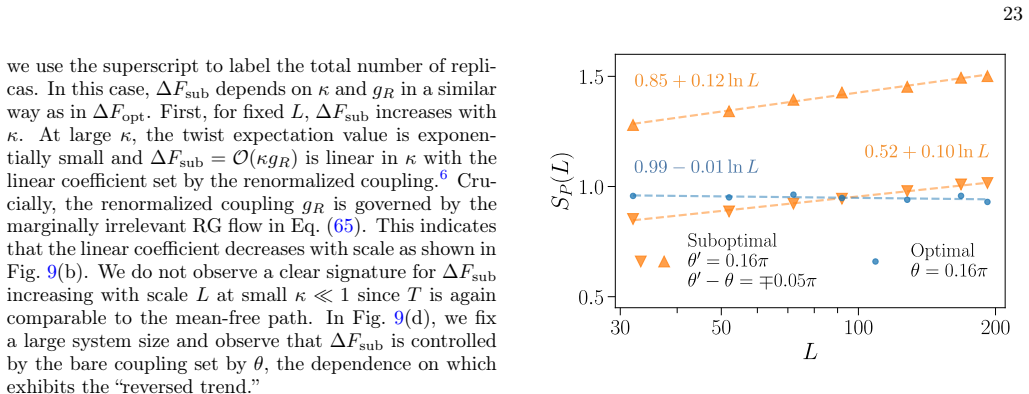
Decoding fidelity In this section, we describe how we obtain the decoding fidelityFdirectly from the syndrome sampling algorithm by extracting the probabilitiesQα|s. This procedure also allows us to determine the corresponding defect free en- ergy∆F. We use the syndrome sampling algorithm of [39, 103] as reviewed in Appendix H1. At each timet, we save the...
-
[14]
Our results are for the er- ror model with spatially uniform rotation angleθ, as in Sec
Numerics for the error model with uniform rotation angle In this appendix, we provide numerical results for the bipartite entanglement entropy and defect free energy distribution, which are additional observables that dis- tinguish the two replica limits associated with optimal and suboptimal decoders. Our results are for the er- ror model with spatially ...
-
[15]
Numerics for the error model with random rotation angles In this appendix, we examine the predictions of NLsM in the surface code with coherent errors of random rota- tion angles. We consider the rotation angleθ ℓ on each edge drawn independently from a Gaussian distribution in Eq. (4). The NLsM is derived microscopically as an effective theory for decodi...
-
[16]
Fault-tolerant quantum computation by anyons,
A. Kitaev, “Fault-tolerant quantum computation by anyons,”Annals of Physics, vol. 303, p. 2–30, Jan. 2003
work page 2003
-
[17]
E. Dennis, A. Kitaev, A. Landahl, and J. Preskill, “Topological quantum memory,”Journal of Mathemat- ical Physics, vol. 43, p. 4452–4505, Sept. 2002
work page 2002
-
[18]
Probing topological spin liquids on a programmable quantum simulator,
G. Semeghini, H. Levine, A. Keesling, S. Ebadi, T. T. Wang, D. Bluvstein, R. Verresen, H. Pichler, M. Kali- nowski, R. Samajdar, A. Omran, S. Sachdev, A. Vish- wanath, M. Greiner, V. Vuletić, and M. D. Lukin, “Probing topological spin liquids on a programmable quantum simulator,”Science, vol. 374, p. 1242–1247, Dec. 2021
work page 2021
-
[19]
A quantum processor based on coherent transport of entangled atom arrays,
D. Bluvstein, H. Levine, G. Semeghini, T. T. Wang, S. Ebadi, M. Kalinowski, A. Keesling, N. Maskara, H. Pichler, M. Greiner, V. Vuletić, and M. D. Lukin, “A quantum processor based on coherent transport of entangled atom arrays,”Nature, vol. 604, p. 451–456, Apr. 2022
work page 2022
-
[20]
Realizing topologically ordered states on a quantum processor,
K. J. Satzingeret al., “Realizing topologically ordered states on a quantum processor,”Science, vol. 374, 46 Figure 17. Decoding fidelity for the error model with rotation anglesθℓ drawn from a Gaussian distribution with varianceg. (a) FidelityFopt of the optimal decoder as a function ofκfor various system sizesL. Whenκ≫1,Fopt increases with scaleL. (b)F ...
work page 2021
-
[21]
Suppressing quantum errors by scal- ing a surface code logical qubit,
R. Acharyaet al., “Suppressing quantum errors by scal- ing a surface code logical qubit,”Nature, vol. 614, p. 676–681, Feb. 2023
work page 2023
-
[22]
Observation of non-abelian ex- change statistics on a superconducting processor,
T. Andersen, Y. Lensky, K. Kechedzhi, I. Drozdov, A. Bengtsson, S. Hong, A. Morvan, X. Mi, A. Oprem- cak, E.-A. Kim,et al., “Observation of non-abelian ex- change statistics on a superconducting processor,”Bul- letin of the American Physical Society, vol. 68, 2023
work page 2023
-
[23]
Logical quan- tum processor based on reconfigurable atom arrays,
D. Bluvstein, S. J. Evered, A. A. Geim, S. H. Li, H. Zhou, T. Manovitz, S. Ebadi, M. Cain, M. Kalinowski, D. Hangleiter, J. P. Bonilla Ataides, N. Maskara, I. Cong, X. Gao, P. Sales Ro- driguez, T. Karolyshyn, G. Semeghini, M. J. Gullans, M. Greiner, V. Vuletić, and M. D. Lukin, “Logical quan- tum processor based on reconfigurable atom arrays,” Nature, vo...
work page 2023
-
[24]
Quantum error correction below the surface code threshold,
R. Acharyaet al., “Quantum error correction below the surface code threshold,”Nature, vol. 638, p. 920–926, Dec. 2024
work page 2024
-
[25]
Diag- nostics of mixed-state topological order and breakdown of quantum memory,
R. Fan, Y. Bao, E. Altman, and A. Vishwanath, “Diag- nostics of mixed-state topological order and breakdown of quantum memory,”PRX Quantum, vol. 5, May 2024
work page 2024
-
[26]
Y. Bao, R. Fan, A. Vishwanath, and E. Altman, “Mixed-state topological order and the errorfield double formulation of decoherence-induced transitions,”arXiv preprint arXiv:2301.05687, 2023
work page internal anchor Pith review Pith/arXiv arXiv 2023
-
[27]
Quantum criticality under decoherence or weak measurement,
J. Y. Lee, C.-M. Jian, and C. Xu, “Quantum criticality under decoherence or weak measurement,”PRX quan- tum, vol. 4, no. 3, p. 030317, 2023
work page 2023
-
[28]
Intrinsic mixed- state topological order,
Z. Wang, Z. Wu, and Z. Wang, “Intrinsic mixed- state topological order,”PRX Quantum, vol. 6, no. 1, p. 010314, 2025
work page 2025
-
[29]
Noisy approach to intrinsically mixed-state topological order,
R. Sohal and A. Prem, “Noisy approach to intrinsically mixed-state topological order,”PRX Quantum, vol. 6, no. 1, p. 010313, 2025
work page 2025
-
[30]
Information dynamics in decohered quantum memory with repeated syndrome measure- ments,
J. Hauser, Y. Bao, S. Sang, A. Lavasani, U. Agrawal, and M. P. Fisher, “Information dynamics in decohered quantum memory with repeated syndrome measure- ments,”Physical Review B, vol. 113, no. 5, p. 054303, 2026
work page 2026
-
[31]
Phases of floquet code under lo- cal decoherence,
Y. Tang and Y. Bao, “Phases of floquet code under lo- cal decoherence,”Physical Review A, vol. 112, no. 6, p. 062437, 2025
work page 2025
-
[32]
Separability transitions in topological states induced by local decoherence,
Y.-H. Chen and T. Grover, “Separability transitions in topological states induced by local decoherence,”Phys- ical Review Letters, vol. 132, no. 17, p. 170602, 2024
work page 2024
-
[33]
Symmetry-enforced many- body separability transitions,
Y.-H. Chen and T. Grover, “Symmetry-enforced many- body separability transitions,”PRX Quantum, vol. 5, no. 3, p. 030310, 2024. 47
work page 2024
-
[34]
Toward a classification of mixed-state topological orders in two dimensions,
T. D. Ellison and M. Cheng, “Toward a classification of mixed-state topological orders in two dimensions,”PRX Quantum, vol. 6, no. 1, p. 010315, 2025
work page 2025
-
[35]
C. Wang, J. Harrington, and J. Preskill, “Confinement- higgs transition in a disordered gauge theory and the accuracy threshold for quantum memory,”Annals of Physics, vol. 303, no. 1, pp. 31–58, 2003
work page 2003
-
[36]
Error threshold for color codes and ran- dom three-body ising models,
H. G. Katzgraber, H. Bombín, and M. A. Martin- Delgado, “Error threshold for color codes and ran- dom three-body ising models,”Physical review letters, vol. 103, no. 9, p. 090501, 2009
work page 2009
-
[37]
H. Bombín, “Topological subsystem codes,”Physical Review A—Atomic, Molecular, and Optical Physics, vol. 81, no. 3, p. 032301, 2010
work page 2010
-
[38]
Strong resilience of topological codes to depolarization,
H. Bombin, R. S. Andrist, M. Ohzeki, H. G. Katz- graber, and M. A. Martin-Delgado, “Strong resilience of topological codes to depolarization,”Physical Review X, vol. 2, no. 2, p. 021004, 2012
work page 2012
-
[39]
Three-dimensional color code thresh- olds via statistical-mechanical mapping,
A. Kubica, M. E. Beverland, F. Brandão, J. Preskill, and K. M. Svore, “Three-dimensional color code thresh- olds via statistical-mechanical mapping,”Physical re- view letters, vol. 120, no. 18, p. 180501, 2018
work page 2018
-
[40]
Statistical mechan- ical models for quantum codes with correlated noise,
C. T. Chubb and S. T. Flammia, “Statistical mechan- ical models for quantum codes with correlated noise,” Annales de l’Institut Henri Poincaré D, vol. 8, no. 2, pp. 269–321, 2021
work page 2021
-
[41]
Optimal thresh- olds for fracton codes and random spin models with sub- system symmetry,
H. Song, J. Schönmeier-Kromer, K. Liu, O. Viyuela, L. Pollet, and M. A. Martin-Delgado, “Optimal thresh- olds for fracton codes and random spin models with sub- system symmetry,”Physical Review Letters, vol. 129, no. 23, p. 230502, 2022
work page 2022
-
[42]
Tensor networks and quan- tum error correction,
A. J. Ferris and D. Poulin, “Tensor networks and quan- tum error correction,”Physical review letters, vol. 113, no. 3, p. 030501, 2014
work page 2014
-
[43]
Efficient algo- rithms for maximum likelihood decoding in the surface code,
S. Bravyi, M. Suchara, and A. Vargo, “Efficient algo- rithms for maximum likelihood decoding in the surface code,”Physical Review A,vol.90, no.3, p.032326, 2014
work page 2014
-
[44]
Tensor-networksimula- tions of the surface code under realistic noise,
A.S.DarmawanandD.Poulin, “Tensor-networksimula- tions of the surface code under realistic noise,”Physical Review Letters, vol. 119, July 2017
work page 2017
-
[45]
Linear-time general de- coding algorithm for the surface code,
A. S. Darmawan and D. Poulin, “Linear-time general de- coding algorithm for the surface code,”Physical Review E, vol. 97, May 2018
work page 2018
-
[46]
Ul- trahigh error threshold for surface codes with biased noise,
D. K. Tuckett, S. D. Bartlett, and S. T. Flammia, “Ul- trahigh error threshold for surface codes with biased noise,”Physical review letters, vol. 120, no. 5, p. 050505, 2018
work page 2018
-
[47]
Tailoring surface codes for highly biased noise,
D.K.Tuckett, A.S.Darmawan, C.T.Chubb, S.Bravyi, S. D. Bartlett, and S. T. Flammia, “Tailoring surface codes for highly biased noise,”Physical Review X, vol. 9, no. 4, p. 041031, 2019
work page 2019
-
[48]
General tensor network decoding of 2d pauli codes,
C. T. Chubb, “General tensor network decoding of 2d pauli codes,”arXiv preprint arXiv:2101.04125, 2021
-
[49]
Optimal adaptation of surface-code decoders to local noise,
A. S. Darmawan, “Optimal adaptation of surface-code decoders to local noise,” 2024
work page 2024
-
[50]
Perturbative stabil- ity and error-correction thresholds of quantum codes,
Y. Li, N. O’Dea, and V. Khemani, “Perturbative stabil- ity and error-correction thresholds of quantum codes,” PRX Quantum, vol. 6, no. 1, p. 010327, 2025
work page 2025
-
[51]
Revisiting Nishimori multicriticality through the lens of information measures
Z.-Q. Wan, X.-D. Dai, and G.-Y. Zhu, “Revisiting nishi- mori multicriticality through the lens of information measures,”arXiv preprint arXiv:2511.02907, 2025
work page internal anchor Pith review Pith/arXiv arXiv 2025
-
[52]
Cor- recting coherent errors with surface codes,
S. Bravyi, M. Englbrecht, R. König, and N. Peard, “Cor- recting coherent errors with surface codes,”npj Quan- tum Information, vol. 4, Oct. 2018
work page 2018
-
[53]
Emergent unitary designs for encoded qubits from coherent errors and syndrome measure- ments,
Z. Cheng, E. Huang, V. Khemani, M. J. Gullans, and M. Ippoliti, “Emergent unitary designs for encoded qubits from coherent errors and syndrome measure- ments,”PRX Quantum, vol. 6, no. 3, p. 030333, 2025
work page 2025
-
[54]
Coherent-error threshold for surface codes from majorana delocaliza- tion,
F. Venn, J. Behrends, and B. Béri, “Coherent-error threshold for surface codes from majorana delocaliza- tion,”Phys. Rev. Lett., vol. 131, p. 060603, Aug 2023
work page 2023
-
[55]
Surface codes, quantumcircuits, andentanglementphases,
J. Behrends, F. Venn, and B. Béri, “Surface codes, quantumcircuits, andentanglementphases,”Phys. Rev. Res., vol. 6, p. 013137, Feb 2024
work page 2024
-
[56]
J. Behrends and B. Béri, “The surface code beyond pauli channels: Logicalnoisecoherence, information-theoretic measures, and errorfield-double phenomenology,”arXiv preprint arXiv:2412.21055, 2025
-
[57]
Phases of decodability in the surface code with unitary errors,
Y. Bao and S. Anand, “Phases of decodability in the surface code with unitary errors,” 2024
work page 2024
-
[58]
Stability of gapped quan- tum matter and error-correction with adiabatic noise,
A. Lavasani and S. Vijay, “Stability of gapped quan- tum matter and error-correction with adiabatic noise,” Physical Review Research, vol. 7, no. 2, p. 023166, 2025
work page 2025
-
[59]
Nonlinear sigma models for monitored dy- namics of free fermions,
M. Fava, L. Piroli, T. Swann, D. Bernard, and A. Nahum, “Nonlinear sigma models for monitored dy- namics of free fermions,”Physical Review X, vol. 13, no. 4, p. 041045, 2023
work page 2023
-
[60]
C.-M. Jian, B. Bauer, A. Keselman, and A. W. Ludwig, “Criticality and entanglement in nonunitary quantum circuits and tensor networks of noninteract- ing fermions,”Physical Review B, vol. 106, no. 13, p. 134206, 2022
work page 2022
-
[61]
C.-M. Jian, H. Shapourian, B. Bauer, and A. W. Ludwig, “Measurement-induced entanglement transi- tions in quantum circuits of non-interacting fermions: Born-rule versus forced measurements,”arXiv preprint arXiv:2302.09094, 2023
-
[62]
Theory of free fermions under random projective mea- surements,
I. Poboiko, P. Pöpperl, I. V. Gornyi, and A. D. Mirlin, “Theory of free fermions under random projective mea- surements,”Physical Review X, vol. 13, no. 4, p. 041046, 2023
work page 2023
-
[63]
Mon- itored fermions with conserved u (1) charge,
M. Fava, L. Piroli, D. Bernard, and A. Nahum, “Mon- itored fermions with conserved u (1) charge,”Physical Review Research, vol. 6, no. 4, p. 043246, 2024
work page 2024
-
[64]
Measurement-induced transitions for interacting fermions,
I. Poboiko, P. Pöpperl, I. V. Gornyi, and A. D. Mir- lin, “Measurement-induced transitions for interacting fermions,”Physical Review B, vol. 111, no. 2, p. 024204, 2025
work page 2025
-
[65]
Fieldtheoryofmonitoredinteractingfermiondynamics with charge conservation,
H. Guo, M. S. Foster, C.-M. Jian, and A. W. Ludwig, “Fieldtheoryofmonitoredinteractingfermiondynamics with charge conservation,”Physical Review B, vol. 112, no. 6, p. 064304, 2025
work page 2025
-
[66]
Theory of the phase transition in random unitary circuits with measure- ments,
Y. Bao, S. Choi, and E. Altman, “Theory of the phase transition in random unitary circuits with measure- ments,”Physical Review B, vol. 101, Mar. 2020
work page 2020
-
[67]
Measurement-induced criticality in random quan- tum circuits,
C.-M. Jian, Y.-Z. You, R. Vasseur, and A. W. W. Lud- wig, “Measurement-induced criticality in random quan- tum circuits,”Physical Review B, vol. 101, Mar. 2020
work page 2020
-
[68]
M. P. Fisher, V. Khemani, A. Nahum, and S. Vijay, “Random quantum circuits,”Annual Review of Con- densed Matter Physics, vol. 14, p. 335–379, Mar. 2023
work page 2023
-
[69]
Three-loopβ-functions of non-linearσmod- els on symmetric spaces,
S. Hikami, “Three-loopβ-functions of non-linearσmod- els on symmetric spaces,”Physics Letters B, vol. 98, no. 3, pp. 208–210, 1981
work page 1981
-
[70]
Four-loop-orderβ-function of nonlinear σ-models in symmetric spaces,
F. Wegner, “Four-loop-orderβ-function of nonlinear σ-models in symmetric spaces,”Nuclear Physics B, vol. 316, no. 3, pp. 663–678, 1989
work page 1989
-
[71]
Nonstandard sym- 48 metry classes in mesoscopic normal-superconducting hybrid structures,
A. Altland and M. R. Zirnbauer, “Nonstandard sym- 48 metry classes in mesoscopic normal-superconducting hybrid structures,”Physical Review B, vol. 55, p. 1142–1161, Jan. 1997
work page 1997
-
[72]
Percolation, quan- tum tunnelling and the integer hall effect,
J. Chalker and P. Coddington, “Percolation, quan- tum tunnelling and the integer hall effect,”Journal of Physics C: Solid State Physics, vol. 21, no. 14, p. 2665, 1988
work page 1988
-
[73]
Disordered 2d quasiparticles in class d: Dirac fermions with random mass, and dirty superconductors,
M. Bocquet, D. Serban, and M. Zirnbauer, “Disordered 2d quasiparticles in class d: Dirac fermions with random mass, and dirty superconductors,”Nuclear Physics B, vol. 578, p. 628–680, July 2000
work page 2000
-
[74]
Decoherence-induced self-dual criticality in topological states of matter,
Q. Wang, R. Vasseur, S. Trebst, A. W. W. Ludwig, and G.-Y. Zhu, “Decoherence-induced self-dual criticality in topological states of matter,” 2025
work page 2025
-
[75]
F. Evers and A. D. Mirlin, “Anderson transitions,”Re- views of Modern Physics, vol. 80, no. 4, pp. 1355–1417, 2008
work page 2008
-
[76]
Quantum codes on a lattice with boundary
S. B.BravyiandA. Y.Kitaev, “Quantumcodesonalat- tice with boundary,”arXiv preprint quant-ph/9811052, 1998
work page internal anchor Pith review Pith/arXiv arXiv 1998
-
[77]
Coherent information for calderbank-shor-steane codes under decoherence,
R. Niwa and J. Y. Lee, “Coherent information for calderbank-shor-steane codes under decoherence,” Physical Review A, vol. 111, Mar. 2025
work page 2025
-
[78]
Topolog- ical defects on the lattice: I. the ising model,
D. Aasen, R. S. K. Mong, and P. Fendley, “Topolog- ical defects on the lattice: I. the ising model,”Jour- nal of Physics A: Mathematical and Theoretical, vol. 49, p. 354001, Aug. 2016
work page 2016
-
[79]
Location of the ising spin-glass multicritical point on nishimori’s line,
P. Le Doussal and A. B. Harris, “Location of the ising spin-glass multicritical point on nishimori’s line,”Phys- ical review letters, vol. 61, no. 5, p. 625, 1988
work page 1988
-
[80]
Riemannian symmetric superspaces and their origin in random-matrix theory,
M. R. Zirnbauer, “Riemannian symmetric superspaces and their origin in random-matrix theory,”Journal of Mathematical Physics, vol. 37, no. 10, pp. 4986–5018, 1996
work page 1996
discussion (0)
Sign in with ORCID, Apple, or X to comment. Anyone can read and Pith papers without signing in.