MeshTailor: Cutting Seams via Generative Mesh Traversal
Pith reviewed 2026-05-21 11:02 UTC · model grok-4.3
The pith
MeshTailor generates coherent seams on 3D meshes by autoregressive traversal directly on the mesh graph.
A machine-rendered reading of the paper's core claim, the machinery that carries it, and where it could break.
Core claim
MeshTailor is the first mesh-native generative framework for synthesizing edge-aligned seams on 3D surfaces. It operates directly on the mesh graph, eliminating projection artifacts and fragile snapping heuristics. ChainingSeams provides a hierarchical serialization of the seam graph that orders chains from global structural cuts down to local details in a coarse-to-fine manner, and a dual-stream encoder fuses topological and geometric context. The MeshTailor Transformer utilizes an autoregressive pointer layer to trace seams vertex-by-vertex within local neighborhoods, producing more coherent and structurally regular seam layouts than recent optimization-based and learning-based baselines.
What carries the argument
ChainingSeams hierarchical serialization of the seam graph combined with dual-stream vertex embeddings that feed an autoregressive pointer layer for vertex-by-vertex tracing inside local neighborhoods.
If this is right
- Direct operation on the mesh graph removes dependence on extrinsic coordinates and associated projection errors.
- Coarse-to-fine chaining lets the model build large structural seams first before adding fine details.
- Autoregressive vertex prediction within neighborhoods produces edge-aligned seams without post-processing heuristics.
- The resulting layouts show greater coherence and structural regularity than both optimization and earlier learning methods.
Where Pith is reading between the lines
- The same traversal approach could be adapted for other mesh tasks such as generating cut paths for unfolding or procedural detailing.
- If the hierarchical ordering generalizes, similar graph-native generators might reduce reliance on 2D projections across broader 3D geometry processing pipelines.
- Applications like automated texture atlas creation or fabrication planning could incorporate this seam generator as a modular step.
Load-bearing premise
That ordering seams in global-to-local chains and embedding both topology and geometry together is enough for an autoregressive model to trace reliable seams without needing projections or snapping fixes.
What would settle it
A side-by-side quantitative comparison on a benchmark set of 3D meshes measuring seam coherence and structural regularity metrics to check whether MeshTailor outputs are measurably superior to optimization and prior learning baselines.
Figures




read the original abstract
We present MeshTailor, the first mesh-native generative framework for synthesizing edge-aligned seams on 3D surfaces. Unlike prior optimization-based or extrinsic learning-based methods, MeshTailor operates directly on the mesh graph, eliminating projection artifacts and fragile snapping heuristics. We introduce ChainingSeams, a hierarchical serialization of the seam graph that orders chains from global structural cuts down to local details in a coarse-to-fine manner, and a dual-stream encoder that fuses topological and geometric context. Leveraging this hierarchical representation and dual-stream vertex embeddings, our MeshTailor Transformer utilizes an autoregressive pointer layer to trace seams vertex-by-vertex within local neighborhoods. Extensive evaluations show that MeshTailor produces more coherent and structurally regular seam layouts compared to recent optimization-based and learning-based baselines.
Editorial analysis
A structured set of objections, weighed in public.
Referee Report
Summary. The manuscript presents MeshTailor, the first mesh-native generative framework for synthesizing edge-aligned seams on 3D surfaces. It operates directly on the mesh graph using ChainingSeams, a hierarchical serialization of the seam graph that orders chains from global structural cuts to local details in a coarse-to-fine manner, together with a dual-stream encoder fusing topological and geometric context. The MeshTailor Transformer employs an autoregressive pointer layer to trace seams vertex-by-vertex within local neighborhoods. The central claim is that this approach yields more coherent and structurally regular seam layouts than recent optimization-based and learning-based baselines, supported by extensive evaluations.
Significance. If the central claims hold, the work offers a meaningful contribution to geometry processing by introducing a direct mesh-graph generative model that sidesteps projection artifacts and snapping heuristics common in prior extrinsic methods. The combination of hierarchical ChainingSeams serialization and dual-stream embeddings provides a novel mechanism for autoregressive seam tracing, which could influence future work on mesh segmentation, UV mapping, and related tasks. The paper's emphasis on native mesh operations is a clear strength, though the absence of detailed quantitative support in the abstract limits immediate evaluation of its practical impact.
major comments (2)
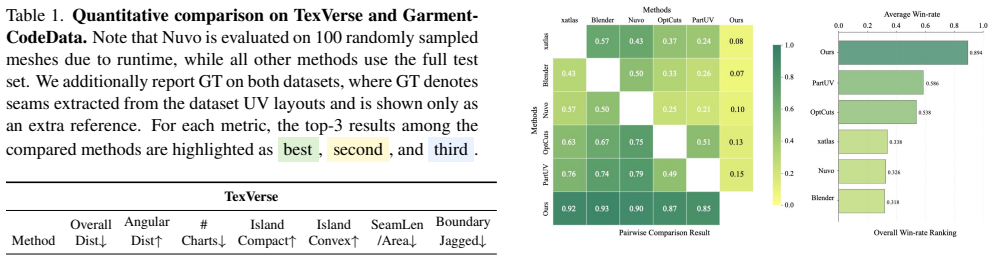
- Abstract: the claim that 'extensive evaluations show that MeshTailor produces more coherent and structurally regular seam layouts' is load-bearing for the superiority assertion, yet the abstract (and available summary) provides no quantitative metrics, baseline details, error analysis, or ablation results; this directly weakens the ability to verify the reported advantage over optimization and learning baselines.
- Method description of ChainingSeams and autoregressive pointer layer: the hierarchical serialization via ChainingSeams combined with dual-stream vertex embeddings is asserted to enable reliable autoregressive seam tracing without projection artifacts. For meshes with complex topology or long seams, however, sequential local vertex choices risk compounding prediction errors, potentially producing locally plausible but globally fragmented or irregular layouts; this assumption is central to the coherence claim and requires explicit discussion or additional global-consistency experiments.
minor comments (2)
- Abstract: the phrase 'mesh-native' is used without an immediate contrast to extrinsic methods; a brief parenthetical definition would improve clarity for readers unfamiliar with the distinction.
- Notation throughout: the dual-stream encoder is described as fusing 'topological and geometric context,' but the precise fusion mechanism (e.g., concatenation, attention, or gating) is not specified in the summary; adding an equation or diagram reference would aid reproducibility.
Simulated Author's Rebuttal
We thank the referee for the detailed and constructive report. We address each major comment below and have prepared revisions to strengthen the presentation of results and the discussion of model assumptions.
read point-by-point responses
-
Referee: [—] Abstract: the claim that 'extensive evaluations show that MeshTailor produces more coherent and structurally regular seam layouts' is load-bearing for the superiority assertion, yet the abstract (and available summary) provides no quantitative metrics, baseline details, error analysis, or ablation results; this directly weakens the ability to verify the reported advantage over optimization and learning baselines.
Authors: We agree that the abstract would benefit from concrete quantitative support for the central claim. In the revised manuscript we have updated the abstract to include a concise summary of the key metrics (coherence score, structural regularity index, and relative improvements versus the strongest baselines) drawn from the quantitative tables in Section 5. This keeps the abstract brief while making the superiority statement verifiable at a glance. revision: yes
-
Referee: [—] Method description of ChainingSeams and autoregressive pointer layer: the hierarchical serialization via ChainingSeams combined with dual-stream vertex embeddings is asserted to enable reliable autoregressive seam tracing without projection artifacts. For meshes with complex topology or long seams, however, sequential local vertex choices risk compounding prediction errors, potentially producing locally plausible but globally fragmented or irregular layouts; this assumption is central to the coherence claim and requires explicit discussion or additional global-consistency experiments.
Authors: We acknowledge the legitimate concern about error accumulation in long autoregressive sequences. The hierarchical ordering in ChainingSeams is intended to mitigate this by resolving global cuts before local refinements, and the dual-stream embeddings supply both local geometry and global topological context at each step. In the revision we have added an explicit paragraph in Section 3.3 discussing potential compounding errors and the mechanisms that limit their impact. We have also inserted a new global-consistency experiment (reported in Section 5.4) that measures end-to-end seam continuity on high-genus and long-seam meshes; the results show that fragmentation remains low relative to the baselines. revision: yes
Circularity Check
No significant circularity in MeshTailor derivation chain
full rationale
The paper introduces a new mesh-native generative approach with ChainingSeams for hierarchical seam serialization and a dual-stream encoder for topological-geometric fusion, followed by an autoregressive pointer-based tracing in the MeshTailor Transformer. These components are presented as novel constructions operating directly on the mesh graph, with evaluations against external optimization and learning baselines. No equations, predictions, or central claims reduce by construction to fitted inputs or self-citations; the framework is self-contained with independent content relative to prior work. No load-bearing uniqueness theorems or ansatzes from overlapping author citations are invoked in the provided text.
Axiom & Free-Parameter Ledger
Lean theorems connected to this paper
-
IndisputableMonolith/Foundation/ArithmeticFromLogic.leanLogicNat recovery and embed_strictMono_of_one_lt unclear?
unclearRelation between the paper passage and the cited Recognition theorem.
We introduce ChainingSeams, a hierarchical serialization of the seam graph that orders chains from global structural cuts down to local details in a coarse-to-fine manner, and a dual-stream encoder that fuses topological and geometric context.
-
IndisputableMonolith/Foundation/AbsoluteFloorClosure.leanreality_from_one_distinction unclear?
unclearRelation between the paper passage and the cited Recognition theorem.
our MeshTailor Transformer utilizes an autoregressive pointer layer to trace seams vertex-by-vertex within local neighborhoods
What do these tags mean?
- matches
- The paper's claim is directly supported by a theorem in the formal canon.
- supports
- The theorem supports part of the paper's argument, but the paper may add assumptions or extra steps.
- extends
- The paper goes beyond the formal theorem; the theorem is a base layer rather than the whole result.
- uses
- The paper appears to rely on the theorem as machinery.
- contradicts
- The paper's claim conflicts with a theorem or certificate in the canon.
- unclear
- Pith found a possible connection, but the passage is too broad, indirect, or ambiguous to say the theorem truly supports the claim.
Reference graph
Works this paper leans on
-
[1]
Kim, Siddhartha Chaudhuri, Jun Saito, and Thibault Groueix
Noam Aigerman, Kunal Gupta, Vladimir G. Kim, Siddhartha Chaudhuri, Jun Saito, and Thibault Groueix. Neural jaco- bian fields: learning intrinsic mappings of arbitrary meshes. ACM Trans. on Graphics (Proc. SIGGRAPH), 41(4):109:1– 109:17, 2022. 2
work page 2022
-
[2]
Mesh simplification for unfolding
Manas Bhargava, Camille Schreck, Marco Freire, Pierre- Alexandre Hugron, Sylvain Lefebvre, Silvia Sell ´an, and Bernd Bickel. Mesh simplification for unfolding. InCom- puter Graphics Forum, 2025. 3
work page 2025
-
[3]
Blender manual: Seams from islands
Blender. Blender manual: Seams from islands. https : / / docs . blender . org / manual / en / latest / modeling / meshes / uv / unwrapping / seams.html. 5, 13
-
[4]
Blender — a 3d modelling and rendering package.https://www.blender.org/
Blender Online Community. Blender — a 3d modelling and rendering package.https://www.blender.org/. 3, 6
-
[5]
Kaufman, Qingnan Zhou, Shahar Z
Xingyi Du, Danny M. Kaufman, Qingnan Zhou, Shahar Z. Kovalsky, Yajie Yan, Noam Aigerman, and Tao Ju. Optimiz- ing global injectivity for constrained parameterization.ACM Trans. on Graphics (Proc. SIGGRAPH Asia), 40(6):260:1– 260:18, 2021. 2
work page 2021
-
[6]
Multiresolution analysis of arbitrary meshes
Matthias Eck, Tony DeRose, Tom Duchamp, Hugues Hoppe, Michael Lounsbery, and Werner Stuetzle. Multiresolution analysis of arbitrary meshes. InProc. SIGGRAPH, page 173–182, 1995. 2
work page 1995
-
[7]
Slava Elizarov, Ciara Rowles, and Simon Donn ´e. Geome- try image diffusion: Fast and data-efficient text-to-3d with image-based surface representation. InProc. Int. Conf. on Learning Representations, 2025. 3
work page 2025
-
[8]
Michael S. Floater. Parametrization and smooth approxima- tion of surface triangulations.Comput. Aided Geom. Des., 14(3):231–250, 1997. 2
work page 1997
-
[9]
Michael S. Floater. Mean value coordinates.Computer Aided Geometric Design, 20(1):19–27, 2003. 2
work page 2003
-
[10]
Hamilton, Zhitao Ying, and Jure Leskovec
William L. Hamilton, Zhitao Ying, and Jure Leskovec. In- ductive representation learning on large graphs. InProc. Conf. on Neural Information Processing Systems, pages 1024–1034, 2017. 3, 4
work page 2017
-
[11]
Romero, Tsung-Yi Lin, and Ming-Yu Liu
Zekun Hao, David W. Romero, Tsung-Yi Lin, and Ming-Yu Liu. Meshtron: High-fidelity, artist-like 3d mesh generation at scale, 2024. 3
work page 2024
-
[12]
Mesh pa- rameterization: theory and practice
Kai Hormann, Konrad Polthier, and Alia Sheffer. Mesh pa- rameterization: theory and practice. InACM SIGGRAPH ASIA 2008 Courses, 2008. 1, 2
work page 2008
-
[13]
xatlas: Mesh uv unwrapping library
jpcy. xatlas: Mesh uv unwrapping library. GitHub repository,
-
[14]
D-charts: Quasi-developable mesh segmentation.Computer Graphics Forum, 24(3), 2005
Dan Julius, Vladislav Kraevoy, and Alla Sheffer. D-charts: Quasi-developable mesh segmentation.Computer Graphics Forum, 24(3), 2005. 3
work page 2005
-
[15]
Garmentcodedata: A dataset of 3d made-to-measure garments with sewing pat- terns
Maria Korosteleva, Timur Levent Kesdogan, Fabian Kem- per, Stephan Wenninger, Jasmin Koller, Yuhan Zhang, Mario Botsch, and Olga Sorkine-Hornung. Garmentcodedata: A dataset of 3d made-to-measure garments with sewing pat- terns. InProc. Euro. Conf. on Computer Vision, pages 110– 127, 2024. 5, 6, 13
work page 2024
-
[16]
Least squares conformal maps for automatic tex- ture atlas generation.ACM Trans
Bruno L ´evy, Sylvain Petitjean, Nicolas Ray, and J ´erome Maillot. Least squares conformal maps for automatic tex- ture atlas generation.ACM Trans. on Graphics, 21(3):362:1– 362:10, 2002. 2
work page 2002
-
[17]
Minchen Li, Danny M. Kaufman, Vladimir G. Kim, Justin Solomon, and Alla Sheffer. Optcuts: joint optimization of surface cuts and parameterization.ACM Trans. on Graphics (Proc. SIGGRAPH Asia), 37(6):247:1–247:13, 2018. 1, 2, 6
work page 2018
-
[18]
Siran Li, Ruiyang Liu, Chen Liu, Zhendong Wang, Gaofeng He, Yong-Lu Li, Xiaogang Jin, and Huamin Wang. Garma- genet: A multimodal generative framework for sewing pat- tern design and generic garment modeling.ACM Transac- tions on Graphics (TOG), 44(6):1–23, 2025. 3
work page 2025
-
[19]
Auto-regressive surface cutting, 2025
Yang Li, Victor Cheung, Xinhai Liu, Yuguang Chen, Zhongjin Luo, Biwen Lei, Haohan Weng, Zibo Zhao, Jing- wei Huang, Zhuo Chen, and Chunchao Guo. Auto-regressive surface cutting, 2025. 2, 3, 9
work page 2025
-
[20]
PARTFIELD: learning 3d feature fields for part segmentation and beyond
Ming-Yu Liu, Mikaela Angelina Uy, Donglai Xiang, Hao Su, Sanja Fidler, Nicholas Sharp, and Jun Gao. PARTFIELD: learning 3d feature fields for part segmentation and beyond
-
[21]
Richard Liu, Noam Aigerman, Vladimir G. Kim, and Rana Hanocka. DA wand: Distortion-aware selection using neural mesh parameterization. InProc. IEEE/CVF Conf. on Com- puter Vision & Pattern Recognition, pages 16739–16749,
-
[22]
Seamless: seam erasure and seam-aware decou- pling of shape from mesh resolution.ACM Trans
Songrun Liu, Zachary Ferguson, Alec Jacobson, and Yotam Gingold. Seamless: seam erasure and seam-aware decou- pling of shape from mesh resolution.ACM Trans. on Graph- ics (Proc. SIGGRAPH Asia), 36(6):216:1–216:15, 2017. 13
work page 2017
-
[23]
Generating 3d house wireframes with semantics
Xueqi Ma, Yilin Liu, Wenjun Zhou, Ruowei Wang, and Hui Huang. Generating 3d house wireframes with semantics. In ECCV, pages 223–240, 2024. 3
work page 2024
-
[24]
Clr-wire: Towards continuous latent representations for 3d curve wireframe generation
Xueqi Ma, Yilin Liu, Tianlong Gao, Qirui Huang, and Hui Huang. Clr-wire: Towards continuous latent representations for 3d curve wireframe generation. InACM SIGGRAPH, pages 77:1–77:11, 2025. 3
work page 2025
-
[25]
Autosdf: Shape priors for 3d comple- tion, reconstruction and generation
Paritosh Mittal, Yen-Chi Cheng, Maneesh Singh, and Shub- ham Tulsiani. Autosdf: Shape priors for 3d comple- tion, reconstruction and generation. InProceedings of the IEEE/CVF conference on computer vision and pattern recognition, pages 306–315, 2022. 3
work page 2022
-
[26]
Luca Morreale, Noam Aigerman, Vladimir G. Kim, and Niloy J. Mitra. Neural surface maps. InProc. IEEE/CVF Conf. on Computer Vision & Pattern Recognition, pages 4639–4648, 2021. 2
work page 2021
-
[27]
Spectral conformal parameterization
Patrick Mullen, Yiying Tong, Pierre Alliez, and Mathieu Desbrun. Spectral conformal parameterization. InProc. Eu- rographics Symp. on Geometry Processing, pages 1487:1– –1487:8, 2008. 2
work page 2008
-
[28]
Charlie Nash, Yaroslav Ganin, S. M. Ali Eslami, and Pe- ter W. Battaglia. Polygen: An autoregressive generative model of 3d meshes. InProc. Int. Conf. on Machine Learn- ing, pages 7220–7229. PMLR, 2020. 3
work page 2020
-
[29]
Autocuts: simultaneous dis- tortion and cut optimization for uv mapping.ACM Trans
Roi Poranne, Marco Tarini, Sandro Huber, Daniele Panozzo, and Olga Sorkine-Hornung. Autocuts: simultaneous dis- tortion and cut optimization for uv mapping.ACM Trans. on Graphics (Proc. SIGGRAPH Asia), 36(6):215:1–215:11,
-
[30]
Scalable locally injective mappings
Michael Rabinovich, Roi Poranne, Daniele Panozzo, and Olga Sorkine-Hornung. Scalable locally injective mappings. ACM Trans. on Graphics, 36(2):16:1–16:16, 2017. 2
work page 2017
-
[31]
Pedro V . Sander, John Snyder, Steven J. Gortler, and Hugues Hoppe. Texture mapping progressive meshes. InProc. SIG- GRAPH, pages 409:1–416:8, 2001. 3
work page 2001
-
[32]
Boundary first flatten- ing.ACM Trans
Rohan Sawhney and Keenan Crane. Boundary first flatten- ing.ACM Trans. on Graphics, 37(1):5:1–5:14, 2017. 2
work page 2017
-
[33]
Variational surface cut- ting.ACM Trans
Nicholas Sharp and Keenan Crane. Variational surface cut- ting.ACM Trans. on Graphics (Proc. SIGGRAPH), 37(4): 156:1–156:13, 2018. 2
work page 2018
-
[34]
Surface parameterization for meshing by triangulation flattening, 2000
Alla Sheffer and Eric De Sturler. Surface parameterization for meshing by triangulation flattening, 2000. 2
work page 2000
-
[35]
Abf++: fast and robust angle based flat- tening.ACM Trans
Alla Sheffer, Bruno L ´evy, Maxim Mogilnitsky, and Alexan- der Bogomyakov. Abf++: fast and robust angle based flat- tening.ACM Trans. on Graphics, 24(2):311:1–311:20, 2005. 2, 5
work page 2005
-
[36]
Mesh param- eterization methods and their applications.Found
Alla Sheffer, Emil Praun, and Kenneth Rose. Mesh param- eterization methods and their applications.Found. Trends. Comput. Graph. Vis., 2(2):105–171, 2006. 1
work page 2006
-
[37]
Meshgpt: Generating triangle meshes with decoder-only transformers
Yawar Siddiqui, Antonio Alliegro, Alexey Artemov, Tatiana Tommasi, Daniele Sirigatti, Vladislav Rosov, Angela Dai, and Matthias Nießner. Meshgpt: Generating triangle meshes with decoder-only transformers. InProc. IEEE/CVF Conf. on Computer Vision & Pattern Recognition, pages 19615– 19625, 2024. 3
work page 2024
-
[38]
O. Sorkine, D. Cohen-Or, R. Goldenthal, and D. Lischin- ski. Bounded-distortion piecewise mesh parameterization. In IEEE Visualization, 2002. VIS 2002., pages 355–362, 2002. 2
work page 2002
-
[39]
Pratul P. Srinivasan, Stephan J. Garbin, Dor Verbin, Jonathan T. Barron, and Ben Mildenhall. Nuvo: Neural uv mapping for unruly 3d representations. InProc. Euro. Conf. on Computer Vision, pages 18–34, 2024. 1, 2, 6
work page 2024
-
[40]
Roformer: Enhanced transformer with rotary position embedding, 2023
Jianlin Su, Yu Lu, Shengfeng Pan, Ahmed Murtadha, Bo Wen, and Yunfeng Liu. Roformer: Enhanced transformer with rotary position embedding, 2023. 15
work page 2023
-
[41]
Qwen Team. Qwen3-vl technical report.arXiv preprint arXiv:2511.21631, 2025. 13
work page internal anchor Pith review Pith/arXiv arXiv 2025
-
[42]
Graphseam: Super- vised graph learning framework for semantic uv mapping,
Fatemeh Teimury, Bruno Roy, Juan Sebasti ´an Casallas, David MacDonald, and Mark Coates. Graphseam: Super- vised graph learning framework for semantic uv mapping,
-
[43]
How to draw a graph.Proceedings of the London Mathematical Society, 3(1):743–767, 1963
William Thomas Tutte. How to draw a graph.Proceedings of the London Mathematical Society, 3(1):743–767, 1963. 2
work page 1963
-
[44]
Oriol Vinyals, Meire Fortunato, and Navdeep Jaitly. Pointer networks. InProc. Conf. on Neural Information Processing Systems, page 2692–2700, 2015. 2
work page 2015
-
[45]
LLaMA-Mesh: Unifying 3d mesh generation with language models.arXiv preprint arXiv:2411.09595, 2024
Zhengyi Wang, Jonathan Lorraine, Yikai Wang, Hang Su, Jun Zhu, Sanja Fidler, and Xiaohui Zeng. Llama-mesh: Unifying 3d mesh generation with language models.arXiv preprint arXiv:2411.09595, 2024. 3
-
[46]
Partuv: Part-based uv unwrap- ping of 3d meshes
Zhaoning Wang, Xinyue Wei, Ruoxi Shi, Xiaoshuai Zhang, Hao Su, and Minghua Liu. Partuv: Part-based uv unwrap- ping of 3d meshes. InProc. SIGGRAPH Asia, pages 15:1– 15:12, 2025. 2, 3, 5, 6, 16
work page 2025
-
[47]
Octgpt: Octree-based multi- scale autoregressive models for 3d shape generation
Si-Tong Wei, Rui-Huan Wang, Chuan-Zhi Zhou, Baoquan Chen, and Peng-Shuai Wang. Octgpt: Octree-based multi- scale autoregressive models for 3d shape generation. InPro- ceedings of the Special Interest Group on Computer Graph- ics and Interactive Techniques Conference Conference Pa- pers, pages 1–11, 2025. 3
work page 2025
-
[48]
Structured 3D Latents for Scalable and Versatile 3D Generation
Jianfeng Xiang, Zelong Lv, Sicheng Xu, Yu Deng, Ruicheng Wang, Bowen Zhang, Dong Chen, Xin Tong, and Jiaolong Yang. Structured 3d latents for scalable and versatile 3d gen- eration.arXiv preprint arXiv:2412.01506, 2024. 3
work page internal anchor Pith review Pith/arXiv arXiv 2024
-
[49]
Neural fields in visual computing and beyond
Yiheng Xie, Towaki Takikawa, Shunsuke Saito, Or Litany, Shiqin Yan, Numair Khan, Federico Tombari, James Tomp- kin, Vincent Sitzmann, and Srinath Sridhar. Neural fields in visual computing and beyond. InComputer graphics forum, pages 641–676. Wiley Online Library, 2022. 3
work page 2022
-
[50]
Duoteng Xu, Yuguang Chen, Jing Li, Xinhai Liu, Xueqi Ma, Zhuo Chen, Dongyu Zhang, and Chunchao Guo. Seam- crafter: Enhancing mesh seam generation for artist uv un- wrapping via reinforcement learning, 2025. 3
work page 2025
-
[51]
Mitra, Dani Lischin- ski, Daniel Cohen-Or, and Hui Huang
Xingguang Yan, Liqiang Lin, Niloy J. Mitra, Dani Lischin- ski, Daniel Cohen-Or, and Hui Huang. Shapeformer: Transformer-based shape completion via sparse representa- tion. InProc. IEEE/CVF Conf. on Computer Vision & Pat- tern Recognition, pages 6229–6239, 2022. 3
work page 2022
-
[52]
Xingguang Yan, Han-Hung Lee, Ziyu Wan, and Angel X. Chang. An object is worth 64x64 pixels: Generating 3d ob- ject via image diffusion, 2024. 3
work page 2024
-
[53]
Sampart3d: Segment any part in 3d objects.arXiv preprint arXiv:2411.07184, 2024
Yunhan Yang, Yukun Huang, Yuan-Chen Guo, Liangjun Lu, Xiaoyang Wu, Edmund Y Lam, Yan-Pei Cao, and Xihui Liu. Sampart3d: Segment any part in 3d objects.arXiv preprint arXiv:2411.07184, 2024. 3
-
[54]
Biao Zhang, Jiapeng Tang, Matthias Nießner, and Peter Wonka. 3dshape2vecset: A 3d shape representation for neu- ral fields and generative diffusion models.ACM Trans. on Graphics (Proc. SIGGRAPH), 42(4):92:1–92:16, 2023. 3
work page 2023
-
[55]
Flatten anything: unsupervised neural surface parameteriza- tion
Qijian Zhang, Junhui Hou, Wenping Wang, and Ying He. Flatten anything: unsupervised neural surface parameteriza- tion. InProc. Conf. on Neural Information Processing Sys- tems, pages 93–113, 2024. 1, 2
work page 2024
-
[56]
Texverse: A universe of 3d objects with high-resolution textures, 2025
Yibo Zhang, Li Zhang, Rui Ma, and Nan Cao. Texverse: A universe of 3d objects with high-resolution textures, 2025. 5, 7, 13
work page 2025
-
[57]
Zibo Zhao, Wen Liu, Xin Chen, Xianfang Zeng, Rui Wang, Pei Cheng, Bin Fu, Tao Chen, Gang Yu, and Shenghua Gao. Michelangelo: conditional 3d shape generation based on shape-image-text aligned latent representation. InProc. Conf. on Neural Information Processing Systems, 2023. 5, 15
work page 2023
-
[58]
Iso-charts: stretch-driven mesh parameterization us- ing spectral analysis
Kun Zhou, John Synder, Baining Guo, and Heung-Yeung Shum. Iso-charts: stretch-driven mesh parameterization us- ing spectral analysis. InProc. Eurographics Symp. on Ge- ometry Processing, pages 45–54, 2004. 3 MeshTailor: Cutting Seams via Generative Mesh Traversal Supplemental Material Xueqi Ma1 Xingguang Yan2 Congyue Zhang1 Hui Huang1* 1Shenzhen Universit...
work page 2004
-
[59]
to encode token order. In addition, we introduce a chain-local positional embedding that resets after every [EOC]to encode within-chain progress. Letπ t denote the number of steps since the most recent[EOC](starting from 0at each chain start). We add ˜et ←e t +PosEmb chain πt , which helps the model distinguish early versus late vertices inside the curren...
discussion (0)
Sign in with ORCID, Apple, or X to comment. Anyone can read and Pith papers without signing in.