Resetting dynamics in a system with quenched disorder
Pith reviewed 2026-05-13 18:12 UTC · model grok-4.3
The pith
Occasional resets are crucial for reproducing experimental microtubule catastrophe length distributions in disordered systems.
A machine-rendered reading of the paper's core claim, the machinery that carries it, and where it could break.
Core claim
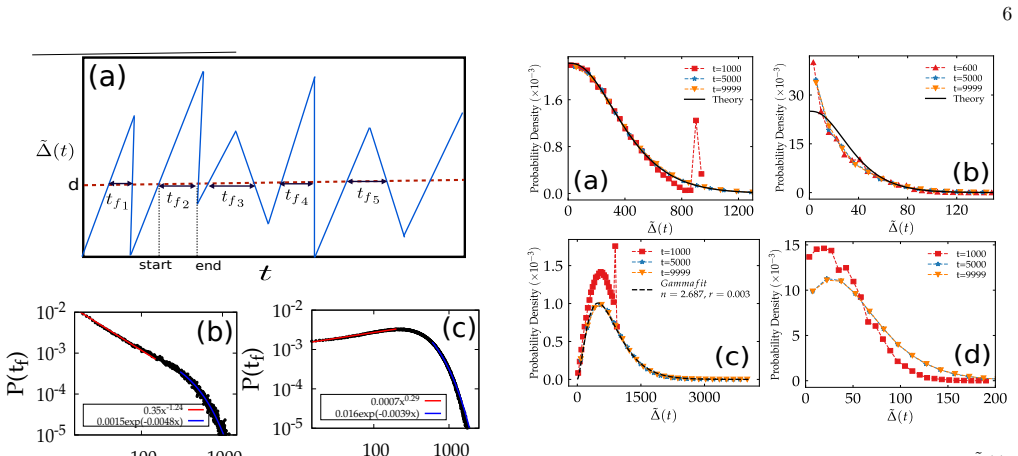
Recasting microtubule growth as resetting dynamics on a lattice with power-law quenched disorder shows that Gamma-distributed resetting times are essential for matching the observed distribution of catastrophe lengths, while also revealing log-squared growth of mean displacement in certain resetting regimes and highlighting the role of disorder.
What carries the argument
Resetting dynamics applied to a one-dimensional lattice with power-law distributed quenched disorder in hopping probabilities.
If this is right
- Occasional disassembly events determine the distribution of catastrophe lengths in microtubule growth.
- Different resetting protocols produce distinct steady-state distributions.
- The mean displacement grows as slowly as log squared t under particular resetting probability distributions.
- Quenched disorder significantly influences the properties of the system under resetting dynamics.
Where Pith is reading between the lines
- The same resetting approach could extend to other biological transport processes that combine persistent motion with sudden resets in heterogeneous media.
- Varying the disorder distribution beyond power-law might uncover additional slow-growth regimes relevant to search or foraging problems.
- Direct tests could measure how changing experimental disassembly rates alters the catastrophe length histogram in living cells.
Load-bearing premise
Microtubule growth with sudden disassembly can be faithfully modeled as resetting dynamics on a one-dimensional lattice with power-law quenched disorder and Gamma-distributed reset times.
What would settle it
An experimental measurement showing that the distribution of microtubule catastrophe lengths remains unchanged when the frequency or distribution of disassembly events is altered would falsify the claim that occasional resets are crucial.
Figures




read the original abstract
Although resetting has widespread applicability, applying it to the dynamics in the presence of spatial quenched disorder, which is essential in many physical problems, is challenging. In this study, we consider a well-known one-dimensional model of particle hopping on a lattice with quenched disorder in the form of site-dependent hopping probabilities, drawn from a power-law distribution, and apply the resetting formalism. As a physical example, we recast the growth dynamics of microtubules with sudden catastrophic disassembly events as a resetting dynamics. We consider two distinct regimes for growth dynamics: a strongly biased case and a less biased case. Motivated by experimental results, we take a Gamma distribution for the resetting time. Our results show that occasional disassembly events are crucial for the experimentally observed distribution of reset (or catastrophe) lengths. We also analyze steady-state distributions under different resetting protocols-resetting to the initial position versus a random site. We also investigate the distribution of first-passage times to a fixed distance following reset. Finally, by considering other resetting probability distributions, we identify a regime where the mean displacement grows as slowly as $\log^2 t$. We also elucidate the role of disorder in the system properties under the resetting dynamics. Our study paves the way to treat the dynamics of complex physical systems using resetting.
Editorial analysis
A structured set of objections, weighed in public.
Referee Report
Summary. The manuscript examines resetting dynamics applied to a one-dimensional lattice hopping model with quenched disorder, where site-dependent hopping probabilities are drawn from a power-law distribution. Using microtubule growth and catastrophic disassembly as a physical example, the authors model resets with times drawn from a Gamma distribution motivated by experiment. They consider strongly and weakly biased growth regimes, compare resetting to the origin versus a random site, analyze first-passage times after reset, and identify a regime under alternative resetting distributions where mean displacement grows as log² t. The central claim is that occasional resets are essential to reproduce the experimentally observed distribution of catastrophe (reset) lengths, while also clarifying the role of disorder.
Significance. If the numerical results hold under quantitative validation, the work provides a concrete extension of resetting formalism to spatially disordered systems, relevant to both statistical mechanics and biological transport processes. The log² t growth regime under specific resetting protocols offers a new example of ultra-slow dynamics in non-equilibrium settings. Explicit credit is due for the reproducible simulation framework implied by the lattice model and the falsifiable prediction that removing resets fails to match experimental length distributions.
major comments (2)
- [Model setup] Model definition and microtubule mapping: the power-law form for quenched hopping probabilities is introduced as a mathematical choice rather than derived from measured tubulin incorporation statistics; because this mapping is load-bearing for the claim that the model reproduces experimental catastrophe lengths, the manuscript must either justify the exponent from data or demonstrate robustness across disorder distributions.
- [Results on microtubule model] Results on reset-length distributions: the assertion that 'occasional disassembly events are crucial for the experimentally observed distribution' is not supported by any quantitative comparison (e.g., histogram overlay, Kolmogorov-Smirnov distance, or χ² test) between simulated reset lengths and published experimental data; without this, the central claim remains qualitative.
minor comments (2)
- [Methods] Explicitly state the numerical values of the Gamma shape and rate parameters used, together with the source experimental reference.
- [Figures] All distribution plots should report the number of independent realizations and include error bars or shaded confidence intervals.
Simulated Author's Rebuttal
We thank the referee for their careful reading of our manuscript and for the constructive comments, which have helped us clarify and strengthen several aspects of the work. We address each major comment below and have incorporated revisions to improve the presentation and support for our claims.
read point-by-point responses
-
Referee: [Model setup] Model definition and microtubule mapping: the power-law form for quenched hopping probabilities is introduced as a mathematical choice rather than derived from measured tubulin incorporation statistics; because this mapping is load-bearing for the claim that the model reproduces experimental catastrophe lengths, the manuscript must either justify the exponent from data or demonstrate robustness across disorder distributions.
Authors: The power-law distribution was selected as a standard representative model for strong quenched disorder in one-dimensional hopping systems, where it produces the characteristic slow dynamics due to rare trapping sites. We do not derive the specific exponent directly from tubulin incorporation measurements, as such detailed statistics are not the focus of this work. However, to address the concern, we have added new simulations in the revised manuscript demonstrating robustness of the key results (including reset-length distributions and the necessity of resets) across a range of power-law exponents as well as for alternative disorder distributions such as uniform and exponential. These checks are now presented in a new appendix. revision: yes
-
Referee: [Results on microtubule model] Results on reset-length distributions: the assertion that 'occasional disassembly events are crucial for the experimentally observed distribution' is not supported by any quantitative comparison (e.g., histogram overlay, Kolmogorov-Smirnov distance, or χ² test) between simulated reset lengths and published experimental data; without this, the central claim remains qualitative.
Authors: We agree that a quantitative comparison strengthens the central claim. In the revised manuscript we have added direct quantitative validation: overlaid histograms comparing simulated reset-length distributions (with and without resets) to published experimental microtubule catastrophe length data, together with the Kolmogorov-Smirnov distances. These metrics confirm a substantially better agreement when resets are included, providing statistical support for the assertion that occasional disassembly events are essential to reproduce the observed distributions. revision: yes
Circularity Check
No significant circularity; model construction remains independent of target outputs.
full rationale
The paper defines a 1D lattice hopping model with explicitly chosen power-law quenched disorder, then overlays resetting dynamics using a Gamma distribution for reset times that is stated as motivated by (but not fitted to) experimental microtubule data. The central claim—that occasional resets are required to reproduce the observed catastrophe length distribution—is obtained by comparing the model's simulated length histograms and first-passage statistics in the presence versus absence of resetting; no equation defines the output distribution in terms of itself, no parameter is adjusted on the target histogram and then relabeled a prediction, and no self-citation supplies a uniqueness theorem or ansatz that closes the loop. The derivation therefore consists of independent dynamical steps whose results are not forced by construction from the inputs.
Axiom & Free-Parameter Ledger
free parameters (2)
- power-law exponent for hopping probabilities
- shape and rate parameters of Gamma resetting-time distribution
axioms (2)
- domain assumption Quenched disorder realized as fixed but random site-dependent hopping probabilities drawn from a power-law distribution
- domain assumption Resetting events occur at times drawn from a Gamma distribution
Reference graph
Works this paper leans on
-
[1]
M. R. Evans and S. N. Majumdar, Phys. Rev. Lett.106, 160601 (2011)
work page 2011
-
[2]
M. R. Evans, S. N. Majumdar, and G. Schehr, J. Phys. A: Math. Theor.53, 193001 (2020)
work page 2020
- [3]
- [4]
-
[5]
S. N. Majumdar and G. Oshanin, J. Phys. A: Math. Theor.51, 435001 (2018)
work page 2018
- [6]
-
[7]
O. Tal-Friedman, A. Pal, A. Sekhon, S. Reuveni, and Y. Roichman, J Phys. Chem. Lett.11, 7350 (2020)
work page 2020
- [8]
-
[9]
S. Paramanick, A. Biswas, H. Soni, A. Pal, and N. Ku- mar, PRX Life2, 033007 (2024)
work page 2024
-
[10]
A. Pal, A. Kundu, and M. R. Evans, J. Phys. A: Math. Theor.49, 225001 (2016)
work page 2016
-
[11]
J. Antonaglia, W. J. Wright, X. Gu, R. R. Byer, T. C. Hufnagel, M. LeBlanc, J. T. Uhl, and K. A. Dahmen, Phys. Rev. Lett.112, 155501 (2014)
work page 2014
-
[12]
W. F. Brace and J. D. Byerlee, Science153, 990 (1966)
work page 1966
-
[13]
Vere-Jones, Australian Journal of Statistics30, 123 (1988)
D. Vere-Jones, Australian Journal of Statistics30, 123 (1988)
work page 1988
-
[14]
O. B´ enichou, M. Coppey, M. Moreau, P. Suet, and R. Voituriez, Phys. Rev. Lett.94, 198101 (2005)
work page 2005
- [15]
- [16]
- [17]
-
[18]
P. W. Anderson, Phys. Rev.109, 1492 (1958)
work page 1958
- [19]
- [20]
-
[21]
D. L. Price, M.-L. Saboungi, and F. J. Bermejo, Rep. Prog. Phys.66, 407 (2003)
work page 2003
-
[22]
J. Bernasconi, S. Alexander, and R. Orbach, Phys. Rev. Lett.41, 185 (1978)
work page 1978
-
[23]
Lecture notes in physics no. 153,
Y. G. Sinai, “Lecture notes in physics no. 153,” (1982)
work page 1982
-
[24]
E. Marinari, G. Parisi, D. Ruelle, and P. Windey, Phys. Rev. Lett.50, 1223 (1983)
work page 1983
- [25]
- [26]
-
[27]
L. B. Shaw, J. P. Sethna, and K. H. Lee, Phys. Rev. E 70, 021901 (2004)
work page 2004
-
[28]
´E. Rold´ an, A. Lisica, D. S´ anchez-Taltavull, and S. W. Grill, Phys. Rev. E93, 062411 (2016)
work page 2016
-
[29]
M. K. Gardner, M. Zanic, C. Gell, V. Bormuth, and J. Howard, Cell147, 1092 (2011)
work page 2011
-
[30]
G. Margolin, I. V. Gregoretti, T. M. Cickovski, C. Li, W. Shi, M. S. Alber, and H. V. Goodson, Mol. Biol. Cell 23, 642 (2012)
work page 2012
-
[31]
H. T. Schek, M. K. Gardner, J. Cheng, D. J. Odde, and A. J. Hunt, Curr. Biol.17, 1445 (2007)
work page 2007
- [32]
- [33]
-
[34]
A. Bren, Y. Hart, E. Dekel, D. Koster, and U. Alon, BMC Systems Biology7, 27 (2013)
work page 2013
-
[35]
S. K. Nandi, G. Biroli, J. P. Bouchaud, K. Miyazaki, and D. Reichman, Phys. Rev. Lett.113, 245701 (2014)
work page 2014
-
[36]
Feller,An Introduction to Probability Theory and Its Applications, 3rd ed
W. Feller,An Introduction to Probability Theory and Its Applications, 3rd ed. (John Wiley & Sons, New York, 1968)
work page 1968
-
[37]
S. Alexander, J. Bernasconi, W. R. Schneider, and R. Orbach, Rev. Mod. Phys.53, 175 (1981)
work page 1981
- [38]
- [39]
- [40]
- [41]
- [42]
-
[43]
T. L. Hill, Proc. Natl. Acad. Sci. (USA)81, 6728 (1984)
work page 1984
-
[44]
P. Babinec and M. Babincov´ a, Zeitschrift f¨ ur Natur- forschung C50, 739 (1995)
work page 1995
- [45]
-
[46]
C. Ambrose, J. F. Allard, E. N. Cytrynbaum, and G. O. Wasteneys, Nat. Commun.2, 430 (2011)
work page 2011
-
[47]
D. J. Odde, L. Cassimeris, and H. M. Buettner, Biophys. J.69, 796 (1995)
work page 1995
-
[48]
C. Aumeier, L. Schaedel, J. Gaillard, K. John, L. Blan- choin, and M. Th´ ery, Nature cell biology18, 1054 (2016)
work page 2016
-
[49]
L. Cassimeris, N. K. Pryer, and E. D. Salmon, J. Cell Biol.107, 2223 (1988)
work page 1988
- [50]
-
[51]
D. J. Needleman, A. Groen, R. Ohi, T. Maresca, L. Mirny, and T. Mitchison, Mol. Biol. Cell21, 323 (2010). 12
work page 2010
-
[52]
L. A. Mirny and D. J. Needleman, Met. Cell Biol.95, 582 (2010)
work page 2010
-
[53]
A. Barbini and L. Giuggioli, J. Phys. A: Math. Theor. 57, 425001 (2024)
work page 2024
-
[54]
I. Petreska, L. Pejov, T. Sandev, L. Kocarev, and R. Metzler, Fractal and Fractional6, 88 (2022)
work page 2022
- [55]
- [56]
- [57]
-
[58]
D. K. Lubensky and D. R. Nelson, Phys. Rev. E65, 031917 (2002)
work page 2002
- [59]
- [60]
- [61]
- [62]
- [63]
- [64]
- [65]
-
[66]
J. Bernasconi and W. R. Schneider, J. Phys. A: Math. Gen.15, L729 (1982)
work page 1982
- [67]
discussion (0)
Sign in with ORCID, Apple, or X to comment. Anyone can read and Pith papers without signing in.