Investigating Extended Main-Sequence Turnoffs in Galactic Open Clusters
Pith reviewed 2026-05-13 17:20 UTC · model grok-4.3
The pith
Stellar rotation splits the main sequence in fourteen low-extinction galactic open clusters.
A machine-rendered reading of the paper's core claim, the machinery that carries it, and where it could break.
Core claim
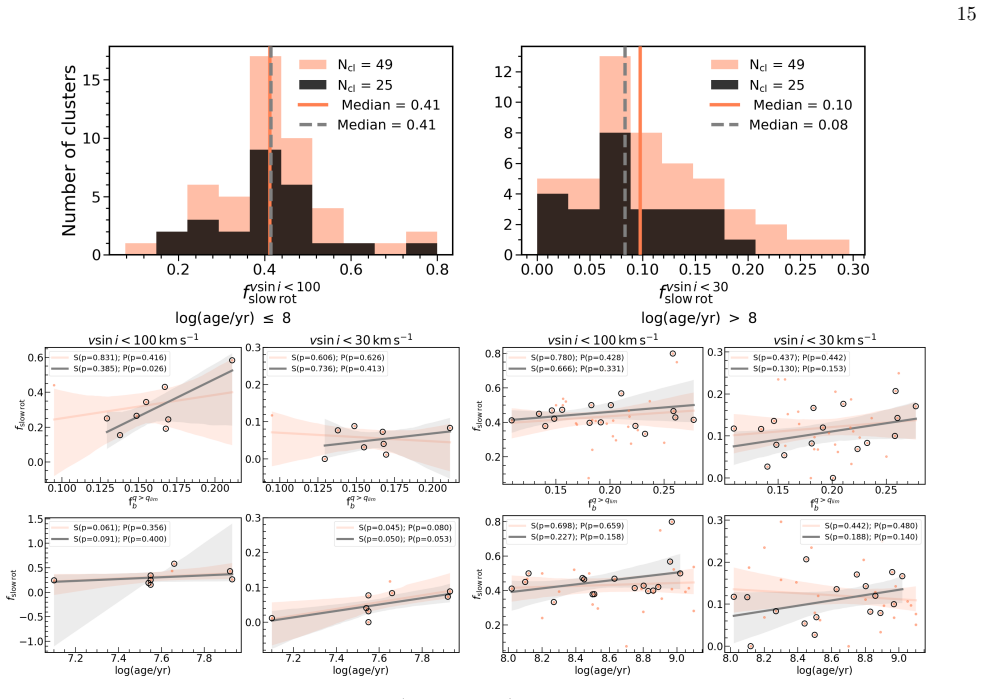
In a survey of 53 galactic open clusters, 14 with A_v ≲ 0.15 mag (Class I) exhibit a split main sequence in which fast rotators populate the redder part and slow rotators the bluer part of the main-sequence turnoff. Cluster members are identified with the ML-MOC algorithm applied to Gaia DR3 astrometry, and projected rotational velocities are drawn from Gaia ESO spectroscopy and Gaia DR3 line broadening. In the other clusters, differential extinction prevents clean color-rotation separation and inflates the MSTO width. The fraction of slow rotators satisfies a median f_slow rot^{v sin i<100} ≈ 0.41 and f_slow rot^{v sin i<30} ≈ 0.08, with no statistically significant correlation to binary or
What carries the argument
Classification of clusters into four classes based on color-rotation distribution, extinction level, and MSTO morphology, which isolates the rotation-driven split in the low-extinction subset.
Load-bearing premise
The ML-MOC algorithm plus Gaia DR3 astrometry cleanly separates true cluster members from field stars without introducing color or rotation biases that could mimic or mask the reported splits.
What would settle it
Re-running the membership selection with an independent algorithm or obtaining new spectroscopy that shows no rotation difference between the blue and red sides of the MSTO in the reported 14 clusters would falsify the central claim.
Figures




read the original abstract
The extended main sequence (eMS) and extended main sequence turnoff (eMSTO) phenomena have been observed in some young and intermediate-age star clusters in the Milky Way and in the Magellanic Clouds. In this study, we conduct a survey of 53 galactic open clusters (OCs) to investigate the roles of stellar rotation, differential extinction, and cluster properties in the emergence of eMS and eMSTO. The projected rotational velocities are taken from the Gaia ESO spectroscopic survey and the Gaia DR3 line-broadening velocities. Stellar members of each OC are identified using the ML-MOC algorithm with Gaia DR3 astrometry. We divide clusters into four classes based on the color-rotation distribution, extinction, and MSTO morphology and report 14 clusters ($A_{\rm v} \lesssim 0.15$ mag, Class I) that exhibit split MS with fast and slow rotators populating the redder and bluer parts of MSTO. For the remaining clusters, differential extinction hampers the color-rotation distinction and also inflates MSTO width and therefore introduces a systematic offset in the MSTO-age relation. We also quantify the fraction of slow rotators among MSTO stars, finding a median value of $f_{\rm slow\, rot}^{v \sin i<100} \approx 0.41$ and the fraction reaching the spin-down limit, $f_{\rm slow\, rot}^{v \sin i<30}$, is $ \approx 0.08$. We find no statistically significant correlation between $f_{\rm slow\, rot}$ and either the binary fraction or cluster age.
Editorial analysis
A structured set of objections, weighed in public.
Referee Report
Summary. The manuscript surveys 53 Galactic open clusters using Gaia DR3 astrometry and spectroscopic velocities (Gaia ESO and DR3 line-broadening) to investigate extended main-sequence turnoffs (eMSTOs). Stellar members are identified with the ML-MOC algorithm, clusters are classified into four classes based on color-rotation distributions, extinction, and MSTO morphology, and 14 low-extinction (A_v ≲ 0.15 mag) Class I clusters are reported to exhibit split main sequences with fast and slow rotators on the redder and bluer sides of the MSTO. Slow-rotator fractions are quantified (median f_slow rot^{v sin i<100} ≈ 0.41), and no statistically significant correlations are found with binary fraction or cluster age.
Significance. If the membership selection proves robust, the work supplies direct Milky Way evidence that stellar rotation drives eMSTO splits in low-extinction open clusters, extending Magellanic Cloud results to a larger, homogeneous Galactic sample. The measured slow-rotator fractions provide a useful observational benchmark for spin-down models, and the null correlations with age and binaries help narrow the parameter space for rotation-related explanations of MSTO width.
major comments (3)
- [Membership selection] Membership selection (ML-MOC applied to Gaia DR3 astrometry): no injection-recovery tests or color-binned purity/completeness estimates are reported for MSTO stars in the Class I sample. Because the headline split is diagnosed in the color-rotation plane, even modest differential field contamination correlated with color could artificially produce or suppress the reported fast/slow rotator segregation.
- [Cluster classification] Definition of Class I and rotation thresholds: the quantitative criteria separating Class I clusters (A_v ≲ 0.15 mag plus clear color-rotation split) and the exact v sin i boundaries used to label fast versus slow rotators are not stated with sufficient precision to allow reproduction or assessment of sensitivity to threshold choice.
- [Statistical analysis] Statistical analysis of correlations: the claim of no significant correlation between f_slow rot and either binary fraction or age is based on the full sample of 53 clusters, yet only 14 are Class I; the specific statistical test, effective degrees of freedom, and handling of upper limits on v sin i should be documented to evaluate the power of the null result.
minor comments (2)
- [Abstract] The abstract states the median slow-rotator fraction but does not define the v sin i < 100 km/s and < 30 km/s thresholds on first use; a brief parenthetical definition would improve clarity.
- [Figures] Figures displaying color-magnitude or color-rotation diagrams for the Class I clusters would benefit from explicit indication of membership probability or v sin i uncertainty to allow visual assessment of the robustness of the reported splits.
Simulated Author's Rebuttal
We thank the referee for their thorough review and constructive feedback on our manuscript. We address each of the major comments below and will make revisions to improve the clarity and robustness of the presented results.
read point-by-point responses
-
Referee: [Membership selection] Membership selection (ML-MOC applied to Gaia DR3 astrometry): no injection-recovery tests or color-binned purity/completeness estimates are reported for MSTO stars in the Class I sample. Because the headline split is diagnosed in the color-rotation plane, even modest differential field contamination correlated with color could artificially produce or suppress the reported fast/slow rotator segregation.
Authors: We agree that additional validation of the membership selection is important given the reliance on the color-rotation plane for identifying the split. In the revised version, we will perform and report injection-recovery tests specifically for the MSTO stars in the Class I clusters, including color-binned estimates of purity and completeness. This will help quantify any potential impact of field contamination. revision: yes
-
Referee: [Cluster classification] Definition of Class I and rotation thresholds: the quantitative criteria separating Class I clusters (A_v ≲ 0.15 mag plus clear color-rotation split) and the exact v sin i boundaries used to label fast versus slow rotators are not stated with sufficient precision to allow reproduction or assessment of sensitivity to threshold choice.
Authors: We will update the manuscript to explicitly state the quantitative criteria for Class I classification, including the precise extinction threshold and the metric used to identify a 'clear color-rotation split'. We will also specify the exact v sin i values used to define fast and slow rotators and include a brief sensitivity analysis to variations in these thresholds. revision: yes
-
Referee: [Statistical analysis] Statistical analysis of correlations: the claim of no significant correlation between f_slow rot and either binary fraction or age is based on the full sample of 53 clusters, yet only 14 are Class I; the specific statistical test, effective degrees of freedom, and handling of upper limits on v sin i should be documented to evaluate the power of the null result.
Authors: The correlation analysis was conducted on the subsample of 14 Class I clusters where reliable slow-rotator fractions could be measured. We will revise the text to clearly state this, document the statistical test employed (Spearman rank correlation coefficient), report the p-values, effective sample size, and describe how upper limits on v sin i were handled (e.g., by assigning conservative values or using appropriate statistical methods for censored data). revision: yes
Circularity Check
No circularity in derivation chain
full rationale
The paper reports direct observational classifications and statistics from Gaia DR3 astrometry processed via ML-MOC membership selection, combined with external v sin i measurements from Gaia ESO and DR3. Cluster classes are assigned by inspecting measured color-rotation distributions and extinction values; slow-rotator fractions are computed as simple counts within the selected MSTO samples. No equations, fitted parameters, or self-citations are invoked to derive the central results; the reported splits, fractions, and lack of correlations follow immediately from the input data without reduction to prior outputs or definitions within the paper itself.
Axiom & Free-Parameter Ledger
free parameters (2)
- A_v threshold =
0.15 mag
- v sin i slow-rotator thresholds =
100 km/s and 30 km/s
axioms (2)
- domain assumption ML-MOC algorithm applied to Gaia DR3 astrometry yields unbiased cluster membership lists
- domain assumption Gaia line-broadening velocities and Gaia ESO v sin i values accurately trace projected rotational velocities without significant binary contamination
Reference graph
Works this paper leans on
-
[1]
Agarwal, M., Rao, K. K., Vaidya, K., & Bhattacharya, S. 2021, MNRAS, 502, 2582, doi: 10.1093/mnras/stab118
-
[2]
Almeida, A., Monteiro, H., & Dias, W. S. 2023, MNRAS, 525, 2315, doi: 10.1093/mnras/stad2291
-
[3]
Amard, L., & Matt, S. P. 2020, ApJ, 889, 108, doi: 10.3847/1538-4357/ab6173 Astropy Collaboration, Robitaille, T. P., Tollerud, E. J., et al. 2013, A&A, 558, A33, doi: 10.1051/0004-6361/201322068
-
[4]
Bastian, N., & de Mink, S. E. 2009, MNRAS, 398, L11, doi: 10.1111/j.1745-3933.2009.00696.x
-
[5]
2020, MNRAS, 495, 1978, doi: 10.1093/mnras/staa1332
Bastian, N., Kamann, S., Amard, L., et al. 2020, MNRAS, 495, 1978, doi: 10.1093/mnras/staa1332
-
[6]
2018, MNRAS, 480, 3739, doi: 10.1093/mnras/sty2100
Bastian, N., Kamann, S., Cabrera-Ziri, I., et al. 2018, MNRAS, 480, 3739, doi: 10.1093/mnras/sty2100
-
[7]
2025, A&A, 700, A241, doi: 10.1051/0004-6361/202555369
Bastian, N., Kamann, S., Niederhofer, F., & Saracino, S. 2025, A&A, 700, A241, doi: 10.1051/0004-6361/202555369
-
[8]
2024, A&A, 687, A211, doi: 10.1051/0004-6361/202347476
Bauer-Fasching, B., Bernhard, K., Br¨ andli, E., et al. 2024, A&A, 687, A211, doi: 10.1051/0004-6361/202347476
-
[9]
Bhattacharya, S., Agarwal, M., Rao, K. K., & Vaidya, K. 2021, MNRAS, 505, 1607, doi: 10.1093/mnras/stab1404
-
[10]
2022, MNRAS, 517, 3525, doi: 10.1093/mnras/stac2906
Vaidya, K. 2022, MNRAS, 517, 3525, doi: 10.1093/mnras/stac2906
-
[11]
Boffin, H. M. J., Carraro, G., & Beccari, G., eds. 2015, Astrophysics and Space Science Library, Vol. 413, Ecology of Blue Straggler Stars, doi: 10.1007/978-3-662-44434-4
-
[12]
Bouma, L. G., Curtis, J. L., Hartman, J. D., Winn, J. N., & Bakos, G. ´A. 2021, AJ, 162, 197, doi: 10.3847/1538-3881/ac18cd
-
[13]
Bragaglia, A., Alfaro, E. J., Flaccomio, E., et al. 2022, A&A, 659, A200, doi: 10.1051/0004-6361/202142674
-
[14]
C., 2004, @doi [ ] 10.1038/nature02934 , http://adsabs.harvard.edu/abs/2004Natur.431..819B 431, 819
Braithwaite, J., et al. 2004, Nature, 431, 819, doi: 10.1038/nature02934 19 T able 2.The binary fractions and slow rotator fractions of the 53 OCs. Here, Column 1: cluster name; Columns 2, 3, and 3: limiting isochrone, transition isochrone, and transition magnitude used to estimate binary fractions; Column 4: binary fraction; Columns 5 and 6: number of MS...
-
[15]
Brandt, T. D., & Huang, C. X. 2015, ApJ, 807, 25, doi: 10.1088/0004-637X/807/1/25
-
[16]
2024, ApJ, 968, 22, doi: 10.3847/1538-4357/ad3e6e 20 T able 3.Parameters of the MSTO binaries
Bu, Y., He, C., Wang, L., Lin, J., & Li, C. 2024, ApJ, 968, 22, doi: 10.3847/1538-4357/ad3e6e 20 T able 3.Parameters of the MSTO binaries. clusterGaiaDR3 ID RA DEC G BP−RPvsiniRUWE Type PeriodeREF vsini (deg) (deg) (mag) (mag) (km s −1) (days) Melotte 22 65207709611941376 56.851821 23.914478 7.286 0.042 7±3 1.001 SB 7.3452 0 1 Melotte 22 66507469798631808...
-
[17]
Buder, S., Sharma, S., Kos, J., et al. 2021, MNRAS, 506, 150, doi: 10.1093/mnras/stab1242
-
[18]
2024, AJ, 167, 12, doi: 10.3847/1538-3881/ad07e5
Cavallo, L., Spina, L., Carraro, G., et al. 2024, AJ, 167, 12, doi: 10.3847/1538-3881/ad07e5
-
[19]
Comaniciu, D., & Meer, P. 2002, IEEE Transactions on Pattern Analysis and Machine Intelligence, 24, 603, doi: 10.1109/34.1000236
-
[20]
Cordoni, G., Milone, A. P., Marino, A. F., et al. 2018, ApJ, 869, 139, doi: 10.3847/1538-4357/aaedc1
-
[21]
2024, MNRAS, 532, 1547, doi: 10.1093/mnras/stae1569
Cordoni, G., Casagrande, L., Yu, J., et al. 2024, MNRAS, 532, 1547, doi: 10.1093/mnras/stae1569
-
[22]
2021, MNRAS, 504, 155, doi: 10.1093/mnras/stab233
Correnti, M., Goudfrooij, P., Bellini, A., & Girardi, L. 2021, MNRAS, 504, 155, doi: 10.1093/mnras/stab233
-
[23]
Puzia, T. H. 2017, MNRAS, 467, 3628, doi: 10.1093/mnras/stx010
-
[24]
Deng, Y.-Y., & Li, Z.-M. 2024, Research in Astronomy and Astrophysics, 24, 065004, doi: 10.1088/1674-4527/ad3dc5 Ekstr¨ om, S., Georgy, C., Eggenberger, P., et al. 2012, A&A, 537, A146, doi: 10.1051/0004-6361/201117751 Espinosa Lara, F., & Rieutord, M. 2011, A&A, 533, A43, doi: 10.1051/0004-6361/201117252
-
[25]
Eyer, L., Audard, M., Holl, B., et al. 2023, A&A, 674, A13, doi: 10.1051/0004-6361/202244242
-
[26]
R., Mucciarelli, A., Lanzoni, B., et al
Ferraro, F. R., Mucciarelli, A., Lanzoni, B., et al. 2023, Nature Communications, 14, 2584, doi: 10.1038/s41467-023-38153-w Fr´ emat, Y., Royer, F., Marchal, O., et al. 2023, A&A, 674, A8, doi: 10.1051/0004-6361/202243809
-
[27]
2019, A&A, 625, A89, doi: 10.1051/0004-6361/201832581 Gaia Collaboration, Brown, A
Gagnier, D., Rieutord, M., Charbonnel, C., Putigny, B., & Espinosa Lara, F. 2019, A&A, 625, A89, doi: 10.1051/0004-6361/201832581 Gaia Collaboration, Brown, A. G. A., Vallenari, A., et al. 2018, A&A, 616, A1, doi: 10.1051/0004-6361/201833051 Gaia Collaboration, Vallenari, A., & et al. 2023, A&A, 674, A1, doi: 10.1051/0004-6361/202243940
-
[28]
2023, A&A, 674, A22, doi: 10.1051/0004-6361/202244367
Gavras, P., Rimoldini, L., Nienartowicz, K., et al. 2023, A&A, 674, A22, doi: 10.1051/0004-6361/202244367
-
[29]
2019, A&A, 622, A66, doi: 10.1051/0004-6361/201834505
Georgy, C., Charbonnel, C., Amard, L., et al. 2019, A&A, 622, A66, doi: 10.1051/0004-6361/201834505
-
[30]
Gilmore, G., Randich, S., & et al. 2022, A&A, 666, A120, doi: 10.1051/0004-6361/202243134
-
[31]
Ginsburg, A., Sip˝ ocz, B. M., Brasseur, C. E., et al. 2019, AJ, 157, 98, doi: 10.3847/1538-3881/aafc33
-
[32]
Glatt, K., Grebel, E. K., Sabbi, E., et al. 2008, AJ, 136, 1703, doi: 10.1088/0004-6256/136/4/1703 G l¸ ebocki, R., & Gnaci´ nski, P. 2005, in ESA Special
-
[33]
2024, ApJ, 972, 137, doi: 10.3847/1538-4357/ad5282
Gootkin, K., Hon, M., Huber, D., et al. 2024, ApJ, 972, 137, doi: 10.3847/1538-4357/ad5282
-
[34]
2011, ApJ, 737, 3, doi: 10.1088/0004-637X/737/1/3
Chandar, R. 2011, ApJ, 737, 3, doi: 10.1088/0004-637X/737/1/3
-
[35]
Harris, C. R., Millman, K. J., van der Walt, S. J., et al. 2020, Nature, 585, 357, doi: 10.1038/s41586-020-2649-2
-
[36]
2025, ApJ, 979, 246, doi: 10.3847/1538-4357/ad9de3
He, C., Li, C., & Li, G. 2025, ApJ, 979, 246, doi: 10.3847/1538-4357/ad9de3
-
[37]
2023, MNRAS, 525, 5880, doi: 10.1093/mnras/stad2674
He, C., Li, C., Sun, W., et al. 2023, MNRAS, 525, 5880, doi: 10.1093/mnras/stad2674
-
[38]
Hunter, J. D. 2007, Computing in Science & Engineering, 9, 90, doi: 10.1109/MCSE.2007.55
-
[39]
V., Roy, K., Joshi, N., & Subramaniam, A
Jadhav, V. V., Roy, K., Joshi, N., & Subramaniam, A. 2021, AJ, 162, 264, doi: 10.3847/1538-3881/ac2571
-
[40]
2024, ApJ, 971, 71, doi: 10.3847/1538-4357/ad5344
Jiang, Y., Zhong, J., Qin, S., et al. 2024, ApJ, 971, 71, doi: 10.3847/1538-4357/ad5344
-
[41]
2021, MNRAS, 508, 2302, doi: 10.1093/mnras/stab2643
Saracino, S. 2021, MNRAS, 508, 2302, doi: 10.1093/mnras/stab2643
-
[42]
2020, MNRAS, 492, 2177, doi: 10.1093/mnras/stz3583 21
Kamann, S., Bastian, N., Gossage, S., et al. 2020, MNRAS, 492, 2177, doi: 10.1093/mnras/stz3583 21
-
[43]
2023, MNRAS, 518, 1505, doi: 10.1093/mnras/stac3170
Kamann, S., Saracino, S., Bastian, N., et al. 2023, MNRAS, 518, 1505, doi: 10.1093/mnras/stac3170
-
[44]
2025, MNRAS, 542, 2768, doi: 10.1093/mnras/staf1371
Kamann, S., Bastian, N., Niederhofer, F., et al. 2025, MNRAS, 542, 2768, doi: 10.1093/mnras/staf1371
-
[45]
2022, MNRAS, 517, 2028, doi: 10.1093/mnras/stac2598
Keszthelyi, Z., et al. 2022, MNRAS, 517, 2028, doi: 10.1093/mnras/stac2598
-
[46]
2025, A&A, 698, A27, doi: 10.1051/0004-6361/202553956
Leanza, S., Dalessandro, E., Cadelano, M., et al. 2025, A&A, 698, A27, doi: 10.1051/0004-6361/202553956
-
[47]
2014, Nature, 516, 367, doi: 10.1038/nature13969
Li, C., de Grijs, R., & Deng, L. 2014, Nature, 516, 367, doi: 10.1038/nature13969
-
[48]
2019, ApJ, 876, 65, doi: 10.3847/1538-4357/ab15d2
Li, C., Sun, W., de Grijs, R., et al. 2019, ApJ, 876, 65, doi: 10.3847/1538-4357/ab15d2
-
[49]
2020, MNRAS, 497, 4363, doi: 10.1093/mnras/staa2266
Li, G., Guo, Z., Fuller, J., et al. 2020, MNRAS, 497, 4363, doi: 10.1093/mnras/staa2266
-
[50]
2026, ApJL, 996, L42, doi: 10.3847/2041-8213/ae3008
Li, Z., Jia, S., Wei, D., et al. 2026, ApJL, 996, L42, doi: 10.3847/2041-8213/ae3008
-
[51]
2009, A&A, 508, 1375, doi: 10.1051/0004-6361/200913311
Maceroni, C., Montalb´ an, J., Michel, E., et al. 2009, A&A, 508, 1375, doi: 10.1051/0004-6361/200913311
-
[52]
Mackey, A. D., & Broby Nielsen, P. 2007, MNRAS, 379, 151, doi: 10.1111/j.1365-2966.2007.11915.x
-
[53]
Richardson, J. C. 2008, ApJL, 681, L17, doi: 10.1086/590343
-
[54]
Annual Review of Astronomy and Astrophysics , author =
Maeder, A., & Meynet, G. 2000, ARA&A, 38, 143, doi: 10.1146/annurev.astro.38.1.143
-
[55]
Marino, A. F., Milone, A. P., Casagrande, L., et al. 2018a, ApJL, 863, L33, doi: 10.3847/2041-8213/aad868
-
[56]
Marino, A. F., Przybilla, N., Milone, A. P., et al. 2018b, AJ, 156, 116, doi: 10.3847/1538-3881/aad3cd
-
[57]
Annual Review of Astronomy and Astrophysics , author =
Mathieu, R. D., & Pols, O. R. 2025, ARA&A, 63, 467, doi: 10.1146/annurev-astro-071221-054402
-
[58]
Maurya, J., Samal, M. R., Amard, L., et al. 2024, MNRAS, 532, 1212, doi: 10.1093/mnras/stae1611
-
[59]
2025, ApJ, 989, 123, doi: 10.3847/1538-4357/adef40
Maurya, J., Zhang, Y., Kamann, S., et al. 2025, ApJ, 989, 123, doi: 10.3847/1538-4357/adef40
-
[60]
Milone, A. P., Bedin, L. R., Piotto, G., & Anderson, J. 2009, A&A, 497, 755, doi: 10.1051/0004-6361/200810870
-
[61]
Milone, A. P., Bedin, L. R., Piotto, G., et al. 2015, MNRAS, 450, 3750, doi: 10.1093/mnras/stv829
-
[62]
2024, MNRAS, 534, 3022, doi: 10.1093/mnras/stae2226
Mani, P. 2024, MNRAS, 534, 3022, doi: 10.1093/mnras/stae2226
-
[63]
2017, MNRAS, 468, 2745, doi: 10.1093/mnras/stx674
Netopil, M., Paunzen, E., H¨ ummerich, S., & Bernhard, K. 2017, MNRAS, 468, 2745, doi: 10.1093/mnras/stx674
-
[64]
Nguyen, C. T., Costa, G., Girardi, L., et al. 2022, A&A, 665, A126, doi: 10.1051/0004-6361/202244166
-
[65]
T., Costa, G., Bressan, A., et al
Nguyen, C. T., Costa, G., Bressan, A., et al. 2025, A&A, 701, A258, doi: 10.1051/0004-6361/202556005
-
[66]
2015, MNRAS, 453, 2070, doi: 10.1093/mnras/stv1791
Niederhofer, F., Georgy, C., Bastian, N., & Ekstr¨ om, S. 2015, MNRAS, 453, 2070, doi: 10.1093/mnras/stv1791
-
[67]
2024, MNRAS, 527, 10335, doi: 10.1093/mnras/stad3887
Panthi, A., & Vaidya, K. 2024, MNRAS, 527, 10335, doi: 10.1093/mnras/stad3887
-
[68]
Platais, I., Melo, C., Quinn, S. N., et al. 2012, ApJL, 751, L8, doi: 10.1088/2041-8205/751/1/L8
-
[69]
Randich, S., Gilmore, G., & et al. 2022, A&A, 666, A121, doi: 10.1051/0004-6361/202243141
-
[70]
Monthly Notices of the Royal Astronomical Society: Letters , author =
Rao, K. K., Bhattacharya, S., Vaidya, K., & Agarwal, M. 2023a, MNRAS, 518, L7, doi: 10.1093/mnrasl/slac122
-
[71]
Rao, K. K., & Chen, W.-P. 2025, arXiv e-prints, arXiv:2512.05458, doi: 10.48550/arXiv.2512.05458
-
[72]
2023b, MNRAS, 526, 1057, doi: 10.1093/mnras/stad2755
Bhattacharya, S. 2023b, MNRAS, 526, 1057, doi: 10.1093/mnras/stad2755
-
[73]
K., Vaidya, K., Agarwal, M., et al
Rao, K. K., Vaidya, K., Agarwal, M., et al. 2022, MNRAS, 516, 2444, doi: 10.1093/mnras/stac2241
- [74]
-
[75]
2, 430–448, doi: 10.1016/B978-0-443-21439-4.00042-0
Astrophysics, Vol. 2, 430–448, doi: 10.1016/B978-0-443-21439-4.00042-0
-
[76]
Rucinski, S. M., Kuschnig, R., Matthews, J. M., et al. 2007, MNRAS, 380, L63, doi: 10.1111/j.1745-3933.2007.00349.x
-
[77]
See, V., Lu, Y. L., Amard, L., & Roquette, J. 2024, MNRAS, 533, 1290, doi: 10.1093/mnras/stae1828
-
[78]
O., P´ erez-Villegas, A., Dias, B., et al
Souza, S. O., P´ erez-Villegas, A., Dias, B., et al. 2025, A&A, 701, A221, doi: 10.1051/0004-6361/202555201
-
[79]
Sun, W., de Grijs, R., Deng, L., & Albrow, M. D. 2019a, ApJ, 876, 113, doi: 10.3847/1538-4357/ab16e4
-
[80]
2019b, ApJ, 883, 182, doi: 10.3847/1538-4357/ab3cd0
Sun, W., Li, C., Deng, L., & de Grijs, R. 2019b, ApJ, 883, 182, doi: 10.3847/1538-4357/ab3cd0
discussion (0)
Sign in with ORCID, Apple, or X to comment. Anyone can read and Pith papers without signing in.