Recognition: 2 theorem links
· Lean TheoremEHT-Constrained Analysis of Shadow Deformation in Quantum-Improved Rotating Non-Singular Magnetic Monopole
Pith reviewed 2026-05-10 19:49 UTC · model grok-4.3
The pith
In a quantum-improved rotating Bardeen black hole, rising asymptotic safety and spin parameters shrink the apparent shadow while increasing its distortion.
A machine-rendered reading of the paper's core claim, the machinery that carries it, and where it could break.
Core claim
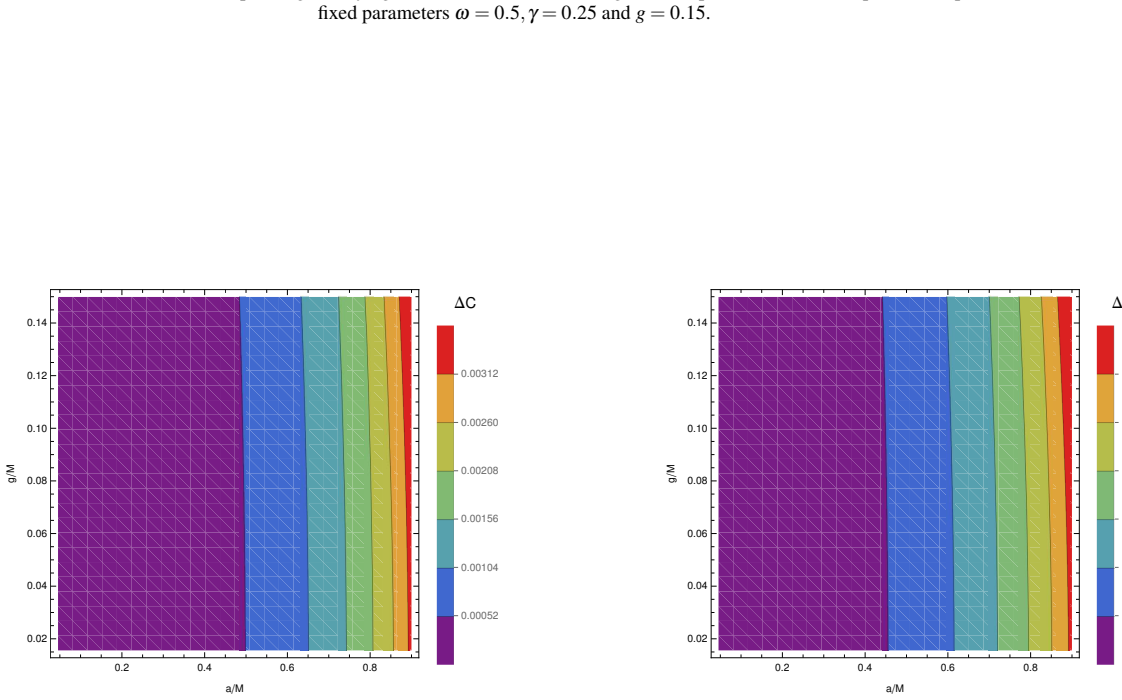
We studied the shadow cast by a rotating Bardeen black hole within the framework of asymptotically safe gravity. The null geodesics were analyzed using the Hamilton-Jacobi separation method to derive shadow observables. Our findings show that an increase in both the asymptotic safety parameter and the spin parameter leads to a decrease in the apparent shadow size and an increase in shadow distortion. The monopole charge of the black hole played an important role in the shadow profile. Furthermore, we compute the energy emission rate associated with varying values of the asymptotic safety parameter.
What carries the argument
Hamilton-Jacobi separation of null geodesics in the rotating Bardeen metric of asymptotically safe gravity, used to extract shadow observables such as radius and distortion.
If this is right
- Apparent shadow size decreases with increasing asymptotic safety parameter and spin.
- Shadow distortion increases with the same two parameters.
- Monopole charge exerts a controlling influence on the overall shadow profile.
- Energy emission rate changes measurably as the asymptotic safety parameter is varied.
Where Pith is reading between the lines
- Higher-resolution future EHT arrays could place quantitative upper bounds on the asymptotic safety parameter from shadow data alone.
- The same geodesic-separation technique could be applied to other quantum-corrected rotating metrics to generate comparative shadow templates.
- If the reported trends hold, shadow observations would provide an independent route to test whether black holes carry a magnetic-monopole charge.
Load-bearing premise
The rotating Bardeen metric in asymptotically safe gravity is taken as the exact background spacetime whose null geodesics can be separated and compared directly with EHT shadow observables.
What would settle it
EHT measurements showing that shadow size fails to decrease or that distortion fails to increase when the spin or asymptotic safety parameter is independently varied would contradict the reported relations.
Figures


read the original abstract
We studied the shadow cast by a rotating Bardeen black hole within the framework of asymptotically safe gravity. The null geodesics were analyzed using the Hamilton Jacobi separation method to derive shadow observables. Our findings show that an increase in both the asymptotic safety parameter and the spin parameter leads to a decrease in the apparent shadow size and an increase in shadow distortion. The monopole charge of the black hole played an important role in the shadow profile. Furthermore, we compute the energy emission rate associated with varying values of the asymptotic safety parameter.
Editorial analysis
A structured set of objections, weighed in public.
Referee Report
Summary. The paper analyzes the shadow cast by a rotating Bardeen black hole in asymptotically safe gravity. Null geodesics are treated via the Hamilton-Jacobi separation method to obtain shadow observables; the central results are that increasing the asymptotic-safety parameter and the spin parameter both shrink the apparent shadow radius and increase its distortion, while the monopole charge shapes the overall profile. The energy emission rate is also computed as a function of the asymptotic-safety parameter.
Significance. If the separability assumption holds and the derived observables are robust, the work supplies concrete, falsifiable trends that could be used to place EHT-based bounds on the asymptotic-safety parameter in a regular, non-singular rotating spacetime. The explicit inclusion of the monopole charge and the energy-emission calculation are additional strengths that enlarge the set of testable predictions.
major comments (2)
- [Geodesic analysis / Hamilton-Jacobi separation] The central trends (shadow radius decreases and distortion increases with the asymptotic-safety parameter) rest on the claim that the Hamilton-Jacobi equation separates for the rotating, AS-improved Bardeen metric. No explicit verification is supplied that a Carter constant still exists or that the θ-equation remains independent of the radial functions once the AS modifications are inserted. Without this check, the analytic impact-parameter expressions used to extract size and distortion are uncontrolled.
- [Metric construction] The rotating metric is obtained by applying the Newman-Janis algorithm to the non-rotating AS-improved Bardeen solution. It is not shown that the resulting line element retains the precise functional form (g_{tφ}, Δ, etc.) required for separability; any deviation introduced by the running-G or other AS corrections would invalidate the separation constants and therefore the reported shadow observables.
minor comments (2)
- The abstract states that the analysis is 'EHT-constrained,' yet the text provides no quantitative comparison (e.g., χ² fits or allowed ranges) against the published M87* or Sgr A* shadow diameters and asymmetries. Adding such a direct confrontation would make the constraint claim concrete.
- No numerical error estimates, convergence tests, or resolution checks are reported for the ray-tracing or boundary-finding procedure used to extract the shadow silhouette. These are needed to assess the reliability of the quoted size and distortion trends.
Simulated Author's Rebuttal
We thank the referee for the careful and constructive review of our manuscript on the shadow of a rotating Bardeen black hole in asymptotically safe gravity. The comments on geodesic separability and metric construction are well taken, and we address them point by point below. We are happy to revise the manuscript to incorporate explicit verifications that strengthen the presentation.
read point-by-point responses
-
Referee: [Geodesic analysis / Hamilton-Jacobi separation] The central trends (shadow radius decreases and distortion increases with the asymptotic-safety parameter) rest on the claim that the Hamilton-Jacobi equation separates for the rotating, AS-improved Bardeen metric. No explicit verification is supplied that a Carter constant still exists or that the θ-equation remains independent of the radial functions once the AS modifications are inserted. Without this check, the analytic impact-parameter expressions used to extract size and distortion are uncontrolled.
Authors: We acknowledge that the original manuscript did not include an explicit step-by-step verification of separability after inserting the asymptotic-safety modifications. The AS parameter enters the metric through a radially dependent running of the gravitational coupling that modifies the effective mass function while preserving the overall Kerr-like structure. Consequently, the Hamilton-Jacobi equation continues to admit a Carter constant, and the θ-equation decouples from the radial functions. To make this fully transparent, we will add a dedicated subsection (or appendix) that explicitly derives the separation constants and confirms the independence of the θ-equation for the AS-improved metric. This addition will not alter the reported trends but will place them on firmer analytic ground. revision: yes
-
Referee: [Metric construction] The rotating metric is obtained by applying the Newman-Janis algorithm to the non-rotating AS-improved Bardeen solution. It is not shown that the resulting line element retains the precise functional form (g_{tφ}, Δ, etc.) required for separability; any deviation introduced by the running-G or other AS corrections would invalidate the separation constants and therefore the reported shadow observables.
Authors: The Newman-Janis algorithm was applied to the static AS-improved Bardeen line element in the standard manner, with the AS corrections absorbed into the mass function M(r). The resulting rotating metric retains the required functional dependence: Δ remains a function of r only, g_{tφ} has the standard cross-term structure, and no angular-dependent corrections appear in the metric coefficients that would spoil separability. We agree, however, that an explicit display of the full metric components and a short demonstration that the AS modifications do not introduce non-separable terms would eliminate any ambiguity. We will include this explicit metric form and verification in the revised manuscript. revision: yes
Circularity Check
No significant circularity: derivation rests on metric assumption and geodesic separation rather than self-referential fitting or definition
full rationale
The paper takes the rotating Bardeen metric in asymptotically safe gravity as given background, applies Hamilton-Jacobi separation to obtain null geodesic constants of motion, and computes shadow observables (radius, distortion) as functions of the asymptotic-safety parameter, spin, and monopole charge. These quantities are then compared to EHT data for constraints, but the observables are not defined in terms of themselves or fitted back into the input parameters. No equation reduces a claimed prediction to a quantity constructed from the same fit; the separability step is asserted but does not create a closed loop with the reported trends. Self-citations, if present, are not load-bearing for the central shadow-size and distortion results.
Axiom & Free-Parameter Ledger
free parameters (2)
- asymptotic safety parameter
- monopole charge
axioms (2)
- domain assumption The spacetime is described by the rotating Bardeen metric modified by asymptotic-safety corrections.
- domain assumption Null geodesics can be separated by the Hamilton-Jacobi method in this spacetime.
Lean theorems connected to this paper
-
IndisputableMonolith/Cost/FunctionalEquation.leanwashburn_uniqueness_aczel unclear?
unclearRelation between the paper passage and the cited Recognition theorem.
The null geodesics were analyzed using the Hamilton–Jacobi separation method to derive shadow observables... increase in both the asymptotic safety parameter (ω) and the spin parameter (a) leads to a decrease in the apparent shadow size
-
IndisputableMonolith/Foundation/RealityFromDistinction.leanreality_from_one_distinction unclear?
unclearRelation between the paper passage and the cited Recognition theorem.
G(r) = G0 r² / (r² + w̄ G0) ... cutoff identification k = γ / r
What do these tags mean?
- matches
- The paper's claim is directly supported by a theorem in the formal canon.
- supports
- The theorem supports part of the paper's argument, but the paper may add assumptions or extra steps.
- extends
- The paper goes beyond the formal theorem; the theorem is a base layer rather than the whole result.
- uses
- The paper appears to rely on the theorem as machinery.
- contradicts
- The paper's claim conflicts with a theorem or certificate in the canon.
- unclear
- Pith found a possible connection, but the passage is too broad, indirect, or ambiguous to say the theorem truly supports the claim.
Forward citations
Cited by 2 Pith papers
-
Families of regular spacetimes and energy conditions
A classification of admissible energy density profiles with bounded Kretschmann scalar produces families of regular static spherically symmetric spacetimes in GR, including new closed-form solutions involving hypergeo...
-
Families of regular spacetimes and energy conditions
A classification of admissible energy density profiles with bounded Kretschmann scalar yields a unified framework for regular static spherically symmetric spacetimes satisfying the weak energy condition, recovering kn...
Reference graph
Works this paper leans on
-
[1]
The corresponding energy emission rate is studied in Section 6
In Section 4, we analyse the effective potential governin g photon motion, followed by the computation and visualisation of black hole shadows in Section 5. The corresponding energy emission rate is studied in Section 6. Finally, in Section 7, we employ observational data to place constraints on the black hole shadow and the underlying model parameters. I...
-
[2]
In the context of Quantum Ein- stein Gravity (QEG), this idea is implemented through the Eu - clidean path integral over metric configurations, starting from a specified action S
The Running Newton Constant The effective average action Γ k is constructed by integrat- ing out quantum fluctuations with momenta that are above the infrared cutoff scale k[ 59]. In the context of Quantum Ein- stein Gravity (QEG), this idea is implemented through the Eu - clidean path integral over metric configurations, starting from a specified action S. ...
-
[3]
is inserted into the ERGE ( 2), the flow equation reduces to a pair of cou- pled differential equations of dimensionless Newton coupl ing and the dimensionless cosmological constant. These quanti - ties are introduced as follows: gk ≡ kd− 2Gk, λ k ≡ k− 2 ¯λ k, as derived in [ 21, 26]: ∂ t g = (d − 2 + η N) g, (5) and ∂ t λ = − (2 − η N) λ + 1 2 g(4π )(1− d...
-
[4]
into definitions ( 9) and (10) leads to, Φ 1 1 (0) = π 2 6 , Φ 2 2 (0) = 1 ˜Φ 1 1 (0) = 1, ˜Φ 2 2 (0) = 1 2 4 and, B1 = π 18 − 8 π , B2 = 2 3π , (16) with these expressions for B1 and B2, we substitute ( 13) in (12) to obtain the following expression for the β -function β (g) = 2g ( 1 − ( B2 − 1 2 B1 ) g 1 − B2g ) , (17) with the following definitions w ≡ −...
-
[5]
These run toward the infrared (IR) fixed point gIR ∗ = 0 as k → 0
Flows for which g(k) remains negative at all scales. These run toward the infrared (IR) fixed point gIR ∗ = 0 as k → 0
-
[6]
Flows satisfying g(k) > gUV ∗ for all k, which are driven into the UV fixed point gUV ∗ = 1/ ω ′ in the limit k → ∞
-
[7]
These interpolate between two fixed points: they approach gIR ∗ as k → 0 and tend towards gUV ∗ for k → ∞
Flows that evolve entirely within band g(k) ∈ [0,gUV ∗ ]. These interpolate between two fixed points: they approach gIR ∗ as k → 0 and tend towards gUV ∗ for k → ∞ . The first group corresponds to an unphysical scenario be- cause it requires a negative Newton constant, whereas the se c- ond group does not match the low-energy sector. Therefore, only the tra...
-
[8]
Cutoff Identification Drawing inspiration from the renormalization group treat- ment of the Uehling correction to the Coulomb potential in 5 QED where the RG scale k is linked to the inverse radial dis- tance r [62, 63] we employ an analogous identification in the gravitational setting. In this approach, the running scale k is tied directly to the geometric...
-
[9]
¯w is proportional to ¯h, reflecting its quantum origin
-
[10]
¯w is the only constant in ( 29) that governs the scale de- pendence of G
-
[11]
In general, the explicit form of d(P) depends on the choice of integration path C
In the classical limit ¯ w = 0, the standard Newton con- stant is recovered, G(P) = G0. In general, the explicit form of d(P) depends on the choice of integration path C . However, for spherically symmetric space-times, the path can be Considered as a straight line from the origin to P, in which case d(P) depends solely on the radial coordinate r through ...
-
[12]
(66) Thus, the radial component of the WEC is always satisfied
Radial Condition Using pr = − E , we immediately obtain E + pr = 0. (66) Thus, the radial component of the WEC is always satisfied
-
[13]
Energy Density Condition The condition E ≥ 0 requires G(r)ρ ′(r) +ρ (r)G′(r) ≥ 0. (67) This expression consists of two contributions: • A classical term G(r)ρ ′(r) arising from the Bardeen profile, • A correction term ρ (r)G′(r) induced by the running Newton coupling
-
[14]
(69) 8 This expression depends on two key structures: Gρ ′+ ρ G′, Gρ ′′+ 2ρ ′G′+ ρ G′′
Tangential Condition The non-trivial condition is E + pθ ≥ 0, (68) which yields E + p θ = 2E − 1 8π Σ [ 2(Gρ ′+ ρ G′) +r(Gρ ′′+ 2ρ ′G′+ ρ G′′) ] . (69) 8 This expression depends on two key structures: Gρ ′+ ρ G′, Gρ ′′+ 2ρ ′G′+ ρ G′′. (70) The second term introduces higher-derivative corrections aris- ing purely from the running of the Newton coupling. At...
-
[15]
The Foundation of the General Theory of Relati v- ity,
A. Einstein, “The Foundation of the General Theory of Relati v- ity,” Annalen der Physik 49 (1916) 769–822
1916
-
[16]
Black holes in general relativity
Hawking, S.W. Black holes in general relativity. Com- mun.Math. Phys. 25, 152–166 (1972)
1972
-
[17]
K. Schwarzschild, ¨Uber das Gravitationsfeld eines Massen- punktes nach der Einsteinschen Theorie, Sitzungsberichte der K¨ oniglich Preußischen Akademie der Wissenschaften (Berlin), 1916, pp. 189–196
1916
-
[18]
(1916) ¨Uber die Eigengravitation des elektrischen Feldes nach der Einsteinschen Theorie
Reissner, H. (1916) ¨Uber die Eigengravitation des elektrischen Feldes nach der Einsteinschen Theorie. Annalen der Physik, 355, 106-120
1916
-
[19]
1238-1245
Gunnar Nordstr¨ om, On the Energy of the Gravitation field in Einstein’s Theory, in: KNAW, Proceedings, 20 II, 1918, Ams- terdam, 1918, pp. 1238-1245
1918
-
[20]
J. R. Oppenheimer and H. Snyder,On Continued Gravitational Contraction,Phys. Rev., 56(5), 455–459, Sep 1939
1939
-
[21]
R. P . Kerr,Gravitational Field of a Spinning Mass as an Example of Algebraically Special Metrics, Phys. Rev. Lett., 11(5), 237– 238, Sep 1963
1963
-
[22]
E. T. Newman, E. Couch, K. Chinnapared, A. Exton, A. Prakash, R. Torrence; Metric of a Rotating, Charged Mass. J. Math. Phys. 1 June 1965; 6 (6): 918–919. 13
1965
-
[23]
Constraining the spin and the deformation parameters from the black hole shadow
N. Tsukamoto, Z. Li, and C. Bambi, “Constraining the spin and the deformation parameters from the black hole shadow,” JCA P 06, 043 (2014), arXiv:1403.0371 [gr-qc]
work page Pith review arXiv 2014
-
[24]
Black hole shadow in a general rotating space - time obtained by the Newman–Janis algorithm,
N. Tsukamoto, “Black hole shadow in a general rotating space - time obtained by the Newman–Janis algorithm,” Phys. Rev. D 97, 064021 (2018), arXiv:1708.07427 [gr-qc]
-
[25]
Israel,Gravitational Collapse and Causality,Phys
W. Israel,Gravitational Collapse and Causality,Phys. Rev ., 153(5), 1388–1393, Jan 1967
1967
-
[26]
Carter,Axisymmetric Black Hole Has Only Two Degrees of Freedom,Phys
B. Carter,Axisymmetric Black Hole Has Only Two Degrees of Freedom,Phys. Rev. Lett., 26(6), 331–333, Feb 1971
1971
-
[27]
D. C. Robinson,Uniqueness of the Kerr Black Hole,Phys. Rev. Lett., 34(14), 905–906, Apr 1975
1975
-
[28]
Testing the nature of dark compact objects: a status report,
V . Cardoso and P . Pani, Testing the nature of dark compact ob- jects: a status report, Living Reviews in Relativity 22 (2019) 4, doi:10.1007/s41114-019-0020-4, arXiv:1904.05363 [gr-qc]
-
[29]
R. Shaikh, Testing black hole mimickers with the Event Hori- zon Telescope image of Sagittarius A ∗, Mon. Not. R. Astron. Soc. 523 (2023) 375–384, doi:10.1093/mnras/stad1383
-
[30]
N. D. Birrell and P . C. W. Davies, Quantum Fields in Curved Space (Cambridge University Press, Cambridge, 1982)
1982
-
[31]
The ultraviolet behavior of Einstein g rav- ity,
Sagnotti, A. (1986) “The ultraviolet behavior of Einstein g rav- ity,” Nucl.Phys. B266 (1986) 709. Elsevier
1986
-
[32]
O. Aharony and T. Banks, Note on the quantum mechan- ics of M theory, J. High Energy Phys. 9903 (1999) 016, doi:10.1088/1126-6708/1999/03/016, arXiv:hep-th/9812237
-
[33]
’t Hooft and M
G. ’t Hooft and M. V eltman, One-loop divergencies in the the- ory of gravitation, Annales de l’Institut Henri Poincar´ e A 20 (1974) 69–94
1974
-
[34]
Weinberg, Ultraviolet Divergences in Quantum Theories o f Gravitation, in General Relativity: An Einstein Centenary Sur- vey, edited by S
S. Weinberg, Ultraviolet Divergences in Quantum Theories o f Gravitation, in General Relativity: An Einstein Centenary Sur- vey, edited by S. W. Hawking and W. Israel (Cambridge Uni- versity Press, Cambridge, 1979, pp. 790-831)
1979
-
[35]
Reuter, Nonperturbative evolution equation for quan- tum gravity, Phys
M. Reuter, Nonperturbative evolution equation for quantum gravity, Phys. Rev. D 57 (1998) 971–985, doi:10.1103/PhysRevD.57.971, arXiv:hep-th/9605030
-
[36]
Percacci, Asymptotic Safety, in Approaches to Quantum Gravity: Toward a New Understanding of Space, Time and Matter, edited by D
R. Percacci, Asymptotic Safety, in Approaches to Quantum Gravity: Toward a New Understanding of Space, Time and Matter, edited by D. Oriti (Cambridge University Press, Cam - bridge, 2009, pp. 111-128)
2009
-
[37]
Niedermaier and M
M. Niedermaier and M. Reuter, The asymptotic safety scenari o in quantum gravity, Living Reviews in Relativity 9, 5 (2006)
2006
-
[38]
A. Eichhorn, Status of the asymptotic safety paradigm for quantum gravity and matter, F oundations of Physics 48 (2018) 1407–1429, doi:10.1007/s10701-018-0196-6
-
[39]
Percacci, An Introduction to Covariant Quantum Gravity and Asymptotic Safety (World Scientific, 2017)
R. Percacci, An Introduction to Covariant Quantum Gravity and Asymptotic Safety (World Scientific, 2017)
2017
-
[40]
M. Reuter and F. Saueressig, Renormalization group flow of quantum gravity in the Einstein–Hilbert truncation, Phys. Rev. D 65 (2002) 065016, doi:10.1103/PhysRevD.65.065016, arXiv:hep-th/0110054
-
[41]
D. F. Litim, On fixed points of quantum gravity, AIP Conf. Proc. 841 (2006) 322–329, doi:10.1063/1.2218173, arXiv:hep- th/0606044
-
[42]
K. Falls, D. F. Litim, K. Nikolakopoulos, and C. Rahmede, Asymptotic safety of quantum gravity beyond Ricci scalars, Phys. Rev. D 93 (2016) 104022, doi:10.1103/PhysRevD.93.104022, arXiv:1601.07696 [hep - th]
-
[43]
Donoghue, Leading Quantum Correction to the Newtonian Poten- tial, Phys
J. Donoghue, Leading Quantum Correction to the Newtonian Poten- tial, Phys. Rev. Lett. 72, 2996, (1994); General Rela - tivity as an Ef- fective Field Theory: The Leading Quantum Corrections, Phys. Rev. D 50, 3874, (1994)
1994
-
[44]
A. Bonanno and F. Saueressig, Asymptotically safe gravity a nd black holes, Comptes Rendus Physique 13 (2012) 566–577, doi:10.1016/j.crhy.2012.02.002, arXiv:1202.5291 [gr-qc]
-
[45]
G. Narain and R. Percacci, Renormalization group flow in scalar–tensor theories. I, Class. Quantum Grav. 27 (2010) 075001, doi:10.1088/0264-9381/27/7/075001, arXiv:0911.0386 [hep-th]
-
[46]
D. F. Litim, Renormalisation group and the Planck scale, Phil. Trans. R. Soc. A 369 (2011) 2759–2778, doi:10.1098/rsta.2011.0103, arXiv:1102.4624 [hep-th]
-
[47]
K. Falls and D. F. Litim, Black hole thermodynamics under the microscope, Phys. Rev. D 89 (2014) 084002, doi:10.1103/PhysRevD.89.084002, arXiv:1212.1821 [gr-qc]
-
[48]
M. Shaposhnikov and C. Wetterich, Asymptotic safety of gravity and the Higgs boson mass, Phys. Lett. B 683 (2010) 196–200, doi:10.1016/j.physletb.2009.12.022, arXiv:0912.0208 [hep-th]
-
[49]
2009.A Statistical Learning Perspective of Genetic Programming
M. Reuter and F. Saueressig, Quantum Einstein Gravity, Lect. Notes Phys. 863 (2013) 185–223, doi:10.1007/978-3-642- 33036-2 4, arXiv:1202.2274 [hep-th]
-
[50]
H. W. Hamber, Quantum Gravitation: The Feynman Path Integral Approach (Springer-V erlag, Berlin, 2009), doi:10.1007/978-3-540-85293-9
-
[51]
R. Percacci and D. Perini, Constraints on matter from asymptotic safety, Phys. Rev. D 67 (2003) 081503, doi:10.1103/PhysRevD.67.081503, arXiv:hep-th/0207033
-
[52]
K. Falls, D. F. Litim, and A. Raghuraman, Black holes and asymptotically safe gravity, Int. J. Mod. Phys. A 27 (2012) 1250019, doi:10.1142/S0217751X12500194, arXiv:1002.02 60 [hep-th]
-
[53]
O. Ruiz and E. Tuiran, Nonperturbative quantum cor- rection to the Reissner–Nordstr¨ om spacetime with run- ning Newton’s constant, Phys. Rev. D 107 (2023) 066003, doi:10.1103/PhysRevD.107.066003
-
[54]
Quantum Schwarzschild geometry in effective field theory models of gravity,
E. Battista, “Quantum Schwarzschild geometry in effective field theory models of gravity,” Phys. Rev. D 109, 026004 (2024), doi:10.1103/PhysRevD.109.026004
-
[55]
Event Horizon Telescope Collaboration, First M87 Event Horizon Telescope Results. I. The Shadow of the Su- permassive Black Hole, Astrophys. J. Lett. 875 (2019) L1, doi:10.3847/2041-8213/ab0ec7, arXiv:1906.11238 [as tro- ph.GA]
-
[56]
P . Kocherlakota et al. , Constraints on black-hole space- times with nontrivial topology from the Event Hori- zon Telescope, Phys. Rev. D 103 (2021) 104047, doi:10.1103/PhysRevD.103.104047, arXiv:2103.12281 [gr-qc]
-
[57]
A. Held, R. Gold, and A. Eichhorn, Asymptotic safety casts its shadow, J. Cosmol. Astropart. Phys. 06 (2019) 029, doi:10.1088/1475-7516/2019/06/029, arXiv:1904.07 133 [gr-qc]
-
[58]
P . V . P . Cunha and C. A. R. Herdeiro, Shadows and strong gravitational lensing: a brief review, Gen. Relativ. Gravit. 50 (2018) 42, doi:10.1007/s10714-018-2361-9, arXiv:1801.0 0860 [gr-qc]
-
[59]
S. Brahma and C. F. Steinwachs, Loop quantum grav- ity corrections to black hole evaporation, Phys. Rev. D 101 (2020) 126004, doi:10.1103/PhysRevD.101.126004, arXiv:1911.11606 [gr-qc]
-
[60]
A. Ashtekar and M. Bojowald, Black hole evaporation: A paradigm, Class. Quantum Grav. 38 (2021) 035015, doi:10.1088/1361-6382/abd47e, arXiv:2009.10096 [gr-qc]
-
[61]
C. Barcel´ o, R. Carballo-Rubio, and L. J. Garay, Gravitatio nal echoes from macroscopic quantum gravity effects, J. High En- ergy Phys. 2020 (2020) 34, doi:10.1007/JHEP05(2020)054, arXiv:1901.04951 [gr-qc]. 14
-
[62]
On consistency of the interacting (anti)holomorphic higher-spin sector
A. Platania, Dynamical renormalization group flow of black holes, Eur . Phys. J. C79 (2019) 470, doi:10.1140/epjc/s10052- 019-6970-2, arXiv:1903.10411 [gr-qc]
-
[63]
R. Gambini, J. Olmedo, and J. Pullin, Quantum black holes in loop quantum gravity, Class. Quantum Grav. 37 (2020) 205012, doi:10.1088/1361-6382/abac2a, arXiv:2006.01513 [gr-qc]
-
[64]
H. Liu, P . Liu, Y . Liu, and Y . Wei, Shadows of rotating black holes in modified gravity, Chin. Phys. C 45 (2021) 015105, doi:10.1088/1674-1137/abc1b8, arXiv:2002.08007 [gr-qc]
-
[65]
J. M. Bardeen, Black Hole Shadows in the Presence of a Cos- mological Constant, in Proceedings of the Thirteenth Marce l Grossmann Meeting, edited by K. Rosquist et al. (World Scien - tific, 2015), p. 1349
2015
-
[66]
Kumar, S
R. Kumar, S. G. Ghosh, and A. Wang, Gravitational deflection of light and shadow cast by rotating Kalb-Ramond black holes , Phys. Rev. D 101 (2020) 104001
2020
-
[67]
E. Alesci and L. Modesto, Particle creation by loop black hol es, Gen. Relativ. Gravit. 51 (2019) 141, doi:10.1007/s10714-019- 2610-0, arXiv:1812.01836 [gr-qc]
-
[68]
S. W. Hawking, Black hole explosions?, Nature 248 (1974) 30– 31, doi:10.1038/248030a0
-
[69]
J. D. Bekenstein, Black holes and entropy, Phys. Rev. D 7 (1973) 2333–2346, doi:10.1103/PhysRevD.7.2333
-
[70]
A. Bonanno and M. Reuter, Renormalization group improved black hole spacetimes, Phys. Rev. D 62, 043008 (2000), doi:10.1103/PhysRevD.62.043008, arXiv:hep-th/0002196
-
[71]
J. M. Bardeen, Non-singular general-relativistic gravita tional collapse, in Proceedings of the International Conference G R5 (Tbilisi, USSR, p. 174, 1968)
1968
-
[72]
E. Ay´ on-Beato and A. Garc´ ıa, “The Bardeen model as a non- linear magnetic monopole,” Phys. Lett. B 493 (2000) 149–152, doi:10.1016/S0370-2693(00)01125-4
-
[73]
Reuter, Newton’s Constant isn’t Constant, arXiv:hep- th/0012069
M. Reuter, Newton’s Constant isn’t Constant, arXiv:hep- th/0012069
-
[74]
Souma, Non-trivial ultraviolet fixed point in quan- tum gravity, Prog
W. Souma, Non-trivial ultraviolet fixed point in quan- tum gravity, Prog. Theor . Phys. 102 (1999) 181–195, doi:10.1143/PTP .102.181, arXiv:hep-th/9907027
work page doi:10.1143/ptp 1999
- [75]
-
[76]
Dittrich and M
W. Dittrich and M. Reuter, Effective Lagrangians in Quantum Electrodynamics (Springer-V erlag, Berlin, 1985)
1985
-
[77]
E. A. Uehling, Polarization effects in the positron theory, Phys. Rev. 48 (1935) 55–63, doi:10.1103/PhysRev.48.55
-
[78]
Tuiran, Quantum Gravity Effects in Rotating Black Hole Spacetimes, Ph.D
E. Tuiran, Quantum Gravity Effects in Rotating Black Hole Spacetimes, Ph.D. thesis, Johannes Gutenberg University Mainz (2007)
2007
-
[79]
E. T. Newman and A. I. Janis, Note on the Kerr spin- ning particle metric, J. Math. Phys. 6 (1965) 915–917, doi:10.1063/1.1704350
-
[80]
Generating rotating regular black hole solutions without complexification
M. Azreg-A¨ ınou, “Generating rotating regular black hole s o- lutions without complexification,” Phys. Rev. D 90, 064041 (2014), arXiv:1405.2569 [gr-qc]
work page Pith review arXiv 2014
discussion (0)
Sign in with ORCID, Apple, or X to comment. Anyone can read and Pith papers without signing in.