Beam energy dependence of identified particle production in heavy-ion collisions using a parton-hadron string dynamics model
Pith reviewed 2026-05-10 18:16 UTC · model grok-4.3
The pith
The PHSD transport model predicts that baryon stopping, strangeness production, pair production, and baryon-antibaryon annihilation shape identified particle yields in high-density Au+Au collisions at 6.7-25 A GeV.
A machine-rendered reading of the paper's core claim, the machinery that carries it, and where it could break.
Core claim
The PHSD calculations for Au+Au collisions deliver a qualitative description of the p_T spectra, dN/dy yields, mean p_T values, and particle ratios for pi±, K±, p, and pbar across the listed energies and centralities. The results indicate that baryon stopping, strangeness production, pair production, and baryon-antibaryon annihilation play key roles in the high baryon density region. These findings supply theoretical context for interpreting data from current and upcoming heavy-ion facilities.
What carries the argument
The parton-hadron string dynamics (PHSD) transport model, which evolves the collision system through partonic and hadronic stages while incorporating string fragmentation and rescattering to generate the final particle distributions.
If this is right
- Particle ratios and yields vary with energy mainly through changes in baryon stopping and pair production rates.
- Baryon-antibaryon annihilation reduces net baryon yields more strongly in central collisions at lower energies.
- The model supplies a baseline for interpreting data from the RHIC beam energy scan and future runs at FAIR and NICA.
- Centrality trends in the spectra reflect the geometric dependence of stopping and subsequent hadronic interactions.
Where Pith is reading between the lines
- The same mechanisms could influence directed flow or other collective observables that the paper does not calculate.
- Extending the same framework to even lower energies would test whether annihilation continues to dominate at higher net baryon densities.
- Quantitative mismatches with future data might be resolved by refining the initial baryon density profile rather than altering the transport parameters.
Load-bearing premise
The PHSD model's parameters, tuned on earlier data, correctly capture the underlying dynamics of particle production at these specific beam energies and centralities without major adjustments.
What would settle it
New measurements of the proton-to-antiproton ratio or kaon-to-pion ratio at 6.7 A GeV that lie well outside the range predicted by the model would indicate that the highlighted mechanisms do not fully govern production.
Figures


read the original abstract
We report predictions for the transverse momentum ($p_T$) spectra of $\pi^{\pm}$, $K^{\pm}$, $p$, and $\bar{p}$ in various collision centrality from Au + Au collisions at beam energies ($E_{lab}$) of 6.7, 8, 11, and 25 A~GeV using a parton-hadron string dynamics (PHSD) transport model. We studied the dependence of particle yields ($dN/dy$), mean transverse momenta ($\langle p_T \rangle$), and particle ratios on collision energy and centrality to understand the underlying mechanisms of particle production. A comparison of the PHSD model results with available experimental measurements provides a qualitative description of these observables. Our results highlight the importance of baryon stopping, strangeness production, pair production, and baryon-antibaryon annihilation in the high baryon density region. These findings also provide theoretical insights relevant to the ongoing beam energy scan program at RHIC and the future heavy-ion programs at FAIR and NICA.
Editorial analysis
A structured set of objections, weighed in public.
Referee Report
Summary. The paper reports predictions using the PHSD transport model for p_T spectra, dN/dy yields, mean p_T, and particle ratios of π±, K±, p, and p-bar in Au+Au collisions at E_lab = 6.7, 8, 11, and 25 A GeV across centralities. It compares these outputs qualitatively to existing experimental data and concludes that the results highlight the roles of baryon stopping, strangeness production, pair production, and baryon-antibaryon annihilation in the high-baryon-density regime, offering insights for RHIC BES, FAIR, and NICA programs.
Significance. If validated, the predictions could serve as useful benchmarks for beam-energy-scan experiments. However, the significance is reduced because the work relies on a pre-existing, externally tuned model without new quantitative agreement metrics or explicit isolation of the cited mechanisms, rendering the 'highlight the importance' claim more interpretive than demonstrated.
major comments (2)
- [Abstract] Abstract: The assertion that the results 'highlight the importance of baryon stopping, strangeness production, pair production, and baryon-antibaryon annihilation' is not supported by any described process-variation tests (e.g., PHSD runs with annihilation or string fragmentation disabled). Without such controlled comparisons, the attribution of observed patterns to these specific channels cannot be distinguished from effects of prior parameter tuning.
- [Abstract] The manuscript provides only qualitative agreement statements with data and no quantitative metrics (e.g., χ² values, percentage deviations, or error-band comparisons) for the p_T spectra or ratios at the listed energies. This weakens the evidential basis for using the model outputs to infer underlying dynamics.
minor comments (1)
- [Abstract] The abstract lists beam energies as 6.7, 8, 11, and 25 A GeV but does not specify the corresponding experimental data sets or references used for the qualitative comparisons.
Simulated Author's Rebuttal
We thank the referee for the constructive feedback on our manuscript. We address the two major comments point by point below.
read point-by-point responses
-
Referee: [Abstract] Abstract: The assertion that the results 'highlight the importance of baryon stopping, strangeness production, pair production, and baryon-antibaryon annihilation' is not supported by any described process-variation tests (e.g., PHSD runs with annihilation or string fragmentation disabled). Without such controlled comparisons, the attribution of observed patterns to these specific channels cannot be distinguished from effects of prior parameter tuning.
Authors: The PHSD model implements baryon stopping, strangeness production, pair production, and baryon-antibaryon annihilation as core dynamical components that have been validated in prior publications. The present work employs the standard, untuned configuration of the model to generate predictions and interprets the resulting energy and centrality trends in terms of these established mechanisms. Explicit channel-disabling tests are not included because they lie outside the scope of providing benchmark predictions for RHIC BES, FAIR, and NICA; such variations were already examined in earlier PHSD studies. We therefore view the attribution as grounded in the model's documented physics rather than new tuning, but we acknowledge the interpretive character of the statement. revision: no
-
Referee: [Abstract] The manuscript provides only qualitative agreement statements with data and no quantitative metrics (e.g., χ² values, percentage deviations, or error-band comparisons) for the p_T spectra or ratios at the listed energies. This weakens the evidential basis for using the model outputs to infer underlying dynamics.
Authors: The manuscript indeed restricts itself to qualitative comparisons, as its primary aim is to supply predictions and trend analyses for ongoing and future beam-energy-scan experiments. Quantitative measures such as χ² were not computed because the data sets at these energies carry varying systematic uncertainties and the model parameters remain fixed from previous global fits. We can revise the text to explicitly state the qualitative nature of the agreement and to note the absence of statistical metrics, thereby clarifying the evidential basis without altering the figures or conclusions. revision: partial
Circularity Check
No significant circularity; model application is external
full rationale
The paper applies the established PHSD transport model (cited from prior literature) to generate predictions for pT spectra, yields, and ratios at 6.7–25 A GeV without deriving the model, refitting its parameters to the present observables, or presenting any self-referential equations. Results are compared qualitatively to external experimental data, and interpretive claims about mechanisms follow from the model's default behavior rather than any reduction by construction. No load-bearing self-citations, fitted-input predictions, or ansatz smuggling are present; the chain is self-contained against external benchmarks.
Axiom & Free-Parameter Ledger
free parameters (1)
- PHSD model parameters
axioms (1)
- domain assumption The parton-hadron string dynamics model correctly describes the space-time evolution and particle production in heavy-ion collisions at these energies.
Lean theorems connected to this paper
-
IndisputableMonolith/Cost/FunctionalEquation.leanwashburn_uniqueness_aczel unclear?
unclearRelation between the paper passage and the cited Recognition theorem.
The PHSD model is a microscopic covariant dynamical transport approach... parameters tuned from prior data... 50 million minimum-bias Au+Au events
-
IndisputableMonolith/Foundation/RealityFromDistinction.leanreality_from_one_distinction unclear?
unclearRelation between the paper passage and the cited Recognition theorem.
Our results highlight the importance of baryon stopping, strangeness production, pair production, and baryon-antibaryon annihilation
What do these tags mean?
- matches
- The paper's claim is directly supported by a theorem in the formal canon.
- supports
- The theorem supports part of the paper's argument, but the paper may add assumptions or extra steps.
- extends
- The paper goes beyond the formal theorem; the theorem is a base layer rather than the whole result.
- uses
- The paper appears to rely on the theorem as machinery.
- contradicts
- The paper's claim conflicts with a theorem or certificate in the canon.
- unclear
- Pith found a possible connection, but the passage is too broad, indirect, or ambiguous to say the theorem truly supports the claim.
Reference graph
Works this paper leans on
-
[1]
7 − 39 GeV from the STAR beam energy scan (BES) program suggests a change in particle production mech- anism below 19.6 GeV [8]. The results indicate more baryon stopping at lower beam energies, and the behav- ior of the K/π ratio suggests that the maximum baryon density in these collisions is attained around √ sN N = 7. 7 GeV [8]. In an another study in ...
work page internal anchor Pith review Pith/arXiv arXiv 2026
-
[2]
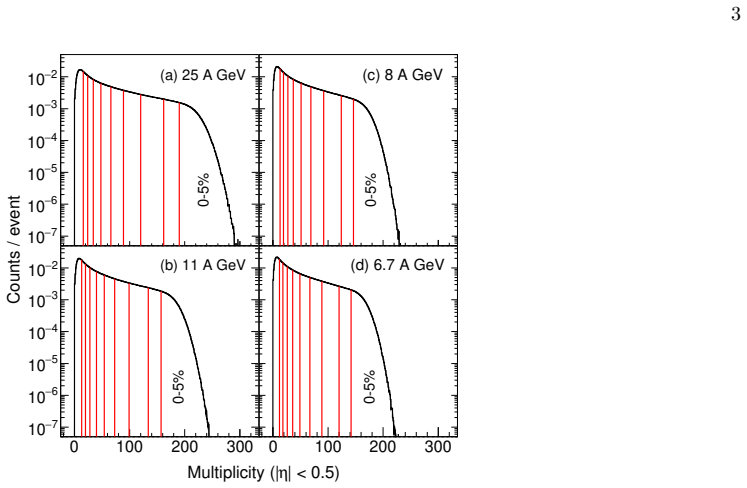
7, 8, 11, and 25 A GeV ( √ sN N ≈ 4 − 7 GeV) using the PHSD model. The energy range studied in this work overlaps with the collision energy range of the upcom- ing experiments at F AIR and NICA. In this beam energy range, the baryon chemical potential is high, and thus, maximal baryon stopping is expected. Additionally, the transverse momentum distributio...
-
[3]
Finally, Section IV summa- rizes and discusses the findings presented in this paper
7, 8, 11, and 25 A GeV. Finally, Section IV summa- rizes and discusses the findings presented in this paper. II. PHSD MODEL The PHSD model is a microscopic covariant dynam- ical transport approach developed to study strongly in- teracting matter in relativistic heavy-ion collisions [18– 21]. It is based on the Dynamical Quasi-Particle Model (DQPM) and form...
-
[4]
5 in Au + Au collisions at beam energies Elab =
-
[5]
For all the particles, the ⟨pT ⟩ is obtained from their pT - distribution
7, 8, 11, and 25 A GeV from the PHSD model. For all the particles, the ⟨pT ⟩ is obtained from their pT - distribution. The values of ⟨pT ⟩ increase with the parti- cle mass at all beam energies. For pions, ⟨pT ⟩ exhibits a weak dependence on Npart across all energies, suggesting that the transverse dynamics of pions are only slightly affected by collision ...
-
[6]
5. Figure 6 shows the ratios, π − /π +, K − /K +, and ¯p/p , as a function of Npart in Au + Au collisions at Elab =
-
[7]
7, 8, 11, and 25 A GeV from the PHSD model. The π − /π + ratio do not show significant dependence on col- lision centrality within the uncertainties over the energy range considered. However, the ratio seems to be larger at the lowest beam energy of 6.7 A GeV compared to the other energies. This could be attributed to isospin effects and to increased contri...
work page 2025
- [8]
-
[9]
F. Becattini, J. Manninen, and M. Gazdzicki, Phys. Rev. C 73, 044905 (2006)
work page 2006
-
[10]
A. Andronic, P. Braun-Munzinger, and J. Stachel, Nucl. Phys. A 772, 167 (2006)
work page 2006
-
[11]
E. V. Shuryak, Phys. Lett. B 78, 150 (1978)
work page 1978
- [12]
- [13]
-
[14]
S. A. Bass et al. , Nucl. Phys. A 661, 205 (1999)
work page 1999
-
[15]
L. Adamczyk et al. (STAR Collaboration), Phys. Rev. C 96, 044904 (2017)
work page 2017
- [16]
- [17]
-
[18]
M. S. Abdallah et al. (STAR Collaboration), Phys.Lett. B 831, 137152 (2022)
work page 2022
-
[19]
M. I. Abdulhamid et al. (STAR Collaboration), JHEP 10, 139 (2024)
work page 2024
-
[20]
M. I. Abdulhamid et al. (STAR Collaboration), Phys. Rev. C 110, 054911 (2024)
work page 2024
-
[21]
J. Adamczewski-Musch et al. (HADES Collaboration), Eur. Phys. J. A 56, 259 (2020)
work page 2020
- [22]
-
[23]
T. Ablyazimov et al. (CBM Collaboration), Eur. Phys. J. A 53, 60 (2017)
work page 2017
-
[24]
V. Abgaryan et al. (MPD Collaboration), Eur. Phys. J. A 58, 140 (2022)
work page 2022
- [25]
- [26]
- [27]
- [28]
- [29]
- [30]
- [31]
- [32]
- [33]
- [34]
- [35]
-
[36]
B. Nilsson-Almqvist and E. Stenlund, Comput. Phys. Commun. 43, 387 (1987)
work page 1987
- [37]
- [38]
- [39]
- [40]
- [41]
-
[42]
V. D. Toneev et al. , Phys. Rev. C 85, 034910 (2012)
work page 2012
-
[43]
V. P. Konchakovski et al. , Phys. Rev. C 85, 011902 10 (2012)
work page 2012
- [44]
- [45]
- [46]
- [47]
- [48]
- [49]
- [50]
-
[51]
J. Barrette et al. (E877 Collaboration), Phys. Rev. C 62, 024901 (2000)
work page 2000
- [52]
- [53]
-
[54]
L. Ahle et al. (E866 and E917 Collaboration), Phys. Lett. B 476, 1-8 (2000)
work page 2000
-
[55]
B. B. Back et al. (E917 Collaboration), Phys. Rev. Lett. 86, 1970 (2001)
work page 1970
-
[56]
B. B. Back et al. (E917 Collaboration), Phys. Rev. Lett. 87, 242301 (2001)
work page 2001
- [57]
discussion (0)
Sign in with ORCID, Apple, or X to comment. Anyone can read and Pith papers without signing in.