Recognition: 2 theorem links
· Lean TheoremA Close Quasar Pair in a Massive Galaxy Merger at z=5.7
Pith reviewed 2026-05-10 18:25 UTC · model grok-4.3
The pith
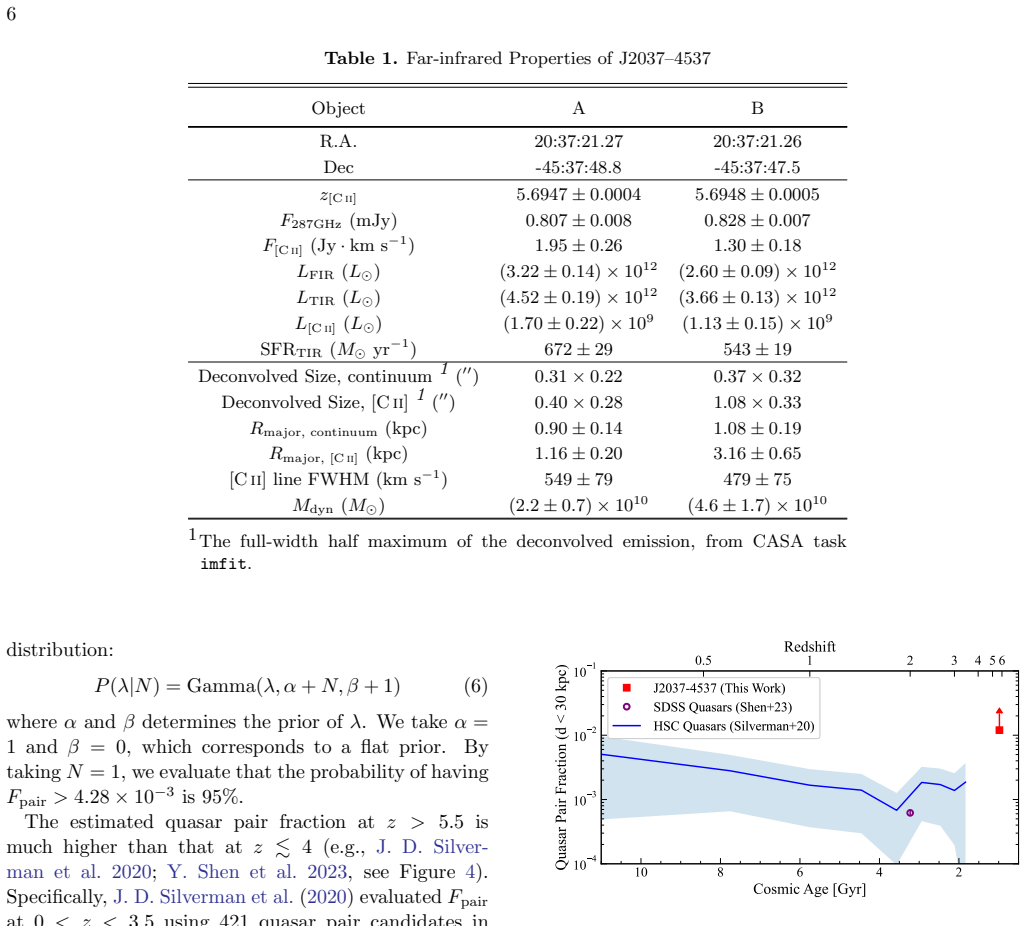
Confirmation of a quasar pair at z=5.7 sets a lower limit on the high-redshift pair fraction above 1.2 percent.
A machine-rendered reading of the paper's core claim, the machinery that carries it, and where it could break.
Core claim
The authors confirm J2037-4537 as a close quasar pair at z=5.7, with ALMA observations revealing tidal disturbed features in the far-infrared continuum and CII line emission that establish two distinct massive star-forming host galaxies rather than a doubly-imaged lensed quasar. This places a lower limit on the quasar pair fraction F_pair >1.2% at 5.5<z<6, which is much higher than the fraction at z≲4. The system is expected to form a gravitationally-bound supermassive black hole binary within ≲2 Gyr and likely contributes to the high gravitational-wave background reported by pulsar timing array experiments.
What carries the argument
High-resolution ALMA imaging of the far-infrared continuum and CII line emission that reveals tidal disturbed features in the quasar host galaxies.
If this is right
- The quasar pair fraction at 5.5<z<6 exceeds 1.2 percent and is much higher than at z≲4.
- The two supermassive black holes will form a gravitationally-bound binary within ≲2 Gyr.
- The elevated pair fraction at z>5.5 contributes to the high gravitational-wave background from pulsar timing array experiments.
- Close quasar pairs arise as products of galaxy mergers in which both black holes are actively accreting.
Where Pith is reading between the lines
- Galaxy mergers were likely more efficient at simultaneously activating both supermassive black holes in the early universe than at later times.
- Additional high-redshift pair detections could refine models of black hole growth through mergers.
- The link to gravitational waves suggests these systems influence the stochastic background detectable by future observatories.
Load-bearing premise
The tidal disturbed features observed in the far-infrared continuum and CII line emission definitively indicate a galaxy merger rather than projection effects or other phenomena that could mimic them in a lensed system.
What would settle it
Higher-resolution or multi-wavelength observations showing no tidal features or demonstrating that the two quasars are images of a single object with identical properties and no separate hosts would falsify the pair interpretation.
Figures



read the original abstract
Close quasar pairs are rare products of galaxy mergers in which both supermassive black holes (SMBHs) are actively accreting, offering strong constraints on merger-driven active galactic nuclei (AGN) evolution. Identifying close quasar pairs at $z\gtrsim4$ is challenging due to the declining quasar number density in the early Universe. Here we report the confirmation of a close quasar pair at $z=5.7$, J2037--4537, utilizing high-resolution Atacama Large Millimeter/submillimeter Array (ALMA) observations. The quasar host galaxies exhibit tidal disturbed features in both the far-infrared continuum emission and the {\cii} line emission, ruling out the doubly-imaged lensed quasar scenario. The two quasar hosts are massive $(M_\text{dyn}\gtrsim10^{10}M_\odot)$ and star-forming (SFR $\gtrsim500 M_\odot~ \mathrm{yr^{-1}}$). The confirmation of J2037--4537 puts a lower limit on the quasar pair fraction at $5.5<z<6$, $F_\text{pair}>1.2\%$, which is much higher than the quasar pair fraction at $z\lesssim4$. J2037--4537 is expected to form a gravitationally-bound SMBH binary within $\lesssim2$ Gyr. The elevated quasar pair fraction at $z>5.5$, as indicated by J2037--4537, likely contributes to the high gravitational-wave background reported by recent Pulsar Timing Array experiments.
Editorial analysis