Multiscale morphology and contact mechanics of physisorbed Al and Cu nanoparticles
Pith reviewed 2026-05-10 16:51 UTC · model grok-4.3
The pith
Al and Cu nanoparticles smaller than 3-6 nm on graphene show non-standard scaling and rapid contact changes
A machine-rendered reading of the paper's core claim, the machinery that carries it, and where it could break.
Core claim
Calculations show that NPs with a surface area-to-volume ratio above about 1.8 nm^{-1}, or with a linear size under 3-6 nm, behave differently from larger particles. For these smaller NPs, scaling of their total surface area and volume with the linear size can deviate from quadratic and cubic dependencies, respectively. Their mean interfacial separation and relative contact area change rapidly with size, exhibiting substantial variation. In contrast, for larger NPs, these quantities approach the thermodynamic limit. The height distributions of all particles exhibit a narrow spike and a decaying tail, both of which can be fit to Gaussians for larger NPs. In contrast, the interfacial gap分布 are
What carries the argument
Large-scale molecular dynamics simulations mimicking thermal dewetting of thin films to produce nanoparticles on graphene, used to track size-dependent changes in surface area, volume, interfacial separation, and contact area.
Load-bearing premise
The molecular dynamics model and dewetting procedure accurately capture the physisorption interactions and morphological evolution of Al and Cu nanoparticles on graphene without significant artifacts.
What would settle it
Measuring the mean interfacial separation for nanoparticles of sizes 2 nm and 10 nm on graphene and finding no rapid change with size for the smaller ones would challenge the reported behavior.
Figures
read the original abstract
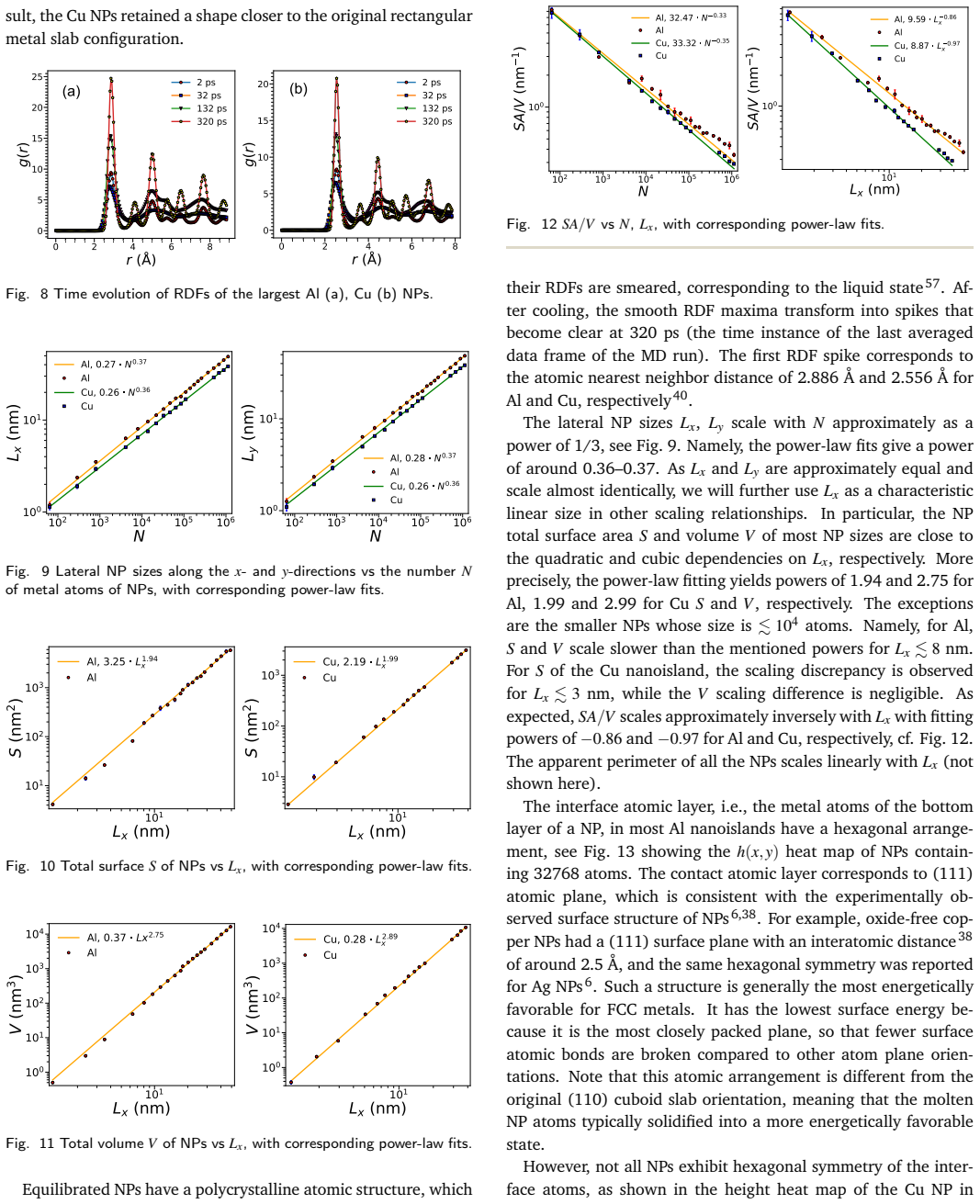
Using large-scale molecular dynamics simulations, we investigate the scaling of morphological and contact mechanics properties of Al and Cu nanoparticles (NPs) physisorbed on suspended graphene. The characteristic linear size of a NP ranges from 1 nm to 49 nm, covering a length scale of 1.5 decades. The NPs were obtained using a procedure mimicking thermal dewetting of thin films. Calculations show that NPs with a surface area-to-volume ratio above about 1.8 nm$^{-1}$, or with a linear size under 3-6 nm, behave differently from larger particles. For these smaller NPs, scaling of their total surface area and volume with the linear size can deviate from quadratic and cubic dependencies, respectively. Their mean interfacial separation and relative contact area change rapidly with size, exhibiting substantial variation. In contrast, for larger NPs, these quantities approach the thermodynamic limit. The height distributions of all particles exhibit a narrow spike and a decaying tail, both of which can be fit to Gaussians for larger NPs. In contrast, the interfacial gap distributions are close to a single Gaussian. The height power spectrum density (PSD) heatmaps of the smaller NPs are smeared and do not manifest a clear structure in contrast to the sixfold symmetry of the PSD of the larger ones. The maximum spatial frequency of the hexagonal 2D PSD roughly corresponds to the nearest-neighbor atomic distance of Al and Cu. For larger NPs with diameters of 20-25 nm, the isotropic height PSD exhibits power-law regions, which can be interpreted as self-affine roughness with Hurst exponents of 0.1-0.56. We also calculate the relative difference between the apparent contact area and the approximated area of the bottom atomic layer. Our simulations illustrate how surface topography evolves with NP size and suggest that larger NPs can have random surface roughness.
Editorial analysis
A structured set of objections, weighed in public.
Referee Report
Summary. Using large-scale molecular dynamics simulations, the paper examines the scaling of morphological and contact mechanics properties of Al and Cu nanoparticles physisorbed on suspended graphene across sizes from 1 nm to 49 nm. The nanoparticles are created by mimicking thermal dewetting of thin films. Key observations include that NPs with surface area-to-volume ratio above ~1.8 nm^{-1} (linear size under 3-6 nm) show deviations from quadratic and cubic scaling in total surface area and volume, rapid changes in mean interfacial separation and relative contact area, contrasting with larger NPs approaching thermodynamic limits. Height distributions show narrow spike and decaying tail (Gaussian for large NPs), interfacial gaps are Gaussian, PSD analysis reveals sixfold symmetry for large NPs and self-affine roughness with Hurst exponents 0.1-0.56 for 20-25 nm NPs.
Significance. Should the MD results hold under validated potentials, this work provides valuable multiscale insights into how nanoparticle morphology and contact with graphene evolve with size, bridging atomic and continuum regimes. This is significant for applications in nanoelectronics, catalysis, and materials design involving physisorbed metal NPs on 2D materials. The identification of a crossover size and self-affine roughness in larger particles offers testable predictions for experiments.
major comments (3)
- [Simulation Methods] The central claims on size-dependent deviations (crossover at 3-6 nm, rapid changes in interfacial separation and contact area) rest on the MD model, but the manuscript provides no details on interatomic potentials for Al/Cu-graphene physisorption, the thin-film dewetting protocol (temperatures, timescales, relaxation criteria), equilibration, or statistical sampling/error analysis. This is load-bearing, as unvalidated potentials or protocol artifacts could produce the reported rapid changes for small NPs rather than intrinsic physics.
- [Results on Scaling and Morphology] For NPs with linear size under 3-6 nm, the claim of deviations from quadratic/cubic scaling in surface area and volume is undermined by the lack of explicit definitions of 'linear size' and how surface area/volume are extracted from atomic coordinates. At these scales atomic discreteness already renders continuum scaling ill-defined, and any apparent deviation may arise from how the potentials treat van der Waals binding or finite-size relaxation during dewetting.
- [Contact Mechanics Analysis] The reported mean interfacial separation, relative contact area, and distinction between apparent contact area and bottom-layer approximated area lack benchmarks (binding energies, equilibrium separations, or comparison to DFT/experiment). Without these, it is unclear whether the rapid size dependence for small NPs reflects physical behavior or simulation-specific effects.
minor comments (2)
- [PSD Analysis] The abstract states that height PSD heatmaps for smaller NPs are 'smeared' while larger ones show sixfold symmetry, but the main text should quantify the smearing (e.g., via peak width or symmetry metrics) and specify the fitting procedure for the power-law regions and Hurst exponents.
- [Height Distributions] The height distributions are described as exhibiting a 'narrow spike and a decaying tail' fit to Gaussians for larger NPs; the text should report the fit parameters, R^{2} values, and whether the same functional form applies (or fails) for the smallest NPs.
Simulated Author's Rebuttal
We thank the referee for the positive assessment of our work's significance and for the detailed, constructive comments. We have revised the manuscript to address the concerns on methodological transparency, explicit definitions, and benchmarks.
read point-by-point responses
-
Referee: [Simulation Methods] The central claims on size-dependent deviations (crossover at 3-6 nm, rapid changes in interfacial separation and contact area) rest on the MD model, but the manuscript provides no details on interatomic potentials for Al/Cu-graphene physisorption, the thin-film dewetting protocol (temperatures, timescales, relaxation criteria), equilibration, or statistical sampling/error analysis. This is load-bearing, as unvalidated potentials or protocol artifacts could produce the reported rapid changes for small NPs rather than intrinsic physics.
Authors: We agree that expanded methodological details are necessary for reproducibility and to substantiate the claims. In the revised manuscript we have added a dedicated subsection describing: the specific interatomic potentials (including functional forms and parameters for metal-metal and metal-graphene physisorption, with citations to their original parametrizations and any available DFT or experimental validation); the thin-film dewetting protocol (initial film geometry, temperature schedule, total simulation times, energy and force convergence criteria); equilibration and production run lengths; and the number of independent realizations together with the statistical procedures used to compute means and uncertainties. These additions directly address the possibility of protocol artifacts. revision: yes
-
Referee: [Results on Scaling and Morphology] For NPs with linear size under 3-6 nm, the claim of deviations from quadratic/cubic scaling in surface area and volume is undermined by the lack of explicit definitions of 'linear size' and how surface area/volume are extracted from atomic coordinates. At these scales atomic discreteness already renders continuum scaling ill-defined, and any apparent deviation may arise from how the potentials treat van der Waals binding or finite-size relaxation during dewetting.
Authors: We accept that the original text lacked explicit operational definitions. We have inserted precise definitions: linear size is the diameter of the sphere whose volume equals the nanoparticle volume obtained from the atomic count and bulk density; total surface area is computed via the convex hull of atomic positions supplemented by a solvent-accessible surface algorithm; volume is obtained from an alpha-shape construction. We have also added a short discussion acknowledging that continuum scaling is only approximate below ~3 nm and that the observed deviations arise from the interplay of atomic discreteness, the specific van der Waals cutoff in the potentials, and the finite-size relaxation inherent to the dewetting process. These clarifications make the reported crossover physically interpretable rather than an artifact of undefined quantities. revision: yes
-
Referee: [Contact Mechanics Analysis] The reported mean interfacial separation, relative contact area, and distinction between apparent contact area and bottom-layer approximated area lack benchmarks (binding energies, equilibrium separations, or comparison to DFT/experiment). Without these, it is unclear whether the rapid size dependence for small NPs reflects physical behavior or simulation-specific effects.
Authors: We have augmented the manuscript with benchmark comparisons. For a single Al or Cu atom on graphene we now report the equilibrium separation and binding energy obtained with our potentials and compare them directly to published DFT results and available experimental estimates. For the contact-area definitions we have added a brief validation against literature values for similar metal-graphene interfaces. These benchmarks support that the rapid variation seen for small NPs is a genuine physical consequence of the high surface-to-volume ratio and discrete atomic packing rather than a simulation artifact. The distinction between apparent contact area and bottom-layer area is also now defined more rigorously with an accompanying schematic. revision: yes
Circularity Check
No circularity: all results are direct MD simulation outputs
full rationale
The paper reports morphological and contact properties obtained exclusively from large-scale molecular dynamics simulations of Al and Cu nanoparticles on graphene. No mathematical derivations, fitted parameters renamed as predictions, or self-citation chains appear in the abstract or described methodology. Scaling deviations for small NPs, height distributions, PSD heatmaps, and contact area metrics are computed directly from atomic configurations generated by the dewetting protocol. The reader's assessment of score 0.0 is confirmed: results stand as independent simulation data without reduction to inputs by construction.
Axiom & Free-Parameter Ledger
free parameters (2)
- Surface area-to-volume transition threshold =
1.8 nm^{-1}
- Linear size transition threshold =
3-6 nm
axioms (2)
- domain assumption Interatomic potentials in the MD simulations accurately describe physisorption of Al and Cu on graphene.
- domain assumption The thermal dewetting mimicry procedure generates nanoparticle configurations representative of equilibrium physisorbed states.
Reference graph
Works this paper leans on
-
[1]
In principle, it is possible to reconstruct the height profile 1–15 | 1 arXiv:2604.07646v1 [cond-mat.mes-hall] 8 Apr 2026 of a surface scan with Å precision using transmission electron mi- croscopy
work page internal anchor Pith review Pith/arXiv arXiv 2026
-
[2]
22 for an example ofP tot (u)for a NP with 681472 atoms
The gap distributionsP tot (u)for all atoms comprising a NP (whereuis the distance from an atom to the substrate) exhibit a clear layered ordering, confirming the polycrystalline structure of both Al and Cu NPs; see Fig. 22 for an example ofP tot (u)for a NP with 681472 atoms. Other NPs have similar histograms. The bottom layer atoms correspond to the bar...
work page 2000
-
[3]
The size scaling ofA r in Figs. 32, 33 is consistent with the reported¯udependence: smaller NPs have a lowerA r reflecting larger¯u. This means that, geometrically , water molecules are harder to leak through the larger NPs’ contact interface. Note that for macroscopic randomly rough surfaces, the contact area percolates 63 atA r ≈0.48. If this holds for ...
work page 2008
-
[4]
3 K. S. Suhas, V. K. Reddy , T. Reddy and Y. Pai,Discover Materi- als, 2026,6,
work page 2026
-
[5]
4 S. Harsha, R. K. Sharma, M. Dierner, C. Baeumer, I. Makhotkin, G. Mul, P. Ghigna, E. Spiecker, J. Will and M. Al- tomare,Advanced Functional Materials, 2024,34, 2403628. 5 M. Kim, H.-J. Ahn, V. C. Silalahi, D. Heo, S. Adhikari, Y. Jang, J. Lee and D. Lee,International Journal of Molecular Sciences, 2023,24, 13102. 6 J. A. Badán, E. Navarrete-Astorga, R....
work page 2024
-
[6]
7 O. Khomenko, A. Biesiedina, K. Khomenko and R. Cher- nushchenko,Progress in Physics of Metals, 2022,23, 239–267. 8 M. B. Gawande, A. Goswami, F.-X. Felpin, T. Asefa, X. Huang, R. Silva, X. Zou, R. Zboril and R. S. Varma,Chemical Reviews, 2016,116, 3722–3811. 9 H. Kart, H. Yıldırım, S. Kart and T. Cagin,Materials Chemistry and Physics, 2014,147, 204–212....
work page 2022
-
[7]
11 T. A. Saleh,Surface Science of Adsorbents and Nanoadsorbents, Elsevier, 2022, vol. 34, pp. 1–38. 12 M. Pozzi, S. Jonak Dutta, M. Kuntze, J. Bading, J. S. Rüßbült, C. Fabig, M. Langfeldt, F. Schulz, P. Horcajada and W. J. Parak,Journal of Chemical Education, 2024,101, 3146–3155. 13 A. Yalamanchali, K. L. Pyfer and M. F. Jarrold,The Journal of Physical C...
work page 2022
-
[8]
23 N. Prodanov, W. B. Dapp and M. H. Müser,Tribol. Lett., 2014, 53, 433–448. 24 M. Rovatti, G. Paolicelli, A. Vanossi and S. Valeri,Meccanica, 2011,46, 597–607. 25 N. Rodriguez, L. Gontard, C. Ma, R. Xu and B. N. J. Persson, Tribol. Lett., 2025,73,
work page 2014
-
[9]
26 X. Chen, H. C. Swift, P. Hole, A. D. L. Humphris and J. K. Hobbs,Nanoscale, 2026, 1–8. 27 D. Dietzel, T. Mönninghoff, C. Herding, M. Feldmann, H. Fuchs, B. Stegemann, C. Ritter, U. D. Schwarz and A. Schirmeisen,Phys. Rev. B, 2010,82, 035401. 14 | 1–15 28 T. D. Jacobs and L. Pastewka,MRS Bulletin, 2022,47, 1–6. 29 B. N. J. Persson,Tribology Letters, 2023,71,
work page 2026
-
[10]
30 B. Persson, O. Albohr, U. Tartaglino, A. Volokitin and E. Tosatti,J. Phys. Condens. Matter, 2005,17, R1. 31 L. Pastewka, N. Prodanov, B. Lorenz, M. H. Müser, M. O. Rob- bins and B. N. J. Persson,Phys. Rev. E, 2013,87, 062809. 32 T. D. Jacobs, T. Junge and L. Pastewka,Surface Topography: Metrology and Properties, 2017,5, 013001. 33 D. Frenkel and B. Smi...
work page 2005
-
[11]
36 M. A. Ben Aissa, B. Tremblay , A. Andrieux-Ledier, E. Maison- haute, N. Raouafi and A. Courty ,Nanoscale, 2015,7, 3189–
work page 2015
-
[12]
37 C. R. Jacobson, D. Solti, D. Renard, L. Yuan, M. Lou and N. J. Halas,Accounts of Chemical Research, 2020,53, 2020–2030. 38 K. Chung, J. Bang, A. Thacharon, H. Y. Song, S. H. Kang, W.-S. Jang, N. Dhull, D. Thapa, C. M. Ajmal, B. Song, S.-G. Lee, Z. Wang, A. Jetybayeva, S. Hong, K. H. Lee, E. J. Cho, S. Baik, S. H. Oh, Y.-M. Kim, Y. H. Lee, S.-G. Kim and...
work page 2020
-
[13]
48 W. Humphrey , A. Dalke and K. Schulten,Journal of Molecular Graphics, 1996,14, 33–38. 49 A. Stukowski,Modelling and Simulation in Materials Science and Engineering, 2009,18, 015012. 50 N. Sasaki, K. Kobayashi and M. Tsukada,Phys. Rev. B, 1996, 54, 2138–2149. 51 Z. Ma, H. Wang, Y. Zhao, Z. Li, H. Liu, Y. Yang and Z. Zhao, Materials, 2024,17,
work page 1996
-
[14]
Retrieved from http://www.cloudcompare.org/,
52 CloudCompare development team,GPL software (2025) CloudCompare (version 2.14). Retrieved from http://www.cloudcompare.org/,
work page 2025
-
[15]
53 M. Kazhdan, M. Bolitho and H. Hoppe, Proceedings of the Fourth Eurographics Symposium on Geometry Processing, Goslar, DEU, 2006, p. 61–70. 54 V. Diaz, P. Oosterom, M. Meijers, E. Verbree, N. Ahmed and T. Lankveld, inComparison of Cloud-to-Cloud Distance Calcu- lation Methods - Is the Most Complex Always the Most Suitable?, Springer Nature Switzerland, ...
work page 2006
-
[16]
57 K. Dong, R. Liu, A. Yu, R. Zou and J. Li,Journal of Physics: Condensed Matter, 2003,15,
work page 2003
-
[17]
58 I. A. Lyashenko, A. V. Khomenko and A. M. Zaskoka,Tribology Transactions, 2013,56, 1019–1026. 59 A. Khomenko, D. Boyko, M. Zakharov, K. Khomenko and Y. Khyzhnya,Proceedings of the IEEE 7th International Confer- ence on Nanomaterials: Applications and Properties (NAP’17), 2017, 01NNPT01–1–4. 60 K. Murata, K. Mitsuoka, T. Hirai, T. Walz, P. Agre, J. B. H...
work page 2013
discussion (0)
Sign in with ORCID, Apple, or X to comment. Anyone can read and Pith papers without signing in.