Recognition: unknown
On the origin of the BAOtr-DESI tension
Pith reviewed 2026-05-10 15:50 UTC · model grok-4.3
The pith
BAOtr and DESI BAO datasets cannot be fit simultaneously by any CMB-consistent CPL dark energy model.
A machine-rendered reading of the paper's core claim, the machinery that carries it, and where it could break.
Core claim
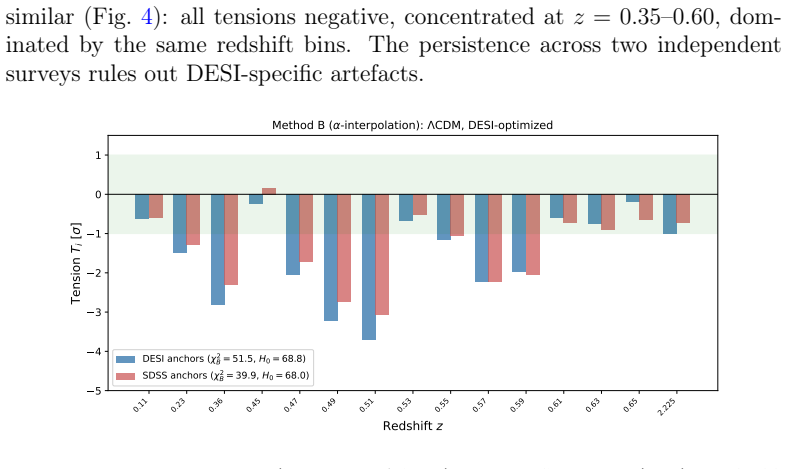
The published 3D BAO distances are fiducial-independent by construction with residuals at the 0.3 percent level. No model in the CPL parameter space that is consistent with Planck theta-star and fits DESI well can also accommodate the BAOtr data; the reverse also fails. The direct 3.7-sigma data-versus-data disagreement at z=0.510 cannot be removed by any smooth modification of D_M(z). These results remain stable when SDSS data replace DESI and across analysis choices.
What carries the argument
The CPL dark energy parametrization w(z)=w0+wa(1-a), used to jointly optimize Omega_m and H0 under the Planck theta-star constraint and test against both DESI and BAOtr distance ratios.
If this is right
- Models with chi-squared_DESI below or equal to 5 produce chi-squared_BAOtr above or equal to 42.
- Reducing the BAOtr tension to chi-squared approximately 37 forces chi-squared_DESI above or equal to 8.
- The 3.7-sigma mismatch at z=0.510 sets an irreducible floor that no smooth D_M(z) adjustment can remove.
- The conclusions hold after substituting SDSS for DESI and across extrapolation schemes.
- The remaining possibilities are observational systematics or new physics beyond the CPL form.
Where Pith is reading between the lines
- If BAOtr measurements are shown to be free of systematics, 3D BAO pipelines may contain unaccounted reconstruction effects beyond fiducial choice.
- Future surveys could routinely cross-check angular and 3D BAO at the same redshifts to isolate such dataset tensions.
- If systematics are ruled out, dark energy models with non-smooth or scale-dependent features would need explicit testing.
Load-bearing premise
The CPL parametrization is flexible enough to describe any smooth dark energy evolution consistent with the data.
What would settle it
A reanalysis or new measurement of the comoving distance ratio at z=0.510 that brings BAOtr and DESI into agreement within 2 sigma after all fiducial corrections.
Figures



read the original abstract
The fiducial-independent angular/transverse BAO dataset, obtained from two-point angular correlation functions in thin redshift shells (hereafter BAOtr), systematically prefers smaller comoving distance ratios $D_{\rm M}/r_{\rm d}$ than the DESI DR2 three-dimensional BAO measurements at $z \lesssim 0.65$, driving dataset-dependent CPL dark-energy inferences and conflicting conclusions about the Hubble tension. We investigate whether this disagreement can be attributed to the $\Lambda$CDM fiducial assumed in the 3D BAO pipeline, or resolved within the CPL parametrisation. We show that the published 3D BAO distances are fiducial-independent by construction, with residual effects at $\lesssim 0.3\%$ -- negligible against the 10--18\% BAOtr uncertainties. We then scan the CPL parameter space with $\Omega_m$ and $H_0$ jointly determined at each $(w_0, w_a)$ by the Planck $\theta_*$ constraint and optimisation against the DESI data. Two complementary tests are performed: a direct comparison of each DESI-optimized model with the BAOtr data, and an $\alpha$-interpolation test that anchors the prediction to the DESI measurements. Both reveal an inescapable trade-off: models that fit DESI well ($\chi^2_{\rm DESI} \lesssim 5$) yield $\chi^2_{\rm BAOtr} \gtrsim 42$, while reducing the BAOtr tension to $\chi^2_{\rm BAOtr} \sim 37$ requires $\chi^2_{\rm DESI} \gtrsim 8$. No CMB-consistent CPL model fits both datasets simultaneously. The direct comparison at $z = 0.510$ -- where BAOtr and DESI disagree by $3.7\sigma$ (data-versus-data) -- sets an irreducible tension floor that no smooth modification of $D_{\rm M}(z)$ can remove. These conclusions are robust across analysis methods, extrapolation schemes, and substitution of SDSS for DESI. The remaining explanations are observational systematics -- most plausibly in the BAOtr measurements -- or new physics beyond CPL.
Editorial analysis
A structured set of objections, weighed in public.
Referee Report
Summary. The manuscript claims that the BAOtr angular BAO dataset and DESI DR2 3D BAO measurements exhibit an irreducible tension, most notably a 3.7σ discrepancy in D_M/r_d at z=0.510. After demonstrating that residual fiducial dependence in the published DESI distances is ≲0.3% (negligible compared to BAOtr uncertainties), the authors perform CPL parameter scans with Ω_m and H_0 fixed by the Planck θ_* constraint plus optimization to DESI. Both direct model-to-BAOtr comparisons and an α-interpolation test show an inescapable χ² trade-off: good DESI fits (χ²_DESI ≲5) produce χ²_BAOtr ≳42, while acceptable BAOtr fits require χ²_DESI ≳8. No CMB-consistent CPL model accommodates both datasets simultaneously, and the single-redshift data-versus-data inconsistency sets a floor that no smooth D_M(z) modification can remove. The conclusions are stated to be robust to analysis choices and to substitution of SDSS for DESI.
Significance. If the central result holds, the work is significant for BAO cosmology and the Hubble tension debate: it rules out fiducial-cosmology artifacts and standard CPL dark-energy evolution as explanations for the BAOtr–DESI mismatch, thereby focusing attention on possible observational systematics (most plausibly in BAOtr) or physics beyond CPL. The explicit χ² scans, the model-independent 3.7σ datum at z=0.510, and the α-interpolation test that anchors predictions directly to DESI constitute concrete, falsifiable evidence rather than a circular fit. The demonstration that the published DESI distances are effectively fiducial-independent at the 0.3% level is a useful technical clarification for the community.
major comments (1)
- [Results section on α-interpolation test] The assertion that 'no smooth modification of D_M(z) can remove' the tension floor is load-bearing for the final conclusion. While the 3.7σ data-versus-data discrepancy at z=0.510 is model-independent, the extrapolation to arbitrary smooth D_M(z) rests on the CPL scans plus the α-interpolation test. A brief explicit statement of the functional form assumed for the interpolation (or the range of α values explored) would make this step fully transparent.
minor comments (2)
- [Abstract and main results paragraphs] The specific χ² thresholds (χ²_DESI ≲5, χ²_BAOtr ≳42, etc.) are quoted without accompanying degrees of freedom or reduced-χ² values; adding these would allow readers to judge the absolute goodness of fit.
- [Discussion of robustness] A short table or figure panel comparing the best-fit CPL parameters and χ² values when SDSS is substituted for DESI would make the robustness statement more quantitative.
Simulated Author's Rebuttal
We thank the referee for the careful reading of the manuscript and the positive overall assessment. The recommendation for minor revision is welcome, and we address the single major comment below.
read point-by-point responses
-
Referee: [Results section on α-interpolation test] The assertion that 'no smooth modification of D_M(z) can remove' the tension floor is load-bearing for the final conclusion. While the 3.7σ data-versus-data discrepancy at z=0.510 is model-independent, the extrapolation to arbitrary smooth D_M(z) rests on the CPL scans plus the α-interpolation test. A brief explicit statement of the functional form assumed for the interpolation (or the range of α values explored) would make this step fully transparent.
Authors: We agree that an explicit description of the interpolation procedure will improve transparency. The α-interpolation test anchors the predicted D_M(z) to the DESI measurements at the observed redshifts and uses a smooth, monotonic interpolation whose deviation amplitude is controlled by the parameter α. In the revised manuscript we will insert a concise statement specifying the functional form (a linear interpolation in the scaled comoving distance ratio) and the range of α explored (chosen to span the plausible domain for smooth modifications consistent with the CPL framework). This clarification does not alter the reported results or conclusions. revision: yes
Circularity Check
No significant circularity; central claim from direct data comparison
full rationale
The derivation proceeds via explicit CPL parameter scans optimized jointly to Planck θ* and DESI data, followed by independent χ² evaluation against BAOtr and an α-interpolation test that anchors predictions directly to DESI measurements. The fiducial-independence argument rests on the published pipeline construction (residuals ≲0.3%) rather than any self-fit. No step reduces a prediction to its own input by definition, no load-bearing self-citation chain is invoked for uniqueness, and the 3.7σ z=0.510 discrepancy is a raw data-versus-data comparison. This is the normal non-circular case for a data-driven tension analysis.
Axiom & Free-Parameter Ledger
free parameters (4)
- w0
- wa
- Omega_m
- H0
axioms (2)
- domain assumption CPL parametrization w(z) = w0 + wa z/(1+z) is adequate to describe any relevant smooth dark energy evolution.
- domain assumption Planck theta* constraint provides a valid external anchor for Omega_m and H0 at each CPL point.
Forward citations
Cited by 3 Pith papers
-
Geometric Constraints on the Pre-Recombination Expansion History from the Hubble Tension
Model-independent reconstruction shows that early-universe modifications resolving the Hubble tension exist at the background level, requiring a smooth ~15% pre-recombination expansion rate enhancement.
-
Double the axions, half the tension: multi-field early dark energy eases the Hubble tension
Two-field axion-like early dark energy reduces Hubble tension to 1.5 sigma residual and improves high-ell CMB fits over single-field models.
-
Do equation of state parametrizations of dark energy faithfully capture the dynamics of the late universe?
Node-based reconstruction of cosmic expansion prefers stronger deceleration at z≈1.7 than smooth DE EoS parametrizations, isolating z~1.5-2 as a window where the latter may compress localized kinematic features permit...
Reference graph
Works this paper leans on
- [1]
-
[2]
D. J. Eisenstein, et al., Detection of the baryon acoustic peak in the large-scale correlation function of SDSS luminous red galaxies, Astro- phys. J. 633 (2005) 560–574.arXiv:astro-ph/0501171,doi:10.1086/ 466512
work page Pith review arXiv 2005
-
[3]
A. Meiksin, M. White, J. A. Peacock, Baryonic signatures in large-scale structure, Mon. Not. Roy. Astron. Soc. 304 (1999) 851–864.arXiv: astro-ph/9812214,doi:10.1046/j.1365-8711.1999.02369.x
-
[4]
C.Blake, K.Glazebrook, Probingdarkenergyusingbaryonicoscillations in the galaxy power spectrum as a cosmological ruler, Astrophys. J. 594 (2003) 665–673.arXiv:astro-ph/0301632,doi:10.1086/376983
-
[5]
H.-J. Seo, D. J. Eisenstein, Probing dark energy with baryonic acoustic oscillations from future large galaxy redshift surveys, Astrophys. J. 598 (2003) 720–740.arXiv:astro-ph/0307460,doi:10.1086/379122
-
[6]
S. Cole, et al., The 2dF Galaxy Redshift Survey: Power-spectrum analysis of the final dataset and cosmological implications, Mon. Not. Roy. Astron. Soc. 362 (2005) 505–534.arXiv:astro-ph/0501174, doi:10.1111/j.1365-2966.2005.09318.x
-
[7]
S. Alam, et al., The clustering of galaxies in the completed SDSS-III Baryon Oscillation Spectroscopic Survey: cosmological analysis of the DR12galaxysample, Mon.Not.Roy.Astron.Soc.470(2017)2617–2652. arXiv:1607.03155,doi:10.1093/mnras/stx721. 29
-
[8]
S. Alam, et al., Completed SDSS-IV extended Baryon Oscillation Spec- troscopic Survey: Cosmological implications of two decades of spectro- scopicsurveysattheApachePointObservatory, Phys.Rev.D103(2021) 083533.arXiv:2007.08991,doi:10.1103/PhysRevD.103.083533
-
[9]
B. Abareshi, et al., Overview of the Instrumentation for the Dark En- ergy Spectroscopic Instrument, Astron. J. 164 (2022) 207.arXiv: 2205.10939,doi:10.3847/1538-3881/ac882b
-
[10]
A. G. Adame, et al., DESI 2024 VI: Cosmological Constraints from the Measurements of Baryon Acoustic Oscillations, JCAP 02 (2025) 021. arXiv:2404.03002,doi:10.1088/1475-7516/2025/02/021
-
[11]
M. Abdul Karim, et al., DESI DR2 Results II: Measurements of Baryon Acoustic Oscillations and Cosmological Constraints, Phys. Rev. D 112 (2025) 083515.arXiv:2503.14738,doi:10.1103/tr6y-kpc6
-
[12]
2001, International Journal of Modern Physics D, 10, 213, doi: 10.1142/S0218271801000822
M. Chevallier, D. Polarski, Accelerating universes with scaling dark mat- ter, Int. J. Mod. Phys. D 10 (2001) 213–224.arXiv:gr-qc/0009008, doi:10.1142/S0218271801000822
-
[13]
E. V. Linder, Exploring the expansion history of the universe, Phys. Rev. Lett. 90 (2003) 091301.arXiv:astro-ph/0208512,doi:10.1103/ PhysRevLett.90.091301
work page Pith review arXiv 2003
-
[14]
Planck 2018 results. VI. Cosmological parameters
N. Aghanim, et al., Planck 2018 results. VI. Cosmological parameters, Astron. Astrophys. 641 (2020) A6, [Erratum: Astron. Astrophys. 652 (2021) C4].arXiv:1807.06209,doi:10.1051/0004-6361/201833910
work page internal anchor Pith review Pith/arXiv arXiv doi:10.1051/0004-6361/201833910 2018
-
[15]
W. Giarè, M. Najafi, S. Pan, E. Di Valentino, J. T. Firouzjaee, Robust Preference for Dynamical Dark Energy in DESI BAO and SN Mea- surements, JCAP 10 (2024) 035.arXiv:2407.16689,doi:10.1088/ 1475-7516/2024/10/035
- [16]
-
[17]
W. J. Wolf, C. García-García, D. J. Bartlett, P. G. Ferreira, Scant evidence for thawing quintessence, Phys. Rev. D 110 (2024) 083528. arXiv:2408.17318,doi:10.1103/PhysRevD.110.083528. 30
-
[18]
W. Giarè, Dynamical Dark Energy Beyond Planck? Constraints from multiple CMB probes, DESI BAO and Type-Ia Supernovae, Phys. Rev. D 112 (2025) 023508.arXiv:2409.17074,doi:10.1103/ss37-cxhn
-
[19]
L. Perivolaropoulos, F. Skara, Challenges forΛCDM – An update, New Astron. Rev. 95 (2022) 101659.arXiv:2105.05208,doi:10.1016/j. newar.2022.101659
work page doi:10.1016/j 2022
-
[20]
I. Pantos, L. Perivolaropoulos, Status of theS8 Tension: A 2026 Review of Probe Discrepancies, Phys. Dark Univ. (2026).arXiv:2602.12238
-
[21]
C. G. Tsagas, L. Perivolaropoulos, K. Asvesta, Large-scale peculiar ve- locities in the universe, Phys. Rep.To appear (2025).arXiv:2510. 05340
2025
-
[22]
S. Afroz, S. Mukherjee, Hint toward an inconsistency between BAO and supernovae datasets: The evidence of redshift evolving dark energy from DESI DR2 is absent, Phys. Rev. D 113 (2026) 083514.arXiv: 2504.16868,doi:10.1103/k59d-l795
-
[23]
Gravitational lensing by Born-Infeld naked singularities.Phys
A. Gómez-Valent, A. Favale, M. Migliaccio, A. A. Sen, Late-time phe- nomenology required to solve theH0 tension in view of the cosmic lad- ders and the anisotropic and angular BAO data sets, Phys. Rev. D 109 (2024) 023525.arXiv:2309.07795,doi:10.1103/PhysRevD.109. 023525
-
[24]
A. Favale, A. Gómez-Valent, M. Migliaccio, Quantification of 2D vs 3D BAO tension using SNIa as a redshift interpolator and test of the Etherington relation, Phys. Lett. B 858 (2024) 139027.arXiv:2405. 12142,doi:10.1016/j.physletb.2024.139027
-
[25]
A. Gómez-Valent, J. Solà Peracaula, Composite dark energy and the cosmological tensions, Phys. Lett. B 864 (2025) 139391.arXiv:2412. 15124,doi:10.1016/j.physletb.2025.139391
- [26]
-
[28]
2022, ApJ, 938, 113, doi: 10.3847/1538-4357/ac8b7a
D. Scolnic, et al., The Pantheon+ Analysis: The Full Dataset and Light- Curve Release, Astrophys. J. 938 (2022) 113.arXiv:2112.03863,doi: 10.3847/1538-4357/ac8b7a
-
[29]
The Pantheon+ Analysis: Cosmological Constraints
D. Brout, et al., The Pantheon+ Analysis: Cosmological Constraints, Astrophys. J. 938 (2022) 110.arXiv:2202.04077,doi:10.3847/ 1538-4357/ac8e04
work page internal anchor Pith review arXiv 2022
-
[30]
A. G. Riess, et al., A Comprehensive Measurement of the Local Value of the Hubble Constant with 1 km/s/Mpc Uncertainty from the Hubble Space Telescope and the SH0ES Team, Astrophys. J. Lett. 934 (2022) L7.arXiv:2112.04510,doi:10.3847/2041-8213/ac5c5b
-
[31]
C. Alcock, B. Paczyński, An evolution free test for non-zero cosmological constant, Nature 281 (1979) 358.doi:10.1038/281358a0
-
[33]
G. C. Carvalho, A. Bernui, M. Benetti, J. C. Carvalho, J. S. Alcaniz, Baryon Acoustic Oscillations from the SDSS DR10 galaxies angular cor- relation function, Phys. Rev. D 93 (2016) 023530.arXiv:1507.08972, doi:doi.org/10.1103/PhysRevD.93.023530
-
[34]
G. C. Carvalho, A. Bernui, M. Benetti, J. C. Carvalho, E. de Carvalho, J. S. Alcaniz, Baryon acoustic oscillations from the SDSS DR10 galax- ies angular correlation function, Astropart. Phys. 119 (2020) 102432. arXiv:1709.00271,doi:10.1016/j.astropartphys.2020.102432
-
[35]
E. de Carvalho, A. Bernui, F. Avila, C. P. Novaes, J. P. Nogueira- Cavalcante, BAO angular scale atz eff = 0.11with the SDSS blue galaxies, Astron. Astrophys. 649 (2021) A20.arXiv:2103.14121,doi: 10.1051/0004-6361/202039936. 32
-
[36]
J. S. Alcaniz, G. C. Carvalho, A. Bernui, J. C. Carvalho, M. Benetti, Measuring baryon acoustic oscillations with angular two-point function, in: Fundam. Theor. Phys., Vol. 187, Springer, 2017, pp. 11–19.arXiv: 1611.08458,doi:10.1007/978-3-319-51700-1_2
-
[37]
E. de Carvalho, A. Bernui, G. C. Carvalho, C. P. Novaes, H. S. Xavier, Angular Baryon Acoustic Oscillation measure atz= 2.225from the SDSS quasar survey, JCAP 04 (2018) 064.arXiv:1709.00113,doi: 10.1088/1475-7516/2018/04/064
-
[38]
Ö. Akarsu, J. D. Barrow, L. A. Escamilla, J. A. Vazquez, Graduated dark energy: Observational hints of a spontaneous sign switching of the cosmological constant, Phys. Rev. D 101 (2020) 063528.arXiv: 1912.08751,doi:10.1103/PhysRevD.101.063528
-
[40]
Ö. Akarsu, S. Kumar, E. Özülker, J. A. Vazquez, A. Yadav, Relaxing cosmological tensions with a sign switching cosmological constant: Im- proved results with Planck, BAO, and Pantheon data, Phys. Rev. D 108 (2023) 023513.arXiv:2211.05742,doi:10.1103/PhysRevD.108. 023513
-
[41]
S. A. Adil, Ö. Akarsu, E. Di Valentino, R. C. Nunes, E. Özülker, A. A. Sen, E. Specogna, Omnipotent dark energy: A phenomenological answer to the Hubble tension, Phys. Rev. D 109 (2024) 023527.arXiv:2306. 08046,doi:10.1103/PhysRevD.109.023527
-
[42]
E. Di Valentino, A. Mukherjee, A. A. Sen, Dark Energy with Phantom Crossing and theH 0 Tension, Entropy 23 (2021) 404.arXiv:2005. 12587,doi:10.3390/e23040404
-
[43]
L. A. Escamilla, Ö. Akarsu, E. Di Valentino, J. A. Vazquez, Model- independent reconstruction of the Interacting Dark Energy Kernel: Binned and Gaussian process, JCAP 11 (2023) 051.arXiv:2305.16290, doi:10.1088/1475-7516/2023/11/051. 33
-
[45]
A. Pérez-Fernández, et al., Fiducial-Cosmology-dependent systematics for the DESI 2024 BAO Analysis, JCAP 01 (2025) 141.arXiv:2406. 06085,doi:10.1088/1475-7516/2025/01/141
- [46]
-
[47]
S. D. Landy, A. S. Szalay, Bias and variance of angular correlation func- tions, Astrophys. J. 412 (1993) 64–71.doi:10.1086/172900
-
[48]
D.J.Eisenstein, H.-J.Seo, E.Sirko, D.N.Spergel, ImprovingCosmolog- ical Distance Measurements by Reconstruction of the Baryon Acoustic Peak, Astrophys. J. 664 (2007) 675–679.arXiv:astro-ph/0604362, doi:10.1086/518712
-
[49]
N. Padmanabhan, X. Xu, D. J. Eisenstein, R. Scalzo, A. J. Cuesta, K. T. Mehta, E. Kazin, A 2 per cent distance toz= 0.35by reconstructing baryon acoustic oscillations — I. Methods and application to the Sloan Digital Sky Survey, Mon. Not. Roy. Astron. Soc. 427 (2012) 2132–2145. arXiv:1202.0090,doi:10.1111/j.1365-2966.2012.21888.x
-
[52]
F. Beutler, H.-J. Seo, S. Saito, C.-H. Chuang, A. J. Cuesta, D. J. Eisen- stein, H. Gil-Marín, J. N. Grieb, N. Hand, F.-S. Kitaura, C. Modi, 34 T. Nishimichi, M. Olmstead, F. Prada, A. J. Ross, R. Scoccimarro, E. Sefusatti, A. Slosar, J. Tinker, R. Tojeiro, M. Vargas-Magaña, The clustering of galaxies in the completed SDSS-III Baryon Oscillation Spectrosc...
-
[53]
A. J. Ross, et al., The clustering of galaxies in the completed SDSS-III Baryon Oscillation Spectroscopic Survey: observational systematics and baryon acoustic oscillations in the correlation function, Mon. Not. Roy. Astron. Soc. 464 (2017) 1168–1191.arXiv:1607.03145,doi:10.1093/ mnras/stw2372
-
[54]
V. Poulin, T. L. Smith, T. Karwal, M. Kamionkowski, Early Dark En- ergy Can Resolve The Hubble Tension, Phys. Rev. Lett. 122 (2019) 221301.arXiv:1811.04083,doi:10.1103/PhysRevLett.122.221301
-
[55]
T. Karwal, M. Kamionkowski, Dark energy at early times, the Hubble parameter, and the string axiverse, Phys. Rev. D 94 (2016) 103523. arXiv:1608.01309,doi:10.1103/PhysRevD.94.103523
-
[56]
A. G. Adame, et al., DESI 2024 III: Baryon Acoustic Oscillations from Galaxies and Quasars, JCAP 04 (2025) 012.arXiv:2404.03000,doi: 10.1088/1475-7516/2025/04/012
-
[57]
H., Staveley-Smith, L., Campbell, L., Parker, Q., Saunders, W., & Watson, F
A. Carnero, E. Sánchez, M. Crocce, A. Cabré, E. Gaztañaga, Clus- tering of photometric luminous red galaxies — II. Cosmological impli- cations from the baryon acoustic scale, Mon. Not. Roy. Astron. Soc. 419 (2012) 1689–1694.arXiv:1104.5426,doi:10.1111/j.1365-2966. 2011.19832.x
-
[58]
E. Sánchez, D. Alonso, F. J. Sánchez, J. García-Bellido, I. Sevilla, Precise measurement of the radial baryon acoustic oscillation scales in galaxy redshift surveys, Mon. Not. Roy. Astron. Soc. 434 (2013) 2008– 2019.arXiv:1210.6446,doi:10.1093/mnras/stt1146
-
[59]
T. Nishimichi, et al., Characteristic scales of baryon acoustic oscillations from perturbation theory: non-linearity and redshift-space distortion effects, Publ. Astron. Soc. Jap. 59 (2007) 1049–1060.arXiv:0705.1589, doi:10.1093/pasj/59.6.1049. 35
-
[60]
, archivePrefix = "arXiv", eprint =
M. Crocce, A. Cabré, E. Gaztañaga, Modelling the angular correlation function and its full covariance in photometric galaxy surveys, Mon. Not. Roy. Astron. Soc. 414 (2011) 329–349.arXiv:1004.4640,doi: 10.1111/j.1365-2966.2011.18393.x
-
[61]
N. Padmanabhan, et al., Calibrating photometric redshifts of luminous red galaxies, Mon. Not. Roy. Astron. Soc. 378 (2007) 852–872.arXiv: astro-ph/0703454,doi:10.1111/j.1365-2966.2007.11593.x
-
[62]
A. J. Ross, W. J. Percival, M. Crocce, A. Cabré, E. Gaztañaga, Mea- suring redshift-space distortions using photometric surveys, Mon. Not. Roy. Astron. Soc. 417 (2011) 1350–1373.arXiv:1102.0968,doi: 10.1111/j.1365-2966.2011.19351.x
-
[63]
S.Ho, A.Cuesta, H.-J.Seo, etal., ClusteringofSloanDigitalSkySurvey III Photometric Luminous Galaxies: The Measurement, Systematics, and Cosmological Implications, Astrophys. J. 761 (2012) 14.arXiv: 1201.2137,doi:10.1088/0004-637X/761/1/14
-
[64]
B. Leistedt, H. V. Peiris, Exploiting the full potential of photometric quasar surveys: optimal power spectra through blind mitigation of sys- tematics, Mon. Not. Roy. Astron. Soc. 444 (2014) 2.arXiv:1404.6530, doi:10.1093/mnras/stu1439
-
[65]
and Samushia, Lado and Howlett, Cullan and Percival, Will J
A.J.Ross, L.Samushia, C.Howlett, W.J.Percival, A.Burden, M.Man- era, The clustering of the SDSS DR7 main Galaxy sample — I. A 4 per cent distance measure atz= 0.15, Mon. Not. Roy. Astron. Soc. 449 (2015) 835–847.arXiv:1409.3242,doi:10.1093/mnras/stv154
-
[66]
J. E. Bautista, et al., The completed SDSS-IV extended Baryon Oscil- lation Spectroscopic Survey: measurement of the BAO and growth rate of structure of the luminous red galaxy sample from the anisotropic cor- relation function between redshifts 0.6 and 1.0, Mon. Not. Roy. Astron. Soc. 500 (2021) 736–762.arXiv:2007.08993,doi:10.1093/mnras/ staa2800
-
[67]
H. Gil-Marín, et al., The completed SDSS-IV extended Baryon Oscilla- tion Spectroscopic Survey: measurement of the BAO and growth rate of structure of the luminous red galaxy sample from the anisotropic power 36 spectrum between redshifts 0.6 and 1.0, Mon. Not. Roy. Astron. Soc. 498 (2020) 2492–2531.arXiv:2007.08994,doi:10.1093/mnras/staa2455
-
[68]
A. de Mattia, et al., The completed SDSS-IV extended Baryon Oscilla- tion Spectroscopic Survey: measurement of the BAO and growth rate of structure of the emission line galaxy sample from the anisotropic power spectrum between redshifts 0.6 and 1.1, Mon. Not. Roy. Astron. Soc. 501 (2021) 5616–5645.arXiv:2007.09008,doi:10.1093/mnras/staa3891
-
[69]
R. Neveux, et al., The completed SDSS-IV extended Baryon Oscil- lation Spectroscopic Survey: BAO and RSD measurements from the anisotropic power spectrum of the quasar sample between redshift 0.8 and 2.2, Mon. Not. Roy. Astron. Soc. 499 (2020) 210–229.arXiv: 2007.08999,doi:10.1093/mnras/staa2780
-
[70]
J. Hou, et al., The completed SDSS-IV extended Baryon Oscillation Spectroscopic Survey: BAO and RSD measurements from anisotropic clustering analysis of the quasar sample in configuration space between redshift 0.8 and 2.2, Mon. Not. Roy. Astron. Soc. 500 (2021) 1201–1221. arXiv:2007.08998,doi:10.1093/mnras/staa3234
-
[71]
H. du Mas des Bourboux, et al., The completed SDSS-IV extended Baryon Oscillation Spectroscopic Survey: baryon acoustic oscillations withLyman-αforests, Astrophys.J.901(2020)153.arXiv:2007.08995, doi:10.3847/1538-4357/abb085
-
[72]
Crosschecking Cosmic Distances from DESI BAO and DES SNe
M. Lopez-Hernandez, E. Ó Colgáin, S. Pourojaghi, M. M. Sheikh- Jabbari, Crosschecking Cosmic Distances from DESI BAO and DES SNe Points to Systematics, arXiv (2025).arXiv:2510.04179
work page internal anchor Pith review Pith/arXiv arXiv 2025
-
[73]
S. Casertano, et al., The Local Distance Network: a community con- sensus report on the measurement of the Hubble constant at 1% pre- cision, Astron. Astrophys. (2025).arXiv:2510.23823,doi:10.1051/ 0004-6361/202557993
work page internal anchor Pith review Pith/arXiv arXiv 2025
- [74]
-
[75]
N. Menci, S. A. Adil, U. Mukhopadhyay, A. A. Sen, S. Vagnozzi, Nega- tive cosmological constant in the dark energy sector: tests from JWST 37 photometric and spectroscopic observations of high-redshift galaxies, JCAP 07 (2024) 072.arXiv:2401.12659,doi:10.1088/1475-7516/ 2024/07/072
- [76]
- [77]
-
[78]
S. Das, A. Nasiri, Y. K. Yazdi, Aspects of EverpresentΛ. Part I. A fluctuating cosmological constant from spacetime discreteness, JCAP 10 (2023) 047.arXiv:2304.03819,doi:10.1088/1475-7516/2023/10/ 047
-
[79]
G. Alestas, L. Kazantzidis, L. Perivolaropoulos,H0 tension, phantom dark energy and cosmological parameter degeneracies, Phys. Rev. D 101 (2020) 123516.arXiv:2004.08363,doi:10.1103/PhysRevD.101. 123516
-
[80]
G. Alestas, L. Perivolaropoulos, Late-time approaches to the Hubble tension deformingH(z), worsen the growth tension, Mon. Not. Roy. Astron. Soc. 504 (2021) 3956–3962.arXiv:2012.13932,doi:10.1093/ mnras/stab1070
-
[81]
Relativistic continuous matrix product states for quantum fields without cutoff.Phys
V. Marra, L. Perivolaropoulos, Rapid transition ofG eff atz t ≃0.01 as a possible solution of the Hubble and growth tensions, Phys. Rev. D 104 (2021) L021303.arXiv:2102.06012,doi:10.1103/PhysRevD.104. L021303
-
[82]
Efstratiou, E
D. Efstratiou, E. A. Paraskevas, L. Perivolaropoulos, Addressing the DESI DR2 Phantom-Crossing Anomaly and EnhancedH0 Tension with Reconstructed Scalar-Tensor Gravity, arXiv (11 2025).arXiv:2511. 04610
2025
-
[83]
R. Niu, X. Zhang, B. Wang, W. Zhao, Constraining Scalar-tensor Theo- ries Using Neutron Star–Black Hole Gravitational Wave Events, Astro- 38 phys. J. 921 (2021) 149.arXiv:2105.13644,doi:10.3847/1538-4357/ ac1d4f
-
[84]
S. Vagnozzi, Seven Hints That Early-Time New Physics Alone Is Not SufficienttoSolvetheHubbleTension, Universe9(9)(2023)393.arXiv: 2308.16628,doi:10.3390/universe9090393
-
[85]
S. Vagnozzi, F. Pacucci, A. Loeb, Implications for the Hubble tension from the ages of the oldest astrophysical objects, JHEAp 36 (2022) 27– 35.arXiv:2105.10421,doi:10.1016/j.jheap.2022.07.004
-
[86]
I. Pantos, L. Perivolaropoulos, Dissecting the Hubble tension: Insights from a diverse set of Sound Horizon-free H0 measurements, arXiv (1 2026).arXiv:2601.00650
discussion (0)
Sign in with ORCID, Apple, or X to comment. Anyone can read and Pith papers without signing in.