Recognition: unknown
Rotating Thin Shells in Einstein-Gauss-Bonnet Gravity
Pith reviewed 2026-05-10 15:17 UTC · model grok-4.3
The pith
Rotating thin shells in Einstein-Gauss-Bonnet gravity are restricted to vacuum shells or those with pressure in only one tangential direction.
A machine-rendered reading of the paper's core claim, the machinery that carries it, and where it could break.
Core claim
We construct a rotating thin shell gluing two spacetimes in Einstein-Gauss-Bonnet gravity, using the Davis junction conditions. We take the inner and outer spacetimes as replicas of the same rotating metric, with different values of mass and angular momentum. We show that the only possible thin shells either are vacuum thin shells or have a non-zero pressure in one tangential direction while the remaining stress tensor components vanish. We obtain the equation of motion for the shell, which resembles the continuity equation for a shell in General Relativity (GR), even though the quantity analogous to the intrinsic mass of the shell in GR is not connected to its stress tensor. We study the特殊案
What carries the argument
Davis junction conditions applied to match the rotating Einstein-Gauss-Bonnet metric at the Chern-Simons point across a thin shell surface.
If this is right
- For vacuum thin shells connecting zero-hair spacetimes, trajectories can be obtained analytically and in some cases the shell collapses to form a naked singularity.
- Stable static vacuum thin shells exist when both the inner and outer spacetimes are overextremal.
- Unstable static vacuum thin shells exist when the horizons of the inner and outer spacetimes approach each other near extremality.
Where Pith is reading between the lines
- The decoupling between the shell's effective mass and its stress tensor may produce thermodynamic relations different from those in general relativity.
- The same junction construction could be repeated with other higher-curvature gravity models that admit similar rotating solutions.
Load-bearing premise
The inner and outer regions are described by the same rotating metric form, differing only in the values of mass and angular momentum, so that the Davis junction conditions can be applied directly.
What would settle it
An explicit thin-shell solution with nonzero pressure in both tangential directions that still satisfies the Einstein-Gauss-Bonnet field equations and the junction conditions.
Figures


read the original abstract
A rotating metric solution in Einstein-Gauss-Bonnet gravity with a negative cosmological constant was recently found in the Chern-Simons point. We construct a rotating thin shell gluing two spacetimes in Einstein-Gauss-Bonnet gravity, using the Davis junction conditions. We take the inner and outer spacetimes as replicas of the same rotating metric, with different values of mass and angular momentum. We show that the only possible thin shells either are vacuum thin shells or have a non-zero pressure in one tangential direction while the remaining stress tensor components vanish. We obtain the equation of motion for the shell, which resembles the continuity equation for a shell in General Relativity (GR), even though the quantity analogous to the intrinsic mass of the shell in GR is not connected to its stress tensor. We study the special case of vacuum thin shells connecting two spacetimes with zero hair. We obtain analytically the possible trajectories of the shell, and in certain situations we observe that the solution ceases to be valid. We find cases where the vacuum shell collapses and a naked singularity is formed. There two types of static vacuum thin shell solutions, one being stable occurring when both inner and outer spacetimes are overextremal, and the other unstable occurring when the horizons of inner and outer spacetimes approach each other, and are close to extremality.
Editorial analysis
A structured set of objections, weighed in public.
Referee Report
Summary. The paper constructs rotating thin shells in Einstein-Gauss-Bonnet gravity at the Chern-Simons point by gluing two replicas of a recently found rotating metric solution (with differing mass and angular momentum parameters) using the Davis junction conditions. It claims that the only admissible thin shells are vacuum shells or those with non-zero pressure in exactly one tangential direction (all other stress-tensor components vanishing). An equation of motion for the shell is derived that formally resembles the GR continuity equation, even though the effective mass-like quantity is decoupled from the surface stress tensor. For the vacuum case the paper obtains analytic trajectories, identifies collapse to naked singularities, and classifies two families of static solutions (stable when both sides are over-extremal; unstable when horizons approach each other near extremality).
Significance. If the junction conditions are correctly applied, the work supplies a concrete extension of the thin-shell formalism to rotating solutions in Einstein-Gauss-Bonnet gravity and isolates a structural difference from GR (decoupling of the mass-like quantity from the stress tensor). The explicit analytic treatment of vacuum-shell trajectories, including concrete examples of collapse and stable static configurations, is a clear strength that furnishes falsifiable predictions for further study. The construction rests on an external metric solution and the standard Davis conditions, which keeps the number of free parameters minimal.
major comments (2)
- [Junction conditions and stress-tensor derivation] Section applying the Davis junction conditions: The algebraic constraints that restrict the surface stress tensor to vacuum or single-component pressure forms are obtained solely from the jump in extrinsic curvature via the Davis relations. In Einstein-Gauss-Bonnet (Lovelock) gravity the complete thin-shell junction conditions contain additional surface terms proportional to the jump in the Gauss-Bonnet curvature invariants. The manuscript does not derive or demonstrate that these GB contributions vanish identically at the Chern-Simons point; if they do not, the allowed stress-tensor structures and the subsequent equation of motion would be modified. This assumption is load-bearing for the central claim that “the only possible thin shells” are of the reported types.
- [Equation of motion for the shell] Equation-of-motion derivation: The statement that the shell equation “resembles the continuity equation for a shell in GR” is presented without an explicit side-by-side comparison or derivation that isolates the origin of the resemblance once the mass-stress decoupling is taken into account. Because this resemblance is used to interpret the dynamics, an expanded derivation (including the precise definition of the effective mass-like quantity) is required to substantiate the analogy.
minor comments (2)
- [Abstract] Abstract: the sentence “There two types of static vacuum thin shell solutions” contains a grammatical error and should read “There are two types…”
- [Introduction and metric setup] The rotating metric solution is described as “recently found”; the explicit citation to that work should appear in the introduction and in the construction section for completeness.
Simulated Author's Rebuttal
We thank the referee for the careful reading and constructive comments. We address the two major points below and will revise the manuscript to include the requested derivations and clarifications.
read point-by-point responses
-
Referee: Section applying the Davis junction conditions: The algebraic constraints that restrict the surface stress tensor to vacuum or single-component pressure forms are obtained solely from the jump in extrinsic curvature via the Davis relations. In Einstein-Gauss-Bonnet (Lovelock) gravity the complete thin-shell junction conditions contain additional surface terms proportional to the jump in the Gauss-Bonnet curvature invariants. The manuscript does not derive or demonstrate that these GB contributions vanish identically at the Chern-Simons point; if they do not, the allowed stress-tensor structures and the subsequent equation of motion would be modified. This assumption is load-bearing for the central claim that “the only possible thin shells” are of the reported types.
Authors: We acknowledge that the full junction conditions in EGB gravity include additional contributions from the Gauss-Bonnet term. At the Chern-Simons point the theory possesses a special structure, but the manuscript does not explicitly verify the vanishing of these terms. We will add a dedicated calculation in the revised manuscript showing that the GB surface terms vanish identically for the rotating metrics under consideration, thereby confirming that the Davis conditions are sufficient and the reported stress-tensor restrictions remain valid. revision: yes
-
Referee: Equation-of-motion derivation: The statement that the shell equation “resembles the continuity equation for a shell in GR” is presented without an explicit side-by-side comparison or derivation that isolates the origin of the resemblance once the mass-stress decoupling is taken into account. Because this resemblance is used to interpret the dynamics, an expanded derivation (including the precise definition of the effective mass-like quantity) is required to substantiate the analogy.
Authors: We agree that the analogy requires a more explicit derivation. In the revised manuscript we will expand the relevant section with a step-by-step derivation of the shell equation from the junction conditions, provide the precise definition of the effective mass-like quantity (highlighting its decoupling from the surface stress tensor), and include a direct side-by-side comparison with the GR continuity equation to clarify the origin and limitations of the resemblance. revision: yes
Circularity Check
No circularity in derivation chain
full rationale
The paper derives the allowed stress-tensor structures and shell equation of motion by direct application of the external Davis junction conditions to the jump in extrinsic curvature between two copies of a previously published rotating metric solution. No parameters are fitted to data and then relabeled as predictions, no central premise reduces to a self-citation whose validity is assumed inside the paper, and the resemblance to the GR continuity equation is an output of the calculation rather than an input. The construction remains self-contained once the metric form and junction conditions are granted.
Axiom & Free-Parameter Ledger
axioms (2)
- domain assumption Davis junction conditions remain valid for thin shells in Einstein-Gauss-Bonnet gravity
- domain assumption The rotating metric solution found at the Chern-Simons point can be used as both inner and outer spacetime with independent mass and angular momentum parameters
Reference graph
Works this paper leans on
-
[1]
We define the AdS length in five dimensions as l2 =−3Λ,(7) and so the Gauss-Bonnet coefficient is given by α= l2 4 .(8) This relation betweenαandΛholds specifically only for d= 5dimensions [23]. B. Rotating solution The black hole rotating solution in CS EGB AdS grav- ity found in [33] has a metric ds2 =l 2 cosh2(ρ) −A(r)dt2 + dr2 A(r) +r 2(dψ+N ψdt)2 +l ...
-
[2]
s p |Q4| 4|m|k (τ+κ) # ,∆>0, (40) R= vuut− Q2 2|Q4| +kexp
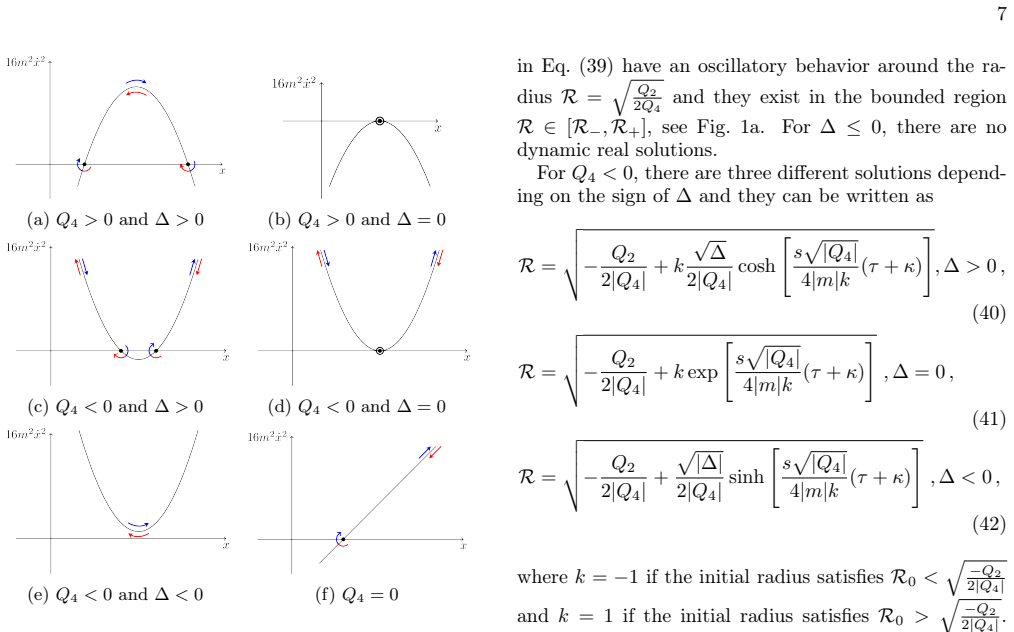
Dynamic solutions When bothb ± = 0, there are several analytic solutions that Eq. (34) can take, depending on the initial data. Writing Eq. (34) explicitly, as a function of the following quantities, Q0 =(j2 − −j 2 +)2 + 8m2(2m2 −(j 2 + +j 2 −)) Q2 =8 (j2 + −j 2 −)(M− −M +) + 4m2(M− +M +) Q4 =16(4m2 −(M − −M +)2), (37) we get ˙R=± p Q0 +Q 2R2 −Q 4R4 8mR ,...
-
[3]
Static solutions In addition to the dynamical solutions, there are also staticsolutionsforthevacuumshell, whichareillustrated in Fig. 1. These solutions occur when˙R= 0and ¨R= 0, which in the phase space are represented by the apex of the parabola,R= q Q2 2Q4 , for∆ = 0. It can be shown that indeed these two conditions together are consistent withp R = 0,...
-
[4]
H.Weyl,Gravitationandelectricity,Sitzungsber.Preuss. Akad. Wiss. Berlin (Math. Phys. )1918, 465 (1918)
1918
-
[5]
N. D. Birrell and P. C. W. Davies,Quantum Fields in Curved Space, Cambridge Monographs on Mathematical Physics (Cambridge University Press, Cambridge, UK, 1982)
1982
-
[6]
E. S. Fradkin and A. A. Tseytlin, Effective Field Theory from Quantized Strings, Phys. Lett. B158, 316 (1985)
1985
-
[7]
D. G. Boulware and S. Deser, String-Generated Gravity Models, Phys. Rev. Lett.55, 2656 (1985)
1985
-
[8]
C. G. Callan, Jr., I. R. Klebanov, and M. J. Perry, String Theory Effective Actions, Nucl. Phys. B278, 78 (1986)
1986
-
[9]
D. J. Gross and J. H. Sloan, The Quartic Effective Action for the Heterotic String, Nucl. Phys. B291, 41 (1987)
1987
- [10]
-
[11]
Lovelock, The Einstein tensor and its generalizations, J
D. Lovelock, The Einstein tensor and its generalizations, J. Math. Phys.12, 498 (1971)
1971
- [12]
-
[13]
C. Garraffo and G. Giribet, The Lovelock Black Holes, Mod. Phys. Lett. A23, 1801 (2008), arXiv:0805.3575 [gr- qc]
-
[14]
R. Troncoso and J. Zanelli, Chern-Simons supergravi- ties with off-shell local superalgebras, in6th Conference on Quantum Mechanics of Fundamental Systems: Black Holes and the Structure of the Universe(1997) pp. 119– 145, arXiv:hep-th/9902003
-
[15]
R. Troncoso and J. Zanelli, Higher dimensional gravity, propagating torsion and AdS gauge invariance, Class. Quant. Grav.17, 4451 (2000), arXiv:hep-th/9907109
-
[16]
R. Troncoso and J. Zanelli, Gauge supergravities for all odd dimensions, Int. J. Theor. Phys.38, 1181 (1999), arXiv:hep-th/9807029
-
[17]
J. M. Maldacena, The LargeNlimit of superconformal field theories and supergravity, Adv. Theor. Math. Phys. 2, 231 (1998), arXiv:hep-th/9711200
work page internal anchor Pith review arXiv 1998
-
[18]
Zanelli, Lecture notes on Chern-Simons (super- )gravities
J. Zanelli, Lecture notes on Chern-Simons (super- )gravities. Second edition (February 2008), in7th Mexi- can Workshop on Particles and Fields(2005) arXiv:hep- th/0502193
-
[19]
Cai, Gauss-Bonnet Black Holes in AdS Spaces, Phys
R.-G. Cai, Gauss-Bonnet Black Holes in AdS Spaces, Phys. Rev. D65, 084014 (2002), arXiv:0109133 [hep-th]
2002
- [20]
- [21]
- [22]
- [23]
-
[24]
H.-C. Kim and R.-G. Cai, Slowly Rotating Charged Gauss-Bonnet Black holes in AdS Spaces, Phys. Rev. D 77, 024045 (2008), arXiv:0711.0885 [hep-th]
-
[25]
Y. Brihaye and E. Radu, Five-dimensional rotating black holes in Einstein-Gauss-Bonnet theory, Phys. Lett. B 661, 167 (2008), arXiv:0801.1021 [hep-th]
-
[26]
A. Anabalon, N. Deruelle, Y. Morisawa, J. Oliva, M. Sasaki, D. Tempo, and R. Troncoso, Kerr-Schild ansatz in Einstein-Gauss-Bonnet gravity: An exact vac- uum solution in five dimensions, Class. Quant. Grav.26, 065002 (2009), arXiv:0812.3194 [hep-th]
-
[27]
M. Banados, C. Teitelboim, and J. Zanelli, Dimension- ally continued black holes, Phys. Rev. D49, 975 (1994), arXiv:gr-qc/9307033
-
[28]
R.-G. Cai and K.-S. Soh, Topological black holes in the dimensionallycontinuedgravity,Phys.Rev.D59,044013 (1999), arXiv:gr-qc/9808067
- [29]
-
[30]
J. Crisostomo, R. Troncoso, and J. Zanelli, Black hole scan, Phys. Rev. D62, 084013 (2000), arXiv:hep- th/0003271
- [31]
- [32]
-
[33]
G. Giribet, N. Merino, O. Miskovic, and J. Zanelli, Black hole solutions in Chern-Simons AdS supergravity, JHEP 08, 083, arXiv:1406.3096 [hep-th]
-
[34]
Y. Brihaye and E. Radu, Black hole solutions in d=5 Chern-Simons gravity, JHEP11, 049, arXiv:1305.3531 [gr-qc]
-
[35]
B. Kleihaus, J. Kunz, and E. Radu, Phases of Rotating Black Objects in d = 5 Einstein–Gauss–Bonnet Theory, Universe9, 156 (2023), arXiv:2303.12471 [gr-qc]
-
[36]
A. Anabalon, D. Astefanesei, A. Cisterna, F. Izau- rieta, J. Oliva, C. Quijada, and C. Quinzacara, Ro- tating and accelerating AdS black holes in Einstein- Gauss-Bonnet gravity, Phys. Lett. B857, 139000 (2024), arXiv:2404.04691 [hep-th]
-
[37]
The Black Hole in Three Dimensional Space Time
M. Banados, C. Teitelboim, and J. Zanelli, The Black hole in three-dimensional space-time, Phys. Rev. Lett. 69, 1849 (1992), arXiv:hep-th/9204099
work page Pith review arXiv 1992
-
[38]
Israel, Singular hypersurfaces and thin shells in gen- eral relativity, Nuovo Cim
W. Israel, Singular hypersurfaces and thin shells in gen- eral relativity, Nuovo Cim. B44S10, 1 (1966)
1966
-
[39]
Darmois, Les équations de la gravitation einsteini- enne, MSM25(1927)
G. Darmois, Les équations de la gravitation einsteini- enne, MSM25(1927)
1927
-
[40]
Poisson,A Relativist’s Toolkit: The Mathematics of Black-Hole Mechanics(Cambridge University Press, 2009)
E. Poisson,A Relativist’s Toolkit: The Mathematics of Black-Hole Mechanics(Cambridge University Press, 2009)
2009
-
[41]
Hayward and J
G. Hayward and J. Louko, Variational principles for non- smooth metrics, Phys. Rev. D42, 4032 (1990)
1990
-
[42]
P. Hajicek and J. Kijowski, Lagrangian and Hamiltonian formalism for discontinuous fluid and gravitational field, Phys. Rev. D57, 914 (1998), [Erratum: Phys.Rev.D 61, 129901 (2000)], arXiv:gr-qc/9707020
-
[43]
Israel, Gravitational Collapse and Causality, Phys
W. Israel, Gravitational Collapse and Causality, Phys. Rev.153, 1388 (1967)
1967
-
[44]
Kuchař, Charged shells in general relativity and their gravitational collapse, Czech
K. Kuchař, Charged shells in general relativity and their gravitational collapse, Czech. J. Phys. B18, 435 (1968)
1968
-
[45]
T. Delsate, J. V. Rocha, and R. Santarelli, Collapsing thinshellswithrotation,Phys.Rev.D89,121501(2014), arXiv:1405.1433 [gr-qc]
-
[46]
P. R. Brady, J. Louko, and E. Poisson, Stability of a shell around a black hole, Phys. Rev. D44, 1891 (1991)
1991
-
[47]
C. Bejarano and E. F. Eiroa, Dilaton thin-shell worm- holes supported by a generalized Chaplygin gas, Phys. Rev. D84, 064043 (2011), arXiv:1106.6340 [gr-qc]
-
[48]
Katz and D
J. Katz and D. Lynden-Bell, Tension shells and tension stars, Classical and Quantum Gravity8, 2231 (1991)
1991
- [49]
-
[50]
R. C. Myers, Higher Derivative Gravity, Surface Terms and String Theory, Phys. Rev. D36, 392 (1987)
1987
- [51]
- [52]
- [53]
- [54]
- [55]
- [56]
-
[57]
B. P. Brassel, S. D. Maharaj, and R. Goswami, Stars and junction conditions in Einstein–Gauss–Bonnet grav- ity, Class. Quant. Grav.40, 125004 (2023)
2023
- [58]
-
[59]
J. Crisostomo, S. del Campo, and J. Saavedra, Hamil- tonian treatment of collapsing thin shells in Lanczos- Lovelock’s theories, Phys. Rev. D70, 064034 (2004), arXiv:hep-th/0311259
- [60]
- [61]
-
[62]
Liu, Vacuum transitions with the Gauss-Bonnet term in D dimensions, Phys
Y. Liu, Vacuum transitions with the Gauss-Bonnet term in D dimensions, Phys. Rev. D111, 044012 (2025), arXiv:2406.19451 [hep-th]
-
[63]
Chahboun, R
O. Chahboun, R. A. Laamara, and E. H. Saidi, Einstein- Gauss-Bonnet dark matter halo: negative masses, rota- tion curves and the origin of dark matter effects, Class. Quant. Grav.41, 135016 (2024)
2024
-
[64]
E. Gravanis and S. Willison, ‘Mass without mass’ from thin shells in Gauss-Bonnet gravity, Phys. Rev. D75, 084025 (2007), arXiv:gr-qc/0701152
-
[65]
C. Garraffo, G. Giribet, E. Gravanis, and S. Willison, Gravitational solitons and C0 vacuum metrics in five- dimensional Lovelock gravity, J. Math. Phys.49, 042502 (2008), arXiv:0711.2992 [gr-qc]
- [66]
- [67]
-
[68]
C.Garrafo, G.Giribet, E.Gravanis,andS.Willison,Vac- uum thin shell solutions in five dimensional lovelock grav- ity,inThe Twelfth Marcel Grossmann Meeting(2010)pp. 1964–1966, arxiv:1001.3096
- [69]
-
[70]
M. Nozawa and H. Maeda, Effects of lovelock terms on the final fate of gravitational collapse: Analysis in dimen- sionally continued gravity, Class. Quant. Grav.23, 1779 (2006), arXiv:gr-qc/0510070
discussion (0)
Sign in with ORCID, Apple, or X to comment. Anyone can read and Pith papers without signing in.