Recognition: 2 theorem links
· Lean TheoremOperator structure of power corrections and anomalous scaling in energy correlators
Pith reviewed 2026-05-10 15:45 UTC · model grok-4.3
The pith
The dijet operator in energy correlators must mix with a triple-jet operator to produce the observed universal anomalous scaling of linear power corrections.
A machine-rendered reading of the paper's core claim, the machinery that carries it, and where it could break.
Core claim
Through an explicit loop calculation, the one-loop anomalous dimension of the relevant operators is derived, revealing that the dijet operator must be combined with a specific triple-jet component to capture the power corrections in the energy-energy correlator.
What carries the argument
Light-ray operators that encode the non-perturbative power corrections and their mixing under renormalization, specifically the combination of dijet and triple-jet operators.
If this is right
- The universal anomalous scaling is a direct consequence of this operator mixing.
- This provides a framework to connect operator theory directly to high-precision collider phenomenology.
- The approach can be extended to other energy correlators and power correction terms.
- Predictions for the scaling behavior can be tested against experimental measurements at colliders.
Where Pith is reading between the lines
- Similar operator mixing structures may appear in higher-order power corrections or multi-particle correlators.
- Data from energy correlators could be used to extract the coefficients of these operators more precisely.
- Extensions to other processes like deep inelastic scattering might reveal analogous anomalous dimensions.
Load-bearing premise
The light-ray operator approach fully captures all non-perturbative power corrections without missing contributions from other operators or higher-order effects.
What would settle it
A higher-loop calculation or precise experimental measurement of the energy correlator that deviates from the predicted anomalous scaling would falsify the claim that this operator combination is sufficient.
Figures

read the original abstract
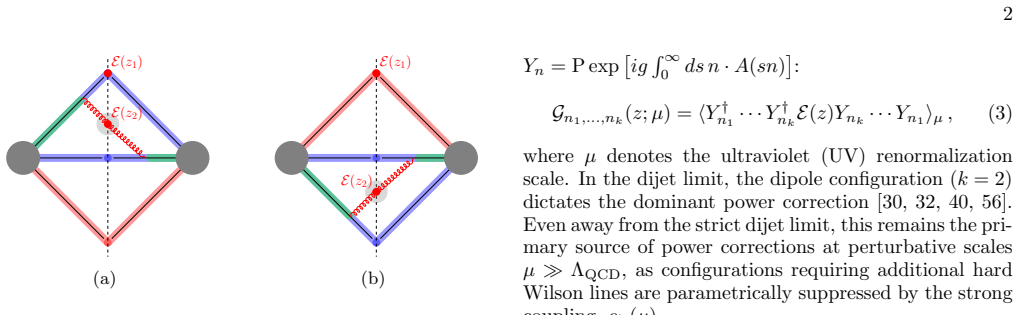
Energy correlators offer a clean probe of quantum chromodynamics, serving as an ideal laboratory to rigorously investigate non-perturbative power corrections. The recent discovery that linear corrections exhibit a universal anomalous scaling points to a deep, underlying theoretical structure. We uncover the quantum field-theoretic origin of this phenomenon in the energy-energy correlator using light-ray operators. Through an explicit loop calculation, we derive the one-loop anomalous dimension, revealing that the dijet operator must be combined with a specific triple-jet component. This provides a first-principles framework that connects operator theory with high-precision collider phenomenology.
Editorial analysis
A structured set of objections, weighed in public.
Referee Report
Summary. The manuscript investigates the operator structure of power corrections in energy-energy correlators using light-ray operators in QCD. Through an explicit one-loop calculation, it derives the anomalous dimension and shows that the dijet operator must mix with a specific triple-jet component to account for the universal anomalous scaling of linear power corrections.
Significance. If the loop calculation and operator basis are complete, the work supplies a first-principles QFT derivation of the recently observed universal scaling, directly linking operator mixing to collider observables. The explicit computation of the one-loop mixing matrix is a clear strength, offering a parameter-free result rather than a fit.
major comments (1)
- [one-loop calculation of the anomalous dimension] The one-loop mixing calculation: the central claim that the dijet operator combined with the specified triple-jet component produces the universal anomalous dimension assumes the chosen light-ray operators form a closed basis. The manuscript does not demonstrate that contributions from additional higher-twist or multi-parton operators (such as four-jet configurations or alternative collinear structures) are absent or do not mix at one loop. If such operators contribute to the same power-suppressed terms, the reported anomalous dimension would be incomplete and the connection to universal scaling would not hold.
Simulated Author's Rebuttal
We thank the referee for their careful reading of the manuscript and for recognizing the value of the explicit one-loop calculation. We address the major comment below.
read point-by-point responses
-
Referee: [one-loop calculation of the anomalous dimension] The one-loop mixing calculation: the central claim that the dijet operator combined with the specified triple-jet component produces the universal anomalous dimension assumes the chosen light-ray operators form a closed basis. The manuscript does not demonstrate that contributions from additional higher-twist or multi-parton operators (such as four-jet configurations or alternative collinear structures) are absent or do not mix at one loop. If such operators contribute to the same power-suppressed terms, the reported anomalous dimension would be incomplete and the connection to universal scaling would not hold.
Authors: We agree that a demonstration of basis closure is necessary to support the central claim. The operator basis in the manuscript is constructed from the twist expansion appropriate to linear power corrections in the energy-energy correlator, restricting to dijet and triple-jet light-ray operators that match the collinear scaling and quantum numbers of the observable. At one-loop order, four-jet and higher configurations are excluded from mixing into the linear term by color factors, momentum conservation, and the fact that they generate only quadratic or higher power corrections in the back-to-back limit. We will add a short subsection that enumerates the possible additional operators and shows explicitly why their one-loop matrix elements do not contribute to the reported anomalous dimension. This clarification will be included in the revised version. revision: partial
Circularity Check
No circularity: explicit one-loop derivation from light-ray operators
full rationale
The paper's central claim is an explicit one-loop calculation of the anomalous dimension for the dijet operator mixing with a triple-jet component in the energy-energy correlator. No load-bearing step reduces to a self-definition, a fitted parameter renamed as prediction, or a self-citation chain that is itself unverified. The derivation is presented as first-principles QFT computation; the 'recent discovery' of universal scaling is treated as external motivation rather than an input that forces the result. The operator basis completeness is an assumption open to external falsification, not a circular closure. This is the normal non-circular outcome for a loop-level operator mixing calculation.
Axiom & Free-Parameter Ledger
axioms (2)
- domain assumption Energy correlators can be described using light-ray operators in QCD
- standard math Perturbative loop calculations yield the anomalous dimensions of these operators
Lean theorems connected to this paper
-
IndisputableMonolith/Cost/FunctionalEquation.leanwashburn_uniqueness_aczel unclear?
unclearRelation between the paper passage and the cited Recognition theorem.
Through an explicit loop calculation, we derive the one-loop anomalous dimension, revealing that the dijet operator must be combined with a specific triple-jet component.
-
IndisputableMonolith/Foundation/AbsoluteFloorClosure.leanreality_from_one_distinction unclear?
unclearRelation between the paper passage and the cited Recognition theorem.
We uncover the quantum field-theoretic origin of this phenomenon in the energy-energy correlator using light-ray operators.
What do these tags mean?
- matches
- The paper's claim is directly supported by a theorem in the formal canon.
- supports
- The theorem supports part of the paper's argument, but the paper may add assumptions or extra steps.
- extends
- The paper goes beyond the formal theorem; the theorem is a base layer rather than the whole result.
- uses
- The paper appears to rely on the theorem as machinery.
- contradicts
- The paper's claim conflicts with a theorem or certificate in the canon.
- unclear
- Pith found a possible connection, but the passage is too broad, indirect, or ambiguous to say the theorem truly supports the claim.
Forward citations
Cited by 1 Pith paper
-
Hydrodynamics and Energy Correlators
Energy-energy correlators in heavy-ion collisions exhibit classical hydrodynamic scaling from collective flow at large angles within the small-angle regime, collective modes at smaller angles, and light-ray OPE at eve...
Reference graph
Works this paper leans on
-
[1]
C. L. Basham, L. S. Brown, S. D. Ellis, and S. T. Love, Energy Correlations in electron - Positron Annihilation: Testing QCD, Phys. Rev. Lett.41, 1585 (1978). 6
1978
-
[2]
C. L. Basham, L. S. Brown, S. D. Ellis, and S. T. Love, Electron - Positron Annihilation Energy Pattern in Quantum Chromodynamics: Asymptotically Free Per- turbation Theory, Phys. Rev. D17, 2298 (1978)
1978
-
[3]
C. L. Basham, L. S. Brown, S. D. Ellis, and S. T. Love, Energy Correlations in Perturbative Quantum Chromo- dynamics: A Conjecture for All Orders, Phys. Lett. B 85, 297 (1979)
1979
-
[4]
C. L. Basham, L. S. Brown, S. D. Ellis, and S. T. Love, Energy Correlations in electron-Positron Annihilation in Quantum Chromodynamics: Asymptotically Free Per- turbation Theory, Phys. Rev. D19, 2018 (1979)
2018
-
[5]
I. Moult and H. X. Zhu, Energy Correlators: A Journey From Theory to Experiment, (2025), arXiv:2506.09119 [hep-ph]
-
[6]
D. M. Hofman and J. Maldacena, Conformal collider physics: Energy and charge correlations, JHEP05, 012, arXiv:0803.1467 [hep-th]
-
[7]
P. Kravchuk and D. Simmons-Duffin, Light-ray op- erators in conformal field theory, JHEP11, 102, arXiv:1805.00098 [hep-th]
-
[8]
M. Kologlu, P. Kravchuk, D. Simmons-Duffin, and A. Zhiboedov, The light-ray OPE and conformal collid- ers, JHEP01, 128, arXiv:1905.01311 [hep-th]
- [9]
- [10]
- [11]
-
[12]
C.-H. Chang and D. Simmons-Duffin, Three-point energy correlators and the celestial block expansion, JHEP02, 126, arXiv:2202.04090 [hep-th]
- [13]
-
[14]
V. Del Duca, C. Duhr, A. Kardos, G. Somogyi, and Z. Tr´ ocs´ anyi, Three-Jet Production in Electron-Positron Collisions at Next-to-Next-to-Leading Order Accuracy, Phys. Rev. Lett.117, 152004 (2016), arXiv:1603.08927 [hep-ph]
-
[15]
Z. Tulip´ ant, A. Kardos, and G. Somogyi, Energy–energy correlation in electron–positron annihilation at NNLL + NNLO accuracy, Eur. Phys. J. C77, 749 (2017), arXiv:1708.04093 [hep-ph]
- [16]
- [17]
-
[18]
I. Moult and H. X. Zhu, Simplicity from Re- coil: The Three-Loop Soft Function and Factoriza- tion for the Energy-Energy Correlation, JHEP08, 160, arXiv:1801.02627 [hep-ph]
- [19]
- [20]
-
[21]
R. Akhoury and V. I. Zakharov, On the universality of the leading, 1/Q power corrections in QCD, Phys. Lett. B357, 646 (1995), arXiv:hep-ph/9504248
-
[22]
P. Nason and M. H. Seymour, Infrared renormalons and power suppressed effects in e+ e- jet events, Nucl. Phys. B454, 291 (1995), arXiv:hep-ph/9506317
- [23]
- [24]
- [25]
- [26]
- [27]
-
[28]
M. Dasgupta and B. R. Webber, Two loop enhancement factor for 1 / Q corrections to event shapes in deep in- elastic scattering, JHEP10, 001, arXiv:hep-ph/9809247
-
[29]
M. Dasgupta, L. Magnea, and G. Smye, Universality of 1/Q corrections revisited, JHEP11, 025, arXiv:hep- ph/9911316
- [30]
- [31]
- [32]
-
[33]
P. Nason and G. Zanderighi, Fits ofα s using power corrections in the three-jet region, JHEP06, 058, arXiv:2301.03607 [hep-ph]
- [34]
- [35]
-
[36]
P. Nason and G. Zanderighi, Fits ofα s from event-shapes in the three-jet region: extension to all energies, JHEP 06, 200, arXiv:2501.18173 [hep-ph]
-
[37]
U. G. Aglietti, G. Ferrera, W.-L. Ju, and J. Miao, Thrust Distribution in Electron-Positron Annihilation at Full Next-to-Next-to-Next-to-Leading-Logarithmic Ac- curacy Including Next-to-Next-to-Leading-Order Terms in QCD, Phys. Rev. Lett.134, 251904 (2025), 7 arXiv:2502.01570 [hep-ph]
-
[38]
M. A. Benitez, A. Bhattacharya, A. H. Hoang, V. Ma- teu, M. D. Schwartz, I. W. Stewart, and X. Zhang, A Precise Determination ofα s from the Heavy Jet Mass Distribution, (2025), arXiv:2502.12253 [hep-ph]
work page internal anchor Pith review Pith/arXiv arXiv 2025
-
[39]
Navaset al.(Particle Data Group), Review of particle physics, Phys
S. Navaset al.(Particle Data Group), Review of particle physics, Phys. Rev. D110, 030001 (2024)
2024
- [40]
- [41]
- [42]
- [43]
- [44]
- [45]
- [46]
-
[47]
E. Herrmann, Z.-B. Kang, J. Penttala, and C. Zhang, Collinear limit of the energy-energy correlator in e+e− collisions: transition from perturbative to non- perturbative regimes, (2025), arXiv:2507.17704 [hep-ph]
-
[48]
C. Farren-Colloty, J. Helliwell, R. Patel, G. P. Salam, and S. Zanoli, Anomalous scaling of linear power corrections, (2025), arXiv:2507.18696 [hep-ph]
-
[49]
M. Dasgupta and F. Hounat, Exploring soft anomalous dimensions for 1/Q power corrections, JHEP09, 060, arXiv:2411.16867 [hep-ph]
-
[50]
A. Banfi and B. K. El-Menoufi, Characterising hadroni- sation across the phase space, (2025), arXiv:2511.17708 [hep-ph]
-
[51]
E. A. Kuraev, L. N. Lipatov, and V. S. Fadin, The Pomeranchuk singularity in nonabelian gauge theories, Sov. Phys. JETP45, 199 (1977)
1977
-
[52]
I. I. Balitsky and L. N. Lipatov, The Pomeranchuk Singu- larity in Quantum Chromodynamics, Sov. J. Nucl. Phys. 28, 822 (1978)
1978
- [53]
- [54]
- [55]
- [56]
- [57]
-
[58]
In this Letter, we neglect the contribution from multi-leg Wilson line contribution
-
[59]
S. Caron-Huot, M. Kologlu, P. Kravchuk, D. Meltzer, and D. Simmons-Duffin, Detectors in weakly-coupled field theories, JHEP04, 014, arXiv:2209.00008 [hep-th]
-
[60]
W. T. Giele and E. W. N. Glover, Higher Order Correc- tions to Jet Cross Sections in e+ e- Annihilation, Phys. Rev. D46, 1980 (1992)
1980
- [61]
-
[62]
S. Catani and M. H. Seymour, A General algorithm for calculating jet cross-sections in NLO QCD, Nucl. Phys. B485, 291 (1997), [Erratum: Nucl.Phys.B 510, 503–504 (1998)], arXiv:hep-ph/9605323
-
[63]
T. Becher and M. Neubert, Threshold resummation in momentum space from effective field theory, Phys. Rev. Lett.97, 082001 (2006), arXiv:hep-ph/0605050
-
[64]
Infrared singularities of scattering amplitudes in perturbative QCD
T. Becher and M. Neubert, Infrared singularities of scattering amplitudes in perturbative QCD, Phys. Rev. Lett.102, 162001 (2009), [Erratum: Phys.Rev.Lett. 111, 199905 (2013)], arXiv:0901.0722 [hep-ph]
work page Pith review arXiv 2009
-
[65]
A comprehensive guide to the physics and usage of PYTHIA 8.3
C. Bierlichet al., A comprehensive guide to the physics and usage of PYTHIA 8.3, SciPost Phys. Codeb.2022, 8 (2022), arXiv:2203.11601 [hep-ph]
work page internal anchor Pith review arXiv 2022
-
[66]
M. Kologlu, P. Kravchuk, D. Simmons-Duffin, and A. Zhiboedov, Shocks, Superconvergence, and a Stringy Equivalence Principle, JHEP11, 096, arXiv:1904.05905 [hep-th]
discussion (0)
Sign in with ORCID, Apple, or X to comment. Anyone can read and Pith papers without signing in.