Recognition: unknown
The Atacama Cosmology Telescope: A Test of the Gravitational Force Law on Cosmological Scales Using the Kinematic Sunyaev-Zeldovich Effect
Pith reviewed 2026-05-10 11:51 UTC · model grok-4.3
The pith
The kinematic Sunyaev-Zeldovich effect from galaxy pairs constrains gravity to follow an inverse-square law on scales of tens to hundreds of megaparsecs.
A machine-rendered reading of the paper's core claim, the machinery that carries it, and where it could break.
Core claim
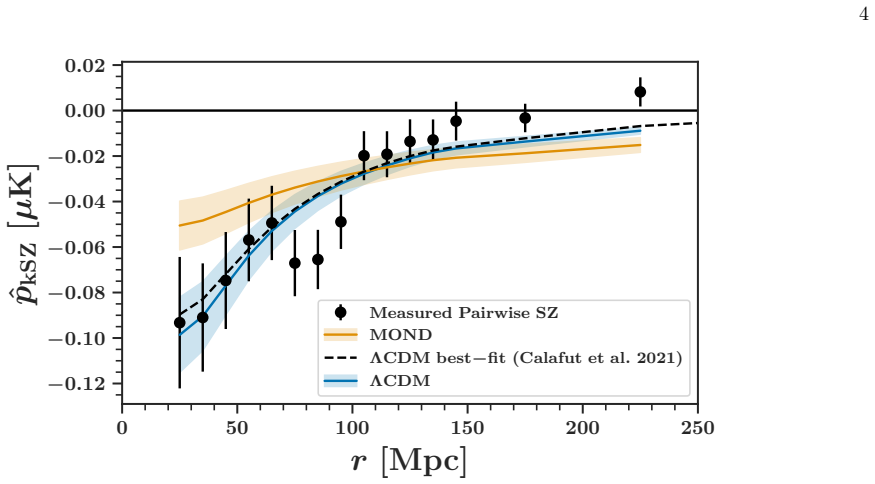
By combining CMB maps from the Atacama Cosmology Telescope with a galaxy catalog from the Sloan Digital Sky Survey, the mean pairwise velocity of massive halos is estimated using the kinematic Sunyaev-Zeldovich effect. On scales from 30 to 230 megaparsecs, the gravitational acceleration is constrained to follow g proportional to 1 over r to the n with n equal to 2.1 plus or minus 0.3, consistent with the standard Lambda CDM model.
What carries the argument
The mean pairwise velocity of halos measured through the kinematic Sunyaev-Zeldovich effect, which directly probes the gravitational acceleration between them as a function of separation.
If this is right
- The result is consistent with Newtonian gravity in an expanding spacetime over large distances.
- Upcoming surveys could rule out a linear inverse dependence (n=1) at 10 sigma significance.
- The kSZ effect can serve as a powerful tool for testing gravity on cosmological scales.
- Agreement with inverse quadratic radial dependence is shown over the distances separating galaxy halos.
Where Pith is reading between the lines
- Future higher-precision data could distinguish between specific modified-gravity models that predict different power-law indices.
- The same kSZ pairwise-velocity technique could be applied to other large-scale structure catalogs to cross-check the result.
- If the index remains consistent with 2 at smaller separations, it would constrain the scale at which any deviation from inverse-square gravity might appear.
Load-bearing premise
The kinematic Sunyaev-Zeldovich signal accurately isolates the line-of-sight peculiar velocity of halos without significant contamination from other CMB effects or miscentering in the galaxy catalog.
What would settle it
A higher-precision measurement of the pairwise velocity that returns a value of n inconsistent with 2.1 plus or minus 0.3 at several sigma, for example a value near 1, would falsify the claimed consistency with standard gravity.
Figures


read the original abstract
The mean pairwise velocity of massive halos reflects the gravitational force law on cosmic scales. We combine cosmic microwave background intensity maps from the Atacama Cosmology Telescope and a galaxy catalog from the Sloan Digital Sky Survey to estimate the mean pairwise velocity using the kinematic Sunyaev-Zeldovich (kSZ) effect. On scales from 30 -- 230 megaparsecs, we constrain the gravitational acceleration between pairs of halos at separation $r$ to be $g\propto 1/r^n$ with $n=2.1\pm 0.3$, which is consistent with Newtonian gravity in an expanding spacetime (\textit{i.e.}, the standard $\Lambda$CDM model). This constraint shows agreement with an inverse quadratic radial dependence over the large distances separating galaxy halos, as expected in standard cosmology. Upcoming surveys have the potential to rule out $n = 1$ at $10\sigma$ significance. Our results establish the kSZ effect as a powerful tool for testing gravity on cosmological scales.
Editorial analysis
A structured set of objections, weighed in public.
Referee Report
Summary. The manuscript combines Atacama Cosmology Telescope CMB intensity maps with an SDSS galaxy catalog to extract the mean pairwise velocity of massive halos via the kinematic Sunyaev-Zeldovich effect. On comoving scales 30–230 Mpc the authors fit the observed velocity profile to a power-law gravitational acceleration g ∝ 1/r^n and report n = 2.1 ± 0.3, which is statistically consistent with the n = 2 expectation of Newtonian gravity in an expanding ΛCDM universe. The work also forecasts that future surveys could exclude n = 1 at ~10σ.
Significance. If the central measurement is robust, the result supplies an independent, large-scale test of the inverse-square force law between halos and demonstrates that the kSZ effect can serve as a practical probe of gravity on cosmological scales. The quoted uncertainty already reaches the precision needed to confirm the standard model; the projected 10σ reach with upcoming data would make the method competitive with other gravity tests.
minor comments (3)
- The description of the velocity reconstruction pipeline and the covariance matrix estimation (mentioned in the methods) would benefit from an explicit equation or flowchart showing how the pairwise estimator is constructed from the filtered temperature map and the galaxy positions.
- Figure 3 (or equivalent) that shows the measured velocity profile versus separation should include the best-fit n = 2.1 model overlaid together with the n = 1 and n = 3 reference curves so that the goodness-of-fit can be assessed visually.
- The null-test section reports stability of n under variations in tSZ leakage, CIB, and miscentering; adding a short table that lists the recovered n and its uncertainty for each test would make the robustness statement quantitative.
Simulated Author's Rebuttal
We thank the referee for their positive summary of our work and for recommending minor revision. The assessment correctly captures the central result: a kSZ-based measurement of the mean pairwise velocity that yields a gravitational acceleration consistent with the inverse-square law on scales 30–230 Mpc. No specific major comments were raised in the report, so we have no points to address point-by-point. We will incorporate any minor editorial suggestions in the revised manuscript.
Circularity Check
No significant circularity; derivation self-contained
full rationale
The central result is obtained by measuring the mean pairwise velocity of halos via the kSZ effect in ACT CMB maps cross-correlated with SDSS galaxies, then fitting the power-law index n in g ∝ 1/r^n directly to the observed velocity profile on 30-230 Mpc scales. This fit is a statistical constraint from external data and does not reduce by construction to any pre-fixed parameter, ansatz, or self-citation chain. The quoted n = 2.1 ± 0.3 is compared to the ΛCDM expectation but is not forced by it; null tests for contamination are reported as independent checks. No load-bearing step equates the output to the input by definition.
Axiom & Free-Parameter Ledger
free parameters (1)
- n =
2.1
axioms (3)
- domain assumption The kSZ temperature shift directly traces the line-of-sight peculiar velocity of electrons in halos.
- domain assumption The SDSS galaxy catalog provides an unbiased tracer of the massive halos whose pairwise velocities are being measured.
- domain assumption Standard ΛCDM expansion history and linear bias relations hold when interpreting the result as a test of gravity.
Forward citations
Cited by 1 Pith paper
-
Modifications of CMB Temperature and Polarization Quadrupole Signals in Thurston Spacetimes
Thurston spacetimes generate distinct evolving temperature and polarization patterns in the CMB that can be tracked via Stokes parameters and potentially isolated per geometry.
Reference graph
Works this paper leans on
-
[1]
Modified Gravity and Cosmology
Clifton, T., Ferreira, P. G., Padilla, A., & Skordis, C. 2012, arXiv:1106.2476, Phys. Rep., 513, 1, Modified Gravity and Cosmology
work page internal anchor Pith review arXiv 2012
- [2]
-
[3]
Tests of the Gravitational Inverse-Square Law
Adelberger, E. G., Heckel, B. R., & Nelson, A. E. 2003, hep-ph/0307284, Annual Review of Nuclear and Particle Science, 53, 77, Tests of the Gravitational Inverse-Square Law
work page Pith review arXiv 2003
-
[4]
Chudaykin, A., Kunz, M., & Carron, J. 2025, arXiv:2503.09893, Phys. Rev. D, 112, 083537, Modified Gravity Constraints with the Planck ISW-lensing Bispec- trum
-
[5]
Castello, S., Grimm, N., & Bonvin, C. 2022, arXiv:2204.11507, Phys. Rev. D, 106, 083511, Rescu- ing Constraints on Modified Gravity Using Gravitational Redshift in Large-Scale Structure
-
[6]
Sunyaev, R. A. & Zeldovich, Y. B. 1980, Mon. Not. R. As- tron. Soc., 190, 413, The Velocity of Clusters of Galaxies Relative to the Microwave Background - The Possibility of its Measurement
1980
-
[7]
2012, Phys
Hand, N., et al. 2012, Phys. Rev. Lett., 109, 041101, Ev- idence of Galaxy Cluster Motions with the Kinematic Sunyaev-Zel’dovich Effect, https://link.aps.org/doi/10. 1103/PhysRevLett.109.041101
2012
-
[8]
De Bernardis, F., et al. 2017, arXiv:1607.02139, J. Cosmol. Astropart. Phys., 2017, 008, Detection of the Pairwise Kinematic Sunyaev-Zel’dovich Effect with Boss DR11 and the Atacama Cosmology Telescope
-
[9]
Calafut, V., et al. 2021, arXiv:2101.08374, Phys. Rev. D, 104, 043502, The Atacama Cosmology Telescope: Detec- tion of the Pairwise Kinematic Sunyaev-Zel’dovich Effect with SDSS DR15 Galaxies
-
[10]
Soergel, B., et al. 2016, https://academic.oup.com/mnras/article- pdf/461/3/3172/8108015/stw1455.pdf, Monthly Notices of the Royal Astronomical Society, 461, 3172, Detection of the Kinematic Sunyaev- Zel’dovich Effect With DES Year 1 and SPT, https://doi.org/10.1093/mnras/stw1455
-
[11]
SPT-3G and DES Collaboration. 2023, Phys. Rev. D, 107, 042004, Measurement of the Mean Central Optical Depth of Galaxy Clusters Via the Pairwise Kinematic Sunyaev-Zel’dovich Effect with SPT-3G and DES, https: //link.aps.org/doi/10.1103/PhysRevD.107.042004
-
[12]
1983, Ap
Milgrom, M. 1983, Ap. J., 270, 365, A Modification Of The Newtonian Dynamics as a Possible Alternative to the Hidden Mass Hypothesis
1983
-
[13]
& Milgrom, M
Bekenstein, J. & Milgrom, M. 1984, Ap. J., 286, 7, Does the Missing Mass Problem Signal The Breakdown of Newtonian Gravity?
1984
-
[14]
Peebles, P. J. E. 1976, Astrophys. Space Sci., 45, 3, A Cosmic Virial Theorem
1976
-
[15]
& Peebles, P
Davis, M. & Peebles, P. J. E. 1977, Ap. J. S., 34, 425, On The Integration of the BBGKY Equations for the Development Of Strongly Nonlinear Clustering in an Ex- panding Universe
1977
-
[16]
See Supplemental Material in https://doi.org/10.1103/ rk8v-rcm3 for a full derivation and special cases, which includes Refs. [45-69]
-
[17]
Peebles, P. J. E. 1980, The Large-Scale Structure of the Universe (Princeton University Press)
1980
-
[18]
& Yokoyama, J
Seto, N. & Yokoyama, J. 1999, PASJ, 51, 233, Pairwise Infall Velocity and Acceleration in the Zel’dovich Ap- proximation
1999
-
[19]
Ross, A. J., et al. 2016, https://academic.oup.com/mnras/article- pdf/464/1/1168/18517623/stw2372.pdf, Monthly No- tices of the Royal Astronomical Society, 464, 1168, The Clustering of Galaxies in the Completed SDSS-III Baryon Oscillation Spectroscopic Survey: Observational System- atics and Baryon Acoustic Oscillations in the Correlation Function, https:...
-
[20]
2013, BOSS Publications and Results, http:// www.sdss3.org/science/boss publications.php
SDSS. 2013, BOSS Publications and Results, http:// www.sdss3.org/science/boss publications.php
2013
-
[21]
Alam, S., et al. 2017, https://academic.oup.com/mnras/article- pdf/470/3/2617/18315003/stx721.pdf, Monthly No- tices of the Royal Astronomical Society, 470, 2617, The Clustering of Galaxies in the Completed SDSS- III Baryon Oscillation Spectroscopic Survey: Cos- mological Analysis of the DR12 Galaxy Sample, https://doi.org/10.1093/mnras/stx721
-
[22]
Planck Collaboration, et al. 2020, A&A, 641, A6, Planck 2018 Results - VI. Cosmological Parameters, https://doi. org/10.1051/0004-6361/201833910
-
[23]
G., Juszkiewicz, R., Feldman, H
Ferreira, P. G., Juszkiewicz, R., Feldman, H. A., Davis, M., & Jaffe, A. H. 1999, astro-ph/9812456, Ap. J., 515, L1, Streaming Velocities as a Dynamical Estimator of Ω
-
[24]
A., Gong, Y., Hadzhiyska, B., & Hsu, Y.-H
Gallardo, P. A., Gong, Y., Hadzhiyska, B., & Hsu, Y.-H. 2025, Research Notes of the AAS, 9, 284, Iskay2: Signal Extraction of the Kinematic Sunyaev-Zel’dovich Effect Through the Pairwise Estimator: Pipeline and Valida- tion, https://doi.org/10.3847/2515-5172/ae1587
- [25]
-
[26]
Naess, S., et al. 2020, Journal of Cosmology and As- troparticle Physics, 2020, 046, The Atacama Cosmol- ogy Telescope: Arcminute-Resolution Maps Of 18 000 Square Degrees Of The Microwave Sky From Act 2008- 2018 Data Combined With Planck, https://dx.doi.org/ 10.1088/1475-7516/2020/12/046
-
[27]
The Atacama Cosmology Telescope: DR6 Power Spectra, Likelihoods and $\Lambda$CDM Parameters
Louis, T., et al. 2025, arXiv:2503.14452, The Ata- cama Cosmology Telescope: DR6 Power Spectra, Like- lihoods and ΛCDM Parameters, https://arxiv.org/abs/ 2503.14452
work page internal anchor Pith review arXiv 2025
-
[28]
S., et al
Aguado, D. S., et al. 2019, The Astrophysical Jour- nal Supplement Series, 240, 23, The Fifteenth Data Release of the Sloan Digital Sky Surveys: First Re- lease of MaNGA-derived Quantities, Data Visualization Tools, and Stellar Library, https://dx.doi.org/10.3847/ 1538-4365/aaf651
2019
-
[29]
Vavagiakis, E. M., et al. 2021, Phys. Rev. D, 104, 043503, The Atacama Cosmology Telescope: Probing the Baryon Content of SDSS DR15 Galaxies with the Thermal and Kinematic Sunyaev-Zel’dovich Effects, https://link.aps. org/doi/10.1103/PhysRevD.104.043503
-
[30]
2018, Monthly Notices of the Royal Astronomical Society, 473, 4077 Planck Collaboration, Ade, P
Planck Collaboration, et al. 2016, A&A, 594, A13, Planck 2015 Results - XIII. Cosmological Parameters, https:// doi.org/10.1051/0004-6361/201525830
-
[31]
Gong, Y., Bean, R., Gallardo, P. A., Vavagiakis, E. M., Battaglia, N., & Niemack, M. 2024, arXiv:2307.11894, Phys. Rev. D, 109, 023513, Pairwise Kinematic Sunyaev- Zel’dovich Signal Extraction Efficacy and Optical Depth Estimation
-
[32]
Alam, S., et al. 2021, arXiv:2007.08991, Phys. Rev. D, 103, 083533, Completed SDSS-IV Extended Baryon Os- cillation Spectroscopic Survey: Cosmological Implica- tions from two Decades of Spectroscopic Surveys at the Apache Point Observatory
-
[33]
McGaugh, S. & Milgrom, M. 2013, arXiv:1301.0822, Ap. J., 766, 22, Andromeda Dwarfs in Light of Modified New- tonian Dynamics
- [34]
-
[35]
R., et al
Guachalla, B. R., et al. 2025, Phys. Rev. D, 112, 103512, Backlighting Extended Gas Halos Around Luminous Red Galaxies: Kinematic Sunyaev-Zel’dovich Effect From DESI Y1 And ACT Data, https://link.aps.org/doi/10. 1103/lqbj-wcqj
2025
-
[36]
The Simons Observatory: Science goals and forecasts
Ade, P., et al. 2019, arXiv:1808.07445, J. Cosmol. As- tropart. Phys., 2019, 056, The Simons Observatory: Sci- ence Goals and Forecasts
work page Pith review arXiv 2019
-
[37]
The DESI Experiment Part I: Science,Targeting, and Survey Design
DESI Collaboration, et al. 2016, arXiv:1611.00036, arXiv e-prints, arXiv:1611.00036, The DESI Experiment Part I: Science, Targeting, and Survey Design
work page internal anchor Pith review arXiv 2016
-
[38]
Schutt, T., Maniyar, A. S., Schaan, E., Coulton, W. R., & Mishra, N. 2024, Phys. Rev. D, 109, 103539, New Temperature Inversion Estimator to Detect CMB Patchy Screening by Large-Scale Structure, https://link.aps. org/doi/10.1103/PhysRevD.109.103539
-
[39]
Abitbol, M., et al. 2025, Journal of Cosmology and As- troparticle Physics, 2025, 034, The Simons Observatory: Science Goals and Forecasts for the Enhanced Large Aperture Telescope, https://doi.org/10.1088/1475-7516/ 2025/08/034
-
[40]
Hunter, J. D. 2007, Computing in Science and Engineer- ing, 9, 90, Matplotlib: A 2D Graphics Environment
2007
-
[41]
R., et al
Harris, C. R., et al. 2020, nature, 585, 357, Array pro- gramming with NumPy
2020
-
[42]
2024, pandas- dev/pandas: Pandas (v2.2.2), https://doi.org/10
The Pandas Development Team. 2024, pandas- dev/pandas: Pandas (v2.2.2), https://doi.org/10. 5281/zenodo.10957263
2024
-
[43]
2010, in Proceedings of the 9th Python in Science Conference, ed
Wes McKinney. 2010, in Proceedings of the 9th Python in Science Conference, ed. St´ efan van der Walt & Jarrod Millman, 56 – 61
2010
-
[44]
Virtanen, P., et al. 2020, arXiv:1907.10121, Nature Meth- ods, 17, 261, SciPy 1.0: Fundamental Algorithms for Sci- entific Computing in Python
-
[45]
Juszkiewicz, R., Springel, V., & Durrer, R. 1999, astro- ph/9812387, Ap. J. Lett., 518, L25, Dynamics of Pairwise Motions
-
[46]
K., Hui, L., Diaferio, A., & Scoccimarro, R
Sheth, R. K., Hui, L., Diaferio, A., & Scoccimarro, R. 2001, astro-ph/0009167, Mon. Not. R. Astron. Soc., 325, 1288, Linear and Non-Linear Contributions to Pairwise Peculiar Velocities
- [47]
-
[48]
Kosowsky, A. 2010, arXiv:0910.4802, Advances in As- tronomy, 2010, 357342, Dwarf Galaxies, MOND, and Rel- ativistic Gravitation
-
[49]
Modified Newtonian Dynamics ( MOND): Observational Phenomenology and Relativistic Extensions
Famaey, B. & McGaugh, S. S. 2012, arXiv:1112.3960, Living Reviews in Relativity, 15, 10, Modified Newtonian Dynamics (MOND): Observational Phenomenology and Relativistic Extensions
- [50]
- [51]
- [52]
- [53]
-
[54]
Gravitational Waves and Gamma-rays from a Binary Neutron Star Merger: GW170817 and GRB 170817A
Abbott, B. P.et al.. 2017, arXiv:1710.05834, Ap. J. Lett., 848, L13, Gravitational Waves and Gamma-Rays from a Binary Neutron Star Merger: GW170817 and GRB 170817A
work page Pith review arXiv 2017
-
[55]
Tests of General Relativity with GW170817
Abbott, B. P.et al.. 2019, arXiv:1811.00364, Phys. Rev. Lett., 123, 011102, Tests of General Relativity with GW170817
work page Pith review arXiv 2019
-
[56]
Boran, S., Desai, S., Kahya, E. O., & Woodard, R. P. 2018, arXiv:1710.06168, Phys. Rev. D, 97, 041501, GW170817 Falsifies Dark Matter Emulators
-
[57]
Nipoti, C., Ciotti, L., Binney, J., & Londrillo, P. 2008, arXiv:0802.1122, Mon. Not. R. Astron. Soc., 386, 2194, Dynamical Friction in Modified Newtonian Dynamics
- [58]
- [59]
- [60]
- [61]
-
[62]
Dodelson, S. 2011, arXiv:1112.1320, International Jour- nal of Modern Physics D, 20, 2749, The Real Problem with MOND
-
[63]
Pardo, K. & Spergel, D. N. 2020, arXiv:2007.00555, Phys. Rev. Lett., 125, 211101, What is the Price of Abandoning Dark Matter? Cosmological Constraints on Alternative Gravity Theories
-
[64]
& Z lo´ snik, T
Skordis, C. & Z lo´ snik, T. 2021, Phys. Rev. Lett., 127, 161302, New Relativistic Theory for Modified Newtonian Dynamics, https://link.aps.org/doi/10.1103/ PhysRevLett.127.161302
2021
-
[65]
Bekenstein, J. & Magueijo, J. 2006, astro-ph/0602266, Phys. Rev. D, 73, 103513, Modified Newtonian Dynamics Habitats Within the Solar System
-
[66]
1986, Ap
Milgrom, M. 1986, Ap. J., 302, 617, Solutions for the Modified Newtonian Dynamics Field Equation
1986
- [67]
-
[68]
Cabass, G., Ivanov, M. M., Philcox, O. H. E., Simonovi´ c, M., & Zaldarriaga, M. 2022, arXiv:2201.07238, Phys. Rev. Lett., 129, 021301, Constraints on Single-Field In- flation from the BOSS Galaxy Survey
- [69]
discussion (0)
Sign in with ORCID, Apple, or X to comment. Anyone can read and Pith papers without signing in.