Recognition: unknown
Block-encodings as programming abstractions: The Eclipse Qrisp BlockEncoding Interface
Pith reviewed 2026-05-10 04:36 UTC · model grok-4.3
The pith
A programming interface abstracts block-encodings into a high-level tool for quantum algorithm implementation.
A machine-rendered reading of the paper's core claim, the machinery that carries it, and where it could break.
Core claim
Block-encodings function as a high-level programming abstraction when supported by an interface that includes constructors for their creation, utilities for qubitization, arithmetic composition operations, and direct mappings to algorithmic applications such as matrix inversion and Hamiltonian simulation.
What carries the argument
The BlockEncoding interface, which abstracts the theoretical requirements of block-encodings and qubitization into programmable methods that handle embedding and operation without exposing circuit-level complexities.
If this is right
- Quantum algorithms that depend on non-unitary operations become easier to code and test.
- Resource estimation for circuits using block-encodings can be done programmatically.
- Composition of multiple block-encodings supports building more complex quantum transformations.
- Implementation of QSVT, QSP, and similar techniques requires less specialized knowledge.
- Practical examples demonstrate streamlined development of matrix inversion and simulation algorithms.
Where Pith is reading between the lines
- Such an abstraction could encourage more interdisciplinary work between quantum algorithm theorists and software developers.
- Future extensions might include automated optimization of the resulting circuits beyond current manual approaches.
- Adoption in teaching settings could accelerate learning of advanced quantum computing concepts.
- Scalability tests on increasingly large operators would help determine its suitability for near-term quantum devices.
Load-bearing premise
The interface correctly and efficiently implements the underlying block-encoding theory and qubitization procedures in its code without hidden bugs or performance penalties.
What would settle it
Construct a block-encoding for a simple non-unitary matrix using the interface, generate the corresponding quantum circuit, and check through simulation or compilation whether the embedding accuracy and gate count match independent theoretical calculations.
Figures


read the original abstract
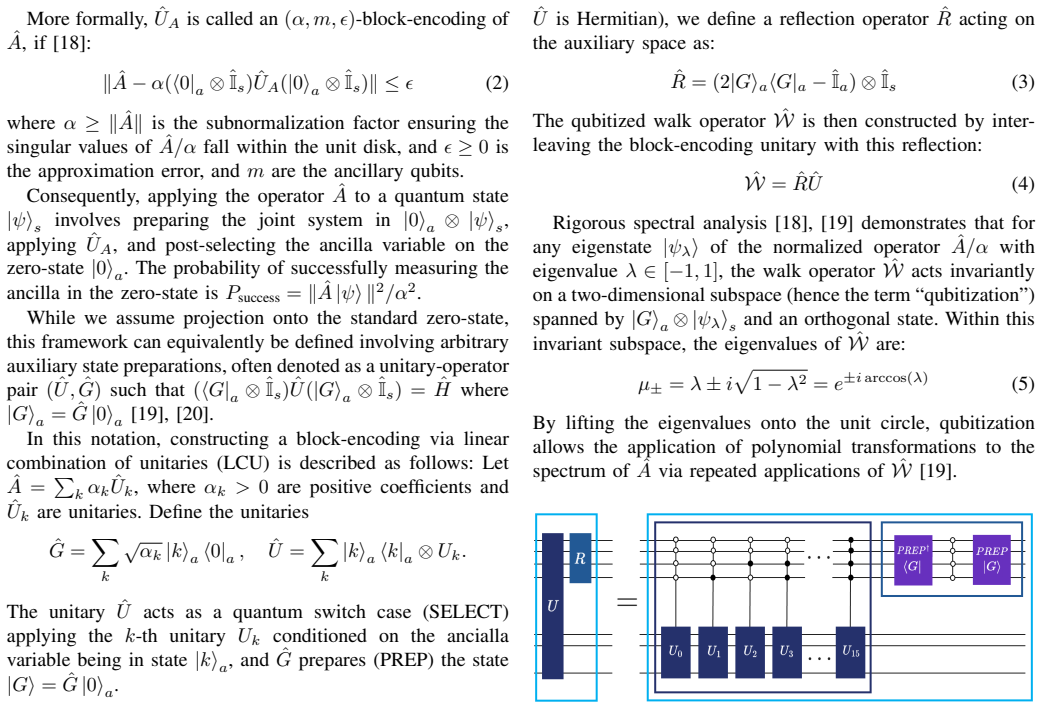
Block-encoding is a foundational technique in modern quantum algorithms, enabling the implementation of non-unitary operations by embedding them into larger unitary matrices. While theoretically powerful and essential for advanced protocols like Quantum Singular Value Transformation (QSVT) and Quantum Signal Processing (QSP), the generation of compilable implementations of block-encodings poses a formidable challenge. This work presents the BlockEncoding interface within the Eclipse Qrisp framework, establishing block-encodings as a high-level programming abstraction accessible to a broad scientific audience. Serving as both a technical framework introduction and a hands-on tutorial, this paper explicitly details key underlying concepts abstracted away by the interface, such as block-encoding construction and qubitization, and their practical integration into methods like the Childs-Kothari-Somma (CKS) algorithm. We outline the interface's software architecture, encompassing constructors, core utilities, arithmetic composition, and algorithmic applications such as matrix inversion, polynomial filtering, and Hamiltonian simulation. Through code examples, we demonstrate how this interface simplifies both the practical realization of advanced quantum algorithms and their associated resource estimation.
Editorial analysis
A structured set of objections, weighed in public.
Referee Report
Summary. The manuscript presents the BlockEncoding interface in the Eclipse Qrisp quantum programming framework. It establishes block-encodings as a high-level abstraction, explains underlying concepts including construction and qubitization, and demonstrates integration into algorithms such as the Childs-Kothari-Somma (CKS) method, matrix inversion, polynomial filtering, and Hamiltonian simulation via descriptions of the software architecture, constructors, utilities, arithmetic composition, and code examples.
Significance. If the interface correctly implements the theoretical block-encodings, the work would lower barriers to advanced quantum algorithms like QSVT and QSP for a broader audience by providing accessible constructors and composition methods. The explicit coverage of abstracted concepts and code examples for resource estimation is a positive contribution to usability and education in the field.
major comments (1)
- The central claim that the interface faithfully realizes theoretical block-encoding constructions (abstract; sections on constructors, core utilities, arithmetic composition, and algorithmic applications) lacks any verification step. No example extracts the effective operator from a generated circuit and compares it to the mathematical definition on a small test matrix, leaving potential issues in qubit allocation, normalization, or phase handling unaddressed. This directly undermines the assertion of correct and efficient realization for downstream algorithms like CKS and matrix inversion.
minor comments (1)
- The abstract could more explicitly separate the novel interface contributions from established block-encoding theory to clarify the paper's incremental advance.
Simulated Author's Rebuttal
We thank the referee for their constructive and detailed review of our manuscript. We address the single major comment below, agreeing that an explicit verification would strengthen the presentation, and describe the planned revision.
read point-by-point responses
-
Referee: The central claim that the interface faithfully realizes theoretical block-encoding constructions (abstract; sections on constructors, core utilities, arithmetic composition, and algorithmic applications) lacks any verification step. No example extracts the effective operator from a generated circuit and compares it to the mathematical definition on a small test matrix, leaving potential issues in qubit allocation, normalization, or phase handling unaddressed. This directly undermines the assertion of correct and efficient realization for downstream algorithms like CKS and matrix inversion.
Authors: We agree that the manuscript would benefit from an explicit verification step that extracts the effective operator realized by a generated circuit and compares it numerically to the mathematical block-encoding definition on a small test matrix. Such a check would directly address possible concerns about qubit allocation, normalization factors, and phase conventions. In the revised version we will add a new subsection (or extended code example) under the constructors or core utilities section that performs this verification for at least one low-dimensional test matrix, reports the numerical agreement (or discrepancy), and discusses how the same procedure can be applied to the CKS and matrix-inversion examples already present in the paper. revision: yes
Circularity Check
No circularity: software interface description on established theory
full rationale
The manuscript introduces the BlockEncoding interface as a high-level abstraction in the Eclipse Qrisp framework, detailing constructors, utilities, arithmetic composition, and applications such as CKS, matrix inversion, polynomial filtering, and Hamiltonian simulation via code examples. It explicitly builds on prior theoretical block-encoding and qubitization concepts without new mathematical derivations, parameter fitting, or predictions. No self-definitional loops, fitted inputs renamed as predictions, or load-bearing self-citations appear; the central claim of accessibility and simplification rests on descriptive architecture and examples rather than any chain that reduces to its own inputs by construction. The work is self-contained as a framework tutorial.
Axiom & Free-Parameter Ledger
Forward citations
Cited by 1 Pith paper
-
Unitaria: Quantum Linear Algebra via Block Encodings
Unitaria is a new open-source Python library that provides a high-level, composable interface for block encodings in quantum computing, enabling automatic circuit generation and classical simulation-based verification.
Reference graph
Works this paper leans on
-
[1]
Quantum algorithm for linear systems of equations,
A. W. Harrow, A. Hassidim, and S. Lloyd, “Quantum algorithm for linear systems of equations,”Phys. Rev. Lett., vol. 103, p. 150502,
-
[2]
[Online]. Available: https://link.aps.org/doi/10.1103/PhysRevLett. 103.150502
-
[3]
Quantum algorithm for systems of linear equations with exponentially improved dependence on precision,
A. M. Childs, R. Kothari, and R. D. Somma, “Quantum algorithm for systems of linear equations with exponentially improved dependence on precision,”SIAM Journal on Computing, vol. 46, no. 6, pp. 1920–1950,
1920
-
[4]
Childs, Robin Kothari, and Rolando D
[Online]. Available: https://doi.org/10.1137/16M1087072
-
[5]
A. Gily ´en, Y . Su, G. H. Low, and N. Wiebe, “Quantum singular value transformation and beyond: exponential improvements for quantum matrix arithmetics,” inProceedings of the 51st Annual ACM SIGACT Symposium on Theory of Computing, ser. STOC 2019. New York, NY , USA: Association for Computing Machinery, 2019, p. 193–204. [Online]. Available: https://doi....
-
[6]
Optimal polynomial based quantum eigenstate filtering with application to solving quantum linear systems,
L. Lin and Y . Tong, “Optimal polynomial based quantum eigenstate filtering with application to solving quantum linear systems,”Quantum, vol. 4, p. 361, 2020. [Online]. Available: https://doi.org/10.22331/ q-2020-11-11-361
2020
-
[7]
A shortcut to an optimal quantum linear system solver,
A. M. Dalzell, “A shortcut to an optimal quantum linear system solver,”
-
[8]
A shortcut to an optimal quantum linear system solver
[Online]. Available: https://arxiv.org/abs/2406.12086
work page internal anchor Pith review Pith/arXiv arXiv
-
[9]
Quantum linear system solvers: A survey of algorithms and applications
M. E. S. Morales, L. Pira, P. Schleich, K. Koor, P. C. S. Costa, D. An, A. Aspuru-Guzik, L. Lin, P. Rebentrost, and D. W. Berry, “Quantum linear system solvers: A survey of algorithms and applications,” 2025. [Online]. Available: https://arxiv.org/abs/2411.02522
-
[10]
Exponential quantum advantage in processing massive classical data
H. Zhao, A. Zlokapa, H. Neven, R. Babbush, J. Preskill, J. R. McClean, and H.-Y . Huang, “Exponential quantum advantage in processing massive classical data,” 2026. [Online]. Available: https: //arxiv.org/abs/2604.07639
work page internal anchor Pith review Pith/arXiv arXiv 2026
-
[11]
D. An, J.-P. Liu, and L. Lin, “Linear combination of hamiltonian simulation for nonunitary dynamics with optimal state preparation cost,”Phys. Rev. Lett., vol. 131, p. 150603, 2023. [Online]. Available: https://link.aps.org/doi/10.1103/PhysRevLett.131.150603
-
[12]
Filtered quantum phase estimation,
G. Lee, M. Kang, J. Hong, S. Fomichev, and J. Huh, “Filtered quantum phase estimation,” 2025. [Online]. Available: https://arxiv.org/abs/2510. 04294
2025
-
[13]
M.-A. Filip and N. Fitzpatrick, “Beyond asymptotic reasoning: the practicalities of a quantum ground state projector based on the wall-chebyshev expansion,”Quantum Science and Technology, vol. 11, no. 1, p. 015027, 2025. [Online]. Available: https: //doi.org/10.1088/2058-9565/ae2887
-
[14]
Grand unification of quantum algorithms,
J. M. Martyn, Z. M. Rossi, A. K. Tan, and I. L. Chuang, “Grand unification of quantum algorithms,”PRX Quantum, vol. 2, p. 040203, 2021. [Online]. Available: https://link.aps.org/doi/10.1103/ PRXQuantum.2.040203
2021
-
[15]
QSPPACK: Quantum sig- nal processing PACKage,
Y . Dong, X. Meng, K. B. Whaley, and L. Lin, “QSPPACK: Quantum sig- nal processing PACKage,” https://github.com/qsppack/QSPPACK, 2021, gitHub repository
2021
-
[16]
pyqsp: Python Quantum Signal Processing package,
I. L. Chuang, J. Docter, J. M. Martyn, Z. M. Rossi, and A. K. Tan, “pyqsp: Python Quantum Signal Processing package,” https://github. com/ichuang/pyqsp, 2021, gitHub repository
2021
-
[17]
Expressing and Analyzing Quantum Algorithms with Qualtran
M. P. Harrigan, T. Khattar, C. Yuan, A. Peduri, N. Yosri, F. D. Malone, R. Babbush, and N. C. Rubin, “Expressing and analyzing quantum algorithms with qualtran,” 2024. [Online]. Available: https://arxiv.org/abs/2409.04643
-
[18]
PennyLane: Automatic differentiation of hybrid quantum-classical computations
V . Bergholm, J. Izaac, M. Schuld, C. Gogolin, S. Ahmed, V . Ajith, M. S. Alam, G. Alonso-Linaje, B. AkashNarayanan, A. Asadiet al., “Pennylane: Automatic differentiation of hybrid quantum-classical computations,”arXiv preprint arXiv:1811.04968, 2022. [Online]. Available: https://arxiv.org/abs/1811.04968
work page internal anchor Pith review arXiv 2022
-
[19]
Cobble: Compiling Block Encodings for Quantum Computational Linear Algebra
C. Yuan, “Cobble: Compiling block encodings for quantum computational linear algebra,” 2025. [Online]. Available: https://arxiv.org/abs/2511.01736
work page internal anchor Pith review arXiv 2025
- [20]
-
[21]
Lecture notes on quantum algorithms for scientific computation,
L. Lin, “Lecture notes on quantum algorithms for scientific computation,” 2022. [Online]. Available: https://arxiv.org/abs/2201. 08309
2022
-
[22]
G. H. Low and I. L. Chuang, “Hamiltonian Simulation by Qubitization,”Quantum, vol. 3, p. 163, 2019. [Online]. Available: https://doi.org/10.22331/q-2019-07-12-163
-
[23]
Exact and efficient Lanczos method on a quantum computer,
W. Kirby, M. Motta, and A. Mezzacapo, “Exact and efficient Lanczos method on a quantum computer,”Quantum, vol. 7, p. 1018, 2023. [Online]. Available: https://doi.org/10.22331/q-2023-05-23-1018
-
[24]
Rise of conditionally clean ancillae for efficient quantum circuit constructions,
T. Khattar and C. Gidney, “Rise of conditionally clean ancillae for efficient quantum circuit constructions,”Quantum, vol. 9, p. 1752,
-
[25]
Available: https://doi.org/10.22331/q-2025-05-21-1752
[Online]. Available: https://doi.org/10.22331/q-2025-05-21-1752
-
[26]
A. M. Dalzell, S. McArdle, M. Berta, P. Bienias, C.-F. Chen, A. Gily ´en, C. T. Hann, M. J. Kastoryano, E. T. Khabiboulline, A. Kubica, G. Salton, S. Wang, and F. G. S. L. Brand ˜ao, Quantum Algorithms: A Survey of Applications and End-to-end Complexities. Cambridge University Press, 2025. [Online]. Available: http://dx.doi.org/10.1017/9781009639651
-
[27]
Products between block-encodings,
D. Dong, Y . Li, and J. Xue, “Products between block-encodings,” 2025. [Online]. Available: https://arxiv.org/abs/2509.15779
-
[28]
Generalized quantum signal processing,
D. Motlagh and N. Wiebe, “Generalized quantum signal processing,” PRX Quantum, vol. 5, p. 020368, 2024. [Online]. Available: https://link.aps.org/doi/10.1103/PRXQuantum.5.020368
-
[29]
Generalized quantum singular value transformation,
C. S ¨underhauf, “Generalized quantum singular value transformation,”
-
[30]
Available: https://arxiv.org/abs/2312.00723
[Online]. Available: https://arxiv.org/abs/2312.00723
-
[31]
Generalized quantum signal processing and non- linear fourier transform are equivalent,
L. Laneve, “Generalized quantum signal processing and non- linear fourier transform are equivalent,” 2025. [Online]. Available: https://arxiv.org/abs/2503.03026
-
[32]
Inverse nonlinear fast fourier transform on su(2) with applications to quantum signal processing,
H. Ni, R. Sarkar, L. Ying, and L. Lin, “Inverse nonlinear fast fourier transform on su(2) with applications to quantum signal processing,”
-
[33]
Inverse nonlinear fast Fourier transform on SU(2) with applications to quantum signal processing
[Online]. Available: https://arxiv.org/abs/2505.12615
-
[34]
Eigenstate filtering using quantum signal processing,
R. Zander, “Eigenstate filtering using quantum signal processing,” https://github.com/eclipse-qrisp/Qrisp/blob/main/documentation/source/ general/tutorial/GQSP filtering.ipynb
-
[35]
Halving the cost of quantum addition,
C. Gidney, “Halving the cost of quantum addition,”Quantum, vol. 2, p. 74, 2018. [Online]. Available: https://doi.org/10.22331/ q-2018-06-18-74
2018
-
[36]
An introduction to the conjugate gradient method without the agonizing pain,
J. R. Shewchuket al., “An introduction to the conjugate gradient method without the agonizing pain,” 1994
1994
-
[37]
Embedding learning in hybrid quantum-classical neural networks,
D. Camps and R. Van Beeumen, “Fable: Fast approximate quantum circuits for block-encodings,” in2022 IEEE International Conference on Quantum Computing and Engineering (QCE), 2022, pp. 104–113. [Online]. Available: https://doi.org/10.1109/QCE53715.2022.00029
-
[38]
S-fable and ls-fable: Fast approximate block-encoding algorithms for unstructured sparse matrices,
P. Kuklinski and B. Rempfer, “S-fable and ls-fable: Fast approximate block-encoding algorithms for unstructured sparse matrices,” 2024. [Online]. Available: https://arxiv.org/abs/2401.04234
-
[39]
Efficient LCU block encodings through Dicke states preparation
F. D. Chiara, M. Nibbi, Y . Shen, and R. V . Beeumen, “Efficient lcu block encodings through dicke states preparation,” 2025. [Online]. Available: https://arxiv.org/abs/2507.20887
-
[40]
Practical block encodings of matrix polynomials that can also be trivially controlled,
M. Nibbi, F. D. Chiara, Y . Shen, A. Szasz, and R. V . Beeumen, “Practical block encodings of matrix polynomials that can also be trivially controlled,” 2026. [Online]. Available: https://arxiv.org/abs/2601.18767
-
[41]
Dictionary-based Block Encoding of Sparse Matrices with Low Subnormalization and Circuit Depth,
C. Yang, Z. Li, H. Yao, Z. Fan, G. Zhang, and J. Liu, “Dictionary-based Block Encoding of Sparse Matrices with Low Subnormalization and Circuit Depth,”Quantum, vol. 9, p. 1805, 2025. [Online]. Available: https://doi.org/10.22331/q-2025-07-22-1805
-
[42]
Block encoding linear combinations of pauli strings using the stabilizer formalism,
N. Schillo, A. Sturm, and R. Quay, “Block encoding linear combinations of pauli strings using the stabilizer formalism,” 2026. [Online]. Available: https://arxiv.org/abs/2601.05740
work page internal anchor Pith review arXiv 2026
-
[43]
Explicit Block Encodings of Discrete Laplacians with Mixed Boundary Conditions
A. Boutot and V . Dsouza, “Explicit block encodings of discrete laplacians with mixed boundary conditions,” 2026. [Online]. Available: https://arxiv.org/abs/2603.12405
work page internal anchor Pith review Pith/arXiv arXiv 2026
-
[44]
Quantum algorithm for linear matrix equations
R. D. Somma, G. H. Low, D. W. Berry, and R. Babbush, “Quantum algorithm for linear matrix equations,” 2025. [Online]. Available: https://arxiv.org/abs/2508.02822
-
[45]
Quantum support vector machine for big data classification,
P. Rebentrost, M. Mohseni, and S. Lloyd, “Quantum support vector machine for big data classification,”Phys. Rev. Lett., vol. 113, p. 130503, 2014. [Online]. Available: https://link.aps.org/doi/10.1103/ PhysRevLett.113.130503
2014
-
[46]
Quantum Regularized Least Squares,
S. Chakraborty, A. Morolia, and A. Peduri, “Quantum Regularized Least Squares,”Quantum, vol. 7, p. 988, 2023. [Online]. Available: https://doi.org/10.22331/q-2023-04-27-988
-
[47]
Preconditioned block encodings for quantum linear systems,
L. Lapworth and C. S ¨underhauf, “Preconditioned block encodings for quantum linear systems,”Quantum Science and Technology, vol. 10, no. 4, p. 045064, 2025. [Online]. Available: https: //doi.org/10.1088/2058-9565/ae0f4b
-
[48]
J. Zylberman, T. Fredon, N. F. Loureiro, and F. Debbasch,Quantum Algorithm for Anisotropic Diffusion and Convection Equations with V ector Norm Scaling. Springer Nature Switzerland, 2026, p. 255–263. [Online]. Available: http://dx.doi.org/10.1007/978-3-032-13855-2 23
-
[49]
Counterdiabatic driving with performance guarantees,
J. R. Fin ˇzgar, S. Notarnicola, M. Cain, M. D. Lukin, and D. Sels, “Counterdiabatic driving with performance guarantees,” Phys. Rev. Lett., vol. 135, p. 180602, 2025. [Online]. Available: https://link.aps.org/doi/10.1103/pqhl-nbtk
-
[50]
Efficient product formulas for commutators and applications to quantum simulation,
Y .-A. Chen, A. M. Childs, M. Hafezi, Z. Jiang, H. Kim, and Y . Xu, “Efficient product formulas for commutators and applications to quantum simulation,”Phys. Rev. Res., vol. 4, p. 013191, 2022. [Online]. Available: https://link.aps.org/doi/10.1103/PhysRevResearch.4.013191
-
[51]
Quantum algorithm for simulating resonant inelastic x-ray scattering in battery materials,
I. Loaiza, A. Kunitsa, S. Fomichev, D. Motlagh, D. Dhawan, S. Jahangiri, J. H. Fuglsbjerg, A. F. Izmaylov, N. Wiebe, Y . Abu- Lebdeh, J. M. Arrazola, and A. Delgado, “Quantum algorithm for simulating resonant inelastic x-ray scattering in battery materials,”
-
[52]
Available: https://arxiv.org/abs/2602.20270
[Online]. Available: https://arxiv.org/abs/2602.20270
-
[53]
Quantum computing enhanced computational catalysis,
V . von Burg, G. H. Low, T. H¨aner, D. S. Steiger, M. Reiher, M. Roetteler, and M. Troyer, “Quantum computing enhanced computational catalysis,” Phys. Rev. Res., vol. 3, p. 033055, 2021. [Online]. Available: https://link.aps.org/doi/10.1103/PhysRevResearch.3.033055
-
[54]
Even more efficient quantum computations of chemistry through tensor hypercontraction,
J. Lee, D. W. Berry, C. Gidney, W. J. Huggins, J. R. McClean, N. Wiebe, and R. Babbush, “Even more efficient quantum computations of chemistry through tensor hypercontraction,”PRX Quantum, vol. 2, p. 030305, 2021. [Online]. Available: https://link.aps.org/doi/10.1103/ PRXQuantum.2.030305
2021
-
[55]
Efficient simulation of pre-born-oppenheimer dynamics on a quantum computer,
M. Pocrnic, I. Loaiza, J. M. Arrazola, N. Wiebe, and D. Motlagh, “Efficient simulation of pre-born-oppenheimer dynamics on a quantum computer,” 2026. [Online]. Available: https://arxiv.org/abs/2602.11272
-
[56]
Quantum algorithm for simulating non-adiabatic dynamics at metallic surfaces,
R. A. Lang, P. Jain, J. M. Arrazola, and D. Motlagh, “Quantum algorithm for simulating non-adiabatic dynamics at metallic surfaces,”
-
[57]
Available: https://arxiv.org/abs/2601.16264
[Online]. Available: https://arxiv.org/abs/2601.16264
-
[58]
Quantum algorithm for vibronic dynamics: case study on singlet fission solar cell design,
D. Motlagh, R. A. Lang, P. Jain, J. A. Campos-Gonzalez-Angulo, W. Maxwell, T. Zeng, A. Aspuru-Guzik, and J. Miguel Arrazola, “Quantum algorithm for vibronic dynamics: case study on singlet fission solar cell design,”Quantum Science and Technology, vol. 10, no. 4, p. 045048, 2025. [Online]. Available: https://doi.org/10.1088/ 2058-9565/ae0828
2025
-
[59]
BlockEncoding – Qrisp documentation,
Qrisp Developers, “BlockEncoding – Qrisp documentation,” https:// qrisp.eu/reference/Block Encodings/BlockEncoding.html, 2026, online; accessed 2026
2026
-
[60]
R. Chao, D. Ding, A. Gilyen, C. Huang, and M. Szegedy, “Finding angles for quantum signal processing with machine precision,” 2020. [Online]. Available: https://arxiv.org/abs/2003.02831
-
[61]
Product Decomposition of Periodic Functions in Quantum Signal Processing,
J. Haah, “Product Decomposition of Periodic Functions in Quantum Signal Processing,”Quantum, vol. 3, p. 190, 2019. [Online]. Available: https://doi.org/10.22331/q-2019-10-07-190
-
[63]
Efficient phase-factor evaluation in quantum signal processing,
——, “Efficient phase-factor evaluation in quantum signal processing,” Phys. Rev. A, vol. 103, p. 042419, 2021. [Online]. Available: https://link.aps.org/doi/10.1103/PhysRevA.103.042419
-
[64]
Quantum eigenvalue processing,
G. H. Low and Y . Su, “Quantum eigenvalue processing,”SIAM Journal on Computing, vol. 55, no. 1, pp. 135–215, 2026. [Online]. Available: https://doi.org/10.1137/24M1689363
-
[65]
An adversary bound for quantum signal processing,
L. Laneve, “An adversary bound for quantum signal processing,” Quantum, vol. 10, p. 2025, 2026. [Online]. Available: https: //doi.org/10.22331/q-2026-03-13-2025
-
[66]
Blockencoding class 101: Block encoding, lcu, resource estimation,
M. Petri ˇc and R. Zander, “Blockencoding class 101: Block encoding, lcu, resource estimation,” https://github.com/eclipse-qrisp/Qrisp/blob/main/ documentation/source/general/tutorial/BE tutorial/BE vol1.ipynb
-
[67]
Blockencoding class 201: Qubitization, chebyshev polynomials, qsp,
——, “Blockencoding class 201: Qubitization, chebyshev polynomials, qsp,” https://github.com/eclipse-qrisp/Qrisp/blob/main/documentation/ source/general/tutorial/BE tutorial/BE vol2.ipynb
-
[68]
Efficient and explicit block encoding of finite difference discretizations of the laplacian
A. Sturm and N. Schillo, “Efficient and explicit block encoding of finite difference discretizations of the laplacian,” 2025. [Online]. Available: https://arxiv.org/abs/2509.02429
-
[69]
Trade-offs between quantum and classical resources in the linear combination of unitaries,
K. Wada, H. Harada, Y . Suzuki, Y . Tokunaga, N. Yamamoto, and S. Endo, “Trade-offs between quantum and classical resources in the linear combination of unitaries,” 2026. [Online]. Available: https://arxiv.org/abs/2512.06260
-
[70]
Explicit block- encoding for partial differential equation-constrained optimization,
Y . Sato, J. Kato, H. Yano, K. Ito, and N. Yamamoto, “Explicit block- encoding for partial differential equation-constrained optimization,”
-
[71]
Available: https://arxiv.org/abs/2511.14420
[Online]. Available: https://arxiv.org/abs/2511.14420
-
[72]
Resource-efficient variational compilation of block- encodings,
L. Rullk ¨otter, S. Weber, V . M. Katukuri, C. Tutschku, and B. C. Mummaneni, “Resource-efficient variational compilation of block- encodings,” 2025. [Online]. Available: https://arxiv.org/abs/2507.17658
-
[73]
Harmonic sequence state-preparation,
B. Rempfer, P. Kuklinski, J. Elenewski, and K. Obenland, “Harmonic sequence state-preparation,” 2026. [Online]. Available: https://arxiv.org/ abs/2602.23664
discussion (0)
Sign in with ORCID, Apple, or X to comment. Anyone can read and Pith papers without signing in.