Diagnosing Urban Street Vitality via a Visual-Semantic and Spatiotemporal Framework for Street-Level Economics
Pith reviewed 2026-05-10 16:51 UTC · model grok-4.3
The pith
A visual-semantic framework shows street vibrancy arises from brand hierarchy interactions with mall externalities across daily time periods.
A machine-rendered reading of the paper's core claim, the machinery that carries it, and where it could break.
Core claim
The framework integrates instance segmentation of streetscape elements, a dual VLM-LLM pipeline for standardizing signage into global brand hierarchies to quantify a brand premium index, and a temporal lag design using LBS data within a category-weighted Gaussian spillover model. This constructs the Street Economic Vitality Index as a three-dimensional system that reveals quasi-causal spatiotemporal heterogeneity in street vibrancy arising from interactions between hierarchical brand clustering and mall-induced externalities, where high-quality interfaces show peak attraction during midday and evening while structural recession produces a lagged nighttime repulsion effect.
What carries the argument
The Street Economic Vitality Index (SEVI), a three-dimensional diagnostic system that integrates visual-semantic parsing of street views, brand hierarchy standardization, and time-lagged spatiotemporal regression to link commercial activity, spatial utilization, and physical environment.
If this is right
- Hierarchical brand clustering interacts with mall-induced externalities to shape street vibrancy.
- High-quality interfaces produce peak attraction during midday and evening tidal periods.
- Structural recession generates a lagged repulsion effect during nighttime periods.
- The three-dimensional diagnostic system enables evidence-based precision spatial governance.
Where Pith is reading between the lines
- The framework could be applied to other cities to test whether the brand clustering and mall interaction patterns hold in different retail contexts.
- Real-time LBS integration might support dynamic interventions that adjust for observed time-of-day effects.
- The brand standardization component could help map economic diversity patterns across street networks.
Load-bearing premise
The dual-stage VLM-LLM pipeline reliably standardizes signage into global brand hierarchies without significant error, and the temporal lag design using LBS data accurately captures realized demand without selection or measurement bias.
What would settle it
A ground-truth audit of brand classifications from the VLM-LLM pipeline showing high mismatch rates with actual store signage, or a replication of the time-lagged regression finding no consistent time-specific coefficients for brand clustering and interface quality effects.
Figures



read the original abstract
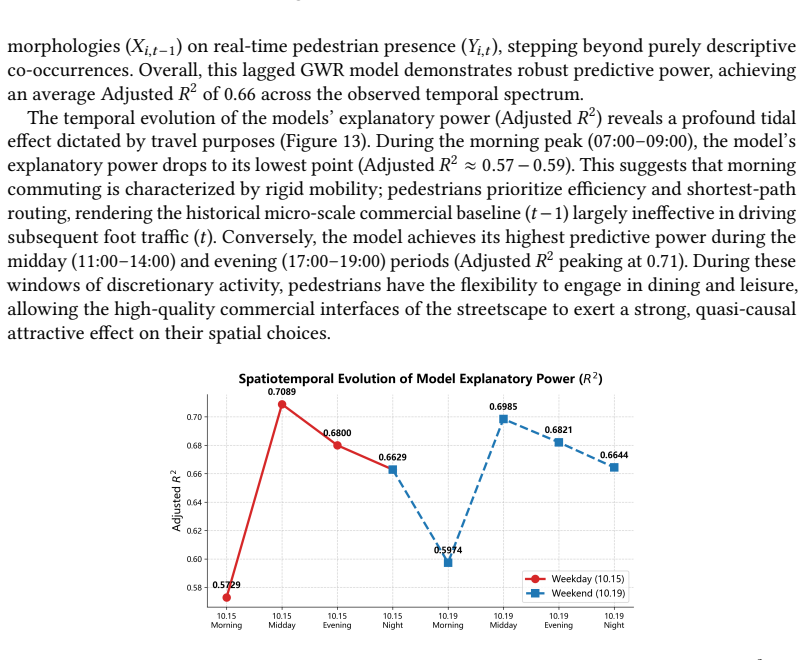
Micro-scale street-level economic assessment is fundamental for precision spatial resource allocation. While Street View Imagery (SVI) advances urban sensing, existing approaches remain semantically superficial and overlook brand hierarchy heterogeneity and structural recession. To address this, we propose a visual-semantic and field-based spatiotemporal framework, operationalized via the Street Economic Vitality Index (SEVI). Our approach integrates physical and semantic streetscape parsing through instance segmentation of signboards, glass interfaces, and storefront closures. A dual-stage VLM-LLM pipeline standardizes signage into global hierarchies to quantify a spatially smoothed brand premium index. To overcome static SVI limitations, we introduce a temporal lag design using Location-Based Services (LBS) data to capture realized demand. Combined with a category-weighted Gaussian spillover model, we construct a three-dimensional diagnostic system covering Commercial Activity, Spatial Utilization, and Physical Environment. Experiments based on time-lagged geographically weighted regression across eight tidal periods in Nanjing reveal quasi-causal spatiotemporal heterogeneity. Street vibrancy arises from interactions between hierarchical brand clustering and mall-induced externalities. High-quality interfaces show peak attraction during midday and evening, while structural recession produces a lagged nighttime repulsion effect. The framework offers evidence-based support for precision spatial governance.
Editorial analysis
A structured set of objections, weighed in public.
Referee Report
Summary. The manuscript proposes a visual-semantic and field-based spatiotemporal framework for micro-scale street-level economic assessment, operationalized through the Street Economic Vitality Index (SEVI). It integrates instance segmentation of street view imagery for signboards, interfaces, and closures; a dual-stage VLM-LLM pipeline to standardize signage into global brand hierarchies and compute a spatially smoothed brand premium index; Location-Based Services data with temporal lags to capture realized demand; and a category-weighted Gaussian spillover model. These elements form a three-dimensional diagnostic system (Commercial Activity, Spatial Utilization, Physical Environment). Experiments apply time-lagged geographically weighted regression across eight tidal periods in Nanjing and claim to reveal quasi-causal spatiotemporal heterogeneity, with street vibrancy arising from hierarchical brand clustering interacting with mall-induced externalities, high-quality interfaces showing peak attraction midday/evening, and structural recession producing lagged nighttime repulsion.
Significance. If the empirical implementation and quasi-causal interpretations hold after addressing identification concerns, the work would advance urban sensing by moving beyond semantically shallow SVI analysis to incorporate brand hierarchy heterogeneity and dynamic demand signals. The integration of computer vision, language models, and spatially explicit regression offers a potentially replicable template for precision spatial governance, with practical value for resource allocation in commercial districts.
major comments (3)
- [Abstract / Experiments] Abstract (final paragraph) and implied experiments section: The claim that time-lagged GWR 'reveals quasi-causal spatiotemporal heterogeneity' is not supported by the described methods. GWR estimates spatially varying associations conditional on covariates; temporal lags address precedence but leave endogeneity (e.g., brand location choices correlated with pre-existing vitality), omitted spatial confounders, and LBS selection bias unaddressed. No instrumental variables, fixed effects, falsification tests, or robustness checks are mentioned to justify moving from 'associated with' to 'produces lagged repulsion effect.'
- [Abstract / Methods] Abstract (methods description): The dual-stage VLM-LLM pipeline for standardizing signage into global brand hierarchies is presented without any validation metrics, inter-annotator agreement, error rates, or comparison to manual coding. This is load-bearing for the brand premium index and the subsequent category-weighted Gaussian spillover model; without demonstrated reliability, downstream claims about hierarchical clustering effects cannot be assessed.
- [Abstract / SEVI framework] Abstract (SEVI construction): The three-dimensional diagnostic system and its integration of the category-weighted Gaussian spillover model lack explicit equations, parameter definitions, or sensitivity analysis. The abstract supplies no data summaries, sample sizes, R^{2} values, or coefficient tables from the Nanjing regressions, preventing evaluation of the reported tidal-period heterogeneity.
minor comments (2)
- [Abstract] The abstract would benefit from a concise quantitative summary (e.g., key coefficient ranges or fit statistics) to allow readers to gauge effect magnitudes before the full text.
- [Methods] Notation for the brand premium index and spillover weights should be introduced with a small equation or schematic to improve readability.
Simulated Author's Rebuttal
We thank the referee for the constructive and detailed feedback on our manuscript. We address each major comment point by point below, indicating where revisions will be made to improve clarity, accuracy, and completeness.
read point-by-point responses
-
Referee: [Abstract / Experiments] Abstract (final paragraph) and implied experiments section: The claim that time-lagged GWR 'reveals quasi-causal spatiotemporal heterogeneity' is not supported by the described methods. GWR estimates spatially varying associations conditional on covariates; temporal lags address precedence but leave endogeneity (e.g., brand location choices correlated with pre-existing vitality), omitted spatial confounders, and LBS selection bias unaddressed. No instrumental variables, fixed effects, falsification tests, or robustness checks are mentioned to justify moving from 'associated with' to 'produces lagged repulsion effect.'
Authors: We acknowledge that the phrasing 'quasi-causal' overstates the inferential capabilities of time-lagged GWR, which identifies spatially varying associations and temporal precedence but does not resolve endogeneity, omitted spatial confounders, or selection biases. In the revised manuscript, we will replace 'quasi-causal spatiotemporal heterogeneity' with 'spatiotemporal associations and heterogeneity' in the abstract and throughout the text. We will add an explicit limitations paragraph in the discussion section acknowledging these identification challenges and outlining potential future extensions (e.g., IV strategies), while retaining the core empirical findings on heterogeneity across tidal periods. revision: yes
-
Referee: [Abstract / Methods] Abstract (methods description): The dual-stage VLM-LLM pipeline for standardizing signage into global brand hierarchies is presented without any validation metrics, inter-annotator agreement, error rates, or comparison to manual coding. This is load-bearing for the brand premium index and the subsequent category-weighted Gaussian spillover model; without demonstrated reliability, downstream claims about hierarchical clustering effects cannot be assessed.
Authors: We agree that explicit validation is essential for the brand standardization pipeline, which underpins the brand premium index. While the full methods section describes the dual-stage VLM-LLM process, we will revise to include a new validation subsection reporting inter-annotator agreement (e.g., Cohen's kappa), error rates on a held-out test set, and direct comparisons against manual expert coding. These metrics will be summarized in the abstract and tied to the reliability of downstream hierarchical clustering results. revision: yes
-
Referee: [Abstract / SEVI framework] Abstract (SEVI construction): The three-dimensional diagnostic system and its integration of the category-weighted Gaussian spillover model lack explicit equations, parameter definitions, or sensitivity analysis. The abstract supplies no data summaries, sample sizes, R^{2} values, or coefficient tables from the Nanjing regressions, preventing evaluation of the reported tidal-period heterogeneity.
Authors: Abstract length constraints preclude full equations and tables. The complete manuscript already presents the SEVI equations, category-weighted Gaussian spillover model, and parameter definitions in Section 3, with sensitivity analyses in the appendix. We will revise the abstract to incorporate brief parameter definitions, sample sizes (street segments and tidal periods), and key R^{2} summaries. Full coefficient tables and heterogeneity details across the eight periods will be highlighted in the experiments section with references to supplementary materials. revision: partial
Circularity Check
No significant circularity; derivation chain remains self-contained
full rationale
The paper constructs SEVI from distinct inputs (SVI instance segmentation, dual-stage VLM-LLM brand hierarchy extraction, LBS temporal lags, and a category-weighted Gaussian spillover model) before applying time-lagged GWR as an explanatory diagnostic across tidal periods. No equation or step equates the reported spatiotemporal heterogeneity or brand/mall interaction effects to the SEVI components by definition or by renaming fitted parameters as independent predictions. The GWR step produces local coefficient surfaces from the assembled index and covariates rather than recovering its own construction inputs tautologically. External data sources and standard spatial regression methods keep the chain non-circular.
Axiom & Free-Parameter Ledger
Reference graph
Works this paper leans on
-
[1]
Shili Chen, Wei Lang, and Xun Li. 2022. Evaluating urban vitality based on geospatial big data in Xiamen Island, China. Sage Open12, 4 (2022). doi:10.1177/21582440221134519
-
[2]
Tingting Chen, Eddie C. M. Hui, Jiemin Wu, Wei Lang, and Xun Li. 2019. Identifying urban spatial structure and urban vibrancy in highly dense cities using georeferenced social media data.Habitat International89 (2019), 102005. doi:10.1016/j.habitatint.2019.102005
-
[3]
1987.Life Between Buildings: Using Public Space
Jan Gehl. 1987.Life Between Buildings: Using Public Space. Van Nostrand Reinhold, New York
work page 1987
-
[4]
Xixuan Hao, Wei Chen, Yibo Yan, Siru Zhong, Kun Wang, Qingsong Wen, and Yuxuan Liang. 2025. UrbanVLP: Multi-Granularity Vision-Language Pretraining for Urban Socioeconomic Indicator Prediction. InProceedings of the AAAI Conference on Artificial Intelligence, Vol. 39. 28061–28069
work page 2025
-
[5]
Sanwei He, Zhen Zhang, Shan Yu, Chang Xia, and Chih-Lin Tung. 2024. Investigating the effects of urban morphology on vitality of community life circles using machine learning and geospatial approaches.Applied Geography167 (2024), 103287. doi:10.1016/j.apgeog.2024.103287
-
[6]
Yongming Huang, Mingze Chen, Xiamengwei Zhang, Ryosuke Shimoda, and Ruochen Yang. 2025. Multi-Scale Street Vitality Analytics: A Comprehensive Review of Technologies, Data, and Applications.Buildings15, 21 (2025), 3987. doi:10.3390/buildings15213987
-
[7]
1981.Multiple Attribute Decision Making: Methods and Applications
Ching-Lai Hwang and Kwangsun Yoon. 1981.Multiple Attribute Decision Making: Methods and Applications. Springer- Verlag, New York. doi:10.1007/978-3-642-48318-9
-
[8]
1961.The Death and Life of Great American Cities
Jane Jacobs. 1961.The Death and Life of Great American Cities. Random House, New York
work page 1961
-
[9]
Yinghong Jiang, Yun Han, Mengyang Liu, and Yu Ye. 2022. Street vitality and built environment features: A data- informed approach from fourteen Chinese cities.Sustainable Cities and Society79 (2022), 103724. doi:10.1016/j.scs. 2022.103724
-
[10]
Glenn Jocher, Ayush Chaurasia, Laughing, et al. 2023. Ultralytics YOLOv8. doi:10.5281/zenodo.7841070
-
[11]
Bon Woo Koo, Subhrajit Guhathakurta, Nisha Botchwey, and Aaron Hipp. 2023. Can good microscale pedestrian streetscapes enhance the benefits of macroscale accessible urban form? An automated audit approach using Google street view images.Landscape and Urban Planning237 (2023), 104816. doi:10.1016/j.landurbplan.2023.104816
-
[12]
Feng Lan, Xiaoqing Gong, Haizhi Da, and Haizhen Wen. 2020. How do population inflow and social infrastructure affect urban vitality? Evidence from Shanghai, China.Cities100 (2020), 102659. doi:10.1016/j.cities.2020.102659
-
[13]
Qian Li, Caihui Cui, Feng Liu, Qirui Wu, Yadi Run, and Zhigang Han. 2022. Multidimensional urban vitality on streets: Spatial patterns and influence factor identification using multisource urban data.ISPRS International Journal of Geo-Information11, 1 (2022), 2. doi:10.3390/ijgi11010002
-
[14]
Yunqin Li, Nobuyoshi Yabuki, and Tomohiro Fukuda. 2022. Exploring the association between street built environment and street vitality using deep learning methods.Sustainable Cities and Society79 (2022), 103656. doi:10.1016/j.scs.2021. 103656
-
[15]
Bojing Liao and Jie Zhu. 2025. Exploring the causal relationship between campus walkability and affective walking experience: Evidence from 7 major tertiary education campuses in China.Journal of Urban Management14, 3 (2025), 657–674. doi:10.1016/j.jum.2025.01.005
-
[16]
Tsung-Yi Lin, Michael Maire, Serge Belongie, James Hays, Pietro Perona, Deva Ramanan, Piotr Dollár, and C. Lawrence Zitnick. 2014. Microsoft COCO: Common objects in context. InEuropean Conference on Computer Vision. Springer, 740–755. doi:10.1007/978-3-319-10602-1_48
-
[17]
Zhenxiang Ling, Xianxin Meng, Yingbiao Chen, Qinglan Qian, Junyu Kuang, Xianghua Shi, Yifan Yang, Wentao Chen, Zihao Zheng, and Zhifeng Wu. 2025. Unveiling the hidden vitality of block-structured neighborhoods through a multimodal urban perception and ensemble learning framework.International Journal of Digital Earth18, 1 (2025), 2545581. doi:10.1080/1753...
-
[18]
Liu Liu, Alexandra Kudaeva, Marco Cipriano, Fatimeh Al Ghannam, Freya Tan, Gerard de Melo, and Andres Sevtsuk
-
[19]
MINGLE: VLMs for Semantically Complex Region Detection in Urban Scenes.arXiv preprint arXiv:2509.13484 (2025)
work page internal anchor Pith review arXiv 2025
-
[20]
Ying Long and C. C. Huang. 2019. Does block size matter? The impact of urban design on economic vitality for Chinese cities.Environment and Planning B: Urban Analytics and City Science46, 3 (2019), 406–422. doi:10.1177/2399808317715640
-
[21]
Ying Long and Lun Liu. 2016. How green are the streets? An analysis for central city of Beijing using Google Street View. Environment and Planning B: Urban Analytics and City Science43, 6 (2016), 1118–1132. doi:10.1177/0265813515600776
-
[22]
Vikas Mehta. 2009. Look closely: The hedonic value of walkable streets.Journal of Urban Design14, 2 (2009), 213–241. doi:10.1080/13574800802670929
-
[23]
Nanjing Municipal Bureau of Planning and Natural Resources. 2024. Territorial and Spatial Master Plan of Nanjing (2021–2035). https://ghj.nanjing.gov.cn/ghbz/ztgh/202410/t20241024_4992742.html Accessed: 2025-12-22
work page 2024
-
[24]
Ziyu Peng, Weisheng Lu, Hongda An, Xianhua Xia, Yi Zhang, Fan Xue, and Junjie Chen. 2025. Vision language model (VLM)-enabled street view analytics: a systematic literature review.Engineering, Construction and Architectural , Vol. 1, No. 1, Article . Publication date: April 2026. Diagnosing Urban Street Vitality: A Visual-Semantic and Spatiotemporal Frame...
-
[25]
Joseph Redmon, Santosh Divvala, Ross Girshick, and Ali Farhadi. 2016. You only look once: Unified, real-time object detection. InProceedings of the IEEE Conference on Computer Vision and Pattern Recognition. IEEE, 779–788. doi:10.1109/CVPR.2016.91
-
[26]
Andres Sevtsuk. 2014. Location and agglomeration of retail and food services: The case of Somerville, MA.Urban Studies51, 16 (2014), 3745–3764. doi:10.1177/0042098013516523
-
[27]
Kentaro Wada. 2021. Labelme: Image Polygonal Annotation with Python. https://github.com/wkentaro/labelme
work page 2021
-
[28]
X. Wang and B. Yuen. 2022. The influence of street network configuration on street vitality in Singapore.Journal of Urban Management11, 2 (2022), 202–215. doi:10.1016/j.jum.2022.01.002
-
[29]
Yuhan Xu and Xiaosu Ma. 2024. Assessing urban street vitality through visual and auditory perception: A case study of historic urban area in Guangzhou, China.International Review for Spatial Planning and Sustainable Development12, 4 (2024), 57–76. doi:10.14246/irspsd.12.4_57
-
[30]
Fiona Fan Yang, Geng Lin, Yubing Lei, Ying Wang, and Zheng Yi. 2024. Understanding urban vitality from the economic and human activities perspective: A case study of Chongqing, China.Chinese Geographical Science34, 1 (2024), 52–66. doi:10.1007/s11769-023-1402-2
-
[31]
Yu Ye, Daniel Richards, Yi Lu, Xiaoqing Song, Yan Zhuang, Wei Zeng, and Teng Zhong. 2019. Measuring daily accessed street greenery: A human-scale approach for informing better urban planning.Landscape and Urban Planning191 (2019), 103434. doi:10.1016/j.landurbplan.2019.103434
-
[32]
Yang Yue, Yan Zhuang, Anthony G. O. Yeh, Jinyu Xie, Chengling Ma, and Qingquan Li. 2017. Measurements of POI-based mixed use and their relationships with neighbourhood vibrancy.International Journal of Geographical Information Science31, 4 (2017), 658–675. doi:10.1080/13658816.2016.1220561
-
[33]
Anqi Zhang, Weifeng Li, Jiayu Wu, Jian Lin, Jianqun Chu, and Chang Xia. 2021. How can the urban landscape affect urban vitality at the street block level? A case study of 15 metropolises in China.Environment and Planning B: Urban Analytics and City Science48, 5 (2021), 1245–1262. doi:10.1177/2399808320924425
-
[34]
Fung, Hui Lin, and Carlo Ratti
Fan Zhang, Bolei Zhou, Liu Liu, Yu Liu, Hong H. Fung, Hui Lin, and Carlo Ratti. 2019. Social sensing from street-level imagery: A case study in learning spatio-temporal urban mobility patterns.ISPRS Journal of Photogrammetry and Remote Sensing153 (2019), 48–58. doi:10.1016/j.isprsjprs.2019.04.016
-
[35]
Yuxin Zhu, Dazuo Tian, and Feng Yan. 2020. Effectiveness of Entropy Weight Method in Decision-Making.Mathematical Problems in Engineering2020 (2020), 1–5. doi:10.1155/2020/3564835 .1 Robustness Checks Results To validate the structural consistency of the Mall Spillover Vitality (𝑀𝑉𝑖), we performed robustness checks by varying the maximum spatial threshold...
discussion (0)
Sign in with ORCID, Apple, or X to comment. Anyone can read and Pith papers without signing in.