Recognition: 2 theorem links
· Lean TheoremResolving space-sharing conflicts in road user interactions through uncertainty reduction: An active inference-based computational model
Pith reviewed 2026-05-12 04:06 UTC · model grok-4.3
The pith
An active inference model shows normative and explicit cues raise successful resolution of road conflicts but increase collisions if agents violate expectations.
A machine-rendered reading of the paper's core claim, the machinery that carries it, and where it could break.
Core claim
Extending active inference to two-agent road interactions captures three complementary uncertainty-reduction mechanisms: implicit communication through behavioral coupling, reliance on normative expectations such as priority rules, and explicit communication. In simplified intersection scenarios, normative and explicit cues increase successful conflict resolution, but violations of expectations or misleading signals by one agent raise collision likelihood.
What carries the argument
Active inference, where agents minimize uncertainty by updating beliefs and selecting actions, extended to multi-agent settings through three uncertainty reduction mechanisms for social interactions.
Load-bearing premise
That the simulated agents act according to normative expectations and that the three mechanisms accurately represent how real humans reduce uncertainty in intersections.
What would settle it
Measure collision rates in human driving simulator studies at intersections where one agent violates a stop sign or gives misleading signals, and check whether rates rise compared to conditions where all agents follow expectations.
Figures
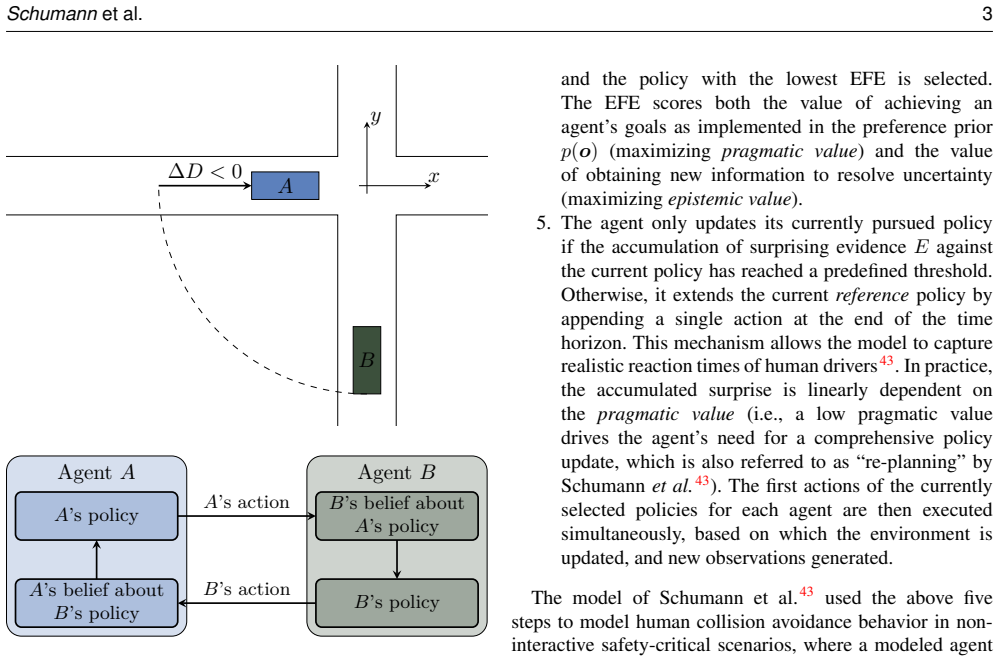


read the original abstract
Understanding how road users resolve space-sharing conflicts is important both for traffic safety and the safe deployment of autonomous vehicles. While existing models have captured specific aspects of such interactions (e.g., explicit communication), a theoretically-grounded computational framework has been lacking. In this paper, we extend a previously developed active inference-based driver behavior model to simulate interactive behavior of two agents. Our model captures three complementary mechanisms for uncertainty reduction in interaction: (i) implicit communication via direct behavioral coupling, (ii) reliance on normative expectations (stop signs, priority rules, etc.), and (iii) explicit communication. In a simplified intersection scenario, we show that normative and explicit communication cues can increase the likelihood of a successful conflict resolution. However, this relies on agents acting as expected. In situations where another agent (intentionally or unintentionally) violates normative expectations or communicates misleading information, reliance on these cues may induce collisions. These findings illustrate how active inference can provide a novel framework for modeling road user interactions which is also applicable in other fields.
Editorial analysis
A structured set of objections, weighed in public.
Referee Report
Summary. The paper extends a prior active-inference driver model to two agents interacting at a simplified intersection. It implements three uncertainty-reduction mechanisms—implicit behavioral coupling, normative expectations (e.g., stop signs, priority rules), and explicit communication—and reports simulation outcomes showing that normative and explicit cues raise the probability of successful space-sharing conflict resolution, while violations or misleading signals can produce collisions. The work positions active inference as a general framework for such interactions.
Significance. The integration of active inference with the three specified uncertainty-reduction channels supplies a coherent computational account that could, if empirically grounded, inform AV interaction design and traffic-safety modeling. The manuscript correctly notes the dependence on agents acting according to normative expectations and thereby avoids over-claiming generality; however, the absence of any calibration, trajectory matching, or out-of-sample validation against human data keeps the quantitative effect sizes tied to the chosen generative-model priors and likelihoods.
major comments (1)
- [Simulation results / abstract] The central simulation result—that normative and explicit cues increase successful-resolution likelihood—is demonstrated only under the assumption that both agents encode and act on the normative expectations exactly as encoded in the generative model (see abstract and the simulation section). No empirical calibration or comparison to human trajectory/decision data is reported, so the reported probability gains cannot yet be treated as predictions about real road users.
minor comments (2)
- [Model section] Clarify the precise functional forms and any free parameters used for the three uncertainty-reduction mechanisms; the current description leaves the implementation details opaque.
- [Discussion] Add a short paragraph distinguishing the scope of the simulation findings from any intended real-world implications, to prevent readers from over-generalizing the collision-risk result.
Simulated Author's Rebuttal
We thank the referee for their constructive review. We address the single major comment below, clarifying the scope and assumptions of our computational study while offering a targeted revision to strengthen the existing qualifications.
read point-by-point responses
-
Referee: [Simulation results / abstract] The central simulation result—that normative and explicit cues increase successful-resolution likelihood—is demonstrated only under the assumption that both agents encode and act on the normative expectations exactly as encoded in the generative model (see abstract and the simulation section). No empirical calibration or comparison to human trajectory/decision data is reported, so the reported probability gains cannot yet be treated as predictions about real road users.
Authors: We agree that the reported increases in successful-resolution probability are obtained under the assumption that both agents share and act upon the normative expectations encoded in the generative model. This assumption is already stated in the abstract (final sentence) and discussed at length in Section 4. The manuscript presents a theoretical simulation study whose goal is to demonstrate how active inference supplies a unified account of three uncertainty-reduction channels; it does not claim to deliver calibrated predictions or effect sizes for real human road users. No trajectory matching or out-of-sample validation against human data was performed, precisely because the contribution is the normative framework itself rather than an empirical model. We will add one clarifying sentence to the discussion (and update the abstract if the editor prefers) to reiterate that all quantitative outcomes are illustrative and prior-dependent, thereby preventing any misreading as empirical forecasts. revision: partial
Circularity Check
No significant circularity; simulations are independent demonstrations of an extended model
full rationale
The paper extends a prior active-inference driver model to a two-agent intersection scenario and reports simulation outcomes under explicit normative and communication assumptions. No load-bearing step reduces a claimed result to a fitted parameter, self-citation chain, or definitional equivalence; the quantitative effects are generated by running the generative model forward rather than by construction from data subsets or prior outputs. Self-citation of the base model is present but does not carry the central claim, which remains falsifiable against external human trajectory data.
Axiom & Free-Parameter Ledger
axioms (2)
- domain assumption Agents minimize uncertainty about other agents' intentions and actions through active inference
- domain assumption Normative expectations (stop signs, priority rules) are reliably shared among agents
Lean theorems connected to this paper
-
IndisputableMonolith/Cost/FunctionalEquation.leanwashburn_uniqueness_aczel unclear?
unclearRelation between the paper passage and the cited Recognition theorem.
Our model captures three complementary mechanisms for uncertainty reduction in interaction: (i) implicit communication via direct behavioral coupling, (ii) reliance on normative expectations (stop signs, priority rules, etc.), and (iii) explicit communication.
-
IndisputableMonolith/Foundation/RealityFromDistinction.leanreality_from_one_distinction unclear?
unclearRelation between the paper passage and the cited Recognition theorem.
the agent strives to minimize surprise over time, which can be modeled in terms of the minimization of variational free energy
What do these tags mean?
- matches
- The paper's claim is directly supported by a theorem in the formal canon.
- supports
- The theorem supports part of the paper's argument, but the paper may add assumptions or extra steps.
- extends
- The paper goes beyond the formal theorem; the theorem is a base layer rather than the whole result.
- uses
- The paper appears to rely on the theorem as machinery.
- contradicts
- The paper's claim conflicts with a theorem or certificate in the canon.
- unclear
- Pith found a possible connection, but the passage is too broad, indirect, or ambiguous to say the theorem truly supports the claim.
Reference graph
Works this paper leans on
-
[1]
Ljung Aust M, Fagerlind H and Sagberg F. Fatal intersection crashes in Norway: Patterns in contributing factors and data collection challenges.Accident; analysis and prevention2012; 45: 782–91. DOI:10.1016/j.aap.2011.11.001
-
[2]
Habibovic A, Tivesten E, Uchida N et al. Driver behavior in car-to-pedestrian incidents: An application of the driving reliability and error analysis method (dream).Accident Analysis & Prevention2013; 50: 554–565
-
[3]
Domeyer JE, Lee JD and Toyoda H. Vehicle automation– other road user communication and coordination: Theory and mechanisms.IEEE Access2020; 8: 19860–19872
-
[4]
Editorial to the special issue on road user interactions in the age of vehicle automation, 2026
Lee YM and Domeyer J. Editorial to the special issue on road user interactions in the age of vehicle automation, 2026
work page 2026
-
[5]
Markkula G, Madigan R, Nathanael D et al. Defining interactions: a conceptual framework for understanding interactive behaviour in human and automated road traffic. Theoretical Issues in Ergonomics Science2020; DOI:10.1080/ 1463922X.2020.1736686
-
[6]
Amundsen F and Hyden C. Proceedings of first workshop on traffic conflicts.Oslo, TTI, Oslo, Norway and LTH Lund, Sweden1977; 78
-
[7]
Portouli E, Nathanael D and Marmaras N. Drivers’ commu- nicative interactions: on-road observations and modelling for integration in future automation systems.Ergonomics2014; 57(12): 1795–1805
-
[8]
Clark HH and Brennan SE. Grounding in communication. Perspectives on socially shared cognition1991
-
[9]
Sadigh D, Landolfi N, Sastry SS et al. Planning for cars that coordinate with people: leveraging effects on human actions for planning and active information gathering over human internal state.Autonomous Robots2018; 42(7): 1405–1426. DOI: 10.1007/s10514-018-9746-1
-
[10]
Domeyer J, Dinparastdjadid A, Lee JD et al. Proxemics and kinesics in automated vehicle–pedestrian communication: Representing ethnographic observations.Transportation research record2019; 2673(10): 70–81
-
[11]
De Clercq K, Dietrich A, N ´u˜nez Velasco JP et al. External human-machine interfaces on automated vehicles: Effects on pedestrian crossing decisions.Human factors2019; 61(8): 1353–1370
-
[12]
Lee YM, Madigan R, Giles O et al. Road users rarely use explicit communication when interacting in today’s traffic: implications for automated vehicles.Cognition, Technology & Work2021; 23(2): 367–380
-
[13]
Domeyer JE, Lee JD, Toyoda H et al. Interdependence in vehicle-pedestrian encounters and its implications for vehicle automation.IEEE transactions on intelligent transportation systems2020; 23(5): 4122–4134
-
[14]
Noonan TZ, Gershon P, Domeyer J et al. Interdependence of driver and pedestrian behavior in naturalistic roadway negotiations.Traffic injury prevention2022; 23(sup1): S62– S67
-
[15]
Domeyer JE, Lee JD, Toyoda H et al. Driver-pedestrian perceptual models demonstrate coupling: Implications for vehicle automation.IEEE Transactions on Human-Machine Systems2022; 52(4): 557–566
-
[16]
Towards pedestrian- av interaction: method for elucidating pedestrian preferences
Camara F, Cosar S, Bellotto N et al. Towards pedestrian- av interaction: method for elucidating pedestrian preferences. InIEEE International Workshop on Intelligent Robots and Systems (IROS)
-
[17]
Camara F, Bellotto N, Cosar S et al. Pedestrian Models for Autonomous Driving Part II: High-Level Models of Human Behavior.IEEE Transactions on Intelligent Transportation Systems2021; 22(9): 5453–5472. DOI:10.1109/TITS.2020. 3006767
-
[18]
When should the chicken cross the road.Game theory for autonomous vehicle-human interactions2018
Fox C, Camara F, Markkula G et al. When should the chicken cross the road.Game theory for autonomous vehicle-human interactions2018
-
[19]
Hierarchical game-theoretic planning for autonomous vehicles
Fisac JF, Bronstein E, Stefansson E et al. Hierarchical game-theoretic planning for autonomous vehicles. In2019 International conference on robotics and automation (ICRA). IEEE, pp. 9590–9596
-
[20]
Game theoretical approach to model decision making for merging maneuvers at freeway on-ramps
Kang K and Rakha HA. Game theoretical approach to model decision making for merging maneuvers at freeway on-ramps. Transportation Research Record2017; 2623(1): 19–28
-
[21]
Schwarting W, Pierson A, Alonso-Mora J et al. Social behavior for autonomous vehicles.Proceedings of the National Academy of Sciences2019; : 201820676DOI:10.1073/pnas. 1820676116
-
[22]
Modeling driver behavior in interactions with other road users
Thalya P, Kovaceva J, Knauss A et al. Modeling driver behavior in interactions with other road users. InProceedings of 8th Transport Research Arena. Prepared usingsagej.cls 16 Collective Intelligence XX(X)
-
[23]
A computational driver model to predict driver control at unsignalised intersections
Boda CN, Lehtonen E and Dozza M. A computational driver model to predict driver control at unsignalised intersections. IEEE Access2020; 8: 104619–104631
-
[24]
At the zebra crossing: Modelling complex decision processes with variable- drift diffusion models
Giles O, Markkula G, Pekkanen J et al. At the zebra crossing: Modelling complex decision processes with variable- drift diffusion models. InProceedings of the Annual Meeting of the Cognitive Science Society, volume 41
-
[25]
Markkula G and Zgonnikov A. Evidence Accumulation Account of Human Operators’ Decisions in Intermittent Control During Inverted Pendulum Balancing. InIEEE International Conference on Systems, Man, and Cybernetics (SMC). Miyazaki, Japan. ISBN 978-1-5386-6650-0, pp. 716–
-
[26]
DOI:10.1109/SMC.2018.00130
-
[27]
Variable-Drift Diffusion Models of Pedestrian Road-Crossing Decisions
Pekkanen J, Giles OT, Lee YM et al. Variable-Drift Diffusion Models of Pedestrian Road-Crossing Decisions. Computational Brain & Behavior2022; 5(1): 60–80. DOI: 10.1007/s42113-021-00116-z
-
[28]
Zgonnikov A, Abbink D and Markkula G. Should I Stay or Should I Go? Cognitive Modeling of Left- Turn Gap Acceptance Decisions in Human Drivers. Human Factors2024; : 00187208221144561DOI: 10.1177/00187208221144561. URLhttps://doi. org/10.1177/00187208221144561. Publisher: SAGE Publications Inc
-
[29]
Markkula G, Lin YS, Srinivasan AR et al. Explaining human interactions on the road by large-scale integration of computational psychological theory.PNAS Nexus2023; 2(6): pgad163. DOI:10.1093/pnasnexus/pgad163. URLhttps: //doi.org/10.1093/pnasnexus/pgad163
-
[30]
Johora FT and M ¨uller JP. Zone-specific interaction modeling of pedestrians and cars in shared spaces.Transportation research procedia2020; 47: 251–258
-
[31]
Siebinga O, Zgonnikov A and Abbink DA. A model of dyadic merging interactions explains human drivers’ behavior from control inputs to decisions.PNAS Nexus2024; 3(10): pgae420. DOI:10.1093/pnasnexus/pgae420. URLhttps: //doi.org/10.1093/pnasnexus/pgae420
-
[32]
Modelling communication-enabled traffic interactions.Royal Society open science2023; 10(5)
Siebinga O, Zgonnikov A and Abbink DA. Modelling communication-enabled traffic interactions.Royal Society open science2023; 10(5)
-
[33]
Active inference, communication and hermeneutics.cortex2015; 68: 129–143
Friston KJ and Frith CD. Active inference, communication and hermeneutics.cortex2015; 68: 129–143
-
[34]
A duet for one.Consciousness and cognition2015; 36: 390–405
Friston K and Frith C. A duet for one.Consciousness and cognition2015; 36: 390–405
-
[35]
A Predic- tive Processing Framework for Joint Action and Commu- nication, 2026
Pezzulo G, Knoblich G, Maisto D et al. A Predic- tive Processing Framework for Joint Action and Commu- nication, 2026. URLhttps://osf.io/preprints/ psyarxiv/q4jnr_v4/
work page 2026
-
[36]
Bicchieri C.Norms in the wild: How to diagnose, measure, and change social norms. Oxford University Press, 2016
work page 2016
-
[37]
Fraade-Blanar L, Favar `o F, Engstr ¨om J et al. Being good (at driving): Characterizing behavioral expectations on automated and human driven vehicles.arXiv preprint arXiv:250208121 2025
work page 2025
-
[38]
A variational approach to niche construction.Journal of the Royal Society Interface2018; 15(141)
Constant A, Ramstead MJ, Veissiere SP et al. A variational approach to niche construction.Journal of the Royal Society Interface2018; 15(141)
-
[39]
Bruineberg J, Rietveld E, Parr T et al. Free-energy minimization in joint agent-environment systems: A niche construction perspective.Journal of theoretical biology2018; 455: 161–178
-
[40]
Constant A, Ramstead MJ, Veissi `ere SP et al. Regimes of expectations: An active inference model of social conformity and human decision making.Frontiers in psychology2019; 10: 679
-
[41]
Friston K, FitzGerald T, Rigoli F et al. Active Inference: A Process Theory.Neural Computation2017; 29(1): 1–49. DOI: 10.1162/NECO a 00912. URLhttps://doi.org/10. 1162/NECO_a_00912
-
[42]
Parr T, Pezzulo G and Friston KJ.Active Inference: The Free Energy Principle in Mind, Brain, and Behavior. MIT Press, 2022. ISBN 978-0-262-04535-3. Google-Books-ID: UrZNEAAAQBAJ
work page 2022
-
[43]
Engstr ¨om J, Wei R, McDonald AD et al. Resolving uncertainty on the fly: modeling adaptive driving behavior as active inference.Frontiers in Neurorobotics 2024; 18. DOI:10.3389/fnbot.2024.1341750. URL https://www.frontiersin.org/articles/ 10.3389/fnbot.2024.1341750. Publisher: Frontiers
-
[44]
Active inference as a unified model of collision avoidance behavior in human drivers, 2025
Schumann JF, Engstr ¨om J, Johnson L et al. Active inference as a unified model of collision avoidance behavior in human drivers, 2025. DOI:10.48550/arXiv.2506.02215. URLhttp: //arxiv.org/abs/2506.02215. ArXiv:2506.02215 [cs]
work page internal anchor Pith review doi:10.48550/arxiv.2506.02215 2025
-
[45]
A World Unto Itself: Human Communication as Active Inference.Frontiers in Psychology2020; 11
Vasil J, Badcock PB, Constant A et al. A World Unto Itself: Human Communication as Active Inference.Frontiers in Psychology2020; 11. DOI:10.3389/fpsyg.2020.00417. URLhttps://www.frontiersin.org/journals/ psychology/articles/10.3389/fpsyg.2020. 00417/full. Publisher: Frontiers
-
[46]
Laurent H, Sangnier M and Treibich C. Traffic safety and norms of compliance with rules: An exploratory study.Economics Bulletin2021; 41(4): 2464–2483. URL http://www.scopus.com/inward/record.url? scp=85125263034&partnerID=8YFLogxK
-
[47]
Tian K, Tzigieras A, Wei C et al. Deceleration parameters as implicit communication signals for pedestrians’ crossing decisions and estimations of automated vehicle behaviour. Accident Analysis & Prevention2023; 190: 107173
-
[48]
Pedestrian interaction with vehicles: roles of explicit and implicit communication
Dey D and Terken J. Pedestrian interaction with vehicles: roles of explicit and implicit communication. InProceedings of the 9th international conference on automotive user interfaces and interactive vehicular applications. pp. 109–113
-
[49]
Miller L, Leitner J, Kraus J et al. Implicit intention communication as a design opportunity for automated vehicles: Understanding drivers’ interpretation of vehicle trajectory at narrow passages.Accident Analysis & Prevention2022; 173: 106691
-
[50]
Zgonnikov A, Beckers N, George A et al. Nudging human drivers via implicit communication by automated vehicles: Empirical evidence and computational cognitive modeling. International Journal of Human-Computer Studies2024; 185: 103224
-
[51]
Goffman E.Interaction ritual: Essays in face-to-face behavior. Routledge, 2017
work page 2017
-
[52]
Wilson EB. Probable inference, the law of succession, and statistical inference.Journal of the American Statistical Association1927; 22(158): 209–212
-
[53]
Pedestrian-driver communication and decision strategies at marked crossings
Sucha M, Dostal D and Risser R. Pedestrian-driver communication and decision strategies at marked crossings. Accident Analysis & Prevention2017; 102: 41–50. Prepared usingsagej.cls Schumannet al. 17
-
[54]
Interactive inference: A multi-agent model of cooperative joint actions
Maisto D, Donnarumma F and Pezzulo G. Interactive inference: A multi-agent model of cooperative joint actions. IEEE Transactions on Systems, Man, and Cybernetics: Systems 2023; 54(2): 704–715
work page 2023
-
[55]
Lee YM, Madigan R, Giles O et al. Road users rarely use explicit communication when interacting in today’s traffic: implications for automated vehicles.Cognition, Technology & Work2021; 23(2): 367–380. DOI:10.1007/ s10111-020-00635-y
-
[56]
Formal scenario-based testing of autonomous vehicles: From simulation to the real world
Fremont DJ, Kim E, Pant YV et al. Formal scenario-based testing of autonomous vehicles: From simulation to the real world. In2020 IEEE 23rd International Conference on Intelligent Transportation Systems (ITSC). IEEE, pp. 1–8
-
[57]
Montali N, Lambert J, Mougin P et al. The Waymo Open Sim Agents Challenge.Advances in Neural Information Processing Systems2023; 36: 59151–59171. URLhttps://proceedings. neurips.cc/paper_files/paper/2023/hash/ b96ce67b2f2d45e4ab315e13a6b5b9c5-Abstract-Datasets_ and_Benchmarks.html
work page 2023
-
[58]
Uzzaman A, Islam M and Hossain MS. Testing autonomous vehicles in virtual environments: A review of simulation tools and techniques.Control Syst Optim Lett2025; 3: 151–157
-
[59]
Siebinga O. A model of the sidewalk salsa. In2025 IEEE International Conference on Systems, Man, and Cybernetics (SMC). IEEE, pp. 7298–7305
-
[60]
Abbas S, Fatima S, Sharif A et al. Drivers’ knowledge, attitude and practices towards traffic rules and regulations.Journal of Road Safety2024; 35(3): 24–31
-
[61]
Fischer J and Tas OS. Information Particle Filter Tree: An Online Algorithm for POMDPs with Belief-Based Rewards on Continuous Domains. InProceedings of the 37th International Conference on Machine Learning. PMLR, pp. 3177–3187. URLhttps://proceedings.mlr. press/v119/fischer20a.html. ISSN: 2640-3498
-
[62]
A Tutorial on the Cross-Entropy Method.Annals of Operations Research 2005; 134(1): 19–67
de Boer PT, Kroese DP, Mannor S et al. A Tutorial on the Cross-Entropy Method.Annals of Operations Research 2005; 134(1): 19–67. DOI:10.1007/s10479-005-5724-z. URL https://doi.org/10.1007/s10479-005-5724-z
-
[63]
Dinparastdjadid A, Supeene I and Engstrom J. Measuring Surprise in the Wild, 2023. DOI:10.48550/arXiv.2305. 07733. URLhttp://arxiv.org/abs/2305.07733. ArXiv:2305.07733 [cs]. Prepared usingsagej.cls 18 Collective Intelligence XX(X) Appendix Model implementation In the original model 43, the kinematic state of an agentv∈Vis defined asx v ={x v, yv, θv, δv, ...
discussion (0)
Sign in with ORCID, Apple, or X to comment. Anyone can read and Pith papers without signing in.