Recognition: unknown
mcdok at SemEval-2026 Task 13: Finetuning LLMs for Detection of Machine-Generated Code
Pith reviewed 2026-05-09 22:39 UTC · model grok-4.3
The pith
Fine-tuning LLMs by adapting the mdok approach produces competitive results on binary detection, source attribution, and hybrid/adversarial code identification in SemEval-2026 Task 13.
A machine-rendered reading of the paper's core claim, the machinery that carries it, and where it could break.
Core claim
The results indicate that the submitted systems are competitive in all three subtasks.
Load-bearing premise
That simply exploring various base models more suitable for code understanding will produce effective detection systems without major architectural changes or detailed ablation studies.
Figures


read the original abstract
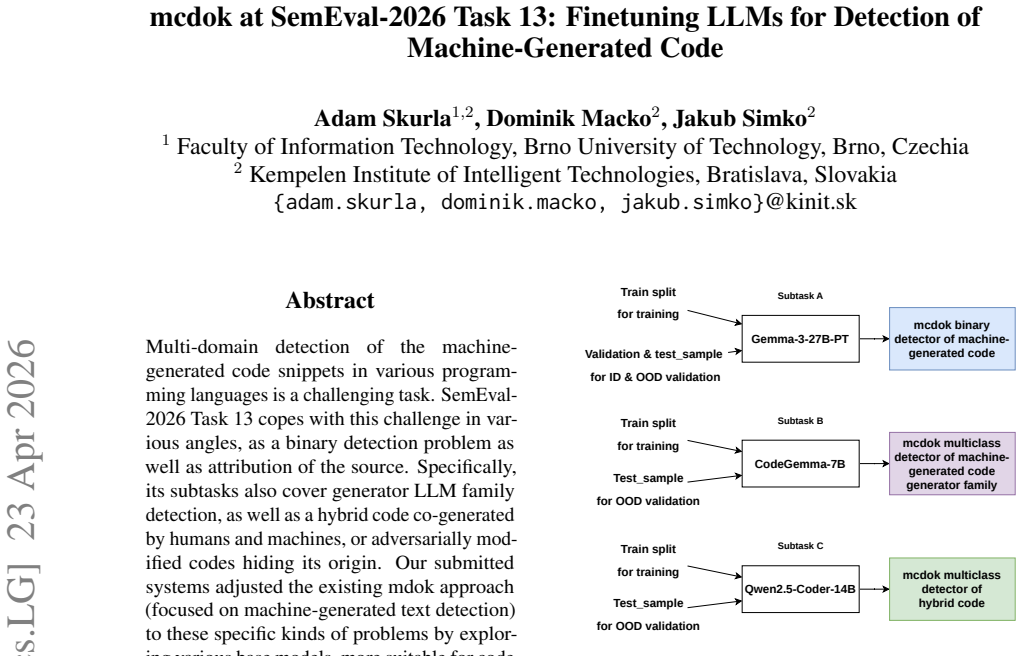
Multi-domain detection of the machine-generated code snippets in various programming languages is a challenging task. SemEval-2026 Task~13 copes with this challenge in various angles, as a binary detection problem as well as attribution of the source. Specifically, its subtasks also cover generator LLM family detection, as well as a hybrid code co-generated by humans and machines, or adversarially modified codes hiding its origin. Our submitted systems adjusted the existing mdok approach (focused on machine-generated text detection) to these specific kinds of problems by exploring various base models, more suitable for code understanding. The results indicate that the submitted systems are competitive in all three subtasks. However, the margins from the top-performing systems are significant, and thus further improvements are possible.
Editorial analysis
A structured set of objections, weighed in public.
Referee Report
Summary. The manuscript describes the mcdok submission to SemEval-2026 Task 13 on multi-domain detection of machine-generated code. It adapts the existing mdok approach (originally for text) by fine-tuning LLMs more suitable for code understanding, addressing binary detection, source attribution, generator LLM family detection, and hybrid/adversarially modified code. The central claim is that the submitted systems are competitive in all three subtasks, though with significant margins to the leaders and room for further improvement.
Significance. If the competitiveness claim holds with supporting metrics, the work would show that base-model exploration during fine-tuning can produce effective detectors for machine-generated code without requiring major architectural innovations. This would be a useful data point for the shared task and for practitioners seeking lightweight adaptations of text-detection methods to code. The significance remains limited by the absence of any quantitative evidence or external validation.
major comments (2)
- Abstract: The claim that 'the results indicate that the submitted systems are competitive in all three subtasks' is unsupported because the manuscript supplies no quantitative scores (e.g., F1, accuracy), baselines, leaderboard deltas, or error analysis for any subtask.
- Abstract: The statement that 'the margins from the top-performing systems are significant' is made without any numerical values or per-subtask breakdown, rendering the competitiveness assessment unverifiable and the call for 'further improvements' unsubstantiated.
minor comments (1)
- Abstract: The method description ('exploring various base models more suitable for code understanding') is too high-level; listing the specific models tested and any selection criteria would improve clarity.
Circularity Check
No circularity: empirical reporting on shared-task data with no derivation chain
full rationale
The paper is a short system-description submission to a shared task. It describes a straightforward adaptation of an existing mdok-style fine-tuning pipeline by swapping base models for code, then states that the resulting systems 'are competitive in all three subtasks' on the basis of their official task scores. No equations, first-principles derivations, or 'predictions' are offered; the competitiveness claim is simply an empirical summary of leaderboard placement. No self-citation is used to justify any mathematical step, no fitted parameter is relabeled as a prediction, and no uniqueness theorem or ansatz is smuggled in. The evaluation is performed on the task's own test distribution, which is the standard, non-circular protocol for such papers. The derivation chain is therefore empty and self-contained.
Axiom & Free-Parameter Ledger
Reference graph
Works this paper leans on
-
[1]
2025 , eprint=
Increasing the Robustness of the Fine-tuned Multilingual Machine-Generated Text Detectors , author=. 2025 , eprint=
2025
- [2]
-
[3]
Working Notes of
Dominik Macko , title =. Working Notes of
-
[4]
2025 , eprint=
Authorship Attribution in Multilingual Machine-Generated Texts , author=. 2025 , eprint=
2025
-
[5]
Dettmers, Tim and Pagnoni, Artidoro and Holtzman, Ari and Zettlemoyer, Luke , booktitle =
-
[6]
2025 , eprint=
Gemma 3 Technical Report , author=. 2025 , eprint=
2025
-
[7]
CodeGemma Team and Heri Zhao and Jeffrey Hui and Joshua Howland and Nam Nguyen and Siqi Zuo and Andrea Hu and Christopher A. Choquette-Choo and Jingyue Shen and Joe Kelley and Kshitij Bansal and Luke Vilnis and Mateo Wirth and Paul Michel and Peter Choy and Pratik Joshi and Ravin Kumar and Sarmad Hashmi and Shubham Agrawal and Zhitao Gong and Jane Fine an...
-
[8]
Qwen2.5-Coder Technical Report
Binyuan Hui and Jian Yang and Zeyu Cui and Jiaxi Yang and Dayiheng Liu and Lei Zhang and Tianyu Liu and Jiajun Zhang and Bowen Yu and Keming Lu and Kai Dang and Yang Fan and Yichang Zhang and An Yang and Rui Men and Fei Huang and Bo Zheng and Yibo Miao and Shanghaoran Quan and Yunlong Feng and Xingzhang Ren and Xuancheng Ren and Jingren Zhou and Junyang L...
work page internal anchor Pith review arXiv
-
[9]
2025 , eprint=
Qwen3 Technical Report , author=. 2025 , eprint=
2025
-
[10]
Voight-Kampff
Janek Bevendorff and Yuxia Wang and Jussi Karlgren and Matti Wiegmann and Maik Fr. Overview of the "Voight-Kampff" Generative. Working Notes of
-
[11]
Droid : A Resource Suite for AI -Generated Code Detection
Orel, Daniil and Paul, Indraneil and Gurevych, Iryna and Nakov, Preslav. Droid : A Resource Suite for AI -Generated Code Detection. Proceedings of the 2025 Conference on Empirical Methods in Natural Language Processing. 2025. doi:10.18653/v1/2025.emnlp-main.1593
-
[12]
S em E val-2026 Task 13: Detecting Machine-Generated Code with Multiple Programming Languages, Generators, and Application Scenarios
Orel, Daniil and Paul, Indraneil and Gurevych, Iryna and Nakov, Preslav. S em E val-2026 Task 13: Detecting Machine-Generated Code with Multiple Programming Languages, Generators, and Application Scenarios. Proceedings of the 20th International Workshop on Semantic Evaluation (SemEval-2026). 2026
2026
-
[13]
Proceedings of the 21st Workshop of Young Researchers' Roundtable on Spoken Dialogue Systems. 2025
2025
-
[14]
Research on LLM s-Empowered Conversational AI for Sustainable Behaviour Change
Chen, Ben. Research on LLM s-Empowered Conversational AI for Sustainable Behaviour Change. Proceedings of the 21st Workshop of Young Researchers' Roundtable on Spoken Dialogue Systems. 2025
2025
-
[15]
Deep Reinforcement Learning of LLM s using RLHF
Levandovsky, Enoch. Deep Reinforcement Learning of LLM s using RLHF. Proceedings of the 21st Workshop of Young Researchers' Roundtable on Spoken Dialogue Systems. 2025
2025
-
[16]
Conversational Collaborative Robots
Kranti, Chalamalasetti. Conversational Collaborative Robots. Proceedings of the 21st Workshop of Young Researchers' Roundtable on Spoken Dialogue Systems. 2025
2025
-
[17]
Dialogue System using Large Language Model-based Dynamic Slot Generation
Hashimoto, Ekai. Dialogue System using Large Language Model-based Dynamic Slot Generation. Proceedings of the 21st Workshop of Young Researchers' Roundtable on Spoken Dialogue Systems. 2025
2025
-
[18]
Towards Adaptive Human-Agent Collaboration in Real-Time Environments
Nakae, Kaito. Towards Adaptive Human-Agent Collaboration in Real-Time Environments. Proceedings of the 21st Workshop of Young Researchers' Roundtable on Spoken Dialogue Systems. 2025
2025
-
[19]
Towards Human-Like Dialogue Systems: Integrating Multimodal Emotion Recognition and Non-Verbal Cue Generation
Jiang, Jingjing. Towards Human-Like Dialogue Systems: Integrating Multimodal Emotion Recognition and Non-Verbal Cue Generation. Proceedings of the 21st Workshop of Young Researchers' Roundtable on Spoken Dialogue Systems. 2025
2025
-
[20]
Controlling Dialogue Systems with Graph-Based Structures
Hilgendorf, Laetitia Mina. Controlling Dialogue Systems with Graph-Based Structures. Proceedings of the 21st Workshop of Young Researchers' Roundtable on Spoken Dialogue Systems. 2025
2025
-
[21]
Multimodal Agentic Dialogue Systems for Situated Human-Robot Interaction
Sucal, Virgile. Multimodal Agentic Dialogue Systems for Situated Human-Robot Interaction. Proceedings of the 21st Workshop of Young Researchers' Roundtable on Spoken Dialogue Systems. 2025
2025
-
[22]
Knowledge Graphs and Representational Models for Dialogue Systems
Walker, Nicholas Thomas. Knowledge Graphs and Representational Models for Dialogue Systems. Proceedings of the 21st Workshop of Young Researchers' Roundtable on Spoken Dialogue Systems. 2025
2025
-
[23]
Proceedings of the 1st Joint Workshop on Large Language Models and Structure Modeling (XLLM 2025). 2025. doi:10.18653/v1/2025.xllm-1.0
-
[24]
Efeoglu, Sefika and Paschke, Adrian. Fine-Tuning Large Language Models for Relation Extraction within a Retrieval-Augmented Generation Framework. Proceedings of the 1st Joint Workshop on Large Language Models and Structure Modeling (XLLM 2025). 2025. doi:10.18653/v1/2025.xllm-1.1
-
[25]
Benchmarking Table Extraction: Multimodal LLM s vs Traditional OCR
Nunes, Guilherme and Rolla, Vitor and Pereira, Duarte and Alves, Vasco and Carreiro, Andre and Baptista, M \'a rcia. Benchmarking Table Extraction: Multimodal LLM s vs Traditional OCR. Proceedings of the 1st Joint Workshop on Large Language Models and Structure Modeling (XLLM 2025). 2025. doi:10.18653/v1/2025.xllm-1.2
-
[26]
Injecting Structured Knowledge into LLM s via Graph Neural Networks
Li, Zichao and Ke, Zong and Zhao, Puning. Injecting Structured Knowledge into LLM s via Graph Neural Networks. Proceedings of the 1st Joint Workshop on Large Language Models and Structure Modeling (XLLM 2025). 2025. doi:10.18653/v1/2025.xllm-1.3
-
[27]
Regular-pattern-sensitive CRF s for Distant Label Interactions
Papay, Sean and Klinger, Roman and Pad \'o , Sebastian. Regular-pattern-sensitive CRF s for Distant Label Interactions. Proceedings of the 1st Joint Workshop on Large Language Models and Structure Modeling (XLLM 2025). 2025. doi:10.18653/v1/2025.xllm-1.4
-
[28]
Swarup, Anushka and Bhandarkar, Avanti and Wilson, Ronald and Pan, Tianyu and Woodard, Damon. From Syntax to Semantics: Evaluating the Impact of Linguistic Structures on LLM -Based Information Extraction. Proceedings of the 1st Joint Workshop on Large Language Models and Structure Modeling (XLLM 2025). 2025. doi:10.18653/v1/2025.xllm-1.5
-
[29]
Detecting Referring Expressions in Visually Grounded Dialogue with Autoregressive Language Models
Willemsen, Bram and Skantze, Gabriel. Detecting Referring Expressions in Visually Grounded Dialogue with Autoregressive Language Models. Proceedings of the 1st Joint Workshop on Large Language Models and Structure Modeling (XLLM 2025). 2025. doi:10.18653/v1/2025.xllm-1.6
-
[30]
Exploring Multilingual Probing in Large Language Models: A Cross-Language Analysis
Li, Daoyang and Zhao, Haiyan and Zeng, Qingcheng and Du, Mengnan. Exploring Multilingual Probing in Large Language Models: A Cross-Language Analysis. Proceedings of the 1st Joint Workshop on Large Language Models and Structure Modeling (XLLM 2025). 2025. doi:10.18653/v1/2025.xllm-1.7
-
[31]
Self-Contrastive Loop of Thought Method for Text-to- SQL Based on Large Language Model
Kang, Fengrui and Tan, Mingxi and Huang, Xianying and Yang, Shiju. Self-Contrastive Loop of Thought Method for Text-to- SQL Based on Large Language Model. Proceedings of the 1st Joint Workshop on Large Language Models and Structure Modeling (XLLM 2025). 2025. doi:10.18653/v1/2025.xllm-1.8
-
[32]
Isaeva, Ulyana and Astafurov, Danil and Martynov, Nikita. Combining Automated and Manual Data for Effective Downstream Fine-Tuning of Transformers for Low-Resource Language Applications. Proceedings of the 1st Joint Workshop on Large Language Models and Structure Modeling (XLLM 2025). 2025. doi:10.18653/v1/2025.xllm-1.9
-
[33]
Bartkowiak, Patryk and Grali \'n ski, Filip. Seamlessly Integrating Tree-Based Positional Embeddings into Transformer Models for Source Code Representation. Proceedings of the 1st Joint Workshop on Large Language Models and Structure Modeling (XLLM 2025). 2025. doi:10.18653/v1/2025.xllm-1.10
-
[34]
Enhancing AMR Parsing with Group Relative Policy Optimization
Barta, Botond and Hamerlik, Endre and Nyist, Mil \'a n and Ito, Masato and Acs, Judit. Enhancing AMR Parsing with Group Relative Policy Optimization. Proceedings of the 1st Joint Workshop on Large Language Models and Structure Modeling (XLLM 2025). 2025. doi:10.18653/v1/2025.xllm-1.11
-
[35]
Structure Modeling Approach for UD Parsing of Historical M odern J apanese
Ozaki, Hiroaki and Omura, Mai and Komiya, Kanako and Asahara, Masayuki and Ogiso, Toshinobu. Structure Modeling Approach for UD Parsing of Historical M odern J apanese. Proceedings of the 1st Joint Workshop on Large Language Models and Structure Modeling (XLLM 2025). 2025. doi:10.18653/v1/2025.xllm-1.12
-
[36]
BARTABSA ++: Revisiting BARTABSA with Decoder LLM s
Pfister, Jan and V. BARTABSA ++: Revisiting BARTABSA with Decoder LLM s. Proceedings of the 1st Joint Workshop on Large Language Models and Structure Modeling (XLLM 2025). 2025. doi:10.18653/v1/2025.xllm-1.13
-
[37]
Typed- RAG : Type-Aware Decomposition of Non-Factoid Questions for Retrieval-Augmented Generation
Lee, DongGeon and Park, Ahjeong and Lee, Hyeri and Nam, Hyeonseo and Maeng, Yunho. Typed- RAG : Type-Aware Decomposition of Non-Factoid Questions for Retrieval-Augmented Generation. Proceedings of the 1st Joint Workshop on Large Language Models and Structure Modeling (XLLM 2025). 2025. doi:10.18653/v1/2025.xllm-1.14
-
[38]
Hellwig, Nils Constantin and Fehle, Jakob and Kruschwitz, Udo and Wolff, Christian. Do we still need Human Annotators? Prompting Large Language Models for Aspect Sentiment Quad Prediction. Proceedings of the 1st Joint Workshop on Large Language Models and Structure Modeling (XLLM 2025). 2025. doi:10.18653/v1/2025.xllm-1.15
-
[39]
Can LLM s Interpret and Leverage Structured Linguistic Representations? A Case Study with AMR s
Raut, Ankush and Zhu, Xiaofeng and Pacheco, Maria Leonor. Can LLM s Interpret and Leverage Structured Linguistic Representations? A Case Study with AMR s. Proceedings of the 1st Joint Workshop on Large Language Models and Structure Modeling (XLLM 2025). 2025. doi:10.18653/v1/2025.xllm-1.16
work page internal anchor Pith review doi:10.18653/v1/2025.xllm-1.16 2025
-
[40]
LLM Dependency Parsing with In-Context Rules
Ginn, Michael and Palmer, Alexis. LLM Dependency Parsing with In-Context Rules. Proceedings of the 1st Joint Workshop on Large Language Models and Structure Modeling (XLLM 2025). 2025. doi:10.18653/v1/2025.xllm-1.17
-
[41]
Han, Xu and Wang, Bo and Sun, Yueheng and Zhao, Dongming and Qu, Zongfeng and He, Ruifang and Hou, Yuexian and Hu, Qinghua. Cognitive Mirroring for D oc RE : A Self-Supervised Iterative Reflection Framework with Triplet-Centric Explicit and Implicit Feedback. Proceedings of the 1st Joint Workshop on Large Language Models and Structure Modeling (XLLM 2025)...
-
[42]
Cross-Document Event-Keyed Summarization
Walden, William and Kuchmiichuk, Pavlo and Martin, Alexander and Jin, Chihsheng and Cao, Angela and Sun, Claire and Allen, Curisia and White, Aaron. Cross-Document Event-Keyed Summarization. Proceedings of the 1st Joint Workshop on Large Language Models and Structure Modeling (XLLM 2025). 2025. doi:10.18653/v1/2025.xllm-1.19
-
[43]
Transfer of Structural Knowledge from Synthetic Languages
Budnikov, Mikhail and Yamshchikov, Ivan. Transfer of Structural Knowledge from Synthetic Languages. Proceedings of the 1st Joint Workshop on Large Language Models and Structure Modeling (XLLM 2025). 2025. doi:10.18653/v1/2025.xllm-1.20
-
[44]
Language Models are Universal Embedders
Zhang, Xin and Li, Zehan and Zhang, Yanzhao and Long, Dingkun and Xie, Pengjun and Zhang, Meishan and Zhang, Min. Language Models are Universal Embedders. Proceedings of the 1st Joint Workshop on Large Language Models and Structure Modeling (XLLM 2025). 2025. doi:10.18653/v1/2025.xllm-1.21
-
[45]
Duan, Shuoqiu and Chen, Xiaoliang and Miao, Duoqian and Gu, Xu and Li, Xianyong and Du, Yajun. D ia DP @ XLLM 25: Advancing C hinese Dialogue Parsing via Unified Pretrained Language Models and Biaffine Dependency Scoring. Proceedings of the 1st Joint Workshop on Large Language Models and Structure Modeling (XLLM 2025). 2025. doi:10.18653/v1/2025.xllm-1.22
-
[46]
Yuan, Jiahao and Sun, Xingzhe and Yu, Xing and Wang, Jingwen and Du, Dehui and Cui, Zhiqing and Di, Zixiang. LLMSR @ XLLM 25: Less is More: Enhancing Structured Multi-Agent Reasoning via Quality-Guided Distillation. Proceedings of the 1st Joint Workshop on Large Language Models and Structure Modeling (XLLM 2025). 2025. doi:10.18653/v1/2025.xllm-1.23
-
[47]
S peech EE @ XLLM 25: End-to-End Structured Event Extraction from Speech
Chaudhuri, Soham and Biswas, Diganta and Saha, Dipanjan and Das, Dipankar and Bandyopadhyay, Sivaji. S peech EE @ XLLM 25: End-to-End Structured Event Extraction from Speech. Proceedings of the 1st Joint Workshop on Large Language Models and Structure Modeling (XLLM 2025). 2025. doi:10.18653/v1/2025.xllm-1.24
-
[48]
Pham Hoang Le, Nguyen and Dinh Thien, An and T. Luu, Son and Van Nguyen, Kiet. D oc IE @ XLLM 25: Z ero S emble - Robust and Efficient Zero-Shot Document Information Extraction with Heterogeneous Large Language Model Ensembles. Proceedings of the 1st Joint Workshop on Large Language Models and Structure Modeling (XLLM 2025). 2025. doi:10.18653/v1/2025.xllm-1.25
-
[49]
Popovic, Nicholas and Kangen, Ashish and Schopf, Tim and F. D oc IE @ XLLM 25: In-Context Learning for Information Extraction using Fully Synthetic Demonstrations. Proceedings of the 1st Joint Workshop on Large Language Models and Structure Modeling (XLLM 2025). 2025. doi:10.18653/v1/2025.xllm-1.26
-
[50]
Tai, Le and Van, Thin. LLMSR @ XLLM 25: Integrating Reasoning Prompt Strategies with Structural Prompt Formats for Enhanced Logical Inference. Proceedings of the 1st Joint Workshop on Large Language Models and Structure Modeling (XLLM 2025). 2025. doi:10.18653/v1/2025.xllm-1.27
-
[51]
Qiu, Chengfeng and Zhou, Lifeng and Wei, Kaifeng and Li, Yuke. D oc IE @ XLLM 25: UIEP rompter: A Unified Training-Free Framework for universal document-level information extraction via Structured Prompt. Proceedings of the 1st Joint Workshop on Large Language Models and Structure Modeling (XLLM 2025). 2025. doi:10.18653/v1/2025.xllm-1.28
-
[52]
Chen, Danchun. LLMSR @ XLLM 25: SWRV : Empowering Self-Verification of Small Language Models through Step-wise Reasoning and Verification. Proceedings of the 1st Joint Workshop on Large Language Models and Structure Modeling (XLLM 2025). 2025. doi:10.18653/v1/2025.xllm-1.29
-
[53]
LLMSR @ XLLM 25: An Empirical Study of LLM for Structural Reasoning
Li, Xinye and Wan, Mingqi and Sui, Dianbo. LLMSR @ XLLM 25: An Empirical Study of LLM for Structural Reasoning. Proceedings of the 1st Joint Workshop on Large Language Models and Structure Modeling (XLLM 2025). 2025. doi:10.18653/v1/2025.xllm-1.30
-
[54]
LLMSR @ XLLM 25: A Language Model-Based Pipeline for Structured Reasoning Data Construction
Xing, Hongrui and Liu, Xinzhang and Jiang, Zhuo and Yang, Zhihao and Yao, Yitong and Wang, Zihan and Deng, Wenmin and Wang, Chao and Song, Shuangyong and Yang, Wang and He, Zhongjiang and Li, Yongxiang. LLMSR @ XLLM 25: A Language Model-Based Pipeline for Structured Reasoning Data Construction. Proceedings of the 1st Joint Workshop on Large Language Model...
-
[55]
S peech EE @ XLLM 25: Retrieval-Enhanced Few-Shot Prompting for Speech Event Extraction
Gedeon, M \'a t \'e. S peech EE @ XLLM 25: Retrieval-Enhanced Few-Shot Prompting for Speech Event Extraction. Proceedings of the 1st Joint Workshop on Large Language Models and Structure Modeling (XLLM 2025). 2025. doi:10.18653/v1/2025.xllm-1.32
-
[56]
Computational Sanskrit and Digital Humanities - World Sanskrit Conference 2025. 2025
2025
-
[57]
An introduction to computational identification and classification of Upam \= a alaṇk \= a ra
Jadhav, Bhakti and Dutta, Himanshu and Kanitkar, Shruti and Kulkarni, Malhar and Bhattacharyya, Pushpak. An introduction to computational identification and classification of Upam \= a alaṇk \= a ra. Computational Sanskrit and Digital Humanities - World Sanskrit Conference 2025. 2025
2025
-
[58]
Aesthetics of S anskrit Poetry from the Perspective of Computational Linguistics: A Case Study Analysis on \'S ikṣ \= a ṣṭaka
Sandhan, Jivnesh and Barbadikar, Amruta and Maity, Malay and Satuluri, Pavankumar and Sandhan, Tushar and Gupta, Ravi M and Goyal, Pawan and Behera, Laxmidhar. Aesthetics of S anskrit Poetry from the Perspective of Computational Linguistics: A Case Study Analysis on \'S ikṣ \= a ṣṭaka. Computational Sanskrit and Digital Humanities - World Sanskrit Confere...
2025
-
[59]
Itaretara Dvandva: A challenge for Dependency Tree semantics
Kulkarni, Amba and Neelamana, Vasudha. Itaretara Dvandva: A challenge for Dependency Tree semantics. Computational Sanskrit and Digital Humanities - World Sanskrit Conference 2025. 2025
2025
-
[60]
A Case Study of Handwritten Text Recognition from Pre-Colonial era S anskrit Manuscripts
Chincholikar, Kartik and Dwivedi, Shagun and Gopalan, Kaushik and Awasthi, Tarinee. A Case Study of Handwritten Text Recognition from Pre-Colonial era S anskrit Manuscripts. Computational Sanskrit and Digital Humanities - World Sanskrit Conference 2025. 2025
2025
-
[61]
Towards Accent-Aware V edic S anskrit Optical Character Recognition Based on Transformer Models
Tsukagoshi, Yuzuki and Kuroiwa, Ryo and Ohmukai, Ikki. Towards Accent-Aware V edic S anskrit Optical Character Recognition Based on Transformer Models. Computational Sanskrit and Digital Humanities - World Sanskrit Conference 2025. 2025
2025
-
[62]
Vedavani: A Benchmark Corpus for ASR on V edic S anskrit Poetry
Kumar, Sujeet and Ray, Pretam and Beerukuri, Abhinay and Kamoji, Shrey and Jagadeeshan, Manoj Balaji and Goyal, Pawan. Vedavani: A Benchmark Corpus for ASR on V edic S anskrit Poetry. Computational Sanskrit and Digital Humanities - World Sanskrit Conference 2025. 2025
2025
-
[63]
Compound Type Identification in S anskrit
Krishnan, Sriram and Satuluri, Pavankumar and Barbadikar, Amruta and Prasanna Venkatesh, T S and Kulkarni, Amba. Compound Type Identification in S anskrit. Computational Sanskrit and Digital Humanities - World Sanskrit Conference 2025. 2025
2025
-
[64]
IKML : A Markup Language for Collaborative Semantic Annotation of I ndic Texts
Lakkundi, Chaitanya S and Rajaraman, Gopalakrishnan and Susarla, Sai Rama Krishna. IKML : A Markup Language for Collaborative Semantic Annotation of I ndic Texts. Computational Sanskrit and Digital Humanities - World Sanskrit Conference 2025. 2025
2025
-
[65]
Challenges in Processing V edic S anskrit: Towards creating a normalized dataset for the Ṛgveda-saṃhit \= a
Krishnan, Sriram and Gayathri, Sepuri and Kulkarni, Amba. Challenges in Processing V edic S anskrit: Towards creating a normalized dataset for the Ṛgveda-saṃhit \= a. Computational Sanskrit and Digital Humanities - World Sanskrit Conference 2025. 2025
2025
-
[66]
P \= a ṇḍitya: Visualizing S anskrit Intellectual Networks
Neill, Tyler. P \= a ṇḍitya: Visualizing S anskrit Intellectual Networks. Computational Sanskrit and Digital Humanities - World Sanskrit Conference 2025. 2025
2025
-
[67]
Anveshana: A New Benchmark Dataset for Cross-Lingual Information Retrieval on E nglish Queries and S anskrit Documents
Jagadeeshan, Manoj Balaji and Raj, Prince and Goyal, Pawan. Anveshana: A New Benchmark Dataset for Cross-Lingual Information Retrieval on E nglish Queries and S anskrit Documents. Computational Sanskrit and Digital Humanities - World Sanskrit Conference 2025. 2025
2025
-
[68]
Concordance of S anskrit Synonyms
Patel, Dhaval. Concordance of S anskrit Synonyms. Computational Sanskrit and Digital Humanities - World Sanskrit Conference 2025. 2025
2025
-
[69]
Proceedings of the First Workshop on Writing Aids at the Crossroads of AI, Cognitive Science and NLP (WRAICOGS 2025). 2025
2025
-
[70]
Chain-of- M eta W riting: Linguistic and Textual Analysis of How Small Language Models Write Young Students Texts
Buhnila, Ioana and Cislaru, Georgeta and Todirascu, Amalia. Chain-of- M eta W riting: Linguistic and Textual Analysis of How Small Language Models Write Young Students Texts. Proceedings of the First Workshop on Writing Aids at the Crossroads of AI, Cognitive Science and NLP (WRAICOGS 2025). 2025
2025
-
[71]
Semantic Masking in a Needle-in-a-haystack Test for Evaluating Large Language Model Long-Text Capabilities
Shi, Ken and Penn, Gerald. Semantic Masking in a Needle-in-a-haystack Test for Evaluating Large Language Model Long-Text Capabilities. Proceedings of the First Workshop on Writing Aids at the Crossroads of AI, Cognitive Science and NLP (WRAICOGS 2025). 2025
2025
-
[72]
Reading Between the Lines: A dataset and a study on why some texts are tougher than others
Khallaf, Nouran and Eugeni, Carlo and Sharoff, Serge. Reading Between the Lines: A dataset and a study on why some texts are tougher than others. Proceedings of the First Workshop on Writing Aids at the Crossroads of AI, Cognitive Science and NLP (WRAICOGS 2025). 2025
2025
-
[73]
P ara R ev : Building a dataset for Scientific Paragraph Revision annotated with revision instruction
Jourdan, L \'e ane and Boudin, Florian and Dufour, Richard and Hernandez, Nicolas and Aizawa, Akiko. P ara R ev : Building a dataset for Scientific Paragraph Revision annotated with revision instruction. Proceedings of the First Workshop on Writing Aids at the Crossroads of AI, Cognitive Science and NLP (WRAICOGS 2025). 2025
2025
-
[74]
Towards an operative definition of creative writing: a preliminary assessment of creativeness in AI and human texts
Maggi, Chiara and Vitaletti, Andrea. Towards an operative definition of creative writing: a preliminary assessment of creativeness in AI and human texts. Proceedings of the First Workshop on Writing Aids at the Crossroads of AI, Cognitive Science and NLP (WRAICOGS 2025). 2025
2025
-
[75]
Decoding Semantic Representations in the Brain Under Language Stimuli with Large Language Models
Sato, Anna and Kobayashi, Ichiro. Decoding Semantic Representations in the Brain Under Language Stimuli with Large Language Models. Proceedings of the First Workshop on Writing Aids at the Crossroads of AI, Cognitive Science and NLP (WRAICOGS 2025). 2025
2025
-
[76]
Proceedings of the The 9th Workshop on Online Abuse and Harms (WOAH). 2025
2025
-
[77]
A Comprehensive Taxonomy of Bias Mitigation Methods for Hate Speech Detection
Fillies, Jan and Wawerek, Marius and Paschke, Adrian. A Comprehensive Taxonomy of Bias Mitigation Methods for Hate Speech Detection. Proceedings of the The 9th Workshop on Online Abuse and Harms (WOAH). 2025
2025
-
[78]
Sensitive Content Classification in Social Media: A Holistic Resource and Evaluation
Antypas, Dimosthenis and Sen, Indira and Perez Almendros, Carla and Camacho-Collados, Jose and Barbieri, Francesco. Sensitive Content Classification in Social Media: A Holistic Resource and Evaluation. Proceedings of the The 9th Workshop on Online Abuse and Harms (WOAH). 2025
2025
-
[79]
From civility to parity: Marxist-feminist ethics for context-aware algorithmic content moderation
Oh, Dayei. From civility to parity: Marxist-feminist ethics for context-aware algorithmic content moderation. Proceedings of the The 9th Workshop on Online Abuse and Harms (WOAH). 2025
2025
-
[80]
A Novel Dataset for Classifying G erman Hate Speech Comments with Criminal Relevance
Kums, Vincent and Meyer, Florian and Pivit, Luisa and Vedenina, Uliana and Wortmann, Jonas and Siegel, Melanie and Labudde, Dirk. A Novel Dataset for Classifying G erman Hate Speech Comments with Criminal Relevance. Proceedings of the The 9th Workshop on Online Abuse and Harms (WOAH). 2025
2025
discussion (0)
Sign in with ORCID, Apple, or X to comment. Anyone can read and Pith papers without signing in.