How to quantify long-time rotational motion in molecular systems
Pith reviewed 2026-05-08 13:42 UTC · model grok-4.3
The pith
Existing methods for quantifying rotational motion fail in supercooled liquids with slow or heterogeneous dynamics, but a new empirical method succeeds.
A machine-rendered reading of the paper's core claim, the machinery that carries it, and where it could break.
Core claim
All existing methods quantifying rotational motion in molecular fluids eventually fail in systems undergoing complex rotational motion characterised by slow, heterogeneous, or intermittent dynamics. This impacts in particular the study of rotational dynamics in molecular supercooled liquids near their glass transition. An empirical method is introduced that efficiently solves all issues. When benchmarked on continuous time random walk models, the method correctly quantifies the statistics of free and caged rotational motion, as well as non-Gaussian and non-Fickian rotational dynamics.
What carries the argument
The empirical method for extracting rotational statistics that avoids averaging errors across heterogeneous trajectories.
If this is right
- The method yields accurate statistics for both free and caged rotational motion across the fluid-to-solid crossover.
- It correctly captures non-Gaussian and non-Fickian features of rotational trajectories.
- It enables a consistent characterization of dynamic heterogeneity in the rotational motion of supercooled molecular fluids.
- It resolves contradictory literature results on rotational-translational decoupling and Debye-Stokes-Einstein violations.
Where Pith is reading between the lines
- The same empirical construction could be applied to re-analyze existing simulation datasets or experimental NMR and dielectric spectra to obtain more reliable long-time rotational measures.
- It provides a practical route to test whether rotational heterogeneity follows the same spatial and temporal patterns as translational heterogeneity in the same liquids.
- The approach may generalize to other intermittent single-particle observables, such as vibrational or conformational dynamics, once analogous benchmarking models are constructed.
Load-bearing premise
The family of continuous time random walk models used for benchmarking captures the essential range of complex rotational dynamics present in real supercooled liquids.
What would settle it
Applying the empirical method to a molecular-dynamics trajectory of an actual supercooled liquid and finding that its extracted rotational statistics disagree with independent, direct measurements of cage sizes or rotational diffusion coefficients would falsify the claim.
Figures




read the original abstract
We show that all existing methods quantifying rotational motion in molecular fluids eventually fail in systems undergoing complex rotational motion characterised by slow, heterogeneous, or intermittent dynamics. This impacts in particular the study of rotational dynamics in molecular supercooled liquids near their glass transition, as well as discussions of the decoupling between rotational and translational motion and violations of the Debye-Stokes-Einstein relation. We present a brief overview of existing methods and explain why none of them can accurately capture the evolution of rotational dynamics from a diffusive fluid to an arrested solid, thus resolving inconsistent literature results. We then introduce an empirical method that efficiently solves all issues. We benchmark our method devising a family of continuous time random walk models for rotational dynamics. Our method correctly quantifies the statistics of free and caged rotational motion, as well as non-Gaussian and non-Fickian rotational dynamics, and should allow a better characterisation of dynamic heterogeneity in the rotational motion of supercooled molecular fluids.
Editorial analysis
A structured set of objections, weighed in public.
Referee Report
Summary. The paper claims that all existing methods for quantifying rotational motion in molecular fluids fail for complex dynamics involving slow, heterogeneous, or intermittent motion, particularly in supercooled liquids near the glass transition. It reviews why these methods lead to inconsistent results on rotational-translational decoupling and Debye-Stokes-Einstein violations, then introduces an empirical method claimed to resolve all such issues. The method is benchmarked on a family of continuous-time random walk (CTRW) models for rotational dynamics, with the assertion that it correctly quantifies free/caged motion as well as non-Gaussian and non-Fickian statistics.
Significance. If the empirical method generalizes reliably beyond the CTRW family to atomistic supercooled liquids, it would provide a consistent framework for characterizing rotational dynamic heterogeneity, potentially clarifying long-standing inconsistencies in the literature on rotational vs. translational decoupling and related transport anomalies.
major comments (1)
- Abstract (benchmarking paragraph): The central claim that the method 'efficiently solves all issues' and 'correctly quantifies' the full range of rotational statistics rests on the CTRW family being representative. However, the manuscript provides no demonstration that these models capture key features of real molecular supercooled liquids such as correlated many-body cage-breaking events, specific orientational potentials, or long-range hydrodynamic effects. Without such justification or additional tests on atomistic data, the generalization to resolve prior inconsistencies remains unsecured.
Simulated Author's Rebuttal
We thank the referee for their careful reading of our manuscript and for providing constructive feedback. We address the major comment below.
read point-by-point responses
-
Referee: Abstract (benchmarking paragraph): The central claim that the method 'efficiently solves all issues' and 'correctly quantifies' the full range of rotational statistics rests on the CTRW family being representative. However, the manuscript provides no demonstration that these models capture key features of real molecular supercooled liquids such as correlated many-body cage-breaking events, specific orientational potentials, or long-range hydrodynamic effects. Without such justification or additional tests on atomistic data, the generalization to resolve prior inconsistencies remains unsecured.
Authors: We thank the referee for highlighting this important point regarding the scope of our benchmarking. The family of CTRW models was constructed to systematically reproduce the key statistical features of rotational dynamics observed in supercooled liquids, namely periods of free rotation, caging, and intermittent large reorientational jumps that produce non-Gaussian and non-Fickian statistics. These features are drawn from established phenomenology in the literature on molecular dynamics simulations of glassy systems. While the models are necessarily simplified and do not incorporate explicit many-body correlations, specific orientational potentials, or hydrodynamic interactions, they enable isolation of how different dynamical regimes affect quantification methods. In the revised manuscript we will add a new subsection (in the Discussion) that provides a more detailed justification for the model family, with additional references to how the CTRW phenomenology aligns with atomistic observations, and that explicitly discusses the limitations of the current tests. We will also clarify that the proposed method is empirical and can be directly applied to atomistic trajectories, while noting that further validation on such data remains an important direction for future work. These changes will make the assumptions and scope of our claims more transparent. revision: yes
Circularity Check
Empirical method with external benchmarking on devised CTRW models; no reduction to fitted inputs or self-citations
full rationale
The paper introduces an empirical method after critiquing existing quantifiers and benchmarks it on a family of continuous-time random walk models for rotational dynamics. No equations or derivations in the provided text reduce the method's outputs to its own fitted parameters by construction, nor does any load-bearing claim rest on self-citations whose content is unverified or equivalent to the target result. The benchmarking is presented as an independent test on constructed models, and the central claim of correctly quantifying free/caged, non-Gaussian, and non-Fickian statistics is tied to performance on those models rather than tautological redefinition. This is a standard non-circular empirical validation setup.
Axiom & Free-Parameter Ledger
Reference graph
Works this paper leans on
-
[1]
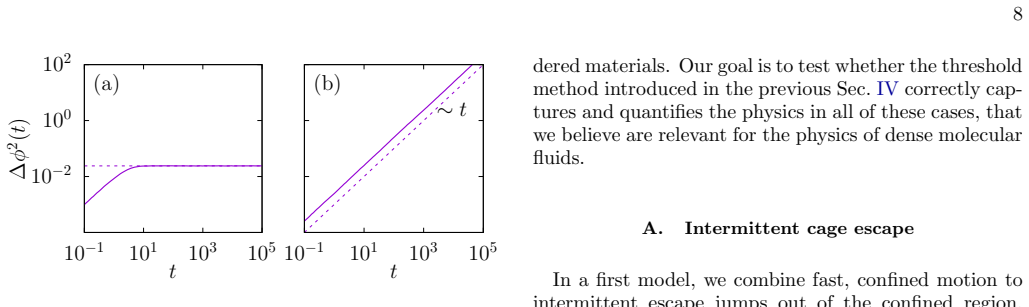
5 0−0. 5 101 100 10−1 10−2 FIG. 8. (a) Mean-squared angular displacement for the model described in Sec. V B, with intermittent cage escapes de- scribed by the Pareto distribution (29) withα= 1.2. The Fickian regime is reached neart≈10 6. The rotational diffu- sion constant is incorrectly estimated by the integral method, and it is not accessible when usi...
-
[2]
5 0−0. 5 101 100 10−1 10−2 FIG. 9. (a) Mean-squared angular displacement for the model described in Sec. V C, with intermittent cage escapes de- scribed by the Pareto distribution (29) withα= 0.7. A sub- diffusive regime is reached at large times with ∆ϕ2 ∼t α. The integral method predicts an incorrect Fickian regime, while a determination of the sub-diff...
-
[3]
J.-P. Boon and S. Yip,Molecular Hydrodynamics(Dover Publications, New York, 1980)
work page 1980
-
[4]
J.-L. Barrat and J.-P. Hansen,Basic concepts for simple and complex liquids(Cambridge University Press, 2003)
work page 2003
-
[5]
Debye,Polar Molecules(Chemical Catalog, 1929)
P. Debye,Polar Molecules(Chemical Catalog, 1929)
work page 1929
-
[6]
H. Goldstein, C. P. Poole, and J. L. Safko,Classical Me- chanics, 3rd ed. (Addison-Wesley, San Francisco, 2002)
work page 2002
-
[7]
L. D. Favro, Theory of the rotational brownian motion of a free rigid body, Phys. Rev.119, 53 (1960)
work page 1960
-
[8]
M. D. Ediger, Spatially heterogeneous dynamics in su- percooled liquids, Annual review of physical chemistry 51, 99 (2000)
work page 2000
-
[9]
R. Richert, Heterogeneous dynamics in liquids: fluctua- tions in space and time, Journal of Physics: Condensed Matter14, R703 (2002)
work page 2002
-
[10]
L. Berthier and G. Biroli, Theoretical perspective on the glass transition and amorphous materials, Reviews of Modern Physics83, 587 (2011)
work page 2011
-
[11]
M. T. Cicerone, F. R. Blackburn, and M. D. Ediger, How do molecules move near tg? molecular rotation of six probes in o-terphenyl across 14 decades in time, The Journal of Chemical Physics102, 471 (1995)
work page 1995
- [12]
-
[13]
L. Berthier, G. Biroli, J.-P. Bouchaud, L. Cipelletti, and W. van Saarloos,Dynamical heterogeneities in glasses, colloids, and granular media, Vol. 150 (OUP Oxford, 2011)
work page 2011
- [14]
-
[15]
F. H. Stillinger and J. A. Hodgdon, Translation-rotation paradox for diffusion in fragile glass-forming liquids, Phys. Rev. E50, 2064 (1994)
work page 2064
-
[16]
G. Tarjus and D. Kivelson, Breakdown of the stokes–einstein relation in supercooled liquids, The Jour- nal of Chemical Physics103, 3071 (1995)
work page 1995
-
[17]
M. T. Cicerone and M. D. Ediger, Enhanced translation of probe molecules in supercooled o-terphenyl: Signa- ture of spatially heterogeneous dynamics?, The Journal of Chemical Physics104, 7210 (1996)
work page 1996
-
[18]
L. Andreozzi, A. Di Schino, M. Giordano, and D. Lep- orini, Evidence of a fractional debye-stokes-einstein law in supercooled o-terphenyl, EPL (Europhysics Letters) 38, 669 (1997). 13
work page 1997
-
[19]
N. L. Mandel, S. Lee, K. Kim, K. Paeng, and L. J. Kauf- man, Single molecule demonstration of debye–stokes– einstein breakdown in polystyrene near the glass tran- sition temperature, Nature communications13, 3580 (2022)
work page 2022
-
[20]
R. Simon, J.-L. Barrat, and L. Berthier, Molecular mo- tion at the experimental glass transition, Phys. Rev. X 16, 011035 (2026)
work page 2026
-
[21]
B. J. Berne and R. Pecora,Dynamic Light Scattering (Wiley, 1976)
work page 1976
-
[22]
J. P. Hansen and I. R. McDonald,Theory of Simple Liq- uids(Academic Press, 1986)
work page 1986
-
[23]
P. Lunkenheimer, U. Schneider, R. Brand, and A. Loid, Glassy dynamics, Contemporary Physics41, 15 (2000)
work page 2000
-
[24]
M. Fl¨ amig, M. Hofmann, N. Fatkullin, and E. R¨ ossler, Nmr relaxometry: The canonical case glycerol, The Jour- nal of Physical Chemistry B124, 1557 (2020)
work page 2020
-
[25]
S. K¨ ammerer, W. Kob, and R. Schilling, Dynamics of the rotational degrees of freedom in a supercooled liquid of diatomic molecules, Phys. Rev. E56, 5450 (1997)
work page 1997
-
[26]
V. Wong and D. A. Case, Evaluating rotational diffusion from protein md simulations, The Journal of Physical Chemistry B112, 6013 (2008)
work page 2008
-
[27]
D. Rozmanov and P. G. Kusalik, Transport coefficients of the tip4p-2005 water model, The Journal of Chemical Physics136, 044507 (2012)
work page 2005
- [28]
-
[29]
S. Zendehroud, J. O. Daldrop, Y. von Hansen, H. Kiefer, and R. R. Netz, Molecular stokes-einstein and stokes- einstein-debye relations for water including viscosity- dependent slip and hydrodynamic radius, Phys. Rev. E 110, 064610 (2024)
work page 2024
-
[30]
S. L. Holtbr¨ ugge and L. V. Sch¨ afer, Robust estimation of rotational diffusion tensors of proteins from molecular dynamics simulations, The Journal of Chemical Physics 163, 064102 (2025)
work page 2025
-
[31]
C. De Michele and D. Leporini, Viscous flow and jump dynamics in molecular supercooled liquids. ii. rotations, Phys. Rev. E63, 036702 (2001)
work page 2001
-
[32]
P. P. Jose, D. Chakrabarti, and B. Bagchi, Anomalous glassy relaxation near the isotropic-nematic phase tran- sition, Phys. Rev. E71, 030701 (2005)
work page 2005
-
[33]
M. G. Mazza, N. Giovambattista, F. W. Starr, and H. E. Stanley, Relation between rotational and translational dynamic heterogeneities in water, Phys. Rev. Lett.96, 057803 (2006)
work page 2006
-
[34]
T. G. Lombardo, P. G. Debenedetti, and F. H. Still- inger, Computational probes of molecular motion in the lewis-wahnstr¨ om model for ortho-terphenyl, The Journal of Chemical Physics125, 174507 (2006)
work page 2006
-
[35]
S. R. Becker, P. H. Poole, and F. W. Starr, Fractional stokes-einstein and debye-stokes-einstein relations in a network-forming liquid, Phys. Rev. Lett.97, 055901 (2006)
work page 2006
-
[36]
S.-H. Chong and W. Kob, Coupling and decoupling be- tween translational and rotational dynamics in a super- cooled molecular liquid, Phys. Rev. Lett.102, 025702 (2009)
work page 2009
-
[37]
K. V. Edmond, M. T. Elsesser, G. L. Hunter, D. J. Pine, and E. R. Weeks, Decoupling of rotational and transla- tional diffusion in supercooled colloidal fluids, Proceed- ings of the National Academy of Sciences109, 17891 (2012)
work page 2012
- [38]
-
[39]
T. Kawasaki and K. Kim, Spurious violation of the Stokes–Einstein–Debye relation in supercooled water, Scientific Reports9, 8118 (2019)
work page 2019
- [40]
- [41]
-
[42]
Ren, Stokes–einstein–debye relation in tip5p water, Chinese Physics B34, 026101 (2025)
G. Ren, Stokes–einstein–debye relation in tip5p water, Chinese Physics B34, 026101 (2025)
work page 2025
-
[43]
E. W. Montroll and G. H. Weiss, Random walks on lat- tices. ii, Journal of Mathematical Physics6, 167 (1965)
work page 1965
-
[44]
B. C. Hall,Lie Groups, Lie Algebras, and Representa- tions: An Elementary Introduction, Graduate Texts in Mathematics, Vol. 222 (Springer International Publish- ing, Cham, 2015)
work page 2015
-
[45]
W. F¨ orstner and B. P. Wrobel,Photogrammetric com- puter vision, Vol. 6 (Springer, 2016)
work page 2016
-
[46]
Euler,Commentationes geometricae 1st part, Vol
L. Euler,Commentationes geometricae 1st part, Vol. 1 (Springer Science & Business Media, 1953)
work page 1953
-
[47]
E. W. Weisstein, Euler angles, https://mathworld. wol- fram. com/ (2009)
work page 2009
-
[48]
Mukundan, Quaternions, inAdvanced methods in computer graphics: with examples in OpenGL(Springer,
R. Mukundan, Quaternions, inAdvanced methods in computer graphics: with examples in OpenGL(Springer,
-
[49]
O. Rodrigues, Des lois g´ eom´ etriques qui r´ egissent les d´ eplacements d’un syst` eme solide dans l’espace, et de la variation des coordonn´ ees provenant de ces d´ eplacements consid´ er´ es ind´ ependamment des causes qui peuvent les produire, Journal de math´ ematiques pures et appliqu´ ees 5, 380 (1840)
- [50]
-
[51]
R. M. Mazo,Brownian Motion: Fluctuations, Dynamics, and Applications, International Series of Monographs on Physics, Vol. 112 (Oxford University Press, 2008)
work page 2008
-
[52]
R. E. Miles, On random rotations in rˆ3, Biometrika52, 636 (1965)
work page 1965
-
[53]
Hausdorff, Die symbolische exponentialformel in der gruppentheorie, Ber
F. Hausdorff, Die symbolische exponentialformel in der gruppentheorie, Ber. Verh. Kgl. S ˜A¤chs. Ges. Wiss. Leipzig., Math.-phys. Kl.58, 19 (1906)
work page 1906
-
[54]
P. Chaudhuri, Y. Gao, L. Berthier, M. Kilfoil, and W. Kob, A random walk description of the heterogeneous glassy dynamics of attracting colloids, Journal of Physics: Condensed Matter20, 244126 (2008)
work page 2008
-
[55]
R. Metzler and J. Klafter, The random walk’s guide to anomalous diffusion: a fractional dynamics approach, Physics reports339, 1 (2000)
work page 2000
-
[56]
L. Berthier, D. Chandler, and J. P. Garrahan, Length scale for the onset of fickian diffusion in supercooled liq- uids, EPL (europhysics Letters)69, 320 (2005)
work page 2005
-
[57]
G. Szamel and E. Flenner, Time scale for the onset of fickian diffusion in supercooled liquids, Phys. Rev. E73, 14 011504 (2006)
work page 2006
-
[58]
fickian non-gaussian diffusion in glass-forming liquids
L. Berthier, E. Flenner, and G. Szamel, Comment on “fickian non-gaussian diffusion in glass-forming liquids”, Phys. Rev. Lett.131, 119801 (2023)
work page 2023
-
[59]
B. Mandelbrot, The pareto-levy law and the distribution of income, International economic review1, 79 (1960)
work page 1960
-
[60]
P. Chaudhuri, L. Berthier, and W. Kob, Universal na- ture of particle displacements close to glass and jamming transitions, Phys. Rev. Lett.99, 060604 (2007)
work page 2007
-
[61]
S. L. Altmann, Hamilton, rodrigues, and the quaternion scandal, Mathematics Magazine62, 291 (1989). Appendix A: Fokker Planck equation for random walks inSO(3) Equation (19) describes the successive composition of infinitesimal rotations. In the axis-angle representation, and in the limitϵ→0, the corresponding stochastic pro- cess can be seen as the discr...
work page 1989
discussion (0)
Sign in with ORCID, Apple, or X to comment. Anyone can read and Pith papers without signing in.