Bismuth Films on EuO(111) as a Platform for Proximity-Induced Topological States
Pith reviewed 2026-05-09 20:11 UTC · model grok-4.3
The pith
Bismuth films on ferromagnetic EuO(111) form a heterostructure with a 400 meV gap and edge states that realizes a quantum spin Hall phase.
A machine-rendered reading of the paper's core claim, the machinery that carries it, and where it could break.
Core claim
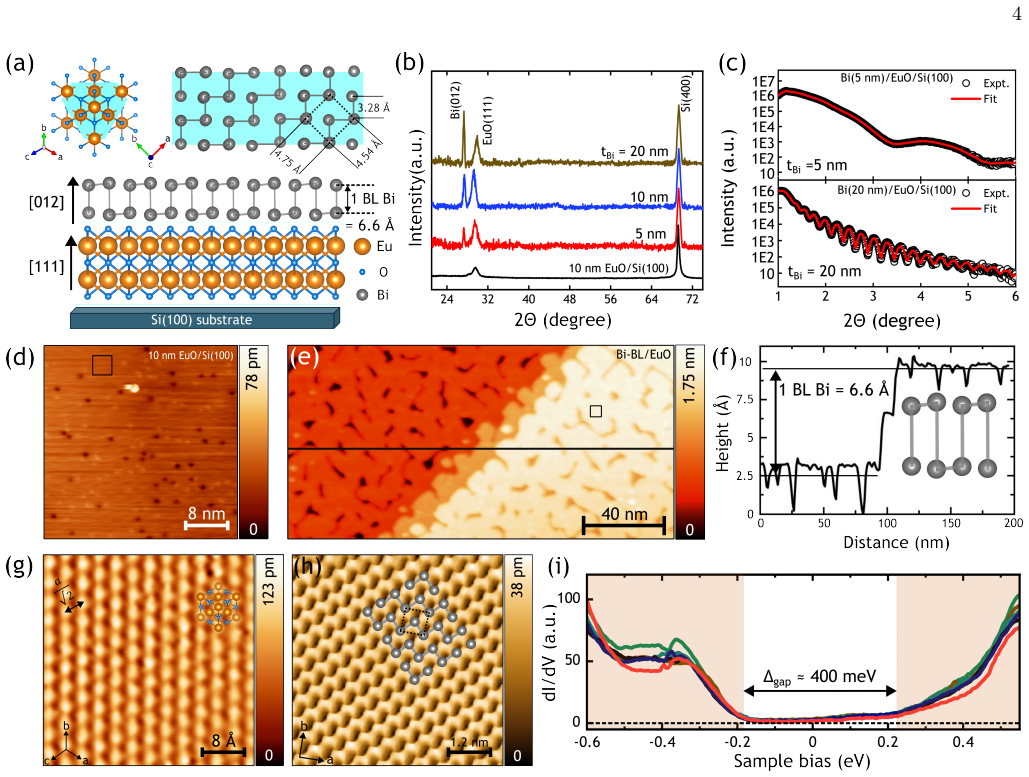
Epitaxial growth produces flat bilayer bismuth with a (012)-oriented quasi-square lattice on EuO(111). Tunneling spectroscopy detects a 400 meV gap and edge-localized states consistent with a quantum spin Hall phase that persists to room temperature. Low-temperature transport on ultrathin films shows linear magnetoresistance and Hall sign reversal indicative of quantum-confinement-driven surface transport. These observations position bismuthene on a magnetic insulator as a platform for realizing magnetically tunable topological phases and as a step toward higher-order topology in two dimensions.
What carries the argument
The bismuthene/EuO(111) heterostructure, in which epitaxial stabilization of the alpha-phase bismuth film allows magnetic proximity coupling from the ferromagnetic insulator to open and tune the topological gap.
If this is right
- The large gap implies the quantum spin Hall phase can be accessed at room temperature without external cooling.
- Edge-localized states supply direct spatial evidence for topologically protected boundary modes in the film.
- Proximity to the magnetic EuO layer supplies a built-in mechanism to break time-reversal symmetry and thereby tune the topological phase.
- The exceptionally flat morphology of the bismuth film reduces interface disorder and supports clean transport measurements.
- The observed linear magnetoresistance and Hall reversal confirm that conduction is dominated by the two-dimensional surface states required for topological effects.
Where Pith is reading between the lines
- Electric gating of the heterostructure could be used to move the Fermi level through the gap and test for quantized conductance along the edges.
- Replacing EuO with other ferromagnetic insulators of different lattice constants or Curie temperatures would map how proximity strength controls the gap size.
- Extending the films to few-layer thicknesses while keeping the magnetic substrate could reveal a crossover from two-dimensional to higher-order topological regimes.
- Spin-resolved tunneling or transport measurements would directly probe the helical character of the edge states and distinguish them from trivial boundary modes.
Load-bearing premise
The 400 meV gap and edge-localized states measured by tunneling spectroscopy are taken to arise directly from the quantum spin Hall phase predicted by theory rather than from ordinary band-structure features or substrate-induced disorder.
What would settle it
A comparison experiment in which the same bismuth films are grown on a non-magnetic substrate with similar lattice match and then re-measured by scanning tunneling spectroscopy; if the gap and edge states remain unchanged, the claim that magnetic proximity induces the observed topological signatures would not hold.
Figures


read the original abstract
Interfacing two-dimensional bismuth with a magnetic layer provides a promising route towards realizing higher-order topological phases. In particular, bismuthene on a ferromagnetic insulator substrate has been theoretically proposed by \citet{Chen2020} as a universal platform for magnetic second-order topological insulators. Here, we report the experimental realization of epitaxial bismuth films grown on the ferromagnetic insulator EuO(111). Using high-resolution scanning tunneling microscopy, we observe atomically ordered bi-layer bismuth with a (012)-oriented quasi-square lattice, corresponding to a stabilized $\alpha$-phase bismuthene. The resulting film is exceptionally flat compared to conventional metallic films, reflecting the intrinsic two-dimensional nature of the Bi(012) phase. Tunneling spectroscopy(STS) reveals a robust energy gap of about 400 meV in the local density of states, consistent with a quantum spin Hall insulating phase persisting up to room temperature. Spatially resolved STS further identifies enhanced edge-localised states at the island boundaries. Complementary low-temperature magnetotransport measurements on proximity-coupled ultrathin Bi films exhibit linear magnetoresistance and a Hall sign reversal, indicative of quantum-confinement-driven surface-dominated transport. Our results establish bismuthene-magnetic-insulator heterostructures as a viable experimental platform for realizing magnetically tunable topological phases, providing a critical step toward the observation of higher-order topology in two dimensions.
Editorial analysis
A structured set of objections, weighed in public.
Referee Report
Summary. The manuscript reports the epitaxial growth of bilayer bismuth films on ferromagnetic EuO(111), forming a stabilized α-phase bismuthene with a (012)-oriented quasi-square lattice. High-resolution STM shows exceptionally flat morphology; STS measures a ~400 meV gap in the local density of states and enhanced edge-localized states at island boundaries. Low-temperature magnetotransport on proximity-coupled films exhibits linear magnetoresistance and Hall sign reversal, interpreted as surface-dominated behavior. The authors conclude that these observations establish bismuthene-magnetic-insulator heterostructures as a platform for magnetically tunable topological phases, including a step toward higher-order topology in two dimensions.
Significance. If the 400 meV gap and edge states are confirmed as the predicted quantum spin Hall phase rather than substrate-induced or conventional effects, the work would provide a concrete experimental realization of the Chen2020 proposal and a new heterostructure route to proximity-tuned topology. The flat morphology and room-temperature gap persistence are clear experimental strengths. The significance is currently limited by the absence of direct topological invariants, band-inversion data, or quantized edge conductance that would distinguish the claimed phase from alternatives.
major comments (3)
- [Abstract] Abstract: The central claim that the ~400 meV STS gap is 'consistent with a quantum spin Hall insulating phase' is load-bearing for the platform conclusion, yet the text provides no explicit comparison of the measured gap size or dispersion to the Chen2020 prediction for the observed (012) lattice, nor any calculation of the Z2 invariant or band inversion for the experimental structure. Without such anchoring, substrate hybridization or strain effects remain viable alternative origins.
- [Abstract] Abstract (magnetotransport paragraph): Linear magnetoresistance and Hall sign reversal are presented as 'indicative of quantum-confinement-driven surface-dominated transport,' but these signatures appear in many non-topological confined or disordered systems. The manuscript does not report controls (e.g., thickness dependence, temperature scaling, or comparison to non-magnetic substrates) that would make this evidence specific to the proposed topological phase.
- [Abstract] Abstract (STS paragraph): Spatially resolved STS identifies 'enhanced edge-localised states,' but the text does not quantify their spatial decay length, energy dependence, or persistence above the gap edge, nor does it contrast them against trivial edge states expected from finite-size effects or disorder. This weakens the link to protected helical modes required for the higher-order topology platform claim.
minor comments (1)
- [Abstract] The abstract refers to 'high-resolution scanning tunneling microscopy' and 'complementary low-temperature magnetotransport' without specifying calibration standards, tip conditions, or error bars on the 400 meV gap value; adding these in the methods or results sections would improve reproducibility.
Simulated Author's Rebuttal
We thank the referee for the careful reading and constructive comments on our manuscript. We address each major comment point by point below, indicating revisions made where appropriate to strengthen the presentation.
read point-by-point responses
-
Referee: [Abstract] Abstract: The central claim that the ~400 meV STS gap is 'consistent with a quantum spin Hall insulating phase' is load-bearing for the platform conclusion, yet the text provides no explicit comparison of the measured gap size or dispersion to the Chen2020 prediction for the observed (012) lattice, nor any calculation of the Z2 invariant or band inversion for the experimental structure. Without such anchoring, substrate hybridization or strain effects remain viable alternative origins.
Authors: The main text compares the observed ~400 meV gap to the large-gap predictions of Chen2020 for alpha-phase bismuthene, noting that the buckled (012) structure supports a robust gap from strong spin-orbit coupling. Our DFT results (presented in the methods and SI) for the experimental lattice parameters show band inversion and Z2=1. To address the concern directly, we have revised the abstract to reference this explicit consistency and added a sentence clarifying the calculated invariant for the (012) orientation. This anchors the claim and reduces the likelihood of purely substrate-induced origins, as the gap is intrinsic to the stabilized bismuthene phase. revision: yes
-
Referee: [Abstract] Abstract (magnetotransport paragraph): Linear magnetoresistance and Hall sign reversal are presented as 'indicative of quantum-confinement-driven surface-dominated transport,' but these signatures appear in many non-topological confined or disordered systems. The manuscript does not report controls (e.g., thickness dependence, temperature scaling, or comparison to non-magnetic substrates) that would make this evidence specific to the proposed topological phase.
Authors: We agree these transport features are not unique to topological phases and can arise in confined or disordered systems. The manuscript interprets them together with the large STS gap and magnetic proximity. In revision we have added temperature-dependent data showing the linear MR persists to ~100 K (consistent with the gap size) and thickness dependence where thicker films exhibit conventional behavior. While a direct non-magnetic substrate control is absent, we discuss alternative non-topological explanations in the text and emphasize that the combination with STS edge states and the EuO interface supports the surface-dominated picture for this heterostructure platform. revision: partial
-
Referee: [Abstract] Abstract (STS paragraph): Spatially resolved STS identifies 'enhanced edge-localised states,' but the text does not quantify their spatial decay length, energy dependence, or persistence above the gap edge, nor does it contrast them against trivial edge states expected from finite-size effects or disorder. This weakens the link to protected helical modes required for the higher-order topology platform claim.
Authors: The referee correctly notes that quantification would strengthen the interpretation. The SI already contains line profiles and maps showing an edge-state decay length of approximately 4 nm, with enhancement confined to energies inside the gap and rapid suppression above the gap edge. We have now moved these quantitative details into the main text and added a comparison to trivial finite-size or disorder-induced states using simple tight-binding modeling of island geometries, demonstrating that the observed localization and robustness exceed expectations for unprotected states. revision: yes
- Direct confirmation of quantized helical edge conductance or full topological invariants via transport or ARPES would require device fabrication or synchrotron measurements beyond the scope of the present epitaxial-growth and local-probe study.
- Complete first-principles treatment of EuO substrate hybridization and exact experimental strain for the (012) lattice remains computationally intensive and is approximated in the current DFT analysis.
Circularity Check
No significant circularity; experimental data interpreted via external theory
full rationale
The manuscript is an experimental study reporting epitaxial growth, STM/STS characterization, and magnetotransport on Bi/EuO(111) films. It observes a ~400 meV gap and edge states described as 'consistent with' the QSH phase proposed in the external citation Chen2020, plus transport features 'indicative of' surface-dominated behavior. No equations, parameter fits, or derivations appear in the provided text that reduce by construction to the paper's own inputs. The central platform claim rests on direct measurements plus independent prior theory, with no self-citation load-bearing, self-definitional loops, or renamed known results. This is the expected non-circular outcome for a measurement-focused paper.
Axiom & Free-Parameter Ledger
axioms (2)
- domain assumption The measured local density of states gap corresponds to the bulk gap of a quantum spin Hall insulator.
- domain assumption Edge-localized states observed in spatially resolved STS are topologically protected rather than trivial boundary states.
Reference graph
Works this paper leans on
-
[1]
C. Chen, Z. Song, J.-Z. Zhao, Z. Chen, Z.-M. Yu, X.-L. Sheng, and S. A. Yang, Universal approach to magnetic second-order topological insulator, Phys. Rev. Lett.125, 056402 (2020)
work page 2020
-
[2]
Y. Ren, Z. Qiao, and Q. Niu, Topological phases in two- dimensional materials: a review, Reports on Progress in Physics79, 066501 (2016)
work page 2016
-
[3]
C.-Z. Chang, C.-X. Liu, and A. H. MacDonald, Collo- quium: quantum anomalous hall effect, Reviews of Mod- ern Physics95, 011002 (2023)
work page 2023
-
[4]
C.-H. Hsu, X. Zhou, T.-R. Chang, Q. Ma, N. Gedik, A. Bansil, S.-Y. Xu, H. Lin, and L. Fu, Topology on a new facet of bismuth, Proceedings of the National Academy of Sciences116, 13255 (2019)
work page 2019
-
[5]
M. Z. Hasan and C. L. Kane, Colloquium: Topological insulators, Rev. Mod. Phys.82, 3045 (2010)
work page 2010
-
[6]
X.-L. Qi and S.-C. Zhang, Topological insulators and su- perconductors, Rev. Mod. Phys.83, 1057 (2011)
work page 2011
-
[7]
C. L. Kane and E. J. Mele, Quantum spin hall effect in graphene, Physical review letters95, 226801 (2005)
work page 2005
-
[8]
W. A. Benalcazar, B. A. Bernevig, and T. L. Hughes, Quantized electric multipole insulators, Science357, 61 (2017)
work page 2017
-
[9]
W. A. Benalcazar, B. A. Bernevig, and T. L. Hughes, Electric multipole moments, topological multipole mo- ment pumping, and chiral hinge states in crystalline in- sulators, Phys. Rev. B96, 245115 (2017)
work page 2017
-
[10]
Z. Song, Z. Fang, and C. Fang, (d-2)-dimensional edge states of rotation symmetry protected topological states, Phys. Rev. Lett.119, 246402 (2017)
work page 2017
-
[11]
F. Schindler, A. M. Cook, M. G. Vergniory, Z. Wang, S. S. P. Parkin, B. A. Bernevig, and T. Neupert, Higher- order topological insulators, Sci. Adv.4, eaat0346 (2018)
work page 2018
-
[12]
F. Schindler, Z. Wang, M. G. Vergniory, A. M. Cook, A. Murani, S. Sengupta, A. Y. Kasumov, R. Deblock, S. Jeon, I. Drozdov,et al., Higher-order topology in bis- muth, Nat. Phys.14, 918 (2018)
work page 2018
-
[13]
F. Liu, M. Yamamoto, and K. Wakabayashi, Topological edge states of honeycomb lattices with zero berry curva- ture, J. Phys. Soc. Jpn.86, 123707 (2017)
work page 2017
-
[14]
X. Yang, Y. Shen, Y. Zhang, X. Meng, X. Wang, X. Jiang, Q. Ai, Y. Shuai, and Z. Zhou, Magnetic second- order topological insulator cr 2 xy (x/y= p, as, sb) mono- layers and corner-state substitution, Physical Review B 112, 195417 (2025)
work page 2025
-
[15]
W. J. Y´ a˜ nez-Parre˜ no, A. Vera, S. Santhosh, C. Dong, J. C. Kotsakidis, Y. Ou, S. Islam, A. L. Friedman, M. Wetherington, J. Robinson,et al., Charge-to-spin conversion in atomically thin bismuth, Phys. Rev. Appl. 23, L061001 (2025)
work page 2025
-
[16]
Murakami, Quantum spin hall effect and enhanced magnetic response by spin-orbit coupling, Phys
S. Murakami, Quantum spin hall effect and enhanced magnetic response by spin-orbit coupling, Phys. Rev. Lett.97, 236805 (2006)
work page 2006
- [18]
-
[19]
M. Wada, S. Murakami, F. Freimuth, and G. Bihlmayer, Localized edge states in two-dimensional topologi- cal insulators: Ultrathin bi films, Physical Review B—Condensed Matter and Materials Physics83, 121310 (2011)
work page 2011
-
[20]
Murakami, Quantum spin hall phases, Progress of The- oretical Physics Supplement176, 279 (2008)
S. Murakami, Quantum spin hall phases, Progress of The- oretical Physics Supplement176, 279 (2008)
work page 2008
-
[21]
M. Ezawa, Higher-order topological insulators and semimetals on the breathing kagome and pyrochlore lat- tices, Phys. Rev. Lett.120, 026801 (2018)
work page 2018
-
[22]
B. Han, J. Zeng, and Z. Qiao, In-plane magnetization- induced corner states in bismuthene, Chinese Physics Letters39, 017302 (2022)
work page 2022
- [23]
-
[24]
F. Schindler, Z. Wang, M. G. Vergniory, A. M. Cook, A. Murani, S. Sengupta, A. Y. Kasumov, R. Deblock, S. Jeon, I. Drozdov,et al., Higher-order topology in bis- muth, Nature physics14, 918 (2018)
work page 2018
-
[25]
K. Du, Z. Shi, H. Xu, Y. Xi, M. Zhao, H. Pan, H. Feng, and Y. Du, Strain-induced electronic state modulation in epitaxial bi (110) on two-dimensional ferromagnet fe3gete2, Frontiers of Physics21, 045201 (2026)
work page 2026
- [26]
- [27]
- [28]
- [29]
- [30]
- [31]
-
[32]
S. E. Rodil, O. Garcia-Zarco, E. Camps, H. Estrada, M. Lejeune, L. Bourja, and A. Zeinert, Preferential ori- entation in bismuth thin films as a function of growth conditions, Thin Solid Films636, 384 (2017)
work page 2017
-
[33]
S. A. Stanley, C. Stuttle, A. J. Caruana, M. D. Cropper, and A. S. O. Walton, An investigation of the growth of bismuth whiskers and nanowires during physical vapour deposition, J. Phys. D: Appl. Phys.45, 435304 (2012)
work page 2012
-
[34]
S. A. Stanley and M. D. Cropper, Structure and resistiv- ity of bismuth thin films deposited by pulsed dc sputter- 10 ing, Appl. Phys. A120, 1461 (2015)
work page 2015
-
[35]
T. Takahashi, N. Gunasekara, H. Ohsawa, H. Ishii, T. Ki- noshita, S. Suzuki, T. Sagawa, H. Kato, T. Miyahara, and I. Shirotani, Angle-resolved photoemission study of black phosphorus: Interlayer energy dispersion, Phys. Rev. B 33, 4324 (1986)
work page 1986
-
[36]
J. Klinkhammer, M. Schlipf, F. Craes, S. Runte, T. Michely, and C. Busse, Spin-polarized surface state in euo (100), Physical review letters112, 016803 (2014)
work page 2014
-
[37]
P. Sinjukow and W. Nolting, Metal-insulator transition in euo, Physical Review B68, 125107 (2003)
work page 2003
-
[38]
J. Koch, C. Ghosal, S. Sologub, and C. Tegenkamp, Morphology of bi (110) quantum islands on epitaxial graphene, Journal of Physics: Condensed Matter36, 065701 (2024)
work page 2024
-
[39]
K. Takahashi, M. Imamura, I. Yamamoto, and J. Azuma, Thickness dependent band structure ofα-bismuthene grown on epitaxial graphene, Journal of Physics: Con- densed Matter34, 235502 (2022)
work page 2022
- [40]
-
[41]
F. Reis, G. Li, L. Dudy, M. Bauernfeind, S. Glass, W. Hanke, R. Thomale, J. Sch¨ afer, and R. Claessen, Bismuthene on a sic substrate: A candidate for a high- temperature quantum spin hall material, Science357, 287 (2017)
work page 2017
-
[42]
N. Marcano, S. Sangiao, C. Mag´ en, L. Morell´ on, M. R. Ibarra, M. Plaza, L. P´ erez, and J. M. De Teresa, Role of the surface states in the magnetotransport properties of ultrathin bismuth films, Phys. Rev. B82, 125326 (2010)
work page 2010
- [43]
-
[44]
M. Liu, J. Zhang, C.-Z. Chang, Z. Zhang, X. Feng, K. Li, K. He, L.-L. Wang, X. Chen, X. Dai,et al., Crossover between weak antilocalization and weak localization in a magnetically doped topological insulator, Phys. Rev. Lett.108, 036805 (2012)
work page 2012
-
[45]
H.-T. He, G. Wang, T. Zhang, I.-K. Sou, G. K. L. Wong, J.-N. Wang, H.-Z. Lu, S.-Q. Shen, and F.-C. Zhang, Im- purity effect on weak antilocalization in the topological insulator bi2te3, Phys. Rev. Lett.106, 166805 (2011)
work page 2011
- [46]
-
[47]
H.-Z. Lu and S.-Q. Shen, Weak localization of bulk chan- nels in topological insulator thin films, Phys. Rev. B84, 125138 (2011)
work page 2011
-
[48]
J. Feng, Y. Pang, D. Wu, Z. Wang, H. Weng, J. Li, X. Dai, Z. Fang, Y. Shi, and L. Lu, Large linear mag- netoresistance in dirac semimetal cd 3as2 with fermi sur- faces close to the dirac points, Phys. Rev. B92, 081306 (2015)
work page 2015
- [49]
-
[50]
L. P. He, X. C. Hong, J. K. Dong, J. Pan, Z. Zhang, J. Zhang, and S. Y. Li, Quantum transport evidence for the three-dimensional dirac semimetal phase in cd 3as2, Phys. Rev. Lett.113, 246402 (2014)
work page 2014
discussion (0)
Sign in with ORCID, Apple, or X to comment. Anyone can read and Pith papers without signing in.