Recognition: unknown
Effectiveness of nonflow suppression using multi-particle correlators
Pith reviewed 2026-05-07 10:38 UTC · model grok-4.3
The pith
Multi-particle correlators can increase deviations from true flow harmonics in small systems
A machine-rendered reading of the paper's core claim, the machinery that carries it, and where it could break.
Core claim
Using toy models that simulate non-flow effects from particle decay and global momentum conservation, multi-particle correlators yield apparent harmonic coefficients that deviate more from the input flow harmonics than conventional approaches, especially in small systems. Analytic explanations account for oscillations in v2{2} and v2{4} in the decay model and a unique flow deformation introduced by multi-particle cumulants in the momentum conservation model.
What carries the argument
Multi-particle correlators (higher-order cumulants such as the four-particle estimator) intended to suppress non-flow but shown to amplify deviations from input flow in the toy models.
If this is right
- In small collision systems, multi-particle correlators may produce less reliable flow estimates than simpler methods.
- Oscillations in v2{2} and v2{4} arise specifically from the particle decay non-flow source and can be derived analytically.
- Momentum conservation non-flow leads to a deformation in collective flow that is characteristic of multi-particle correlators.
- Maximum-likelihood estimation provides a viable alternative that avoids the same amplification of deviations.
Where Pith is reading between the lines
- Analyses of flow in small systems like pp or pA collisions may need to re-evaluate reliance on multi-particle methods for non-flow suppression.
- Testing the toy models against full event generators would help assess how well they represent real non-flow sources.
- Other non-flow mechanisms such as jets or resonances could be added to the models to check if similar amplification occurs.
Load-bearing premise
The two toy models accurately capture the non-flow contributions from particle decay and global momentum conservation in actual heavy-ion collision events.
What would settle it
Experimental flow measurements in small systems such as proton-proton or proton-nucleus collisions that compare multi-particle correlator estimates against input-like values or alternative estimators and test whether the predicted larger deviations appear.
Figures


read the original abstract
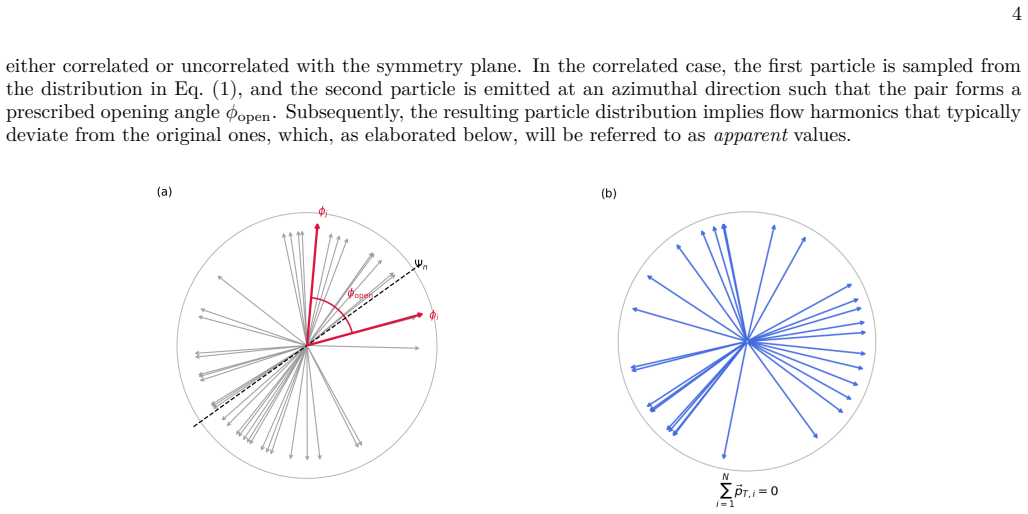
As flow estimators, multi-particle correlators, particularly the higher-order ones, are generally regarded as effective tools for suppressing non-flow contributions. In this work, however, using two well-known toy models that simulate non-flow effects, we demonstrate that multi-particle correlators can, especially in small systems, yield estimates that deviate even further from the underlying flow harmonics than those obtained from other conventional approaches. The two toy models considered here are designed to mimic non-flow effects arising from particle decay and global momentum conservation, such that the {\it apparent} harmonic coefficients become significantly different from the {\it input} values. We provide an analytic explanation for the observed behavior of flow estimates based on multi-particle correlators. Specifically, in the toy model mimicking particle decay, we elucidate the oscillations observed in $v_2\{2\}$ and $v_2\{4\}$. For the other toy model simulating momentum conservation, we show that multi-particle cumulants introduce a deformation in the collective flow that is unique to multi-particle correlators. Additionally, we compare these results with those obtained using the maximum-likelihood estimation method, a recently proposed flow estimator that serves as a viable alternative to traditional techniques.
Editorial analysis
A structured set of objections, weighed in public.
Referee Report
Summary. The paper claims that multi-particle correlators, generally viewed as effective for non-flow suppression in flow measurements, can instead produce estimates of flow harmonics that deviate more from the true input values than conventional approaches, particularly in small systems. This is demonstrated using two toy models simulating non-flow from particle decays and global momentum conservation. Analytic explanations are provided for oscillations in v2{2} and v2{4} in the decay model and for a unique flow deformation induced by cumulants in the momentum conservation model. Results are compared to the maximum-likelihood estimation (MLE) method as an alternative estimator.
Significance. If the behaviors observed in the toy models generalize, the work would be significant for heavy-ion collision physics by highlighting limitations of multi-particle cumulants in small systems (pp, pA) where non-flow dominates. The analytic derivations offer insight into why higher-order correlators can underperform, and the explicit comparison to MLE provides a constructive alternative. This challenges standard practices and could improve analysis techniques if the toy-model insights prove robust.
major comments (2)
- [Toy models] Toy models section: The central claim that multi-particle correlators yield larger deviations from input flow harmonics (especially in small systems) is demonstrated exclusively in the two toy models. The assumption that these models isolate the dominant non-flow effects without additional sources (e.g., jets, resonances, or flow-nonflow correlations) is load-bearing for relevance to real data; no comparison to full event generators is described, leaving open whether the larger deviations are generic or model-specific.
- [Momentum conservation toy model] Analytic explanations for the momentum conservation model: The claim of a unique flow deformation induced by multi-particle cumulants requires explicit statement of the approximations and their validity range across system sizes, as this underpins the distinction from conventional methods.
minor comments (3)
- [Abstract] Abstract: References to the original literature for the 'well-known toy models' simulating decay and momentum conservation would provide better context for readers.
- [Introduction] Notation: The symbols v_2{2} and v_2{4} are used without an introductory definition; a brief clarification in the introduction would aid clarity for non-specialists.
- [Results] Figures: Captions for result plots should explicitly state the system sizes, particle multiplicities, and input v2 values used to facilitate reproduction and interpretation of the deviations.
Simulated Author's Rebuttal
We are grateful to the referee for their thorough review and valuable feedback on our manuscript. We have addressed each of the major comments in detail below, and we will incorporate appropriate revisions to enhance the paper.
read point-by-point responses
-
Referee: Toy models section: The central claim that multi-particle correlators yield larger deviations from input flow harmonics (especially in small systems) is demonstrated exclusively in the two toy models. The assumption that these models isolate the dominant non-flow effects without additional sources (e.g., jets, resonances, or flow-nonflow correlations) is load-bearing for relevance to real data; no comparison to full event generators is described, leaving open whether the larger deviations are generic or model-specific.
Authors: We agree that the toy models are central to our claims and that comparisons to full event generators would provide additional validation. However, the strength of our approach lies in the ability to derive analytic explanations for the observed behaviors, which would be challenging in complex generators. We will revise the manuscript to include a more explicit discussion of the limitations of the toy models, emphasizing that the results illustrate potential issues in specific non-flow scenarios rather than claiming universality. We also note that the MLE comparison serves as a benchmark independent of the models. This revision will clarify the scope without altering the core findings. revision: partial
-
Referee: Analytic explanations for the momentum conservation model: The claim of a unique flow deformation induced by multi-particle cumulants requires explicit statement of the approximations and their validity range across system sizes, as this underpins the distinction from conventional methods.
Authors: We appreciate this point and will add a dedicated paragraph in the revised version explicitly listing the approximations used in the momentum conservation toy model, such as the assumption of a large number of particles for the cumulant expansion and the global nature of the momentum constraint without local correlations. We will specify the validity range, noting that the deformation effect is more pronounced in smaller systems where particle number fluctuations are significant, and contrast it with two-particle methods. This will strengthen the analytic section. revision: yes
Circularity Check
No significant circularity; results from independent toy model tests
full rationale
The paper constructs two explicit toy models with defined input flow harmonics plus non-flow effects (particle decay and global momentum conservation), applies multi-particle correlators to the generated events, and derives analytic explanations for the resulting deviations in v2{2} and v2{4}. These steps are forward simulations from model inputs rather than self-definitional reductions, fitted parameters renamed as predictions, or load-bearing self-citations. The comparison to the maximum-likelihood estimator is likewise an external benchmark. No equations or claims reduce by construction to the target result; the derivation remains self-contained against the stated toy-model benchmarks.
Axiom & Free-Parameter Ledger
Reference graph
Works this paper leans on
-
[1]
J.-P. Blaizot and E. Iancu, Phys. Rept. 359, 355 (2002), arXiv:hep-ph/0101103
- [2]
-
[3]
STAR Collaboration, J. Adams et al. , Nucl.Phys. A757, 102 (2005), arXiv:nucl-ex/0501009
-
[5]
PHENIX Collaboration, K. Adcox et al. , Nucl.Phys. A757, 184 (2005), arXiv:nucl-ex/0410003
- [6]
-
[7]
Aamodt et al
ALICE, K. Aamodt et al. , JINST 3, S08002 (2008)
2008
-
[8]
Aad et al
ATLAS, G. Aad et al. , JINST 3, S08003 (2008)
2008
-
[9]
Chatrchyan et al
CMS, S. Chatrchyan et al. , JINST 3, S08004 (2008)
2008
-
[10]
New Developments in Relativistic Viscous Hydrodynamics,
P. Romatschke, Int. J. Mod. Phys. E19, 1 (2010), arXiv:0902.3663
-
[11]
C. Gale, S. Jeon, and B. Schenke, Int. J. Mod. Phys. A28, 1340011 (2013), arXiv:1301.5893
work page Pith review arXiv 2013
-
[12]
U. W. Heinz and R. Snellings, Annu. Rev. Nucl. Part. Sci. 63, 123 (2013), arXiv:1301.2826
work page Pith review arXiv 2013
- [13]
-
[14]
Kodama, H
T. Kodama, H. Stocker, and N. Xu, J. Phys. G41, 120301 (2014)
2014
-
[15]
R. Derradi de Souza, T. Koide, and T. Kodama, Prog. Part. Nucl. Phys. 86, 35 (2016), arXiv:1506.03863
-
[16]
W. Florkowski, M. P. Heller, and M. Spalinski, Rept. Prog. Phys. 81, 046001 (2018), arXiv:1707.02282
-
[17]
STAR Collaboration, C. Adler et al. , Phys. Rev. Lett. 87, 182301 (2001), arXiv:nucl-ex/0107003
-
[18]
BRAHMS, I. Arsene et al. , Nucl. Phys. A 757, 1 (2005), arXiv:nucl-ex/0410020
-
[19]
PHENIX Collaboration, K. Adcox et al. , Phys. Rev. Lett. 89, 212301 (2002), arXiv:nucl-ex/0204005
-
[20]
STAR Collaboration, J. Adams et al. , Phys. Rev. C72, 014904 (2005), arXiv:nucl-ex/0409033
-
[21]
ALICE Collaboration, K. Aamodt et al. , Phys. Rev. Lett. 105, 252302 (2010), arXiv:1011.3914
- [22]
-
[23]
CMS Collaboration, S. Chatrchyan et al. , Phys. Rev. Lett. 109, 022301 (2012), arXiv:1204.1850
-
[24]
CMS, V. Khachatryan et al. , Phys. Lett. B765, 193 (2017), arXiv:1606.06198
- [25]
- [26]
-
[27]
STAR, L. Adamczyk et al. , Phys. Rev. Lett. 115, 222301 (2015), arXiv:1505.07812
-
[28]
B. Schenke, P. Tribedy, and R. Venugopalan, Phys. Rev. C 89, 064908 (2014), arXiv:1403.2232
- [29]
-
[30]
R. Samanta and P. Bożek, Phys. Rev. C 107, 054916 (2023), arXiv:2301.10659
-
[31]
H. Mascalhusk et al. , Chin. Phys. C 49, 054110 (2025), arXiv:2408.06249
- [32]
-
[33]
D. Teaney and L. Yan, Phys. Rev. C83, 064904 (2011), arXiv:1010.1876
-
[34]
D. Teaney and L. Yan, Phys. Rev. C86, 044908 (2012), arXiv:1206.1905
- [35]
- [36]
- [37]
- [38]
-
[39]
Fu, Phys
J. Fu, Phys. Rev. C92, 024904 (2015)
2015
-
[40]
R. Andrade, F. Grassi, Y. Hama, T. Kodama, and W. Qian, Phys. Rev. Lett. 101, 112301 (2008), arXiv:0805.0018
-
[41]
J. Takahashi et al. , Phys. Rev. Lett. 103, 242301 (2009), arXiv:0902.4870
- [42]
- [43]
- [44]
- [45]
- [46]
- [47]
-
[48]
S. Voloshin and Y. Zhang, Z. Phys. C70, 665 (1996), arXiv:hep-ph/9407282
-
[49]
A. M. Poskanzer and S. A. Voloshin, Phys. Rev. C58, 1671 (1998), arXiv:nucl-ex/9805001
work page Pith review arXiv 1998
-
[50]
N. Borghini, P. M. Dinh, and J.-Y. Ollitrault, Phys. Rev. C63, 054906 (2001), arXiv:nucl-th/0007063
-
[51]
A. Bilandzic, R. Snellings, and S. Voloshin, Phys. Rev. C83, 044913 (2011), arXiv:1010.0233
- [52]
-
[53]
N. Borghini, P. M. Dinh, and J.-Y. Ollitrault, Phys. Rev. C64, 054901 (2001), arXiv:nucl-th/0105040. 20
- [54]
- [55]
- [56]
-
[57]
FOPI, N. Bastid et al. , Phys. Rev. C 72, 011901 (2005), arXiv:nucl-ex/0504002
-
[58]
A. Bilandzic, C. H. Christensen, K. Gulbrandsen, A. Hansen, and Y. Zhou, Phys. Rev. C89, 064904 (2014), arXiv:1312.3572
- [59]
-
[60]
P. Di Francesco, M. Guilbaud, M. Luzum, and J.-Y. Ollitrault, Phys. Rev. C95, 044911 (2017), arXiv:1612.05634
- [61]
- [62]
- [63]
- [64]
-
[65]
Wasserman, All of Statistics: A Concise Course in Statistical Inference , 1 ed
L. Wasserman, All of Statistics: A Concise Course in Statistical Inference , 1 ed. (Springer, 2003)
2003
-
[66]
N. Borghini, P. M. Dinh, and J.-Y. Ollitrault, Phys. Rev. C 62, 034902 (2000), arXiv:nucl-th/0004026
-
[67]
Q. Wang and F. Wang, Phys. Rev. C 81, 064905 (2010), arXiv:0812.1176
-
[68]
J.-Y. Ollitrault, A. M. Poskanzer, and S. A. Voloshin, Phys. Rev. C80, 014904 (2009), arXiv:0904.2315
-
[69]
Feng and F
Y. Feng and F. Wang, J. Phys. G 52, 013001 (2024)
2024
-
[70]
Jacobs and X
P. Jacobs and X. Wang, Prog. Part. Nucl. Phys. 54, 443534 (2005)
2005
-
[71]
Wang, Prog
F. Wang, Prog. Part. Nucl. Phys. 74, 35 (2014)
2014
-
[72]
Andersson, G
B. Andersson, G. Gustafson, and B. Soderberg, Z. Phys. C 20, 317 (1983)
1983
-
[73]
M. A. Lisa, S. Pratt, R. Soltz, and U. Wiedemann, Annu. Rev. Nucl. Part. Sci. 55, 357 (2005)
2005
-
[74]
M. Asakawa, T. Csorgo, and M. Gyulassy, Phys. Rev. Lett. 83, 4013 (1999), arXiv:nucl-th/9810034
-
[75]
Borghini, P
N. Borghini, P. M. Dinh, J.-Y. Ollitrault, A. M. Poskanzer, and S. A. Voloshin, Phys. Rev. C 66 (2002)
2002
-
[76]
N. Borghini, Eur. Phys. J. C 30, 381 (2003), arXiv:hep-ph/0302139
-
[77]
Z. Chajecki and M. Lisa, Phys. Rev. C 79, 034908 (2009), arXiv:0807.3569
-
[78]
N. Borghini, Phys. Rev. C 75, 021904 (2007), arXiv:nucl-th/0612093
-
[79]
A. Bzdak and G.-L. Ma, Phys. Rev. C 97, 014903 (2018), arXiv:1710.00653
-
[80]
A. Bzdak and G.-L. Ma, Phys. Lett. B 781, 117 (2018), arXiv:1801.01277
- [81]
discussion (0)
Sign in with ORCID, Apple, or X to comment. Anyone can read and Pith papers without signing in.