Recognition: unknown
Continuum contribution to charged-current absorption of low-energy ν_e on ⁴⁰Ar
Pith reviewed 2026-05-07 11:34 UTC · model grok-4.3
The pith
Updated nuclear calculations reduce the predicted rate of low-energy neutrino absorption on argon by about 20% compared to earlier models.
A machine-rendered reading of the paper's core claim, the machinery that carries it, and where it could break.
Core claim
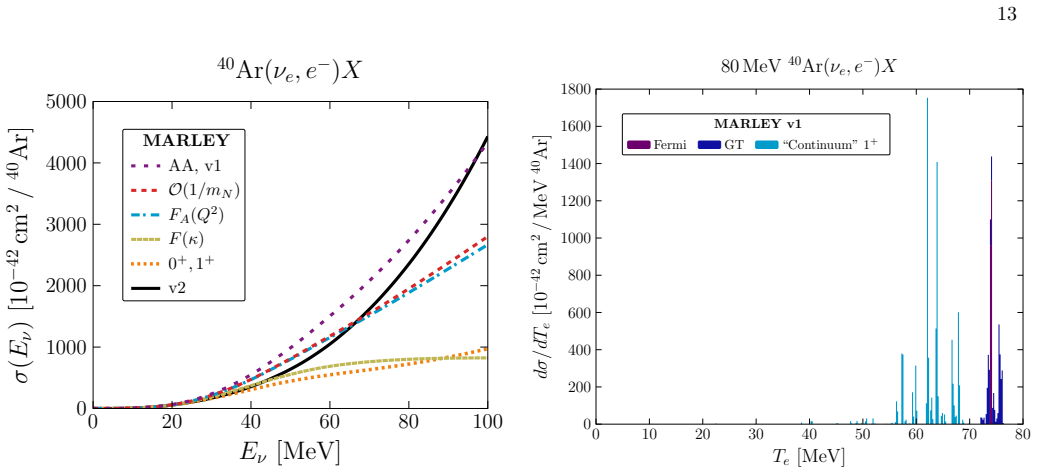
By combining HF-CRPA calculations for continuum states with statistical de-excitation and approximate momentum-transfer corrections for discrete levels, the inclusive cross sections are lower than those from MARLEY 1.2.0 at neutrino energies below 100 MeV. For a representative core-collapse supernova burst, this results in an approximately 20% overestimation of event yields in a DUNE-like detector by the prior model, with the discrepancy being larger at backward angles.
What carries the argument
The hybrid strategy of using Hartree-Fock Continuum Random Phase Approximation (HF-CRPA) to model transitions to unbound continuum states, supplemented by allowed transitions to low-lying levels and coupled to a statistical nuclear de-excitation model.
If this is right
- Lower total and differential cross sections for neutrino energies below 100 MeV.
- Approximately 20% reduction in predicted event rates for supernova neutrinos in liquid argon detectors.
- More forward-peaked event distributions that enhance the potential for supernova direction reconstruction.
- The need to update sensitivity projections for experiments relying on the prior interaction model.
Where Pith is reading between the lines
- Similar refinements could be applied to other nuclear targets used in neutrino detectors to improve accuracy of astrophysical neutrino measurements.
- Updated models may alter the optimal analysis strategies for distinguishing supernova signals from background in large LArTPCs.
- Experimental measurements of differential cross sections at specific angles could test the angular dependence predicted here.
Load-bearing premise
The Hartree-Fock Continuum Random Phase Approximation combined with momentum transfer corrections accurately models the nuclear response for neutrino energies below 100 MeV.
What would settle it
A direct measurement of the charged-current neutrino-argon cross section or the event rate and angular distribution from a supernova neutrino burst in an operating LArTPC detector.
Figures


read the original abstract
Accurate modeling of the absorption of tens-of-MeV $\nu_e$ on $^{40}$Ar is needed to enable measurements of astrophysical neutrinos using large liquid argon time projection chamber (LArTPC) detectors, such as those planned for the Deep Underground Neutrino Experiment (DUNE). We revisit the MARLEY neutrino interaction model used in present estimates of DUNE sensitivity to supernova and solar neutrino signals. Multiple theoretical refinements are pursued, especially in the unbound continuum region of nuclear excitation energy. Inclusive charged-current neutrino-argon cross sections are calculated using a hybrid strategy. Nuclear transitions to unbound states are treated using a Hartree-Fock Continuum Random Phase Approximation (HF-CRPA) model, including forbidden contributions. Allowed transitions to low-lying discrete levels are also included using indirect measurements and approximate corrections for the momentum transfer dependence. Exclusive predictions are obtained by coupling these calculations with a statistical nuclear de-excitation model. The impact on observables of interest for DUNE and similar experiments is examined in terms of both total and differential cross sections. Our refined calculations predict a lower allowed portion of the cross section relative to the prior MARLEY model. At neutrino energies appreciably below 100 MeV, the inclusion of forbidden transitions does not fully compensate for the loss of allowed strength. For a representative neutrino burst from a galactic core-collapse supernova, our results suggest that MARLEY 1.2.0 overestimates the event yield in a DUNE-like detector by approximately 20%. However, because this overestimation is more severe at backwards angles, use of the charged-current $\nu_e$-$^{40}$Ar reaction for supernova pointing may be more feasible than previously expected.
Editorial analysis
A structured set of objections, weighed in public.
Referee Report
Summary. The manuscript presents a hybrid calculation of inclusive charged-current ν_e absorption on ⁴⁰Ar for neutrino energies below ~100 MeV. Unbound continuum states are treated with the Hartree-Fock Continuum Random Phase Approximation (HF-CRPA) including forbidden multipoles, while allowed transitions to low-lying discrete levels use indirect experimental data supplemented by approximate momentum-transfer corrections. Exclusive final states are obtained by coupling to a statistical de-excitation model. The resulting cross sections are lower in the allowed sector than those in MARLEY 1.2.0; for a representative galactic core-collapse supernova neutrino burst this implies an approximately 20% overestimate of the event yield in a DUNE-like LArTPC, with the reduction being more pronounced at backward angles and therefore potentially improving the feasibility of supernova pointing.
Significance. If the central result holds, the work is significant for the DUNE supernova neutrino program because it supplies a more microscopic treatment of the continuum contribution and a data-informed discrete sector. The hybrid strategy and the explicit separation of allowed versus forbidden strength constitute a clear advance over purely phenomenological models. The finding that the overestimate is angle-dependent also has direct experimental implications for directional reconstruction. The manuscript does not, however, supply machine-checked proofs or fully parameter-free derivations; its strength lies in the concrete numerical comparison to MARLEY rather than in formal rigor.
major comments (2)
- [Abstract and §3] Abstract and §3 (hybrid model description): the claim that MARLEY 1.2.0 overestimates the supernova event yield by ~20% rests on the hybrid model predicting substantially lower allowed cross-section strength. The allowed sector is constructed from indirect measurements plus “approximate corrections for the momentum transfer dependence.” No direct benchmark against shell-model calculations that retain the full q-dependence of the form factors is presented for E_ν < 100 MeV, the regime in which discrete states dominate. Because the 20% figure is driven by the reduction in allowed strength, the result is sensitive to the accuracy of these corrections; an explicit sensitivity study or comparison to exact form-factor calculations is required to substantiate the central claim.
- [§4] §4 (results for supernova burst): the reported 20% reduction in event yield and the improved pointing prospects are obtained after folding the hybrid cross sections with a specific supernova neutrino spectrum. The manuscript does not propagate the uncertainty arising from the unbenchmarked q-corrections through to the final event-rate and angular distributions; without this propagation the quantitative 20% statement cannot be assessed at the precision claimed.
minor comments (2)
- The functional form adopted for the approximate momentum-transfer correction (e.g., dipole or polynomial parametrization) is not stated explicitly; providing the explicit expression would improve reproducibility.
- Figure captions and axis labels should indicate the precise neutrino energy range and the supernova spectrum model used for the event-yield calculation.
Simulated Author's Rebuttal
We thank the referee for the thoughtful and constructive report, which highlights important aspects of our hybrid model's reliance on the allowed sector. We address the major comments below and describe the revisions we will make to strengthen the manuscript.
read point-by-point responses
-
Referee: [Abstract and §3] Abstract and §3 (hybrid model description): the claim that MARLEY 1.2.0 overestimates the supernova event yield by ~20% rests on the hybrid model predicting substantially lower allowed cross-section strength. The allowed sector is constructed from indirect measurements plus “approximate corrections for the momentum transfer dependence.” No direct benchmark against shell-model calculations that retain the full q-dependence of the form factors is presented for E_ν < 100 MeV, the regime in which discrete states dominate. Because the 20% figure is driven by the reduction in allowed strength, the result is sensitive to the accuracy of these corrections; an explicit sensitivity study or comparison to exact form-factor calculations is required to substantiate the central claim.
Authors: We agree that the approximate momentum-transfer corrections applied to the allowed transitions constitute a source of uncertainty that directly affects the quoted 20% reduction. These corrections follow the standard dipole form-factor treatment used in the literature for low-energy neutrino-nucleus calculations and are anchored to experimental B(GT) and B(F) values. Nevertheless, the absence of an explicit comparison to a full shell-model calculation retaining the complete q-dependence for E_ν < 100 MeV is a limitation. In the revised manuscript we will add a dedicated sensitivity study in §3 that varies the q-dependence within physically motivated bounds (e.g., scaling the dipole mass by ±10% and comparing to the no-correction limit) and quantifies the resulting spread in the allowed cross section. We will also expand the discussion to note that a complete shell-model-plus-continuum benchmark lies outside the scope of the present hybrid approach, while emphasizing that the discrete strength is still constrained by experimental data. revision: partial
-
Referee: [§4] §4 (results for supernova burst): the reported 20% reduction in event yield and the improved pointing prospects are obtained after folding the hybrid cross sections with a specific supernova neutrino spectrum. The manuscript does not propagate the uncertainty arising from the unbenchmarked q-corrections through to the final event-rate and angular distributions; without this propagation the quantitative 20% statement cannot be assessed at the precision claimed.
Authors: We acknowledge that the current version does not propagate the uncertainty associated with the q-corrections into the supernova event yields or angular distributions. To remedy this, the revised §4 will incorporate the sensitivity results from the new §3 study, displaying the range of event rates and the variation in the backward-angle suppression for the representative supernova spectrum. This will allow the reader to judge the robustness of the ~20% figure. We maintain that the qualitative conclusion—that the reduction is more pronounced at backward angles—remains supported by the underlying cross-section differences, but we will qualify the numerical statement with the estimated uncertainty band. revision: yes
Circularity Check
No significant circularity; derivation relies on external nuclear models and measurements
full rationale
The paper computes charged-current cross sections via a hybrid approach: HF-CRPA for continuum/unbound states (including forbidden transitions) plus indirect experimental data with approximate q-dependence corrections for allowed discrete transitions. These inputs are independent of the present work and not fitted or defined within it. The 20% overestimate claim for MARLEY 1.2.0 follows directly from applying the new cross sections to an external supernova neutrino spectrum; no step reduces by construction to a self-fit, self-citation chain, or renamed input. The derivation chain is self-contained against external benchmarks.
Axiom & Free-Parameter Ledger
axioms (1)
- domain assumption HF-CRPA model plus statistical de-excitation accurately describes transitions to unbound states for neutrino energies below 100 MeV
Reference graph
Works this paper leans on
-
[1]
Energy balance As noted earlier, the HF-CRPA calculations presented herein use the same potential to describe the nucleus in both the initial and final states. However, the assump- tion of a consistent potential is violated because the CC primary interaction changes the nuclear proton number Zby one unit, i.e., Z ′ =Z−ξ .(106) To approximately correct for...
-
[2]
Continuum
Summary of the continuum transition model Above the excitation energy thresholdE c x defined in Eq. 93,MARLEYmodels the structure of the outgoing nucleus from the primary interaction using a continu- ous level density. Nuclear transitions to the continuum are described using the differential cross section from Eq. 110. The nuclear responses corresponding ...
2000
-
[3]
Hirataet al., Observation of a neutrino burst from the supernova SN1987A, Phys
K. Hirataet al., Observation of a neutrino burst from the supernova SN1987A, Phys. Rev. Lett.58, 1490–1493 (1987)
1987
-
[4]
Alekseev, L
E. Alekseev, L. Alekseeva, V. Volchenko, and I. Krivosheina, Possible detection of a neutrino signal on 23 February 1987 at the Baksan Underground Scin- tillation Telescope of the Institute of Nuclear Research, JETP Lett.45, 589–592 (1987)
1987
-
[5]
R. M. Biontaet al., Observation of a neutrino burst in coincidence with supernova 1987A in the Large Magel- lanic Cloud, Phys. Rev. Lett.58, 1494–1496 (1987)
1987
-
[6]
G. G. Raffelt, What have we learned from SN 1987A?, Mod. Phys. Lett. A05, 2581–2592 (1990), https://inspirehep.net/literature/295317
1990
-
[7]
Schaeffer, SN 1987A
R. Schaeffer, SN 1987A. A Review, Acta Phys. Pol.12, 357–376 (1990)
1990
-
[8]
B. Jegerlehner, F. Neubig, and G. Raffelt, Neutrino os- cillations and the supernova 1987A signal, Phys. Rev. D54, 1194–1203 (1996), arXiv:astro-ph/9601111
-
[9]
Vissani, Comparative analysis of SN1987A an- tineutrino fluence, J
F. Vissani, Comparative analysis of SN1987A an- tineutrino fluence, J. Phys. G42, 013001 (2014), arXiv:1409.4710
-
[10]
Supernova Neutrinos: Production, Oscillations and Detection
A. Mirizzi, I. Tamborra, H.-T. Janka, N. Sa- viano, K. Scholberg, R. Bollig, L. H¨ udepohl, and S. Chakraborty, Supernova neutrinos: production, os- cillations and detection, Riv. Nuovo Cimento39, 1–112 (2016), arXiv:1508.00785 [astro-ph.HE]
work page Pith review arXiv 2016
-
[11]
Branch and J
D. Branch and J. C. Wheeler, Supernova 1987A, inSu- pernova Explosions(Springer Berlin Heidelberg, Berlin, Heidelberg, 2017) Chap. 11, pp. 219–243
2017
-
[12]
Antonioliet al., SNEWS: The SuperNova early warn- ing system, New J
P. Antonioliet al., SNEWS: The SuperNova early warn- ing system, New J. Phys.6, 114 (2004), arXiv:astro- ph/0406214
-
[13]
Scholberg, The SuperNova early warning system, Astron
K. Scholberg, The SuperNova early warning system, Astron. Nachr.329, 337–339 (2008), arXiv:0803.0531 [astro-ph]
- [14]
- [15]
-
[17]
M¨ uller, Neutrino emission as diagnostics of core- collapse supernovae, Annu
B. M¨ uller, Neutrino emission as diagnostics of core- collapse supernovae, Annu. Rev. Nucl. Part. Sci.69, 253–278 (2019), arXiv:1904.11067 [astro-ph.HE]
-
[18]
What can be learned from a future supernova neutrino detection?
S. Horiuchi and J. P. Kneller, What can be learned from a future supernova neutrino detection?, J. Phys. G: Nucl. Part. Phys.45, 043002 (2018), arXiv:1709.01515
work page Pith review arXiv 2018
- [19]
-
[20]
Scholberg, Supernova signatures of neutrino mass or- dering, J
K. Scholberg, Supernova signatures of neutrino mass or- dering, J. Phys. G: Nucl. Part. Phys.45, 014002 (2017), arXiv:1707.06384 [hep-ex]
-
[21]
Farzan, Bounds on the coupling of the Majoron to light neutrinos from supernova cooling, Phys
Y. Farzan, Bounds on the coupling of the Majoron to light neutrinos from supernova cooling, Phys. Rev. D 67, 073015 (2003), arXiv:hep-ph/0211375
-
[22]
A. Esteban-Pretel, R. Tom` as, and J. W. F. Valle, Probing nonstandard neutrino interactions with su- pernova neutrinos, Phys. Rev. D76, 053001 (2007), arXiv:0704.0032 [hep-ph]
- [23]
- [24]
-
[25]
A. V. Patwardhanet al., Many-body collective neutrino oscillations: Recent developments, inHandbook of Nu- 25 clear Physics, edited by I. Tanihataet al.(Springer Na- ture Singapore, Singapore, 2020) pp. 1–16
2020
-
[26]
E. Akhmedov, J. Kopp, and M. Lindner, Collective neu- trino oscillations and neutrino wave packets, J. Cosmol. Astropart. Phys.2017(09), 017, arXiv:1702.08338 [hep- ph]
- [27]
-
[28]
A. Nikrant, R. Laha, and S. Horiuchi, Robust measure- ment of supernovaνe spectra with future neutrino detec- tors, Phys. Rev. D97, 023019 (2018), arXiv:1711.00008
-
[29]
R. N. Boyd, G. C. McLaughlin, A. S. J. Murphy, and P. F. Smith, Science from detection of neutrinos from su- pernovae, J. Phys. G: Nucl. Part. Phys.29, 2543 (2003)
2003
-
[31]
Ankowskiet al., Supernova physics at DUNE, (2016), arXiv:1608.07853 [hep-ex]
A. Ankowskiet al., Supernova physics at DUNE, (2016), arXiv:1608.07853 [hep-ex]
-
[32]
Scholberg, Supernova neutrino detection, Annu
K. Scholberg, Supernova neutrino detection, Annu. Rev. Nucl. Part. Sci.62, 81–103 (2012), arXiv:1205.6003
-
[33]
Abiet al.(DUNE collaboration), Volume IV
B. Abiet al.(DUNE collaboration), Volume IV. The DUNE far detector single-phase technology, J. Instrum. 15(08), T08010, arXiv:2002.03010 [physics.ins-det]
-
[34]
F. Capozzi, S. W. Li, G. Zhu, and J. F. Beacom, DUNE as the next-generation solar neutrino experiment, Phys. Rev. Lett.123, 131803 (2019), arXiv:1808.08232 [hep- ph]
- [35]
-
[36]
V. De Romeri, P. Mart´ ınez-Mirav´ e, and M. T´ ortola, Sig- natures of primordial black hole dark matter at DUNE and THEIA, JCAP10, 051, arXiv:2106.05013 [hep-ph]
- [37]
-
[38]
Gardiner, Nuclear de-excitations in low-energy charged-currentν e scattering on 40Ar, Phys
S. Gardiner, Nuclear de-excitations in low-energy charged-currentν e scattering on 40Ar, Phys. Rev. C 103, 044604 (2021), arXiv:2010.02393 [nucl-th]
-
[39]
Alvarez-Rusoet al., NuSTEC white paper: Sta- tus and challenges of neutrino–nucleus scattering, Prog
L. Alvarez-Rusoet al., NuSTEC white paper: Sta- tus and challenges of neutrino–nucleus scattering, Prog. Part. Nucl. Phys.100, 1–68 (2018)
2018
-
[40]
Isaacson, W
J. Isaacson, W. I. Jay, A. Lovato, P. A. N. Machado, and N. Rocco, Introducing a novel event generator for electron-nucleus and neutrino-nucleus scattering, Phys. Rev. D107, 033007 (2023)
2023
-
[41]
J. Isaacson, S. H¨ oche, D. Lopez Gutierrez, and N. Rocco, Novel event generator for the automated sim- ulation of neutrino scattering, Phys. Rev. D105, 096006 (2022), arXiv:2110.15319 [hep-ph]
-
[42]
Alvarez-Rusoet al.(GENIE), Eur
L. Alvarez-Rusoet al.(GENIE collaboration), Recent highlights from GENIE v3, Eur. Phys. J. ST230, 4449– 4467 (2021), arXiv:2106.09381 [hep-ph]
-
[43]
The GENIE Neutrino Monte Carlo Generator
C. Andreopouloset al., The GENIE neutrino Monte Carlo generator, Nucl. Instrum. Methods Phys. Res. A 614, 87–104 (2010), arXiv:0905.2517 [hep-ph]
work page Pith review arXiv 2010
-
[44]
U. Mosel and K. Gallmeister, Lepton-induced reactions on nuclei in a wide kinematical regime, Phys. Rev. D 109, 033008 (2024), arXiv:2308.16161 [nucl-th]
-
[45]
Busset al., Transport-theoretical description of nuclear reactions, Phys
O. Busset al., Transport-theoretical description of nuclear reactions, Phys. Rept.512, 1–124 (2012), arXiv:1106.1344 [hep-ph]
-
[46]
Hayato, A neutrino interaction simulation program library NEUT, Acta Phys
Y. Hayato, A neutrino interaction simulation program library NEUT, Acta Phys. Pol. B40, 2477–2489 (2009)
2009
-
[47]
Y. Hayato and L. Pickering, The NEUT neutrino inter- action simulation program library, Eur. Phys. J. Spec. Top.230, 4469–4481 (2021), arXiv:2106.15809 [hep-ph]
-
[48]
Golan, J
T. Golan, J. Sobczyk, and J. ˙Zmuda, NuWro: the Wroc law Monte Carlo generator of neutrino interac- tions, Nucl. Phys. B - Proc. Suppl.229-232, 499 (2012)
2012
-
[49]
Gardiner, Simulating low-energy neutrino interac- tions with MARLEY, Comput
S. Gardiner, Simulating low-energy neutrino interac- tions with MARLEY, Comput. Phys. Commun.269, 108123 (2021), arXiv:2101.11867 [nucl-th]
-
[50]
Mauger and V
F. Mauger and V. Tretyak, BxDecay0 – C++ port of the legacy Decay0 FORTRAN library,https://github. com/BxCppDev/bxdecay0(2024)
2024
-
[51]
B. Abiet al.(DUNE collaboration), Supernova neu- trino burst detection with the Deep Underground Neu- trino Experiment, Eur. Phys. J. C81, 423 (2021), arXiv:2008.06647 [hep-ex]
-
[52]
A. Abed Abudet al.(DUNE collaboration), Impact of cross-section uncertainties on supernova neutrino spec- tral parameter fitting in the Deep Underground Neu- trino Experiment, Phys. Rev. D107, 112012 (2023), arXiv:2303.17007 [hep-ex]
-
[53]
Abed Abudet al.(DUNE), Supernova pointing ca- pabilities of DUNE, Phys
A. Abed Abudet al.(DUNE), Supernova pointing ca- pabilities of DUNE, Phys. Rev. D111, 092006 (2025), arXiv:2407.10339 [hep-ex]
-
[54]
C. Cuesta Soria (DUNE collaboration), Supernova and solar neutrino searches at DUNE, PoSTAUP2023, 168 (2024), arXiv:2311.06134 [hep-ex]
-
[55]
S. Manthey Corchado (DUNE collaboration), DUNE’s low energy physics searches, PoSICHEP2024, 217 (2025), arXiv:2410.08251 [hep-ex]
-
[56]
P. Anet al.(COHERENT collaboration), Measure- ment of natPb(νe, Xn) production with a stopped-pion neutrino source, Phys. Rev. D108, 072001 (2023), arXiv:2212.11295 [hep-ex]
-
[57]
P. Anet al.(COHERENT collaboration), Measurement of electron-neutrino charged-current cross sections on 127I with the COHERENT NaIνE detector, Phys. Rev. Lett.131, 221801 (2023), arXiv:2305.19594 [nucl-ex]
-
[58]
D. Akimovet al.(COHERENT collaboration), Mea- surement of the coherent elastic neutrino-nucleus scat- tering cross section on CsI by COHERENT, Phys. Rev. Lett.129, 081801 (2022), arXiv:2110.07730 [hep-ex]
-
[59]
S. Hedgeset al.(nEXO collaboration), Supernova electron-neutrino interactions with xenon in the nEXO detector, Phys. Rev. D110, 093002 (2024), arXiv:2405.19419 [hep-ph]
-
[60]
I. Martinez-Soler, Y. F. Perez-Gonzalez, and M. Sen, Signs of pseudo-Dirac neutrinos in SN1987A data, Phys. Rev. D105, 095019 (2022), arXiv:2105.12736 [hep-ph]
-
[61]
A. De Gouvˆ ea, I. Martinez-Soler, Y. F. Perez-Gonzalez, and M. Sen, Fundamental physics with the diffuse super- nova background neutrinos, Phys. Rev. D102, 123012 (2020), arXiv:2007.13748 [hep-ph]
-
[62]
A. de Gouvˆ ea, I. Martinez-Soler, and M. Sen, Impact of neutrino decays on the supernova neutronization- burst flux, Phys. Rev. D101, 043013 (2020), arXiv:1910.01127 [hep-ph]
-
[63]
W. Castiglioni, W. Foreman, B. R. Littlejohn, 26 M. Malaker, I. Lepetic, and A. Mastbaum, Benefits of MeV-scale reconstruction capabilities in large liq- uid argon time projection chambers, Phys. Rev. D102, 092010 (2020), arXiv:2006.14675 [hep-ex]
-
[64]
S. Kubotaet al.(Q-Pix collaboration), Enhanced low- energy supernova burst detection in large liquid argon time projection chambers enabled by Q-Pix, Phys. Rev. D106, 032011 (2022), arXiv:2203.12109 [hep-ex]
-
[65]
B. Hartsock, N. Solomey, J. Folkerts, and B. Doty, Segment geometry optimization and prototype studies of a multi-coincidence GAGG solar neutrino detector, (2025), arXiv:2502.05095 [hep-ex]
-
[66]
J. Folkerts, N. Solomey, B. Hartsock, T. Nolan, O. Pacheco, and G. Pawloski, Method to reduce noise for measurement of 7Be and 8B solar neutrinos on gallium-71, Nucl. Instrum. Meth. A1072, 170116 (2025), arXiv:2312.10157 [hep-ex]
-
[67]
A. Mastbaum, F. Psihas, and J. Zennamo, Xenon- doped liquid argon TPCs as a neutrinoless double beta decay platform, Phys. Rev. D106, 092002 (2022), arXiv:2203.14700 [hep-ex]
- [68]
- [69]
- [70]
- [71]
-
[72]
Pompa, F
F. Pompa, F. Capozzi, O. Mena, and M. Sorel, Absolute νmass measurement with the DUNE experiment, Phys. Rev. Lett.129, 121802 (2022)
2022
- [73]
-
[74]
Bendahmanet al., Exploring the potential of multi- detector analyses for core-collapse supernova neutrino detection, PoSICRC2021, 1090 (2021)
M. Bendahmanet al., Exploring the potential of multi- detector analyses for core-collapse supernova neutrino detection, PoSICRC2021, 1090 (2021)
2021
- [75]
-
[76]
N. Van Dessel, N. Jachowicz, and A. Nikolakopoulos, Forbidden transitions in neutral- and charged-current interactions between low-energy neutrinos and argon, Phys. Rev. C100, 055503 (2019), arXiv:1903.07726 [nucl-th]
-
[77]
N. Van Dessel, A. Nikolakopoulos, and N. Ja- chowicz, Lepton kinematics in low-energy neutrino- argon interactions, Phys. Rev. C101, 045502 (2020), arXiv:1912.10714 [nucl-th]
-
[78]
J. D. Walecka, Semileptonic weak interactions in nuclei, inMuon Physics, edited by V. W. Hughes and C. S. Wu (Academic Press, 1975) pp. 113–218
1975
-
[79]
B. D. Serot, Semileptonic weak and electromagnetic interactions with nuclei: Nuclear current operators through order (v/c) 2 nucleon, Nucl. Phys. A308, 457–499 (1978)
1978
-
[80]
R. Bradford, A. Bodek, H. S. Budd, and J. Arrington, A new parameterization of the nucleon elastic form- factors, Nucl. Phys. B Proc. Suppl.159, 127–132 (2006), arXiv:hep-ex/0602017
-
[81]
A. S. Meyer, M. Betancourt, R. Gran, and R. J. Hill, Deuterium target data for precision neutrino- nucleus cross sections, Phys. Rev. D93, 113015 (2016), arXiv:1603.03048 [hep-ph]
work page Pith review arXiv 2016
-
[82]
Borahet al., Parametrization and applications of the low-Q2 nucleon vector form factors, Phys
K. Borahet al., Parametrization and applications of the low-Q2 nucleon vector form factors, Phys. Rev. D102, 074012 (2020), arXiv:2003.13640 [hep-ph]
discussion (0)
Sign in with ORCID, Apple, or X to comment. Anyone can read and Pith papers without signing in.