Thin film synthesis of SrZn2P2 with SrI2 post-annealing for enhanced crystallinity and optoelectronic quality
Pith reviewed 2026-05-07 13:32 UTC · model grok-4.3
The pith
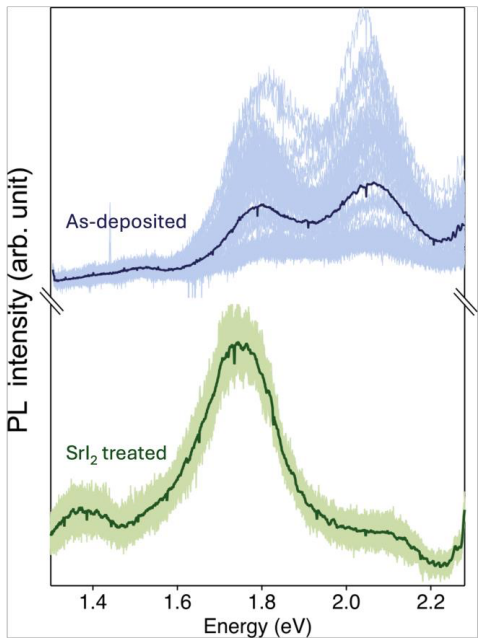
SrI2 post-annealing at 450 °C drives grain growth and boosts photoluminescence intensity and uniformity in SrZn2P2 thin films.
A machine-rendered reading of the paper's core claim, the machinery that carries it, and where it could break.
Core claim
Annealing with SrI2 at 450 °C produces pronounced grain growth and reduced diffraction peak broadening while preserving phase purity in SrZn2P2 films; the same treatment markedly increases both the intensity and spatial uniformity of near-band-edge photoluminescence, thereby connecting microstructural consolidation with enhanced radiative recombination.
What carries the argument
SrI2-assisted post-annealing that induces grain growth while maintaining phase purity and raising radiative efficiency.
If this is right
- Microstructural consolidation from halide annealing correlates directly with higher radiative recombination rates.
- The process supplies a concrete route to microstructural control in SrZn2P2 without loss of phase purity.
- Halide-assisted annealing offers a generalizable step for raising optoelectronic quality in other Zintl phosphide thin films.
Where Pith is reading between the lines
- The same SrI2 protocol may transfer to related ternary Zintl compounds where grain-boundary recombination currently limits performance.
- Quantitative defect spectroscopy before and after annealing would clarify whether grain growth or secondary passivation effects dominate the PL gain.
Load-bearing premise
The observed photoluminescence gains arise chiefly from SrI2-driven grain growth rather than from unmeasured shifts in defect chemistry, surface passivation, or slight composition changes.
What would settle it
Compare photoluminescence maps and grain-size statistics on films annealed at 450 °C with and without SrI2 exposure under otherwise identical conditions; absence of PL improvement when grain growth is blocked would falsify the causal link.
Figures

read the original abstract
Ternary Zintl phosphides are promising light-absorbing semiconductors for thin-film optoelectronic applications, but strategies for controlling their microstructure and optoelectronic quality remain underexplored. Here, we report the synthesis of phase-pure SrZn2P2 thin films using radio-frequency co-sputtering in a PH3 + Ar atmosphere and investigate the impact of post-growth processing on their structural and optical properties. Grazing-incidence X-ray scattering and Raman spectroscopy confirm the formation of crystalline SrZn2P2 films over a finite compositional window. Optical measurements reveal strong absorption near the direct-band-gap energy (~1.8 eV) and near-band-edge photoluminescence. Further, we have studied the effects of chemically compatible halide-assisted annealing. It is found that SrI2 treatments lead to pronounced grain growth and reduced diffraction peak broadening while preserving phase purity, in contrast to rapid thermal or forming-gas annealing. Notably, annealing with SrI2 at 450 {\deg}C significantly enhances both the intensity and spatial uniformity of the photoluminescence, thus connecting the observed microstructural consolidation with improved radiative recombination. Our study demonstrates that halide-assisted annealing provides an effective pathway for microstructural control in SrZn2P2 thin films and highlights a generalizable processing strategy for advancing Zintl phosphide semiconductors toward optoelectronic applications.
Editorial analysis
A structured set of objections, weighed in public.
Referee Report
Summary. The manuscript reports the synthesis of phase-pure SrZn2P2 thin films by RF co-sputtering in a PH3+Ar atmosphere and examines post-growth annealing. It shows that SrI2-assisted annealing at 450 °C induces grain growth and narrows XRD peaks while preserving phase purity (confirmed by GIXS and Raman), in contrast to rapid thermal or forming-gas anneals. Optical data indicate strong absorption near the ~1.8 eV direct gap and near-band-edge PL; the SrI2 treatment markedly increases PL intensity and spatial uniformity, which the authors link to improved radiative recombination via microstructural consolidation.
Significance. If the reported improvements hold under quantitative scrutiny, the work supplies a concrete, chemically compatible processing route for controlling microstructure and optoelectronic quality in Zintl phosphide thin films, a class still underexplored for optoelectronics. The use of orthogonal techniques (GIXS, Raman, absorption, PL mapping) and the directional consistency of the annealing contrast are positive features that strengthen experimental claims in materials-synthesis papers.
major comments (2)
- [Abstract and annealing results] Abstract and results on annealing: the central claim equates SrI2-driven grain growth with enhanced radiative recombination, yet no direct measurements of point-defect density, iodine incorporation, or surface stoichiometry (e.g., XPS, EDX, or Hall data) before/after treatment are reported. Given the finite compositional window noted for phase purity, minor Zn/P shifts or halide-induced passivation could produce the observed PL gains independently of grain size; the contrast with other anneals does not rule these out.
- [Optical and PL measurements] PL characterization: the enhancement in intensity and spatial uniformity is stated qualitatively without reported quantitative metrics (average PL intensity with error bars, uniformity index, or statistical comparison across multiple samples). This limits evaluation of the magnitude and reproducibility of the improvement that underpins the optoelectronic-quality claim.
minor comments (2)
- [Abstract] The abstract would benefit from at least one quantitative statement (e.g., factor of PL intensity increase or FWHM reduction) to allow readers to gauge the effect size immediately.
- [Optical measurements] Notation for the direct-band-gap value (~1.8 eV) should be clarified with the precise method of extraction (Tauc plot, absorption edge fit, etc.) and any temperature dependence.
Simulated Author's Rebuttal
We thank the referee for the constructive review and positive assessment of the significance of our work. We address each major comment below with clarifications and indicate revisions where the manuscript will be strengthened.
read point-by-point responses
-
Referee: [Abstract and annealing results] Abstract and results on annealing: the central claim equates SrI2-driven grain growth with enhanced radiative recombination, yet no direct measurements of point-defect density, iodine incorporation, or surface stoichiometry (e.g., XPS, EDX, or Hall data) before/after treatment are reported. Given the finite compositional window noted for phase purity, minor Zn/P shifts or halide-induced passivation could produce the observed PL gains independently of grain size; the contrast with other anneals does not rule these out.
Authors: We acknowledge that direct measurements of point-defect density, iodine incorporation, or surface stoichiometry (via XPS, EDX, or Hall) are absent from the current study. The manuscript relies on phase-purity confirmation by GIXS and Raman, plus the observation that PL gains occur only with SrI2 annealing (not RTA or forming-gas). In revision we will expand the discussion to explicitly note these missing measurements, acknowledge that minor compositional shifts or passivation could contribute, and frame the grain-growth interpretation as supported but not exclusively proven by the available orthogonal data. No new experimental data will be added. revision: partial
-
Referee: [Optical and PL measurements] PL characterization: the enhancement in intensity and spatial uniformity is stated qualitatively without reported quantitative metrics (average PL intensity with error bars, uniformity index, or statistical comparison across multiple samples). This limits evaluation of the magnitude and reproducibility of the improvement that underpins the optoelectronic-quality claim.
Authors: We agree that quantitative metrics are needed. The PL maps contain sufficient data to compute averages, standard deviations, and a uniformity index (e.g., coefficient of variation) across multiple samples. In the revised manuscript we will add these values with error bars to the results text and figures, enabling direct evaluation of magnitude and reproducibility. revision: yes
Circularity Check
No circularity: purely experimental synthesis and characterization study
full rationale
The manuscript reports radio-frequency co-sputtering synthesis of SrZn2P2 films, followed by post-annealing experiments and direct measurements (GIXS, Raman, absorption, photoluminescence mapping). No equations, fitted parameters, predictive models, or derivation chains appear in the abstract or described methods. All reported outcomes (grain growth, PL intensity increase after SrI2 annealing) rest on comparative experimental data rather than any self-referential construction or reduction to prior inputs. Self-citations, if present, are not load-bearing for any claimed result. This is the expected finding for an experimental materials paper with no theoretical derivations.
Axiom & Free-Parameter Ledger
Reference graph
Works this paper leans on
-
[1]
(1) Wikoff, H. M.; Reese, S. B.; Reese, M. O. Embodied Energy and Carbon from the Manufacture of Cadmium Telluride and Silicon Photovoltaics. Joule 2022, 6 (7), 1710–1725. https://doi.org/10.1016/j.joule.2022.06.006. (2) Lee, T. D.; Ebong, A. U. A Review of Thin Film Solar Cell Technologies and Challenges. Renew. Sustain. Energy Rev. 2017, 70, 1286–1297. ...
-
[2]
(13) Zhu, H.; Teale, S.; Lintangpradipto, M
https://doi.org/10.1038/s41467-025-63345-x. (13) Zhu, H.; Teale, S.; Lintangpradipto, M. N.; Mahesh, S.; Chen, B.; McGehee, M. D.; Sargent, E. H.; Bakr, O. M. Long-Term Operating Stability in Perovskite Photovoltaics. Nat. Rev. Mater. 2023, 8 (9), 569–586. https://doi.org/10.1038/s41578-023-00582-w. (14) Yuan, Z.; Dahliah, D.; Hasan, M. R.; Kassa, G.; Pik...
-
[3]
BaCd2P2: a promising impurity-tolerant counterpart of GaAs for photovoltaics
https://doi.org/10.1021/acsnano.5c02271. (17) Kassa, G.; Yuan, Z.; Hasan, M. R.; Esparza, G. L.; Fenning, D. P.; Hautier, G.; Kovnir, K.; Liu, J. BaCd2P2: a promising impurity-tolerant counterpart of GaAs for photovoltaics. arXiv.org. https://arxiv.org/abs/2506.20829v4 (accessed 2026-04-06). (18) Quadir, S.; Yuan, Z.; Esparza, G. L.; Dugu, S.; Mangum, J. ...
work page internal anchor Pith review Pith/arXiv arXiv doi:10.1021/acsnano.5c02271 2026
-
[4]
https://doi.org/10.1143/JJAP.15.2281. (24) Amarasinghe, M.; Colegrove, E.; Moutinho, H.; Albin, D.; Duenow, J.; Johnston, S.; Kephart, J.; Sampath, W.; Al-Jassim, M.; Sivananthan, S.; Metzger, W. K. Influence of CdTe Deposition Temperature and Window Thickness on CdTe Grain Size and Lifetime After CdCl 2 Recrystallization. IEEE J. Photovolt. 2018, 8 (2), ...
-
[5]
(27) Klüfers, P.; Neumann, H.; Mewis, A.; Schuster, H.-U
https://doi.org/10.5772/67191. (27) Klüfers, P.; Neumann, H.; Mewis, A.; Schuster, H.-U. AB2X2-Verbindungen Im CaAl2Si2-Typ, VIII
-
[6]
/ AB2X2 Compounds with the CaAl2Si2 Structure, VIII [1]. Z. Für Naturforschung B 1980, 35 (10), 1317–1318. https://doi.org/10.1515/znb-1980-1029. (28) Dar, S. A.; Sengar, B. S. Analytical Modeling and Numerical Investigation of Grain Size Effects on Polycrystalline Perovskite Based Thin-Film Solar Cells: Performance Insights and Implications. Sol. Energy ...
-
[7]
(31) Hernandez Vasquez, C.; Albor Aguilera, M. L.; González Trujillo, M. A.; Flores Márquez, J. M.; Galarza Gutiérrez, U.; Aguilar Hernández, J. R.; Jiménez Olarte, D.; Hernandez Vasquez, C.; Albor Aguilera, M. L.; González Trujillo, M. A.; Flores Márquez, J. M.; Galarza Gutiérrez, U.; Aguilar Hernández, J. R.; Jiménez Olarte, D. Study of CdTe Recrystalli...
-
[8]
https://doi.org/10.1103/PhysRevB.59.1758. (43) Kresse, G.; Furthmüller, J. Efficiency of Ab-Initio Total Energy Calculations for Metals and Semiconductors Using a Plane-Wave Basis Set. Comput. Mater. Sci. 1996, 6 (1), 15–50. https://doi.org/10.1016/0927-0256(96)00008-0. (44) Kresse, G.; Furthmüller, J. Efficient Iterative Schemes for Ab Initio Total-Energ...
-
[9]
https://doi.org/10.21105/joss.00717. 1 Supplementary Information for: Thin film synthesis of SrZn2P2 with SrI2 post-annealing for enhanced crystallinity and optoelectronic quality Sita Dugu1, Shaham Quadir1, Christopher P. Muzzillo1, Zhenkun Yuan2,3,4, Smitakshi Goswami 2,5, Xiaojing Hao6, Jialiang Huang6, Guillermo Esparza7, Baptiste Julien1, David Fenni...
discussion (0)
Sign in with ORCID, Apple, or X to comment. Anyone can read and Pith papers without signing in.