Recognition: unknown
Bounds on massive graviton-like particles from searches for axion-like particles coupling to photons
Pith reviewed 2026-05-09 18:59 UTC · model grok-4.3
The pith
Limits on axion-like particles are recast as constraints on massive graviton-like particles using photon conversion effects.
A machine-rendered reading of the paper's core claim, the machinery that carries it, and where it could break.
Core claim
By mapping the ALP mass-coupling plane onto the GLP mass-coupling plane through the shared photon-conversion processes, all existing ALP search results become direct bounds on the coupling strength of massive spin-2 particles over the mass interval from 10^{-20} eV to 10^{14} eV.
What carries the argument
The formal analogy between the photon-conversion processes that govern both particle types, allowing experimental limits in one parameter space to be read directly in the other.
If this is right
- Current ALP data do not improve on existing fifth-force limits for graviton-like particles, but future magnetometers, two-beam interferometers, and resonant upconversion devices could reach couplings down to 10^{-32} GeV^{-1} for masses below 10^{-8} eV.
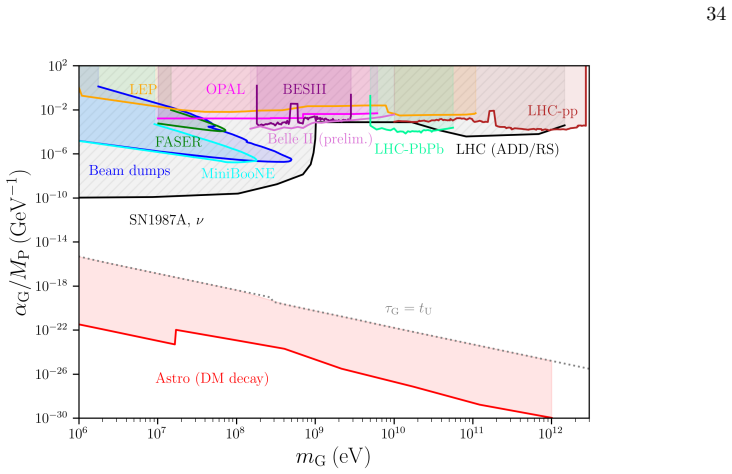
- Exclusive searches for diphoton decays at colliders offer a complementary route to detect TeV-scale graviton-like particles.
- The translated bounds hold whether or not the graviton-like particles make up the dark matter.
- Helioscopes, cavity haloscopes, beam-dump experiments, and astrophysical observations all supply translated constraints in the new parameter space.
Where Pith is reading between the lines
- Because the mapping assumes universal coupling to all Standard Model fields, it may miss model-specific modifications that would alter the effective photon coupling for a real graviton.
- The greater projected reach of certain future detectors for light graviton-like particles compared with axions suggests that gravity-modification tests at laboratory scales could benefit from repurposing these instruments.
- The same recasting technique could be applied to other spin-2 candidates in extensions of the Standard Model if their production and detection channels remain analogous to the photon-conversion case.
- If the assumption of no spin-dependent differences holds, the absence of signals in these translated bounds would constrain any theory in which massive spin-2 particles couple to photons at strengths comparable to axions.
Load-bearing premise
The production and detection mechanisms for axion-like particles and graviton-like particles are similar enough that their experimental limits can be translated directly, with no important differences caused by spin or by the assumption of universal coupling.
What would settle it
A controlled beam experiment that measures a photon-conversion rate for a spin-2 particle substantially different from the rate predicted by the same coupling strength for a spin-0 particle would invalidate the direct translation of bounds.
Figures




read the original abstract
Limits on spin-0 axion-like-particles (ALPs) coupling to photons are reinterpreted as constraints on massive spin-2 graviton-like-particles (GLPs) with universal coupling $\alpha_\text{G}/M_\text{P}$ (where $M_\text{P}$ is the reduced Planck mass) to the Standard Model fields. A minimally model-dependent recasting is performed, exploiting the formally analogous production and detection mechanisms for both particle types, based on the Primakoff and Gertsenshtein effects, i.e., photon-axion/graviton conversion. Constraints originally derived in the ALP mass vs. photon-coupling plane ($m_\text{a}, g_{\text{a}\gamma}$) are translated into the corresponding bounds in the GLP ($m_\text{G}, \alpha_\text{G}/M_\text{P}$) parameter space over the full mass range, $m_\text{a,G} \approx 10^{-20}$--$10^{14}$eV probed in current and future experimental setups including cavity-based detectors (haloscopes and resonant upconversion devices), helioscopes, magnetometers, optical interferometers, beam dumps, fixed-target, and collider experiments, as well as astrophysical and cosmological constraints. Generic scenarios are considered in which GLPs are a dark matter candidate and not. Whereas current ALP searches do not set stronger bounds on massive spin-2 particles than fifth-force tests, future magnetometers, two-beam interferometers, and upconversion experiments have the potential to provide very strong sensitivity, down to $\alpha_\text{G}/M_\text{P} \approx 10^{-32} \text{GeV}^{-1}$, for light graviton-like particles with $m_\text{G}\lesssim 10^{-8}$eV. These future detectors exhibit comparatively greater sensitivity to massive gravitons than to axions. For massive gravitons at the TeV scale, exclusive diphoton decay searches, employed in ALP studies, offer a complementary approach to standard searches for spin-2 resonances in other inclusive final states.
Editorial analysis
A structured set of objections, weighed in public.
Referee Report
Summary. The manuscript reinterprets existing experimental limits on axion-like particles (ALPs) coupling to photons as constraints on massive spin-2 graviton-like particles (GLPs) with universal coupling α_G/M_P to Standard Model fields. It performs a minimally model-dependent recasting based on the formal analogy between Primakoff and Gertsenshtein photon-conversion effects, translating ALP bounds in the (m_a, g_aγ) plane into the GLP (m_G, α_G/M_P) plane over the mass range 10^{-20} to 10^{14} eV. The work covers cavity detectors, helioscopes, magnetometers, interferometers, beam dumps, colliders, and astrophysical constraints, considering both dark-matter and non-dark-matter scenarios, and projects future sensitivities down to α_G/M_P ≈ 10^{-32} GeV^{-1} for light GLPs.
Significance. If the assumed formal analogy holds, the paper usefully extends the ALP experimental program to constrain massive spin-2 particles, identifying that certain future detectors (magnetometers, two-beam interferometers, upconversion devices) may achieve greater sensitivity to GLPs than to ALPs. The comprehensive survey of setups and the note on complementary TeV-scale diphoton searches are strengths. The result would be more significant with explicit validation that spin-2 effects do not alter the mapping.
major comments (3)
- [Abstract] Abstract and recasting description: The central claim rests on the statement that production and detection mechanisms are 'formally analogous' via Primakoff and Gertsenshtein effects, allowing direct translation by rescaling the coupling. The manuscript does not derive or recompute the photon-conversion probability from the spin-2 Lagrangian with universal coupling to the energy-momentum tensor; potential differences from the five polarization states, traceless transverse projector, or massive dispersion relation in the coherence factor are not quantified.
- [Future sensitivity projections] Future sensitivity projections: The claim that future magnetometers and upconversion experiments reach α_G/M_P ≈ 10^{-32} GeV^{-1} for m_G ≲ 10^{-8} eV and exhibit greater sensitivity to GLPs than ALPs assumes identical mass-dependent form factors and normalizations after the replacement g_aγ → const × α_G/M_P. No explicit check of the Gertsenshtein matrix element for spin-2 is provided to confirm this.
- [TeV-scale discussion] TeV-scale discussion: The suggestion that exclusive diphoton decay searches from ALP studies offer a complementary approach for TeV-scale GLPs assumes the branching ratios and production rates match after accounting for universal coupling. Additional decay channels to other SM fields opened by the universal coupling are not addressed, which could modify the effective limits.
minor comments (3)
- The mass range notation m_a,G ≈ 10^{-20}--10^{14} eV should clarify whether applicability differs between ALPs and GLPs in dense media or propagation.
- The coupling notation α_G/M_P is introduced without an explicit definition of the reduced Planck mass M_P in the main text; add this for clarity.
- A few citations to specific ALP experimental papers could be added or updated in the sections discussing cavity-based detectors and helioscopes.
Simulated Author's Rebuttal
We thank the referee for their careful reading and constructive comments on our manuscript. We address each major comment point by point below and have revised the manuscript to improve the clarity and rigor of the recasting procedure.
read point-by-point responses
-
Referee: [Abstract] Abstract and recasting description: The central claim rests on the statement that production and detection mechanisms are 'formally analogous' via Primakoff and Gertsenshtein effects, allowing direct translation by rescaling the coupling. The manuscript does not derive or recompute the photon-conversion probability from the spin-2 Lagrangian with universal coupling to the energy-momentum tensor; potential differences from the five polarization states, traceless transverse projector, or massive dispersion relation in the coherence factor are not quantified.
Authors: We thank the referee for highlighting this aspect. Our approach is a minimally model-dependent recasting that exploits the established formal analogy between the Primakoff conversion for ALPs and the Gertsenshtein conversion for gravitons, both arising from photon interactions in external fields. For GLPs with universal coupling to the energy-momentum tensor, the leading-order interaction permits an analogous conversion probability. In the revised manuscript, we have added a dedicated paragraph in Section 2 that sketches the relevant matrix element, noting that summation over the five polarization states and imposition of the traceless transverse projector result in an effective rate differing from the ALP case by an O(1) numerical factor absorbed into the rescaling of α_G/M_P. The massive dispersion relation modifies the coherence length in a manner parallel to the ALP case for the relevant mass range (m << photon energy). This addition addresses the concern while preserving the recasting framework. revision: partial
-
Referee: [Future sensitivity projections] Future sensitivity projections: The claim that future magnetometers and upconversion experiments reach α_G/M_P ≈ 10^{-32} GeV^{-1} for m_G ≲ 10^{-8} eV and exhibit greater sensitivity to GLPs than ALPs assumes identical mass-dependent form factors and normalizations after the replacement g_aγ → const × α_G/M_P. No explicit check of the Gertsenshtein matrix element for spin-2 is provided to confirm this.
Authors: The projections follow from rescaling published ALP sensitivity curves using the coupling analogy. To address the referee's point, we have added an appendix deriving the Gertsenshtein conversion probability explicitly for the spin-2 case. This confirms that the mass-dependent form factors remain comparable after rescaling, with the additional polarization states providing a modest enhancement in sensitivity for setups such as magnetometers and upconversion devices. The quoted reach of ≈ 10^{-32} GeV^{-1} for m_G ≲ 10^{-8} eV is therefore supported, and the text has been updated to reference the new appendix. revision: yes
-
Referee: [TeV-scale discussion] TeV-scale discussion: The suggestion that exclusive diphoton decay searches from ALP studies offer a complementary approach for TeV-scale GLPs assumes the branching ratios and production rates match after accounting for universal coupling. Additional decay channels to other SM fields opened by the universal coupling are not addressed, which could modify the effective limits.
Authors: The referee is correct that universal coupling opens decay channels to all SM fields, reducing the diphoton branching ratio. In the revised manuscript, we have expanded the TeV-scale section to include this effect. We estimate the diphoton branching ratio to be suppressed by a factor of order 8–10 relative to a photon-only coupling (accounting for decays to quarks, leptons, and other bosons at TeV masses). Production cross sections in colliders are affected similarly. The discussion now states that exclusive diphoton searches remain complementary to inclusive spin-2 resonance searches, albeit with correspondingly adjusted sensitivity, and we provide a brief comparison of the resulting limits. revision: yes
Circularity Check
No circularity: external ALP bounds recast via stated analogy without internal reduction
full rationale
The manuscript translates published ALP limits from the (m_a, g_aγ) plane into GLP limits in the (m_G, α_G/M_P) plane by invoking the formal analogy of Primakoff and Gertsenshtein photon-conversion processes. All numerical bounds originate from external experimental papers; the paper introduces no fitted parameters, no self-defined quantities, and no load-bearing self-citations whose validity depends on the present work. The mapping is presented as a direct rescaling under the stated analogy, with no derivation that collapses to its own inputs by construction. This is a standard reinterpretation exercise whose validity rests on the correctness of the analogy (an external modeling assumption), not on any circular step internal to the paper.
Axiom & Free-Parameter Ledger
axioms (1)
- domain assumption Production and detection of ALPs and GLPs proceed via formally analogous Primakoff and Gertsenshtein photon-conversion processes.
invented entities (1)
-
Massive spin-2 graviton-like particle (GLP) with universal coupling α_G/M_P to Standard Model fields.
no independent evidence
Reference graph
Works this paper leans on
-
[1]
CP Conservation in the Presence of Instantons,
R. D. Peccei and H. R. Quinn, “CP Conservation in the Presence of Instantons,”Phys. Rev. Lett. 38(1977) 1440–1443
1977
-
[2]
A New Light Boson?,
S. Weinberg, “A New Light Boson?,”Phys. Rev. Lett.40(1978) 223–226
1978
-
[3]
Problem of StrongPandTInvariance in the Presence of Instantons,
F. Wilczek, “Problem of StrongPandTInvariance in the Presence of Instantons,”Phys. Rev. Lett. 40(1978) 279–282
1978
-
[4]
Axions as Dark Matter Particles
L. D. Duffy and K. van Bibber, “Axions as Dark Matter Particles,”New J. Phys.11(2009) 105008, arXiv:0904.3346 [hep-ph]
work page Pith review arXiv 2009
-
[5]
D. J. E. Marsh, “Axion Cosmology,”Phys. Rept.643(2016) 1–79,arXiv:1510.07633 [astro-ph.CO]
work page Pith review arXiv 2016
-
[6]
Dark Matter through the Axion Portal,
Y. Nomura and J. Thaler, “Dark Matter through the Axion Portal,”Phys. Rev. D79(2009) 075008,arXiv:0810.5397 [hep-ph]
-
[7]
A taste of dark matter: Flavour constraints on pseudoscalar mediators,
M. J. Dolan, F. Kahlhoefer, C. McCabe, and K. Schmidt-Hoberg, “A taste of dark matter: Flavour constraints on pseudoscalar mediators,”JHEP03(2015) 171,arXiv:1412.5174 [hep-ph]. [Erratum: JHEP 07, 103 (2015)]
-
[8]
Extending LHC Coverage to Light Pseudoscalar Mediators and Coy Dark Sectors,
J. Kozaczuk and T. A. W. Martin, “Extending LHC Coverage to Light Pseudoscalar Mediators and Coy Dark Sectors,”JHEP04(2015) 046,arXiv:1501.07275 [hep-ph]
-
[9]
Light scalars in composite Higgs models,
G. Cacciapaglia, G. Ferretti, T. Flacke, and H. Serˆ odio, “Light scalars in composite Higgs models,” Front. in Phys.7(2019) 22,arXiv:1902.06890 [hep-ph]
-
[10]
Theory and phenomenology of two-Higgs-doublet models
G. C. Branco, P. M. Ferreira, L. Lavoura, M. N. Rebelo, M. Sher, and J. P. Silva, “Theory and phenomenology of two-Higgs-doublet models,”Phys. Rept.516(2012) 1–102,arXiv:1106.0034 [hep-ph]
work page Pith review arXiv 2012
-
[11]
Searching for axions and ALPs from string theory
A. Ringwald, “Searching for axions and ALPs from string theory,”J. Phys. Conf. Ser.485(2014) 012013,arXiv:1209.2299 [hep-ph]
work page Pith review arXiv 2014
-
[12]
Cosmological Relaxation of the Electroweak Scale
P. W. Graham, D. E. Kaplan, and S. Rajendran, “Cosmological Relaxation of the Electroweak Scale,”Phys. Rev. Lett.115(2015) 221801,arXiv:1504.07551 [hep-ph]
work page Pith review arXiv 2015
-
[13]
Re- cent Progress in the Physics of Axions and Axion-Like Particles,
K. Choi, S. H. Im, and C. Sub Shin, “Recent Progress in the Physics of Axions and Axion-Like Particles,”Ann. Rev. Nucl. Part. Sci.71(2021) 225–252,arXiv:2012.05029 [hep-ph]
-
[14]
K. Hinterbichler, “Theoretical Aspects of Massive Gravity,”Rev. Mod. Phys.84(2012) 671–710, arXiv:1105.3735 [hep-th]
-
[15]
On Non-Linear Actions for Massive Gravity,
S. F. Hassan and R. A. Rosen, “On Non-Linear Actions for Massive Gravity,”JHEP07(2011) 009, arXiv:1103.6055 [hep-th]
-
[16]
E. Babichev, L. Marzola, M. Raidal, A. Schmidt-May, F. Urban, H. Veerm¨ ae, and M. von Strauss, “Heavy spin-2 Dark Matter,”JCAP09(2016) 016,arXiv:1607.03497 [hep-th]
-
[17]
Oscillating Spin-2 Dark Matter,
L. Marzola, M. Raidal, and F. R. Urban, “Oscillating Spin-2 Dark Matter,”Phys. Rev. D97(2018) 024010,arXiv:1708.04253 [hep-ph]
-
[18]
Pulsar timing array constraints on spin-2 ULDM,
J. M. Armaleo, D. L. Nacir, and F. R. Urban, “Pulsar timing array constraints on spin-2 ULDM,” JCAP2020(2020) 031
2020
-
[19]
Constraints on hidden gravitons from fifth-force experiments and stellar energy loss,
J. A. R. Cembranos, A. L. Maroto, and H. Villarrubia-Rojo, “Constraints on hidden gravitons from fifth-force experiments and stellar energy loss,”JHEP09(2017) 104,arXiv:1706.07818 [hep-ph]
-
[20]
Massive graviton dark matter searches with long-baseline atom interferometers,
D. Blas, J. Carlton, and C. McCabe, “Massive graviton dark matter searches with long-baseline atom interferometers,”Phys. Rev. D111(2025) 115020,arXiv:2412.14282 [hep-ph]
-
[21]
N. Arkani-Hamed, S. Dimopoulos, and G. R. Dvali, “Phenomenology, astrophysics and cosmology of theories with submillimeter dimensions and TeV scale quantum gravity,”Phys. Rev. D59(1999) 086004,arXiv:hep-ph/9807344
-
[22]
A Large Mass Hierarchy from a Small Extra Dimension
L. Randall and R. Sundrum, “A large mass hierarchy from a small extra dimension,”Phys. Rev. Lett.83(1999) 3370–3373,arXiv:hep-ph/9905221
work page internal anchor Pith review arXiv 1999
-
[23]
Massive gravitons as dark matter and gravitational waves,
K. Aoki and S. Mukohyama, “Massive gravitons as dark matter and gravitational waves,”Phys. Rev. D94(2016) 024001,arXiv:1604.06704 [hep-th]
-
[24]
Dark dimension gravitons as dark matter,
E. Gonzalo, M. Montero, G. Obied, and C. Vafa, “Dark dimension gravitons as dark matter,”JHEP 11(2023) 109,arXiv:2209.09249 [hep-ph]. 38
-
[25]
C. de Rham, J. T. Deskins, A. J. Tolley, and S.-Y. Zhou, “Graviton Mass Bounds,”Rev. Mod. Phys. 89(2017) 025004,arXiv:1606.08462 [astro-ph.CO]
work page Pith review arXiv 2017
-
[26]
Experimental Searches for the Axion and Axion-Like Particles,
P. W. Graham, I. G. Irastorza, S. K. Lamoreaux, A. Lindner, and K. A. van Bibber, “Experimental Searches for the Axion and Axion-Like Particles,”Ann. Rev. Nucl. Part. Sci.65(2015) 485–514, arXiv:1602.00039 [hep-ex]
-
[27]
Probing MeV to 90 GeV axion-like particles with LEP and LHC,
J. Jaeckel and M. Spannowsky, “Probing MeV to 90 GeV axion-like particles with LEP and LHC,” Phys. Lett. B753(2016) 482–487,arXiv:1509.00476 [hep-ph]
-
[28]
ALPtraum: ALP production in proton beam dump experiments,
B. D¨ obrich, J. Jaeckel, F. Kahlhoefer, A. Ringwald, and K. Schmidt-Hoberg, “ALPtraum: ALP production in proton beam dump experiments,”JHEP02(2016) 018,arXiv:1512.03069 [hep-ph]
- [29]
-
[30]
Searching for Axionlike Particles with Ultraperipheral Heavy-Ion Collisions,
S. Knapen, T. Lin, H. K. Lou, and T. Melia, “Searching for Axionlike Particles with Ultraperipheral Heavy-Ion Collisions,”Phys. Rev. Lett.118(2017) 171801,arXiv:1607.06083 [hep-ph]
-
[31]
An introduction to axions and their detection,
I. G. Irastorza, “An introduction to axions and their detection,”SciPost Phys. Lect. Notes45 (2022) 1,arXiv:2109.07376 [hep-ph]
-
[32]
Feebly-interacting particles: FIPs 2020 workshop report,
P. Agrawalet al., “Feebly-interacting particles: FIPs 2020 workshop report,”Eur. Phys. J. C81 (2021) 1015,arXiv:2102.12143 [hep-ph]
-
[33]
Collider constraints on axion-like particles,
D. d’Enterria, “Collider constraints on axion-like particles,”arXiv:2102.08971 [hep-ex]
-
[34]
On the detection of low frequency gravitational waves,
M. E. Gertsenshtein and V. I. Pustovoit, “On the detection of low frequency gravitational waves,” Sov. Phys. JETP16(1962) 433–435.http://www.jetp.ras.ru/cgi-bin/dn/e_016_02_0433.pdf
1962
-
[35]
Invisible Axion Search Methods,
P. Sikivie, “Invisible Axion Search Methods,”Rev. Mod. Phys.93(2021) 015004,arXiv:2003.02206 [hep-ph]
-
[36]
A. Caputo and G. Raffelt, “Astrophysical Axion Bounds: The 2024 Edition,”PoS COSMICWISPers(2024) 041,arXiv:2401.13728 [hep-ph]
-
[37]
Limits on neutral light scalar and pseudoscalar particles in a proton beam dump experiment,
J. Blumleinet al., “Limits on neutral light scalar and pseudoscalar particles in a proton beam dump experiment,”Z. Phys. C51(1991) 341–350
1991
-
[38]
B. D¨ obrich, J. Jaeckel, and T. Spadaro, “Light in the beam dump - ALP production from decay photons in proton beam-dumps,”JHEP05(2019) 213,arXiv:1904.02091 [hep-ph]. [Erratum: JHEP 10, 046 (2020)]
-
[39]
ALPINIST: Axion-Like Particles In Numerous Interactions Simulated and Tabulated,
J. Jerhot, B. D¨ obrich, F. Ertas, F. Kahlhoefer, and T. Spadaro, “ALPINIST: Axion-Like Particles In Numerous Interactions Simulated and Tabulated,”JHEP07(2022) 094,arXiv:2201.05170 [hep-ph]
-
[40]
A fresh look at ALP searches in fixed target experiments,
L. Harland-Lang, J. Jaeckel, and M. Spannowsky, “A fresh look at ALP searches in fixed target experiments,”Phys. Lett. B793(2019) 281–289,arXiv:1902.04878 [hep-ph]
-
[41]
K. Mimasu and V. Sanz, “ALPs at Colliders,”JHEP06(2015) 173,arXiv:1409.4792 [hep-ph]
-
[42]
ALPs Effective Field Theory and Collider Signatures,
I. Brivio, M. B. Gavela, L. Merlo, K. Mimasu, J. M. No, R. del Rey, and V. Sanz, “ALPs Effective Field Theory and Collider Signatures,”Eur. Phys. J. C77(2017) 572,arXiv:1701.05379 [hep-ph]
-
[43]
A. Biek¨ otter and K. Mimasu,Axions and Axion-like particles: collider searches. 8, 2025. arXiv:2508.19358 [hep-ph]
-
[44]
J. Redondo and A. Ringwald, “Light shining through walls,”Contemp. Phys.52(2011) 211–236, arXiv:1011.3741 [hep-ph]. [45]OSQARCollaboration, R. Ballouet al., “New exclusion limits on scalar and pseudoscalar axionlike particles from light shining through a wall,”Phys. Rev. D92(2015) 092002,arXiv:1506.08082 [hep-ex]
-
[45]
On relativistic wave equations for particles of arbitrary spin in an electromagnetic field,
M. Fierz and W. Pauli, “On relativistic wave equations for particles of arbitrary spin in an electromagnetic field,”Proc. Roy. Soc. Lond. A173(1939) 211–232
1939
-
[46]
Binary pulsars as probes for spin-2 ultralight dark matter,
J. M. Armaleo, D. L´ opez Nacir, and F. R. Urban, “Binary pulsars as probes for spin-2 ultralight dark matter,”JCAP01(2020) 053,arXiv:1909.13814 [astro-ph.HE]
-
[47]
NLO predictions for the production of a spin-two particle at the LHC,
G. Das, C. Degrande, V. Hirschi, F. Maltoni, and H.-S. Shao, “NLO predictions for the production of a spin-two particle at the LHC,”Phys. Lett. B770(2017) 507–513,arXiv:1605.09359 [hep-ph]
-
[48]
Collider constraints on massive gravitons coupling to photons,
D. d’Enterria, M. A. Tamlihat, L. Schoeffel, H.-S. Shao, and Y. Tayalati, “Collider constraints on massive gravitons coupling to photons,”Phys. Lett. B846(2023) 138237,arXiv:2306.15558 39 [hep-ph]
-
[49]
Manifesting the invisible axion at low energies,
H. Georgi, D. B. Kaplan, and L. Randall, “Manifesting the invisible axion at low energies,”Phys. Lett. B169(1986) 73–78
1986
-
[50]
L. Di Luzio, M. Giannotti, E. Nardi, and L. Visinelli, “The landscape of QCD axion models,”Phys. Rept.870(2020) 1–117,arXiv:2003.01100 [hep-ph]
-
[51]
N. Craig, A. Hook, and S. Kasko, “The Photophobic ALP,”JHEP09(2018) 028, arXiv:1805.06538 [hep-ph]
-
[52]
Axion-like particle searches at DarkQuest,
N. Blinov, E. Kowalczyk, and M. Wynne, “Axion-like particle searches at DarkQuest,”JHEP02 (2022) 036,arXiv:2112.09814 [hep-ph]
-
[53]
ALPaca: The ALP Automatic Computing Algorithm,
J. Alda, M. Fuentes Zamoro, L. Merlo, X. Ponce D´ ıaz, and S. Rigolin, “ALPaca: The ALP Automatic Computing Algorithm,”arXiv:2508.08354 [hep-ph]
-
[54]
Invisible decays of axion-like particles: constraints and prospects,
L. Darm´ e, F. Giacchino, E. Nardi, and M. Raggi, “Invisible decays of axion-like particles: constraints and prospects,”JHEP06(2021) 009,arXiv:2012.07894 [hep-ph]
-
[55]
Higgs boson production at the LHC,
M. Spira, A. Djouadi, D. Graudenz, and P. M. Zerwas, “Higgs boson production at the LHC,”Nucl. Phys. B453(1995) 17–82,arXiv:hep-ph/9504378
-
[56]
Forbidden Mass Range for Spin-2 Field Theory in De Sitter Space-time,
A. Higuchi, “Forbidden Mass Range for Spin-2 Field Theory in De Sitter Space-time,”Nucl. Phys. B282(1987) 397–436
1987
-
[57]
T. Zimmermann, J. Alvey, D. J. E. Marsh, M. Fairbairn, and J. I. Read, “Dwarf Galaxies Imply Dark Matter is Heavier than 2.2ˆ10 ´21 eV,”Phys. Rev. Lett.134(2025) 151001, arXiv:2405.20374 [astro-ph.CO]
-
[58]
M. Cirelli, A. Strumia, and J. Zupan, “Dark Matter,”arXiv:2406.01705 [hep-ph]
work page internal anchor Pith review arXiv
-
[59]
Colloquium: Annual modulation of dark matter,
K. Freese, M. Lisanti, and C. Savage, “Colloquium: Annual modulation of dark matter,”Rev. Mod. Phys.85(2013) 1561–1581,arXiv:1209.3339 [astro-ph.CO]
-
[60]
The Distribution of Dark Matter in the Milky Way’s Disk,
M. Kuhlen, A. Pillepich, J. Guedes, and P. Madau, “The Distribution of Dark Matter in the Milky Way’s Disk,”Astrophys. J.784(2014) 161,arXiv:1308.1703 [astro-ph.GA]
- [61]
-
[62]
Detecting high-frequency gravitational waves with microwave cavities,
A. Berlin, D. Blas, R. T. D’Agnolo, S. A. Ellis, R. Harnik, Y. Kahn, and J. Sch¨ utte-Engel, “Detecting high-frequency gravitational waves with microwave cavities,”Phys. Rev. D105(2022) 116011. [64]ADMXCollaboration, R. Khatiwadaet al., “Axion Dark Matter Experiment: Detailed design and operations,”Rev. Sci. Instrum.92(2021) 124502,arXiv:2010.00169 [astro-ph.IM]
-
[63]
Axion Dark Matter Search around 6.7 µeV,
S. Lee, S. Ahn, J. Choi, B. R. Ko, and Y. K. Semertzidis, “Axion Dark Matter Search around 6.7 µeV,”Phys. Rev. Lett.124(2020) 101802,arXiv:2001.05102 [hep-ex]
-
[64]
First results from a microwave cavity axion search at 24µeV,
B. M. Brubakeret al., “First results from a microwave cavity axion search at 24µeV,”Phys. Rev. Lett.118(2017) 061302,arXiv:1610.02580 [astro-ph.CO]. [67]ORGANCollaboration, A. P. Quiskamp, B. T. McAllister, P. Altin, E. N. Ivanov, M. Goryachev, and M. E. Tobar, “Direct search for dark matter axions excluding ALP cogenesis in the 63- to 67-µeV range with t...
-
[65]
S. Ahyouneet al., “RADES axion search results with a high-temperature superconducting cavity in an 11.7 T magnet,”JHEP04(2025) 113,arXiv:2403.07790 [hep-ex]
-
[66]
Alesini et al., Galactic axions search with a superconducting resonant cavity, Phys
D. Alesiniet al., “Galactic axions search with a superconducting resonant cavity,”Phys. Rev. D99 (2019) 101101,arXiv:1903.06547 [physics.ins-det]
- [67]
-
[68]
Covariant eigenmode overlap formalism for gravitational wave signals in electromagnetic cavities,
J. Gu´ e, T. Krokotsch, and G. Moortgat-Pick, “Covariant eigenmode overlap formalism for gravitational wave signals in electromagnetic cavities,”arXiv:2602.08507 [gr-qc]
-
[69]
Broadband and Resonant Approaches to Axion Dark Matter Detection,
Y. Kahn, B. R. Safdi, and J. Thaler, “Broadband and Resonant Approaches to Axion Dark Matter Detection,”Phys. Rev. Lett.117(2016) 141801,arXiv:1602.01086 [hep-ph]. 40
-
[70]
Design and implementation of the ABRACADABRA-10 cm axion dark matter search,
J. L. Ouelletet al., “Design and implementation of the ABRACADABRA-10 cm axion dark matter search,”Phys. Rev. D99(2019) 052012,arXiv:1901.10652 [physics.ins-det]
-
[71]
Search for axion-like dark matter with ferromagnets,
A. V. Gramolin, D. Aybas, D. Johnson, J. Adam, and A. O. Sushkov, “Search for axion-like dark matter with ferromagnets,”Nature Phys.17(2021) 79–84,arXiv:2003.03348 [hep-ex]. [75]DMRadioCollaboration, L. Brouweret al., “Projected sensitivity of DMRadio-m3: A search for the QCD axion below 1µeV,”Phys. Rev. D106(2022) 103008,arXiv:2204.13781 [hep-ex]. [76]DM...
-
[72]
Search for dark matter with an LC circuit,
Z. Zhang, D. Horns, and O. Ghosh, “Search for dark matter with an LC circuit,”Phys. Rev. D106 (2022) 023003,arXiv:2111.04541 [hep-ex]
-
[73]
Hunt for magnetic signatures of hidden-photon and axion dark matter in the wilderness,
I. A. Sulaiet al., “Hunt for magnetic signatures of hidden-photon and axion dark matter in the wilderness,”Phys. Rev. D108(2023) 096026,arXiv:2306.11575 [hep-ph]
-
[74]
Axion dark matter search from terrestrial mag- netic fields at extremely low frequencies,
A. Nishizawa, A. Taruya, and Y. Himemoto, “Axion dark matter search from terrestrial magnetic fields at extremely low frequencies,”arXiv:2504.07559 [hep-ph]
-
[75]
Earth as a trans- ducer for axion dark-matter detection,
A. Arza, M. A. Fedderke, P. W. Graham, D. F. J. Kimball, and S. Kalia, “Earth as a transducer for axion dark-matter detection,”Phys. Rev. D105(2022) 095007,arXiv:2112.09620 [hep-ph]
-
[76]
Search for ultralight dark matter in the SuperMAG high-fidelity dataset,
M. Friel, J. W. Gjerloev, S. Kalia, and A. Zamora, “Search for ultralight dark matter in the SuperMAG high-fidelity dataset,”Phys. Rev. D110(2024) 115036,arXiv:2408.16045 [hep-ph]
-
[77]
Optical Ring Cavity Search for Axion Dark Matter,
I. Obata, T. Fujita, and Y. Michimura, “Optical Ring Cavity Search for Axion Dark Matter,”Phys. Rev. Lett.121(2018) 161301,arXiv:1805.11753 [astro-ph.CO]
- [78]
- [79]
-
[80]
Axion Dark Matter Search with Interferometric Gravitational Wave Detectors,
K. Nagano, T. Fujita, Y. Michimura, and I. Obata, “Axion Dark Matter Search with Interferometric Gravitational Wave Detectors,”Phys. Rev. Lett.123(2019) 111301,arXiv:1903.02017 [hep-ph]
discussion (0)
Sign in with ORCID, Apple, or X to comment. Anyone can read and Pith papers without signing in.