Recognition: unknown
Resolving the Unresolved Galactic Winds in Multi-phase Models. I. Methodology and Application
Pith reviewed 2026-05-09 18:17 UTC · model grok-4.3
The pith
UV absorption profiles encode the radial structure of galactic winds, allowing recovery of outflow spatial structures from integrated spectra.
A machine-rendered reading of the paper's core claim, the machinery that carries it, and where it could break.
Core claim
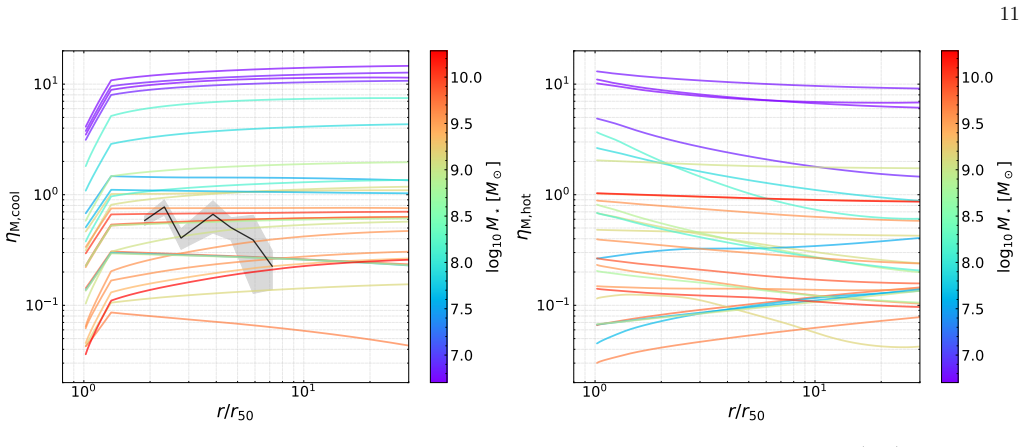
The paper establishes that the velocity-radius mapping encoded in UV absorption profiles enables recovery of outflow spatial structures from spatially integrated spectra. Fitting column density profiles with the multiphase multiscale wind model constrains the initial hot-phase and cool-phase mass-loading factors along with the initial cool-cloud mass. Good fits are obtained for most galaxies, with the cool-phase velocity rising between one and two half-light radii before plateauing and with most galaxies showing increasing cool mass-loading and decreasing hot mass-loading with radius.
What carries the argument
The multiphase, multiscale wind model, which takes initial hot-phase mass-loading factor, cool-phase mass-loading factor, and cool-cloud mass as inputs and produces predicted radial profiles of velocity and column density for comparison to observations.
If this is right
- Cool-phase outflow velocity increases between 1-2 times the half-light radius and then reaches a plateau in all galaxies.
- Most galaxies exhibit increasing cool-phase mass-loading factor and decreasing hot-phase mass-loading factor with radius.
- Constraints on the hot-phase mass-loading factor allow indirect inference of hot wind properties from cool-phase observations.
- The inferred mass-loading factors are mostly of order unity with scatter, consistent with recent multiphase simulations.
Where Pith is reading between the lines
- Applying the same fitting procedure to larger galaxy samples could reveal systematic trends between wind properties and host galaxy characteristics such as stellar mass or star formation rate.
- The predicted acceleration and plateau of cool clouds points to a specific entrainment process whose efficiency could be tested directly in hydrodynamic simulations.
- The presence of radial information in integrated spectra suggests similar methods might extract spatial structure in other unresolved outflows, such as those driven by active galactic nuclei.
Load-bearing premise
The multiphase multiscale wind model accurately represents the true physics of interactions between cool clouds and the hot wind phase.
What would settle it
A spatially resolved observation of cool-phase velocity in a nearby galaxy showing no increase followed by a plateau between one and two half-light radii, or mass-loading factors trending opposite to the model prediction.
Figures




read the original abstract
Galactic winds shape galaxy evolution; however, the outflowing gas is complex: it consists of multiple ionization phases, and its properties vary spatially. Therefore, methods that combine high-fidelity observations with state-of-the-art galactic-wind models are limited. Here we investigate methods for fitting the column density profiles derived from high-quality outflow observations with the multiphase, multiscale wind model from Fielding & Bryan 2022. We identify three key outflow parameters: the initial hot-phase mass-loading factor ($\eta_\text{ M,hot,0}$), the initial cool-phase mass-loading factor ($\eta_\text{ M,cool,0}$), and the initial cool-cloud mass. We obtain good fits for most galaxies, with tight constraints on $\eta_\text{ M,cool,0}$ and moderate constraints on the other two parameters. We find the inferred $\eta_\text{ M,cool,0}$ and $\eta_\text{ M,hot,0}$ are mostly of order unity, with significant scatter. The constraints on $\eta_\text{ M,hot,0}$ suggest that the interaction between the cool and hot phases allows us to indirectly constrain the properties of the hot wind from cool-outflow observations. The model also predicts various radial trends. First, for all galaxies, the cool-phase outflow velocity increases between $1-2$ times of the half-light radius, then reaches a plateau. Second, most galaxies exhibit increasing $\eta_\text{ M,cool}$ and decreasing $\eta_\text{ M,hot}$ with radius, with a few showing the reverse trends. These results are effective, model-conditional constraints, and are consistent with other recent multiphase simulations and observations. This highlights that the velocity-radius mapping encoded in UV absorption profiles enables recovery of outflow spatial structures from spatially integrated spectra. Our method paves the way for future broad parameter studies and guides updates of outflow simulations in future work.
Editorial analysis
A structured set of objections, weighed in public.
Referee Report
Summary. The manuscript presents a methodology for fitting the multiphase, multiscale galactic wind model of Fielding & Bryan (2022) to observed UV absorption column-density profiles of galactic outflows. Three key parameters are constrained: the initial hot-phase mass-loading factor η_M,hot,0, the initial cool-phase mass-loading factor η_M,cool,0, and the initial cool-cloud mass. Good fits are reported for most galaxies in the sample, yielding mostly order-unity values for the mass-loading factors with some scatter. The work derives radial trends, including an increase in cool-phase outflow velocity between 1–2 half-light radii followed by a plateau, and varying radial behaviors in the mass-loading factors. Results are framed as model-conditional constraints that are consistent with other multiphase simulations and observations, with the central claim being that the velocity-radius mapping encoded in the absorption profiles enables recovery of outflow spatial structures from integrated spectra.
Significance. If the central results hold, the paper provides a practical bridge between high-fidelity UV observations and state-of-the-art multiphase wind models, enabling indirect constraints on hot-phase wind properties from cool-phase data. The explicit acknowledgment of model-conditional dependence, together with the reported consistency checks against other simulations, strengthens the utility of the approach. This methodology opens the door to systematic parameter studies across larger samples and can inform refinements to outflow simulations.
minor comments (3)
- [Abstract] The abstract states that 'good fits' are obtained but does not report quantitative fit metrics (e.g., χ² values, reduced χ², or posterior widths) that would allow readers to assess the quality of the three-parameter constraints directly.
- A summary table listing the best-fit values and uncertainties for η_M,hot,0, η_M,cool,0, and initial cool-cloud mass for each galaxy would improve clarity and facilitate comparison across the sample.
- The radial trends (velocity plateau at 1–2 half-light radii, trends in η_M,cool and η_M,hot) are described qualitatively; explicit functional forms or figures showing the model predictions versus radius for representative galaxies would strengthen the presentation.
Simulated Author's Rebuttal
We thank the referee for their positive and constructive review of our manuscript. We are pleased that the referee recognizes the utility of our methodology in bridging high-fidelity UV observations with multiphase wind models and recommends acceptance.
Circularity Check
No significant circularity in the derivation chain
full rationale
The paper fits three initial parameters of the external Fielding & Bryan 2022 multiphase wind model to observed UV column-density profiles, then runs the fitted model forward to obtain radial trends in velocity and mass-loading factors. This is standard model-based inference under explicit model assumptions rather than a self-definitional loop or a fitted quantity renamed as an independent prediction. The central claim that velocity-radius mapping in integrated spectra enables recovery of spatial structure is presented as model-conditional, with no reduction of the result to its own inputs by construction and no load-bearing self-citation that renders the derivation tautological.
Axiom & Free-Parameter Ledger
free parameters (3)
- η_M,hot,0 =
order unity
- η_M,cool,0 =
order unity
- initial cool-cloud mass
axioms (1)
- domain assumption The multiphase multiscale wind model of Fielding & Bryan 2022 provides an accurate description of galactic outflows
Reference graph
Works this paper leans on
-
[1]
The Astropy Project: Sustaining and Growing a Community-oriented Open-source Project and the Latest Major Release (v5.0) of the Core Package. , keywords =. doi:10.3847/1538-4357/ac7c74 , archivePrefix =. 2206.14220 , primaryClass =
work page internal anchor Pith review Pith/arXiv arXiv doi:10.3847/1538-4357/ac7c74
-
[2]
The Astronomical Journal , author =
The Astropy Project: Building an Open-science Project and Status of the v2.0 Core Package. , keywords =. doi:10.3847/1538-3881/aabc4f , archivePrefix =. 1801.02634 , primaryClass =
-
[3]
Astropy: A community Python package for astronomy. , keywords =. 2013. doi:10.1051/0004-6361/201322068 , archivePrefix =. 1307.6212 , primaryClass =
-
[4]
SExtractor: Software for source extraction. , keywords =. 1996. doi:10.1051/aas:1996164 , adsurl =
-
[5]
Quantifying the Observational Effort Required for the Radial Velocity Characterization of TESS Planets. , keywords =. 2018. doi:10.3847/1538-3881/aacea9 , archivePrefix =. 1807.01263 , primaryClass =
-
[6]
X-Ray Scattering Echoes and Ghost Halos from the Intergalactic Medium: Relation to the Nature of AGN Variability. , keywords =. 2015. doi:10.1088/0004-637X/805/1/23 , archivePrefix =. 1503.01475 , primaryClass =
-
[7]
, keywords =
The 2013 Release of Cloudy. , keywords =. 2013
2013
-
[8]
1989", month =
T _ E X and LAT _ E X Macro Definition Files for Astronomical Publications. , year = "1989", month = "Mar", pages =
1989
-
[9]
LaTeX: A Document Preparation System. 1994
1994
-
[10]
Quasi-periodic Fast Propagating Magnetoacoustic Waves during the Magnetic Reconnection Between Solar Coronal Loops. , keywords =. 2018. doi:10.3847/2041-8213/aaf167 , archivePrefix =. 1811.08553 , primaryClass =
-
[11]
Nominal Values for Selected Solar and Planetary Quantities: IAU 2015 Resolution B3. , keywords =. 2016. doi:10.3847/0004-6256/152/2/41 , archivePrefix =. 1605.09788 , primaryClass =
-
[12]
Swift X-Ray Observations of Classical Novae. II. The Super Soft Source Sample. , keywords =. 2011. doi:10.1088/0067-0049/197/2/31 , archivePrefix =. 1110.6224 , primaryClass =
-
[13]
Galaxy Emission Line Classification Using Three-dimensional Line Ratio Diagrams. , keywords =. 2014. doi:10.1088/0004-637X/793/2/127 , archivePrefix =. 1406.5186 , primaryClass =
-
[14]
Taming the TuRMoiL: The Temperature Dependence of Turbulence in Cloud Wind Interactions. , keywords =. doi:10.3847/1538-4357/ad1e51 , archivePrefix =. 2210.15679 , primaryClass =
-
[15]
A test for partial correlation with censored astronomical data. , keywords =. doi:10.1093/mnras/278.4.919 , archivePrefix =. astro-ph/9508018 , primaryClass =
-
[16]
Indirect Evidence for Escaping Ionizing Photons in Local Lyman Break Galaxy Analogs. , keywords =. doi:10.1088/0004-637X/810/2/104 , archivePrefix =. 1504.02446 , primaryClass =
-
[17]
The Impact of Low-luminosity AGNs on Their Host Galaxies: A Radio and Optical Investigation of the Kiloparsec-scale Outflow in MaNGA 1-166919. , keywords =. doi:10.3847/1538-4357/abf5e1 , archivePrefix =. 2105.07335 , primaryClass =
-
[18]
ROSAT Observations of NGC 2146: Evidence for a Starburst-driven Superwind. , keywords =. doi:10.1086/175729 , adsurl =
-
[19]
The Mass-Metallicity Relation with the Direct Method on Stacked Spectra of SDSS Galaxies. , keywords =. doi:10.1088/0004-637X/765/2/140 , archivePrefix =. 1211.3418 , primaryClass =
-
[20]
X-Ray/Ultraviolet Campaign on the Mrk 279 AGN Outflow: Constraining Inhomogeneous Absorber Models. , keywords =. doi:10.1086/425560 , archivePrefix =. astro-ph/0406200 , primaryClass =
-
[21]
Ubiquitous broad-line emission and the relation between ionized gas outflows and Lyman continuum escape in Green Pea galaxies. arXiv e-prints , keywords =. doi:10.48550/arXiv.2401.04278 , archivePrefix =. 2401.04278 , primaryClass =
-
[22]
R., Wuyts, S., F¨ orster Schreiber, N
Incidence, scaling relations and physical conditions of ionized gas outflows in MaNGA. , keywords =. doi:10.1093/mnras/stab780 , archivePrefix =. 2103.06291 , primaryClass =
-
[23]
R., Wuyts , S., F \"o rster Schreiber , N
Cool outflows in MaNGA: a systematic study and comparison to the warm phase. , keywords =. doi:10.1093/mnras/stac190 , archivePrefix =. 2201.08079 , primaryClass =
-
[24]
Astronomische Nachrichten 341(2), 224–235 (2020) https://doi.org/10.1002/asna.202023782
The Athena space X‑ray observatory and the astrophysics of hot plasma. Astronomische Nachrichten , keywords =. doi:10.1002/asna.202023782 , archivePrefix =. 1912.04615 , primaryClass =
-
[25]
2004, MNRAS, 351, 1379, doi: 10.1111/j.1365-2966.2004.07876.x
Can the faint submillimetre galaxies be explained in the cold dark matter model?. , keywords =. doi:10.1111/j.1365-2966.2004.08553.x , archivePrefix =. astro-ph/0406069 , primaryClass =
-
[26]
Classification parameters for the emission-line spectra of extragalactic objects. , keywords =. doi:10.1086/130766 , adsurl =
-
[27]
An 800-Million-Solar-Mass Black Hole in a Significantly Neutral
An 800-million-solar-mass black hole in a significantly neutral Universe at a redshift of 7.5. , keywords =. doi:10.1038/nature25180 , archivePrefix =. 1712.01860 , primaryClass =
-
[28]
, year = 1931, month = jun, volume =
The contours of emission bands in nov and Wolf-Rayet stars. , year = 1931, month = jun, volume =. doi:10.1093/mnras/91.9.966 , adsurl =
-
[29]
Evidence for Reionization at z -0.5ex 6: Detection of a Gunn-Peterson Trough in a z=6.28 Quasar. , keywords =. doi:10.1086/324231 , archivePrefix =. astro-ph/0108097 , primaryClass =
-
[30]
D., D’Aloisio, A., Christenson, H
The mean free path of ionizing photons at 5 < z < 6: evidence for rapid evolution near reionization. , keywords =. doi:10.1093/mnras/stab2696 , archivePrefix =. 2103.16610 , primaryClass =
-
[31]
UNIVERSEMACHINE: The correlation between galaxy growth and dark matter halo assembly from z = 0-10. , keywords =. doi:10.1093/mnras/stz1182 , archivePrefix =. 1806.07893 , primaryClass =
-
[32]
Spatially resolved Spitzer-IRS spectral maps of the superwind in M82. , keywords =. doi:10.1093/mnras/stv1101 , archivePrefix =. 1505.04069 , primaryClass =
-
[33]
The VANDELS survey: a measurement of the average Lyman-continuum escape fraction of star-forming galaxies at z = 3.5. , keywords =. doi:10.1093/mnras/stac1067 , archivePrefix =. 2202.04088 , primaryClass =
-
[34]
The 1\. , keywords =. doi:10.1088/0004-637X/794/2/135 , archivePrefix =. 1406.1718 , primaryClass =
-
[35]
The Dependence of Galactic Outflows on the Properties and Orientation of zCOSMOS Galaxies at z -0.5ex 1. , keywords =. doi:10.1088/0004-637X/794/2/130 , archivePrefix =. 1307.6553 , primaryClass =
-
[36]
Benoit C. J. Borguet and Doug Edmonds and Nahum Arav and Jay Dunn and Gerard A. Kriss , title =. The Astrophysical Journal , abstract =. doi:10.1088/0004-637x/751/2/107 , url =
-
[37]
First detection of Lyman continuum escape from a local starburst galaxy. I. Observations of the luminous blue compact galaxy Haro 11 with the Far Ultraviolet Spectroscopic Explorer (FUSE). , year = 2006, month = mar, volume =. doi:10.1051/0004-6361:20053788 , adsurl =
-
[38]
Intense C IV and He II Emission in z 0 Galaxies: Probing High-energy Ionizing Photons. , keywords =. doi:10.3847/2041-8213/ab21dc , archivePrefix =. 1905.06434 , primaryClass =
-
[39]
2017, ApJL, 837, L12, doi: 10.3847/2041-8213/aa5ff7
High Lyman Continuum Escape Fraction in a Lensed Young Compact Dwarf Galaxy at z = 2.5. , keywords =. doi:10.3847/2041-8213/aa5ff7 , archivePrefix =. 1702.06540 , primaryClass =
-
[40]
Evidence for a Fast Soft X-Ray Wind in M82 from XMM-RGS. , keywords =. doi:10.3847/1538-4357/ad7258 , archivePrefix =. 2408.15327 , primaryClass =
-
[41]
JWST Observations of Starbursts: Polycyclic Aromatic Hydrocarbon Emission at the Base of the M82 Galactic Wind. , keywords =. doi:10.3847/1538-4357/ad33c8 , archivePrefix =. 2401.16648 , primaryClass =
-
[42]
A local clue to the reionization of the universe. Science , keywords =. doi:10.1126/science.1254214 , archivePrefix =. 1410.3511 , primaryClass =
-
[43]
Hydrogen reionization ends by z = 5.3: Lyman- optical depth measured by the XQR-30 sample. , keywords =. doi:10.1093/mnras/stac1046 , archivePrefix =. 2108.03699 , primaryClass =
-
[44]
New Determinations of the UV Luminosity Functions from z 9 to 2 Show a Remarkable Consistency with Halo Growth and a Constant Star Formation Efficiency. , keywords =. doi:10.3847/1538-3881/abf83e , archivePrefix =. 2102.07775 , primaryClass =
-
[45]
JADES NIRSpec Spectroscopy of GN-z11: Lyman- emission and possible enhanced nitrogen abundance in a z = 10.60 luminous galaxy. , keywords =. doi:10.1051/0004-6361/202346159 , archivePrefix =. 2302.07256 , primaryClass =
-
[46]
Circumgalactic Mg II Emission from an Isotropic Starburst Galaxy Outflow Mapped by KCWI. , keywords =. doi:10.3847/1538-4357/abd4e0 , archivePrefix =. 2005.03017 , primaryClass =
-
[47]
VI: Extreme rest-optical equivalent widths detected in NIRISS Wide Field Slitless Spectroscopy
Early results from GLASS-JWST. VI: Extreme rest-optical equivalent widths detected in NIRISS Wide Field Slitless Spectroscopy. arXiv e-prints , keywords =
-
[48]
The Dust Content and Opacity of Actively Star-forming Galaxies. , keywords =. doi:10.1086/308692 , archivePrefix =. astro-ph/9911459 , primaryClass =
work page internal anchor Pith review Pith/arXiv arXiv doi:10.1086/308692
-
[49]
Secular Evolution of Galaxies , year = 2013, editor =
Star Formation Rate Indicators. Secular Evolution of Galaxies , year = 2013, editor =
2013
-
[50]
The Relationship between Infrared, Optical, and Ultraviolet Extinction. , keywords =. doi:10.1086/167900 , adsurl =
-
[51]
2024, , 685, A99, 10.1051/0004-6361/202347230
JADES: The incidence rate and properties of galactic outflows in low-mass galaxies across 3 < z < 9. , keywords =. doi:10.1051/0004-6361/202347230 , archivePrefix =. 2306.11801 , primaryClass =
-
[52]
2018, , 860, 143, 10.3847/1538-4357/aac48e
A Semi-analytical Line Transfer (SALT) Model. II: The Effects of a Bi-conical Geometry. , keywords =. doi:10.3847/1538-4357/aac48e , archivePrefix =. 1805.05981 , primaryClass =
-
[53]
2021, , 906, 104, 10.3847/1538-4357/abc7c3
The Effects of Biconical Outflows on Ly Escape from Green Peas. , keywords =. doi:10.3847/1538-4357/abc7c3 , archivePrefix =. 2011.02549 , primaryClass =
-
[54]
Testing SALT Approximations with Numerical Radiation Transfer Code. I. Validity and Applicability. , keywords =. doi:10.3847/1538-4357/acd331 , archivePrefix =. 2209.14473 , primaryClass =
-
[55]
A., Cen, R., Scarlata, C., et al
The Effect of Radiation and Supernovae Feedback on LyC Escape in Local Star-forming Galaxies. arXiv e-prints , keywords =. doi:10.48550/arXiv.2409.05180 , archivePrefix =. 2409.05180 , primaryClass =
-
[56]
Evaluating Mass Outflow Rate Estimators in FIRE-2 Simulations: Toward a Self-consistent Framework for Spectral-line-based Predictions. , keywords =. doi:10.3847/1538-4357/adf4c2 , archivePrefix =. 2503.22312 , primaryClass =
-
[57]
, year = 1970, month = jan, volume =
Spectral line formation in Wolf-Rayet envelopes. , year = 1970, month = jan, volume =. doi:10.1093/mnras/149.2.111 , adsurl =
-
[58]
Spatially resolved kinematics, galactic wind, and quenching of star formation in the luminous infrared galaxy IRAS F11506-3851. , keywords =. doi:10.1051/0004-6361/201323296 , archivePrefix =. 1406.5154 , primaryClass =
-
[59]
Galactic Stellar and Substellar Initial Mass Function. , keywords =. doi:10.1086/376392 , archivePrefix =. astro-ph/0304382 , primaryClass =
work page internal anchor Pith review Pith/arXiv arXiv doi:10.1086/376392
-
[60]
Stellar Masses and Star Formation Rates for 1M Galaxies from SDSS+WISE. , keywords =. doi:10.1088/0067-0049/219/1/8 , archivePrefix =. 1506.00648 , primaryClass =
-
[61]
Probing cold gas with Mg II and Ly radiative transfer. , keywords =. doi:10.1093/mnras/stae1664 , archivePrefix =. 2403.11524 , primaryClass =
-
[62]
Absorption-line Probes of the Prevalence and Properties of Outflows in Present-day Star-forming Galaxies. , keywords =. doi:10.1088/0004-6256/140/2/445 , archivePrefix =. 1003.5425 , primaryClass =
-
[63]
Wind from a starburst galaxy nucleus. , keywords =. doi:10.1038/317044a0 , adsurl =
-
[64]
Physical properties and H-ionizing-photon production rates of extreme nearby star-forming regions. , keywords =. doi:10.1093/mnras/sty1461 , archivePrefix =. 1709.03503 , primaryClass =
-
[65]
2016, MNRAS, 462, 1415, doi: 10.1093/mnras/stw1756
Modelling and interpreting spectral energy distributions of galaxies with BEAGLE. , keywords =. doi:10.1093/mnras/stw1756 , archivePrefix =. 1603.03037 , primaryClass =
-
[66]
Scaling Relations Between Warm Galactic Outflows and Their Host Galaxies. , keywords =. doi:10.1088/0004-637X/811/2/149 , archivePrefix =. 1412.2139 , primaryClass =
-
[67]
A., Leitherer , C., Chen , Y., & Wofford , A
Shining a light on galactic outflows: photoionized outflows. , keywords =. doi:10.1093/mnras/stw178 , archivePrefix =. 1601.05090 , primaryClass =
-
[68]
A robust measurement of the mass outflow rate of the galactic outflow from NGC 6090. , keywords =. doi:10.1093/mnras/stw1951 , archivePrefix =. 1605.05769 , primaryClass =
-
[69]
The Molecular Baryon Cycle of M82. , keywords =. doi:10.3847/0004-637X/830/2/72 , archivePrefix =. 1608.00974 , primaryClass =
-
[70]
A., Leitherer , C., & Chen , Y
The mass and momentum outflow rates of photoionized galactic outflows. , keywords =. doi:10.1093/mnras/stx1164 , archivePrefix =. 1702.07351 , primaryClass =
-
[71]
2018, , 481, 1690, 10.1093/mnras/sty2380
Metal-enriched galactic outflows shape the mass-metallicity relationship. , keywords =. doi:10.1093/mnras/sty2380 , archivePrefix =. 1808.10453 , primaryClass =
-
[72]
Accurately predicting the escape fraction of ionizing photons using rest-frame ultraviolet absorption lines. , keywords =. doi:10.1051/0004-6361/201832758 , archivePrefix =. 1803.03655 , primaryClass =
-
[73]
Constraining the Metallicities, Ages, Star Formation Histories, and Ionizing Continua of Extragalactic Massive Star Populations. , keywords =. doi:10.3847/1538-4357/ab3104 , archivePrefix =. 1905.04314 , primaryClass =
-
[74]
Optically thin spatially resolved Mg II emission maps the escape of ionizing photons. , keywords =. doi:10.1093/mnras/staa2470 , archivePrefix =. 2008.06059 , primaryClass =
-
[75]
The far-ultraviolet continuum slope as a Lyman Continuum escape estimator at high redshift. , keywords =. doi:10.1093/mnras/stac2874 , archivePrefix =. 2207.05771 , primaryClass =
-
[76]
Ground-based and Airborne Instrumentation for Astronomy VI , year = 2016, editor =
LRS2: design, assembly, testing, and commissioning of the second-generation low-resolution spectrograph for the Hobby-Eberly Telescope. Ground-based and Airborne Instrumentation for Astronomy VI , year = 2016, editor =. doi:10.1117/12.2232209 , adsurl =
-
[77]
Mesa Isochrones and Stellar Tracks (MIST). I. Solar-scaled Models. , keywords =. doi:10.3847/0004-637X/823/2/102 , archivePrefix =. 1604.08592 , primaryClass =
work page internal anchor Pith review doi:10.3847/0004-637x/823/2/102
-
[78]
Outflows and complex stellar kinematics in SDSS star-forming galaxies. , keywords =. doi:10.1051/0004-6361/201424514 , archivePrefix =. 1601.04715 , primaryClass =
-
[79]
Being KLEVER at cosmic noon: Ionized gas outflows are inconspicuous in low-mass star-forming galaxies but prominent in massive AGN hosts. , keywords =. doi:10.1093/mnras/stac1026 , archivePrefix =. 2203.11958 , primaryClass =
-
[80]
The Propagation of Uncertainties in Stellar Population Synthesis Modeling. I. The Relevance of Uncertain Aspects of Stellar Evolution and the Initial Mass Function to the Derived Physical Properties of Galaxies. , keywords =. doi:10.1088/0004-637X/699/1/486 , archivePrefix =. 0809.4261 , primaryClass =
work page internal anchor Pith review Pith/arXiv arXiv doi:10.1088/0004-637x/699/1/486
discussion (0)
Sign in with ORCID, Apple, or X to comment. Anyone can read and Pith papers without signing in.