Recognition: 2 theorem links
· Lean TheoremGrounding Multi-Hop Reasoning in Structural Causal Models via Group Relative Policy Optimization
Pith reviewed 2026-05-11 02:12 UTC · model grok-4.3
The pith
Grounding multi-hop fact verification in a structural causal model and optimizing it with group relative policy optimization yields more accurate and less hallucinated reasoning than standard chain-of-thought methods.
A machine-rendered reading of the paper's core claim, the machinery that carries it, and where it could break.
Core claim
The SCM-GRPO framework represents multi-hop verification as the construction of a structural causal model that encodes dependencies among evidence items and the target claim; group relative policy optimization then adjusts the policy that generates reasoning steps so that the model trades off depth against conciseness, producing shorter, more reliable chains than unguided chain-of-thought prompting.
What carries the argument
Structural causal model that represents causal dependencies between evidence and claims, paired with group relative policy optimization that learns to select concise yet sufficient reasoning paths.
If this is right
- The approach delivers higher accuracy than existing baselines on the HoVer and EX-FEVER benchmarks.
- Reasoning chains become both shorter and more correct once the optimizer respects the observed inverted-U relationship between length and performance.
- Explicit causal modeling supplies a human-readable trace of how each evidence item supports or contradicts the claim.
- Hallucinations decrease because each reasoning step must be justified inside the causal graph rather than generated freely.
- The same optimization can be reused on other multi-hop tasks that suffer from excessive or insufficient chain length.
Where Pith is reading between the lines
- The same causal-plus-RL pattern could be tested on multi-step mathematical reasoning or scientific literature synthesis where evidence must be linked causally.
- If the method generalizes, it suggests that future language-model systems may need explicit causal scaffolding rather than relying only on statistical next-token prediction.
- Applying the framework to live news-verification pipelines would provide a measurable test of whether causal grounding reduces real-world misinformation spread.
Load-bearing premise
Explicitly building a structural causal model of the verification process will capture the true dependencies without adding new modeling errors that cancel out the gains over ordinary chain-of-thought prompting.
What would settle it
On a held-out multi-hop verification set, if the SCM-GRPO method produces chains that are longer, less accurate, or contain more factual errors than plain chain-of-thought, the central claim would be refuted.
Figures




read the original abstract
Multi-Hop Fact Verification (MHFV) necessitates complex reasoning across disparate evidence, posing significant challenges for Large Language Models (LLMs) which often suffer from hallucinations and fractured logical chains. Existing methods, while improving transparency via Chain-of-Thought (CoT), lack explicit modeling of the causal dependencies between evidence and claims. In this work, we introduce a novel framework that grounds reasoning in a Structural Causal Model (SCM), treating verification as a constructive causal inference process. We empirically identify an "inverted U-shaped" correlation between reasoning chain length and accuracy, revealing that excessive structural complexity degrades performance. To address this, we propose a Rule-based Reinforcement Learning strategy using Group Relative Policy Optimization (GRPO). This approach dynamically optimizes the trade-off between structural depth and conciseness. Extensive experiments on HoVer and EX-FEVER demonstrate that our SCM-GRPO framework significantly outperforms state-of-the-art baselines, offering a reliable and interpretable solution for complex fact verification.
Editorial analysis
A structured set of objections, weighed in public.
Referee Report
Summary. The manuscript introduces SCM-GRPO, a framework that grounds multi-hop fact verification in Structural Causal Models (SCMs) by treating verification as constructive causal inference. It identifies an inverted-U correlation between reasoning chain length and accuracy, proposes rule-based Group Relative Policy Optimization (GRPO) to optimize the depth-conciseness trade-off, and reports significant outperformance over state-of-the-art baselines on the HoVer and EX-FEVER datasets.
Significance. If the results hold under rigorous validation, the work could advance interpretable LLM reasoning by explicitly modeling causal dependencies between evidence and claims, offering a potential path to reduce hallucinations in complex verification tasks. The GRPO strategy for dynamically balancing structural complexity and the empirical identification of the inverted-U curve would be notable contributions to causal grounding in AI if they are shown to stem from correct causal assumptions rather than optimization artifacts.
major comments (3)
- §3 (Method): The construction and specification of the SCM (variables, edges, and interventions for evidence-claim dependencies) is insufficiently detailed. Without explicit description or validation of the causal graph (e.g., whether hand-specified or learned), it is impossible to rule out misspecification risks such as spurious edges, which could produce systematically incorrect counterfactuals and attribute gains to GRPO fitting rather than causal grounding.
- §4 (Experiments): The reported outperformance on HoVer and EX-FEVER lacks error bars, statistical significance tests, multiple-run averages, dataset statistics, and ablation studies isolating the SCM component from GRPO and base LLM effects. This is load-bearing for the central claim that SCM grounding yields more accurate, less hallucinated chains than standard CoT.
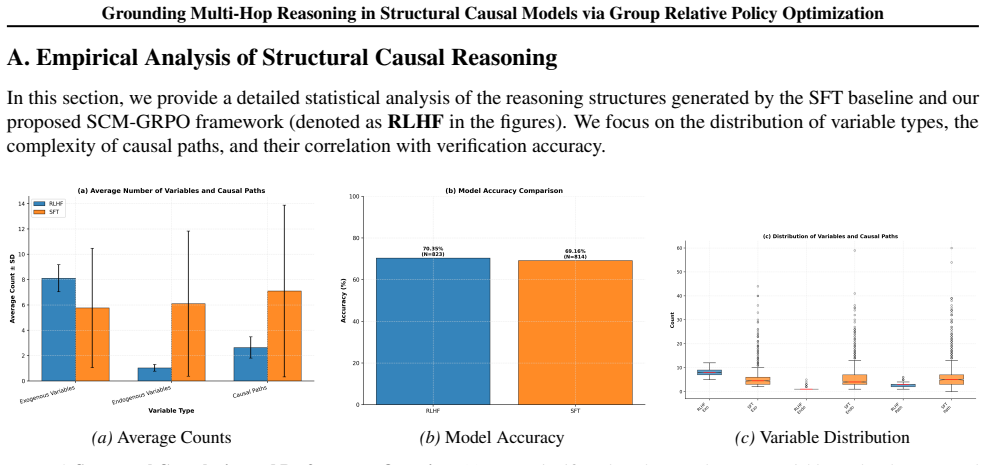
- Abstract and §5 (Discussion): The asserted inverted-U correlation between chain length and accuracy is presented without supporting figures, data points, or analysis demonstrating that GRPO specifically mitigates SCM-induced errors rather than other factors; this weakens the motivation and interpretability claims.
minor comments (2)
- Ensure consistent expansion of acronyms (MHFV, SCM, GRPO, CoT) on first use in the main body and abstract.
- Figure captions and table legends should explicitly state the number of runs and any controls used for the reported metrics.
Simulated Author's Rebuttal
We thank the referee for the constructive and detailed comments, which help clarify areas where the manuscript can be strengthened. We address each major comment below and commit to revisions that improve the rigor and clarity of the work.
read point-by-point responses
-
Referee: §3 (Method): The construction and specification of the SCM (variables, edges, and interventions for evidence-claim dependencies) is insufficiently detailed. Without explicit description or validation of the causal graph (e.g., whether hand-specified or learned), it is impossible to rule out misspecification risks such as spurious edges, which could produce systematically incorrect counterfactuals and attribute gains to GRPO fitting rather than causal grounding.
Authors: We agree that §3 would benefit from greater detail on the SCM. In the revised manuscript we will expand the section to explicitly list the variables (e.g., evidence nodes, claim nodes, and latent causal factors), the directed edges representing dependencies, and the specific interventions used for counterfactual reasoning. We will also clarify the construction process (hand-specified from task structure versus data-driven) and include a discussion of potential misspecification risks together with how the subsequent GRPO stage interacts with the graph. revision: yes
-
Referee: §4 (Experiments): The reported outperformance on HoVer and EX-FEVER lacks error bars, statistical significance tests, multiple-run averages, dataset statistics, and ablation studies isolating the SCM component from GRPO and base LLM effects. This is load-bearing for the central claim that SCM grounding yields more accurate, less hallucinated chains than standard CoT.
Authors: We acknowledge the need for stronger statistical reporting. The revised experimental section will report means and standard deviations across multiple independent runs, include statistical significance tests (e.g., paired t-tests against baselines), provide dataset statistics, and add ablation studies that isolate the SCM component, the GRPO objective, and the base LLM. These additions will directly support the claim that the observed gains derive from the SCM grounding rather than other factors. revision: yes
-
Referee: Abstract and §5 (Discussion): The asserted inverted-U correlation between chain length and accuracy is presented without supporting figures, data points, or analysis demonstrating that GRPO specifically mitigates SCM-induced errors rather than other factors; this weakens the motivation and interpretability claims.
Authors: We will add the requested supporting material to §5. The revision will include figures plotting accuracy against chain length, the underlying data points, and an analysis that compares SCM-GRPO against ablated variants (SCM without GRPO, GRPO without SCM) to show that the optimization specifically reduces errors attributable to excessive structural complexity in the causal graph. revision: yes
Circularity Check
No circularity in derivation chain
full rationale
The paper proposes SCM-GRPO as a new framework that models multi-hop verification inside a structural causal model and applies rule-based GRPO to balance chain length against an empirically observed inverted-U accuracy curve. No equations, definitions, or optimization steps in the provided abstract or description reduce a claimed prediction or result to a fitted input or self-citation by construction. Performance is evaluated on external benchmarks (HoVer, EX-FEVER) rather than on quantities defined from the same fitted parameters. The derivation therefore remains self-contained against external data and does not exhibit any of the enumerated circularity patterns.
Axiom & Free-Parameter Ledger
Lean theorems connected to this paper
-
IndisputableMonolith/Cost/FunctionalEquation.leanwashburn_uniqueness_aczel unclear?
unclearRelation between the paper passage and the cited Recognition theorem.
Structure Reward (R_s)... Δ(y)=|U|−|V|... Occam’s Razor... penalizing excessive mental gymnastics
What do these tags mean?
- matches
- The paper's claim is directly supported by a theorem in the formal canon.
- supports
- The theorem supports part of the paper's argument, but the paper may add assumptions or extra steps.
- extends
- The paper goes beyond the formal theorem; the theorem is a base layer rather than the whole result.
- uses
- The paper appears to rely on the theorem as machinery.
- contradicts
- The paper's claim conflicts with a theorem or certificate in the canon.
- unclear
- Pith found a possible connection, but the passage is too broad, indirect, or ambiguous to say the theorem truly supports the claim.
Reference graph
Works this paper leans on
-
[1]
GPT-4 Technical Report , author =. arXiv preprint arXiv:2303.08774 , year =
work page internal anchor Pith review Pith/arXiv arXiv
-
[2]
DeepSeek-V3 Technical Report , author =. arXiv preprint arXiv:2412.19437 , year =
work page internal anchor Pith review Pith/arXiv arXiv
-
[3]
Training a Helpful and Harmless Assistant with Reinforcement Learning from Human Feedback
Training a Helpful and Harmless Assistant with Reinforcement Learning from Human Feedback , author =. arXiv preprint arXiv:2204.05862 , year =
work page internal anchor Pith review Pith/arXiv arXiv
-
[4]
A Multitask, Multilingual, Multimodal Evaluation of ChatGPT on Reasoning, Hallucination, and Interactivity , author =. Proceedings of the 13th International Joint Conference on Natural Language Processing and the 3rd Conference of the Asia-Pacific Chapter of the Association for Computational Linguistics (Volume 1: Long Papers) , pages =. 2023 , publisher ...
-
[5]
Proceedings of the AAAI Conference on Artificial Intelligence , volume =
Graph of Thoughts: Solving Elaborate Problems with Large Language Models , author =. Proceedings of the AAAI Conference on Artificial Intelligence , volume =. 2024 , doi =
work page 2024
-
[6]
Transactions on Machine Learning Research , year =
Program of Thoughts Prompting: Disentangling Computation from Reasoning for Numerical Reasoning Tasks , author =. Transactions on Machine Learning Research , year =
-
[7]
Chain-of-Verification Reduces Hallucination in Large Language Models
Chain-of-Verification Reduces Hallucination in Large Language Models , author =. Findings of the Association for Computational Linguistics: ACL 2024 , pages =. 2024 , publisher =. doi:10.18653/v1/2024.findings-acl.212 , url =
-
[8]
Advances in Neural Information Processing Systems , volume =
AlpacaFarm: A Simulation Framework for Methods that Learn from Human Feedback , author =. Advances in Neural Information Processing Systems , volume =
-
[9]
Transactions of the Association for Computational Linguistics , volume =
Causal Inference in Natural Language Processing: Estimation, Prediction, Interpretation and Beyond , author =. Transactions of the Association for Computational Linguistics , volume =. 2022 , doi =
work page 2022
-
[10]
Retrieval-Augmented Generation for Large Language Models: A Survey
Retrieval-Augmented Generation for Large Language Models: A Survey , author =. arXiv preprint arXiv:2312.10997 , year =
work page internal anchor Pith review Pith/arXiv arXiv
-
[11]
Advances in Neural Information Processing Systems , volume =
Causal Abstractions of Neural Networks , author =. Advances in Neural Information Processing Systems , volume =. 2021 , url =
work page 2021
-
[12]
Transactions of the Association for Computational Linguistics , volume =
A Survey on Automated Fact-Checking , author =. Transactions of the Association for Computational Linguistics , volume =. 2022 , doi =
work page 2022
-
[13]
AnnoLLM: Making Large Language Models to Be Better Crowdsourced Annotators , author =. Proceedings of the 2024 Conference of the North American Chapter of the Association for Computational Linguistics: Human Language Technologies (Volume 6: Industry Track) , pages =. 2024 , publisher =. doi:10.18653/v1/2024.naacl-industry.15 , url =
-
[14]
Faithful Chain-of-Thought Reasoning , author =. Proceedings of the 13th International Joint Conference on Natural Language Processing and the 3rd Conference of the Asia-Pacific Chapter of the Association for Computational Linguistics (Volume 1: Long Papers) , pages =. 2023 , publisher =. doi:10.18653/v1/2023.ijcnlp-main.20 , url =
-
[15]
A Survey on Hallucination in Large Language Models: Principles, Taxonomy, Challenges, and Open Questions , author =. arXiv preprint arXiv:2311.05232 , year =
work page internal anchor Pith review arXiv
-
[16]
Active retrieval augmented generation
Active Retrieval Augmented Generation , author =. Proceedings of the 2023 Conference on Empirical Methods in Natural Language Processing , pages =. 2023 , publisher =. doi:10.18653/v1/2023.emnlp-main.495 , url =
-
[17]
Advances in Neural Information Processing Systems , volume =
Large Language Models are Zero-Shot Reasoners , author =. Advances in Neural Information Processing Systems , volume =
-
[18]
Advances in Neural Information Processing Systems , volume =
Retrieval-Augmented Generation for Knowledge-Intensive NLP Tasks , author =. Advances in Neural Information Processing Systems , volume =
-
[19]
Halo: Estimation and Reduction of Hallucinations in Open-Source Weak Large Language Models , author =. arXiv preprint arXiv:2308.11764 , year =
-
[20]
Let's Verify Step by Step , author =. arXiv preprint arXiv:2305.20050 , year =
work page internal anchor Pith review Pith/arXiv arXiv
-
[21]
Evaluating the Logical Reasoning Ability of ChatGPT and GPT-4
Evaluating the Logical Reasoning Ability of ChatGPT and GPT-4 , author =. arXiv preprint arXiv:2304.03439 , year =
-
[22]
SelfCheckGPT: Zero-Resource Black-Box Hallucination Detection for Generative Large Language Models , author =. Proceedings of the 2023 Conference on Empirical Methods in Natural Language Processing , pages =. 2023 , publisher =. doi:10.18653/v1/2023.emnlp-main.557 , url =
-
[23]
In: Bouamor, H., Pino, J., Bali, K
FActScore: Fine-grained Atomic Evaluation of Factual Precision in Long Form Text Generation , author =. Proceedings of the 2023 Conference on Empirical Methods in Natural Language Processing , pages =. 2023 , publisher =. doi:10.18653/v1/2023.emnlp-main.741 , url =
-
[24]
Advances in Neural Information Processing Systems , volume =
Training Language Models to Follow Instructions with Human Feedback , author =. Advances in Neural Information Processing Systems , volume =
-
[25]
Fact-Checking Complex Claims with Program-Guided Reasoning , author =. Proceedings of the 61st Annual Meeting of the Association for Computational Linguistics (Volume 1: Long Papers) , pages =. 2023 , publisher =. doi:10.18653/v1/2023.acl-long.386 , url =
-
[26]
Qwen Technical Report , author =. arXiv preprint arXiv:2309.16609 , year =
work page internal anchor Pith review Pith/arXiv arXiv
-
[27]
Advances in Neural Information Processing Systems , volume =
Direct Preference Optimization: Your Language Model is Secretly a Reward Model , author =. Advances in Neural Information Processing Systems , volume =
-
[28]
DeepSeekMath: Pushing the Limits of Mathematical Reasoning in Open Language Models
DeepSeekMath: Pushing the Limits of Mathematical Reasoning in Open Language Models , author =. arXiv preprint arXiv:2402.03300 , year =
work page internal anchor Pith review Pith/arXiv arXiv
-
[29]
Findings of the Association for Computational Linguistics: EMNLP 2021 , pages =
Retrieval Augmentation Reduces Hallucination in Conversation , author =. Findings of the Association for Computational Linguistics: EMNLP 2021 , pages =. 2021 , publisher =. doi:10.18653/v1/2021.findings-emnlp.320 , url =
-
[30]
The Llama 3 Herd of Models , author =. arXiv preprint arXiv:2407.21783 , year =
work page internal anchor Pith review Pith/arXiv arXiv
-
[31]
Llama 2: Open Foundation and Fine-Tuned Chat Models
Llama 2: Open Foundation and Fine-Tuned Chat Models , author =. arXiv preprint arXiv:2307.09288 , year =
work page internal anchor Pith review Pith/arXiv arXiv
-
[32]
International Conference on Learning Representations , year =
Self-Consistency Improves Chain of Thought Reasoning in Language Models , author =. International Conference on Learning Representations , year =
-
[33]
Advances in Neural Information Processing Systems , volume =
Chain-of-Thought Prompting Elicits Reasoning in Large Language Models , author =. Advances in Neural Information Processing Systems , volume =
-
[34]
OpenICL: An Open-Source Framework for In-context Learning , author =. Proceedings of the 61st Annual Meeting of the Association for Computational Linguistics (Volume 3: System Demonstrations) , pages =. 2023 , publisher =. doi:10.18653/v1/2023.acl-demo.47 , url =
-
[35]
The Rise and Potential of Large Language Model Based Agents: A Survey
The Rise and Potential of Large Language Model Based Agents: A Survey , author =. arXiv preprint arXiv:2309.07864 , year =
work page internal anchor Pith review arXiv
-
[36]
Corrective Retrieval Augmented Generation
Corrective Retrieval Augmented Generation , author =. arXiv preprint arXiv:2401.15884 , year =
work page internal anchor Pith review arXiv
-
[37]
International Conference on Learning Representations , year =
ReAct: Synergizing Reasoning and Acting in Language Models , author =. International Conference on Learning Representations , year =
-
[38]
Advances in Neural Information Processing Systems , volume =
Tree of Thoughts: Deliberate Problem Solving with Large Language Models , author =. Advances in Neural Information Processing Systems , volume =
-
[39]
International Conference on Learning Representations , year =
Making Retrieval-Augmented Language Models Robust to Irrelevant Context , author =. International Conference on Learning Representations , year =
-
[40]
Siren's Song in the AI Ocean: A Survey on Hallucination in Large Language Models
Siren's Song in the AI Ocean: A Survey on Hallucination in Large Language Models , author =. arXiv preprint arXiv:2309.01219 , year =
work page internal anchor Pith review arXiv
-
[41]
Verify-and-Edit: A Knowledge-Enhanced Chain-of-Thought Framework , author =. Proceedings of the 61st Annual Meeting of the Association for Computational Linguistics (Volume 1: Long Papers) , pages =. 2023 , publisher =. doi:10.18653/v1/2023.acl-long.320 , url =
-
[42]
MQuAKE: Assessing Knowledge Editing in Language Models via Multi-Hop Questions , author =. Proceedings of the 2023 Conference on Empirical Methods in Natural Language Processing , pages =. 2023 , publisher =. doi:10.18653/v1/2023.emnlp-main.971 , url =
-
[43]
International Conference on Learning Representations , year =
Least-to-Most Prompting Enables Complex Reasoning in Large Language Models , author =. International Conference on Learning Representations , year =
-
[44]
Advances in Neural Information Processing Systems Datasets and Benchmarks Track , year =
FEVEROUS: Fact Extraction and VERification Over Unstructured and Structured Information , author =. Advances in Neural Information Processing Systems Datasets and Benchmarks Track , year =
-
[45]
International Conference on Learning Representations , year =
Self-RAG: Learning to Retrieve, Generate, and Critique through Self-Reflection , author =. International Conference on Learning Representations , year =
-
[46]
RAM: Recover Any 3D Human Motion in-the-Wild
RAM: Recover Any 3D Human Motion in-the-Wild , author =. arXiv preprint arXiv:2603.19929 , year =
work page internal anchor Pith review Pith/arXiv arXiv
-
[47]
Proceedings of the IEEE/CVF Conference on Computer Vision and Pattern Recognition , pages =
Human Motion Instruction Tuning , author =. Proceedings of the IEEE/CVF Conference on Computer Vision and Pattern Recognition , pages =
-
[48]
Proceedings of the AAAI Conference on Artificial Intelligence , volume =
Multiple Human Motion Understanding , author =. Proceedings of the AAAI Conference on Artificial Intelligence , volume =. 2026 , doi =
work page 2026
-
[49]
Proceedings of the 33rd ACM International Conference on Multimedia , pages =
MoCount: Motion-Based Repetitive Action Counting , author =. Proceedings of the 33rd ACM International Conference on Multimedia , pages =. 2025 , doi =
work page 2025
-
[50]
Proceedings of the 33rd ACM International Conference on Multimedia , pages =
Graph Canvas for Controllable 3D Scene Generation , author =. Proceedings of the 33rd ACM International Conference on Multimedia , pages =
-
[51]
Intrinsic Entropy of Context Length Scaling in LLMs , author =. arXiv preprint arXiv:2502.01481 , year =
-
[52]
Proceedings of the IEEE/CVF Winter Conference on Applications of Computer Vision , pages =
CPSeg: Finer-grained Image Semantic Segmentation via Chain-of-Thought Language Prompting , author =. Proceedings of the IEEE/CVF Winter Conference on Applications of Computer Vision , pages =. 2024 , doi =
work page 2024
-
[53]
Proceedings of the IEEE/CVF Conference on Computer Vision and Pattern Recognition , pages =
CountLLM: Towards Generalizable Repetitive Action Counting via Large Language Model , author =. Proceedings of the IEEE/CVF Conference on Computer Vision and Pattern Recognition , pages =. 2025 , doi =
work page 2025
-
[54]
Findings of the Association for Computational Linguistics: ACL 2025 , pages =
Bayesian Optimization for Controlled Image Editing via LLMs , author =. Findings of the Association for Computational Linguistics: ACL 2025 , pages =. 2025 , publisher =. doi:10.18653/v1/2025.findings-acl.523 , url =
-
[55]
The Role of Deductive and Inductive Reasoning in Large Language Models , author =. Proceedings of the 63rd Annual Meeting of the Association for Computational Linguistics (Volume 1: Long Papers) , pages =. 2025 , publisher =. doi:10.18653/v1/2025.acl-long.820 , url =
-
[56]
Learning an Efficient Optimizer via Hybrid-Policy Sub-Trajectory Balance , author =. arXiv preprint arXiv:2511.00543 , year =
-
[57]
Proceedings of the IEEE/CVF International Conference on Computer Vision , pages =
Is Meta-Learning Out? Rethinking Unsupervised Few-Shot Classification with Limited Entropy , author =. Proceedings of the IEEE/CVF International Conference on Computer Vision , pages =
-
[58]
Advances in Neural Information Processing Systems , volume =
Scaling Law for Time Series Forecasting , author =. Advances in Neural Information Processing Systems , volume =
-
[59]
Findings of the Association for Computational Linguistics: EMNLP 2025 , pages =
PAMN: Multi-phase Correlation Modeling for Contrast-Enhanced 3D Medical Image Retrieval , author =. Findings of the Association for Computational Linguistics: EMNLP 2025 , pages =. 2025 , publisher =. doi:10.18653/v1/2025.findings-emnlp.184 , url =
-
[60]
SSRN Electronic Journal , year =
Rare-Earth Exposure and Bottlenecks in AI Data Centers: Cost and Schedule Risk , author =. SSRN Electronic Journal , year =. doi:10.2139/ssrn.6232318 , url =
-
[61]
arXiv preprint arXiv:2511.21772 , year =
A Unified Metric Architecture for AI Infrastructure: A Cross-Layer Taxonomy Integrating Performance, Efficiency, and Cost , author =. arXiv preprint arXiv:2511.21772 , year =. doi:10.48550/arXiv.2511.21772 , url =
-
[62]
arXiv preprint arXiv:2512.14197 , year =
Location-Robust Cost-Preserving Blended Pricing for Multi-Campus AI Data Centers , author =. arXiv preprint arXiv:2512.14197 , year =. doi:10.48550/arXiv.2512.14197 , url =
-
[63]
Proceedings of the AAAI Conference on Artificial Intelligence , volume =
ReTrack: Evidence-Driven Dual-Stream Directional Anchor Calibration Network for Composed Video Retrieval , author =. Proceedings of the AAAI Conference on Artificial Intelligence , volume =. 2026 , doi =
work page 2026
-
[64]
Proceedings of the AAAI Conference on Artificial Intelligence , volume =
ENCODER: Entity Mining and Modification Relation Binding for Composed Image Retrieval , author =. Proceedings of the AAAI Conference on Artificial Intelligence , volume =. 2025 , doi =
work page 2025
-
[65]
Proceedings of the AAAI Conference on Artificial Intelligence , volume =
HABIT: Chrono-Synergia Robust Progressive Learning Framework for Composed Image Retrieval , author =. Proceedings of the AAAI Conference on Artificial Intelligence , volume =. 2026 , doi =
work page 2026
-
[66]
Proceedings of the 33rd ACM International Conference on Multimedia , pages =
OFFSET: Segmentation-Based Focus Shift Revision for Composed Image Retrieval , author =. Proceedings of the 33rd ACM International Conference on Multimedia , pages =. 2025 , doi =
work page 2025
-
[67]
Proceedings of the AAAI Conference on Artificial Intelligence , volume =
INTENT: Invariance and Discrimination-aware Noise Mitigation for Robust Composed Image Retrieval , author =. Proceedings of the AAAI Conference on Artificial Intelligence , volume =. 2026 , doi =
work page 2026
-
[68]
ACM Transactions on Multimedia Computing, Communications and Applications , year =
REFINE: Composed Video Retrieval via Shared and Differential Semantics Enhancement , author =. ACM Transactions on Multimedia Computing, Communications and Applications , year =
-
[69]
arXiv preprint arXiv:2604.01617 (2026)
STABLE: Efficient Hybrid Nearest Neighbor Search via Magnitude-Uniformity and Cardinality-Robustness , author =. arXiv preprint arXiv:2604.01617 , year =
-
[70]
IEEE Transactions on Dependable and Secure Computing , pages =
ERASE: Bypassing Collaborative Detection of AI Counterfeit via Comprehensive Artifacts Elimination , author =. IEEE Transactions on Dependable and Secure Computing , pages =. 2026 , doi =
work page 2026
-
[71]
Proceedings of the 33rd ACM International Conference on Multimedia , pages =
HUD: Hierarchical Uncertainty-Aware Disambiguation Network for Composed Video Retrieval , author =. Proceedings of the 33rd ACM International Conference on Multimedia , pages =. 2025 , doi =
work page 2025
-
[72]
PAIR: Complementarity-Guided Disentanglement for Composed Image Retrieval , author =. ICASSP 2025 -- 2025 IEEE International Conference on Acoustics, Speech and Signal Processing , pages =. 2025 , organization =
work page 2025
-
[73]
MEDIAN: Adaptive Intermediate-Grained Aggregation Network for Composed Image Retrieval , author =. ICASSP 2025 -- 2025 IEEE International Conference on Acoustics, Speech and Signal Processing , pages =. 2025 , organization =
work page 2025
-
[74]
Proceedings of the AAAI Conference on Artificial Intelligence , volume =
UniHOI: Unified Human-Object Interaction Understanding via Unified Token Space , author =. Proceedings of the AAAI Conference on Artificial Intelligence , volume =. 2026 , doi =
work page 2026
-
[75]
Engineering Applications of Artificial Intelligence , volume =
InstrucRobo: Object-Centric Multi-Instruction Decoupling Model for Explainable Robotic Manipulation , author =. Engineering Applications of Artificial Intelligence , volume =. 2026 , issn =
work page 2026
-
[76]
UniBVR: Balancing Visual and Reasoning Abilities in Unified 3D Scene Understanding , author =. Neurocomputing , volume =. 2026 , doi =
work page 2026
-
[77]
IEEE Transactions on Services Computing , year =
Multi-Objective Unlearning in Recommender Systems via Preference Guided Pareto Exploration , author =. IEEE Transactions on Services Computing , year =
-
[78]
Advances in Neural Information Processing Systems , volume =
UltraRE: Enhancing RecEraser for Recommendation Unlearning via Error Decomposition , author =. Advances in Neural Information Processing Systems , volume =
-
[79]
MathAgent: Adversarial Evolution of Constraint Graphs for Mathematical Reasoning Data Synthesis
MathAgent: Adversarial Evolution of Constraint Graphs for Mathematical Reasoning Data Synthesis , author =. 2026 , archivePrefix =. 2604.11188 , primaryClass =
work page internal anchor Pith review Pith/arXiv arXiv 2026
-
[80]
Dynamic Sampling that Adapts: Iterative DPO for Self-Aware Mathematical Reasoning , author =. 2025 , archivePrefix =. 2505.16176 , primaryClass =
work page internal anchor Pith review Pith/arXiv arXiv 2025
discussion (0)
Sign in with ORCID, Apple, or X to comment. Anyone can read and Pith papers without signing in.