Recognition: 3 theorem links
· Lean TheoremEuclid preparation. CosmoPostProcess: A simulation calibrated framework for weak lensing selection bias in richness-selected galaxy clusters
Pith reviewed 2026-05-08 18:13 UTC · model grok-4.3
The pith
A simulation framework corrects projection biases in Euclid cluster weak lensing profiles by 20-40 percent.
A machine-rendered reading of the paper's core claim, the machinery that carries it, and where it could break.
Core claim
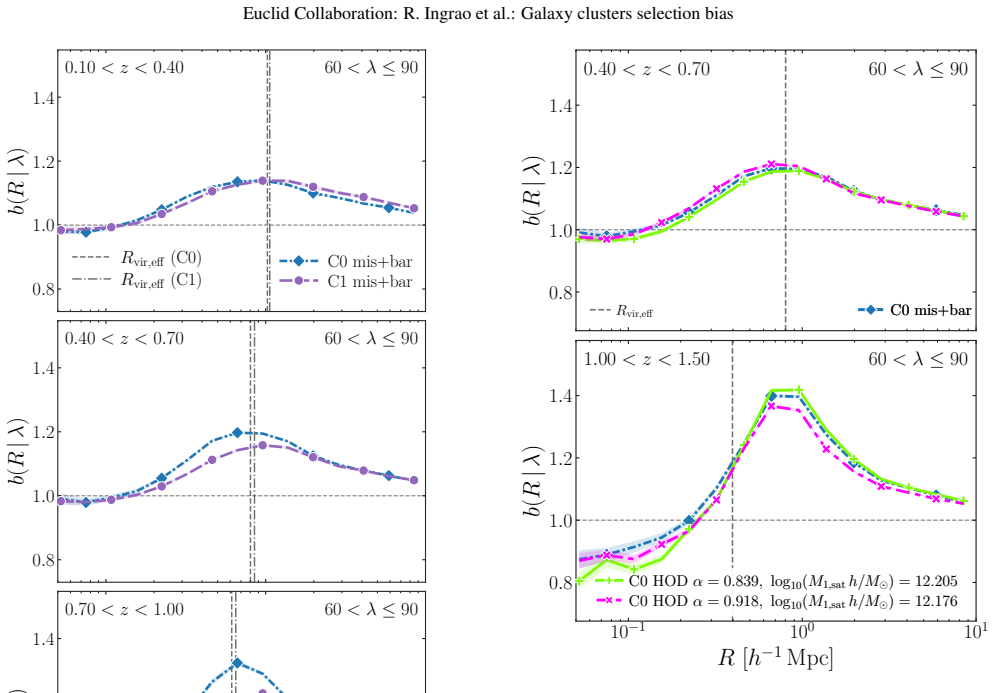
CosmoPostProcess processes N-body simulations by painting galaxies with a halo-occupation model and emulating survey detection plus richness assignment to compute corrections for stacked surface-density profiles binned in richness and redshift. Projection-induced selection bias enhances the stacked profile near the one-halo to two-halo transition, peaking at about 1 h^{-1} Mpc with an amplitude of 20-40 percent that grows from a few percent at z less than or equal to 0.7 to larger values at higher redshift. Baryonic corrections calibrated on hydrodynamical simulations keep the excess surface density within 2 percent over 0.1 to 5 h^{-1} Mpc. The framework also implements a new estimate of光学簇
What carries the argument
CosmoPostProcess, a simulation-based forward-modelling pipeline that paints galaxies onto N-body halos, emulates Euclid detection and richness assignment, and applies baryonic and miscentring corrections to produce bias-adjusted radial profiles.
If this is right
- The corrections control systematics in Euclid DR1 cluster cosmology analyses.
- Projection bias follows a robust pattern across changes in cosmology and the mass-richness relation.
- Baryonic modifications remain sub-dominant at about 2 percent beyond 0.3 h^{-1} Mpc.
- The effect stays mild at low and intermediate redshift but becomes more relevant at z greater than or equal to 0.7.
- Novel optical cluster centre estimates from projected galaxy densities are validated against Euclid pipelines.
Where Pith is reading between the lines
- The same forward-modelling approach could be reused for cluster samples in other surveys that lack colour selection.
- If the bias pattern persists in real data, high-redshift bins will require larger profile corrections than low-redshift ones.
- Applying the framework to mock catalogues with known true profiles would provide an end-to-end test of recovered cosmological parameters.
- Combining these profile corrections with independent probes of the same clusters could further reduce uncertainties on dark-energy parameters.
Load-bearing premise
The halo-occupation distribution model and the emulation of Euclid detection and richness assignment accurately reproduce the selection systematics present in real observational data.
What would settle it
Measuring the difference between stacked weak-lensing profiles from real Euclid data and an unbiased reference sample at radii around 1 h^{-1} Mpc and checking whether it matches the 20-40 percent enhancement predicted by the framework would confirm or refute the central claim.
Figures




read the original abstract
We present \texttt{CosmoPostProcess}, a simulation-based forward-modelling algorithm calibrated to reproduce Euclid optical cluster observables. Its main deliverable is a correction for stacked surface-density profiles, binned in richness and redshift, accounting for selection systematics in richness-selected samples relative to unbiased references. We focus on the Euclid richness definition foreseen for cosmological analyses, which does not apply a colour selection; red-sequence richness is not considered. The algorithm processes $N$-body simulations by painting galaxies with a halo-occupation model and emulating survey detection and richness assignment. We also implement a novel estimate of optical cluster centres from projected galaxy densities, validated against Euclid pipelines. Baryonic effects are included through a correction calibrated on hydrodynamical simulations; the baryon-corrected excess surface density agrees within \(2\,\%\) over \(r\in[0.1,\,5]\,h^{-1}\,\mathrm{Mpc}\). Selection-bias contributions are assessed by varying cosmology and the mass--richness relation. Projection-induced selection bias follows a robust pattern: correlated large-scale structure projected along the line of sight enhances the stacked profile near the one-halo to two-halo transition, peaking at about \(1\,h^{-1}\,\mathrm{Mpc}\) with an amplitude of \(20\!-\!40\,\%\), depending on richness and redshift. The effect is mild at low and intermediate redshift ($z\lesssim0.7$), at the few-percent level, but becomes more relevant at higher redshift ($z\gtrsim0.7$). Baryonic modifications remain sub-dominant outside the core, at about \(2\,\%\) beyond \(r\gtrsim0.3\,h^{-1}\,\mathrm{Mpc}\). The framework delivers radial profile corrections with uncertainties, combining projection-induced selection bias, baryonic physics, and miscentring, to control systematics in Euclid DR1 cluster cosmology. (abridged)
Editorial analysis
A structured set of objections, weighed in public.
Referee Report
Summary. The paper presents CosmoPostProcess, a forward-modeling framework that processes N-body simulations by painting galaxies via a halo occupation distribution (HOD), emulates Euclid's optical detection and richness assignment (without colour selection), and delivers corrections to stacked weak-lensing surface-density profiles binned in richness and redshift. The corrections combine projection-induced selection bias, baryonic effects (calibrated on hydrodynamical simulations to 2% agreement for r in [0.1,5] h^{-1} Mpc), and miscentring. The central claim is that correlated large-scale structure produces a robust 20-40% enhancement near the one-halo to two-halo transition (~1 h^{-1} Mpc), mild at z ≲ 0.7 but more relevant at higher redshift, with the framework providing uncertainty-quantified radial corrections for Euclid DR1 cluster cosmology.
Significance. If the HOD and detection emulation accurately reproduce real selection effects, the framework supplies a practical, simulation-calibrated tool for controlling systematics in Euclid weak-lensing cluster analyses. Strengths include the forward-modeling approach with explicit variation of cosmology and mass-richness parameters, the sub-dominant baryonic corrections beyond 0.3 h^{-1} Mpc, and the novel projected-galaxy-density centre estimator validated against Euclid pipelines. These elements support reproducible corrections with quantified uncertainties.
major comments (1)
- [HOD model and Euclid detection emulation] The 20-40% projection bias amplitude and its claimed robustness originate from the N-body + HOD + detection-emulation pipeline. While cosmology and the mass-richness relation are varied, the manuscript does not report quantitative external anchors (e.g., comparisons of simulated vs. observed richness histograms or projected galaxy overdensities around clusters). This assumption is load-bearing for the delivered correction tables, as inaccuracies in populating correlated large-scale structure would shift both amplitude and radial location of the one-halo to two-halo feature.
minor comments (1)
- [Abstract] The abstract states the baryon-corrected profiles agree within 2% over r ∈ [0.1, 5] h^{-1} Mpc but does not clarify whether this holds uniformly across all richness and redshift bins or only for selected subsets; explicit per-bin statements would improve clarity.
Simulated Author's Rebuttal
We thank the referee for their careful reading of the manuscript and for the constructive feedback on the HOD and detection emulation assumptions. We address the single major comment below, providing clarifications on our modeling choices and the robustness tests performed while preserving the forward-modeling nature of the framework.
read point-by-point responses
-
Referee: [HOD model and Euclid detection emulation] The 20-40% projection bias amplitude and its claimed robustness originate from the N-body + HOD + detection-emulation pipeline. While cosmology and the mass-richness relation are varied, the manuscript does not report quantitative external anchors (e.g., comparisons of simulated vs. observed richness histograms or projected galaxy overdensities around clusters). This assumption is load-bearing for the delivered correction tables, as inaccuracies in populating correlated large-scale structure would shift both amplitude and radial location of the one-halo to two-halo feature.
Authors: We acknowledge that the manuscript does not present new quantitative comparisons of simulated richness histograms or projected galaxy overdensities against external observational datasets. The HOD implementation follows a standard five-parameter model (detailed in Section 3) previously calibrated to reproduce the galaxy number density and two-point clustering statistics from surveys covering the Euclid redshift range. The projection-induced selection bias arises principally from the line-of-sight integration of correlated large-scale structure in the N-body simulations; the HOD populates galaxies consistently with this structure, and the resulting 20-40% enhancement near 1 h^{-1} Mpc remains stable under the explicit variations of cosmology and mass-richness parameters that directly control the amplitude and radial scale of those correlations. We have added a clarifying paragraph in the methods section that references prior external validations of the same HOD family against observed cluster richness distributions and galaxy overdensities, thereby strengthening the discussion of model assumptions without changing the reported correction amplitudes or uncertainties. revision: partial
Circularity Check
No circularity: forward-modelled corrections derived from independent N-body + HOD pipeline
full rationale
The paper's central deliverable—radial profile corrections for projection-induced selection bias, baryonic effects, and miscentring—is obtained by processing N-body simulations, painting galaxies via an HOD model, and emulating Euclid detection/richness assignment. The 20-40% enhancement near 1 h^{-1} Mpc is computed directly from this forward model after varying cosmology and the mass-richness relation. No quoted step equates a 'prediction' to a fitted parameter by construction, invokes a self-citation as the sole justification for a uniqueness claim, or renames an input as an output. The framework remains self-contained against external benchmarks (simulations), with sensitivity tests reported rather than data-driven fits to the target lensing profiles.
Axiom & Free-Parameter Ledger
free parameters (2)
- Halo occupation distribution parameters
- Mass-richness relation parameters
axioms (2)
- domain assumption N-body simulations provide a sufficiently accurate representation of the dark matter distribution and large-scale structure for the purpose of selection bias estimation.
- domain assumption Hydrodynamical simulations supply a reliable baryonic correction that can be applied as a multiplicative factor to the dark-matter-only profiles.
Reference graph
Works this paper leans on
-
[1]
1976 , month = may, journal =
1976
-
[2]
1984 , month = oct, journal =. doi:10.1038/311517a0 , keywords =
-
[3]
doi:10.1086/191003 , keywords =
1985 , month = feb, journal =. doi:10.1086/191003 , keywords =
-
[4]
1986 , month = dec, journal =. doi:10.1038/324446a0 , keywords =
-
[5]
doi:10.1086/192166 , keywords =
1995 , month = may, journal =. doi:10.1086/192166 , keywords =
-
[6]
, year = 1997, month = dec, volume = 490, pages =
1997 , month = dec, journal =. doi:10.1086/304888 , keywords =
-
[7]
1998 , month = oct, journal =. doi:10.1086/300541 , keywords =
-
[8]
1998 , month = mar, journal =. doi:10.1086/305262 , keywords =
-
[9]
2000 , month = jun, journal =. doi:10.1086/308947 , keywords =
-
[10]
2001 , month = may, journal =. doi:10.1046/j.1365-8711.2001.04006.x , keywords =
-
[11]
doi:10.1038/409039A010.1038/35051000 , keywords =
2001 , month = jan, journal =. doi:10.1038/409039A010.1038/35051000 , keywords =
-
[12]
doi:10.1086/424914 , keywords =
2004 , month = nov, journal =. doi:10.1086/424914 , keywords =
-
[13]
2005 , month = oct, journal =
2005
-
[14]
2005 , month = dec, journal =. doi:10.1111/j.1365-2966.2005.09655.x , keywords =
-
[15]
Accurate photometric redshifts for the CFHT Legacy Survey calibrated using the VIMOS VLT Deep Survey
2006 , month = oct, journal =. doi:10.1051/0004-6361:20065138 , keywords =
-
[16]
E., et al., 2007, arXiv e-prints, p
2007 , month = sep, journal =. doi:10.48550/arXiv.0709.1159 , keywords =
-
[17]
Toward a halo mass function for precision cosmology: the limits of universality
2008 , month = dec, journal =. doi:10.1086/591439 , keywords =
-
[18]
2009 , month = jul, journal =. doi:10.1088/0004-637X/699/1/768 , keywords =
-
[19]
2009, MNRAS, 396, 1383, doi:10.1111/j.1365-2966.2009.14843.x
2009 , month = oct, journal =. doi:10.1111/j.1365-2966.2009.15034.x , issn =
-
[20]
doi:10.1088/0004-637X/715/2/1508 , keywords =
2010 , month = jun, journal =. doi:10.1088/0004-637X/715/2/1508 , keywords =
-
[21]
2011 , month = feb, journal =. doi:10.1088/0067-0049/192/2/18 , keywords =
-
[22]
2011 , month = sep, journal =. doi:10.1146/annurev-astro-081710-102514 , keywords =
-
[23]
2012 , month = sep, journal =. doi:10.1146/annurev-astro-081811-125502 , keywords =
-
[24]
2012 , month = oct, journal =. doi:10.1111/j.1365-2966.2012.21743.x , keywords =
-
[25]
2013 , month = jan, journal =. doi:10.1088/0004-637X/762/2/109 , keywords =
-
[26]
2013 , month = aug, journal =. doi:10.1093/mnras/stt791 , keywords =
-
[27]
2013 , month = mar, journal =. doi:10.1086/670067 , keywords =
-
[28]
2013 , month = sep, journal =. doi:10.1016/j.physrep.2013.05.001 , keywords =
-
[29]
2014 , month = apr, journal =. doi:10.1088/0004-637X/785/2/104 , keywords =
-
[30]
doi:10.1088/0004-637X/797/1/34 , keywords =
2014 , month = dec, journal =. doi:10.1088/0004-637X/797/1/34 , keywords =
-
[31]
doi:10.1093/mnras/stt2091 , keywords =
2014 , month = feb, journal =. doi:10.1093/mnras/stt2091 , keywords =
-
[32]
doi:10.1093/mnras/stt1945 , keywords =
2014 , month = mar, journal =. doi:10.1093/mnras/stt1945 , keywords =
-
[33]
The effect of active galactic nuclei feedback on the halo mass function
2014 , month = jun, journal =. doi:10.1093/mnras/stu673 , keywords =
-
[34]
doi:10.1093/mnras/stu784 , keywords =
2014 , month = jul, journal =. doi:10.1093/mnras/stu784 , keywords =
-
[35]
, archivePrefix = "arXiv", eprint =
2014 , month = aug, journal =. doi:10.1093/mnras/stu1023 , keywords =
-
[36]
doi:10.1051/0004-6361/201526081 , keywords =
2015 , month = oct, journal =. doi:10.1051/0004-6361/201526081 , keywords =
-
[37]
doi:10.1088/1475-7516/2015/12/049 , archiveprefix =
2015 , month = dec, journal =. doi:10.1088/1475-7516/2015/12/049 , keywords =
-
[38]
doi:10.1093/mnras/stv219 , keywords =
2015 , month = may, journal =. doi:10.1093/mnras/stv219 , keywords =
-
[39]
doi:10.1093/mnras/stv1560 , keywords =
2015 , month = oct, journal =. doi:10.1093/mnras/stv1560 , keywords =
-
[40]
doi:10.1093/mnras/stv2141 , keywords =
2015 , month = dec, journal =. doi:10.1093/mnras/stv2141 , keywords =
-
[41]
doi:10.1051/0004-6361/201526719 , keywords =
2016 , month = feb, journal =. doi:10.1051/0004-6361/201526719 , keywords =
-
[42]
doi:10.1051/0004-6361/201528009 , keywords =
2016 , month = nov, journal =. doi:10.1051/0004-6361/201528009 , keywords =
-
[43]
doi:10.3847/1538-3881/152/6/228 , keywords =
2016 , month = dec, journal =. doi:10.3847/1538-3881/152/6/228 , keywords =
-
[44]
doi:10.1093/mnras/stv2443 , keywords =
2016 , month = jan, journal =. doi:10.1093/mnras/stv2443 , keywords =
-
[45]
2016 , month = mar, journal =. doi:10.1093/mnras/stv2842 , keywords =
-
[46]
doi:10.1093/mnras/stw630 , keywords =
2016 , month = jun, journal =. doi:10.1093/mnras/stw630 , keywords =
-
[47]
doi:10.1093/mnras/stw2035 , archiveprefix =
2016 , month = dec, journal =. doi:10.1093/mnras/stw2035 , keywords =
-
[48]
doi:10.48550/arXiv.1710.04725 , keywords =
2017 , month = oct, journal =. doi:10.48550/arXiv.1710.04725 , keywords =
-
[49]
Computational Astr ophysics and Cosmology 4(1), 2 (2017)
2017 , month = may, journal =. doi:10.1186/s40668-017-0021-1 , keywords =
-
[50]
doi:10.1093/mnras/stx2701 , keywords =
2018 , month = feb, journal =. doi:10.1093/mnras/stx2701 , keywords =
-
[51]
doi:10.1093/mnras/sty1179 , keywords =
2018 , month = aug, journal =. doi:10.1093/mnras/sty1179 , keywords =
-
[52]
2019 , month = jul, journal =. doi:10.1051/0004-6361/201935088 , keywords =
-
[53]
2019 , month = jun, journal =. doi:10.3847/1538-4357/ab1f10 , keywords =
-
[54]
doi:10.3847/1538-4365/ab3d27 , keywords =
2019 , month = oct, journal =. doi:10.3847/1538-4365/ab3d27 , keywords =
-
[55]
2019 , month = jan, journal =. doi:10.1093/mnras/sty2711 , keywords =
-
[56]
doi:10.1093/mnras/sty3203 , keywords =
2019 , month = mar, journal =. doi:10.1093/mnras/sty3203 , keywords =
-
[57]
doi:10.1093/mnras/stz294 , keywords =
2019 , month = may, journal =. doi:10.1093/mnras/stz294 , keywords =
-
[58]
doi:10.1093/mnras/stz1361 , keywords =
2019 , month = aug, journal =. doi:10.1093/mnras/stz1361 , keywords =
-
[59]
doi:10.1093/mnras/stz1949 , keywords =
2019 , month = oct, journal =. doi:10.1093/mnras/stz1949 , keywords =
-
[60]
Modelling baryonic feedback for survey cosmology
2019 , month = jun, journal =. doi:10.21105/astro.1905.06082 , keywords =
-
[61]
W., Arnaud , M., Biviano , A., et al
2019 , month = feb, journal =. doi:10.1007/s11214-019-0591-0 , keywords =
-
[62]
2020 , month = sep, journal =. doi:10.1051/0004-6361/201833910 , keywords =
-
[63]
2020 , month = dec, journal =. doi:10.1051/0004-6361/202039403 , keywords =
-
[64]
2020 , month = jun, booktitle =
2020
-
[65]
2020 , month = aug, howpublished =
2020
-
[66]
doi:10.1093/mnras/staa1004 , keywords =
2020 , month = may, journal =. doi:10.1093/mnras/staa1004 , keywords =
-
[67]
2020, MNRAS, 496, 4468, doi: 10.1093/mnras/staa1646
2020 , month = aug, journal =. doi:10.1093/mnras/staa1646 , keywords =
-
[68]
doi:10.1103/PhysRevD.102.023509 , keywords =
2020 , month = jul, journal =. doi:10.1103/PhysRevD.102.023509 , keywords =
-
[69]
Virtanen, Pauli and Gommers, Ralf and Oliphant, Travis E. and Haberland, Matt and Reddy, Tyler and Cournapeau, David and Burovski, Evgeni and Peterson, Pearu and Weckesser, Warren and Bright, Jonathan and. 2020 , journal =. doi:10.1038/s41592-019-0686-2 , adsurl =
-
[70]
doi:10.1051/0004-6361/202140795 , keywords =
2021 , month = sep, journal =. doi:10.1051/0004-6361/202140795 , keywords =
-
[71]
doi:10.1093/mnras/staa3473 , archiveprefix =
2021 , month = jan, journal =. doi:10.1093/mnras/staa3473 , keywords =
-
[72]
2021 , month = sep, journal =. doi:10.1093/mnras/stab1855 , keywords =
-
[73]
doi:10.1103/PhysRevD.103.043522 , keywords =
2021 , month = feb, journal =. doi:10.1103/PhysRevD.103.043522 , keywords =
-
[74]
doi:10.1103/PhysRevLett.126.081301 , archiveprefix =
2021 , journal =. doi:10.1103/PhysRevLett.126.081301 , archiveprefix =. 2009.05558 , primaryclass =
-
[75]
doi:10.1051/0004-6361/202141755 , keywords =
2022 , month = may, journal =. doi:10.1051/0004-6361/202141755 , keywords =
-
[76]
doi:10.1051/0004-6361/202243538 , keywords =
2022 , month = sep, journal =. doi:10.1051/0004-6361/202243538 , keywords =
-
[77]
doi:10.1051/0004-6361/202244397 , keywords =
2022 , month = oct, journal =. doi:10.1051/0004-6361/202244397 , keywords =
-
[78]
2022 , month = jan, journal =. doi:10.1103/PhysRevD.105.023520 , keywords =
-
[79]
2023 , month = mar, journal =. doi:10.1051/0004-6361/202244674 , keywords =
-
[80]
doi:10.1051/0004-6361/202142392 , keywords =
2023 , month = jul, journal =. doi:10.1051/0004-6361/202142392 , keywords =
discussion (0)
Sign in with ORCID, Apple, or X to comment. Anyone can read and Pith papers without signing in.