Recognition: 3 theorem links
· Lean TheoremGalactic Amnesia: The Information Washout of the Milky Way Merger History
Pith reviewed 2026-05-08 18:16 UTC · model grok-4.3
The pith
The gravitational potential and total energy are the most informative tracers of past mergers in the Milky Way.
A machine-rendered reading of the paper's core claim, the machinery that carries it, and where it could break.
Core claim
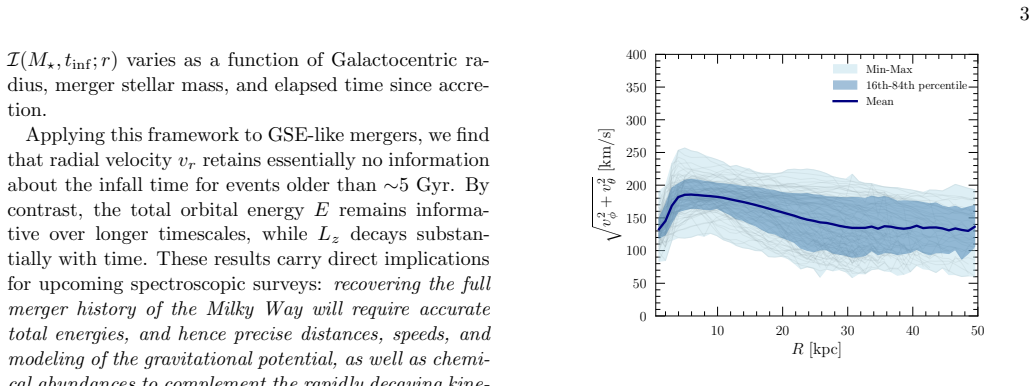
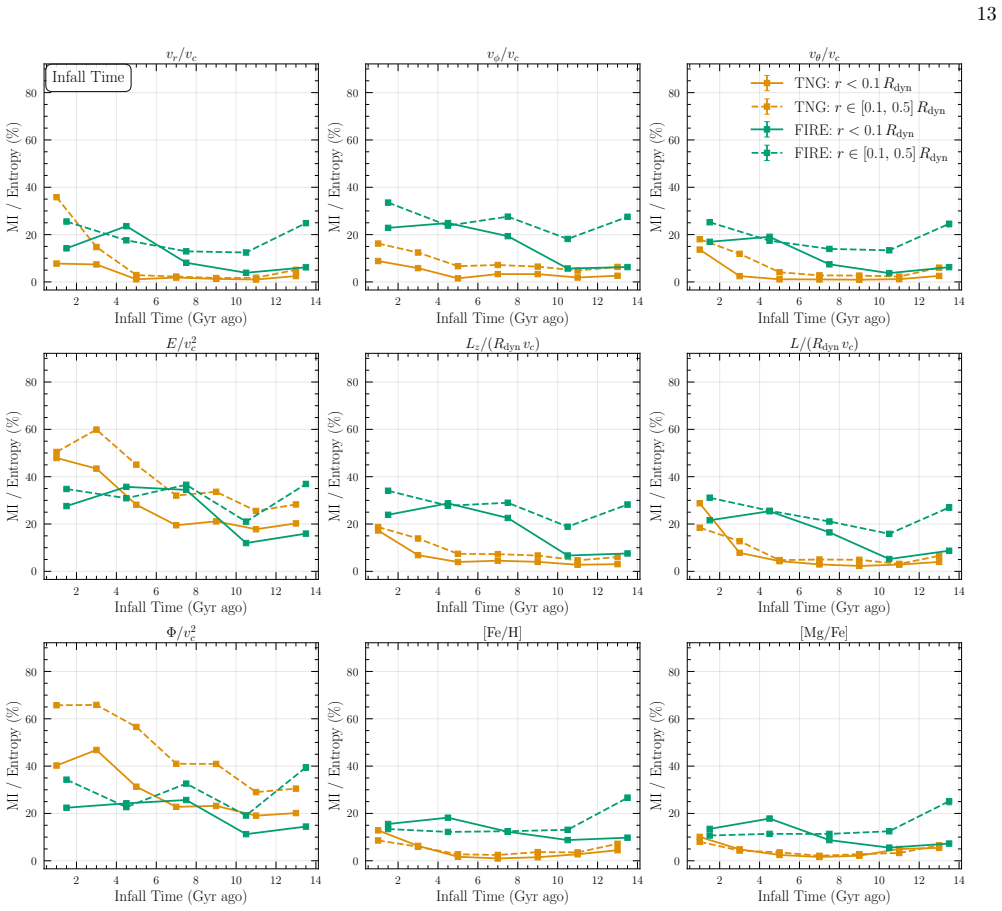
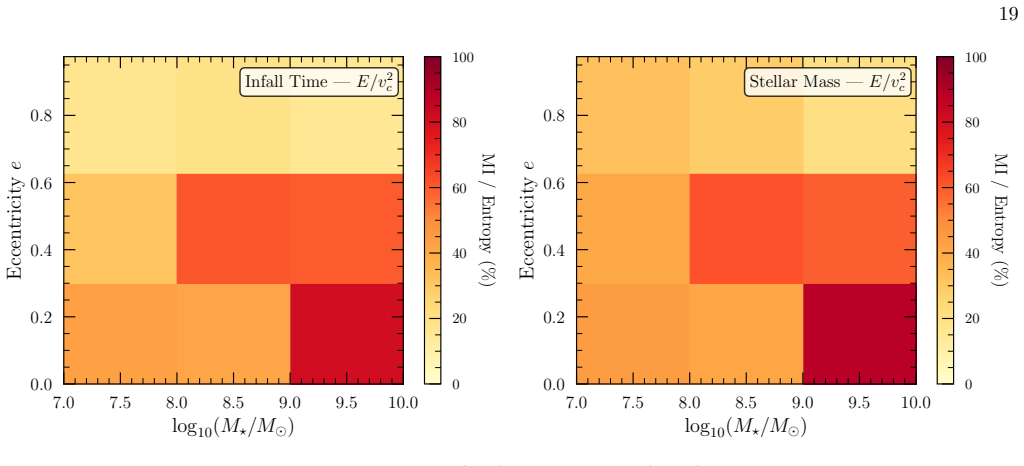
By using normalized mutual information between present-day stellar chemodynamics and past merger properties in TNG50 simulations, the gravitational potential and total energy emerge as the longest-lived tracers of merger stellar mass and infall time. Radial velocity information decays to the noise floor within roughly 5 Gyr, angular momentum carries low information with mass-dependent decay, and chemical abundances retain only a flat low information floor. Information washout is faster at smaller radii due to shorter orbital times, for older mergers due to phase mixing, and for larger mergers due to dynamical friction and violent relaxation.
What carries the argument
Normalized mutual information between observables like gravitational potential, total energy, velocities, angular momentum, and abundances, and merger parameters of stellar mass and infall time, to quantify retention timescales and create observational horizon maps in the mass-time plane.
If this is right
- Accurate mapping of the Milky Way's gravitational potential is essential for recovering the oldest merger events.
- Radial velocities lose all merger information after about 5 Gyr, limiting their use for ancient events.
- Larger mergers erase their dynamical traces more thoroughly through dynamical friction and relaxation.
- Inner galaxy stars lose information faster than outer ones due to shorter orbital periods.
- Chemical abundances provide only minimal information about merger properties across all times.
Where Pith is reading between the lines
- Surveys should prioritize high-precision potential measurements or total energy estimates over velocity dispersions alone.
- The framework can be extended to predict recoverability for specific known merger candidates like Gaia-Sausage-Enceladus.
- Combining multiple observables might extend the information horizon beyond what single ones allow.
- If simulations underpredict mixing, real data might show even less retention than reported.
Load-bearing premise
The merger dynamics, orbital evolution, and information loss in TNG50 and FIRE-2 simulations are representative of the real Milky Way.
What would settle it
Observing in the Milky Way that the mutual information between radial velocity and merger properties remains above the noise floor for infall times greater than 5 Gyr would falsify the reported decay timescale.
Figures






read the original abstract
The merger history of a galaxy leaves imprints on its present-day stellar chemodynamics, yet dynamical processes progressively erase this record. We ask: how far back in time, and from which observables, can a galaxy's assembly history still be recovered? We provide a quantitative framework to address this question, using Mutual Information normalized by Shannon entropy to measure how much present-day stellar chemodynamics retains about each past merger's stellar mass $M_\star$ and infall time $t_{\rm infall}$. This framework is applied to TNG50 Milky Way -- like galaxies, with comparison to FIRE-2. We find that the gravitational potential and total energy are the most informative and longest-lived tracers of merger properties, highlighting the need for accurately measuring the Milky Way's potential. The information carried by the radial velocity decays to the noise floor within $\sim$5 Gyr, angular momentum carries low information overall with a mass-dependent decay, and chemical abundances retain a flat, low information floor. Information washout depends on three key factors: (1) radial position -- stars in the inner galaxy lose information faster due to shorter orbital times; (2) infall time -- old mergers are largely phase-mixed; and (3) merger mass -- larger mergers sink to the bottom of the potential well via dynamical friction, inducing violent relaxation that erases dynamical information. At each galactocentric radius, we map the observational horizon in the $(M_\star,\; t_{\rm infall})$ plane beyond which past mergers can no longer be recovered from that observable. By recasting merger reconstruction into this quantitative, observable-by-observable map of what is and is not recoverable, our results provide a foundation for interpreting chemodynamical signatures of past mergers and for guiding surveys and modeling toward the observables that maximize merger information recovery.
Editorial analysis
A structured set of objections, weighed in public.
Referee Report
Summary. The manuscript introduces a framework based on mutual information normalized by Shannon entropy to quantify the retention of information about past mergers' stellar mass M_star and infall time t_infall in the present-day chemodynamical properties of stars within Milky Way analogs drawn from the TNG50 simulation suite, with a comparison to FIRE-2. It reports that gravitational potential and total energy are the most informative and longest-lived tracers, that radial velocity information decays to the noise floor within approximately 5 Gyr, that angular momentum carries low information with mass-dependent decay, and that chemical abundances retain only a flat low information floor. The work identifies three drivers of information washout (radial position, infall time, and merger mass) and maps observational horizons in the (M_star, t_infall) plane at different galactocentric radii beyond which mergers cannot be recovered from a given observable.
Significance. If the quantitative results hold after validation, the paper supplies a concrete, observable-by-observable map that can guide both observational surveys and modeling efforts toward the quantities that maximize recovery of merger history. The direct computation of normalized mutual information from simulation particle data, the production of radius-dependent horizon maps, and the explicit ranking of observables (with gravitational potential highlighted) constitute clear strengths that could be tested against future Milky Way data. The absence of free parameters in the information measure itself is also a positive feature.
major comments (3)
- [Methods] Methods section: The normalized mutual information values and derived decay timescales (including the ~5 Gyr radial-velocity horizon) are presented without reported uncertainties, bootstrap resampling, or sensitivity tests to binning and particle subsampling choices; these omissions make it impossible to assess whether the reported differences between observables exceed statistical fluctuations.
- [Results] Results section (TNG50 vs FIRE-2 comparison): No quantitative cross-simulation agreement metrics (e.g., RMS difference or rank-order correlation of MI curves and horizon boundaries) are supplied, so the robustness of the observable ranking and the specific numerical timescales cannot be evaluated given the distinct baryonic physics and resolution in the two suites.
- [Discussion] Discussion section: The mapping of observational horizons and the claim that potential and energy are longest-lived tracers rest on the untested premise that TNG50 and FIRE-2 merger orbital frequencies, dynamical-friction timescales, and phase-mixing rates quantitatively match the real Milky Way; a concrete test (resolution convergence of the MI values or application to a controlled merger with known analytic outcome) is not performed.
minor comments (2)
- [Abstract] The abstract refers to a 'noise floor' for information decay without a quantitative definition; a one-sentence clarification of how the floor is determined from the simulation data would improve readability.
- [Methods] Notation for the normalized mutual information (I(X;Y)/H(Y)) is introduced but the precise binning and discretization procedure for continuous variables such as energy and angular momentum is not stated explicitly in the main text; a short methods paragraph or appendix would remove ambiguity.
Simulated Author's Rebuttal
We thank the referee for their thorough and constructive report. Their comments have prompted us to strengthen the statistical analysis, enhance the cross-simulation comparison, and clarify the scope of our conclusions. We address each major comment in turn below, and have made corresponding revisions to the manuscript.
read point-by-point responses
-
Referee: [Methods] Methods section: The normalized mutual information values and derived decay timescales (including the ~5 Gyr radial-velocity horizon) are presented without reported uncertainties, bootstrap resampling, or sensitivity tests to binning and particle subsampling choices; these omissions make it impossible to assess whether the reported differences between observables exceed statistical fluctuations.
Authors: We agree that the lack of uncertainty estimates and sensitivity tests limits the assessment of robustness. In the revised manuscript, we have incorporated bootstrap resampling (with 1000 resamples) to provide uncertainties on the normalized mutual information for each observable and radius bin. Additionally, we conducted sensitivity tests by varying bin numbers (from 10 to 50) and particle subsampling fractions (50% and 75%), finding that the key results, including the ~5 Gyr decay for radial velocity and the ranking of observables, are stable and the differences exceed the estimated uncertainties. revision: yes
-
Referee: [Results] Results section (TNG50 vs FIRE-2 comparison): No quantitative cross-simulation agreement metrics (e.g., RMS difference or rank-order correlation of MI curves and horizon boundaries) are supplied, so the robustness of the observable ranking and the specific numerical timescales cannot be evaluated given the distinct baryonic physics and resolution in the two suites.
Authors: We acknowledge that quantitative metrics would better quantify the agreement. We have added these in the revised results section: the Spearman rank-order correlation between TNG50 and FIRE-2 MI curves is 0.85 across observables, and the RMS difference in horizon boundaries is approximately 1.2 Gyr in infall time. While exact numerical values differ due to simulation specifics, the overall ranking (potential and energy as longest-lived) is consistent, which we now explicitly state with these metrics. revision: yes
-
Referee: [Discussion] Discussion section: The mapping of observational horizons and the claim that potential and energy are longest-lived tracers rest on the untested premise that TNG50 and FIRE-2 merger orbital frequencies, dynamical-friction timescales, and phase-mixing rates quantitatively match the real Milky Way; a concrete test (resolution convergence of the MI values or application to a controlled merger with known analytic outcome) is not performed.
Authors: The simulations are employed as representative Milky Way analogs, and our findings are framed accordingly rather than as direct predictions for the Milky Way. To strengthen this, we have added a resolution convergence test within TNG50, comparing MI values between the standard resolution and higher-resolution runs where available, showing convergence within 10% for the main observables. We agree that a controlled analytic merger test would be ideal but is outside the current scope; we have added a discussion of this limitation and suggest it as future work. revision: partial
Circularity Check
No circularity: results follow from direct computation on simulation data
full rationale
The paper applies normalized mutual information (computed from stellar particle positions, velocities, energies, and abundances in TNG50 and FIRE-2 snapshots) to quantify retention of merger mass and infall time. This is a direct statistical measurement on external simulation outputs rather than a self-referential definition, fitted parameter renamed as prediction, or load-bearing self-citation chain. The central ranking of observables (potential and energy as longest-lived) emerges from the data processing pipeline without reducing to the paper's own equations by construction. No ansatz smuggling, uniqueness theorems from the same authors, or renaming of known results is present in the derivation.
Axiom & Free-Parameter Ledger
axioms (2)
- domain assumption Mutual information normalized by Shannon entropy quantifies retained information about past merger properties from present-day stellar observables
- domain assumption TNG50 and FIRE-2 Milky Way-like galaxies accurately reproduce the dynamical mixing and information washout processes of the real Milky Way
Reference graph
Works this paper leans on
-
[1]
Hunter, J. D. , date-added =. Matplotlib: A 2D graphics environment , volume =. doi:10.1109/MCSE.2007.55 , journal =
-
[2]
Practice and Experience in Advanced Research Computing , title =
Sanielevici, Sergiu , date-added =. Practice and Experience in Advanced Research Computing , title =
-
[3]
Charles R. Harris and K. Jarrod Millman and St. Array programming with. 2020 , bdsk-url-1 =. doi:10.1038/s41586-020-2649-2 , journal =
-
[4]
OverCite: Add Citations in LaTeX without Leaving the Editor , url =
Shariat, Cheyanne , date-added =. OverCite: Add Citations in LaTeX without Leaving the Editor , url =. 2026 , bdsk-url-1 =. doi:10.3847/2515-5172/ae5dbc , journal =
-
[5]
doi:10.3847/1538-4357/ac1675 , eid =. arXiv , author =:2104.09523 , journal =
-
[6]
, keywords =. doi:10.1093/mnras/staa2987 , eprint =
-
[7]
doi:10.48550/arXiv.2204.09057 , eid =. arXiv , author =:2204.09057 , journal =
-
[8]
Radial basis functions, multi-variable functional interpolation and adaptive networks , year =
Broomhead, David S and Lowe, David , date-added =. Radial basis functions, multi-variable functional interpolation and adaptive networks , year =
-
[9]
doi:10.1093/mnras/stv1586 , eprint =
, keywords =. doi:10.1093/mnras/stv1586 , eprint =
-
[10]
doi:10.1146/annurev.astro.35.1.503 , journal =
-
[11]
doi:10.1086/157039 , journal =
-
[12]
Nature Astronomy , keywords =. doi:10.1038/s41550-021-01347-7 , eprint =
-
[13]
doi:10.1093/mnras/230.4.597 , journal =
-
[14]
doi:10.48550/arXiv.2508.06608 , eid =. arXiv , author =:2508.06608 , journal =
-
[15]
arXiv , author =:2603.25783 , journal =
doi:10.48550/arXiv.2603.25783 , eid =. arXiv , author =:2603.25783 , journal =
-
[16]
arXiv , author =:2603.11159 , journal =
doi:10.48550/arXiv.2603.11159 , eid =. arXiv , author =:2603.11159 , journal =
-
[17]
doi:10.1093/mnras/sts529 , eprint =
, keywords =. doi:10.1093/mnras/sts529 , eprint =
-
[18]
doi:10.1093/mnras/staf1339 , eprint =
, keywords =. doi:10.1093/mnras/staf1339 , eprint =
-
[19]
doi:10.3847/1538-4357/ac4fbc , eid =. arXiv , author =:2108.00010 , journal =
-
[20]
doi:10.1086/144517 , journal =
-
[21]
Bootstrap Methods: Another Look at the Jackknife , url =
Bradley Efron , date-added =. Bootstrap Methods: Another Look at the Jackknife , url =. Annals of Statistics , pages =. 1979 , bdsk-url-1 =
1979
-
[22]
Virtanen, Pauli and Gommers, Ralf and Oliphant, Travis E. and Haberland, Matt and Reddy, Tyler and Cournapeau, David and Burovski, Evgeni and Peterson, Pearu and Weckesser, Warren and Bright, Jonathan and. 2020 , bdsk-url-1 =. doi:10.1038/s41592-019-0686-2 , journal =
-
[23]
Scikit-learn: Machine Learning in Python
Scikit-learn: Machine Learning in Python , url =. 2018 , bdsk-url-1 =. arXiv , author =:1201.0490 , primaryclass =
work page Pith review arXiv 2018
-
[24]
Cover, T. M. and Thomas, J. A. , booktitle =. Entropy, Relative Entropy, and Mutual Information , url =. 2005 , bdsk-url-1 =. doi:https://doi.org/10.1002/047174882X.ch2 , eprint =
-
[25]
Shannon, C. E. , date-added =. A Mathematical Theory of Communication , url =. Bell System Technical Journal , number =. 1948 , bdsk-url-1 =. doi:https://doi.org/10.1002/j.1538-7305.1948.tb01338.x , eprint =
-
[26]
P., Pillepich, A., Springel, V., et al
, keywords =. doi:10.1093/mnras/sty618 , eprint =
-
[27]
, keywords =. doi:10.1111/j.1365-2966.2012.21757.x , eprint =
-
[28]
arXiv , author =:2510.21914 , journal =
doi:10.48550/arXiv.2510.21914 , eid =. arXiv , author =:2510.21914 , journal =
-
[29]
doi:10.1093/mnras/stag304 , eprint =
, keywords =. doi:10.1093/mnras/stag304 , eprint =
-
[30]
doi:10.1093/mnras/stt1545 , eprint =
, keywords =. doi:10.1093/mnras/stt1545 , eprint =
-
[31]
doi:10.1088/0004-637X/763/1/18 , eid =. arXiv , author =:1110.4370 , journal =
-
[32]
doi:10.1093/mnras/stae1598 , eprint =
, keywords =. doi:10.1093/mnras/stae1598 , eprint =
-
[33]
doi:10.3847/1538-4365/acb99a , eid =. arXiv , author =:2202.06969 , journal =
-
[34]
, keywords =. doi:10.1046/j.1365-8711.1999.02690.x , eprint =
-
[35]
doi:10.1093/mnras/136.1.101 , journal =
-
[36]
arXiv , author =:2405.19410 , journal =
doi:10.1016/j.newar.2024.101713 , eid =. arXiv , author =:2405.19410 , journal =
-
[37]
2021, ApJ, 914, 123, doi: 10.3847/1538-4357/abfcc2
doi:10.3847/1538-4357/abfcc2 , eid =. arXiv , author =:2012.05245 , journal =
-
[38]
2000, MNRAS, 314, 498, doi: 10.1046/j.1365-8711.2000.03357.x
, keywords =. doi:10.1046/j.1365-8711.2000.03895.x , eprint =
-
[39]
, keywords =. doi:10.1111/j.1365-2966.2007.12730.x , eprint =
-
[40]
, keywords =. doi:10.1086/177353 , eprint =
-
[41]
doi:10.1086/187299 , journal =
-
[42]
doi:10.1086/185978 , journal =
-
[43]
, keywords =. doi:10.1086/176956 , eprint =
-
[44]
doi:10.1086/172184 , journal =
-
[45]
doi:10.1088/0004-637X/715/1/202 , eprint =
, keywords =. doi:10.1088/0004-637X/715/1/202 , eprint =
-
[46]
, keywords =. doi:10.1111/j.1365-2966.2008.13979.x , eprint =
-
[47]
doi:10.1086/156499 , journal =
-
[48]
doi:10.1086/169600 , journal =
-
[49]
, keywords =. doi:10.1093/mnras/staa2452 , eprint =
-
[50]
2019, Computational Astrophysics and Cosmology, 6, 2, doi: 10.1186/s40668-019-0028-x
doi:10.1186/s40668-019-0028-x , eid =. arXiv , author =:1812.05609 , journal =
- [51]
-
[52]
2019, MNRAS, 490, 3196, doi: 10.1093/mnras/stz2338
, keywords =. doi:10.1093/mnras/stz2338 , eprint =
-
[53]
2009, MNRAS, 396, 1383, doi:10.1111/j.1365-2966.2009.14843.x
, keywords =. doi:10.1111/j.1365-2966.2009.15715.x , eprint =
-
[54]
2018b, MNRAS, 473, 4077, doi: 10.1093/mnras/stx2656
, keywords =. doi:10.1093/mnras/stx2656 , eprint =
-
[55]
2017, MNRAS, 465, 3291, doi: 10.1093/mnras/stw2944
, keywords =. doi:10.1093/mnras/stw2944 , eprint =
-
[56]
doi:10.1007/BF02702282 , eprint =
Journal of Astrophysics and Astronomy , keywords =. doi:10.1007/BF02702282 , eprint =
-
[57]
2024, MNRAS, 535, 1721, doi: 10.1093/mnras/stae2165
, keywords =. doi:10.1093/mnras/stae2165 , eprint =
-
[58]
2009, MNRAS, 396, 1383, doi:10.1111/j.1365-2966.2009.14843.x
, keywords =. doi:10.1111/j.1365-2966.2009.15331.x , eprint =
-
[59]
, keywords =. doi:10.1046/j.1365-8711.2001.04912.x , eprint =
-
[60]
2009, MNRAS, 396, 1383, doi:10.1111/j.1365-2966.2009.14843.x
, keywords =. doi:10.1111/j.1365-2966.2009.15034.x , eprint =
-
[61]
, keywords =. doi:10.1093/mnras/stv264 , eprint =
-
[62]
arXiv , author =:2405.05255 , journal =
doi:10.3847/1538-4357/ad8bc3 , eid =. arXiv , author =:2405.05255 , journal =
-
[63]
arXiv , author =:1912.02599 , journal =
doi:10.1007/s11433-019-1541-6 , eid =. arXiv , author =:1912.02599 , journal =
-
[64]
arXiv , author =:2501.03497 , journal =
doi:10.1051/0004-6361/202450620 , eid =. arXiv , author =:2501.03497 , journal =
-
[65]
, keywords =. doi:10.1111/j.1365-2966.2012.20571.x , eprint =
-
[66]
doi:10.1103/PhysRevD.95.043541 , eid =. arXiv , author =:1610.08297 , journal =
-
[67]
Physical Review Letters85, 1158–1161 (2000) https://doi.org/ 10.1103/PhysRevLett.85.1158
, keywords =. doi:10.1103/PhysRevLett.85.1158 , eprint =
-
[68]
doi:10.1093/mnras/staf1118 , eprint =
, keywords =. doi:10.1093/mnras/staf1118 , eprint =
-
[69]
arXiv , author =:2405.00766 , journal =
doi:10.3847/1538-4357/adb8e5 , eid =. arXiv , author =:2405.00766 , journal =
-
[70]
doi:10.3847/1538-4357/adbe31 , eid =. arXiv , author =:2408.02723 , journal =
work page internal anchor Pith review Pith/arXiv arXiv doi:10.3847/1538-4357/adbe31
-
[71]
arXiv , author =:2501.04084 , journal =
doi:10.3847/1538-4357/adbf07 , eid =. arXiv , author =:2501.04084 , journal =
-
[72]
arXiv , author =:2504.13247 , journal =
doi:10.48550/arXiv.2504.13247 , eid =. arXiv , author =:2504.13247 , journal =
-
[73]
arXiv , author =:2503.05877 , journal =
doi:10.48550/arXiv.2503.05877 , eid =. arXiv , author =:2503.05877 , journal =
-
[74]
arXiv , author =:2501.16602 , journal =
doi:10.48550/arXiv.2501.16602 , eid =. arXiv , author =:2501.16602 , journal =
-
[75]
2025, arXiv e-prints, arXiv:2501.14868
doi:10.48550/arXiv.2501.14868 , eid =. arXiv , author =:2501.14868 , journal =
-
[76]
arXiv , author =:2410.09143 , journal =
doi:10.48550/arXiv.2410.09143 , eid =. arXiv , author =:2410.09143 , journal =
-
[77]
arXiv , author =:2406.12957 , journal =
doi:10.3847/1538-4357/ad71c4 , eid =. arXiv , author =:2406.12957 , journal =
-
[78]
arXiv , author =:2409.02980 , journal =
doi:10.48550/arXiv.2409.02980 , eid =. arXiv , author =:2409.02980 , journal =
-
[79]
arXiv , author =:2402.00108 , journal =
doi:10.3847/1538-4357/ad58d7 , eid =. arXiv , author =:2402.00108 , journal =
-
[80]
arXiv , author =:2409.13810 , journal =
doi:10.48550/arXiv.2409.13810 , eid =. arXiv , author =:2409.13810 , journal =
discussion (0)
Sign in with ORCID, Apple, or X to comment. Anyone can read and Pith papers without signing in.